Nuclear workers’ unions want nuclear energy included as clean and sustsainable
—European unions press leaders to include nuclear in clean energy mix, Ft.com Jim Pickard in Glasgow, 5 Nov 21, A dozen union chiefs from across Europe have pressed world leaders to factor in nuclear power as they discuss how to accelerate the path to net zero emissions at the global climate summit in Glasgow……….. ….. The use of nuclear to tackle climate change is fiercely contested, with some countries such as Belgium phasing out their existing power stations. Countries such as Germany, Austria and Luxembourg have opposed a Finnish proposal for the EU “taxonomy” to include nuclear in its definition of sustainable activity…….. Today’s letter was signed by figures including Gary Smith, general secretary of Britain’s GMB union, Helene Lopez, secretary-general of CFE-CGC Energies in France, and Bob Walker, national director of the Canadian Nuclear Workers’ Council – as well as counterparts in Belgium, Czech Republic, Hungary, Slovakia and Romania………. https://www.ft.com/content/f01342c5-d1af-4c36-8362-582b48767a05 |
Canada’s Environment Minister refuses to declare his support for nuclear energy
Guilbeault refuses to declare his support of nuclear energy iPolitics, By Aidan Chamandy. Nov 5, 2021 Environment Minister Steven Guilbeault says “it’s not up to the government to decide” which sources of energy will reduce the country’s greenhouse-gas emissions to net zero by 2050.
Nor would he say explicitly whether he supports nuclear energy, which he’d opposed in his work before entering politics in 2019……
Before running for the Liberals in 2019, Guilbeault worked for decades as an environmental activist for Greenpeace and Équiterre.
In 2018, he said the Pickering nuclear plant in Ontario should be shut down and replaced with other forms of renewable energy. https://ipolitics.ca/2021/11/05/guilbeault-refuses-to-declare-his-support-of-nuclear-energy/
Only Britain has the dubious plan to get to net zero by relying on multiple nuclear reactors

Even without our plentiful opportunities to exploit wind, solar, wave and tidal power many countries feel they do not need nuclear power to reach their goals.
Questions remain over the UK’s nuclear power plans https://www.theguardian.com/news/2021/nov/02/questions-remain-over-the-uks-nuclear-power-plans?fbclid=IwAR3TQj7xYv3jEY824jm9tVFuNln6CgT7xqS3
No other country taking part in Cop26 is relying on multiple new reactors to get to net zero by 2050 Paul Brown, Tue 2 Nov 2021 In 2007, Vincent de Rivaz, the then EDF chief executive, said Britain would be “cooking our Christmas turkeys” with electricity from Hinkley Point C nuclear station by 2017. Instead the first concrete was poured that year and the turkey is now scheduled for late 2026.
In the race against time to avert dangerous global heating, the UK government has decided to back an untried reactor from Rolls Royce. The first of these could be “plugged into the grid by 2031”, according to Nuclear Industry Association.
Internationally average planning time for reactor proposals is 10 years, plus another decade for building, and that is for already proven designs. The 16 planned Rolls Royce reactors are still on the drawing board. The arguments about where they could be sited are beginning. Apart from other possible objections the favoured UK coastal locations are vulnerable to sea level rise, erosion and storms.
Faced with the well-documented delays and drawbacks to nuclear programmes it is perhaps not surprising that there is no other country taking part in the Cop26 process in Glasgow relying on multiple new nuclear reactors to get to net zero carbon targets by 2050. Even without our plentiful opportunities to exploit wind, solar, wave and tidal power many countries feel they do not need nuclear power to reach their goals.
French nuclear company pressing President Macron to declare nuclear power strategy
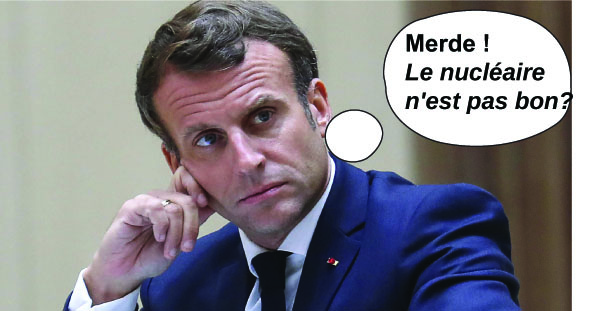
Macron’s Nuclear Power Strategy Will Be Clear by Year End, Ecology Minister Says, Bloomberg, By Francois De Beaupuy and Ania Nussbaum, 27 October 2021,
- Final decision on plants seen after next April’s election
- EDF wants construction of plants to start as soon as possible
French President Emmanuel Macron will probably say by the end of the year whether he supports the construction of new nuclear plants as part of the country’s plan to achieve carbon neutrality by 2050, Ecology Minister Barbara Pompili said…….
“The president will probably express his preference and his orientation on the scenarios before the end of the year,” Pompili told reporters in Paris Tuesday. Still, there wouldn’t be a final decision before next April’s presidential elections, she said.
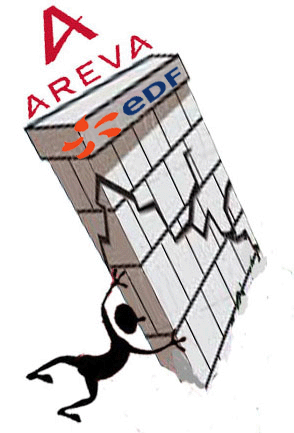
The French atomic industry, led by state-controlled Electricite de France SA, is urging the government to start constructing nuclear plants as soon as possible. That’s because most of EDF’s 56 existing reactors — which provide more than two-thirds of France’s electricity — are due to be shut by 2050 or earlier.
A report on the cost of new nuclear plants will be published in coming weeks, Pompili said. Damaging delays, cost overruns and technical failings have afflicted the country’s nuclear sector in recent years, raising questions about EDF’s ability to build new plants on budget. ……
The government will help EDF and its partners develop small modular nuclear reactors by 2030, Macron said earlier this month. https://www.bloomberg.com/news/articles/2021-10-26/macron-will-probably-announce-nuclear-power-strategy-by-year-end
Biden faces Pentagon hawks in his effort to curb nuclear weapons spending
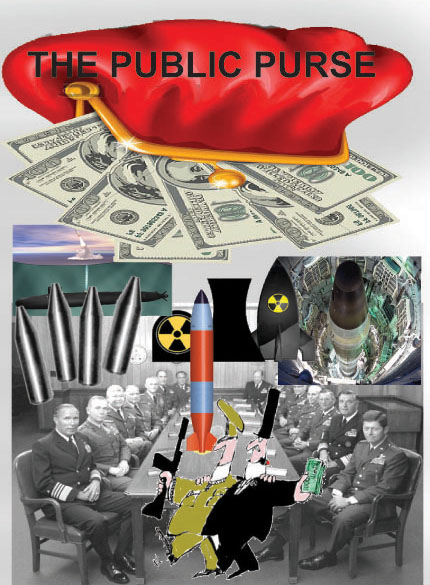
Nuclear arms hawks give bureaucratic mauling to Biden vow to curb arsenal, Guardian, Julian Borger in Washington, Wed 3 Nov 2021 Defence budget and nuclear posture review are battlegrounds as Republicans seek to block limits on US use of weapons,
A battle is being fought in Washington over the Biden administration’s nuclear weapons policy, amid fears by arms control advocates that the president will renege on campaign promises to rein in the US arsenal.
The battlegrounds are a nuclear posture review (NPR) due early next year and a defence budget expected about the same time. At stake is a chance to put the brakes on an arms race between the US, Russia and China – or the risk of that race accelerating.
Despite Biden’s pledge during the campaign – and in his interim national security guidance issued in March – that his administration would reduce “our reliance and excessive expenditure on nuclear weapons”, hawks at the Pentagon have won the early skirmishes.
Biden is also under pressure from some allies, nervous about Biden’s past support for limiting the use of nuclear weapons to the “sole purpose” of deterring, and retaliating against, a nuclear attack on the US or its allies.
The current US posture is broader, leaving open a nuclear response to “significant non-nuclear strategic attacks”. Britain and France also retain a certain amount of ambiguity about when they would use their weapons, and are concerned a US change to “sole purpose” would oblige them ultimately to narrow their options. Paris has taken the lead in conveying those anxieties, and Emmanuel Macron raised nuclear posture issues with Biden when the two met in Rome on Friday.
The big struggle, however, is on the home front, where arms control advocates are on the defensive.
The administration’s first defence budget in February included $43bn for an array of nuclear modernisation schemes, including controversial programmes introduced by Donald Trump, like a new sea-launched cruise missile. The total cost of modernisation could be over $1.5tn.
In September, one of Biden’s political appointees at the Pentagon, Leonor Tomero, who questioned the need for such a vast and growing nuclear weapons budget, was forced out in a bureaucratic power struggle after just nine months in the post. Her job had been to oversee the drafting of the NPR, which sets out what nuclear weapons the US should have and under what conditions they could be used…………..
Senator Edward Markey, a Democrat, has written to Biden demanding to know why Tomero had been removed in the midst of drafting the NPR, demanding to know if “ideology played any role”.
………..Nickolas Roth, the director of the nuclear security programme at the Stimson Center thinktank, said: “I am concerned that the removal of Leonor from her position will have a chilling effect throughout the Biden administration, on those who might be willing to propose anything other than the status quo for US nuclear weapons policy.”
…………. China’s nuclear weapons development, including the recent reported testing of a nuclear-capable hypersonic glider launched from orbit, has increased the political pressure on Biden to abandon his arms control pledges, although the Chinese arsenal is still dwarfed by the US total of 3,750 warheads.
Emma Belcher, the president of the Ploughshares Fund, an arms control advocacy organisation, argued that China’s rise as a nuclear weapons power only underlines the urgency of arms control.
“The best way to control the situation and head off an arms race with China is through diplomacy and restraint,” Belcher said. “We’ve seen this movie before. It’s expensive and dangerous. So what we’re hoping we’ll see from the NPR is for diplomacy to be put first, and an off ramp from a new kind of cold war.” https://www.theguardian.com/world/2021/nov/03/nuclear-arms-joe-biden-pentagon-hawks
China’s grandiose plans for nuclear build and export of reactors.

Along with the potential for geopolitical fallout, potential partners have other concerns. China hasn’t signed on to any of several international treaties that set standards for sharing liability in the event of accidents. It also hasn’t offered to take back spent fuel, an added disadvantage when competing with Russia, which does……………
China’s Climate Goals Hinge on a $440 Billion Nuclear Buildout. China is planning at least 150 new reactors in the next 15 years, more than the rest of the world has built in the past 35. Bloomberg, By Dan Murtaugh and Krystal Chia, 3 November 2021, Nuclear power once seemed like the world’s best hope for a carbon-neutral future. After decades of cost-overruns, public protests and disasters elsewhere, China has emerged as the world’s last great believer, with plans to generate an eye-popping amount of nuclear energy, quickly and at relatively low cost. ……………..
China also expects its domestic projects to persuade potential overseas buyers. In 2019, the former chairman of China National Nuclear Corp. said China could build 30 overseas reactors that could earn Chinese firms $145 billion by 2030 through its Belt and Road Initiative.
Its most eager customer has been Pakistan which, like China, shares a sometimes violently contested border with India. China’s built five nuclear reactors there since 1993, including one that came online this year and another expected to be completed next year.
Other countries have been more hesitant. Romania last year canceled a deal for two reactors with CGN and opted to work with the U.S. instead. A 2015 agreement with Argentina has been stalled by economic upheaval and changes in the country’s leadership. Memorandums of understanding to build reactors with countries including Kenya and Egypt have yet to develop into anything concrete.
Along with the potential for geopolitical fallout, potential partners have other concerns. China hasn’t signed on to any of several international treaties that set standards for sharing liability in the event of accidents. It also hasn’t offered to take back spent fuel, an added disadvantage when competing with Russia, which does……………
Prior to the meltdown at Fukushima, China’s nuclear goals were even bigger. Within a week of the tsunami that triggered a meltdown at the Japanese atomic plant, the Chinese government put a moratorium on new projects and began a deep safety review of its entire program. By 2014, it decided against building any more reactors that required active safety measures, like the one at Fukushima did. It paused approvals again for several years until it was satisfied with its new technology.
Fukushima, Chernobyl, Three-Mile Island: Each new disaster underscores the most obvious risk in nuclear energy. Plants house incredibly dangerous radioactive material — even after 10 years of cooling, spent fuel can release twenty times the fatal dose of radiation in one hour. And in the event of a leak or an explosion, the potential for immediate and long-term damage is enormous. In Chernobyl, 350,000 people had to be evacuated after an explosion shot radioactive material into the atmosphere, and dozens of workers died of radiation poisoning within weeks. More than 30 years later, there are still reports of dangerously high levels of radiation in locally produced milk and grain. ……….
public support for nuclear power has waned to the point that new investment is politically untenable in most democracies. At COP26, applications by the International Atomic Energy Agency and industry advocates to set up shop at a more public and visible area were rejected. Japan’s efforts to restart its fleet are mired in court actions and public opposition, Germany will take the last of its reactors offline next year, and France has pledged to cut its reliance on nuclear energy from 70% to 50% by 2035.
Beijing’s own record was largely spotless until June, when reports emerged of an issue at the French-designed plant in Taishan. Any report of a problem at a nuclear plant is alarming, let alone one at a facility within 100 miles of both Hong Kong and Shenzhen.
The incident underscored the potential problem with big nuclear projects, and how they can be made worse by Chinese firms’ typical lack of transparency or public accountability. While media reports and rumors swirled about a possible problem at the plant, CGN insisted everything was fine. Its partner, the French utility EDF, wasn’t so sure, and eventually took its case to the public as a way to push for more information, at one point alerting the U.S. government.
It took weeks before Chinese officials clarified that the problem involved a few damaged fuel rods, which is common and in this case, experts agreed, unthreatening. The plant was eventually shut for maintenance, which EDF said would have happened as a matter of course in France.
While the incident ended up being largely uneventful, it widened the already gaping trust gap between China and the global marketplace for nuclear technology. China’s business practices are often opaque and sometimes downright hostile to the world’s other big emitters. The U.S., India and others are unlikely to build critical infrastructure around Chinese technology, even if it does prove safe and cost-effective.
………. In 2016, China’s CGN invested in three U.K. reactor developments, part of an effort to upgrade an aging nuclear fleet. Now, even as the country confronts a potentially crippling energy crisis this winter, government officials are trying to minimize CGN’s involvement in one of the projects and buy out its stake in the other two.
Crisis or no, it’s hard to see the country move actively toward more nuclear now, given the country’s fraught relationship with China, said Michal Meidan, director of the China Energy Research Programme at the Oxford Institute for Energy Studies. “The lack of transparency and concerns about working relationships have become deeper,” she said. https://www.bloomberg.com/news/features/2021-11-02/china-climate-goals-hinge-on-440-billion-nuclear-power-plan-to-rival-u-s
Japan’s election – winning candidates at odds on the future of nuclear power

Survey: LDP and Komeito take differing stances on nuclear power https://www.asahi.com/ajw/articles/14474326
By RYUTARO ABE/ Staff Writer, November 3, 2021 According to a new survey, winning candidates in the ruling coalition in the Oct. 31 Lower House election differ greatly on the future of nuclear power in Japan.
Broken down by political parties, 72 percent of ruling Liberal Democratic Party winners supported nuclear power, the highest rate among parties, while just 9 percent of junior coalition partner Komeito victors did so.
The survey, jointly conducted by The Asahi Shimbun and a team led by Masaki Taniguchi, a professor of political science at the University of Tokyo, analyzed the political views of winners in the Lower House election.
For the survey, questionnaires were sent out from Sept. 2, and 448 of 465 election winners responded to them by Oct. 31. The response rate was 96.34 percent.
The survey asked the candidates which view they were leaning toward: “Abolish nuclear power immediately” or “Keep it as a power source for the future.”
Among the winners, those wanting to abolish nuclear power accounted for 19 percent, compared to 24 percent in the previous survey for the 2017 Lower House election.
Winners who favor maintaining nuclear power accounted for 45 percent, compared to 47 percent in the previous survey. Nearly half of the winners believe that nuclear power should remain as a source of power in the future.
Excluding the choice of “neither,” 13 percent of Komeito winners supported the abolition, 4 percentage points higher than those who support nuclear power.
t the time of the 2017 Lower House election, 33 percent of Komeito winners favored retaining nuclear power while no one supported abolishing it. In the new survey, many Komeito candidates drastically changed their stances.
Komeito, in its manifesto for the Lower House election, said, “We aim to achieve a nuclear-free society, not relying on nuclear power for the future.”
The survey also revealed differing stances on nuclear power among all the competing parties.
All the election winners of the Japanese Communist Party, Reiwa Shinsengumi and the Social Democratic Party supported pulling the plug on nuclear power, followed by victorious Constitutional Democratic Party of Japan members at 62 percent.
No winners of the Democratic Party for the People supported its abolition, while 27 percent supported nuclear power.
Thirty-nine percent of winners of Nippon Ishin (Japan Innovation Party) want to retain nuclear power, the second highest rate after that of the LDP victors. The previous survey in 2017 showed just 9 percent favored nuclear power.
The survey also asked candidates about releasing processed radioactive water collected at Tokyo Electric Power Co.’s crippled Fukushima No. 1 nuclear power plant into the sea.
Sixty-two percent of all the winners viewed the water release into the sea as “inevitable.” The LDP and Komeito winners, who shared the view, accounted for 80 percent and 59 percent, respectively.
At the same time, 95 percent of Nippon Ishin winners support the release, the highest rate among parties, followed by DPP victors at 73 percent.
Sixty-five percent of CDP winners leaned toward opposing the release, but 10 percent said, “It is inevitable.”
Nuclear power for Bangladesh – a long, very costly, very dangerous process.
MV Ramana and Zia Mian: Bangladesh is on the way to having its first
nuclear power plant. Designed and being built by Russia at a cost of over
12 billion dollars, the Rooppur nuclear plant has been part of an
on-and-off planning process for six decades.
This sixty-year quest for constructing a reactor is blind to what has been learned over the same
period about nuclear energy.
It could take many more years before the plant
starts to produce any electricity. Intended to operate for sixty years,
electricity from this power plant will contribute to higher electricity
bills for Bangladeshi consumers for decades given the high cost of
construction.
The same amount of electricity could be had much cheaper and
much more quickly. Worse, for its sixty-year working life, and possibly for
longer, it will cast a shadow of a nuclear accident over the people of
Bangladesh, who will be forced to live with constant worry or try to just
forget. Even if an accident does not occur, the nuclear waste produced by
Rooppur will threaten people and nature for millennia with risk of
radioactive contamination. This is what it is now to be a nuclear-powered
nation.
Sarbojonkotha 3rd Nov 2021
Japan’s election gives reprieve for nuclear sector.
Japan’s election gives reprieve for nuclear sector, Argus, By Motoko Hasegawa 1 November 2021
Japan’s ruling Liberal Democratic Party (LDP) secured a victory in the 31 October general elections to the lower house of parliament. This allows the government to maintain its updated energy policy, which lays out plans to restart safe nuclear reactors to help reduce the country’s greenhouse gas emissions.
The LDP secured a majority in Japan’s lower house after voting closed, without accounting for parliamentary seats secured by its junior coalition partner Komeito. This could make it easier for the LDP to push forward with its nuclear policy before the next general upper house election next year. Komeito had pledged to strictly adhere to the 40-year lifespan limit for reactors and a future no-nuclear society, as other opposition parties had insisted on.
LDP leader and prime minister Fumio Kishida and cabinet ministers last month endorsed a basic energy policy that did not include plans for construction or replacement of nuclear reactors and only focused on the restart of safe reactors. But the government did not directly prohibit building reactors, in a reprieve for the nuclear industry………….
Japan has restarted 10 nuclear reactors since the 2011 Fukushima nuclear disaster closed all the country’s reactors to enhance their safety measures. But it will have to phase out existing reactors without any capacity additions. All Japanese reactors are allowed to operate for 40 years with a one-time option to extend their lifespan to 60 years under current nuclear safety rules. This has 15 of the existing 33 reactors with a combined capacity of 14,057MW closing by December 2030 and no operational reactors in 2050, assuming a 40-year lifespan. https://www.argusmedia.com/en/news/2269158-japans-election-gives-reprieve-for-nuclear-sector
Greenpeace is set for a confrontation with security officials at COP26
Greenpeace is set for a confrontation with security officials at COP26
after revealing plans to dock a ship outside the venue without permission.
The climate group’s Rainbow Warrior yacht set sail from Liverpool on
Saturday night, seeking to sail up the Clyde and dock next to the COP26
venue in Glasgow. Port authorities declined the Rainbow Warrior’s request
to berth, with the area under a tight lockdown as world leaders arrive, but
Greenpeace said that the captain has “decided to ignore the warnings”
and will attempt to dock on Monday morning.
iNews 31st Oct 2021
A damning new confidential report on France’s future nuclear reactor plans.

| Nuclear. A damning confidential report on future EPRs. It is a real bomb that has just published the information site “Context” about the new generation of nuclear power plants EDF. These EPR2 that Emmanuel Macron is about to order. “Context” has obtained a confidential report from the government which expresses serious doubts about the design, feasibility, cost and timeframe of what should constitute the new wave of French nuclear power plants. Bercy and EDF make no comment. Ouest France 29th Oct 2021 https://www.ouest-france.fr/environnement/nucleaire/nucleaire-un-rapport-confidentiel-accablant-sur-les-futurs-epr-b54a63b8-37d7-11ec-9832-1d0e4716a307 |
Minister confirms taxpayer will foot bill for UK nuclear power strategy

Minister confirms taxpayer will foot bill for UK nuclear power strategy LBC, TOM SWARBRICK, 31 October 2021 On the fourth time of asking, the Energy minister admitted energy bills will rise to fund the construction of nuclear plants in the UK.
As COP26 gets underway in Glasgow, Tom Swarbrick was joined by Minister for Business, Energy and Clean Growth Greg Hands to discuss the UK’s strategy to achieve net zero.
Tom asked Mr Hands about the Regulated Asset Base model for nuclear, which is the government’s plan to build “at least one large-scale nuclear project” by the end of parliament.
How much are bills going to go up to pay for that?” Tom asked for the first time. The Tory MP dodged the question and insisted that the RAB model “increases our level of choices” for energy production in future.
He repeated that the construction of nuclear plants “creates more options for us.”………..
Before it has been built, how much are prices going to go up as a result of this model?” Tom asked for the third time.
The Energy Minister insisted that “depends on the deals that are being done”, adding that energy bills will “be reduced by around £10.”
Can I just try one more time, and it can be a nod or a shake of the head for an answer,” a dejected Tom said.
“Can you guarantee that through this new way of funding nuclear, that bills will not go up prior to it being built?”
“No, we’re expecting that bill-payers will make a contribution based on the Regular Asset Base model” the Minister confirmed on the fourth time of asking.
“It will end up being cheaper overall for bill-payers by in the region of £10” he repeated, clarifying that the saving is “over the lifetime of that power station.” https://www.lbc.co.uk/radio/presenters/tom-swarbrick/british-taxpayer-will-pay-for-nuclear-energy-program-minister-confirms/
Exelon now to keep two Illinois nuclear stations open, following new State law subsidising nuclear

Two nuclear power plants in northern Illinois reversed plans to retire early, eia, 31 Oct 21, Exelon, the owner-operator of Illinois’s six nuclear power plants, recently announced that the Byron and Dresden nuclear plants will continue operating rather than retire this fall as previously planned. The announcement came after the Illinois state legislature and governor approved a clean energy bill supporting [so-called] carbon-free energy resources…………..
The bill also supports nuclear power plants in the state through a carbon credit plan, where utilities that serve more than 300,000 residential customers are required to purchase electricity credits generated from certain nuclear plants. S.B. 2408 comes in addition to an existing Zero Emission Credits (ZEC) program that began in 2017 and provides revenue to participating nuclear power plants in Illinois.
Prior to S.B. 2408, the Byron and Dresden plant operators reported to EIA that they had planned to retire the plants in September and November 2021, respectively. For power plants with one megawatt (MW) of capacity or more, plant owners and developers report planned capacity retirements and additions to EIA, which we compile and publish in our annual and monthly electric generator inventory data………… https://www.eia.gov/todayinenergy/detail.php?id=50136
UK’s new nuclear financing plan is a nightmare

Tax-and-spend budgets can be dispiriting. But at least Kwasi Kwarteng
squirrelled out a “£30 billion” consumer windfall this week.
Apparently, we’re going to be that much better off on “each new
large-scale” nuclear power plant he’s planning for Blighty.
And all
thanks to “a new funding model” — the regulated asset base, or RAB.
Where the business secretary has plucked his figure from is not exactly
clear. But it’s all part of his conversion to a new nuclear nirvana —
one all the more crucial, too, “in light of rising global gas prices”.
Yes, it’s debatable whether gas prices will still be on the up in, say,
2035 when a new Kwasi nuke might actually be built. But who cares about
that? Buried in the budget was the news ministers have set aside “£1.7
billion to enable a final investment decision” this parliament on a new
reactor (who else spends that sort of sum making a decision?) and is in
talks with EDF over Sizewell C in Suffolk.
On top, Kwarteng has dusted off
Wylfa on Anglesey, the project Hitachi spent four years trying to fire up
before jacking it in and writing off £2.1 billion. Apart from the
decade-long delays in getting built, construction cost overruns are
nuclear’s forte: France’s Flamanville, up from the initial €3.3
billion to €19.1 billion; Finland’s Olkiluoto, up from €3 billion to
€11 billion; and our very own Hinkley Point C, up from £18 billion to
£23 billion.
Kwarteng knows all that. But he’s calculated that the RAB
model, where consumers “contribute to the cost of new nuclear power
projects during the construction phase”, can not only attract private
investors but also allow lower electricity prices in the long run: his
so-called “£30 billion” saving.
For him, it beats the
“contracts-for-difference” template of Hinkley Point C. Both models are
deeply flawed. But the RAB is worse. First, because developers, and their
backers, have no incentive to keep costs down. Sure, there’d be an
independent regulator to rule on cost overruns.
But with investors making
their return on the size of the RAB, the more cost they can get past the
regulator, the better. And, second, because if the project keels over,
consumers are still left with the bill. “Nukegate” in America is proof
of that: two reactors in South Carolina built by Westinghouse that blew up
the company after costs ballooned from $9.8 billion to $25 billion. The
plants were never completed: a scandal leading to criminal lawsuits. But
consumers are still paying for the nukes: billions of dollars of costs,
making up 18 per cent of their electricity bills.
Guess what, too? Fresh
from Chapter 11 bankruptcy, it’s Westinghouse that Kwarteng fancies for
another go at Wylfa.
Times 30th Oct 2021
https://www.thetimes.co.uk/article/new-nuclear-plan-is-a-nightmare-63schq6ks
| R |
35 official events at Cop26 put on by polluting companies

THIRTY-FIVE official side-events at the COP26 climate summit are being
organised by, or feature, big polluting companies or lobby groups that
represent them, The Ferret can reveal.
The National 31st Oct 2021
1 This Month
23-25 October – on Zoom – World BEYOND War’s annual global conferenc


Shut down the radiation-damaged Heysham nuclear reactors now
To see nuclear-related stories in greater depth and intensity – go to https://nuclearinformation.wordpress.com

Say No to NASA’s Reckless Nuclear Reactor on the Moon
Say No to NASA’s Reckless Nuclear Reactor on the Moon

-
Archives
- October 2026 (209)
- September 2026 (339)
- August 2026 (330)
- July 2026 (355)
- June 2026 (287)
- May 2026 (306)
- April 2026 (356)
- March 2026 (251)
- February 2026 (267)
- January 2026 (308)
- December 2025 (358)
- November 2025 (359)
-
Categories
- 1
- 1 NUCLEAR ISSUES
- business and costs
- climate change
- culture and arts
- ENERGY
- environment
- health
- history
- indigenous issues
- Legal
- marketing of nuclear
- media
- opposition to nuclear
- PERSONAL STORIES
- politics
- politics international
- Religion and ethics
- safety
- secrets,lies and civil liberties
- spinbuster
- technology
- Uranium
- wastes
- weapons and war
- Women
- 2 WORLD
- ACTION
- AFRICA
- Atrocities
- AUSTRALIA
- Christina's notes
- Christina's themes
- culture and arts
- Events
- Fuk 2022
- Fuk 2023
- Fukushima 2017
- Fukushima 2018
- fukushima 2019
- Fukushima 2020
- Fukushima 2021
- general
- global warming
- Humour (God we need it)
- Nuclear
- RARE EARTHS
- Reference
- resources – print
- Resources -audiovicual
- Weekly Newsletter
- World
- World Nuclear
- YouTube
-
RSS
Entries RSS
Comments RSS

