UK govt’s budget – £1.7 billion direct government funding to enable Regulated Asset Base funding for new nuclear
Buying out Chinese state owned CGN’s 20% stake in EDF’s Sizewell C development is likely to be dwarfed by the sum the UK government earmarked to smooth the nuclear project’s progress to financial close, an academic has estimated.
The Budget, published last month, included a new allocation of £1.7 billion direct government funding to enable a final investment decision on one large-scale nuclear project to be achieved during the current Parliament. Giving evidence to the Parliamentary committee which has been set up to scrutinise the government’s bill to allow the regulated asset base (RAB) model to be applied to nuclear projects, Professor Stephen Thomas of Greenwich University estimated that EDF and CGN had so far spent about £500 million on developing the Sizewell C project – buying out CGN’s minority stake in Sizewell C is likely to be a “tiny fraction” of the £1.7 billion allocated to nuclear in the Budget.
Utility Week 22nd Nov 2021
UK Parliament debates Nuclear Energy (Financing) Bill, with anxiety over the Government’s big nuclear plans.

“…successive Governments seem to have developed a groupthink, following lobbying from the nuclear industry, that somehow nuclear is a prerequisite for our future.”
…… … there is currently no economic or environmental case for the construction of any further nuclear stations in the UK.”
Of course, consumers who have signed up to buy 100% renewable electricity could quite rightly feel aggrieved at having to pay the “nuclear tax” as well.
SafeEnergy E Journal No.92. December 21, Large New Nuclear Update The UK Government has said it wants to secure a final investment decision on at least one largescale nuclear plant by the end of this Parliament. It is also supporting the development of Small Modular Reactors.
The Government is putting nuclear power at heart of its net zero strategy. Kwasi Kwarteng, business secretary, unveiled the “Net Zero Strategy”, as well as a “Heat and Buildings Strategy” in October. The creation of a “regulated asset base” (RAB) model will be the key to the delivery of a future fleet of large nuclear power plants. The RAB funding model is already being used for other infrastructure projects, such as London’s Thames Tideway super sewer. Under this program, GB electricity consumers, including those in Scotland (but not Northern Ireland) will be billed for the cost of the plant via a “nuclear tax” long before it starts producing electricity, which could take a decade or more from the time the final investment decision is made.
On Wednesday 3rd November, MPs debated the second reading of the Nuclear Energy (Financing) Bill. The Liberal Democrats and the SNP, both put forward amendments, but neither was accepted for debate by the Speaker
The Lib Dem Motion said the Bill does nothing to address concerns about costs around nuclear waste disposal and decommissioning and fails to bring forward meaningful reforms to accelerate the deployment of renewable power. The SNP Motion said there is no longer a justification for large nuclear power stations to provide baseload energy, because large scale nuclear is too inflexible to counter to the intermittency of renewables. It called on the Government to spend more money on energy efficiency measures and targeted support for those who suffering from fuel poverty.
During the debate in the House of Commons (1), the Minister of State for Business, Energy and Industrial Strategy, Gregg Hands, said that we need a new funding model to support the financing of large-scale and advanced nuclear technologies. He said the lack of alternatives to the funding model used for Hinkley Point C has led to the cancellation of recent potential projects, at Wylfa Newydd and Moorside in Cumbria. He said the Bill was intended to get new projects off the ground, including, potentially, Sizewell C, which is the subject of ongoing negotiations between EDF and the Government, as well as further projects, such as on Wylfa.
He said the Bill would add, on average less than £1 per month to consumers’ bills during the construction phase of a nuclear project. But compared with the CfD model used to fund Hinkley Point C this could produce a cost saving for consumers of more than £30 billion.
Regarding Scottish Consumers being forced to pay for new reactors he said:
“…the Scottish Government have a different position with regard to new nuclear projects. To be clear: this Bill will not alter the current approval process for new nuclear, nor the responsibilities of the devolved Governments. Nothing in this Bill will change the fact that Scottish Ministers are responsible for approving applications for large-scale onshore electricity-generating stations in Scotland. The steps taken in this Bill will mean that Scottish consumers will benefit from a cheaper, more resilient and lower-carbon electricity system, so it is right that Scottish consumers should contribute towards the construction of new projects.”
Labour’s Alan Whitehead disappointed many when he said: “We need to support the need to finance new nuclear.”
The SNPs Energy Spokesperson Alan Brown said: “…successive Governments seem to have developed a groupthink, following lobbying from the nuclear industry, that somehow nuclear is a prerequisite for our future.”
He went on to say: “…it was stated … the new funding model could potentially save the taxpayer £30 billion to £80 billion. How much money do the Government estimate has been wasted on Hinkley?”
For the Liberal Democrats, Sarah Olney said “our position is very much that there should not be new nuclear power stations … there is currently no economic or environmental case for the construction of any further nuclear stations in the UK.”
On the £30 billion savings the NFLA UK & Ireland Steering Committee Chair Councillor David Blackburn said:
“The Minister is comparing one expensive environmentally unsustainable project with another expensive environmentally unsustainable project. If he really wanted to save consumers money he would introduce a National Homes Retrofit Scheme as quickly as possible having learned the lessons from its failed Green Homes Scheme, and introduce a scheme to support flexibility, demand management and smart grids so that we can use more of our cheap, sustainable renewable electricity.”
On Scottish Consumers paying this “nuclear tax” because they “will benefit from a cheaper, more resilient and lower-carbon electricity system,” Scottish NFLA Chair, Cllr. Feargal Dalton said:
“Renewables met 97% of Scotland’s electricity demand in 2020. The Scottish electorate has consistently voted for Governments opposed to building new nuclear power stations. With wind and solar now the cheapest forms of electricity Scottish consumers shouldn’t have to pay for the Tories’ failed energy policies.” (2)
Of course, consumers who have signed up to buy 100% renewable electricity could quite rightly feel aggrieved at having to pay the “nuclear tax” as well. https://www.no2nuclearpower.org.uk/wp/wp-content/uploads/2021/11/SafeEnergy_No92.pdf
Question hangs over Bradwell nuclear project – Bradwell B (BRB) a partnership 66.5% China’s CGN and 35% France’s EDF.

SafeEnergy E Journal No.92. December 21 Bradwell Bradwell B (BRB), which is a partnership between the Chinese Company, CGN – with a 66.5% share and EDF Energy with a 33.5% share is hoping to build a Chinese reactor – the UKHPR100 at Bradwell in Essex. BRB appealed to the Planning Inspectorate against the refusal by Maldon District Council of Planning Permission for further land investigations at Bradwell. The Appeal was successful.
But this does not give a green light to a future nuclear power station at Bradwell, and given the current hostility to Chinese involvement in UK Infrastructure seems unlikely to progress much further. The Blackwater Against New Nuclear Group (BANNG) objected to land investigations on the grounds that they were unnecessary since the site is wholly unsuitable, unsustainable and unacceptable for the development of a mega nuclear power station and spent fuel stores.
The Planning Inspector chose to uphold the Appeal on the narrow grounds that the works would be temporary and would create little disruption and disturbance to the environment and human welfare. The Inspector declined to take into account the question of need for new nuclear, relying on the 2011 National Policy Statement on Nuclear (EN6) which deemed Bradwell a ‘potentially suitable’ site. In its latest policy statements the Government is silent on Bradwell and the project seems likely to be dropped altogether on geopolitical grounds.
On 25th November The Times reported that China would be cut out of future involvement in developing new nuclear power stations. Boris Johnson said that a potential adversary could have no role in Britain’s “critical national infrastructure”. The Prime Minister, asked by Labour spokesperson, Matthew Pennycook if he could “confirm unequivocally today that plans for China General Nuclear to own and operate its own plant at Bradwell in Essex have been abandoned”, said:
“Clearly, one of the consequences of our approach on critical national infrastructure in the National Security and Investment Bill is that we do not want to see undue influence by potentially adversarial countries in our critical national infrastructure. That is why we have taken the decisions that we have. On Bradwell, there will be more information forthcoming. What I do not want to do is pitchfork away wantonly all Chinese investment in this country, or minimise the importance to this country of having a trading relationship with China.” (3) https://www.no2nuclearpower.org.uk/wp/wp-content/uploads/2021/11/SafeEnergy_No92.pdf
France’s Court of Auditors warns on the ”uncertainties” surrounding the future of nuclear power
The Court of Auditors alerted Thursday to the “uncertainties” weighing on
the ability to build a new nuclear park “within a reasonable time and at a
reasonable cost”, while President Macron has just decided to launch a new
program of EPR. The construction of new means of electricity production –
whether nuclear or renewable – “now calls for urgent decisions to guarantee
our supply by the decade 2040″, underline the magistrates in a thematic
note.
Boursama 18th Nov 2021
Nuclear power in Hungary: Green, cheap and independent?
Nuclear power in Hungary: Green, cheap and independent? DW, 26 Nov 21,
The Hungarian government is convinced that nuclear power is the path to a green future. A new Russian reactor block is to be constructed that allegedly guarantees low emissions and low energy prices.
While Germany is phasing out nuclear power and many EU states don’t have any atomic plants at all, others are expanding their nuclear programs as part of the fight against climate change. These states argue that atomic energy is low in CO2 emissions and allows them to produce cheap electricity and be more energy-independent.
But can nuclear power really lead the way out of the climate crisis?
EU split on nuclear power
The Hungarian government says it can — and is far from being alone. In mid-October, 10 EU states, including Finland, the Czech Republic and Poland, issued a statement that declared: “To win the climate battle, we need nuclear energy.”
France, a long-time enthusiastic advocate of nuclear energy, took the lead in formulating this statement. Currently, Paris is investing in new types of domestically developed reactors.
Meanwhile, Budapest is planning to expand its Russian-type nuclear plant. It is located near the small town of Paks on the banks of the Danube, less than a two-hour drive south of the Hungarian capital. In addition to the four existing reactors, two others are planned — Paks II.
Good for the environment and consumers?
…………… The question of whether atomic power is really beneficial to the environment is extremely contested. It is not just a matter of the catastrophic consequences of potential reactor accidents and the still unresolved questions about the safe storage of atomic waste. Nuclear energy does not guarantee lower emissions. A study of 123 countries that was published in the scientific journal Nature in 2020 came to the conclusion that actual emissions are not significantly lower in those countries with nuclear power than those without.
New reactor block in seismically active zone
The nuclear plant in Paks also has an impact on flora and fauna in the vicinity, stresses Andras Perger, the climate and energy expert for Greenpeace Hungary. He says that cooling water fed into the Danube can significantly increase the river’s temperature, in particular when water levels are low and all reactors are running.
“The cooling water is already the most significant environmental influence,” Perger says. The water temperature in the zone up to 500 meters (1,640 feet) downriver of the plant is legally permitted to reach a maximum of 30 C (86 F). In August 2018, the river reached, at times, the critical level of 29.8 C, according to the operator. Unofficial measurements conducted by the think tank Energiaklub even showed temperatures significantly above permitted levels.
Perger also stresses the fact that the new reactors are located in a seismically active zone and is skeptical whether all regulations were taken into account when choosing the site. The Federal Environmental Office in neighboring Austria shares his view. This summer, it produced a report that described the location of Paks II as “unsuitable.”……
How independent is nuclear energy?
The state-owned company MVM’s home page states that the new reactor blocks are not just safe but guarantee Hungary greater energy independence. Yet experts are not convinced that the plants really improve Hungary’s relatively high import rate — the technology as well as the fuel rods come from Russia. A study from 2020 comes to the conclusion that in view of this fact, nuclear energy can also ultimately be classed as an import, meaning some three-quarters of the country’s energy balance comes from beyond the country’s borders……………
Lack of transparency
But opposition parties and NGOs have sharply criticized the decision to directly award the contract for expanding the plant to Russia’s state-owned nuclear energy company Rosatom and to finance the project with a Russian loan worth more than €10 billion. The relatively high interest rate of between 4% and 5% and the Hungarian forint‘s drop in value could mean that taxpayers will end up paying more than the €12.5 billion ($14.1 billion) budgeted for the new reactors………….
Critics have also attacked the Fidesz government’s decision to declare the Rosatom contract a matter of national security and its passing of a new law that permits the documents to be kept under lock and key for 30 years.
Little hope for opponents of nuclear energy
Unlike Germany or Austria, Hungary does not have a broad-based anti-nuclear power movement. A number of opinion polls indicate that a majority of Hungarians tend to oppose the renewed extension of the operating licenses of the existing reactors and the expansion of Paks nuclear power plant — in particular after the 2011 Fukushima nuclear disaster.
But scrapping the contract for Paks II or abandoning nuclear power altogether would be difficult. Not only would energy prices for consumers be likely to rise, but the government could be forced to pay high compensation payments to Russia. https://www.dw.com/en/nuclear-power-in-hungary-green-cheap-and-independent/a-59950544
Nicola Sturgeon reaffirms the Scottish Government’s opposition to nuclear power

Nicola Sturgeon has renewed the Scottish Government’s opposition to
nuclear power as part of the country’s drive towards net zero. The First
Minister ruled out any new nuclear power stations in Scotland in direct
opposition to calls from trade unions, backed by Labour’s Anas Sarwar,
for nuclear to be considered as a replacement to fossil fuels.
At First Minister’s Questions in Holyrood Sturgeon insisted it was was an
expensive option for taxpayers. She told SNP MSP Bill Kidd: “Renewables,
hydrogen and carbon capture and storage provides the best pathway to net
zero by 2045 and will deliver the decarbonisation we need to see across
industry, heat and transport. “We believe that nuclear power represents
poor value for consumers.”
Daily Record 25th Nov 2021
https://www.dailyrecord.co.uk/news/politics/nicola-sturgeon-rules-out-nuclear-25544965@ChristinaMac1
Boris Johnson avoids detail on how China will be removed from Sizewell C deal.
Boris Johnson avoided details when specifically asked about China’s
state-owned energy company’s role in Sizewell C – and how they will be
removed from the nuclear project amid concerns over national security. EDF
and China General Nuclear (CGN) are joint developers of Sizewell C taking
80% and 20% shares respectively, though the Financial Times has previously
reported that Whitehall is looking to push out CGN.
At Prime Minister’s Questions, shadow business secretary Matthew Pennycook told Mr Johnson that
“the Government’s Integrated Review concluded the Chinese state poses a
systemic challenge to our national security” and asked him to explain
“precisely how and when his Government intends to remove the CGN’s
interest from the Sizewell C nuclear project?”
Mr Johnson responded: “We
don’t want to see undue influence by potentially adversarial countries in
our critical national infrastructure and so that’s why we have taken the
decisions we have.” The National Security and Investment Bill, currently
going through parliament, is looking to give the government further powers
to screen and potentially block sensitive foreign investments.
Mr Pennycook later responded on Twitter: “We need certainty on the future of China’s
involvement in UK nuclear power and clarity about how and when the
Government intends to remove China’s state-controlled nuclear energy
company from involvement in any future UK project.”
East Anglian Daily Times 25th Nov 2021
https://www.eadt.co.uk/news/boris-johnson-sizewell-c-china-removal-8516062
Labour has called for clarity on how the government plans to remove China’s state-owned energy company from nuclear power projects in the UK.
Labour has called for clarity on how the government plans to remove
China’s state-owned energy company from nuclear power projects in the UK.
Asked about Chinese involvement in nuclear projects at Bradwell and
Sizewell during Prime Minister’s Questions (PMQs) yesterday, Boris
Johnson said the UK “do[es] not want to see undue influence by
potentially adversarial countries in our critical national
infrastructure” and highlighted new national security rules on investment
that come into force in January. Johnson added that more information would
be “forthcoming” about what it will decide about the Bradwell B
project.
Construction News 25th Nov 2021 https://www.constructionnews.co.uk/government/nuclear-pm-urged-to-elaborate-on-potential-removal-of-chinese-firms-25-11-2021/
New nuclear for Scotland- would be a tragic mistake?
SafeEnergy E Journal No.92. December 21, New Nuclear in Scotland Leader of the Scottish Labour Party, Anas Sarwar, says nuclear power should be part of the mix on energy. He has also called for a statutory “just transition commission” to be established to help workers move out of the oil and gas industry. He said: “I think we have to be honest about future opportunities and I think nuclear power has to be part of the mix. “I’m not saying nuclear power has to be the priority, or the lead. But it has to be part of the mix to have a diverse energy supply.” Sarwar insisted nuclear power could mean lower fuel bills for consumers at a time of rising inflation.
In September Sarwar announced plans for a Scottish Energy Transition Commission to outline how Scotland can protect and create highly skilled jobs in the transition to a net-zero economy. The commission will be chaired by pro-nuclear former Labour Energy Minister Brian Wilson. It will support the development of Scottish Labour energy policy and advise on how the transition to netzero can deliver for the working people of Scotland. It will also look at the failures of the current energy market, which has led to spiking prices this winter, the role of public energy companies and Scotland’s energy mix. (2)

The Bella Caledonia website described Wilson as “a devout nuclear enthusiast”. Sarwar told the BBC that “I think we should consider potential new (nuclear power) plants” (3) and certainly with a nuclear lobbyist chairing this is where they’ll end up. Journalist Dominic Hinde points out: “This is a little odd in that Scotland already meets almost a hundred per cent of its electricity needs from renewables and is set to surpass this. Most emissions now come from heating, agriculture and transport.” (4)
Dr Richard Dixon, Director of Friends of the Earth Scotland, called Scottish Labour’s drift towards nuclear power “a tragic mistake”. Nuclear is slow to build, eye-wateringly expensive and dangerous. There is still no agreed solution for nuclear waste, which will need monitoring for many thousands of years. It is neither a solution to short-term energy needs nor to the climate crisis.
Dixon said the Scottish Energy Transition Commission is Scottish Labour’s plan to keep the pressure up on the Scottish government’s official Just Transition Commission, and should have been welcome, but giving it to the former ‘Minister for Hunterston’ devalues it. Anas Sarwar was quoted saying he supports a “diverse energy supply”, which is standard union code for more nuclear – and thinks “nuclear is a key part of that and it’s something that I think we should fundamentally explore”. For many years the Scottish Conservative manifesto for every election said we should have two new nuclear power stations in Scotland. It became a running joke because they knew it was never going to happen and they quietly dropped any mention of nuclear a couple of elections ago. The tragedy of Labour finding a new enthusiasm for the ultimate unsustainable form of energy is that it was a Labour First Minister who put a stop to the nuclear industry’s ambitions in Scotland. Jack McConnell, despite massive pressure from Tony Blair’s government, said in 2005 that Scotland would use planning powers to block any proposals for new reactors in Scotland unless there was an answer to the question of permanent storage of radioactive waste, something that is no closer today than it was then. Scottish Labour’s drift into being pro-nuclear will please no-one but the GMB union and Brian Wilson. It is a betrayal of one of their greatest achievements in government in Scotland. (5)
Meanwhile, North Ayrshire Conservative councillor Tom Marshall has called for a new state-of-theart ‘mini’ nuclear reactor to be built at Hunterston. (6)
According to a Panelbase survey for The Times 37% of Scots asked about the idea of building nuclear power stations in Scotland as fossil-fuel use is cut back expressed support, while only 32% were opposed. When asked if they supported nuclear power to replace energy currently produced by fossil fuels, 57% of respondents felt it was probably or definitely necessary while 26% indicated it was not or probably not necessary. A further 17% were undecided. Liam Kerr, net-zero and energy spokesman for the Scottish Conservatives, called on the SNP to abandon its opposition to nuclear energy. (7)
Others joining a pro-nuclear clamour include Magnus Linklater who complains that “Without Torness, in a wind-free summer like this year’s, Scotland will have to rely on oil and gas courtesy of Vladimir Putin, imports from Norway or — irony of ironies — nuclear power from France.” (8)
And Lord Bird, co-founder of The Big Issue, has somehow got the misconceived idea that nuclear power can help to solve fuel poverty. Brian Wilson, the former UK energy minister, has supported his call. (9)
Unsurprisingly, the GMB union is also demanding the Scottish Government thinks again on nuclear power. (10)
See 1 page briefing on why nuclear power isn’t a solution to climate change here: https://www.no2nuclearpower.org.uk/wp/wpcontent/uploads/2021/11/Nuclear_no_solution_to_Climate-October-2021.pdfhttps://www.no2nuclearpower.org.uk/wp/wp-content/uploads/2021/11/SafeEnergy_No92.pdf
UK government tries to save its nuclear skin by turning to dubious Regulated Asset Base funding

At a time of rising energy bills in the UK, it certainly seems risky of the government to commit to increasing them further and opening themselves up to a downside risk that could prove very costly.
The National Infrastructure Commission, a body designed to give impartial advice to the government, said in March 2020 that a “renewable-based system looks like a safer bet” and a “substantially cheaper” option than the construction of multiple new nuclear power plants.
The UK’s nuclear plan is a financial, environmental and political risk, Investment Monitor, Jon Whiteaker , 16 Nov 21,” …………..The problem with financing nuclear power
…… Hinkley Point C has been a bit of a nightmare for the UK government. It is already seven years behind schedule, has controversial Chinese investors that the government is understood to be trying to get rid of, and is widely agreed to be far too expensive.
It was financed under the contracts for difference (CfD) model used for offshore wind. This guarantees a ‘strike price’ for the power plant owner, allowing them to raise capital for construction by having certainty of revenues.
Using the same funding model as offshore wind has, however, allowed for simple comparisons of the costs of the two power types. While the latest round of offshore wind projects saw strike prices of about £40 per megawatt-hour (MWh) over a 15-year contract, the owners of Hinkley are guaranteed at least £89.5/MWh over 35 years.
The reasons the Hinkley strike price is so much higher is because the capital costs are much higher, but also because the risks involved in developing them are much greater.
At least Hinkley Point C is being built. A number of planned projects, including the Moorside power station in West Cumbria and Wylfa Newydd plant on Anglesey, have been cancelled or shelved in recent years.
With the need to develop the UK’s next generation of nuclear plants increasingly urgent, the government has turned to the RAB model to save its skin.
UK government turns to the RAB model
The RAB model is known mostly for its successful use on the Thames Tideway Tunnel (TTT), the new super sewer in London that is helping to clean up the Thames River. The government says that like that project, nuclear power plants are complex, have high capital costs and long operating lives.
The RAB model allows developers of infrastructure to earn immediate revenues by adding charges to consumers’ utility bills during the construction. Bill payers will have to buy before they try their lovely new nuclear power.
This in theory widens the pool of potential investors, making the government less beholden to a small group of companies who typically invest in and build nuclear plants, lowering the cost of financing, and ultimately saving money for bill payers.
The government predicts that using the RAB model to build a new nuclear plant will save energy bill payers £10 per year compared with the CfD model.
Legislation allowing the introduction of the RAB model for new nuclear was introduced in October 2021 and is moving through the House of Commons. The government has pledged to reach a final investment decision on at least one new nuclear plant by the end of this parliament in 2024.
It is hoped by government that the previously stalled 3.2GW Sizewell C, owned by EDF Energy, will be the first nuclear project to use the RAB model.https://www.investmentmonitor.ai/business-activities/energy/uk-nuclear-rab-energy-renewable
The problems with RAB for nuclear
While this all sounds like a perfect panacea for the government’s problems, there are several downsides to using the RAB model.
The depth of investor interest in new nuclear power stations is yet unknown. As the UK government should be painfully aware, having just hosted COP26, the conversation about what does and does not meet different investors ESG standards is a live one. Whether nuclear power is seen as a sustainable investment is debatable.
Trying to get any of the investors in TTT to make clear their stance on nuclear power is not easy, and I have tried. For the government to achieve its goals, institutional investors, like those that supported TTT, should want to invest in new nuclear too.
Asset manager Aviva Investors, a major investor in UK infrastructure, has called on the government to present a robust ESG case for new nuclear, which it says is lacking at present.
Many investors will be concerned over whether nuclear meets the criteria of an environmentally sustainable activity. Institutional investors are incredibly cautious by nature and the shadow cast by the Fukushima disaster in Japan in 2011 is still long.
All energy suppliers will have to contribute to the costs of RAB nuclear plants, whether they want to or not, before passing those costs on to bill payers. That seems a retrograde step for an energy market that has been diversifying to provide customers with ‘green only’ options in recent years. Whether you have ethical objections to nuclear power or not, you will have to use a supplier that helps fund that technology.
Hinkley Point C is seven years behind schedule. You would be brave to bet against any delays to the first RAB model nuclear plant too.
The government says that there would be a cap on how much extra investors could charge consumers but that this cap could be increased by the government if deemed necessary. If the costs became excessive, the government would have the option of covering the costs itself, although this is ultimately taxpayer money too.
At a time of rising energy bills in the UK, it certainly seems risky of the government to commit to increasing them further and opening themselves up to a downside risk that could prove very costly. Perhaps the government thinks these are all costs worth shouldering to ensure its net-zero plans stay on track.
The National Infrastructure Commission, a body designed to give impartial advice to the government, said in March 2020 that a “renewable-based system looks like a safer bet” and a “substantially cheaper” option than the construction of multiple new nuclear power plants.
That sounds like advice worth considering again. https://www.investmentmonitor.ai/business-activities/energy/uk-nuclear-rab-energy-renewable
Boris Johnson quizzed over future of Bradwell, (Essex) nuclear plant
Boris Johnson quizzed over future of Essex nuclear plant https://www.maldonandburnhamstandard.co.uk/news/19738655.boris-johnson-quizzed-future-essex-nuclear-plant/
By Jessica Day-ParkerTrainee Reporter PRIME Minister Boris Johnson told MPs he does not want to “pitchfork away” all investment from China in response to a question about Bradwell B.
Matthew Pennycook, Labour MP for Greenwich and Woolwich, pressed the Prime Minister on Bradwell B – the proposed nuclear power station at Bradwell-on-Sea put forward by China General Nuclear Power Group (CGN) – in the House of Commons.
Mr Pennycook said: “The Government’s Integrated Review concluded the Chinese state poses a systemic challenge to our national security and the Prime Minister has made clear that when it comes to China we must remain vigilant about our critical national infrastructure.
General Nuclear to own and operate its own plant in Bradwell in Essex have been abandoned?”
Mr Johnson confirmed the Government doesn’t want to see “undue influence by potentially adversarial countries in our critical national infrastructure” and insisted “there will be more information” coming on Bradwell.
But he added: “What I don’t want to do is pitchfork away wantonly all Chinese investment in this country or minimise the importance in this country of having a trading relationship with China.”
The US Faces Pressure To Do More To Address Its Nuclear Legacy In The Marshall Islands.

The US Faces Pressure To Do More To Address Its Nuclear Legacy In The Marshall Islands, Civil Beat By Anita Hofschneider 22 Nov 21, Marshallese are concerned about continued health effects from Cold War-era nuclear testing as well as a concrete dome in which the atomic waste was stored.
Two Congress members are asking the U.S. Department of Energy to provide more information about the effects of U.S. nuclear waste in the Marshall Islands.
The U.S. conducted 67 nuclear weapons tests in the Marshall Islands from 1946 to 1958, exposing Marshallese people to radiation that continues to have health and environmental implications. The U.S. then stored the atomic waste at Runit Dome, a concrete dome on Enewetak Atoll.
Rep. Katie Porter represents Orange County, California, and is chair of the Subcommittee on Oversight and Investigations in the House Committee on Natural Resources.
She has been seeking more details about the effects of nuclear testing in the Marshall Islands in the wake of a Los Angeles Times investigation that found the U.S. stored nuclear waste from Nevada in Runit Dome without informing the Pacific nation.
In a letter Friday, Porter and Rep. Raul Grijalva of Arizona asked for documents and correspondence among Department of Energy officials related to a letter that officials sent to the Marshall Islands about the state of nuclear waste in May.
The Department of Energy didn’t respond to a request for comment.
In October, Porter led a congressional hearing regarding concerns about Runit Dome, which is leaking radioactive waste. The Energy Department said in a report last year that the leaking is not significant.
“The U.S. has both a moral and national security imperative to address our nuclear legacy in the Marshall Islands,” Porter said at the hearing, adding that addressing the issue would be in line with the Biden administration’s commitment to racial justice and national security issues in the Pacific………
In their letter, Porter and Grijalva criticized the agency’s lack of response to repeated document requests, raised concerns about conflicting Energy Department testimony and the timing of the department’s May letter.
The U.S. is in the midst of renegotiating a treaty with the Marshall Islands that in part gives the U.S. military strategic denial rights over the country’s surrounding air and waters.
The Congress members described how the U.S. failed to evacuate Marshallese people quickly enough to protect them from the fallout during the 1946-1958 testing, and cited descriptions of how mothers later gave birth to babies with translucent skin and no bones.
A 2014 study analyzed how the radiation exposure in the Marshall Islands increased the risk of certain cancers, especially thyroid cancer.
Broader Concerns
Franscine Anmontha, communication director of the Marshall Islands National Nuclear Commission, said Saturday that the community is concerned about the ongoing health effects of radiation on people not only on the atolls enrolled in the U.S. medical program but on surrounding atolls.
“If you were to ask a group of young Marshallese people if they knew someone with cancer almost 90% of them would raise their hands,” she said. She said the commission wants to bring scientists to the Marshall Islands to analyze the dome so that they don’t have to rely solely on U.S. data……….
Friday’s letter is the second letter this month pressing the Biden administration for more information about the nuclear testing.
Several Congress members — including Hawaii Reps. Ed Case and Kai Kahele — wrote to the White House on Nov. 5 pushing for the appointment of a lead negotiator for treaty discussions who would have the ability to address concerns about nuclear waste.
The lead negotiator “should have the mandate to see that legacy issues related to U.S. nuclear testing in the region are appropriately resolved, including proper environmental protections, clean up, health benefits, and monetary compensation for victims and their descendants,” the lawmakers wrote…………. https://www.civilbeat.org/2021/11/the-us-faces-pressure-to-do-more-to-address-its-nuclear-legacy-in-the-marshall-islands/
As presidential candidate, Emmanuel Macron opposed nuclear power, now he’s all for it
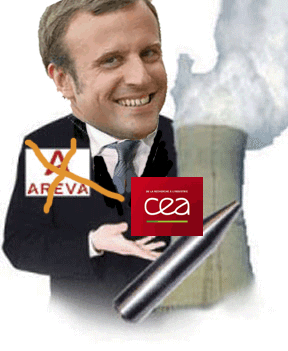
Nuclear: Emmanuel Macron’s energy “at the same time”. Inheriting President Hollande’s nuclear commitments, candidate Macron had made campaign promises that were not very favorable to the atom.
But, in the middle of his five-year term, the President of the Republic has put nuclear power back at the center of France’s energy policy. To end up announcing, at the beginning of November, that it would be necessary to build new power stations.
Les Echos 22nd Nov 2021
Heritage Foundation – murky think tank funded by the nuclear weapons industry, wants weapons-makers to be exempt from climate and pandemic regulations

“Defense industrial base” is a buzzword that has picked up steam during the pandemic: It sends the message that, whatever happens with the economy and pandemic, we need to make sure we are in “fighting shape” — by keeping military contractors afloat. This concept was invoked to explain why, at the beginning of the pandemic, factories that produce bombs and tankers should be allowed to stay open, even amid the outbreak risk to workers. And it was also used to justify subsidies to contractors during the hardship of the pandemic.
Lockheed Martin is just one of numerous weapons manufacturers that has directly funded the Heritage Foundation. According to a report by the think tank Center for International Policy (CIP), the Heritage Foundation ranks ninth among the top think tanks that received funding from military contractors and the U.S. government from 2014 to 2019. Lockheed Martin and Raytheon were two of those major funders, both of which are among the largest weapons companies in the world and would be impacted by the new regulation.
This case provides a window into the murky world of think tanks, which are often viewed as academic and above-the-fray institutions but operate more as lobbying outfits.
Think Tank Funded by the Weapons Industry Pressures Biden Not to Regulate Military Contractors’ Emissions https://www.rsn.org/001/think-tank-funded-by-the-weapons-industry-pressures-biden-not-to-regulate-military-contractors-emissions.html
Sarah Lazare/In These Times 19 November 21The Heritage Foundation has received considerable donations from the arms industry. And now it’s trying to shield that industry from climate regulations targeting military contractors.
The Heritage Foundation, a prominent conservative think tank, is publicly opposing a new Biden administration regulation that would force the weapons industry to report its greenhouse gas emissions related to federal contracts. It turns out the Heritage Foundation also receives significant funding from the weapons industry, which makes the case worth examining — because it reveals how the arms industry pays supposedly respectable institutions to do its policy bidding at the expense of a planet careening toward large-scale climate disaster.
The regulation in question was first proposed in an executive order in May. It would require federal contractors to disclose their greenhouse gas emissions and their “climate-related financial risk,” and to set “science-based reduction targets.” In other words, companies like Lockheed Martin would have to disclose how much carbon pollution its F‑35 aircraft and cluster bombs actually cause.
In October, the Biden administration started the process to amend federal procurement rules to reflect these changes. “Today’s action sends a strong signal that in order to do business with the federal government, companies must protect consumers by beginning to mitigate the impact of climate change on their operations and supply chains,” Shalanda Young, acting director of the White House Office of Management and Budget, said at the time.The Department of Defense is the world’s biggest institutional consumer of fossil fuels and a bigger carbon polluter than 140 countries. Yet its emissions (and those of other armed forces) are excluded from UN climate negotiations, including the recent COP26 talks. The Biden administration itself supports a massive military budget, initially requesting $753 billion for the 2022 National Defense Authorization Act, a number that has since ballooned, with the Senate set to vote on a $778 billion plan. Organizers and researchers argue that, to curb the climate crisis, it is necessary to roll back U.S. militarism and dismantle the military budget.
But according to the Heritage Foundation, even this modest proposal is a bridge too far.
Continue readingWhile the French government promises a nuclear revival, its supreme auditing body warns of serious obstacles to this.

The Court of Auditors (Cour des comptes) is the supreme body for auditing the use of public funds in France. It is independent from the Government and Parliament. It has financial jurisdiction and is in charge of auditing, issuing rulings and certifying the State and Social Security accounts, as well as contributing to the evaluation of public policies.
Nuclear revival: the Court of Auditors highlights many obstacles https://reporterre.net/Relance-du-nucleaire-la-Cour-des-comptes-pointe-de-nombreux-obstacles 19 Nov 21,
In a report published this Thursday, November 18, the Court of Auditors questions our “ability to build a new fleet of [nuclear] reactors on time and at reasonable costs”. This, while “maintaining a 50% nuclear share in electricity production (…) beyond 2050 would require ultimately not having seven EPR or EPR2, but 25 to 30 in the assumption that the current reactors would almost all be shut down by this time, ”the text specifies. And that the composition of the new mix must be decided between 2022 and 2027, believes the institution, given the delays in the construction of new plants.
The report from the Court of Auditors
In this document entitled “The choices of electricity production: anticipating and controlling technological, technical and financial risks”, the wise men of the rue Cambon recall the slippages of cost – 19 billion euros instead of the 3 billion planned – and of deadlines – at least eleven years late – of the Flamanville EPR site. “The gaps are similar for the Olkiluoto RPE in Finland,” they said. In July 2020, the Court of Auditors detailed these troubles at length in a report dedicated to the EPR sector.
Several points of real concern are mentioned.
One is the locations of these new reactors, “as climate change can make the installation of sites along rivers more complicated”.
Management of spent fuel and waste: the construction of new reactors planned to operate until 2100 would in fact involve “either renewing the fuel reprocessing plant at La Hague (…) and creating new sites for ‘warehousing and then disposal of nuclear waste, or to propose another mode of management of spent nuclear fuel and waste which would be, in such a hypothesis, much more voluminous ”, we read in the note.
Another imperative element for the implementation of this half-nuclear mix emphasized by the Court is “the start of the Cigeo radioactive waste disposal project” – a project that is also marred by many uncertainties.
The cost, finally. “EDF will not be able to finance the construction of new nuclear reactors on its own when it has to bear the cost of extending the current fleet and of the“ post Fukushima ”safety investments, face the future costs of dismantling and the uncertain evolution regulated access to historic nuclear power since its inception in 2011, and that it is already indebted to the tune of 42 billion euros, ”warns the Court of Auditors. The project to build six new EPRs had been estimated at 46 billion euros by EDF and could be half-financed by the state, as reported by Reporterre. The cost of the investment has since been reassessed from 52-56 billion euros to 64 billion euros, according to a working document released at the end of October by the media Context.
The implementation of a 100% renewable energy mix also represents many challenges, nevertheless warns the Court of Auditors. It would thus be necessary to define modalities for storing energy (batteries, etc.) at an affordable cost and to overcome implementation difficulties linked to geography, regulations and even social acceptability.
In any case, “the holding of an informed democratic debate would encourage choices made with full knowledge of the facts and then followed up with lasting effects”, recommends the institution. This debate could take place in 2023 during the preparation of the next multiannual energy program, the roadmap for France’s energy policy.

The publication of this report comes at a time when debates rage on the definition of the electricity mix of the future. On October 25, the electricity transmission manager unveiled its six electricity scenarios for 2050: three give pride of place to the atom. Less than three weeks later, Emmanuel Macron promised the construction of new nuclear reactors in France during a televised address.
1 This Month
26 April – Chernobyl: Inside the Meltdown airs on National Geographic on Sunday 26th April from 4pm

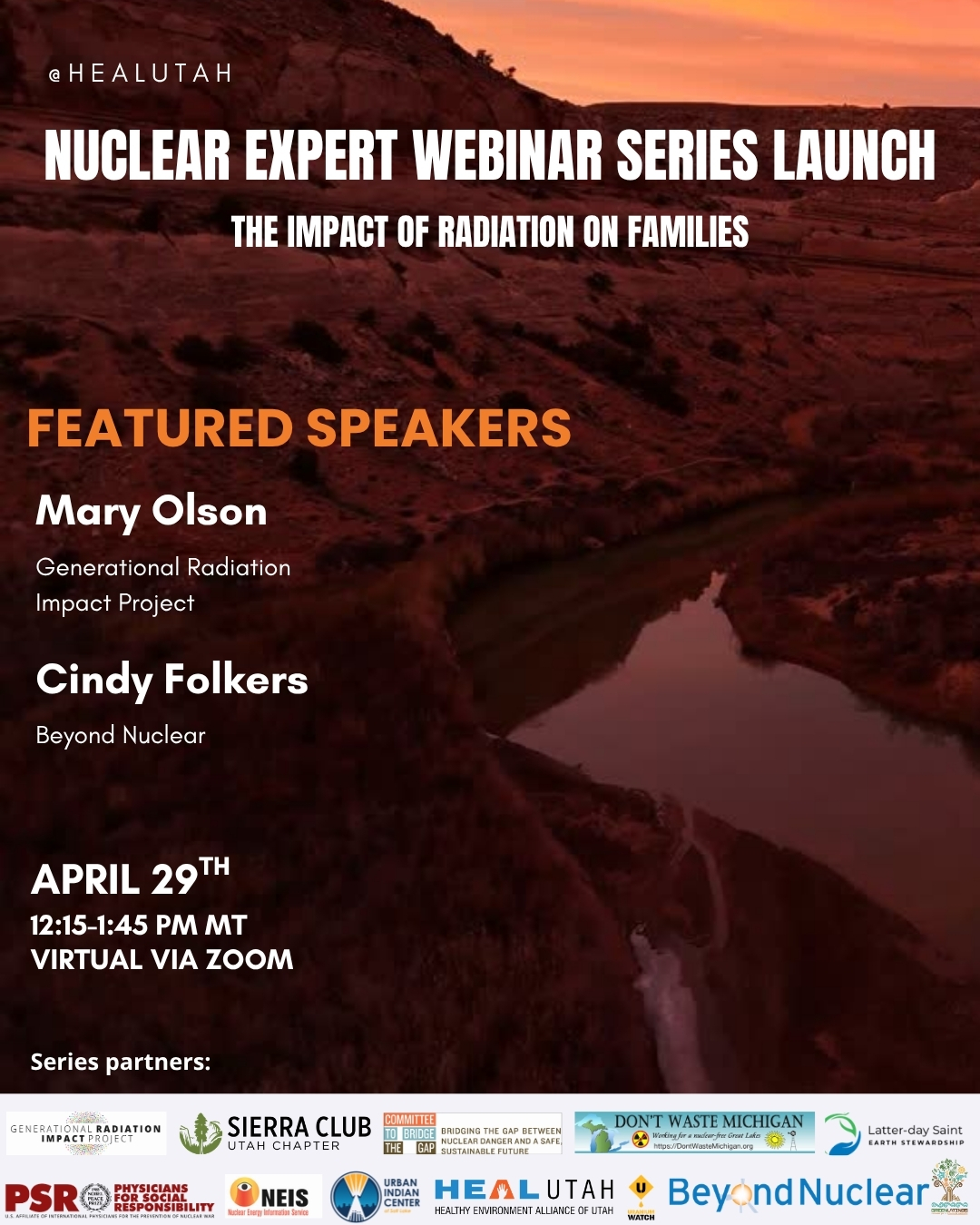
29 April – Nuclear Expert Webinar #1 – Radiation Impacts on Families with Mary Olson and Cindy Folkers
- 12:15 PM MT – 1:45 PM MT
- Location: Virtual – REGISTER TODAY

4 May -West Suburban Peace Coalition to discuss Iran war at May Educational Forum
Monday, May 4, 7:00 – 8:00 PM Central Standard Time
Title: : How Trump’s Narrative Tries to Shape the Reality of the War on Iran.
Contact Walt Zlotow, zlotow@hotmail.com 630 442 3045 for further information
14 May – online event From Bombs to Data Centres: the Face of Nuclear Colonialism

Pine Ridge Uranium is the real threat, not Tehran- Tell Burgum: Stop the Extraction.
Chernobyl: The Lost Tapes – A good documentary on Chernobyl on SBS available On Demand for the next 3 weeks– https://www.sbs.com.au/ondemand/tv-program/chernobyl-the-lost-tapes/2352741955560
To see nuclear-related stories in greater depth and intensity – go to https://nuclearinformation.wordpress.com
-
Archives
- April 2026 (346)
- March 2026 (251)
- February 2026 (268)
- January 2026 (308)
- December 2025 (358)
- November 2025 (359)
- October 2025 (376)
- September 2025 (257)
- August 2025 (319)
- July 2025 (230)
- June 2025 (348)
- May 2025 (261)
-
Categories
- 1
- 1 NUCLEAR ISSUES
- business and costs
- climate change
- culture and arts
- ENERGY
- environment
- health
- history
- indigenous issues
- Legal
- marketing of nuclear
- media
- opposition to nuclear
- PERSONAL STORIES
- politics
- politics international
- Religion and ethics
- safety
- secrets,lies and civil liberties
- spinbuster
- technology
- Uranium
- wastes
- weapons and war
- Women
- 2 WORLD
- ACTION
- AFRICA
- Atrocities
- AUSTRALIA
- Christina's notes
- Christina's themes
- culture and arts
- Events
- Fuk 2022
- Fuk 2023
- Fukushima 2017
- Fukushima 2018
- fukushima 2019
- Fukushima 2020
- Fukushima 2021
- general
- global warming
- Humour (God we need it)
- Nuclear
- RARE EARTHS
- Reference
- resources – print
- Resources -audiovicual
- Weekly Newsletter
- World
- World Nuclear
- YouTube
-
RSS
Entries RSS
Comments RSS
 nuclear-news