Despite deteriorating situation, Ukrainian parliament still insisting on NATO accession
RT, https://www.sott.net/article/467169-Despite-deteriorating-situation-Ukrainian-parliament-still-insisting-on-NATO-accession Tue, 26 Apr 2022 The Rada’s chair says accession to the military alliance is Ukraine’s “prospective vision of its future”
The Ukrainian parliament will not vote to remove the passage about the country’s ambition to join NATO from the constitution, the Rada’s chairman, Ruslan Stefanchuk, has revealed.
n an interview with Ukrainian media outlet Ukrainska Pravda published on Monday, Stefanchuk was asked whether Ukrainian lawmakers were going to amend the country’s constitution with respect to Kiev’s ambition to become a NATO member state. The official replied in the negative, adding that “changing the constitution is not an end in itself.” He went on to say that just because some changes are made does not necessarily mean that they have an effect in real life. Stefanchuk warned against “declaratory norms.
The official emphasized that at this point the Ukrainian authorities’ main focus is on ensuring the security of each and every Ukrainian citizen. “Real guarantees are important to us,” Stefanchuk noted.
“For me as a representative of the political leadership of the state precisely this is a priority, so that people no longer die and pay with their lives for the European dream, for the dream of security and the rest,” the Rada’s chairman said.
However, Kiev would not settle for just any kind of guarantees, according to Stefanchuk, who cited the 1994 Budapest Memorandum as an example of empty promises that have failed to materialize. He called for a well-defined agreement which would be able to put Ukraine at ease.
Going back to “what is written in our constitution regarding NATO and the EU,” Stefanchuk described accession to the two organizations as Ukraine’s “prospective vision of its future.”
On March 29, during the last in-person meeting between the Ukrainian and Russian negotiators in Istanbul, Kiev proposed penning an international agreement on security guarantees for Ukraine.
Ten days prior, Stefanchuk indicated that he did not rule out removing the passage on NATO membership from Ukraine’s constitution, depending on “what path the negotiators will take.” The official added that the Rada could start looking for a “model that will either not contradict the constitution or we will change the constitution in this respect.”
The amendment in question, which was added to the Ukrainian constitution back in February 2019, obliges the country’s government to stick to the goal of NATO membership, with the president being the senior guarantor.
Russia attacked the neighboring state in late February, following Ukraine’s failure to implement the terms of the Minsk agreements, first signed in 2014, and Moscow’s eventual recognition of the Donbass republics of Donetsk and Lugansk. The German and French brokered protocols were designed to give the breakaway regions special status within the Ukrainian state. The Kremlin has since demanded that Ukraine officially declare itself a neutral country that will never join the US-led NATO military bloc. Kiev insists the Russian offensive was completely unprovoked and has denied claims it was planning to retake the two republics by force. AT TOP https://www.sott.net/article/467169-Despite-deteriorating-situation-Ukrainian-parliament-still-insisting-on-NATO-accession
Emmanuel Macron won French election on a wide margin, running on a pro nuclear policy
| Incumbent French president Emmanuel Macron, who ran on a ticket to boost nuclear and renewable energy, was re-elected on Sunday by a wider margin than expected. Macron, from centre-right party La Republique en Marche, won the election with 58.55% of the vote against 41.45% for Marine Le Pen, representing Rassemblement National, though she nevertheless secured the far-right’s highest ever share of the vote. The president planned to build six European pressurised reactors (EPRs) by 2050, with an option foreight more pending further assessment, he stated in his election manifesto. The construction of the first reactor would start in 2028 and come into service in 2035, though the plan was deemed “unrealistic” by some experts. Macron also scrapped a plan to close 12 reactors by 2035 in a U-turn to his 2017 campaign pledge to cut reliance on nuclear energy to 50%, down from 70% currently. Montel 25th April 2022 https://www.montelnews.com/news/1315204/macron-wins-election-vows-to-boost-nuclear-renewables |
French election: Macron and Le Pen’s nuclear plans torn apart: ‘Waste of time AND money’
FRENCH presidential hopefuls Emmanuel Macron and Marine Le Pen have unveiled ambitious plans to boost France’s nuclear power capacity – already at 70 percent of its domestic electricity generation – but experts have questioned the feasibility.
By IAN RANDALL, , Apr 24, 2022
The recent emphasis on large-scale nuclear reactors is, at least superficially, seemingly at odds with President Macron’s announcement late last year that France would be investing in so-called small modular reactor designs as part of his “France 2020” roadmap.
……………… Of the strategy’s allocated €30billion (£25.2billion) budget, €8billion (£6.7 billion) is to be apportioned towards the development of hydrogen power, compared with just €1billion (£0.8billion) towards small-scale reactor concepts.
Despite this funding disparity, however, Mr Macron asserted that the realisation of the small modular reactors was in fact “goal number one”……………………………. https://www.express.co.uk/news/science/1600032/french-election-energy-macron-le-pen-grand-nuclear-plans
Greenpeace chief urges Yoon to reevaluate nuclear-focused decarbonization plan
Greenpeace chief urges Yoon to reevaluate nuclear-focused decarbonization plan https://en.yna.co.kr/view/AEN20220422004700315
All News 11:20 April 22, 2022 SEOUL, April 22 (Yonhap) — The leader of Greenpeace urged President-elect Yoon Suk-yeol on Friday to “reevaluate” his nuclear-focused decarbonization plan in a letter sent to him on the occasion of Earth Day.
Yoon’s transition team is pushing to modify the country’s carbon neutrality plans that the outgoing Moon Jae-in administration declared with a goal to reduce its greenhouse gas emissions by 40 percent from the 2018 levels by 2030 and reach carbon neutrality by 2050.
The overhaul will likely include reversal of Moon’s nuclear phase-out policy and changes in energy mix.
“We urge you to reevaluate whether nuclear energy could be safe, fast, and affordable enough to achieve the 1.5 degree C temperature goal,” Greenpeace International Executive Director Norma Torres said in the letter.
She said, “Korea already has the highest nuclear power plant density in the world … we wonder whether further nuclear expansion will be acceptable by the public.”
Torres also said, “The unsolved nuclear waste problem is also a major issue you need to consider in your nuclear focused decarbonization plan.”
South Korea, instead, needs a new, ambitious energy transition strategy to employ more renewable energy coupled with an ambitious fossil fuel and nuclear phase-out plan, according to her.
“Needless to say, your term from 2022 to 2027 is a critical time to decide whether Korea will pull its weight and therefore contribute to the global mission to prevent disastrous climate change in time or not,” she said.
The life and slow death of nuclear power plants

The UK government and EDF have pledged 20% of the cost each, but the additional 60% is yet to be found. Some of that is a levy on our electricity bills for a decade before Sizewell generates a single Kwh.
once planning permission is given, construction of a small-scale wind farm, 10MW or less, could take less than two months.

A further elephant in the room is that the costs of new nuclear are highly “back loaded”, i.e., that by building them you commit to high levels of expenditure at the end of their working life, to remove the fuel rods, decommission, remove and store nuclear waste.
The Life and Death of nuclear power plants By NEWSROOM, Apr 18, 2022, By Peter Rowberry with additional reporting by Newsroom
It seems that the policy [in the UK] to build new nuclear power stations has caused some friction at the heart of the cabinet, with the Prime Minister trying to get the agreement of the Chancellor to spend at least £100 billion on eight new nuclear power stations. This didn’t stop the government issuing its energy security strategy last week.
Such a huge commitment merits careful scrutiny. Hinkley Point C was one of eight announced by the British government in 2010 with a nuclear site licence granted in November 2012. EDF’s board approved the project in July 2016 and on 15 September 2016 the UK government approved the project in principle. Construction work on-site began by late September 2016. Completion of the reactor bases was completed in June 2019 for reactor 1 and June 2020 for reactor 2. The two bases required a total of 633,700 cubic feet of concrete.
Hinkley C is the only one of the 2010 eight designated sites to have commenced construction. The UK government strategy paper calls for 8 further new nuclear plants but does not name locations. This is similar to the Brown government’s announcement in 2008 which the coalition government pinned down in 2010. With only 1 of 8 since 2010 actually under construction the conclusion is the new 8 suggested could be decades from coming online.
Earlier costs for Hinkley C were estimated at around £18 billion. The current cost estimate is around £22 to £23 billion, and the first reactor will not be complete until June 2026 at the earliest, and the second at least six months later.
This timetable is currently being reviewed, with a fault found in similar nuclear reactors in China meaning the design may need to be changed. EDF have not commented on whether this will affect the timescale for completing the project. These delays, and the consequent impact on other nuclear projects, such as Sizewell C and Wylfa, have resulted in serious failures to meet the government obligations to move to low carbon generation and taken up time, time which we are now desperately short of if we are to meet our target of reducing carbon emissions by 50% by 2030 and to net zero by 2050.
The building of the two reactors that form the Sizewell C project is still not fully financed. Nor has the planning process been completed. All the work in progress so far is on vast quantities of paper and construction cannot commence until Sizewell C plant receives planning permission.
There remains considerable opposition to Sizewell C over the high cost of nuclear energy and environmental issues. The cost of a plant that is over 10 years away from generating power will start hitting electricity bills sometime soon. The BBC reported “Legislation allowing construction and financing costs to be added to customer bills, as Sizewell C is built over the next decade, is due for a second reading in the House of Commons next month.”
The UK government and EDF have pledged 20% of the cost each, but the additional 60% is yet to be found. Some of that is a levy on our electricity bills for a decade before Sizewell generates a single Kwh. The government’s plans to have eight nuclear reactors up and running by 2030 seem naively optimistic. New nuclear is not a quick fix, as our near neighbours will attest. The Finnish reactor, Olkiluoto 3, was started in 2005, but only went onto the grid seventeen years later, on 15 March this year.
Of the eight nuclear power plants announced back in 2010, Hinkley Point C might be generating by 2026 (16 years) and Sizewell C by 2032, subject to planning permission (22 years) None of the other 6 proposed nuclear plants are anywhere near getting off the ground.
France, a country which historically generates a large percentage of its electricity from nuclear, is in the process of building only one new reactor, a third at the Flamanville site. EDF, the state-owned energy giant, began work in December 2007 and the cost was estimated to be €3.3 billion. It is now expected to cost more than €12.7 billion and it is yet to generate a single kilowatt of power.
In contrast, according to the European Wind Energy Association, once planning permission is given, construction of a small-scale wind farm, 10MW or less, could take less than two months. A larger 50MW facility may take six months, although considerably smaller in scale, this is substantially quicker than any new nuclear. This has not stopped president Macron from announcing that his government will support the building of between six and fourteen new reactors.
A further elephant in the room is that the costs of new nuclear are highly “back loaded”, i.e., that by building them you commit to high levels of expenditure at the end of their working life, to remove the fuel rods, decommission, remove and store nuclear waste. The UK Nuclear Decommissioning Authority currently spend around £3 billion a year for Site Licence Companies to make the current decommissioned reactors safe.
The Nuclear Provision is the best estimate of how much it will cost to clean up 17 of the UK’s earliest nuclear sites over a programme lasting over 120 years……………………………………………………
All of this will be less significant if nuclear could deliver low carbon electricity at an affordable price. The biggest issue on the cost of nuclear energy is the so called “strike price”, the price which the government has agreed to pay the owners, EDF, for electricity from their nuclear stations. Originally EDF said that electricity from nuclear could be produced at around £24 per megawatt hour. The strike price is now set at £92. It has also been agreed that the strike price should rise in line with inflation, which as we know has reached a thirty-year high and is likely to continue to be high for the foreseeable future.
Although the cost of the raw materials for building wind turbines has increased, copper and steel in particular, the cost of generation by renewables has steadily decreased over time. The latest strike price for offshore wind is around £40 per megawatt hour and less for onshore wind. There have been several missed opportunities and poor decisions by both the Labour and Conservative parties and both party’s obsession with new nuclear have put us in a position where we need urgent action. In February 2004 the Labour party undertook a £40 billion project to update schools, but, despite intense lobbying, energy efficiency did not form part an integral part of that plan.
The Conservative party made changes to the planning system to make it virtually impossible to get permission to build onshore wind farms, although that policy has now been reversed. They also brought an end to the “feed in tariff (FITs)” for local solar power and increased VAT from 5% to 20% on solar installations – now VAT is zero as part of Sunak’s Spring statement.
Although FITs were replaced by the Smart Export Guarantee, this was significantly less financially attractive and has reduced the incentive to install Solar photovoltaic cells…………………………… more https://newsnet.scot/news-analysis/the-life-and-death-of-nuclear-power-plants/
Kenya. Treasury allocates Sh2bn for nuclear and coal units, but nuclear is unlikely to happen for decades.
By LYNET IGADWAH, WEDNESDAY APRIL 20 2022,
SUMMARY
- A task force appointed by President Uhuru Kenyatta to look into the country’s power purchase agreement (PPAs) recommended the dropping of the Nuclear Power and Energy Agency (Nupea).
- The John Ngumi-led team argued that it was unlikely that Kenya would go into nuclear power production soon……………………………………… https://www.businessdailyafrica.com/bd/economy/treasury-allocates-sh2bn-for-nuclear-and-coal-units-3787880
Energy Department’s own survey shows 8 in 10 Britons support onshore wind – and the Nuclear Free Local Authorities says the Government should back it
Whilst government ministers continue to deride onshore wind as
‘unpopular’, the energy department’s recent public survey shows
otherwise – with 8 in 10 Britons surveyed expressing their support for
the technology, over twice the number endorsing new nuclear – leading the
Nuclear Free Local Authorities (NFLA) to urge the UK government to back it.
The Department for Business, Energy & Industrial Strategy (BEIS) has
collected data every quarter since 2012, recording responses from the
public to a range of energy related questions. The latest public attitude
survey was carried out over the Winter of 2021/22 and published at the end
of last month.
The results reveal continued strong support for renewables,
with onshore wind receiving a favourable response. Contrary to the myth
that onshore wind is unpopular, only 4% of those surveyed registered their
opposition, with 8 in 10 saying they supported it. By way of contrast only
37% of participants supported the development of nuclear energy and only
17% supported the resumption of fracking for shale gas. The government’s
own UK Energy Security Strategy concedes that ‘Onshore wind is one of the
cheapest forms of renewable power’, yet there has been no public funding
made available, nor any target for new generation set, with only a vague
promise to ‘consult this year on developing local partnerships for a
limited number of supportive communities who wish to host new onshore wind
infrastructure in return for benefits, including lower energy bills’.
NFLA 20th April 2022
Grannies For The Future glue themselves to table in protest during nuclear power debate

Grannies glue themselves to table in protest during nuclear power debate.
The pair, ‘Grannies for the future’, took action as a speech was given in
praise of nuclear energy. Campaigning grandmothers glued themselves to a
table in a protest over climate change. The two women carried out the
demonstration during a Dorset Council meeting.
Councillors booed and
heckled the pair as they read out a statement criticising the authority for
its lack of action over the environmental issue. One later claimed she had
her statement ripped from her hand and the other alleged she had been
“rough handled”. Filming of the the meeting was stopped as the two, who
call themselves “Grannies for the Future”, entered the council chamber.
It meant the protest was not broadcast with the public not told what was
happening during the meeting on Thursday. The two, who had the word glue
written on their hands, acted as Weymouth councillor Louie O’Leary was
speaking in praise of nuclear power. It came as a motion by Conservative
leader Cllr Spencer Flower was about to be debated – a move which
protestors feared could have led to a more lenient approach to fossil fuel
and nuclear planning applications in the county.
Stoke on Trent Live 19th April 2022
https://www.stokesentinel.co.uk/news/uk-world-news/grannies-glue-themselves-table-protest-6970737
U.S. Is Set to Launch a $6 Billion Effort to Save Nuclear Plants

Ari Natter, Bloomberg News 18 Apr 22, — The Energy Department is expected to provide details as soon as Monday on a $6 billion program aimed at keeping uneconomical nuclear plants in service, providing a lifeline to an industry that’s seen a raft of early reactor retirements driven by competition from cheaper power sources.
The program, funded through the $550 billion infrastructure bill signed into law last year, will let owners and operators of commercial nuclear reactors apply for credits for plants that are likely to shut down for economic reasons if the closures would lead to higher emissions. The agency is set to issue a guidance document this week detailing the application process.
……………….The program, known officially as the Civil Nuclear Credit Program, could provide a boost to operators including Public Service Enterprise Group Inc., Constellation Energy Corp. and Energy Harbor Corp. U.S. reactors have struggled to survive in the face of competition from cheap natural gas and renewable power. A dozen have already retired early for economic reasons,………
The Energy Department, which will administer the program, plans this week to issue guidance about how to apply for the program and will open a process for certification. The agency expects to issue preliminary credit award decisions following an application period of about 30 days, and “the first award cycle will prioritize and be limited to reactors that are approaching near term closure.” https://www.bnnbloomberg.ca/u-s-is-set-to-launch-a-6-billion-effort-to-save-nuclear-plants-1.1753474
The average American tax-payer gave $900 to military contractors last year.
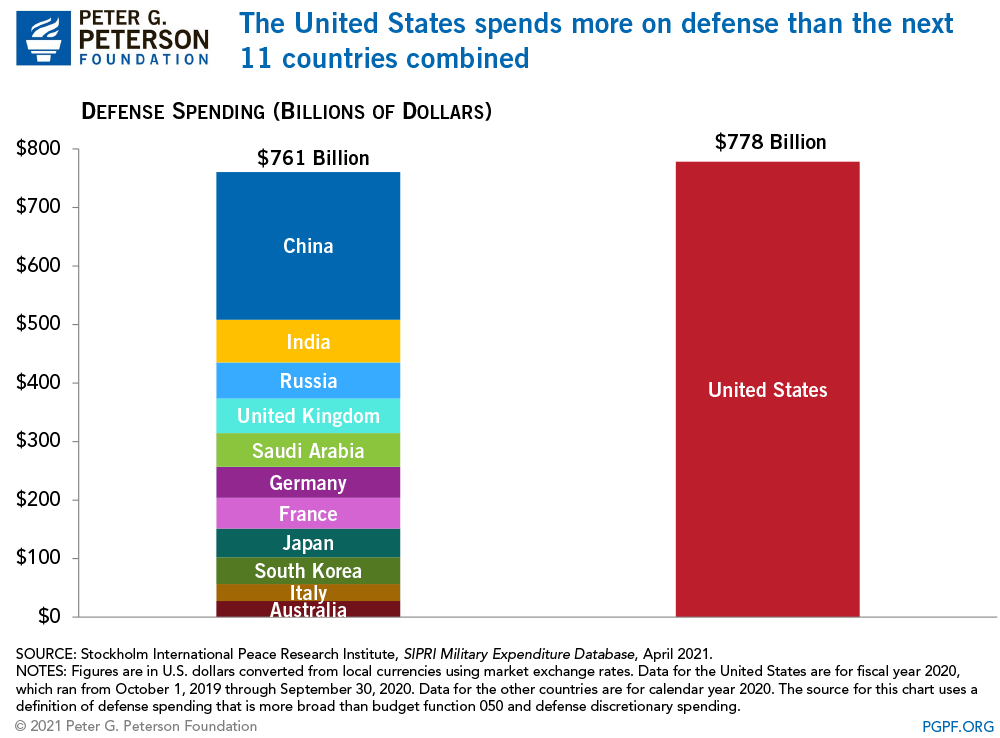
Most serious of all, there’s the problem of U.S. weapons feeding conflicts in ways the Pentagon didn’t foresee, but probably should have.
Compared to the $900 for Pentagon contractors, the average taxpayer contributed only about $27 to the Centers for Disease Control and Prevention, $171 to K-12 education, and barely $5 to renewable energy.
Average US Taxpayer Gave $900 to Military Contractors Last Year, https://truthout.org/articles/average-us-taxpayer-gave-900-to-military-contractors-last-year/?eType=EmailBlastContent&eId=1f951de0-ce82-4df9-b85e-0a76f6faf974
Lindsay Koshgarian, OtherWordsPUBLISHEDApril 17, 2022
ost of us want our tax dollars to be wisely used — especially around tax time.
You’ve probably heard a lot about corporations not paying taxes. Last year, individuals like you contributed six times more in income tax than corporations did.
But have you heard about how many of your tax dollars then end up in corporate pockets? It’s a lot — especially for corporations that contract with the Pentagon. They collect nearly half of all military spending.
The average taxpayer contributed about $2,000 to the military last year, according to a breakdown my colleagues and I prepared for the Institute for Policy Studies. More than $900 of that went to corporate military contractors.
In 2020, the largest Pentagon contractor, Lockheed Martin, took in $75 billion from taxpayers — and paid its CEO more than $23 million.
Unfortunately, this spending isn’t buying us a more secure world.
Last year, Congress added $25 billion the Pentagon didn’t ask for to its already gargantuan budget. Lawmakers even refused to let military leaders retire weapons systems they couldn’t use anymore. The extra money favored top military contractors that gave campaign money to a group of lawmakers, who refused to comment on it.
Then there’s simple price-gouging.
There’s the infamous case of TransDigm, a Pentagon contractor that charged the government $4,361 for a metal pin that should’ve cost $46 — and then refused to share cost data. Congress recently asked TransDigm to repay some of its misbegotten profits, but the Pentagon hasn’t cut off its business.
Somewhere between price-gouging and incompetence lies the F-35 jet fighter, an embarrassment the late Senator John McCain, a Pentagon booster, called “a scandal and a tragedy.”
Among the most expensive weapons systems ever, the F-35 has numerous failings. It’s spontaneously caught fire at least three times — hardly the outcome you’d expect for the top Pentagon contractor’s flagship program. The Pentagon has reduced its request for new F-35s this year by about a third, but Congress may reject that too.
Most serious of all, there’s the problem of U.S. weapons feeding conflicts in ways the Pentagon didn’t foresee, but probably should have.
When U.S. ground troops left Afghanistan, they left behind a huge array of military equipment, from armored vehicles to aircraft, that could now be in Taliban hands. The U.S. also left weapons in Iraq that fell into the hands of ISIS, including guns and an anti-tank missile.
Even weapons we sold to so-called allies like Saudi Arabia have ended up going to people affiliated with groups like al Qaeda.
Military weapons also end up on city streets at home. Over the years, civilian law agencies have received guns, armored vehicles, and even grenade launchers from the military, turning local police into near-military organizations.
Records also show that the Pentagon has lost hundreds of weapons which may have been stolen, including grenade launchers and rocket launchers. Some of these weapons have been used in crimes.
Taxpayers shouldn’t be spending $900 apiece for these outcomes. My team at the Institute for Policy Studies and others have demonstrated ways to cut up to $350 billion per year from the Pentagon budget, including what we spend on weapons contractors, without compromising our safety.
Even better, we could then put some of that money elsewhere.
Compared to the $900 for Pentagon contractors, the average taxpayer contributed only about $27 to the Centers for Disease Control and Prevention, $171 to K-12 education, and barely $5 to renewable energy.
How much more could we get if we invested even a fraction of what we spend on military contractors for these dire needs?
Compared to the $900 for Pentagon contractors, the average taxpayer contributed only about $27 to the Centers for Disease Control and Prevention, $171 to K-12 education, and barely $5 to renewable energy.
How much more could we get if we invested even a fraction of what we spend on military contractors for these dire needs?
Most Americans support shifting Pentagon funds to pay for domestic needs. Instead of making Americans fork over another $900 to corporate military contractors this year, Congress should put our dollars to better use.
Zelensky gives his vision of peace deal with Russia
Had ‘the collective West’ not interfered, this ‘war’ might have ended weeks ago, lives saved, deals signed. But that is not how the utilization of a patsy works.
https://www.sott.net/article/466833-Zelensky-gives-his-vision-of-peace-deal-with-Russia 17 Apr 22,
RT A peace agreement with Russia might consist of two separate documents that would cover the two key issues – security guarantees for Kiev and its future relations with Moscow, Ukrainian President Volodymyr Zelensky said on Saturday.
Speaking to Ukrainian media, Zelensky explained that Moscow would like to have one comprehensive document that would address all the issues. However, because the security guarantees involve other countries, two documents could be a solution. According to the Ukrainian leader:
“A peace treaty with Russia can consist of two different documents. One of them should concern security guarantees for Ukraine, the other to directly address its relations with the Russian Federation.”
He explained that a document covering security guarantees could be signed by those countries “who are ready for these security guarantees,” while another document could cover future relations between Ukraine and Russia.
Zelensky claimed that the UK, US, Italy and Turkey have shown a willingness to provide security guarantees for Ukraine, but there has been no final answer from any of them. A previous list of potential guarantors also included Germany, France, Poland and Israel. Zelensky continued:
“Moscow would like to have one agreement that addresses all the issues. However, not all see themselves at the same table with Russia. For them, security guarantees for Ukraine are one issue, and agreements with Russia are another.”
Despite the apparent progress achieved in the negotiations between Moscow and Kiev in Istanbul in late March, earlier this week Russian President Vladimir Putin said that the peace talks had “returned to a deadlock.” He explained that Ukraine has refused to fulfill one of Russia’s key requests: to recognize Crimea as Russian and the Donbass republics as independent.
Putin’s remarks followed an announcement by Foreign Minister Sergey Lavrov that Kiev had submitted new written proposals that deviated from what was offered during the in-person talks. The new proposal, according to Lavrov, fails to mention that the security guarantees Kiev wants to obtain do not cover Crimea.
Obtaining security guarantees from world powers has been named by Kiev as a key condition for agreeing to a neutral status and abandoning its ambition to join NATO.
Russia attacked the neighboring state in late February, following Ukraine’s failure to implement the terms of the Minsk agreements, first signed in 2014, and Moscow’s eventual recognition of the Donbass republics of Donetsk and Lugansk. The German and French brokered protocols were designed to give the breakaway regions special status within the Ukrainian state.
The Kremlin has since demanded that Ukraine officially declare itself a neutral country that will never join the US-led NATO military bloc. Kiev insists the Russian offensive was completely unprovoked and has denied claims it was planning to retake the two republics by force.
Moscow has warned Western countries against “pumping up” Ukraine with weapons, saying that these actions were exacerbating the conflict.
Comment: The potential ‘two-part’ agreements indicate Ukraine is incidental in this power play, otherwise the forces d’jour would accept a deal between Russia and Ukraine and step aside.
Meanwhile, conflict threatens to break off talks:
Ukrainian President Volodymyr Zelenskiy has threatened to break off talks with Moscow should Russian forces wipe out the remaining Ukrainian soldiers trapped in Mariupol as Moscow claimed it had taken control of the besieged and battered port city after a weeks-long battle.
The Russian Defense Ministry on April 16 said it had cleared the Mariupol urban area of Ukrainian troops and had trapped a few remaining fighters in the Azovstal steel plant.
A Russian Defense Ministry spokesman was quoted by Russia’s RIA Novosti news agency as saying that Ukrainian forces have lost a total of 4,000 troops during the long fight for the city. Casualty figures from both sides have proved impossible to independently confirm.
Ukraine has not commented on the latest Russian claims but in recent days has indicated the situation in Mariupol was desperate, with deaths mounting among the trapped civilian population and many experts predicting the city would soon fall to the Russians.
In an interview published earlier on April 16 with Ukrayinska Pravda, Zelenskiy warned Russia against committing atrocities against Ukrainian soldiers in the city.
“The elimination of our troops, of our men [in Mariupol] will put an end to any negotiations. That will bring an impasse as we don’t negotiate on either our territories or our people. The situation is very difficult [in Mariupol]. Our soldiers are blocked, the wounded are blocked. There is a humanitarian crisis…. Nevertheless, the guys are defending themselves.”
Kyiv Mayor Vitaliy Klitschko said at least one person was killed and several others wounded in early morning attacks.
“For those Kyivites who left and are already thinking of heading back to return to the capital, I ask you to refrain from this and stay in safer places.”
In his nightly address to the nation, Zelenskiy said:
“The success of our military on the battlefield has been really significant. Historically significant. But it’s still not enough to clear our land from the invading forces. The sanctions against Russia are very serious, economically painful. But it is not enough to starve Russia’s military machine. We need to promote stronger, more destructive sanctions. This will determine how long this war will last.”
Meanwhile, the United States and its Western allies continued to pile pressure on Moscow over its campaign. The German government said on April 15 that it plans to release more than 1 billion euros in military aid for Ukraine. The move comes amid criticism from Ukraine and some EU partners such as Poland and the Baltic states that Germany has not done enough to send armaments to Kyiv.
The UN refugee agency said as of April 16 that 4,836,445 million Ukrainians had left the country since the Russian invasion — up by 40,200 from the previous day’s total.
Had ‘the collective West’ not interfered, this ‘war’ might have ended weeks ago, lives saved, deals signed. But that is not how the utilization of a patsy works.
Recent history sheds light on the Ukraine situation . Part Three- Denazification
Retired Swiss Military-Intelligence Officer. Is it possible to actually know what has been and is going on in Ukraine?
Jacques Baud, The Unz Review 02 Apr 2022
”………………………………………………………………….. Denazification

In cities like Kharkov, Mariupol and Odessa, the Ukrainian defense is provided by the paramilitary militias. They know that the objective of “denazification” is aimed primarily at them. For an attacker in an urbanized area, civilians are a problem. This is why Russia is seeking to create humanitarian corridors to empty cities of civilians and leave only the militias, to fight them more easily.
Conversely, these militias seek to keep civilians in the cities from evacuating in order to dissuade the Russian army from fighting there. This is why they are reluctant to implement these corridors and do everything to ensure that Russian efforts are unsuccessful — they use the civilian population as “human shields.” Videos showing civilians trying to leave Mariupol and beaten up by fighters of the Azov regiment are of course carefully censored by the Western media.
On Facebook, the Azov group was considered in the same category as the Islamic State [ISIS] and subject to the platform’s “policy on dangerous individuals and organizations.” It was therefore forbidden to glorify its activities, and “posts” that were favorable to it were systematically banned. But on February 24, Facebook changed its policy and allowed posts favorable to the militia. In the same spirit, in March, the platform authorized, in the former Eastern countries, calls for the murder of Russian soldiers and leaders. So much for the values that inspire our leaders.
Our media propagate a romantic image of popular resistance by the Ukrainian people. It is this image that led the European Union to finance the distribution of arms to the civilian population. In my capacity as head of peacekeeping at the UN, I worked on the issue of civilian protection. We found that violence against civilians occurred in very specific contexts. In particular, when weapons are abundant and there are no command structures.
These command structures are the essence of armies: their function is to channel the use of force towards an objective. By arming citizens in a haphazard manner, as is currently the case, the EU is turning them into combatants, with the consequential effect of making them potential targets. Moreover, without command, without operational goals, the distribution of arms leads inevitably to settling of scores, banditry and actions that are more deadly than effective. War becomes a matter of emotions. Force becomes violence. This is what happened in Tawarga (Libya) from 11 to 13 August 2011, where 30,000 black Africans were massacred with weapons parachuted (illegally) by France. By the way, the British Royal Institute for Strategic Studies (RUSI) does not see any added value in these arms deliveries.
Moreover, by delivering arms to a country at war, one exposes oneself to being considered a belligerent. The Russian strikes of March 13, 2022, against the Mykolayev air base follow Russian warnings that arms shipments would be treated as hostile targets.
The EU is repeating the disastrous experience of the Third Reich in the final hours of the Battle of Berlin.War must be left to the military and when one side has lost, it must be admitted. And if there is to be resistance, it must be led and structured. But we are doing exactly the opposite — we are pushing citizens to go and fight, and at the same time, Facebook authorizes calls for the murder of Russian soldiers and leaders. So much for the values that inspire us.
Some intelligence services see this irresponsible decision as a way to use the Ukrainian population as cannon fodder to fight Vladimir Putin’s Russia. It would have been better to engage in negotiations and thus obtain guarantees for the civilian population than to add fuel to the fire. It is easy to be combative with the blood of others.
4. The Maternity Hospital At Mariupol
It is important to understand beforehand that it is not the Ukrainian army that is defending Mariupol, but the Azov militia, composed of foreign mercenaries.
In its March 7, 2022 summary of the situation, the Russian UN mission in New York stated that “Residents report that Ukrainian armed forces expelled staff from the Mariupol city birth hospital No. 1 and set up a firing post inside the facility.” On March 8, the independent Russian media Lenta.ru, publishedthe testimony of civilians from Mariupol who told that the maternity hospital was taken over by the militia of the Azov regiment, and who drove out the civilian occupants by threatening them with their weapons. They confirmed the statements of the Russian ambassador a few hours earlier.
The hospital in Mariupol occupies a dominant position, perfectly suited for the installation of anti-tank weapons and for observation. On 9 March, Russian forces struck the building. According to CNN, 17 people were wounded, but the images do not show any casualties in the building and there is no evidence that the victims mentioned are related to this strike. There is talk of children, but in reality, there is nothing. This does not prevent the leaders of the EU from seeing this as a war crime. And this allows Zelensky to call for a no-fly zone over Ukraine.
In reality, we do not know exactly what happened. But the sequence of events tends to confirm that Russian forces struck a position of the Azov regiment and that the maternity ward was then free of civilians.
The problem is that the paramilitary militias that defend the cities are encouraged by the international community not to respect the rules of war. It seems that the Ukrainians have replayed the scenario of the Kuwait City maternity hospital in 1990, which was totally staged by the firm Hill & Knowlton for $10.7 million in order to convince the United Nations Security Council to intervene in Iraq for Operation Desert Shield/Storm.
Western politicians have accepted civilian strikes in the Donbass for eight years without adopting any sanctions against the Ukrainian government. We have long since entered a dynamic where Western politicians have agreed to sacrifice international law towards their goal of weakening Russia………………. more https://www.sott.net/article/466340-Retired-Swiss-Military-Intelligence-Officer-Is-it-Possible-to-Actually-Know-What-Has-Been-And-is-Going-on-in-Ukraine
Recent history sheds light on the Ukraine situation . Part Two Outbreak of war.
Retired Swiss Military-Intelligence Officer. Is it possible to actually know what has been and is going on in Ukraine?
Jacques Baud, The Unz Review, 04 Apr 2022
Part Two: The War
As a former head of analysis of Warsaw Pact forces in the Swiss strategic intelligence service, I observe with sadness — but not astonishment — that our services are no longer able to understand the military situation in Ukraine. The self-proclaimed “experts” who parade on our TV screens tirelessly relay the same information modulated by the claim that Russia — and Vladimir Putin — is irrational. Let’s take a step back.
1. The Outbreak Of War
Since November 2021, the Americans have been constantly threatening a Russian invasion of Ukraine. However, the Ukrainians at first did not seem to agree. Why not?
We have to go back to March 24, 2021. On that day, Volodymyr Zelensky issued a decree for the recapture of the Crimea, and began to deploy his forces to the south of the country. At the same time, several NATO exercises were conducted between the Black Sea and the Baltic Sea, accompanied by a significant increase in reconnaissance flights along the Russian border. Russia then conducted several exercises to test the operational readiness of its troops and to show that it was following the evolution of the situation.
Things calmed down until October-November with the end of the ZAPAD 21 exercises, whose troop movements were interpreted as a reinforcement for an offensive against Ukraine. However, even the Ukrainian authorities refuted the idea of Russian preparations for a war, and Oleksiy Reznikov, Ukrainian Minister of Defense, states that there had been no change on its border since the spring.
In violation of the Minsk Agreements, Ukraine was conducting air operations in Donbass using drones, including at least one strike against a fuel depot in Donetsk in October 2021. The American press noted this, but not the Europeans; and no one condemned these violations.
In February 2022, events came to a head. On February 7, during his visit to Moscow, Emmanuel Macron reaffirmed to Vladimir Putin his commitment to the Minsk Agreements, a commitment he would repeat after his meeting with Volodymyr Zelensky the next day. But on February 11, in Berlin, after nine hours of work, the meeting of political advisors to the leaders of the “Normandy format” ended without any concrete result: the Ukrainians still refused to apply the Minsk Agreements, apparently under pressure from the United States. Vladimir Putin noted that Macron had made empty promises and that the West was not ready to enforce the agreements, the same opposition to a settlement it had exhibited for eight years.
Ukrainian preparations in the contact zone continued. The Russian Parliament became alarmed; and on February 15 it asked Vladimir Putin to recognize the independence of the Republics, which he initially refused to do.
On 17 February, President Joe Biden announced that Russia would attack Ukraine in the next few days. How did he know this? It is a mystery. But since the 16th, the artillery shelling of the population of Donbass had increased dramatically, as the daily reports of the OSCE observers show. Naturally, neither the media, nor the European Union, nor NATO, nor any Western government reacted or intervened. It would be said later that this was Russian disinformation. In fact, it seems that the European Union and some countries have deliberately kept silent about the massacre of the Donbass population, knowing that this would provoke a Russian intervention.
At the same time, there were reports of sabotage in the Donbass. On 18 January, Donbass fighters intercepted saboteurs, who spoke Polish and were equipped with Western equipment and who were seeking to create chemical incidents in Gorlivka. They could have been CIA mercenaries, led or “advised” by Americans and composed of Ukrainian or European fighters, to carry out sabotage actions in the Donbass Republics.
In fact, as early as February 16, Joe Biden knew that the Ukrainians had begun intense shelling the civilian population of Donbass, forcing Vladimir Putin to make a difficult choice: to help Donbass militarily and create an international problem, or to stand by and watch the Russian-speaking people of Donbass being crushed.
If he decided to intervene, Putin could invoke the international obligation of “Responsibility To Protect” (R2P). But he knew that whatever its nature or scale, the intervention would trigger a storm of sanctions. Therefore, whether Russian intervention were limited to the Donbass or went further to put pressure on the West over the status of the Ukraine, the price to pay would be the same. This is what he explained in his speech on February 21. On that day, he agreed to the request of the Duma and recognized the independence of the two Donbass Republics and, at the same time, he signed friendship and assistance treaties with them.
The Ukrainian artillery bombardment of the Donbass population continued, and, on 23 February, the two Republics asked for military assistance from Russia. On 24 February, Vladimir Putin invoked Article 51 of the United Nations Charter, which provides for mutual military assistance in the framework of a defensive alliance.
In order to make the Russian intervention seem totally illegal in the eyes of the public, Western powers deliberately hid the fact that the war actually started on February 16. The Ukrainian army was preparing to attack the Donbass as early as 2021, as some Russian and European intelligence services were well aware.
In his speech of February 24, Vladimir Putin stated the two objectives of his operation: “demilitarize” and “denazify” the Ukraine. So, it was not a question of taking over Ukraine, nor even, presumably, of occupying it; and certainly not of destroying it.
From then on, our knowledge of the course of the operation is limited: the Russians have excellent security for their operations (OPSEC) and the details of their planning are not known. But fairly quickly, the course of the operation allows us to understand how the strategic objectives were translated on the operational level.
Demilitarization:
- ground destruction of Ukrainian aviation, air defense systems and reconnaissance assets;
- neutralization of command and intelligence structures (C3I), as well as the main logistical routes in the depth of the territory;
- encirclement of the bulk of the Ukrainian army massed in the southeast of the country.
- destruction or neutralization of volunteer battalions operating in the cities of Odessa, Kharkov, and Mariupol, as well as in various facilities in the territory.
Denazification:
2. Demilitarization
The Russian offensive was carried out in a very “classic” manner. Initially — as the Israelis had done in 1967 — with the destruction on the ground of the air force in the very first hours. Then, we witnessed a simultaneous progression along several axes according to the principle of “flowing water”: advance everywhere where resistance was weak and leave the cities (very demanding in terms of troops) for later. In the north, the Chernobyl power plant was occupied immediately to prevent acts of sabotage. The images of Ukrainian and Russian soldiers guarding the plant togetherare of course not shown.
The idea that Russia is trying to take over Kiev, the capital, to eliminate Zelensky, comes typically from the West. But Vladimir Putin never intended to shoot or topple Zelensky. Instead, Russia seeks to keep him in power by pushing him to negotiate, by surrounding Kiev. The Russians want to obtain the neutrality of Ukraine.
Many Western commentators were surprised that the Russians continued to seek a negotiated solution while conducting military operations. The explanation lies in the Russian strategic outlook since the Soviet era. For the West, war begins when politics ends. However, the Russian approach follows a Clausewitzian inspiration: war is the continuity of politics and one can move fluidly from one to the other, even during combat. This allows one to create pressure on the adversary and push him to negotiate.
From an operational point of view, the Russian offensive was an example of previous military action and planning: in six days, the Russians seized a territory as large as the United Kingdom, with a speed of advance greater than what the Wehrmacht had achieved in 1940.
The bulk of the Ukrainian army was deployed in the south of the country in preparation for a major operation against the Donbass. This is why Russian forces were able to encircle it from the beginning of March in the “cauldron” between Slavyansk, Kramatorsk and Severodonetsk, with a thrust from the East through Kharkov and another from the South from Crimea. Troops from the Donetsk (DPR) and Lugansk (LPR) Republics are complementing the Russian forces with a push from the East.
At this stage, Russian forces are slowly tightening the noose, but are no longer under any time pressure or schedule. Their demilitarization goal is all but achieved and the remaining Ukrainian forces no longer have an operational and strategic command structure.
The “slowdown” that our “experts” attribute to poor logistics is only the consequence of having achieved their objectives. Russia does not want to engage in an occupation of the entire Ukrainian territory. In fact, it appears that Russia is trying to limit its advance to the linguistic border of the country…………………………… more https://www.sott.net/article/466340-Retired-Swiss-Military-Intelligence-Officer-Is-it-Possible-to-Actually-Know-What-Has-Been-And-is-Going-on-in-Ukraine
Recent history sheds light on the Ukraine situation . Part One
Retired Swiss Military-Intelligence Officer. Is it possible to actually know what has been and is going on in Ukraine?
The integration of these paramilitary forces into the Ukrainian National Guard was not at all accompanied by a “denazification,” as some claim.
Among the many examples, that of the Azov Regiment’s insignia is instructive.
Jacques Baud
The Unz Review 02 Apr 2022 I Just recently I came across perhaps the clearest and most reasonable account of what has been going on in Ukraine. Its importance comes due to the fact that its author, Jacques Baud, a retired colonel in the Swiss intelligence service, was variously a highly placed, major participant in NATO training operations in Ukraine. Over the years, he also had extensive dealings with his Russian counterparts. His long essay first appeared (in French) at the respected Centre Français de Recherche sur le Renseignement. A literal translation appeared at The Postil (April 1, 2022). I have gone back to the original French and edited the article down some and rendered it, I hope, in more idiomatic English. I do not think in editing it I have damaged Baud’s fascinating account. For in a real sense, what he has done is “to let the cat out of the bag.” — Boyd D. Cathay
Part One: The Road To War
For years, from Mali to Afghanistan, I have worked for peace and risked my life for it. It is therefore not a question of justifying war, but of understanding what led us to it.
Let’s try to examine the roots of the Ukrainian conflict. It starts with those who for the last eight years have been talking about “separatists” or “independentists” from Donbass. This is a misnomer. The referendums conducted by the two self-proclaimed Republics of Donetsk and Lugansk in May 2014, were not referendums of “independence” (независимость), as some unscrupulous journalists have claimed, but referendums of “self-determination” or “autonomy” (самостоятельность). The qualifier “pro-Russian” suggests that Russia was a party to the conflict, which was not the case, and the term “Russian speakers” would have been more honest. Moreover, these referendums were conducted against the advice of Vladimir Putin.
In fact, these Republics were not seeking to separate from Ukraine, but to have a status of autonomy, guaranteeing them the use of the Russian language as an official language — because the first legislative act of the new government resulting from the American-sponsored overthrow of [the democratically-elected] President Yanukovych, was the abolition, on February 23, 2014, of the Kivalov-Kolesnichenko law of 2012 that made Russian an official language in Ukraine. A bit like if German putschists decided that French and Italian would no longer be official languages in Switzerland.
This decision caused a storm in the Russian-speaking population. The result was fierce repression against the Russian-speaking regions (Odessa, Dnepropetrovsk, Kharkov, Lugansk and Donetsk) which was carried out beginning in February 2014 and led to a militarization of the situation and some horrific massacres of the Russian population (in Odessa and Mariupol, the most notable).
At this stage, too rigid and engrossed in a doctrinaire approach to operations, the Ukrainian general staff subdued the enemy but without managing to actually prevail. The war waged by the autonomists consisted in highly mobile operations conducted with light means. With a more flexible and less doctrinaire approach, the rebels were able to exploit the inertia of Ukrainian forces to repeatedly “trap” them.
In 2014, when I was at NATO, I was responsible for the fight against the proliferation of small arms, and we were trying to detect Russian arms deliveries to the rebels, to see if Moscow was involved. The information we received then came almost entirely from Polish intelligence services and did not “fit” with the information coming from the OSCE [Organization for Security and Co-operation in Europe] — and despite rather crude allegations, there were no deliveries of weapons and military equipment from Russia.
The rebels were armed thanks to the defection of Russian-speaking Ukrainian units that went over to the rebel side. As Ukrainian failures continued, tank, artillery and anti-aircraft battalions swelled the ranks of the autonomists. This is what pushed the Ukrainians to commit to the Minsk Agreements.
But just after signing the Minsk 1 Agreements, the Ukrainian President Petro Poroshenko launched a massive “anti-terrorist operation” (ATO/Антитерористична операція) against the Donbass. Poorly advised by NATO officers, the Ukrainians suffered a crushing defeat in Debaltsevo, which forced them to engage in the Minsk 2 Agreements.
It is essential to recall here that Minsk 1 (September 2014) and Minsk 2 (February 2015) Agreements did not provide for the separation or independence of the Republics, but their autonomy within the framework of Ukraine. Those who have read the Agreements (there are very few who actually have) will note that it is written that the status of the Republics was to be negotiated between Kiev and the representatives of the Republics, for an internal solution within Ukraine.
That is why, since 2014, Russia has systematically demanded the implementation of the Minsk Agreements while refusing to be a party to the negotiations, because it was an internal matter of Ukraine. On the other side, the West — led by France — systematically tried to replace Minsk Agreements with the “Normandy format,” which put Russians and Ukrainians face-to-face. However, let us remember that there were never any Russian troops in the Donbass before 23-24 February 2022. Moreover, OSCE observers have never observed the slightest trace of Russian units operating in the Donbass before then. For example, the U.S. intelligence map published by the Washington Post on December 3, 2021 does not show Russian troops in the Donbass.
n October 2015, Vasyl Hrytsak, director of the Ukrainian Security Service (SBU), confessed that only 56 Russian fighters had been observed in the Donbass. This was exactly comparable to the Swiss who went to fight in Bosnia on weekends, in the 1990s, or the French who go to fight in Ukraine today.
The Ukrainian army was then in a deplorable state. In October 2018, after four years of war, the chief Ukrainian military prosecutor, Anatoly Matios, stated that Ukraine had lost 2,700 men in the Donbass: 891 from illnesses, 318 from road accidents, 177 from other accidents, 175 from poisonings (alcohol, drugs), 172 from careless handling of weapons, 101 from breaches of security regulations, 228 from murders and 615 from suicides.
In fact, the Ukrainian army was undermined by the corruption of its cadres and no longer enjoyed the support of the population. According to a British Home Office report, in the March/April 2014 recall of reservists, 70 percent did not show up for the first session, 80 percent for the second, 90 percent for the third, and 95 percent for the fourth. In October/November 2017, 70% of conscripts did not show up for the “Fall 2017” recall campaign. This is not counting suicides and desertions (often over to the autonomists), which reached up to 30 percent of the workforce in the ATO area. Young Ukrainians refused to go and fight in the Donbass and preferred emigration, which also explains, at least partially, the demographic deficit of the country.
The Ukrainian Ministry of Defense then turned to NATO to help make its armed forces more “attractive.” Having already worked on similar projects within the framework of the United Nations, I was asked by NATO to participate in a program to restore the image of the Ukrainian armed forces. But this is a long-term process and the Ukrainians wanted to move quickly.
So, to compensate for the lack of soldiers, the Ukrainian government resorted to paramilitary militias. In 2020, they constituted about 40 percent of the Ukrainian forces and numbered about 102,000 men, according to Reuters. They were armed, financed and trained by the United States, Great Britain, Canada and France. There were more than 19 nationalities.
These militias had been operating in the Donbass since 2014, with Western support. Even if one can argue about the term “Nazi,” the fact remains that these militias are violent, convey a nauseating ideology and are virulently anti-Semitic…[and] are composed of fanatical and brutal individuals. The best known of these is the Azov Regiment, whose emblem is reminiscent of the 2nd SS Das Reich Panzer Division, which is revered in the Ukraine for liberating Kharkov from the Soviets in 1943, before carrying out the 1944 Oradour-sur-Glane massacre in France.
The characterization of the Ukrainian paramilitaries as “Nazis” or “neo-Nazis” is considered Russian propaganda. But that’s not the view of the Times of Israel, or the West Point Academy’s Center for Counterterrorism. In 2014, Newsweek magazine seemed to associate them more with… the Islamic State. Take your pick!
So, the West supported and continued to arm militias that have been guilty of numerous crimes against civilian populations since 2014: rape, torture and massacres…
The integration of these paramilitary forces into the Ukrainian National Guard was not at all accompanied by a “denazification,” as some claim.
Among the many examples, that of the Azov Regiment’s insignia is instructive: see above
In 2022, very schematically, the Ukrainian armed forces fighting the Russian offensive were organized as:
- The Army, subordinated to the Ministry of Defense. It is organized into 3 army corps and composed of maneuver formations (tanks, heavy artillery, missiles, etc.).
- The National Guard, which depends on the Ministry of the Interior and is organized into 5 territorial commands.
The National Guard is therefore a territorial defense force that is not part of the Ukrainian army. It includes paramilitary militias, called “volunteer battalions” (добровольчі батальйоні), also known by the evocative name of “reprisal battalions,” and composed of infantry. Primarily trained for urban combat, they now defend cities such as Kharkov, Mariupol, Odessa, Kiev, etc……. more https://www.sott.net/article/466340-Retired-Swiss-Military-Intelligence-Officer-Is-it-Possible-to-Actually-Know-What-Has-Been-And-is-Going-on-in-Ukraine
Dr Richard Dixon: Scottish and UK governments are on a collision course over nuclear energy and oil.
The UK Government’s new energy strategy
makes no sense at all and puts Westminster on collision course with
Holyrood. In early March, Boris Johnson said he would produce, as a matter
of urgency, a plan to respond to the twin challenges of war in Ukraine and
the cost-of-living crisis.
Four weeks later, we finally have the British
Energy Security Strategy and it does pretty much the opposite of what’s
needed. Supposedly this is because the PM and Chancellor could not agree on
key measures. The result is a strategy that convinces no-one. Even the
right-wing press have roundly lambasted it.
The first thing you are taught
in any class about energy is that using less is much better than producing
it differently. Yet, there is nothing at all in the strategy on the
quickest, cheapest and most obvious way to save energy and reduce bills –
improving the energy efficiency of people’s homes.
The last thing youwould do if you want to change our energy system quickly and at an
affordable cost is invest in new nuclear reactors, yet that is exactly what
the government plans to do, egged on by Labour’s new enthusiasm.
The cover of the strategy shows the construction site at Hinkley Point C,
originally proposed in the mid-1980s, subject of a two-and-a-half year
public inquiry and with construction now running ten years late and many
times over budget. The world’s most expensive power plant is perhaps not
the cleverest example to use.
The plan suggests eight new nuclear reactors.
In 2010, the Conservative-Lib Dem coalition government planned to build
eight new reactors in the next decade … 12 years later the two reactors
at Hinkley are the only ones actually under construction and they might
possibly producing electricity in 2027 with a price tag of £23 billion.
There will be a new round of applications for oil and gas production in the
autumn, given a green gloss by the complete con that is the Climate
Compatibility Checklist. The Cambo oilfield might be back on the table. The
government says it is reviewing the science on fracking, and Ineos has
already kindly offered to start drilling.
The Scottish Government is due to
publish a set of energy scenarios before the summer and a draft Energy
Strategy in the autumn. There will be plenty of energy efficiency and
renewables but no new nuclear and no fracking. Apart from offshore wind,
the UK and Scottish plans on energy are pretty much the opposite of each
other. Sparks will fly.
Scotsman 14th April 2022
1 This Month
23-25 October – on Zoom – World BEYOND War’s annual global conferenc


Shut down the radiation-damaged Heysham nuclear reactors now
To see nuclear-related stories in greater depth and intensity – go to https://nuclearinformation.wordpress.com

Say No to NASA’s Reckless Nuclear Reactor on the Moon
Say No to NASA’s Reckless Nuclear Reactor on the Moon

-
Archives
- October 2026 (199)
- September 2026 (339)
- August 2026 (330)
- July 2026 (355)
- June 2026 (287)
- May 2026 (306)
- April 2026 (356)
- March 2026 (251)
- February 2026 (267)
- January 2026 (308)
- December 2025 (358)
- November 2025 (359)
-
Categories
- 1
- 1 NUCLEAR ISSUES
- business and costs
- climate change
- culture and arts
- ENERGY
- environment
- health
- history
- indigenous issues
- Legal
- marketing of nuclear
- media
- opposition to nuclear
- PERSONAL STORIES
- politics
- politics international
- Religion and ethics
- safety
- secrets,lies and civil liberties
- spinbuster
- technology
- Uranium
- wastes
- weapons and war
- Women
- 2 WORLD
- ACTION
- AFRICA
- Atrocities
- AUSTRALIA
- Christina's notes
- Christina's themes
- culture and arts
- Events
- Fuk 2022
- Fuk 2023
- Fukushima 2017
- Fukushima 2018
- fukushima 2019
- Fukushima 2020
- Fukushima 2021
- general
- global warming
- Humour (God we need it)
- Nuclear
- RARE EARTHS
- Reference
- resources – print
- Resources -audiovicual
- Weekly Newsletter
- World
- World Nuclear
- YouTube
-
RSS
Entries RSS
Comments RSS


