Macron ‘panicking’ as France faces ‘catastrophic’ nuclear energy crisis, expert claims

France is in a catastrophic situation in terms of the vast debt that it owes in nuclear and the existential waste and decommissioning problem that it is facing
A record number of France’s 56 nuclear reactors have gone offline, sparking serious concerns over energy security across the Channel.
https://www.express.co.uk/news/science/1713491/macron-france-nuclear-energy-edf-crisis By JACOB PAUL, Dec 23, 2022, French President Emmanuel Macron is said to be in a “panic” as the issues with France’s ageing nuclear reactors have laid bare the flaws in the country’s energy plans, an expert has told Express.co.uk. Sixteen out France’s 56 nuclear reactors are currently offline due to corrosion and maintenance issues, sending its normal power output levels plummeting in recent months. Prior to these problems, France’s nuclear fleet generated 70 percent of the country’s electricity.
According to Dr Paul Dorfman, a nuclear expert from the University of Sussex, France’s “chickens are coming home to roost” as the decision to rely so heavily on nuclear is appearing to backfire, with further delays to repairs also announced this week.
He said: “France was nuclear power excellence, post-war all buffed up with power – it said it was going to be the top dogs. So it had a vast quantity of nuclear reactors dotted all around France. But what is happening now is that its chickens are coming home to roost.
“EDF (owned by the French state) is 43billion euros in debt, it faces a 100billion euro bill for mandatory safety upgrades, and a significant number of its reactors continue to be offline due to ageing corrosion problems. It also faces a huge decommissioning and waste management bill that is uncosted – they are just beginning to say ‘oh my god’.
“Around a quarter of their reactors are still offline at winter when they really need it. They are even importing power from Germany after being a net exporter. France is panicking about what to do about renewables and insulation.”
But all this could be of concern for Britain, which does rely on some French imports that are sent across the Channel via interconnectors. National Grid has previously warned that if the UK fails to shore up enough energy imports from Europe this winter, it may have to roll out organised blackouts in the “deepest, darkest” nights of the coldest months of the year.
However, while France’s nuclear power issues have sparked concern, Dr Dorfman said the UK is luckier than France in that it is one of the leading players in offshore wind, which could provide a vital lifeline this winter.
He said: “The UK has seriously thought about renewables in the last few years, without any question. But there have been problems with onshore wind and legislation issues. There also problems with the legislation for solar, but offshore wind has helped enormously. But the UK hasn’t really considered about the lowest hanging through which is energy efficiency and insulation.”
When asked whether the UK is lucky that it has not copied the French model, Dr Dorfman responded: “We are hugely lucky. France is in a catastrophic situation in terms of the vast debt that it owes in nuclear and the existential waste and decommissioning problem that it is facing…The UK is certainly in a better position in terms of offshore windpower, but it needs to get its act together in terms of allowing much greater onshore wind and much greater solar…and all the things that make up a balanced energy portfolio.
“France is not going to change, the reactors are not going to get any younger. Rumour has it, the corrosion issues have been known about for years. Because it takes so long to build reactors, you can’t expect new builds to happen within a decade or two decades.
“Nobody knows what is going to happen with Russia. All we know amongst all this mess is that renewables cost between a quarter and a fifth less than nuclear and that the vast majority of all new power additions worldwide is renewables.”
This comes as analysis by leading renewable energy trade bodies revealed that low carbon power reportedly met more than half of the UK’s electricity needs over the past two months. Renewable UK, the Nuclear Industry Association found that between the end of October and December 18, clean energy sources like wind and solar provided 40 percent of the country’s electricity, while nuclear power plants accounted for 14 percent of demand.
The power that came from both offshore and onshore wind turbines alone generated more than half of Britain’s low carbon power output over the period, while nuclear supplied 27 percent.
Canada’s Federal environment minister rejects impact assessment for small modular nuclear reactor on the Bay of Fundy.
Coalition for Responsible Energy Development in New Brunswick (CRED-NB), December 23, 2022
SAINT JOHN, NEW BRUNSWICK – In a deeply disappointing decision for the environment and public oversight, Steven Guilbeault, federal Minister of Environment and Climate Change, has ruled against a full federal Impact Assessment (IA) for a small modular nuclear reactor (SMR) proposed by New Brunswick Power at Point Lepreau in New Brunswick.
This decision comes in response to a request submitted by the Coalition for Responsible Energy Development in New Brunswick (CRED-NB) on July 4, 2022, calling for an IA for this first-of-its-kind nuclear project in Canada. Letters of support for CRED-NB’s request were submitted by the Wolastoq Grand Council, and Indigenous organizations representing the Peskotomuhkati Nation and the Mi’gmaq First Nations in New Brunswick and over 300 public interest groups and individuals.
In rejecting the need for an IA for the proposed SMR project, the Minister found it would be “unwarranted” as the concerns raised by Indigenous peoples and members of the public would be considered as part of the licensing process by the nuclear regulator and within New Brunswick’s Clean Environment Act.
“The Minister’s choice not to designate the SMR for an assessment goes against their commitments to sound, science-based decision-making and public participation,” noted Ann McAllister of CRED-NB, reacting to the news of the Minister’s decision. “This lack of a precautionary approach is especially dismaying given that sodium-cooled nuclear technology – of which this SMR is one – has a known history of accidents and has never been successfully commercialized, despite repeated attempts over the decades.”
“The mechanism we had to uphold environmental justice has been denied,” reacted Kerrie Blaise, an environmental lawyer who assisted CRED-NB with the IA request. “The many unknowns and the potential for not only severe but irreversible impacts to the health of communities and the environment will not be subject to a rigorous public and cumulative effects assessment that an IA provides. This is quite simply something that cannot be achieved by the nuclear regulator in their license-specific assessment.”
“By refusing an IA for the SMR project at Point Lepreau, the Minister suggested the concerns about the project raised by CRED-NB would be dealt with by a provincial Environmental Impact Assessment,” said Dr. Susan O’Donnell,Adjunct Professor at the University of New Brunswick and St. Thomas University, and CRED-NB member. “The provincial process is not as comprehensive as the federal IA. However in its submission, the Government of New Brunswick stated that a provincial EIA would address all the concerns raised in the CRED-NB request, and that the premier has confirmed that a provincial EIA review, including public consultation, will be required before the project can proceed. We look forward to that comprehensive provincial review in the new year.”
Pressure from the nuclear industry lobby changed federal environmental assessment law in 2019, exempting SMRs below a certain threshold from undergoing a full environmental IA. The only way for thisproject to have undergone an IA, was at the direction of the Minister. The Minister’s decision sets an unfortunate precedent, weakening our impact assessment laws and ability for broad public participation.
Dishonesty: British authorities knew it was wrong to proceed with the thermal oxide reprocessing plant (Thorp) at Sellafield.
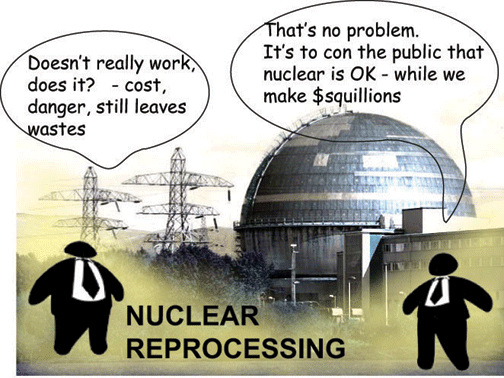
Letter William Walker: In 1993, a government official told me that “it
was sometimes right to do the wrong thing”. For reasons of political
expediency, it was right to give political consent for the operation of the
thermal oxide reprocessing plant (Thorp) at Sellafield.
This huge facility, not mentioned in Samanth Subramanian’s fine long read, had been built over
the previous decade to reprocess British and foreign, especially Japanese,
spent nuclear fuels. Abandoning it would be too embarrassing for the many
politicians and their parties that had backed it, expensive in terms of
compensation for broken contracts, and damaging to Britain’s and the
nuclear industry’s international reputation.
It was wrong to proceed, as
the government well knew, because the primary justification for its
construction – supply of plutonium for fast breeder reactors (FBRs) – had
been swept away by the abandonment of FBRs in the 1980s (none were built
anywhere).
Because returning Thorp’s separated plutonium and radwaste to
Japan would be difficult and risky.
Because decommissioning Thorp would
become much more costly after its radioactive contamination.
Because there was a known win-win solution, favoured by most utilities – store the spent
fuel safely at Sellafield prior to its return to senders, avoiding the many
troubles that lay ahead.
Guardian 22nd Dec 2022
Nuclear Free Local Authorities ‘bitterly disappointed’ government will press ahead with ‘criminal nuclear power tax’
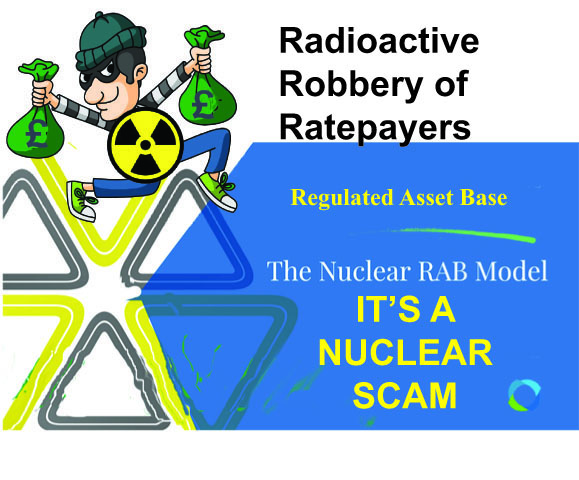
https://www.nuclearpolicy.info/news/nuclear-free-local-authorities-bitterly-disappointed-government-will-press-ahead-with-criminal-nuclear-power-tax/ 19 Dec 22, The UK/Ireland Nuclear Free Local Authorities were bitterly disappointed, but unsurprised, to hear recently British Government confirmation that it has decided to go ahead with the controversial Regulated Asset Base funding model for future nuclear power projects.
The government is proposing to use the RAB model to pay for the cost of constructing a new power plant at Sizewell C in Suffolk and for a fleet of so-called Small Modular Reactors to increase nuclear generating capacity three-fold to 24 GW by 2050 in line with the Energy Security Strategy published by Boris Johnson in April of this year.
To the NFLAs RAB should be renamed ROB as it is akin to daylight robbery. The RAB model de-risks nuclear projects for contractors and operators as, rather than requiring them to find the finance upfront, all electricity customers instead face an additional levy on their bills to meet the cost of building the new plants; all of which, based on historic precedent, will be delivered late and way over budget. The public will also have to meet the costs of any delays, which are likely to be considerable.
Responding to a consultation on the proposals launched by the Department of Business Energy and Industrial Strategy in August, the NFLA called for RAB to be scrapped and for nuclear operators to source money for new construction projects from the private sector, rather than electricity customers.
The NFLA is especially concerned at the unfairness of levying elderly customers who are unlikely to see any ‘benefit’ from the nuclear power generated, given that construction of any new plant is likely to take at least a decade, or levying poorer households, who are already at risk of fuel poverty. The NFLA called for elderly and poorer households to be exempted. The proposal is also particularly iniquitous when applied to Scottish customers, who will be taxed despite the Scottish Government refusing to countenance new nuclear plants for the nation.
The government published its response on 14 December stating that it will go ahead with the proposals, with only a vague and unsubstantiated recognition that ‘support for vulnerable groups would be best tackled holistically
Commenting on the response, NFLA Steering Committee Chair, West Dunbartonshire Councillor Lawrence O’Neill said:
“It is outrageous that British Government ministers want to press ahead with a scheme that imposes a criminal tax to pay for their nuclear delusion on the poorest, oldest and most vulnerable customers, and doubly criminal when imposed on customers living in Scotland where we as a nation certainly do not want to entertain it.
“Nuclear power projects are notorious for coming in late and way over cost, Hinkley Point C being a case in point. RAB simply takes away the risk to prospective nuclear operators of raising initial finance in the commercial lending market and finding the extra money needed to meet cost overruns and delays and transfers it onto electricity consumers who are already struggling to pay overinflated energy bills.
“The most immediate beneficiary EDF Energy will be laughing all the way to the bank as it picks up the subsidy to build Sizewell C collected from British taxpayers then pays the resulting profits from its future operations back to its owner, the French Government”.
Owner of Palisades to reapply for taxpayer funding to reopen nuclear power plant

Riley Beggin, Hannah Mackay, The Detroit News, 19 Dec 22,
Holtec International, the owner of the Palisades nuclear plant near South Haven, will reapply for federal funding in an attempt to revive the shuttered plant.
The company applied for funds through the U.S. Energy Department’s Civil Nuclear Credit Program after the plant was officially shut down in May. It announced in November it had been denied.
The $6 billion program funded by the Bipartisan Infrastructure Law aims to keep existing reactors around the country running. Applicants must demonstrate that they will be closed for economic reasons and that carbon emissions and air pollutants will rise if they are closed.
………….. Holtec acquired the plant from Entergy Nuclear last December and planned to decommission it.
The plan received scrutiny from Attorney General Dana Nessel and several environmental groups, which questioned whether the company had the finances to quickly and safely decommission the plant. The environmental groups also raised concerns it could threaten the Great Lakes if the company decided to ship nuclear waste to a storage facility out of state…………….
In the meantime, Holtec will continue decommissioning the plant, O’Brien added, with a focus on “managing the spent fuel removal from the spent fuel pool to dry cask storage.”
There would be hurdles to reopening. Palisades shut down more than a week early in May as “a conservative decision based on equipment performance,” U.S. Nuclear Regulatory Commission Public Affairs Officer Prema Chandrathil said at the time. The control rod drive mechanism had a degrading seal.
The Nuclear Regulatory Commission transferred Palisades’ license from Entergy to Holtec “for the purpose of decommissioning Palisades” on June 28, the NRC said. All fuel was removed from the reactor on June 13.
Holtec then applied in July for funding under the federal Civil Nuclear Credit Program. To qualify for credits, there must be “reasonable assurance” the reactor can be operated with its current license and pose no significant safety hazards. https://www.detroitnews.com/story/news/local/michigan/2022/12/19/palisades-nuclear-power-plant-to-reapply-for-federal-funding/69740779007/
New Delay, Cost Overrun For France’s Next-gen Nuclear Plant

https://www.barrons.com/news/new-delay-cost-overrun-for-france-s-next-gen-nuclear-plant-01671212709 By AFP – Agence France Presse, December 16, 2022
Welding problems will require a further six-month delay for France’s next-generation nuclear reactor at Flamanville, the latest setback for the flagship technology the country hopes to sell worldwide, state-owned electricity group EDF said Friday.
The delay will also add 500 million euros to a project whose total cost is now estimated at around 13 billion euros ($13.8 billion), blowing past the initial projection of 3.3 billion euros when construction began in 2007.
It comes as EDF is already struggling to restart dozens of nuclear reactors taken down for maintenance or safety work that has proved more challenging than originally thought.
EDF also said Friday that one of the two conventional reactors at Flamanville would not be brought back online until February 19 instead of next week as planned, while one at Penly in northwest Farnce would be restarted on March 20 instead of in January.
The French government has warned of potential power shortages this winter because of the shutdowns at around two-dozen of the 56 reactors across the country that normally generate around 70 percent of its electricity needs.
EDF said the latest problems at Flamanville, on the English Channel in Normandy, emerged last summer when engineers discovered that welds in cooling pipes for the new pressurised water reactor, called EPR, were not tolerating extreme heat as expected.
As a result, the new reactor will be start generating power only in mid-2024.
The French-developed European Pressurised Reactor was designed to relaunch nuclear power in Europe after the 1986 Chernobyl catastrophe in Russia, and is touted as offering more efficient power output and better safety.
But similar projects at Olkiluoto in Finland, Hinkley Point in Britain and the Taishan plant in China have also suffered production setbacks and delays, raising doubts about the viability of the new technology.
French President Emmanuel Macron said in February that he wants a nuclear “renaissance” that would see up to 14 new reactors in France as the country seeks to reduce use of fossil fuels.
Can France rely on its nuclear fleet for a low-carbon 2050?
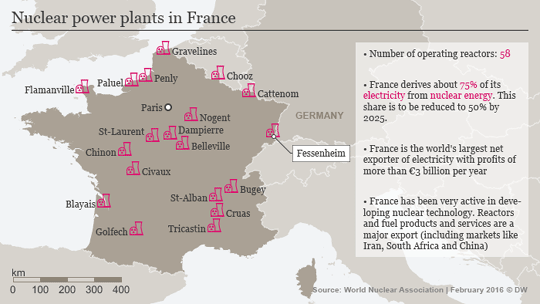
Map above refers to 2016 – many of the nuclear plants above are not currently in operation
Nuclear Engineering International, 14 Dec 22,
EDF has not shown its 900 MW units can be operated that far ahead, says ASN’s annual assessment of nuclear safety in France. Decisions have to be taken soon if nuclear is to play a big part in 2050 – and a ‘Marshall Plan’ is needed to rebuild the industry’s capability
France may have to go back to the drawing board with regard to options for decarbonising its economy, because assumptions it has made on the lifetime of the 900 MW reactors in its nuclear fleet may be unwarranted.
That was the warning in French nuclear safety authority ASN’s annual report on safety in the country’s nuclear industries.
The annual “ASN report on the state of nuclear safety and radiation protection in France in 2021”, published earlier this year, warned of “new energy policy prospects which must address safety concerns at once”. And it reminded operators that “quality and rigour in the design, manufacture and oversight of nuclear facilities, which were not up to the required level in the latest major nuclear projects conducted in France, constitute the first level of Defence in Depth in terms of safety.”
ASN noted that five of the six scenarios presented in a report by French system operator Re´seau de Transport d’Electricite´ (RTE) report on “Energies of the future”, which aims to achieve a decarbonised economy by 2050, are based on continued operation of the existing nuclear fleet. But with regard to the 900 MW fleet, ASN says, it cannot say that those plants can be operated beyond 50 years, based on information it received during the generic examination of the fourth periodic safety review of that reactor series. It added, “Due to the specific features of some reactors, it might not be possible, with the current methods, to demonstrate their ability to operate up to 60 years”.
EDF has 32 operating 900 MWe reactors commissioned between 1978 and 1987 and they are reaching their fourth periodic safety review. This safety review has “particular challenges”, ASN says. In particular:
Some items of equipment are reaching their design-basis lifetime……………………
Too optimistic on new-build?
The safety authority also noted that one RTE scenario had almost 50% nuclear in its electricity mix in 2050. It said, consultation with industry revealed that the rate of construction of new nuclear reactors in order to achieve such a level would be hard to sustain……………………………………
Broad concerns
More broadly, ASN said whatever France’s energy policy, it will “imply a considerable industrial effort, in order to tackle the industrial and safety challenges.
If nuclear power is needed for 2050, the nuclear sector will have to implement a ‘Marshall Plan’ to make it industrially sustainable and have the skills it needs.
It warned that “Quality and rigour in the design, manufacture and oversight of nuclear facilities… were not up to the required level in the latest major nuclear projects conducted in France”.
It also warned that more work was also needed in fuel chain facilities. It said a series of events “is currently weakening the entire fuel cycle chain and is a major strategic concern for ASN requiring particularly close attention”. Most urgent is a build-up of radioactive materials and delays in construction of a centralised spent fuel storage pool planned by EDF to address the risk of saturation of the existing pools by 2030. The need for the pool was identified back in 2010, but work has not begun.
ASN said the combination of shortcomings between fuel cycle and nuclear plants meant the electricity system “faces an unprecedented two-fold vulnerability in availability”. New vulnerabilities like the discovery of stress corrosion cracking mostly “stem from the lack of margins and inadequate anticipation,” ASN said, and “must serve as lessons for the entire nuclear sector and the public authorities.”……………….
An energy policy comprising a long-term nuclear component “must be accompanied by an exemplary policy for the management of waste and legacy nuclear facilities,” ASN said………………………………….. more https://www.neimagazine.com/features/featurecan-france-rely-on-its-nuclear-fleet-for-a-low-carbon-2050-10436984/
Hungary’s risky bet on Russia’s nuclear power
By Nick Thorpe, BBC News, Hungary, 15 Dec 22,
“If this new power plant is built,”, says Janos, a tall, friendly nuclear engineer who works in Reactor block 2 of the existing nuclear power station at Paks, “it will be good for the town, and good for the country.”
It’s a big if.
Despite the Hungarian government’s unswerving commitment to the Paks 2 project, despite the Russian commitment to supply the finance and technology, the Russian war in Ukraine is making the new power station less likely by the day.
It is the biggest single investment in Hungarian history.
The government claims it will make the country less dependent on Russia, from which Hungary gets most of its oil and gas. Critics say it will make Hungary even more dependent on Russia for much of this century.
Paks 1 nuclear power station, on the shore of the Danube and an hour’s drive south of Budapest, was built by the Soviet Union in the 1980s, and its four reactors still supply around 40% of Hungary’s electricity needs.
Their working life is due to end in the 2030s. In 2014, Prime Minster Viktor Orban signed a deal with Russian President Vladimir Putin to build two new 1,200 MW reactors beside the old ones.
Russia will finance the plant with a €10bn loan, which Hungarian consumers should pay back in their electricity bills, starting in 2026, when the plant was due to come on line.
Years of delays with permits meant that ground-clearing work at the site only began last August.
While Hungary has pressed ahead with Paks 2, last May Finland cancelled a similar, Russian-built plant on the Hanhikivi peninsula in mid-construction, because of the Russian invasion of Ukraine.
The war in Ukraine is now hanging like a dark cloud over the Paks project, too.
Fighting in the early days of the war around Ukraine’s former nuclear plant at Chernobyl and artillery duels around the Zaporizhzhia plant, the biggest in Europe, have harmed the project.
Even those who believe in Paks 2 with an almost religious zeal sound worried.
“Isolation of Russia is not a solution, even in this war situation,” says Attila Aszodi, former government commissioner for Paks 2.
Died-in-the-wool opponents such as former Green MEP Benedek Javor are more blunt.
“Paks 2 is a purely political project,” he says, pointing to close relations established by Viktor Orban with Russian Vladimir Putin since 2009.
Since Russia’s invasion of Ukraine, the Hungarian leader has pushed back repeatedly against EU sanctions on Russia and its officials have maintained close diplomatic ties with Moscow.
“From an energy perspective it’s not necessary to build [Paks 2], and it’s definitely not necessary to build it with the Russians,” says Mr Javor.
Died-in-the-wool opponents such as former Green MEP Benedek Javor are more blunt.
“Paks 2 is a purely political project,” he says, pointing to close relations established by Viktor Orban with Russian Vladimir Putin since 2009.
Since Russia’s invasion of Ukraine, the Hungarian leader has pushed back repeatedly against EU sanctions on Russia and its officials have maintained close diplomatic ties with Moscow.
“From an energy perspective it’s not necessary to build [Paks 2], and it’s definitely not necessary to build it with the Russians,” says Mr Javor.
He argues the money would be better spent on renewables like solar, from which Hungary already gets 10% of its energy, and improving the electricity grid.
This autumn, the government abruptly ended subsidies for households installing solar panels, because the grid could not cope with the new inputs.
The Fidesz government has also made wind power practically impossible, by banning the construction of turbines within 10km (6.2 miles) of a settlement.
“We might arrive at a point where Paks 2 cannot be constructed but there is no alternative,” says Mr Javor. “Then Hungary will have a serious problem with the security of supply.”
The list of complications from the war in Ukraine is long.
Many major components of the plant are supposed to be built in Russia, and transported overland.
The original plan was to bring them through Ukraine and there are no obvious alternative routes.
Several thousand welders are supposed to be employed.
Back in 2014, everyone I asked said Ukrainian welders would be found. And the plant is not simply a Russian one.
Under EU pressure, it is now a hybrid, using Russian hardware and a control system to be built by the Siemens-led, French-German consortium Framatome.
The turbines are supposed to be built by GE Hungary, a subsidiary of US firm General Electric. It is hard to imagine US, German and French engineers working shoulder to shoulder with their Russian comrades, 400 km from the border of a country the Russians shell day and night.
There are other question marks, too. How will Russia supply nuclear fuel? How will Hungary send highly radioactive used fuel elements back to Russia?
And will the EU eventually extend sanctions to nuclear technology and employees of Russian state nuclear firm Rosatom?……………………. https://www.bbc.com/news/world-europe-63964744
UK government ‘s announcement was NOT yet a funding decision for Sizewell C nuclear, just an exclusion of China from the project
Steve Thomas: The UK government’s announcement of November 29, 2022 on
funding the Sizewell C nuclear power project was widely reported as a
decision to invest in the plant and to complete the exit of China General
Nuclear (CGN) from the project.3
However, close examination of the press
releases by the Government4 and by EDF5 suggest it was no more than the
long-anticipated buying out of China General Nuclear from the project and
funds to allow the development of the project to the point of a Final
Investment Decision (FID).
The budget set up by EDF and CGN to fund this
phase of the project appears to be spent and new funds were needed if the
project was not to stall. Nevertheless, this announcement has important
implications not only for the Sizewell C project but also for the Hinkley
Point C and Bradwell B projects and for the nuclear stations expected to
follow Sizewell C.
Stop Sizewell C 12th Dec 2022
Objections to nuclear power in Taiwan
https://www.taipeitimes.com/News/editorials/archives/2022/12/12/2003790557 By Chen Yi-nan 陳逸南 12 Dec 22
An article published by the Liberty Times on Thursday reported that Wang Hung-wei (王鴻薇), the Chinese Nationalist Party’s (KMT) candidate in the legislative by-election in Taipei’s third electoral district, has proposed that the Guosheng Nuclear Power Plant in New Taipei City’s Wanli District (萬里) and the Ma-anshan Nuclear Power Plant in Pingtung County not be decommissioned.
Environmental organizations criticized Wang’s proposal as being “legally baseless and practically infeasible,” to which she has yet to respond.
Instead, she asked her rival in the by-election, the Democratic Progressive Party’s (DPP) Enoch Wu (吳怡農), to answer the question, and invited him to a public policy debate.
Wu said that Taiwan Power Co (Taipower) had already deemed Wang’s proposal unrealistic and it is “highly irresponsible” to discuss national energy plans by striking a bargain.
Wu added that the Taiwan Environmental Protection Union had also released a statement opposing Wang’s proposal.
While Wang advocates keeping the nation’s nuclear power plants operational, the union believes that the goal should be to achieve a nuclear-free homeland.
Without responding to the union, Wang wished to hear Wu’s opinions on public policy.
Spent nuclear fuel rods at the Guosheng and the Ma-anshan plants are high-level radioactive waste that cannot be processed or safely disposed of in Taiwan.
The spent fuel rods are kept in the power plants’ spent fuel pools.
The dry-cask storage method was once employed in an attempt to dispose of the radioactive waste, but a long-term solution to the issue has never been developed.
If the Guosheng and the Ma-anshan plants continue to operate, how can the nation take care of high-level radioactive waste?
Where would the used fuel rods be stored?
This is an extremely serious problem, and all parties involved should think about it seriously.
Politicians should not appropriate the issue to win votes. If radioactive waste is not handled carefully, future generations would pay the price.
Former US president Abraham Lincoln once said: “You can fool all of the people some of the time, and some of the people all of the time, but you cannot fool all of the people all the time.”
People in Taiwan should take heed of and reflect upon Lincoln’s words, especially Taiwanese politicians.
Whether the Guosheng and the Ma-anshan plants should be decommissioned is a highly technical issue requiring scientific expertise.
It is not necessarily a problem concerning laws and politics, nor is it public policy open to debate. The candidates for a legislative by-election need not concern themselves with it.
A candidate’s irresponsible proposal is likely a trick to win votes, which is nothing more than fraud.
Candidates should not toy with the issue of nuclear power plants and radioactive waste, while voters should be sensible, smart and alert.
Chen Yi-nan is an arbitrator.
Translated by Yi-hung Liu
UK policy changes: windfalls and renewables

The government is getting side-tracked by its nuclear obsession, with its newly created development outfit ‘Great British Nuclear’ expected to triple UK nuclear capacity by 2050 – getting to 24GW, with 20-30 SMRs and 4-6 new large reactors. Hard to believe. But so is backing a new coal mine. Let’s hope 2023 makes more sense
It’s been a wild year politically in the UK. After a period when
windfall taxes were resisted, we ended up with a government which bowed to
them- as did most of the EU. And they even got extended to cover power.
Chancellor Jeremy Hunt hit electricity generation companies with a 45%
Energy Electricity Generator Levy, on their ‘excess returns’ as he
attempted to fund measures to ease the cost of living crisis.
That was in addition to the existing windfall tax on North Sea oil & gas operators
which is to be raised from 25% to 35% and extended by 2 years until 2028.
Renewable energy suppliers that operate under the Contracts for Difference
system are exempted from the new electricity tax, but not those who are
operating under the Renewables Obligation (RO). So they will be hit quite
hard- they had after all enjoyed a significant wind fall since the RO
subsidy level was high, based on the assumption that gas was cheap. It no
longer is.
There will now be an incentive to shift from RO support to CfDs,
but this may not be easy for some companies. Chris Hewett, Chief Executive
of Solar Energy UK, said: ‘The Chancellor should be taking every
opportunity to encourage investment in clean energy.
Yet, there will be no tax relief for companies investing in meeting the government’s target of
70GW of solar capacity by 2035 – unlike investments in oil and gas
production, which will be taxed less than fossil-free generators.’ A
swifter move to decarbonised energy would have avoided the dire
consequences we are seeing now.’ Fair enough.
But that doesn’t mean opting for costly and slow to deploy nuclear decarbonisation. It means
getting on with lower cost renewables fast and adjusting the wind fall
taxes and CfD system to that end. And of course cutting back on energy
wastage where ever possible.
The government is getting side-tracked by its
nuclear obsession, with its newly created development outfit ‘Great
British Nuclear’ expected to triple UK nuclear capacity by 2050 – getting
to 24GW, with 20-30 SMRs and 4-6 new large reactors. Hard to believe. But
so is backing a new coal mine. Let’s hope 2023 makes more sense
Renew Extra 10th Dec 2022
https://renewextraweekly.blogspot.com/2022/12/uk-policy-changes-windfalls-and.html
Nuclear power does not stack up for Australia – PM Albanese
Australian Prime Minister Anthony Albanese has shut down calls for the
country to consider nuclear power options despite rising electricity
prices.
The prime minister recently declared that proponents of nuclear as
a carbon-neutral energy source in Australia are wrong. His comments came
after Peter Malinauskas, the premier of South Australia, urged both sides
of politics to be more mature on the nuclear question, saying the debate
has become “consumed by culture wars” rather than based on evidence.
In response, Albanese told radio station FIVEaa on Monday that the case for
nuclear power in Australia does not stack up, citing waste storage as a key
problem.
Xinhua 6th Dec 2022
https://english.news.cn/20221206/e6558b077e90438e977ac388f850f859/c.html
Five ways the Biden DOE is spending tax-payers money big on nuclear energy
THe Hill, BY SAUL ELBEIN – 12/08/22
The Department of Energy is spending big to keep America’s old nuclear reactors online while laying the foundations of the nuclear energy industry of the future.
The investment into America’s long-declining nuclear industry — which includes tens of millions of funding announced this week — builds on a far-broader package of federal subsidies invested in the nuclear sector, which remains America’s leading single source of zero-carbon electricity [ not zero in full nuclear fuel cycle].
One program — a $6 billion fund established under the 2021 bipartisan infrastructure plan — will help to keep otherwise uneconomic nuclear plants from shutting down.
But other programs announced by the Energy Department look beyond the current generation of nuclear plants to build out foundations for the next generation of nuclear energy.
Here are five nuclear goals that the Energy Department is pouring money into.

Advanced and theoretical research
One grant announced on Wednesday will pay $12 million to fund scientists across America’s national laboratories as they work on advanced research into problems at the edges of our understanding of nuclear physics.
The five projects funded “span topics like the 3-dimensional internal structure of nucleons, the exotic states of quarks and gluons, the microscopic properties of quark-gluon plasma and neutrino and nuclear interactions,” according to a statement from the Energy Department…………………………….
Training nuclear-electric engineers

The Energy Department is also funding universities to educate “the next generation nuclear security work force.”
The department announced on Wednesday that $5 million will go to three state universities to help them create curriculum to train electrical engineers to work on nuclear reactors. ……………
Keep old plants online

The infrastructure legislation passed into law earlier this year contained $6 billion in Civil Nuclear Credits to help keep online nuclear plants that would otherwise be replaced with fossil-fuel infrastructure.
The Energy Department paid out its first disbursement last month, sending $1.1 billion to keep southern California’s Diablo Canyon Power Plant running. …………….
Build nuclear fuel supply chains

The Energy Department is putting $150 million into producing nuclear fuel essential to advanced reactors, officials announced in November.
So-called high-assay, low-enriched uranium (HALEU) is uranium that is far more enriched than the nuclear fuel used in current reactors. It’s only low-enriched in contrast to the kinds of enriched uranium used in nuclear weapons.
Since it’s essential to smaller, more efficient nuclear reactors, the Energy Department estimates that the U.S. will need about 40 metric tons of HALEU per year by the end of the decade……………………………
Catching up on fusion

The Energy Department in October announced $47 million for research into fusion — the process by which stars like our sun create energy.
Unlike fission, fusion energy is created by forcing atoms together, rather than splitting them — a process that releases no radioactive pollution.
But the extreme temperatures and pressures needed to convince atoms to fuse have so far kept fusion as a theoretical energy source, rather than a practical one.
At the superheated temperatures and pressures required for fusion, gas turns into plasma — which is extremely difficult to control.
“We can’t just put it in a vessel because it will melt anything it touches,” said Eugenio Schuster of Lehigh University, who had received $1.75 million to work with researchers on this problem.
The money helps pay for collaborative experiments between U.S. and international scientists at research “tokamaks” at sites in China, the European Union and South Korea
European Commission supports French government in funding for small nuclear reactors

On 7 December 2022, the European Commission announced that it has decided,
under the state aid rules, to approve the grant by France of aid to EDF to
support a research and development project for small nuclear reactors.
Practical Law 7th Dec 2022
TODAY. Right Wing politics – are they getting cold feet about nuclear power?

It’s getting harder to understand politics
The Right wing – traditionally stupid – now having (rather intelligent?) second thoughts about waging eternal war, and even concerned about the cost of the weapons-to Ukraine binge. The Left, the intelligentsia (?) , are gung ho for war.
Now shock horror! – twinges of criticism of nuclear power amongst the Right, while the political Left, by and large promote nuclear power.
Even in Australia the right-wing News Corpse is whingeing about nuclear costs.
What is a traditional Leftie like me, supposed to do?
It is a truth universally acknowledged that the political Right are pretty stupid. (At least, here in Australia, I can vouch for that.)
But, on the subject of nuclear power, there seems to be a glimmer of light emerging. And that is confusing to the onlooker.
Up until now, one could depend on Right-wing media and politicians to be firmly united in praising nuclear power (it’s safe, clean, cheap, solves climate change, solves energy problems, has no connection with weapons etc etc). Meanwhile the political Left are a bit less stupid, (have a few reservations about nuclear power – mainly cost) and on their extreme Left, actually oppose it.
We knew where we all stood. But now – there’s a weakening among the previously sturdy Right.
Dwayne Yancey in his thoughtful article ‘The Complicated Politics of Nuclear Power” points out that in the USA 37% of Republicans oppose nuclear power, and in Virginia, a strongly religious Republican Delegate, Marie March, opposes plans for “a sacrifice zone” of small nuclear reactors there.
In the UK, Sanjoy Sen, writing in Conservative Home, raises serious doubts about nuclear power plans, and raises the possibility that someone might “get cold feet and cancel all that”. He rather ominously warns “what can we learn from our French neighbours, the world’s biggest nuclear enthusiasts?” [nuclear power is failing in France] He does go on to parrot out the widely believed dogma that small nuclear reactors are the answer to everything. But still his article shows a definite chink in Right wing belief in the rightness of nuclear power.
1 This Month




PLEASE OPPOSE HR 8255 AND S.3639 – bills would accelerate satellite deployment, with no environmental review or safeguards – https://ncstd5li.quorum.us/campaign/169331/
To see nuclear-related stories in greater depth and intensity – go to https://nuclearinformation.wordpress.com
-
Archives
- September 2026 (330)
- August 2026 (330)
- July 2026 (355)
- June 2026 (287)
- May 2026 (306)
- April 2026 (356)
- March 2026 (251)
- February 2026 (267)
- January 2026 (308)
- December 2025 (358)
- November 2025 (359)
- October 2025 (375)
-
Categories
- 1
- 1 NUCLEAR ISSUES
- business and costs
- climate change
- culture and arts
- ENERGY
- environment
- health
- history
- indigenous issues
- Legal
- marketing of nuclear
- media
- opposition to nuclear
- PERSONAL STORIES
- politics
- politics international
- Religion and ethics
- safety
- secrets,lies and civil liberties
- spinbuster
- technology
- Uranium
- wastes
- weapons and war
- Women
- 2 WORLD
- ACTION
- AFRICA
- Atrocities
- AUSTRALIA
- Christina's notes
- Christina's themes
- culture and arts
- Events
- Fuk 2022
- Fuk 2023
- Fukushima 2017
- Fukushima 2018
- fukushima 2019
- Fukushima 2020
- Fukushima 2021
- general
- global warming
- Humour (God we need it)
- Nuclear
- RARE EARTHS
- Reference
- resources – print
- Resources -audiovicual
- Weekly Newsletter
- World
- World Nuclear
- YouTube
-
RSS
Entries RSS
Comments RSS

