$Billions of tax-payer money to go to kickstarting the “new nuclear reactor” industry’s “inflection point”

“It’s a really great investor environment — both publicly and privately,”
said Ryan Norman, analyst
at energy think-tank Third Way
US nuclear enjoys revival as public and private funding pours in. The US
nuclear industry has hailed 2022 as an “inflection point”, with surging
private investment and unprecedented government support breathing new life
into a sector that fell from favour in recent decades.
New federal legislation enacted in the past 18 months will pump about $40bn into the
sector over the coming decade, according to industry estimates, while
roughly $5bn in private funds has flowed into companies designing new types
of reactor in the past year alone.
“It’s a really great investor environment — both publicly and privately,” said Ryan Norman, analyst
at energy think-tank Third Way. “There’s federal recognition that nuclear
energy technologies have a key role to play in the US energy future,” he
said. “No matter how you cut it, we’re talking about billions of dollars
being poured into these advanced reactor companies.”
FT 1st Jan 2023
https://www.ft.com/content/f3c6f333-bc2e-4694-963a-7084e438905a
German minister reignites coalition row with call to review nuclear exit
BERLIN, Jan 2 (Reuters) https://www.reuters.com/business/energy/german-minister-reignites-coalition-row-with-call-review-nuclear-exit-2023-01-02/ – Germany’s transport minister called for an expert committee to examine whether the lifespan of the country’s nuclear plants should be extended, reopening a row within Chancellor Olaf Scholz’s coalition.
Germany’s rush to free itself from imported Russian fuels after Moscow’s invasion of Ukraine spurred calls for the country’s three remaining nuclear plants to be kept open rather than shut at the end of 2022.
Advertisement · Scroll to continue
Report an ad
Late last year, Social Democrat Scholz attempted to suppress a row between the environmentalist Greens, strong proponents of an exit from nuclear power, and the liberal Free Democrats by ordering that all three be kept running until April.
But Free Democrat Transport Minister Volker Wissing reignited the argument, telling the Frankfurter Allgemeine that the environmental benefits of electric cars would be reduced unless they were charged using nuclear energy, which is emissions-free.
“We need an expert answer to the question of how we can ensure we have stable and affordable energy supplies while also achieving our climate protection goals,” he told the newspaper in an interview published on Monday evening.
Critics of the nuclear exit say it could force Germany to rely more than planned on coal, which is more polluting than gas, during the transition to renewable energy.
The pro-business liberals, lonely centre-right figures in a coalition dominated by two centre-left parties, are languishing in the polls and have suffered setbacks in regional elections. They hope a January party conference will offer the chance of a relaunch.
Canada’s first new nuclear power reactor in 30 years has embarked on a crucial review. Can it pass quickly?

GE says it’s the simplest reactor it has ever designed. Such claims are common among SMR developers, and are almost entirely untested.
“The vendors would really like to have basically no guards with guns at a reactor site, if they can avoid it,”
While a solar or wind farm can typically be built in a few years, nuclear reactors have been known to take a decade or longer. With governments and utilities pondering how to achieve net-zero greenhouse emissions by mid-century, this has proved to be a significant competitive disadvantage for nuclear power.
Globe and Mail, Dec. 28, 2022, Matthew McClearn
On the shores of Lake Ontario, about 70 kilometres east of Toronto, something is happening that hasn’t happened in Canada in well over a generation: Workers are breaking ground for a new nuclear reactor.
Ontario Power Generation plans to construct a GE-Hitachi BWRX-300 at its Darlington Nuclear Generating Station in Clarington. To do that it needs permission from the Canadian Nuclear Safety Commission (CNSC)
The utility’s application to the CNSC, which it submitted in the fall, will be the first real test of GE-Hitachi’s claims about the reactor, a new model that is not yet used anywhere else in the world. The uncertain process could have dramatic implications for what this new reactor will ultimately cost, how long it will take to build – and whether anyone else will want to build one.
The reactor’s design is novel in several respects. At 300 megawatts, the BWRX-300 is marketed as a small modular reactor, or SMR. (Darlington’s existing four reactors each produce 935 megawatts.) In considering the application, the CNSC will be the first regulator in the world to review an SMR for large-scale power generation.
This will be the first large nuclear power reactor the CNSC has reviewed since 1993. And, if built, it would be the first nuclear power reactor in Canadian history that wasn’t of the homegrown CANDU design.
GE-Hitachi has said the BWRX-300 will be 60 per cent less expensive per megawatt than a typical reactor, making it the cheapest SMR on the market, and that it can be built in as few as 24 months. And the company has touted “passive safety systems.” Even if operators walked away, it has said, the reactor would cool itself without power for a whole week, at minimum. The company also claims the BWRX-300′s environmental footprint is less than that of larger reactors. GE says it’s the simplest reactor it has ever designed.
Such claims are common among SMR developers, and are almost entirely untested. The BWRX-300 “has not gone through any licensing review anywhere, in any country,” said M.V. Ramana, a professor at the University of British Columbia’s School of Public Policy and Global Affairs who researches nuclear energy. “When a design is submitted to a regulator for safety review, the regulators ask questions, and the design starts being changed. And so there is going to be this process of evolution.”…………………………………
Allison Macfarlane, director of UBC’s School of Public Policy and Global Affairs, said SMR vendors have also sought smaller emergency-planning zones in the U.S. And she noted that some vendors argue that SMRs will require less physical security than larger reactors. “The vendors would really like to have basically no guards with guns at a reactor site, if they can avoid it,” she added.
Acquiring regulatory approval to build a newly designed reactor within two or three years is not the norm.
Prof. Macfarlane said there is no hard rule on how long the process takes. The fastest application she has seen before the NRC was a request by the U.S. Navy for an informal review of a reactor for a nuclear aircraft carrier. (The Navy didn’t actually require NRC approval.) The NRC’s review took 18 months, she said.
For a power reactor, the best case scenario before the NRC is three to four years. At worst, the process can stretch out for a decade.
“Usually, there’s just this endless back and forth,” she said.
Prof. Ramana is also skeptical of OPG’s timeline. Most nuclear projects suffer delays, he said. “When it comes to a new reactor design, those delays tend to be much larger. … It should not be a surprise to anyone if this design is going to be quite delayed.”
That accords with GE-Hitachi’s own experiences in the U.S. The company applied to the NRC for final design approval for its Economic Simplified Boiling Water Reactor in 2005. The reactor wasn’t certified until nine years later, in 2014. In 2011, the company applied to the NRC to renew the design certification for its Advanced Boiling Water Reactor, which had first been certified in the 1990s. That process took about a decade.
Even if the CNSC does grant OPG its construction license in record time, delays are not uncommon after construction has commenced. One notorious example is Westinghouse’s AP1000 reactor, which made an outsized contribution to that company’s filing for bankruptcy protection in 2017.
“In the case of the AP1000, the delays happened well after the design was licensed to be constructed,” Prof. Ramana said.
That historical experience notwithstanding, OPG, various levels of government and voices from across the nuclear industry have said that this new reactor will be in service as early as 2028. Meeting that deadline is a matter of no small urgency for the nuclear industry. While a solar or wind farm can typically be built in a few years, nuclear reactors have been known to take a decade or longer. With governments and utilities pondering how to achieve net-zero greenhouse emissions by mid-century, this has proved to be a significant competitive disadvantage for nuclear power…………………..
The CNSC is an administrative tribunal that reports to Parliament through the Minister of Natural Resources. While it doesn’t answer to him, that minister, Jonathan Wilkinson, has promoted SMRs in recent statements. By adopting them early, he said in October, “Canada could realize a significant share of the global exports of technology, goods and services.” In its most recent budget, the federal government earmarked nearly $51-million to improve the CNSC’s capacity to regulate SMRs.
CNSC president Rumina Velshi is also a vocal supporter. She declared in October that SMRs “are likely to be an important part of the next generation of nuclear” and that they “will need to be deployed quicker, less expensively and much more widespread than reactors of the past.” The CNSC has established a new group focused exclusively on SMRs, which will “guide the entire organization on SMR readiness.”
Earlier this year, Ms. Velshi told attendees of a summit on advanced reactors that the CNSC would rise “to the challenge of conducting SMR licensing reviews efficiently and effectively.”
Ms. Velshi is enthusiastic about the CNSC harmonizing its codes and standards with those of regulators of other countries. She has said this is “essential” for SMR deployment worldwide, and has signalled her intent to work closely with the NRC.
In September, the two regulators signed an agreement to collaborate on reviewing the BWRX-300.
Allison Macfarlane, director of UBC’s School of Public Policy and Global Affairs, said SMR vendors have also sought smaller emergency-planning zones in the U.S. And she noted that some vendors argue that SMRs will require less physical security than larger reactors. “The vendors would really like to have basically no guards with guns at a reactor site, if they can avoid it,” she added.
Acquiring regulatory approval to build a newly designed reactor within two or three years is not the norm.
Prof. Macfarlane said there is no hard rule on how long the process takes. The fastest application she has seen before the NRC was a request by the U.S. Navy for an informal review of a reactor for a nuclear aircraft carrier. (The Navy didn’t actually require NRC approval.) The NRC’s review took 18 months, she said.
For a power reactor, the best case scenario before the NRC is three to four years. At worst, the process can stretch out for a decade.
“Usually, there’s just this endless back and forth,” she said.
Prof. Ramana is also skeptical of OPG’s timeline. Most nuclear projects suffer delays, he said. “When it comes to a new reactor design, those delays tend to be much larger. … It should not be a surprise to anyone if this design is going to be quite delayed.”
That accords with GE-Hitachi’s own experiences in the U.S. The company applied to the NRC for final design approval for its Economic Simplified Boiling Water Reactor in 2005. The reactor wasn’t certified until nine years later, in 2014. In 2011, the company applied to the NRC to renew the design certification for its Advanced Boiling Water Reactor, which had first been certified in the 1990s. That process took about a decade.
Even if the CNSC does grant OPG its construction license in record time, delays are not uncommon after construction has commenced. One notorious example is Westinghouse’s AP1000 reactor, which made an outsized contribution to that company’s filing for bankruptcy protection in 2017.
“In the case of the AP1000, the delays happened well after the design was licensed to be constructed,” Prof. Ramana said.
That historical experience notwithstanding, OPG, various levels of government and voices from across the nuclear industry have said that this new reactor will be in service as early as 2028. Meeting that deadline is a matter of no small urgency for the nuclear industry. While a solar or wind farm can typically be built in a few years, nuclear reactors have been known to take a decade or longer. With governments and utilities pondering how to achieve net-zero greenhouse emissions by mid-century, this has proved to be a significant competitive disadvantage for nuclear power.
A successful, quick application would bode well for further BWRX-300 construction, in Canada and beyond. OPG’s environmental impact statement suggests the utility could deploy up to four at Darlington, with the last one completed in 2035.
Earlier this year, SaskPower, Saskatchewan’s main electric utility, selected the BWRX-300 for “potential” deployment in the province in the mid-2030s. (It won’t make a firm decision until 2029.) A U.S. utility, the Tennessee Valley Authority, also plans to build a BWRX-300.
The CNSC is an administrative tribunal that reports to Parliament through the Minister of Natural Resources. While it doesn’t answer to him, that minister, Jonathan Wilkinson, has promoted SMRs in recent statements. By adopting them early, he said in October, “Canada could realize a significant share of the global exports of technology, goods and services.” In its most recent budget, the federal government earmarked nearly $51-million to improve the CNSC’s capacity to regulate SMRs.
CNSC president Rumina Velshi is also a vocal supporter. She declared in October that SMRs “are likely to be an important part of the next generation of nuclear” and that they “will need to be deployed quicker, less expensively and much more widespread than reactors of the past.” The CNSC has established a new group focused exclusively on SMRs, which will “guide the entire organization on SMR readiness.”
Earlier this year, Ms. Velshi told attendees of a summit on advanced reactors that the CNSC would rise “to the challenge of conducting SMR licensing reviews efficiently and effectively.”
Ms. Velshi is enthusiastic about the CNSC harmonizing its codes and standards with those of regulators of other countries. She has said this is “essential” for SMR deployment worldwide, and has signalled her intent to work closely with the NRC.
In September, the two regulators signed an agreement to collaborate on reviewing the BWRX-300.
| Reply |
Sunak’s wrongheaded renewables tax risks trashing Britain’s wind and solar ambitions.
DR NINA SKORUPSKA: Sunak’s wrongheaded renewables tax risks trashing
Britain’s wind and solar ambitions. The Government must change course,
otherwise we will see winters even more painful than this one.
Call it what you will – a windfall tax, a clawback, a levy – the fact remains that the
Electricity Generator Levy (EGL), in its current form, is set to cause
irreparable damage to Britain’s green energy industry by stalling
investment. In principle, our sector is certainly not against the
Government’s policy to require generators to help pay for energy bill
support.
However, we would question the wisdom of subjecting the cheaper,
greener renewable power sector to a more punishing tax regime than its oil
and gas counterparts. It is an inexplicable disparity – our sector is key
to tackling the volatile costs of fossil fuels at the heart of rising
energy bills. Treatment should be fair and equitable in relation to the oil
and gas sector.
Telegraph 23rd Dec 2022
The Nuclear Subsidy Tango of Bill Gates and Joe Manchin

Bill Gates sold West Virginia Sen. Joe Manchin on this year’s Democratic climate spending blowout as a way to put unemployed coal workers to work building advanced nuclear reactors.
Now we learn, belatedly, that these projects depend on Russia for fuel and will cost taxpayers more than
advertised. The Energy Department last year awarded up to $2 billion for an advanced nuclear reactor “demonstration” project in Wyoming being developed by TerraPower, a company Mr. Gates founded. These advanced reactors have been promoted because they take up significantly less space than conventional reactors and could theoretically use reprocessed nuclear fuel.
Wall St Journal 22nd Dec 2022
U.S. Faith Leaders Call for Xmas Truce in Ukraine as Zelensky Visits D.C. Seeking More Arms & Money
Democracy Now 22 Dec 22,
Ukrainian President Volodymyr Zelensky has wrapped up a one-day visit to Washington, D.C., where he called on the Biden administration and lawmakers to provide more military and financial aid to Ukraine in its fight against Russia. This was Zelensky’s first overseas trip in nearly a year, since the war began. Ahead of the trip, over 1,000 faith leaders in the United States called for a Christmas truce in Ukraine. For more on the war and hopes for peace, we speak with CodePink co-founder Medea Benjamin, theologian Cornel West and Reverend Graylan Scott Hagler, senior adviser to the Fellowship of Reconciliation……………………
AMY GOODMAN: During his speech to a joint session of Congress later in the day, Ukrainian President Volodymyr Zelensky said aid to Ukraine should be viewed as investment, not charity.
AMY GOODMAN: Ahead of President Zelensky’s trip to Washington, over a thousand faith leaders in the United States called for a Christmas truce in Ukraine. The signatories included the Reverend Jesse Jackson, Bishop William Barber and members of the Russian Orthodox Church. The letter was initiated by the Fellowship of Reconciliation, CodePink and the National Council of Elders. The groups also released this short video featuring some of the signatories.
AMY GOODMAN: We’re joined now by three guests involved in this call by over a thousand faith leaders for a Christmas truce in Ukraine.- Reverend Graylan Scott Hagler….. Cornel West … Medea Benjamin, co-founder of CodePink………………..
MEDEA BENJAMIN: We feel that this war is not going to be won on the battlefield. This is something that the Chair of the Joint Chiefs of Staff Mark Milley said. We see that the head of NATO, Jens Stoltenberg, who has been so hawkish on this, was asked his greatest fear; he said, “Spinning out of control. If it goes wrong, it could go horribly wrong.” We see us no longer marching towards a nuclear Armageddon with their eyes closed; it’s with our eyes opened. There will not be a military victory. There must be negotiations.
And we don’t want the moral center questioning this war to be coming from people like Marjorie Taylor Greene, Lauren Boebert, Donald Trump or Tucker Carlson, who are the people now questioning this war. We want it to come from the moral center of this country. That means the faith-based community, who understands that we have to protect all of God’s creations and that our moral obligation is to stop the killing, stop the fighting, stop the war. And that’s why we have called for this Christmas truce.
CORNEL WEST: ……………………… we have to be willing to have a moral witness that keeps track of the organized greed, of the routinized hatred, of the manipulated fear and the chronic hypocrisy of the wounded Russian empire and the American empire, that is, of course, 800 — has 800 military troops units around the world and doesn’t want to be honest about its own role. We know that if there were missiles in Canada or Mexico or Venezuela or Cuba, the U.S. military would blow them to smithereens. So we have no moral authority when it comes to dealing with the gangster activity of Putin. We have American gangster activity in our military-industrial complex tied to the White House.
…………….. AMY GOODMAN: And, Reverend Graylan Hagler, if you can talk about what this truce would mean, as a minister in Washington, D.C., and senior adviser to the Fellowship of Conciliation? It seems that in the United States — this is unlike even the media in France, for example, and Germany — that negotiation is viewed as capitulation. In other places, it’s viewed as how to save the planet. But talk about what it would look like here and what your response was to yesterday’s joint session of Congress, to the plea that President Zelensky made, with his people under fire across Ukraine, what it means for President Biden to agree to send this Patriot missile system. Clearly, Zelensky, to laughter, has said he’ll be asking for more.
REV. GRAYLAN SCOTT HAGLER:………………………………………….. What we’re looking at is, in 1914, on Christmas Eve, in World War I, people came out of the trenches, combatants, and celebrated for a moment an atmosphere of peace. And we’re saying that that history is speaking to us right now and calling upon us right now to create an atmosphere where we can begin the road towards peace and reconciliation, because the issue is, is weapons are not going to take us there, and combatants are not going to take us there. It’s only when we sit down and say, “Enough is enough, and we need to reason from the heart and the spirit of justice.”
…………………..MEDEA BENJAMIN: Well, I think it’s important to understand that Angela Merkel, in her interview, also said, “Why would Putin ever trust the West in peace negotiations?” Basically, using those peace negotiations not to stop the inflow of weapons into Ukraine, but to start pouring them in even more. And so, there is no trust on any side at this point.
But there is a need for negotiations. Both sides have staked out their positions, maximalist positions on each side, Zelensky now saying they want every inch of Donbas and all of Crimea back, and the Russians saying they now control and owned these four regions of Ukraine that they can’t even control on the battlefield. But these are positions for negotiations. But the call for negotiations has to come from Biden. And it is not happening. We see that after he met with Macron, the head of France, Macron said there are legitimate security interests of Russia that have to be taken into account. So that all has to be dealt with at the peace table.
And so, what we are saying with this Christmas truce call is that let’s be realistic with the American people. We keep pouring more money. Now it will be another $45 billion that will be approved by the end of this week. That’s over $100 billion, without a year going by, that could have been used for so many essential needs here in this country, and instead poured into a war that is not winnable on the battlefield.
So, we need to be honest about this. And that’s why we have this call for a Christmas truce. That’s why Reverend Barber will be giving a Christmas Eve sermon on the moral imperative of a truce. That’s why we’re having a week of protests, starting January 13th; February 19th, the Libertarian Party and the People’s Party calling for a protest in Washington, D.C.; March 8th, International Women’s Day, an international call of women to say, “Stop this war, and end all wars.” That’s what we need to do.
AMY GOODMAN: I wanted to turn to two clips of President Biden. This was the joint news conference that he held with the Ukrainian President Volodymyr Zelensky yesterday afternoon at the White House.
…………… (Biden – ) the United States is committed to ensuring that the brave Ukrainian people can continue, continue to defend their country against Russian aggressions as long as it takes.
AMY GOODMAN: And Biden went on to indicate he would let Zelensky set the timetable for any negotiated settlement with Russia.
PRESIDENT JOE BIDEN: It can succeed in the battlefield with our help, and the help of our European allies and others, so that if and when President Zelensky is ready to talk with the Russians, he will be able to succeed, as well, because he will have won on the battlefield……………………..
AMY GOODMAN: ………………………………….There’s also discussion that this moment that President Biden and President Zelensky have seized for Zelensky’s joint session of Congress address is right before the House changes hands to Republicans, because a number of Republicans — not clear if the House speaker will be McCarthy — are demanding that this money and weapons flow stop. How do you feel as a progressive antiwar activist — two things — being allied with far-right Republicans and, secondly, being called by some a Russian apologist?
MEDEA BENJAMIN: I feel that if I were in Russia, I would be in jail for protesting this war. I also feel terrible that my congresspeople in the Progressive Caucus were cowed and silenced. I think the 30 who signed on that letter, in their heart of hearts, probably believe that negotiations is the only way. And we have to pressure them more to come out and say that their original stance was right………………. So, it’s our job to put the pressure on our members of Congress, whether they’re Republican or Democrat, to come out with the only rational position right now.
The U.S., unfortunately, and the Biden administration, has been against negotiations, nixed the negotiations that were going on in late March, early April, and told the Ukrainians, basically, “You don’t have to negotiate, because we’re going to keep pouring more weapons in.” This is only helping the weapons companies, who actually were the sponsors of a reception at the Ukrainian Embassy in Washington, D.C., on December 8th, brought to you by Lockheed Martin, Northrop Grumman and Raytheon. They are the ones who are getting rich in this. The Ukrainians are suffering. ………. …………………………………more https://www.democracynow.org/2022/12/22/christmas_truce_letter
The Democrats are Now the War Party
The Democratic Party has become the party of permanent war, fueling massive military spending which is hollowing out the country from the inside and flirting with with nuclear war.
Chris Hedges Substack, 26 Dec 22,
The Democrats position themselves as the party of virtue, cloaking their support for the war industry in moral language stretching back to Korea and Vietnam, when President Ngo Dinh Diem was as lionized as Ukrainian President Volodymyr Zelensky. All the wars they support and fund are “good” wars. All the enemies they fight, the latest being Russia’s Vladimir Putin and China’s Xi Jinping, are incarnations of evil. The photo of a beaming House Speaker Nancy Pelosi and Vice President Kamala Harris holding up a signed Ukrainian battle flag behind Zelensky as he addressed Congress was another example of the Democratic Party’s abject subservience to the war machine.
The Democrats, especially with the presidency of Bill Clinton, became shills not only for corporate America but for the weapons manufacturers and the Pentagon. No weapons system is too costly. No war, no matter how disastrous, goes unfunded. No military budget is too big, including the $858 billion in military spending allocated for the current fiscal year, an increase of $45 billion above what the Biden administration requested.
The historian Arnold Toynbee cited unchecked militarism as the fatal disease of empires, arguing that they ultimatley commit suicide.
There once was a wing of the Democratic Party that questioned and stood up to the war industry: Senators J. William Fulbright, George McGovern, Gene McCarthy, Mike Gravel, William Proxmire and House member Dennis Kucinich. But that opposition evaporated along with the antiwar movement. When 30 members of the party’s progressive caucus recently issued a call for Biden to negotiate with Putin, they were forced by the party leadership and a warmongering media to back down and rescind their letter. Not that any of them, with the exception of Alexandria Ocasio-Cortez, have voted against the billions of dollars in weaponry sent to Ukraine or the bloated military budget. Rashida Tlaib voted present.
The opposition to the perpetual funding of the war in Ukraine has come primarily from Republicans, 11 in the Senate and 57 in the House, several, such as Marjorie Taylor Greene, unhinged conspiracy theorists. Only nine Republicans in the House joined the Democrats in supporting the $1.7 trillion spending bill needed to prevent the government from shutting down, which included approval of $847 billion for the military — the total is boosted to $858 billion when factoring in accounts that don’t fall under the Armed Services committees’ jurisdiction. In the Senate, 29 Republicans opposed the spending bill. The Democrats, including nearly all 100 members of the House Congressional Progressive Caucus, lined up dutifully for endless war.
This lust for war is dangerous, pushing us into a potential war with Russia and, perhaps later, with China — each a nuclear power. It is also economically ruinous. The monopolization of capital by the military has driven U.S. debt to over $30 trillion, $6 trillion more than the U.S. GDP of $24 trillion. Servicing this debt costs $300 billion a year. We spend more on the military than the next nine countries, including China and Russia, combined. Congress is also on track to provide an extra $21.7 billion to the Pentagon — above the already expanded annual budget — to resupply Ukraine.
“But those contracts are just the leading edge of what is shaping up to be a big new defense buildup,” The New York Times reported. “Military spending next year is on track to reach its highest level in inflation-adjusted terms since the peaks in the costs of the Iraq and Afghanistan wars between 2008 and 2011, and the second highest in inflation-adjusted terms since World War II — a level that is more than the budgets for the next 10 largest cabinet agencies combined.”
The Democratic Party, which, under the Clinton administration aggressively courted corporate donors, has surrendered its willingness to challenge, however tepidly, the war industry.
“As soon as the Democratic Party made a determination, it could have been 35 or 40 years ago, that they were going to take corporate contributions, that wiped out any distinction between the two parties,” Dennis Kucinich said when I interviewed him on my show for The Real News Network. “Because in Washington, he or she who pays the piper plays the tune. That’s what’s happened. There isn’t that much of a difference in terms of the two parties when it comes to war.”
In his 1970 book “The Pentagon Propaganda Machine,” Fulbright describes how the Pentagon and the arms industry pour millions into shaping public opinion through public relations campaigns, Defense Department films, control over Hollywood and domination of the commercial media. Military analysts on cable news are universally former military and intelligence officials who sit on boards or work as consultants to defense industries, a fact they rarely disclose to the public. Barry R. McCaffrey, a retired four-star army general and military analyst for NBC News, was also an employee of Defense Solutions, a military sales and project management firm. He, like most of these shills for war, personally profited from the sales of the weapons systems and expansion of the wars in Iraq and Afghanistan…………………………………………..
By not opposing a Democratic Party whose primary business is war, liberals become the sterile, defeated dreamers in Fyodor Dostoevsky’s “Notes from the Underground.”
A former convict, Dostoevsky did not fear evil. He feared a society that no longer had the moral fortitude to confront evil. And war, to steal a line from my latest book, is the greatest evil https://chrishedges.substack.com/p/the-democrats-are-now-the-war-party?utm_source=substack&utm_medium=email
Canada’s Feds forgo environmental assessment for controversial nuclear project
By Cloe Logan | News | December 23rd 2022
The federal government has decided not to require a controversial nuclear project to undergo an environmental assessment, prompting criticism from experts opposed to the technology who fear the rejection sets an “unfortunate precedent.”
New Brunswick’s primary energy provider, Énergie NB Power, has proposed the project, which relies on a small modular reactor (SMR) — a portable nuclear technology still in the development stage. The federal government and some provincial governments are betting on SMRs, which don’t produce greenhouse gas emissions, to replace coal and other fossil fuels as an energy source. However, many experts say the risks heavily outweigh the benefits: SMRs are expensive, experimental, produce toxic nuclear waste and are unlikely to be financially viable.
NB Power has plans to operate two SMRs and a spent fuel reprocessing facility at its current site on the Bay of Fundy, the Point Lepreau Nuclear Generating Station. The Moltex SMR and spent fuel reprocessing unit are expected to be in operation by the early 2030s, while the ARC SMR will be up and running by 2029, according to the company. The latter project was being considered for federal assessment after a request from the Coalition for Responsible Energy Development in New Brunswick (CRED-NB) since it does not automatically fall under the federal assessment process. The Moltex project does because it will require recycling nuclear waste, according to CBC News.
The federal government is currently pushing the new technology through its SMR Action Plan, touting its ability to play an essential role in the pathway to net-zero greenhouse gas emissions. Likewise, the provinces of Alberta, Ontario, Saskatchewan and New Brunswick have signed a memorandum of understanding expressing support for SMR technology.
However, because SMRs are still in the development stage, any potential benefits they might have in slashing greenhouse gas emissions wouldn’t happen soon enough to contribute to Canada’s goal of cutting emissions 40 per cent below 2005 levels by 2030, CRED-NB told Canada’s National Observer in March.
CRED-NB, comprised of 20 citizen groups and businesses and more than 100 individuals across the province, asked federal Environment and Climate Change Minister Steven Guilbeault in July to consider the importance of evaluating the SMR project under the Impact Assessment Act, a federal process that examines the environmental impacts of major projects, including all oil and gas, refineries, pipelines and liquefied natural gas (LNG) facilities. The group raised concerns about its potential impacts to the surrounding environment, nuclear waste and Indigenous treaty rights.
The Passamaquoddy Recognition Group, representing the Peskotomuhkati Nation and the Wolastoq Grand Council, which has spoken out about how the storage of nuclear waste and continued funding for nuclear goes against the United Nations Declaration on the Rights of Indigenous Peoples Act (UNDRIP), also sent letters of support.
In the initial request, CRED-NB notes concerns with “project splitting,” which is the “intentional breaking up of the project in its components parts” in order to get around the need for an impact assessment. In 2019, the federal government exempted nuclear reactors with fewer than 200 megawatts of thermal power and SMRs on pre-existing nuclear sites with fewer than 900 megawatts from the Impact Assessment Act. This came after lobbying from the Canadian Nuclear Safety Commission, the federal-level independent regulator of nuclear power, which raised concerns the assessment process would hurt the SMR industry in briefing notes obtained by Greenpeace.
Since there are two SMRs slated for the Point Lepreau site, the coalition argues they are essentially one project with different operators. However, assessing the ARC SMR individually means it falls under the megawatt limit.
In Guilbeault’s decision, he said an impact assessment for the SMR project was “unwarranted” because current legislative processes will address the issues raised by CRED-NB and that his decision was based on analysis from the Impact Assessment Agency. The project is set to undergo provincial assessment and will need to be licensed by the Nuclear Safety and Control Act, he noted.
In a submission to the Impact Assessment Agency, New Brunswick’s environmental assessment branch said concerns raised “would be expected to be addressed as part of the provincial [environmental impact assessment] review.”
However, CRED-NB stressed the federal government process is more thorough than a provincial assessment, which will come in 2023.
“The mechanism we had to uphold environmental justice has been denied,” said Kerrie Blaise, an environmental lawyer who assisted CRED-NB with the impact assessment request.
“The many unknowns and the potential for not only severe but irreversible impacts to the health of communities and the environment will not be subject to a rigorous public and cumulative effects assessment that an IA (impact assessment) provides. This is quite simply something that cannot be achieved by the nuclear regulator in their licence-specific assessment.”
Democrats Are Making a Devil’s Bargain on Pentagon Funding. It’s Not Paying Off.
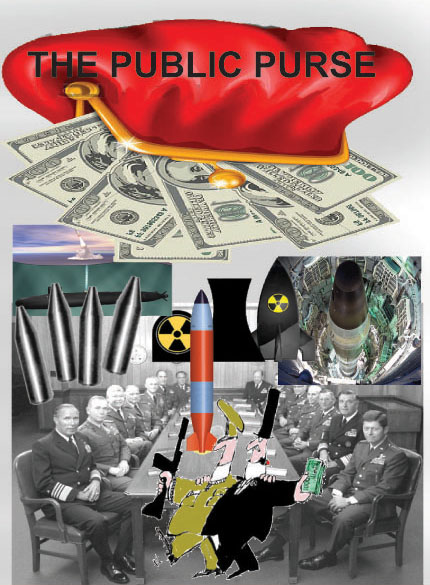
The Pentagon is not just another government agency. It’s the embodiment of a U.S. foreign policy that prizes militarism and force over diplomacy and multilateralism.
Progressives can’t win unless Pentagon spending is put on the chopping block. By Lindsay Koshgarian , TRUTHOUT, December 23, 2022
The year 2022 confirmed yet again that accepting massive military budget increases in exchange for a smattering of social benefits funding — a common devil’s bargain struck by Democrats in Congress — will never deliver the kind of world we dream of.
The military budget deal just reached by Congress will put Pentagon spending at $858 billion — more than $118 billion higher than when President Biden came into office, and more than $180 billion higher than the last budget approved under President Obama. That increase would have been more than enough to cover the costs of the entire Build Back Better agenda.
By comparison with the ever-growing Pentagon budget, wins on big progressive spending priorities in the last two years have been hit or miss, with plenty of notable misses. Political fortunes for the successful Inflation Reduction Act and the failed Build Back Better plan were widely understood to rest on a couple of high-profile swing votes, but a larger and longer-running political dynamic was also at play.
Members of Congress who favor progressive spending priorities regularly make deals to accept big military increases in exchange for a smattering of domestic spending increases, a pattern that’s set to play out again this year. The result of this tacit understanding in Congress has been that the priorities in the annual discretionary budget have remained frozen, with more than half of the annual budget going to the military in a typical year.
With the exception of pandemic relief, even when the budget pie grows, domestic spending never takes a significantly larger portion. To win more progressive priorities, that balance must shift. Pentagon spending has to be put on the chopping block — both because the military budget is far too high, and because the current dealmaking consensus means an eternally limited budget share for progressive priorities.
Progressive Goals Lose When the Pentagon Gains
It’s been a mixed year for progressive spending priorities. The Inflation Reduction Act, the first major act by Congress to address climate change, was a historic moment and a huge win for progressives — but it was also far too small to address the massive challenge posed by the climate crisis……………………………………
How Pentagon Spending Gets a Pass
The $858 billion budget that Congress just approved for the military, on a bipartisan basis, is part of the National Defense Authorization Act (NDAA). The NDAA is widely considered “must-pass” legislation, having passed with wide bipartisan support every year for more than 60 years. No other piece of legislation except the budget deal (and possibly the debt limit) is regarded as required in the same way………………..
There is no shortage of reasons why so many members continue to support the NDAA and Pentagon budget increases in general. Many in Congress still conflate military spending with security, and think there can never be too much of it — or else it’s purely political maneuvering to avoid being seen as weak on defense. And with Pentagon contractors sprinkling campaign contributions and federally funded jobs on congressional districts like so much fairy dust, there are plenty of politically expedient reasons to vote for a Pentagon budget increase.
But a less recognized part of the problem is the now-ingrained practice of trading off higher Pentagon spending for more domestic spending. The commonly accepted practice of negotiating bigger Pentagon budgets in exchange for a smattering of smaller domestic spending increases has greased the wheels of politically treacherous budget negotiations for years. It has also meant that Pentagon budget increases sail through with far too little scrutiny, even at a time like now when the agency has just failed its fifth audit.
It Wasn’t Always Like This
The long-accepted pattern of trading higher Pentagon spending in exchange for higher domestic spending solidified with the 2011 Budget Control Act, which explicitly locked in shares of the annual discretionary budget for military and non-military purposes.
The Budget Control Act locked in budget patterns that were in place at the height of the post-9/11 wars, a time of historically high Pentagon spending. But the legislation expired in 2021, and the negotiations have stayed stuck in the same mold.
Fifteen years before the Budget Control Act was passed, Congress had just completed a historic drawdown of the Pentagon budget. In the years after the end of the Cold War, it was widely agreed that the U.S. could pull back militarily, and the nation did go through a period of decreased military spending. That ended with the post-9/11 wars — but now that the U.S. has officially ended those wars, pulling the last troops out of Afghanistan last year, no military cutbacks have materialized. It’s the first time on record that no “peace dividend” resulted from the end of a major U.S. war.
The Pentagon Is a Losing Trade
Year after year, the saga continues: Democrats accept a big Pentagon increase in exchange for a smattering of little increases that even put together, don’t quite add up to what the Pentagon gets.
The progressive movement has had some wins, but in many ways, it has stalled on major spending priorities. The failure to seriously take on Pentagon spending is one of the reasons.
That’s beginning to change. In recent years, progressive movements and progressive champions in Congress have begun to take on Pentagon spending. The Poor People’s Campaign and the People Over Pentagon coalition have connected the need for a lower Pentagon budget to winning other progressive priorities. This year, a majority of House Democrats voted to remove $37 billion that the House Armed Services Committee had voted to add to the Pentagon budget. Also this year, Representatives Barbara Lee and Representative Mark Pocan introduced The People Over Pentagon Act, to cut $100 billion from the Pentagon budget and reinvest it in domestic priorities.
Those efforts haven’t been successful yet. But they’re necessary both ethically and practically. The Pentagon is not just another government agency. It’s the embodiment of a U.S. foreign policy that prizes militarism and force over diplomacy and multilateralism. It’s the agency that executed the wars after the 9/11 attacks, leading to more than 900,000 deaths. The list of ongoing damage done by the Pentagon runs long, from poisoned drinking water, to complicity in unjust wars and unaddressed harm to its own service members.
Practically, fighting to cut the military budget is also necessary because politics as usual will keep leading to the same results as usual. If progressives want more wins on progressive investments ranging from health care to child care to climate change, the Pentagon budget has to become a target. https://truthout.org/articles/democrats-are-making-a-devils-bargain-on-pentagon-funding-its-not-paying-off/?eType=EmailBlastContent&eId=2ebfd90a-c597-4908-b350-da03822ad182
EDITORIAL: Without national debate, radical nuclear policy shift intolerable

But the most fundamental and intractable challenge is how to deal with spent nuclear fuel and radioactive waste from nuclear plants, inevitable byproducts of nuclear power generation.
The grim reality is that there is no prospect for establishing a nuclear fuel recycling system or securing a site for final disposal of nuclear waste in the foreseeable future.
Let us not forget the lessons of the 2011 nuclear disaster and consider how best to fulfill our responsibility to future generations.
https://www.asahi.com/ajw/articles/14800117 December 23, 2022
Prime Minister Fumio Kishida is embarking on yet another radical policy shift without weighing the possible consequences. The government devised new policy guidelines for expanding the use of nuclear energy while turning a blind eye to fundamental and intractable issues that inevitably will result. It also failed to address a host of doubts and questions.
The Kishida administration spent only four months on this policy initiative without making any serious effort to win broad public support. The attempt to chip away at important policy principles comes on the heels of its recent decision to drastically beef up Japan’s defense capabilities.
The administration’s new agenda calls for accelerating the process of restarting idled nuclear reactors, extending the life span of aging reactors and constructing new ones to replace moribund facilities. It deviates sharply from the restrictive policy in place since the 2011 Fukushima nuclear disaster. We beg the administration to retract this unacceptable policy about-face.
RASH MOVE BASED ON DUBIOUS LOGIC
Kishida in late August called for debate on promoting nuclear power generation. He did not mention any potentially controversial key elements of the proposal during the July Upper House election, such as “reconstruction” of old reactors, even though this represents a major regime shift. After the election, the administration raced to develop new policy guidelines in a manner that were far from democratic.
It amounts to keeping the nation heavily dependent on nuclear energy for decades to come. This will hollow out the principle of reducing the nation’s reliance on nuclear power “as much as possible,” which has been upheld since the catastrophic triple meltdown more than a decade ago.
The administration is also using distorted logic and dubious arguments to support the policy change.
Kishida cited the “ongoing crisis” of a power crunch and rush to realize a carbon-neutral future as reasons for expanding the use of nuclear power.
But the government’s plan to promote nuclear power generation will not help ride out the current energy crisis. Restarting an offline reactor requires following established procedures, so this approach will not increase the nation’s power supply quickly or significantly. Extending the life span of aging reactors and building new ones to replace those destined to be decommissioned will only start producing benefits after 10 or more years. The outlook of these plans is murky and a strong case cannot be made for rushing into the decision.
The government also has its policy priorities askew. The overriding priority is to secure a stable energy supply and reduce the nation’s carbon footprint. This should be accomplished by promoting domestic renewable energy sources, not on expanding nuclear power generation. The government has promised to develop renewable energy into a major power source. It should first make all-out efforts to ramp up power generation using renewable energy sources and, if shortages remain, consider ways to tap other energy sources.
NUMEROUS QUESTIONS UNANSWERED
The proposal to bolster nuclear power generation raises numerous questions.
The older a reactor grows the more uncertain its safety becomes. The legal life span of a nuclear reactor is 40 years in principle but can be extended to 60 years in certain cases. This rule was introduced under a bipartisan agreement after the disaster at the Fukushima No. 1 nuclear plant and incorporated into the related law under the jurisdiction of the Nuclear Regulation Authority (NRA).
But the government has decided to transfer this rule to the jurisdiction of the Ministry of Economy, Trade and Industry, which champions nuclear power generation. The move is aimed at paving the way for extending the life span of reactors beyond the 60-year limit by establishing a new system of periodical reactor inspections for safety checks at intervals of 10 years or less. This amounts to nothing more than a fait accomplis to secure reactor operations beyond 60 years without engaging in meaningful policy debate. It could also gut the principle of “the separation between promotion and regulation.”
Rebuilding aged reactors is also questionable from an economic viewpoint. The cost of building new reactors keeps ballooning. The government has offered to subsidize the costs in response to a request from the power industry. That could lead to an excessive and unreasonable financial burden on the public.
The government’s plan also calls for developing and constructing “next-generation innovative reactors.” The only next-generation innovative reactor that appears technologically feasible in the near term, however, is a conventional light-water reactor equipped with a better safety mechanism than the current version. These reactors are already in operation in some countries. But it remains doubtful whether this is really a safety innovation.
In addition to Japan’s susceptibility to major natural disasters, potentially grave nuclear safety hazards include its ability to deal with a a possible military attack like the one that occurred in Ukraine.
But the most fundamental and intractable challenge is how to deal with spent nuclear fuel and radioactive waste from nuclear plants, inevitable byproducts of nuclear power generation.
The grim reality is that there is no prospect for establishing a nuclear fuel recycling system or securing a site for final disposal of nuclear waste in the foreseeable future.
The new nuclear policy guidelines offer no answers to these questions. Just as it did in making a radical shift in the nation’s security policy, the Kishida administration is taking advantage of public anxiety to rush headlong into a major nuclear policy change by simply stressing the benefits of the move without responding to legitimate questions and concerns.
The four-month process of making the decision on this policy change indicates the government only acted in line with predetermined conclusions and a certain timeframe in mind.
LESSONS OF FUKUSHIMA
The advisory council for the industry ministry that discussed the proposal did not even scrutinize the core question of how nuclear power generation will help secure a stable energy supply, which is supposed to be the core purpose of the new policy initiative.
Instead, the panel spent ages discussing approaches to extending the life of reactors and building new ones, apparently on the assumption that promoting nuclear power is a given.
Members of the panel were mostly proponents of expanded use of atomic energy. A small number who remained cautious called for national debate on the matter over the next 12 months, but the idea was brushed aside.
Nuclear power remains a sharply divisive policy issue. Ensuring stability in this field requires broad public support. If the government gives short shrift to the process of listening to a wide range of views to build broad public consensus, it cannot hope to recover public trust in its nuclear policy that was dashed by the disaster.
The government says it will solicit public opinions and hold meetings with concerned parties to alleviate any fears. But such steps would be meaningless if they are intended only to placate disgruntled citizens to ease the political pressure of opposition.
Meaningful debate requires the involvement of a wider spectrum of experts, including those who have no interest in nuclear power generation and those who remain skeptical. The country deserves a meticulous and multifaceted debate on all key issues and questions, including whether it is really vital to produce more electricity with nuclear power to achieve a carbon-free future.
The Diet has an important role to play. All the political parties should start independent discussions on this issue.
Any rash change in nuclear policy is unacceptable. Let us not forget the lessons of the 2011 nuclear disaster and consider how best to fulfill our responsibility to future generations.
How Ukraine’s Jewish president Zelensky made peace with neo-Nazi paramilitaries on front lines of war with Russia

In its bid to deflect from the influence of Nazism in contemporary Ukraine, US media has found its most effective PR tool in the figure of Zelensky, a former TV star and comedian from a Jewish background. It is a role the actor-turned-politician has eagerly assumed.
But as we will see, Zelensky has not only ceded ground to the neo-Nazis in his midst, he has entrusted them with a front line role in his country’s war against pro-Russian and Russian forces.
The Grayzone, ALEXANDER RUBINSTEIN AND MAX BLUMENTHAL·MARCH 4, 2022
While Western media deploys Volodymyr Zelensky’s Jewish heritage to refute accusations of Nazi influence in Ukraine, the president has ceded to neo-Nazi forces and now depends on them as front line fighters.
Back in October 2019, as the war in eastern Ukraine dragged on, Ukrainian President Volodymyr Zelensky traveled to Zolote, a town situated firmly in the “gray zone” of Donbas, where over 14,000 had been killed, mostly on the pro-Russian side. There, the president encountered the hardened veterans of extreme right paramilitary units keeping up the fight against separatists just a few miles away.
Elected on a platform of de-escalation of hostilities with Russia, Zelensky was determined to enforce the so-called Steinmeier Formula conceived by then-German Foreign Minister Walter Steinmeier which called for elections in the Russian-speaking regions of Donetsk and Lugansk.
In a face-to-face confrontation with militants from the neo-Nazi Azov Battalion who had launched a campaign to sabotage the peace initiative called “No to Capitulation,” Zelensky encountered a wall of obstinacy.
With appeals for disengagement from the frontlines firmly rejected, Zelensky melted down on camera. “I’m the president of this country. I’m 41 years old. I’m not a loser. I came to you and told you: remove the weapons,” Zelensky implored the fighters.
Once video of the stormy confrontation spread across Ukrainian social media channels, Zelensky became the target of an angry backlash.
Andriy Biletsky, the proudly fascist Azov Battalion leader who once pledged to “lead the white races of the world in a final crusade…against Semite-led Untermenschen”, vowed to bring thousands of fighters to Zolote if Zelensky pressed any further. Meanwhile, a parliamentarian from the party of former Ukrainian President Petro Poroshenko openly fantasized about Zelensky being blown to bits by a militant’s grenade.
Though Zelensky achieved a minor disengagement, the neo-Nazi paramilitaries escalated their “No Capitulation” campaign. And within months, fighting began to heat up again in Zolote, sparking a new cycle of violations of the Minsk Agreement.
By this point, Azov had been formally incorporated into the Ukrainian military and its street vigilante wing, known as the National Corps, was deployed across the country under the watch of the Ukrainian Interior Ministry, and alongside the National Police. In December 2021, Zelensky would be seen delivering a “Hero of Ukraine” award to a leader of the fascistic Right Sector in a ceremony in Ukraine’s parliament.
A full-scale conflict with Russia was approaching, and the distance between Zelensky and the extremist paramilitaries was closing fast.
This February 24, when Russian President Vladimir Putin sent troops into Ukrainian territory on a stated mission to “demilitarize and denazify” the country, US media embarked on a mission of its own: to deny the power of neo-Nazi paramilitaries over the country’s military and political sphere. As the US government-funded National Public Radio insisted, “Putin’s language [about denazification] is offensive and factually wrong.”
In its bid to deflect from the influence of Nazism in contemporary Ukraine, US media has found its most effective PR tool in the figure of Zelensky, a former TV star and comedian from a Jewish background. It is a role the actor-turned-politician has eagerly assumed.
But as we will see, Zelensky has not only ceded ground to the neo-Nazis in his midst, he has entrusted them with a front line role in his country’s war against pro-Russian and Russian forces.
The president’s Jewishness as Western media PR device
Hours before President Putin’s February 24 speech declaring denazification as the goal of Russian operations, Ukrainian President Volodymyr Zelensky “asked how a people who lost eight million of its citizens fighting Nazis could support Nazism,” according to the BBC.
Raised in a non-religious Jewish family in the Soviet Union during the 1980’s, Zelensky has downplayed his heritage in the past. “The fact that I am Jewish barely makes 20 in my long list of faults,” he joked during a 2019 interview in which he declined to go into further detail about his religious background.
Today, as Russian troops bear down on cities like Mariupol, which is effectively under the control of the Azov Battalion, Zelensky is no longer ashamed to broadcast his Jewishness. “How could I be a Nazi?” he wondered aloud during a public address. For a US media engaged in an all-out information war against Russia, the president’s Jewish background has become an essential public relations tool.
A few examples of the US media’s deployment of Zelensky as a shield against allegations of rampant Nazism in Ukraine are below (see mash-up above [on original] for video ): ………………………………….
Behind the corporate media spin lies the complex and increasingly close relationship Zelensky’s administration has enjoyed with the neo-Nazi forces invested with key military and political posts by the Ukrainian state, and the power these open fascists have enjoyed since Washington installed a Western-aligned regime through a coup in 2014.
In fact, Zelensky’s top financial backer, the Ukrainian Jewish oligarch Igor Kolomoisky, has been a key benefactor of the neo-Nazi Azov Battalion and other extremists militias.
Backed by Zelensky’s top financier, neo-Nazi militants unleash a wave of intimidation
Incorporated into the Ukrainian National Guard, the Azov Battalion is considered the most ideologically zealous and militarily motivated unit fighting pro-Russian separatists in the eastern Donbass region.
With Nazi-inspired Wolfsangel insignia on the uniforms of its fighters, who have been photographed with Nazi SS symbols on their helmets, Azov “is known for its association with neo-Nazi ideology…[and] is believed to have participated in training and radicalizing US-based white supremacy organizations,” according to an FBI indictment of several US white nationalists that traveled to Kiev to train with Azov.
Igor Kolomoisky, a Ukrainian energy baron of Jewish heritage, has been a top funder of Azov since it was formed in 2014. He has also bankrolled private militias like the Dnipro and Aidar Battalions, and has deployed them as a personal thug squad to protect his financial interests.
In 2019, Kolomoisky emerged as the top backer of Zelensky’s presidential bid. Though Zelensky made anti-corruption the signature issue of his campaign, the Pandora Papers exposed him and members of his inner circle stashing large payments from Kolomoisky in a shadowy web of offshore accounts.
When Zelensky took office in May 2019, the Azov Battalion maintained de facto control of the strategic southeastern port city of Mariupol and its surrounding villages. As Open Democracy noted, “Azov has certainly established political control of the streets in Mariupol. To maintain this control, they have to react violently, even if not officially, to any public event which diverges sufficiently from their political agenda.”
Attacks by Azov in Mariupol have included assaults on “feminists and liberals” marching on International Women’s Day among other incidents……………………………
Zelensky failed to rein in neo-Nazis, wound up collaborating with them
Following his failed attempt to demobilize neo-Nazi militants in the town of Zolote in October 2019, Zelensky called the fighters to the table, telling reporters “I met with veterans yesterday. Everyone was there – the National Corps, Azov, and everyone else.”
A few seats away from the Jewish president was Yehven Karas, the leader of the neo-Nazi C14 gang.
During the Maidan “Revolution of Dignity” that ousted Ukraine’s elected president in 2014, C14 activists took over Kiev’s city hall and plastered its walls with neo-Nazi insignia before taking shelter in the Canadian embassy.
As the former youth wing of the ultra-nationalist Svoboda Party, C14 appears to draw its name from the infamous 14 words of US neo-Nazi leader David Lane: “We must secure the existence of our people and a future for white children.”………………………………………………..
Throughout 2019, Zelensky and his administration deepened their ties with ultra-nationalist elements across Ukraine…………………………………………………………
In November 2021, one of Ukraine’s most prominent ultra-nationalist militiamen, Dmytro Yarosh, announced that he had been appointed as an advisor to the Commander-in-Chief of the Armed Forces of Ukraine. Yarosh is an avowed follower of the Nazi collaborator Bandera who led Right Sector from 2013 to 2015, vowing to lead the “de-Russification” of Ukraine…………………………………….
Ukrainian state-backed neo-Nazi leader flaunts influence on the eve of war with Russia
On February 5, 2022, only days before full-scale war with Russia erupted, Yevhen Karas of the neo-Nazi C14 delivered a stem-winding public address in Kiev intended to highlight the influence his organization and others like it enjoyed over Ukrainian politics………………………………….
“If we get killed…we died fighting a holy war”
…………………………………… With fighting underway, Azov’s National Corps gathered hundreds of ordinary civilians, including grandmothers and children, to train in public squares and warehouses from Kharviv to Kiev to Lviv.
On February 27, the official Twitter account of the National Guard of Ukraine posted video of “Azov Fighters” greasing their bullets with pig fat to humiliate Russian Muslim fighters from Chechnya.
…………………… Besides authorizing the release of hardcore criminals to join the battle against Russia, Zelensky has ordered all males of fighting age to remain in the country. Azov militants have proceeded to enforce the policy by brutalizing civilians attempting to flee from the fighting around Mariupol.
According to one Greek resident in Mariupol recently interviewed by a Greek news station, “When you try to leave you run the risk of running into a patrol of the Ukrainian fascists, the Azov Battalion,” he said, adding “they would kill me and are responsible for everything.”
Footage posted online appears to show uniformed members of a fascist Ukrainian militia in Mariupol violently pulling fleeing residents out of their vehicles at gunpoint.
Other video filmed at checkpoints around Mariupol showed Azov fighters shooting and killing civilians attempting to flee.
On March 1, Zelensky replaced the regional administrator of Odessa with Maksym Marchenko, a former commander of the extreme right Aidar Battalion, which has been accused of an array of war crimes in the Donbass region.
Meanwhile, as a massive convoy of Russian armored vehicles bore down on Kiev, Yehven Karas of the neo-Nazi C14 posted a video on YouTube from inside a vehicle presumably transporting fighters.
“If we get killed, it’s fucking great because it means we died fighting a holy war,” Karas exclaimed. ”If we survive, it’s going to be even fucking better! That’s why I don’t see a downside to this, only upside!”
https://thegrayzone.com/2022/03/04/nazis-ukrainian-war-russia/
Macron ‘panicking’ as France faces ‘catastrophic’ nuclear energy crisis, expert claims

France is in a catastrophic situation in terms of the vast debt that it owes in nuclear and the existential waste and decommissioning problem that it is facing
A record number of France’s 56 nuclear reactors have gone offline, sparking serious concerns over energy security across the Channel.
https://www.express.co.uk/news/science/1713491/macron-france-nuclear-energy-edf-crisis By JACOB PAUL, Dec 23, 2022, French President Emmanuel Macron is said to be in a “panic” as the issues with France’s ageing nuclear reactors have laid bare the flaws in the country’s energy plans, an expert has told Express.co.uk. Sixteen out France’s 56 nuclear reactors are currently offline due to corrosion and maintenance issues, sending its normal power output levels plummeting in recent months. Prior to these problems, France’s nuclear fleet generated 70 percent of the country’s electricity.
According to Dr Paul Dorfman, a nuclear expert from the University of Sussex, France’s “chickens are coming home to roost” as the decision to rely so heavily on nuclear is appearing to backfire, with further delays to repairs also announced this week.
He said: “France was nuclear power excellence, post-war all buffed up with power – it said it was going to be the top dogs. So it had a vast quantity of nuclear reactors dotted all around France. But what is happening now is that its chickens are coming home to roost.
“EDF (owned by the French state) is 43billion euros in debt, it faces a 100billion euro bill for mandatory safety upgrades, and a significant number of its reactors continue to be offline due to ageing corrosion problems. It also faces a huge decommissioning and waste management bill that is uncosted – they are just beginning to say ‘oh my god’.
“Around a quarter of their reactors are still offline at winter when they really need it. They are even importing power from Germany after being a net exporter. France is panicking about what to do about renewables and insulation.”
But all this could be of concern for Britain, which does rely on some French imports that are sent across the Channel via interconnectors. National Grid has previously warned that if the UK fails to shore up enough energy imports from Europe this winter, it may have to roll out organised blackouts in the “deepest, darkest” nights of the coldest months of the year.
However, while France’s nuclear power issues have sparked concern, Dr Dorfman said the UK is luckier than France in that it is one of the leading players in offshore wind, which could provide a vital lifeline this winter.
He said: “The UK has seriously thought about renewables in the last few years, without any question. But there have been problems with onshore wind and legislation issues. There also problems with the legislation for solar, but offshore wind has helped enormously. But the UK hasn’t really considered about the lowest hanging through which is energy efficiency and insulation.”
When asked whether the UK is lucky that it has not copied the French model, Dr Dorfman responded: “We are hugely lucky. France is in a catastrophic situation in terms of the vast debt that it owes in nuclear and the existential waste and decommissioning problem that it is facing…The UK is certainly in a better position in terms of offshore windpower, but it needs to get its act together in terms of allowing much greater onshore wind and much greater solar…and all the things that make up a balanced energy portfolio.
“France is not going to change, the reactors are not going to get any younger. Rumour has it, the corrosion issues have been known about for years. Because it takes so long to build reactors, you can’t expect new builds to happen within a decade or two decades.
“Nobody knows what is going to happen with Russia. All we know amongst all this mess is that renewables cost between a quarter and a fifth less than nuclear and that the vast majority of all new power additions worldwide is renewables.”
This comes as analysis by leading renewable energy trade bodies revealed that low carbon power reportedly met more than half of the UK’s electricity needs over the past two months. Renewable UK, the Nuclear Industry Association found that between the end of October and December 18, clean energy sources like wind and solar provided 40 percent of the country’s electricity, while nuclear power plants accounted for 14 percent of demand.
The power that came from both offshore and onshore wind turbines alone generated more than half of Britain’s low carbon power output over the period, while nuclear supplied 27 percent.
Canada’s Federal environment minister rejects impact assessment for small modular nuclear reactor on the Bay of Fundy.
Coalition for Responsible Energy Development in New Brunswick (CRED-NB), December 23, 2022
SAINT JOHN, NEW BRUNSWICK – In a deeply disappointing decision for the environment and public oversight, Steven Guilbeault, federal Minister of Environment and Climate Change, has ruled against a full federal Impact Assessment (IA) for a small modular nuclear reactor (SMR) proposed by New Brunswick Power at Point Lepreau in New Brunswick.
This decision comes in response to a request submitted by the Coalition for Responsible Energy Development in New Brunswick (CRED-NB) on July 4, 2022, calling for an IA for this first-of-its-kind nuclear project in Canada. Letters of support for CRED-NB’s request were submitted by the Wolastoq Grand Council, and Indigenous organizations representing the Peskotomuhkati Nation and the Mi’gmaq First Nations in New Brunswick and over 300 public interest groups and individuals.
In rejecting the need for an IA for the proposed SMR project, the Minister found it would be “unwarranted” as the concerns raised by Indigenous peoples and members of the public would be considered as part of the licensing process by the nuclear regulator and within New Brunswick’s Clean Environment Act.
“The Minister’s choice not to designate the SMR for an assessment goes against their commitments to sound, science-based decision-making and public participation,” noted Ann McAllister of CRED-NB, reacting to the news of the Minister’s decision. “This lack of a precautionary approach is especially dismaying given that sodium-cooled nuclear technology – of which this SMR is one – has a known history of accidents and has never been successfully commercialized, despite repeated attempts over the decades.”
“The mechanism we had to uphold environmental justice has been denied,” reacted Kerrie Blaise, an environmental lawyer who assisted CRED-NB with the IA request. “The many unknowns and the potential for not only severe but irreversible impacts to the health of communities and the environment will not be subject to a rigorous public and cumulative effects assessment that an IA provides. This is quite simply something that cannot be achieved by the nuclear regulator in their license-specific assessment.”
“By refusing an IA for the SMR project at Point Lepreau, the Minister suggested the concerns about the project raised by CRED-NB would be dealt with by a provincial Environmental Impact Assessment,” said Dr. Susan O’Donnell,Adjunct Professor at the University of New Brunswick and St. Thomas University, and CRED-NB member. “The provincial process is not as comprehensive as the federal IA. However in its submission, the Government of New Brunswick stated that a provincial EIA would address all the concerns raised in the CRED-NB request, and that the premier has confirmed that a provincial EIA review, including public consultation, will be required before the project can proceed. We look forward to that comprehensive provincial review in the new year.”
Pressure from the nuclear industry lobby changed federal environmental assessment law in 2019, exempting SMRs below a certain threshold from undergoing a full environmental IA. The only way for thisproject to have undergone an IA, was at the direction of the Minister. The Minister’s decision sets an unfortunate precedent, weakening our impact assessment laws and ability for broad public participation.
Dishonesty: British authorities knew it was wrong to proceed with the thermal oxide reprocessing plant (Thorp) at Sellafield.
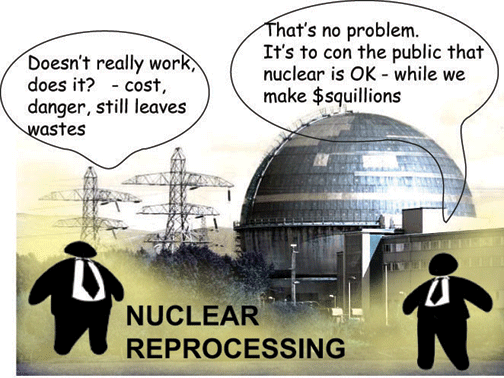
Letter William Walker: In 1993, a government official told me that “it
was sometimes right to do the wrong thing”. For reasons of political
expediency, it was right to give political consent for the operation of the
thermal oxide reprocessing plant (Thorp) at Sellafield.
This huge facility, not mentioned in Samanth Subramanian’s fine long read, had been built over
the previous decade to reprocess British and foreign, especially Japanese,
spent nuclear fuels. Abandoning it would be too embarrassing for the many
politicians and their parties that had backed it, expensive in terms of
compensation for broken contracts, and damaging to Britain’s and the
nuclear industry’s international reputation.
It was wrong to proceed, as
the government well knew, because the primary justification for its
construction – supply of plutonium for fast breeder reactors (FBRs) – had
been swept away by the abandonment of FBRs in the 1980s (none were built
anywhere).
Because returning Thorp’s separated plutonium and radwaste to
Japan would be difficult and risky.
Because decommissioning Thorp would
become much more costly after its radioactive contamination.
Because there was a known win-win solution, favoured by most utilities – store the spent
fuel safely at Sellafield prior to its return to senders, avoiding the many
troubles that lay ahead.
Guardian 22nd Dec 2022
Nuclear Free Local Authorities ‘bitterly disappointed’ government will press ahead with ‘criminal nuclear power tax’
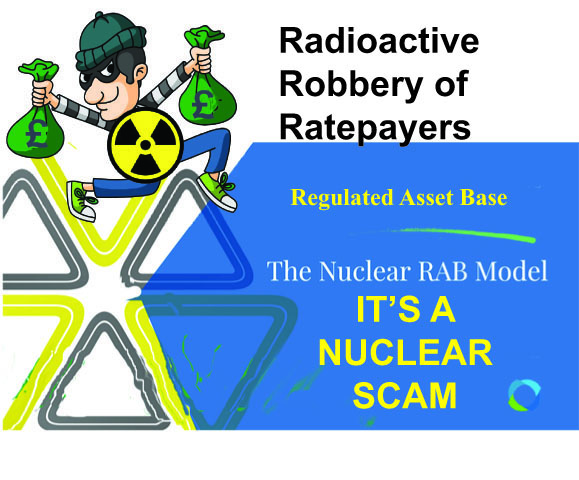
https://www.nuclearpolicy.info/news/nuclear-free-local-authorities-bitterly-disappointed-government-will-press-ahead-with-criminal-nuclear-power-tax/ 19 Dec 22, The UK/Ireland Nuclear Free Local Authorities were bitterly disappointed, but unsurprised, to hear recently British Government confirmation that it has decided to go ahead with the controversial Regulated Asset Base funding model for future nuclear power projects.
The government is proposing to use the RAB model to pay for the cost of constructing a new power plant at Sizewell C in Suffolk and for a fleet of so-called Small Modular Reactors to increase nuclear generating capacity three-fold to 24 GW by 2050 in line with the Energy Security Strategy published by Boris Johnson in April of this year.
To the NFLAs RAB should be renamed ROB as it is akin to daylight robbery. The RAB model de-risks nuclear projects for contractors and operators as, rather than requiring them to find the finance upfront, all electricity customers instead face an additional levy on their bills to meet the cost of building the new plants; all of which, based on historic precedent, will be delivered late and way over budget. The public will also have to meet the costs of any delays, which are likely to be considerable.
Responding to a consultation on the proposals launched by the Department of Business Energy and Industrial Strategy in August, the NFLA called for RAB to be scrapped and for nuclear operators to source money for new construction projects from the private sector, rather than electricity customers.
The NFLA is especially concerned at the unfairness of levying elderly customers who are unlikely to see any ‘benefit’ from the nuclear power generated, given that construction of any new plant is likely to take at least a decade, or levying poorer households, who are already at risk of fuel poverty. The NFLA called for elderly and poorer households to be exempted. The proposal is also particularly iniquitous when applied to Scottish customers, who will be taxed despite the Scottish Government refusing to countenance new nuclear plants for the nation.
The government published its response on 14 December stating that it will go ahead with the proposals, with only a vague and unsubstantiated recognition that ‘support for vulnerable groups would be best tackled holistically
Commenting on the response, NFLA Steering Committee Chair, West Dunbartonshire Councillor Lawrence O’Neill said:
“It is outrageous that British Government ministers want to press ahead with a scheme that imposes a criminal tax to pay for their nuclear delusion on the poorest, oldest and most vulnerable customers, and doubly criminal when imposed on customers living in Scotland where we as a nation certainly do not want to entertain it.
“Nuclear power projects are notorious for coming in late and way over cost, Hinkley Point C being a case in point. RAB simply takes away the risk to prospective nuclear operators of raising initial finance in the commercial lending market and finding the extra money needed to meet cost overruns and delays and transfers it onto electricity consumers who are already struggling to pay overinflated energy bills.
“The most immediate beneficiary EDF Energy will be laughing all the way to the bank as it picks up the subsidy to build Sizewell C collected from British taxpayers then pays the resulting profits from its future operations back to its owner, the French Government”.
1 This Month
23-25 October – on Zoom – World BEYOND War’s annual global conferenc


Shut down the radiation-damaged Heysham nuclear reactors now
To see nuclear-related stories in greater depth and intensity – go to https://nuclearinformation.wordpress.com

Say No to NASA’s Reckless Nuclear Reactor on the Moon
Say No to NASA’s Reckless Nuclear Reactor on the Moon
-
Archives
- October 2026 (190)
- September 2026 (339)
- August 2026 (330)
- July 2026 (355)
- June 2026 (287)
- May 2026 (306)
- April 2026 (356)
- March 2026 (251)
- February 2026 (267)
- January 2026 (308)
- December 2025 (358)
- November 2025 (359)
-
Categories
- 1
- 1 NUCLEAR ISSUES
- business and costs
- climate change
- culture and arts
- ENERGY
- environment
- health
- history
- indigenous issues
- Legal
- marketing of nuclear
- media
- opposition to nuclear
- PERSONAL STORIES
- politics
- politics international
- Religion and ethics
- safety
- secrets,lies and civil liberties
- spinbuster
- technology
- Uranium
- wastes
- weapons and war
- Women
- 2 WORLD
- ACTION
- AFRICA
- Atrocities
- AUSTRALIA
- Christina's notes
- Christina's themes
- culture and arts
- Events
- Fuk 2022
- Fuk 2023
- Fukushima 2017
- Fukushima 2018
- fukushima 2019
- Fukushima 2020
- Fukushima 2021
- general
- global warming
- Humour (God we need it)
- Nuclear
- RARE EARTHS
- Reference
- resources – print
- Resources -audiovicual
- Weekly Newsletter
- World
- World Nuclear
- YouTube
-
RSS
Entries RSS
Comments RSS

