Crops growing 30 miles outside of Chernobyl are still contaminated with dangerous levels of strontium .
https://www.washingtonpost.com/politics/2022/04/20/does-russia-sell-nearly-1-billion-uranium-us-year/ 7 Oct 22, Crops grown near Chernobyl are still contaminated, more than three decades after the worst nuclear disaster in history.
Almost half the grain analyzed by scientists in Ivankiv, about 30 miles from the power plant, showed levels of strontium 90 far above recommended levels.
It was also present at unsafe levels in firewood and wood ash used to fertilize crops.
The Ukrainian government stopped testing goods for strontium 90 in 2013.
A radioactive isotope, it collects in the teeth, bones and marrow like calcium, and can cause numerous kinds of cancer.
Black pigmentation in Chernobyl’s Eastern Tree Frogs

Chernobyl is spawning MUTANT frogs: Bizarre black amphibians are spotted near the nuclear plant – 36 years after its catastrophic meltdown
- Eastern tree frogs are meant to have bright green skin
- But scientists working near Chernobyl have found many with black skin
- They think the dark skin may have helped them to survive the exclusion zone
https://www.dailymail.co.uk/sciencetech/article-11290735/Chernobyl-spawning-MUTANT-frogs-Bizarre-black-amphibians-spotted-near-nuclear-plant.html By SHIVALI BEST FOR MAILONLINE and MICHAEL HAVIS, 7 October 2022
Mutant black frogs are spawning near the Chernobyl power plant, 36 years after its catastrophic meltdown unleashed one of the worst nuclear disasters in history.
Eastern tree frogs are meant to have bright green skin but scientists working near Chernobyl have found many with darker or black pigmentation.
In 1986, the site in northern Ukraine – then under Soviet rule – witnessed the largest release of radioactive material into the environment in human history.
Now scientists think the mutated frogs’ darker skin may have helped them survive in the exclusion zone, which today restricts access to 1,0000 sq miles around ground zero.
Germán Orizaola, a researcher at Spain’s University of Oviedo, who co-authored the new study, said: ‘We become aware of these frogs the very first night we worked in Chernobyl.
‘We were looking for this species near the damaged power plant and we detected many frogs that were just black.
‘We know that melanin is responsible for dark or black colouration in many organisms, including frogs.
‘At the same time, we know that melanin protects from the damage caused by different types of radiation, from UV to ionizing radiation – the kind at Chernobyl.’
For their study, Dr Orizaola and his co-author, Pablo Burraco, collected more than 200 male frogs from 12 different breeding ponds with different levels of radiation.
They found that frogs within the exclusion zone were much darker than those from outside it.
And though there was no correlation between the darkest frogs and the most irradiated places today, there was a correlation with the worst-affected places from the time of the accident.
In other words, the darker frogs had stood a better chance of survival when disaster struck in 1986, making them more numerous today.
Dr Orizaola said: ‘With this species it’s possible to find, under normal circumstances, a small percentage of frogs with unusual colouration.
UK government sees energy conservation measures as making Britain a ‘nanny state’
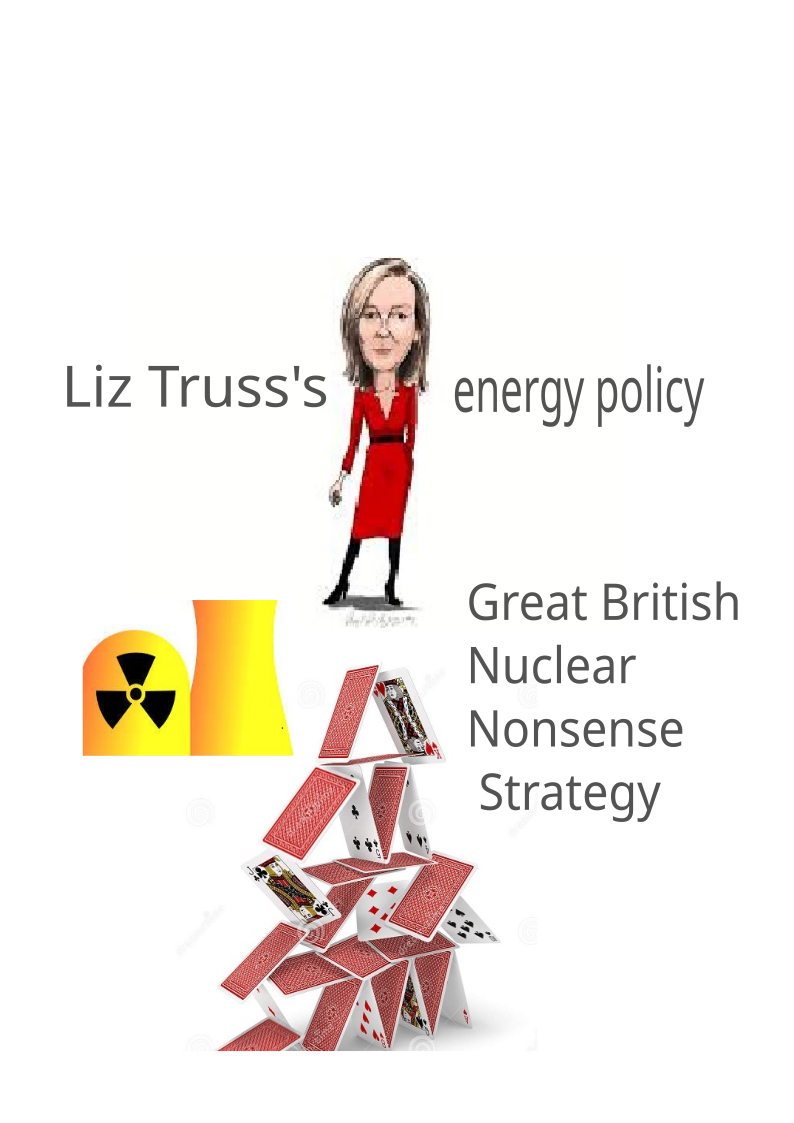
Liz Truss blocks energy saving campaign ‘on ideological grounds’.
Minister says government views public information campaign as ‘nanny
state’. Liz Truss has blocked plans for a public information campaign
asking people to save energy over the winter, reportedly because she is
“ideologically opposed” to the idea.
Ministers on Friday morning claimed
the idea was “nanny state” and confirmed that they would not be urging
people to keep an eye on their usage despite warnings from National Grid of
possibly rolling blackouts. Business secretary Jacob Rees-Mogg is said to
have been keen on a £15 million campaign as a relatively cost-effective
way of reducing the UK’s energy usage at a time of surging prices and
scarcity.
Independent 7th Oct 2022
Zaporizhzhia on the brink: How deteriorating conditions at the nuclear power plant could lead to disaster
Bulletin, By Zakhar Popovych, Denys I. Bondar, M.V. Ramana | October 7, 2022, Soon after it started its invasion of Ukraine on February 24, 2022, the Russian military occupied the southern part of the Zaporizhzhia region. The occupied area includes the territory of the Zaporizhzhia Nuclear Power Plant (NPP), the largest in Europe. During the summer, the area around the Zaporizhzhia NPP was hit multiple times by missiles and artillery. These affected all high-voltage electric power lines that connect the facility to the grid, so the plant was forced to work for some time in island mode, using the minimal power produced by one of the reactors to maintain functions essential to the plant’s safety. After the International Atomic Energy Agency (IAEA), the UN’s nuclear watchdog, conducted its inspection on September 1st, Ukrainian maintenance teams were allowed by the Russian military to repair the power lines and refill the diesel fuel storage tanks needed for emergency power generators. This made it possible to supply the facility with external power for the reactor cooling and other maintenance systems.
On September 10, the three of us had a conversation via Zoom with Pavlo Oleshuk, a representative of Atomprofspilka, the nuclear energy and industry workers’ union of Ukraine. Oleshuk is an experienced member of the team that operates the Rivne NPP in northwest Ukraine. As an organizer with the union, he has been in close and constant contact with the employees who directly operate the Zaporizhzhia NPP.
Oleshuk’s descriptions gave us new insight into the working and living conditions of his colleagues at the beleaguered plant. Such details have been otherwise difficult to get as plant operators have avoided talking in public ever since Russian forces seized the plant. Our discussion with Oleshuk lasted for more than two hours, and we offer here the main insights.
At the time we talked to Oleshuk, one of the reactors at the Zaporizhzhia NPP was still operating. However, shortly after our conversation, EnergoAtom, the Ukrainian state nuclear power plant operator, decided to shut down all reactors there. Despite this decision, there is a continued risk of a major nuclear incident as the plant requires permanent cooling. Furthermore, as our discussion with Oleshuk reveals, other factors exacerbate the fragility of the situation at the Zaporizhzhia NPP.
Context. Oleshuk began with a description of Zaporizhzhia NPP and the city of Energodar, which means literally “the gift of energy.”………………………………………………….
Working under threats and intimidation. The Zaporizhzhia NPP, the city of Energodar, and the surrounding areas have all been under Russian occupation for the past few months. According to Oleshuk’s sources at the plant, Russian armed forces first took control of the nearby territory and peacefully approached the personnel of the power plant claiming that they would not intervene with the operations of the plant. But once the armed forces entered the plant’s premises, so did personnel from the FSB—Russia’s principal security agency and successor to the old KGB—and a couple of experts from Rosatom, the Russian state nuclear energy corporation. …………………
For their part, the FSB personnel, unlike regular soldiers, violated the rules about who can access different areas of the plant and went everywhere within the premises, including inside radiation-controlled zones. But rather than taking control over the plant’s operations, the FSB agents seem to have been tasked with finding the so-called “ringleaders” who are organizing protests against the occupation ………………..
Over time, many more nuclear power plant workers have left Energodar for other cities that are still under the control of the Ukrainian government, creating a shortage of personnel at the Zaporizhzhia NPP. Even though some nuclear power plant maintenance functions can be carried out remotely, most cannot. As a result, there are concerns about the safety of these reactors and their associated systems.
Living without supplies. Because it is in Russian-occupied territory, residents of Energodar can no longer get their supplies from Ukraine-controlled territories, although they are located just across the Dnipro River. Instead, they must get them from other occupied territories—which means that even the supply of basic groceries is intermittent, with some food products simply no longer available………………….
Another major problem for the residents of Energodar is the collapse of utilities. ………………………
The supply of water supply has also become a problem since it relies exclusively on electric pumps and there are no water towers in Ukraine because the electricity supply was always considered to be reliable and abundant. ……………….
Outlook. With winter coming, the future is grim for the workers of the Zaporizhzhia NPP who still live in Energodar. Like other satellite cities, Energodar relies on the Zaporizhzhia NPP for most of its energy needs, including for heating……………………..
If both nuclear and thermal power plants cannot resume operation, then Energodar’s inhabitants will not be able to heat their living premises. The Ukrainian winter is cold with temperatures often being less than 20 degrees Celsius below zero (-4 degrees Fahrenheit). Plant workers don’t know how they will survive the winter.
Making an already desperate situation worse, there has been a loss of leadership and governance. The mayor of Energodar, Dmytro Orlov, was initially arrested by the Russians, but later managed to flee the city. The occupying forces did try to take over the city hall, but effectively the local authority has largely collapsed. The inhabitants are now left on their own.
According to Oleshuk, the situation is simply no longer tenable for the plant workers who are exhausted and stressed out. …………………more https://thebulletin.org/2022/10/zaporizhzhia-on-the-brink-how-deteriorating-conditions-at-the-nuclear-power-plant-could-lead-to-disaster/
First containers sealed into Dounreay low level waste vaults
First containers sealed into Dounreay low level waste vaults. Dounreay’s
waste team is carrying out the first in a series of campaigns to seal the
waste into place in the low level waste vaults.
As part of the waste disposal process, the spaces between the containers in the low level waste
vault are being filled with grout. The team undertook a series of trials to
confirm that the grout would readily flow between the containers and also
tested the membranes that will be used to seal the grout shutters. A first
campaign of grouting has now been completed within the vault and 16 waste
packages have been sealed into their final positions. Further grouting
campaigns of increasing size are planned.
NDA 5th Oct 2022
https://www.gov.uk/government/news/first-containers-sealed-into-dounreay-low-level-waste-vaults
Does Russia sell nearly $1 billion in uranium to the U.S. a year?

If you can follow all this – well good luck to you!
https://www.washingtonpost.com/politics/2022/04/20/does-russia-sell-nearly-1-billion-uranium-us-year/ Analysis by Glenn KesslerThe Fact Checker, April 20, 2022 ,
“We are still sending about $100 million every month to Russia to buy uranium.”
— Sen. John Barrasso (R-Wyo.), interviewed on Fox News, April 13
“In 2021 Russian imports [of uranium] cost almost $1 billion, money that helped underwrite Mr. Putin’s war machine.”
— Barrasso, in an opinion article in the Wall Street Journal, April 12
The Biden administration has imposed sweeping sanctions on Russia since Moscow’s invasion of Ukraine, including eliminating preferential trading privileges and banning imports of Russian oil, liquefied natural gas and coal. So we were surprised to hear these numbers from Barrasso — that Russia received nearly $1 billion for uranium products in 2021 and is on track to earn $1.2 billion this year. The uranium is generally used as fuel to generate electricity in nuclear power plants.
Barrasso, the senior Republican on the Senate Energy and Natural Resources Committee, represents Wyoming, which has uranium mines that would benefit from a ban on Russian uranium. In fact, the domestic uranium mining industry has all but come to a halt, with production falling to an all-time low in 2019, as nuclear energy increasingly has relied on imports. That constituency might have made Barrasso a suspect source, though we have found that he does not routinely make up his numbers.
The Facts
Continue readingThe government’s price isn’t right for plutonium-contaminated land in Palomares (Almeria)
https://euroweeklynews.com/2022/10/07/the-governments-price-isnt-right-for-plutonium-contaminated-land-in-palomares-almeria/By Linda Hall • 07 October 2022
FIFTY-SIX years on, Palomares is still suffering the effects of its infamous “nuclear incident.”
This occurred on January 17 in 1966 when four unarmed thermonuclear bombs were released after two US aircraft crashed in mid-air over the Mediterranean.
One bomb was found far out to sea but three fell on Palomares, releasing plutonium and contaminating an area of two square kilometres. The US army decontaminated some of the land but much remains untreated.
Spain’s central government announced in early October that it would soon be completing its estimate of the value of the plutonium-affected properties it intends to acquire.
“This would appear to be the first step in the clean-up plan drafted more than 10 years ago,” provincial media sources said.
Buying up the land was in the public interest “to safeguard residents’ health and permit a close watch on the land”, the government said, allocating €345,127 for the compulsory purchase of 324,073 square metres of land.
According to the same sources, the 30 owners involved, who include developers and agricultural growers, dismissed the €1 per square metre compensation as “laughable.”
They maintained that this was particularly risible after Spain’s Energy, Environmental and Technological Research Centre (CIEMAT) recommended a price of €17 per square metre of rural land and €83 for building land in a 2007 report to the Nuclear Safety Council.
Most of the land in question is located within the Cuevas del Almanzora boundaries although five properties belong to Vera.


France’s nuclear energy strategy — once its pride and joy — faces big problems this winter
CNBC Sam Meredith, @SMEREDITH19 5 Oct 22,
- Deep-rooted problems with France’s nuclear-heavy energy strategy are raising serious questions about its winter preparedness.
- A long-standing source of national pride, France generates roughly 70% of its electricity from a nuclear fleet of 56 reactors, all operated by state-owned utility EDF.
- In recent months, however, more than half of EDF’s nuclear reactors have been shut down for corrosion problems, maintenance and technical issues.
…………………….. more than half of EDF’s nuclear reactors have been shut down for corrosion problems, maintenance and technical issues in recent months, thanks in part to extreme heat waves and repair delays from the Covid pandemic. The outages have resulted in French power output falling to a near 30-year low just as the European Union faces its worst energy crisis in decades.
“I find the France nuclear relationship really interesting because it just bluntly shows you all of the pros and cons of nuclear,” Norbert Ruecker, head of economics and next generation research at Julius Baer, told CNBC via telephone.
“Yes, it’s low carbon but it’s not economic. You need to nationalize EDF to make it happen. Yes, it offers baseload but wait a second, sometimes a whole plant disappears for weeks and months, so that baseload promise is not really there,” Ruecker said.
……………………………………………… A ‘winter of discontent’?
French power prices climbed to a string of all-time highs this summer, peaking at an eyewatering level of around 1,100 euros ($1,073) per megawatt hour in late August. Analysts fear the country may struggle to produce enough nuclear energy to support both its own needs and those of its neighbors in the coming months.
Underlining the structural problems in the country’s nuclear fleet, France not only lost its position as Europe’s biggest exporter of electricity this year but also, remarkably, actually imported more power than it exported.
Data from energy analysts at EnAppSys that was published in July found that Sweden clinched the top spot as Europe’s largest net power exporter during the first six months of 2022. Prolonged outages in France’s nuclear fleet saw the country’s exports halve from the same period last year, and analysts at EnAppSys warned the situation showed “no signs of improving any time soon.”
To compensate, France imported expensive electricity from U.K., Germany, Spain and elsewhere.
“Thanks to the market, thanks to the power lines that we have, Europe saved France from a big blackout” this summer, Julius Baer’s Ruecker said.
“It was the U.K., Germany, Spain and to some extent Switzerland that all stepped in. So, for me, the past month really has just uncovered some of the political talk which was not always objective,” he added, referring to talk of nuclear energy as a climate solution among politicians…………………………………………………….
What does it mean for Europe?
France’s ailing power output has renewed criticism of its nuclear-heavy energy strategy at a time when many others in Europe are turning to atomic power as a replacement for a shortfall in Russian gas.
Germany, which initially planned to shutter its three remaining reactors by the end of the year, decided to delay its nuclear phaseout to shore up energy supplies this winter. The U.K., meanwhile, is seeking to ramp up its nuclear power generation, and the EU has listed nuclear energy among its list of “green” investments.
“It is important to say that if France has a nuclear problem, Europe has a problem as well in terms of electricity,” Alexandre Danthine, senior associate for the French power market at Aurora Energy Research, told CNBC via telephone.
“They are, in general, a big exporter, but in winter they need energy from neighboring countries in order to satisfy demands — whatever the situation,” Danthine said.
In France, Eurasia Group’s Rahman noted, Macron reacted angrily last month to suggestions, including from outgoing EDF boss Jean-Bernard Levy, that his “stop-start approach” to nuclear power in the last five years was partly responsible for the crisis.
In what was widely seen as a policy U-turn, Macron announced in February his intention for France to build at least six new nuclear reactors in the decades to come, with the option for another eight. At the start of his presidency, Macron had committed to reducing the share of nuclear power in the country’s energy mix.
The reversal controversially placed atomic power at the center of France’s bid to achieve carbon neutrality by the middle of the century.
Advocates of nuclear power argue it has the potential to play a major role in helping countries generate electricity while slashing carbon emissions and reducing their reliance on fossil fuels.
To critics of the energy source, however, nuclear power is an expensive distraction to faster, cheaper and cleaner alternatives. Instead, environmental campaign groups argue technologies such as wind and solar should be prioritized in the planned shift to renewable energy sources. https://www.cnbc.com/2022/10/05/frances-nuclear-heavy-energy-strategy-faces-big-problems-this-winter.html
Poland suggests hosting US nuclear weapons- ‘nuclear sharing’
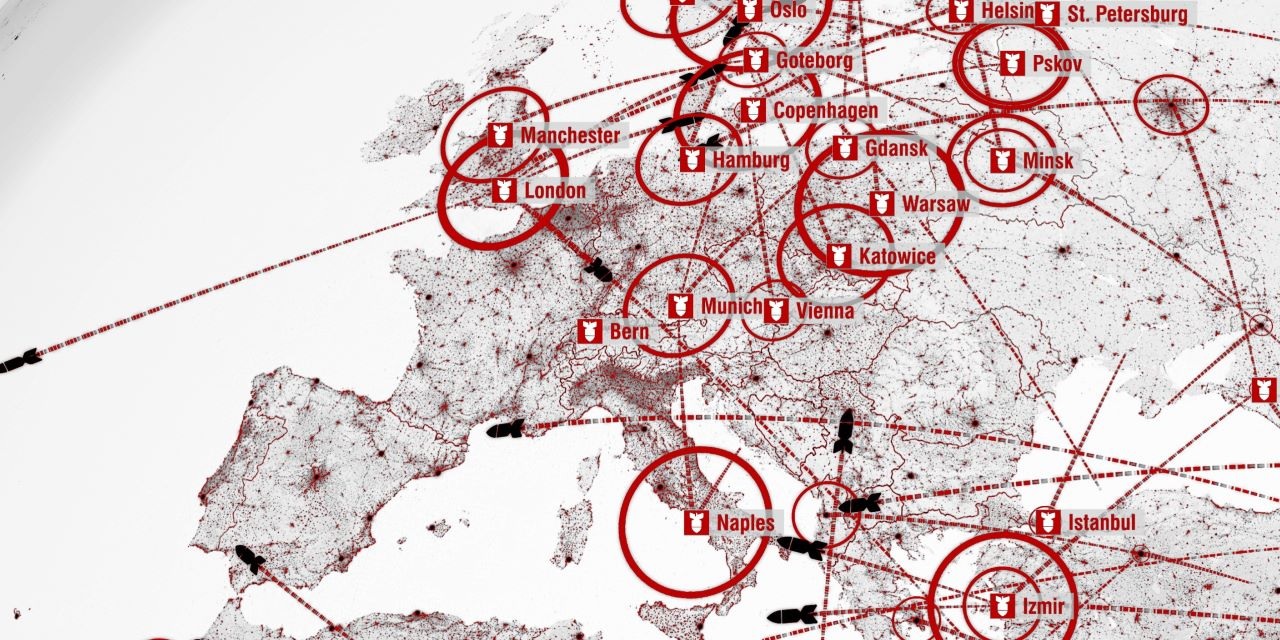
Poland suggests hosting US nuclear weapons amid growing fears of Putin’s threats, https://www.theguardian.com/world/2022/oct/05/poland-us-nuclear-wars-russia-putin-ukraine Julian Borger in Washington, 6 Oct 22, Andrzej Duda, the Polish president, in September. He said there was ‘a potential opportunity’ for Poland to take part in ‘nuclear sharing’.
Poland says it has asked to have US nuclear weapons based on its territory, amid growing fears that Vladimir Putin could resort to using nuclear arms in Ukraine to stave off a rout of his invading army.
The request from the Polish president, Andrzej Duda, is widely seen as symbolic, as moving nuclear warheads closer to Russia would make them more vulnerable and less militarily useful, according to experts. Furthermore, the White House has said it had not received such a request.
“We’re not aware of this issue being raised and would refer you to the government of Poland,” a US official said.
Duda’s announcement appears to be the latest example of nuclear signalling as the US and its allies seek to deter Putin from the first nuclear use in battle since 1945, while preparing potential responses if deterrence fails that would have maximum punitive impact while containing the risk of escalation to all-out nuclear war.
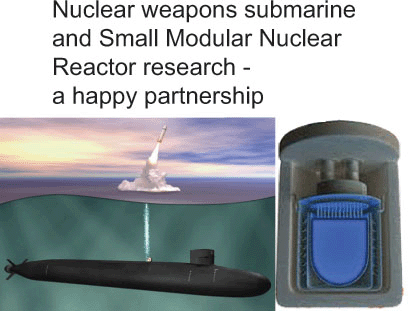
TODAY. Small Nuclear Reactors have only one use – to lead and help the global nuclear weapons juggernaut
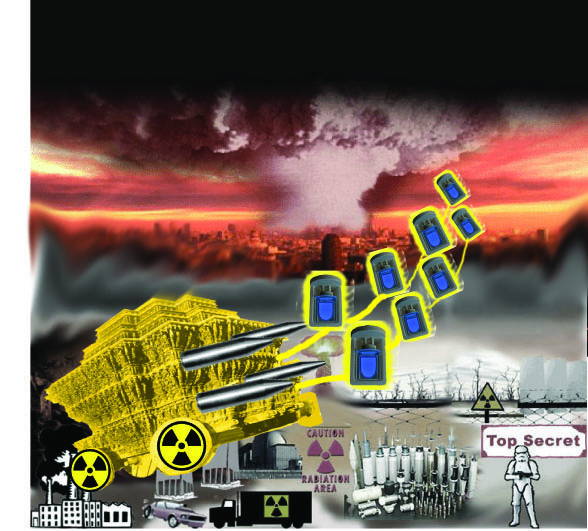
Once again, credible sources reiterate that ‘advanced nuclear’ technology – especially Small Nuclear Reactors (SMRs) are:
- non-existent as a functioning electricity source
- the most expensive of all energy sources
- not really small anyway 300MWe (and cunningly designated “medium” – up to 700MWe)
- serious producers of toxic, virtually eternal, wastes
- Thorium ones need plutonium or enriched uranium to start the reaction
- require huge security – safety and proliferation risks
- Millions of them needed to be effective against climate change, but none available till long after urgent action is needed.
- Distract and divert attention, energy and money away from real climate solutions.
So – why on Earth are all the powerful governments and media constantly trumpeting the virtues of Small Nuclear Reactors?
There is only one real reason:
Small Nuclear Reactors are essential for the nuclear weapons industry.
As the Big Nuclear power industry is failing, and cyclotrons now produce medical radioisotopes, there is really no need for the so-called “peaceful” nuclear industry (except for the massive clean-up jobs)
The Small Nuclear Reactor fantasy keeps the whole show, the whole hypocrisy, alive.
Starting with the (dubiously useful) nuclear submarines – the small nuclear reactor dream is already taking shape. But the industry needs a nice, clean-sounding ‘cover’ for its real killer purpose. Hence the foolish frenzy for “Nice Clean, Climate-helping, Waste-eating, Jobs-providing” Small Nuclear Reactors. (go to Google – you will find nothing but a procession of these lies.
Ukraine War Exposes Risks to Deploying Small Nuclear Reactors
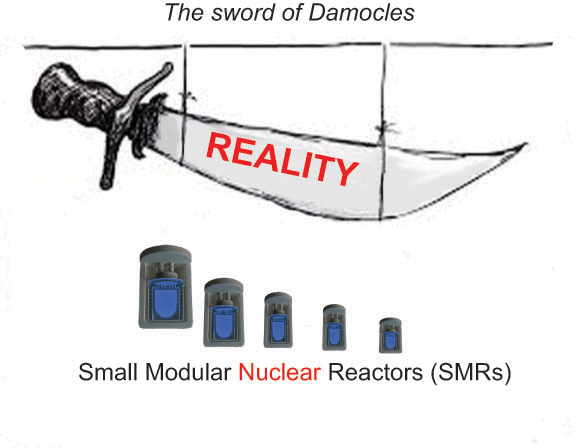
- Small modular reactors are seen as the future of atomic energy
- Russian seizure of atomic plant exposes safety vulnerabilities
By Jonathan Tirone, October 6, 2022, The Russian army’s seizure of the biggest nuclear power plant in Europe isn’t just exposing Ukrainians to the risk of an atomic accident but may also undermine plans to install new miniature reactors in far-flung places. ……… (subscribers only) more https://www.bloomberg.com/news/articles/2022-10-05/ukraine-war-shows-new-risk-to-nuclear-power-s-next-small-thing#xj4y7vzkg
NextEra Energy finds that small nuclear reactors (SMRs) really are the biggest boondoggle of all
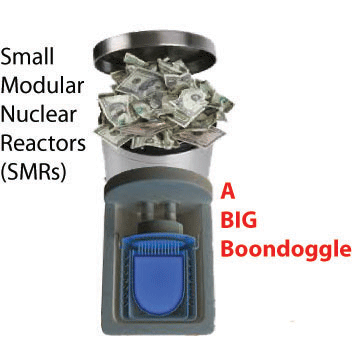
There were a couple of interesting developments in June in regards to electric power. One was that NextEra Energy issued its Investor Conference Report 2022 to its stockholders. Another was a paper from Stanford University, “Low-cost solutions to global warming, air pollution, and energy insecurity for 145 countries,” (LCS study) by Mark Z. Jacobson, et al. Looking into them is rather interesting.
The first of these makes very clear that in the opinions of the people running NextEra Energy, combustion
generating sources and nuclear power are getting too expensive. Furthermore, their opinion is that the most expensive of these, at least in the late 2020s, will be small modular nuclear reactors (SMRs).

We should make clear, just in case anyone doesn’t know, that NextEra is hardly anti-nuclear. While it is already the biggest investor in renewable energy in the US, it does own seven nuclear reactors, including the one at Seabrook. Electricity from new, near-firm solar and wind plants is a good deal less expensive than electricity from existing nuclear plants.
Let’s state this clearly: We are paying extra for electricity from nuclear plants, even after they have been paid down, and even though the sun can shine and the wind can blow almost all the time, because of really cheap battery storage. Put another way, it would be cheaper to close the nuclear plants and replace them with new renewable facilities.
Clean Technica 4th Oct 2022 https://cleantechnica.com/2022/10/04/why-should-we-pay-extra-for-nuclear-power/
Will Sizewell C nuclear really go ahead? EDF’s €60bn debt, and €52bn costs for French nuclear build.
When EDF board members joined a video call in late August to discuss a landmark UK nuclear project, they were instead treated to a stand-off between the utility’s outgoing boss and the French state. Rather than signing off the Sizewell C plant in Suffolk as Jean-Bernard Lévy had pushed for, the biggest French power producer’s controlling shareholder demanded more time to finish new audit reports and the meeting descended into acrimony, according to people familiar with the discussions.
“Some people didn’t understand what they were doing there and why there wasn’t going to be a decision on anything,” one of the people said. “It was messy.” The episode, one of several clashes at the company to have spilled into the open in recent months, will provide little comfort to Lévy’s successor, Luc Rémont, who is due to take over as chief executive and chair just as Paris executes a plan to buy out the 16 per cent of EDF it does not already own.
While the nationalisation clarifies the ownership structure, the company could still be subject to demands from the French state that have not always been in its immediate interest, including that it shield consumers from soaring energy prices. Big strategic questions on everything from Sizewell to renewable energy investments, meanwhile, still loom large.
Rémont, currently a senior executive at industrial conglomerate Schneider Electric, will need to solve
the group’s short-term problems while also preparing EDF to take on some of France’s biggest nuclear construction projects in two decades — a period when it has struggled to complete any on time or on budget.
The company’s electricity output is on course to reach all-time lows this year, after corrosion problems at the company’s nuclear plants added to maintenance stoppages and led to the outage at one point of more than half the French fleet of 56 reactors. That has strained supplies across Europe just as the region pivots away from Russian gas, while also turning France into a net power importer for the first time.
French officials have so far insisted that the Sizewell C plant in Britain will go ahead, adding that the state had commissioned extra audits simply to calculate the financial consequences of removing a Chinese state-backed company from the project.
But the government may eventually want to revisit some of its choices, bankers and union representatives close to EDF said, particularly as the group grapples with costly investments. By the end of this year, EDF’s
net debt is already forecast to swell to about €60bn, while its French construction programme alone could cost another €52bn.
FT 5th Oct 2022
https://www.ft.com/content/559ce578-fa0d-4bbe-9860-9d512b1510e1
Why We Need To Teach Nuclear War

Thoughtful teachers must be willing to educate their students slowly and honestly about the history of our nuclear past.
https://www.commondreams.org/views/2022/09/27/why-we-need-teach-nuclear-war BRIAN GIBBS, September 27, 2022,
We do not teach nuclear war, but we need to.
Make no mistake, the invasion of Ukraine is a nuclear-fueled conflict and students are ill-prepared to understand it. We need to be clear about this. Any military intervention by a nuclear power is a nuclear conflict. Russia threatened a nuclear retaliation if the United States became directly involved in the invasion of Ukraine; Sweden and Norway have asked for and been granted entrance into NATO placing increased pressure on Russia; and the New York Times reported that Russia is advancing on a nuclear reactor in Ukraine. It is a nuclear conflict.
The horror of nuclear war, an analysis of a country’s nuclear strategies and policies, not the immediate and active resistance to the creation, positioning and use of nuclear weapons is taught. Content standards, guidelines and textbooks discuss nuclear weapons little if at all. They typically describe the dropping of the two atomic bombs framing them as the only reasonable conclusion to World War II. Students have little background and understanding of nuclear weapons, their proliferation, or how they are used as threat and bargaining chip in every conflict and war since their introduction to the field of combat. During recent interviews several students indicated they were shocked when North Korea’s leader Kim Jung Un indicated that he was going to hit Guam with a missile strike. They had an assumption that nuclear strike capabilities were something from a time long ago.
Students were also disturbed when President Trump threatened North Korea with total annihilation from a U.S. missile strike. The students shared that they had a vague sense that other countries had nuclear weapons but indicated that they only time nuclear weaponry, tactics, or strategy were shared was as part of a short lesson focused on the dropping of the atomic bombs on Hiroshima and Nagasaki. Several students indicated that they were confused as they had thought there was only one atomic bomb dropped not two.
Though it may not seem like it, the teaching of war is a controversial topic in American classrooms. This is shocking as it is overwhelmingly the main topic in social studies standards, curriculum, and testing. War is often taught as something which occurred, is over, as something bad but necessary and is too often taught as parables of heroics by reluctant Americans. Little time is typically spent on the messy beginnings and endings of wars, examining the morality of them, or discussing the choices and decisions made by leaders and soldiers, and even more rarely, the actions of the always present anti-war movements. As the students suggested, nuclear war is taught even less. Often in a one-day lesson on the actions of the Enola Gay and Boxcar, the planes that dropped the two bombs or as background, almost a white noise to briefly learning about the Cold War.
There are several reasons for this. Teachers report feeling lack of support in the teaching of complex things. Teachers indicate that they feel enormous community pressure to not teach a more thorough, honest, and critical examination of war. Some teachers say that to critique a war in the past is to critique a war in the present and the soldiers involved. If they do this, they fear accusations of indoctrination and anti-American sentiment. This is mostly from more conservative ideological and political spaces, but teachers also report feeling a different form of pressure from schools situated in more left-leaning spaces. These parents do not want their children exposed to the horror of war even in high school. They seem to fear this examination of historical reality could damage or traumatize their children. This pressure to fail to offer robust examinations became ever more exacerbated during the polarization and America First approach of the Trump administration. Things which had not been seen as controversial have become controversial. As Diana Hess has pointed out (2009) things are not controversial on their own, but rather they become controversial because of time and community context and community interpretation of the issues.
Some if not much of our history is disturbing. This is particularly true of war. Much of the anti-Critical Race Theory legislation passing through state legislatures makes the argument that no student should be made to feel bad while learning history or studying literature. This is impossible without shading or obfuscating the truth or just outright lying to children. An authentic examination of our past will lead to students feeling things, likely bad over the enormity of what has been done. In the hands of thoughtful, capable teachers’ students can experience history honestly, have time to thoughtfully discuss, examine documents, and investigate, thinking about what happened and what could have happened. Also understanding that there has been and always will be resistance to the use of and expansion of nuclear weapons.
Fear of traumatizing students is a concern surfaced by teachers who choose to not teach honestly. This is a legitimate concern. With the rise of our awareness and understanding of trauma and generational trauma and how it affects our youth teachers are right to be concerned. Too often, this concern leads to avoidance which in turn leads to not teaching necessary topics. If we want our children to grow into strong participants in our democracy and thoughtful stewards of our world students need to be made aware of the world-ending disaster that could be just around the corner. As the Los Angeles Times reported American weaponry has been given to Ukraine under the rules that it be used to repel Russian forces in Ukraine, but not to attack Russian forces on Russian soil. The reason for this is clear. Use of American equipment in attacks on Russia would be seen by Russa as aggressive acts directly supported by the United States. Which could in turn lead to direct military involvement in the war by the United States. Though nuclear missiles might not be used if this conflict were to occur it would absolutely be a nuclear war.
Any conflict or military action by a nuclear power has the potential to quickly escalate and spiral into a nuclear conflict. Our children do not understand this fully and they will not understand it if we continue to avoid the topic. The only way to prevent this is for thoughtful teachers to educate their students slowly and honestly about the history of our nuclear past, including our use of the atomic bombs at the end of World War II. The alienation between the United States and the Soviet Union in the post-War World II era must be studied. So must the history of atomic weapons and the development of more advanced systems that continues to this day.
Students need to understand the aging and deteriorating state of the missiles and safety measures the United States and Russia have and the consequence of an accidental launch. Likewise, students need to understand the litany of nuclear treaties, non-proliferation pacts, and the deep history of citizen resistance groups that have and continue to resist the possession, testing of, and continued development of nuclear weapons. This knowledge, this understanding, when taught well, over time, through discussion and inquiry, in the hands of a thoughtful teacher can help empower rather than overwhelm students. Knowledge and understanding help dispel feelings of fear, more importantly it can help students at a young age begin to develop ways out and solutions for a more peaceful world.
The mission of most schools includes the creation of active and engaged humans prepared to help guide and change the world. This is as it should be. Part of this is honest and authentic examinations of our past and possible futures. This will allow students to develop into thoughtful adults who can make educated decisions about warfare, foreign policy, and nuclear war. It is absolutely necessary.
Nothing’s more important than avoiding nuclear war
Pearls and Irritations, Caitlin Johnstone , 5 Oct 22,
Avoiding nuclear war is the single most important agenda in the world. The single most important agenda in history. It is more important than your political faction. It is more important than how Vladimir Putin makes your feelings feel. It is more important than anything else.
Whenever I say this I always get some liberal saying “Some things are worth dying for” or some shit. Actually, no. Nothing, literally nothing, is worth the obliteration of all life on earth. It’s not worth gambling all terrestrial life to please your dopey egocentric fixations.
People who think nuclear brinkmanship is worth the risk either haven’t thought hard enough about what nuclear war is and what it would mean, or they just hate life and have some sick desire to see the end of everything. Either way they should be dismissed with extreme aggression.
If there’s one thing everyone should be able to come together on, it’s that every measure should be taken to avoid the end of everything. It is only because our civilisation is awash with war propaganda that this isn’t glaringly obvious to everybody.
That necessarily means de-escalation and detente. It means compromise. It means change. It means acknowledging what your side did wrong to bring us this close to the edge and taking drastic measures to change that and make sure it never happens again. It’s not egoically pleasing, but it’s necessary. More so than anything has ever been. Risking the annihilation of all terrestrial life is not worth the egoic gratification we get from our narratives about “winning” and “losing” and “good guys” and “bad guys”. This is infinitely more important than that.
Our civilisation is so backwards and insane that people will act like you’re the worst person in the world for saying we should try to avoid nuclear armageddon. I and many others have been screaming for years that US policy toward Russia is bringing us closer and closer to nuclear war; now we’re on the brink and the people we were screaming at are acting like we’re the assholes.
Two administrations ago the US had a president who mocked the idea that Russia was a primary rival and said Ukraine was a core interest to Russia but not the US, and liberals thought he was awesome. After four years of intelligence agency-driven narratives marrying Russia to Trump, liberals are now braying for World War III.
Before 2016 Democrats saw those who spent energy freaking out about Russia as weird, archaic cold warriors. Now they see anyone who doesn’t want war with Russia as a secret agent of the Kremlin. All because they were trained that Russia = Trump and therefore fighting Russia = fighting Trump.
Everyone’s anti-war until the war propaganda starts.
Real monsters don’t look the way we’re trained to expect. Those who’ll rape and hurt us are usually people we know and trust. The most murderous tyrants don’t look like Hollywood villains; they make jokes and praise freedom and democracy and shake your hand on the campaign trail.
Those who are causing the most death, oppression and misery in our world don’t resemble the Hitler-like monsters we’ve been trained to anticipate. They look friendly. They say things you agree with. Depending on their party, they might even ask you your pronouns. Meanwhile, Marvel supervillains have more depth and complexity than the one-dimensional characters the imperial spin machine concocts to represent its official enemies……………………………………………….. more https://johnmenadue.com/nothings-more-important-than-avoiding-nuclear-war/
1 This Month


Read the Public Inquiry Report, the Commissioners’ report, Surrendering Australia: The AUKUS Deception is available to download for free at aukuspublicinquiry.com. Or just watch the replay of the National Press Club Luncheon.



19 November – Webinar – The Reality of Reprocessing
Time: 11:00 AM Pacific Time (US & Canada) / 2:00 PM Eastern / 7:00 PM UK / 8:00 PM CET
Register for the Zoom Event Here



Shut down the radiation-damaged Heysham nuclear reactors now
To see nuclear-related stories in greater depth and intensity – go to https://nuclearinformation.wordpress.com

Say No to NASA’s Reckless Nuclear Reactor on the Moon
Say No to NASA’s Reckless Nuclear Reactor on the Moon
-
Archives
- November 2026 (119)
- October 2026 (302)
- September 2026 (339)
- August 2026 (330)
- July 2026 (355)
- June 2026 (287)
- May 2026 (306)
- April 2026 (356)
- March 2026 (251)
- February 2026 (267)
- January 2026 (308)
- December 2025 (358)
-
Categories
- 1
- 1 NUCLEAR ISSUES
- business and costs
- climate change
- culture and arts
- ENERGY
- environment
- health
- history
- indigenous issues
- Legal
- marketing of nuclear
- media
- opposition to nuclear
- PERSONAL STORIES
- politics
- politics international
- Religion and ethics
- safety
- secrets,lies and civil liberties
- spinbuster
- technology
- Uranium
- wastes
- weapons and war
- Women
- 2 WORLD
- ACTION
- AFRICA
- Atrocities
- AUSTRALIA
- Christina's notes
- Christina's themes
- culture and arts
- Events
- Fuk 2022
- Fuk 2023
- Fukushima 2017
- Fukushima 2018
- fukushima 2019
- Fukushima 2020
- Fukushima 2021
- general
- global warming
- Humour (God we need it)
- Nuclear
- RARE EARTHS
- Reference
- resources – print
- Resources -audiovicual
- Weekly Newsletter
- World
- World Nuclear
- YouTube
-
RSS
Entries RSS
Comments RSS

