Fires break out in exclusion zone around Chernobyl nuclear plant
Arpan Rai & Maira ButtFriday 08 May 2026, https://www.independent.co.uk/bulletin/news/chernobyl-fires-radiation-russia-ukraine-b2973234.html
A forest fire burns in the exclusion zone around the Chernobyl nuclear power plant (AP)
- Russia has said it is carrying out enhanced radiation monitoring after fires broke out in the exclusion zone around the Chernobyl nuclear power plant on Friday.
- The country’s national public health agency said that enhanced radiation monitoring was being conducted and the situation was now “stable”.
- The 1986 Chernobyl disaster is considered to be the world’s worst civil nuclear accident.
- It spread Iodine-131, Caesium-134 and Caesium-137 across parts of Ukraine, Belarus, Russia, northern and central Europe.
- Meanwhile, Ukraine has continued its long-range attacks on Russia with a drone strike one of the country’s largest oil refineries, located in Yaroslav
Fears Royal Navy nuclear submarine docks will be built overseas
A multibillion-pound nuclear submarine maintenance contract is at risk of
being awarded to a foreign shipyard, despite safeguards that normally
dictate that high-security work must be performed at secure sites in the
UK. The Ministry of Defence is preparing to kick off a tender for the Royal
Navy’s Additional Fleet Time Docking Capability (AFTDC) programme to build
floating dry docks that are pivotal to national security. The scheme would
double the availability of nuclear submarine docks at HM Naval Base Clyde.
The new docks would allow concurrent dry-dock maintenance of two submarines
at the base, also known as Faslane.
Times 9th May 2026,
https://www.thetimes.com/business/companies-markets/article/royal-navy-nuclear-submarine-docks-programme-euston-v22btzbm3
‘The odds are not in our favour’: who sets the Doomsday Clock – and what can they tell us about the future of humanity?

because nuclear bombs have not been used since 1945, the public has developed a false sense of security. We don’t like to contemplate the role played by luck. “We’ve been lucky, because the odds are not in our favour. The more weapons that exist, for longer, the more likely it is something will go wrong,”
Guardian Sophie McBain, Sat 9 May 2026
The Earth is getting hotter. Conflicts are raging, in the Middle East and Ukraine, each increasing the chance of nuclear war. AI is infiltrating almost every aspect of our lives, despite its unpredictability and tendency to hallucinate. Scientists, tinkering in labs, risk introducing new, deadly pathogens, more destructive than Covid. Our pandemic response preparedness has weakened. The Doomsday Clock – a large, quarter clock with no numbers, keeps ticking, counting down the seconds until the apocalypse. Tick. Tick. Tick. In January, we reached 85 seconds to midnight. Experts believe humanity has never stood so close to the brink.
“What we have seen is a slow almost sleepwalk into increasing dangers over the last decade. And we see these problems growing. We see science advancing at a rate that defies our ability to understand it, much less control it,” says Alexandra Bell, CEO of the Bulletin of the Atomic Scientists, the organisation that sets the Doomsday Clock. She speaks of the “complete failure in leadership” in the US and other countries, which are doing little to address global, catastrophic threats, even as they feed into one another. Climate change increases global conflict, for instance, and the incorporation of AI into nuclear decision-making is, frankly, terrifying.
Bell speaks over video call from her office in Washington DC, which is decorated with a huge world map, Day of the Dead cushions and a framed print of Barbie superimposed on to a mushroom cloud – a gift from a colleague in response to the Barbenheimer phenomenon, because in this field it helps to have a sense of humour.
Bell, who has spent much of her career working on nuclear arms control, believes that because nuclear bombs have not been used since 1945, the public has developed a false sense of security. We don’t like to contemplate the role played by luck. “We’ve been lucky, because the odds are not in our favour. The more weapons that exist, for longer, the more likely it is something will go wrong,” she says – though she’s quick to add that diplomatic disarmament and peace-making efforts also played a big role……………………………………………………………………………………………………………………………………………………………………………………………………………………………………………………………….. 2026: Inching to doomsday. It’s 85 seconds to midnight
In January, the clock was set to 85 seconds to midnight, the closest it has ever been. Within four weeks, the AI expert Gary Marcus argued on the Bulletin’s website that humanity was already “significantly closer to the brink”, after a showdown between AI developer Anthropic and the White House revealed Trump’s determination to have unrestricted military access to AI. A recent study found that in simulated war games, leading AIs from OpenAI, Anthropic and Google opted to use nuclear weapons 95% of the time.
Two days later, the US and Israel began bombing Iran, raising the risk of nuclear war. “Further escalation or expansion of the conflict could lead to actions driven by miscalculation, misperception or madness, as President Kennedy once said,” warned Alexandra Bell, who succeeded Bronson as president of the Bulletin in 2025. From the start, she worried about the lack of a plan to secure Iran’s nuclear materials, and that other countries would conclude that having nuclear weapons is the only way to maintain their security…………………………………………………………………………………………………………………………………… https://www.theguardian.com/science/2026/may/09/doomsday-clock-ai-iran-ukraine-war-climate-breakdown-nuclear-apocalypse
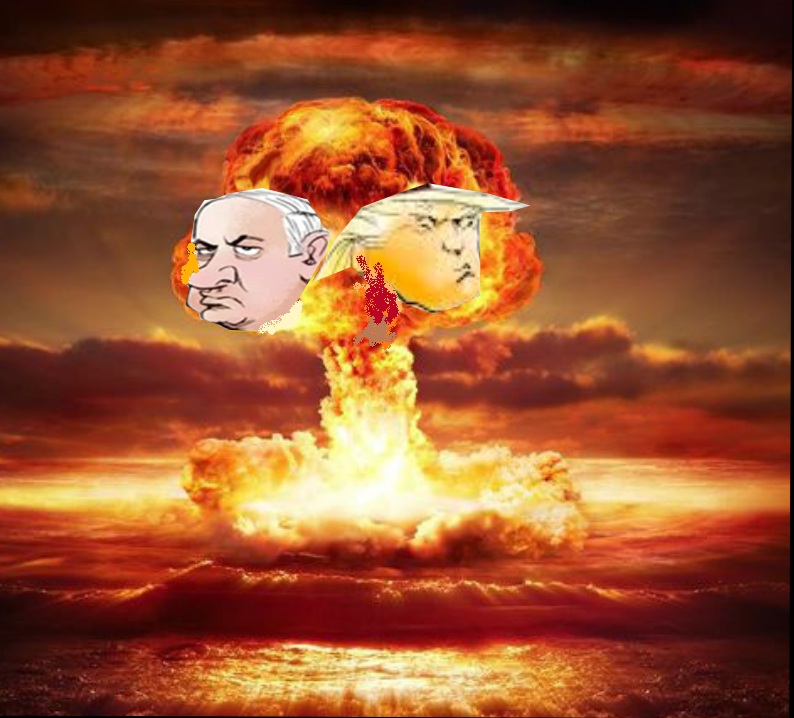
Will Trump’s failed Iran war provoke his break from Netanyahu’s ironclad grip?
10 May 2026 AIMN Editorial – Walt Zlotow, West Suburban Peace Coalition Glen Ellyn IL, https://theaimn.net/will-trumps-failed-iran-war-provoke-his-break-from-netanyahus-ironclad-grip/
On Iran war day 71 it’s clear Trump has not only lost his war, he’s blundered the world into a looming economic catastrophe. As horrendous as that is, it wasn’t even Trump’s idea. Trump was simply following orders from his real boss, Israeli Prime Minister Benjamin Netanyahu. On February 11, Netanyahu arrived at the White House with Mossad Director David Barnea. They encouraged – if not demanded – invasion. The Netanyahu-Barnea tag team argued Iran would collapse within a couple of days from a combination of assassinating Iran’s leader Ali Khamenei, massive bombing, Mossad-fomented civil unrest and ground incursions by Kurdish fighters.
That couple of days has morphed into 71 days of arguably the greatest military disaster in US history. Instead of collapsing within a couple of days, Iran retaliated against the massive US, Israeli bombing onslaught with their own. Result? All 13 US bases in the neighboring Gulf States are damaged or destroyed. Gulf States infrastructure has suffered massive damage. So has Israel, suffering its worst bombing in its 78 years.
Worst of all, Iran shut down the Strait of Hormuz, choking off a fifth of world oil supply which may cause a worldwide recession, if not depression. The Netanyahu-Barnea presentation was a blizzard of lies Trump swallowed whole in spite of Intelligence assessments to the contrary.
As the world careens toward economic catastrophe, Trump is completely out of options to achieve any of his war goals. Check that. Friday he alluded to striking Iran with nuclear weapons. Trump told reporters on whether the ceasefire if off: “If there’s no ceasefire you’re just going to have to look at one big glow coming out of Iran.”
Assuming he either doesn’t order nuclear strikes, or his military commanders disobey this directive to do so, Trump is facing the worst military defeat in America’s 250 years, all brought on by his fealty to Benjamin Netanyahu. What motivated Trump’s caving to the Israeli Prime Minister? Was it the hundreds of millions in campaign cash showered upon Trump and his Republican Congress? Was it the ‘Epstein Button’, damaging evidence related to the Epstein pedophile enterprise that Trump dare not risk being exposed? Is Trump simply an ardent Zionist believing that any Israeli murder and mayhem to further Israeli expansion and Middle East dominance is worthy of Trump’s enabling?
While we’ll likely never know, Trump must be contemplating the enormity of the disaster he’s inflicted on the Middle East, and very soon the US and entire world. The one benefit that may result from Trump’s immoral, criminal war is he may be rethinking his special relationship with the man who brought on the greatest calamity of his life, Benjamin Netanyahu. Trump needs to truly become the peace president he campaigned to be in 2016. He can do that by quitting his senseless and lost Iran war. He needs to jettison his subservience to Netanyahu’s vision of Greater Israel. He needs to cut off all US military aid to Israel till Netanyahu or his successor end the genocide in Gaza, near genocide in Lebanon and quest to destroy its hegemonic rival, Iran.
If Trump refuses to do the right thing, events on the battlefield and the world economy may push Trump aside and hopefully implement that peace initiative without him.
Christiane Amanpour Lays Out Her Fear for CNN With Blistering Attack on David Ellison’s CBS ‘Realignment’
David Gilmour, May 6th, 2026, https://www.mediaite.com/media/tv/christiane-amanpour-lays-out-her-fear-for-cnn-with-blistering-attack-on-david-ellisons-cbs-realignment/
Veteran CNN journalist Christiane Amanpour pointed to the “ideological realignment” at CBS News on Wednesday as she expressed her “concern” at what her own network might look like under the oversight of incoming owner David Ellison.
Speaking in London at the Truth Tellers Sir Harry Evans Investigative Journalism Summit on Wednesday, Amanpour voiced “concern” over Ellison’s influence on CBS News and what it potentially meant for CNN as his Paramount Skydance acquisition of the network’s parent company, Warner Bros. Discovery, moves forward.
The deal would place Ellison, the son of Oracle co-founder and Trump donor Larry Ellison, in control of the network where Amanpour has worked since 1983, alongside CBS News, which has already undergone sweeping changes under Paramount and Skydance leadership.
“[Defense Secretary] Pete Hegseth, the world’s favorite frat boy supremo, has said that the sooner David Ellison owns CNN, the better. And CNN has become this sort of lightning rod, hasn’t it, for this administration?” asked moderator Emily Maitlis, as the topic of corporate ownership takeover came up. “Does it change what you do? Do you fear what is coming at you now in terms of a change?”
“Clearly I’m concerned, and I’m not sure how much I’m allowed to say about a corporate thing that’s underway, but I am, obviously, as a person, as a journalist with a record, concerned,” Amanpour said. “And I’m concerned based on what’s happened to the other things that he’s taken over already like CBS News right? I mean, do I have to list what’s happening there?”
Amanpour then delivered a blistering takedown of the CBS News under Ellison’s leadership.
“I mean hemorrhaging viewers, probably hemorrhaging money, this ideological realignment of CBS and the destruction potentially of 60 Minutes,” she said.
In a passionate case for 60 Minutes, she praised the show as “one of literally the legacy” programs in American television journalism, adding: “Nobody can match 60 Minutes for a brilliant television magazine show that’s been doing hard news and cultural news, and for decades and decades.”
The comments come amid mounting scrutiny over the future editorial direction of major news outlets as billionaire-backed consolidation reshapes the media landscape.
Amanpour suggested staff at CNN were anxious about preserving newsroom autonomy under new ownership.
“I would like to think that we would have the very basic, which is editorial independence, I’m hoping for that,” she said. “I know many of us at CNN are incredibly – including leadership – are very, very committed to that clearly.”
Covert NATO initiative turns film into anti-Russia battleground
The Grayzone and Kit Klarenberg, May 10, 2026
A scandal has erupted over covert NATO conferences with the Western entertainment industry. Leaked documents reviewed by The Grayzone show how NATO has sought to infiltrate film and TV for decades, with UK intel operatives taking the lead.
On May 3, The Guardian revealed that NATO has held a series of secret meetings with film directors, screenwriters and TV producers in cities from Paris to Los Angeles. The disclosure suggests NATO is seeking to employ the entertainment industry in its propaganda operations as a European war looms.
To date, NATO’s “conversations” with scriptwriters have reportedly “inspired, at least in part” three separate unstated projects, which are already in development. At a forthcoming London summit, NATO operatives are set to meet with screenwriters tied to the Writers’ Guild of Great Britain (WGGB). In email correspondence, the union told its members the event will focus on the “evolving security situation in Europe and beyond.”
Organizers claim NATO was “built on the belief that cooperation and compromise, the nurturing of friendships and alliances, is the way forward.” The alliance is actively seeking to influence film and TV projects extolling this mantra, stating, “even if something so simple as that message finds its way into a future story,” as a result of the meeting, “that will be enough.”
But collusion between NATO and the entertainment industry has a well-established history. Over recent decades, NATO has covertly sought to employ film and television creatives as psychological operations specialists, while influencing popular culture. A core driver of this push has been Chris Donnelly, a veteran British Ministry of Defence and military intelligence operative, who led alliance expansion into Central and Eastern Europe during the 1990s.
Donnelly later developed the Integrity Initiative to cultivate support for conflict with Russia through covert networks of influential pro-war pundits and operatives. Hidden behind a seemingly legitimate think tank called the Institute for Statecraft, the Integrity Initiative only became known to the public after independent outlets like The Grayzone reported on leaked emails from Donnelly revealing its existence.
In leaked documents discussing NATO expansion, Donnelly stated, “What I needed in the 1990s and did not have” was a major international public relations firm to “scale up successful activities to have real impact,” and achieve “essential behavioural change” in audiences. To address the problem, he proposed “advertising campaigns on TV promoting change, a TV soap opera looking at the problem of corruption” and other innocent-seeming cultural products aimed at enhancing NATO control.
Donnelly expanded NATO – often against significant public opposition – in the former Soviet Union, Warsaw Pact and Yugoslavia by penetrating target countries’ governments, militaries and even religious institutions. This ensured a NATO-friendly lobby on the streets, and throughout corridors of power, across the region. This experience was fundamental to Donnelly’s founding of now-defunct ‘charity’ the Institute for Statecraft. Through its subsidiary Integrity Initiative, the Institute constructed clandestine nexuses of journalists, academics, and military and intelligence operatives throughout the Western world, known as “clusters”.
These networks could be mobilized to spread pro-NATO propaganda, and encourage public and state-level antagonism towards Russia. Integrity Initiative played a not insubstantial role in laying the Ukraine proxy war’s foundations. An essay published on the Institute’s website in July 2014 by MI6-connected academic Victor Madeira openly laid out this objective, declaring “economic boycott, breach of diplomatic relations” and “propaganda and counter-propaganda” could produce “armed conflict of the old-fashioned sort” with Moscow, “that Great Britain and the West could win.”
In a leaked Institute file, Madeira discusses precisely the kind of “propaganda and counter-propaganda” he meant. “We’ll need to go beyond old-style military ‘romps’ and get entertainment ‘outputs’ that draw out the nature of 21st-century conflict: diffuse, across society, without clear boundaries at times,” he wrote. “That’s the real fight we’re fighting; we can more than hold our own on the military side of things.”
Popular TV show ‘McMafia’ influenced by British intelligence
In February 2018, a veteran writer on US state cultural policy and public diplomacy named Martha Bayles emailed Donnelly to pitch a “multi-episode, multi-season dramatic television series” about Russia in the 1990s. Bayles pointed to a US-UK co-production called McMafia as an example of the “commercial and cultural dominance” of long-form TV with “an avid following among young and old alike.” The widely-watched program drew on former BBC World Service reporter Misha Glenny’s 2008 non-fiction book of the same name………………………………………………………………………………………………………………..
Donnelly and the British military-intelligence veterans who staffed his now-defunct Institute for Statecraft were hard at work weaponizing popular culture to drive public hostility to Russia. In January 2018, the British state broadcaster interviewed a staffer at Donnelly’s Institute, Euan Grant, about “the impact of suspect Russian money” on London, as part of BBC wider series enquiring “How Real is McMafia?”………………………………………………………………………………
As part of the proposed collaboration, NATO would be granted “input” into the show’s script. At the time, the Institute for Statecraft was the British representative of NATO’s Atlantic Treaty Association, a “community of policy-makers, think tankers, diplomats, academics and representatives from industry.” The organization described its mission as “inform[ing] the public of NATO’s role in international peace and security and promote democracy, individual liberty and the rule of law through debate and dialogue.”
Western popular culture infiltrated by NATO for years
Leaked files show Grant masterminded a dedicated Institute project countering supposed “Russian destabilisation” of “international financial sectors.” Contacts in journalism and the arts provided an ideal delivery mechanism. He argued the broadcast of popular TV shows and films referencing Russian organized crime provided an extraordinary propaganda bonanza for the British military-intelligence apparatus, potentially exposing millions of Westerners to anti-Russian programming……………………………………….
In other leaked documents, Grant strategized a covert propaganda blitz to expose how the NATO protectorate of Moldova was supposedly “exploited” by Moscow, for “building Russian and Russian speaking influence in EU, EU applicant and Eastern Partnership countries.” He noted how recent Hollywood films and the smash French drama series Spiral had featured “Moldovan linked” plotlines, providing “opportunities” to Institute for Statecraft propagandists. He suggested the BBC “might also be interested” in covering recent books about Russian organized crime, “set in Moldova.”……………………………………………………………………………………………………………………………..
Were these top serials demonizing Russia organic products?
It is uncertain which recent Western cultural productions have resulted from NATO’s covert meddling. However, inexplicably timed historical dramas in recent years, featuring highly negative portrayals of Russia and Russians, raise serious questions……………………………………………………………………………………………………………………………………………………………………………………………………………. https://thegrayzone.substack.com/p/covert-nato-initiative-turns-film?utm_source=post-email-title&publication_id=474765&post_id=197028664&utm_campaign=email-post-title&isFreemail=true&r=4ds0bd&triedRedirect=true&utm_medium=email
The AI Mythos: If We Can Destroy the World, Imagine What We Can Do for Your Hedge Fund
Jim Naureckas, May 8, 2026, https://fair.org/home/the-ai-mythos-if-we-can-destroy-the-world-imagine-what-we-can-do-for-your-hedge-fund/
You ever wonder why people who make AI talk about how AI might destroy humanity—but still keep making AI? Brian Phillips of the Ringer (5/6/26) has a plausible explanation.
Writing about Anthropic’s announcement that it wasn’t going to release a new product, Claude Mythos, to the public because it was too dangerous, Phillips notes:
The AI industry has been driven from the beginning by wildly overwrought claims, many of them pertaining to the destructive potential of its products. Too dangerous to release to the public is a move the industry has pulled before
It may seem like a strange tactic for companies to scaremonger about their own products. When Ford rolls out a new pickup truck, the CEO generally doesn’t go around giving keynote addresses about how much more lethal it will make American highways. But the AI industry is selling a narrative—a mythos, if you will—as much as it’s selling a product, and that narrative is one of revolutionary, transformational power. “Our product can make your life a bit easier, although there are still a lot of kinks to iron out” is not a trillion-dollar sales pitch; “we’ve invented something so powerful that it has the potential to destroy humanity” is.
In this read, apocalyptic narratives about AI are largely if not entirely designed to justify more investment in a technology that has already sucked up so much money that analysts wonder if it will ever show a profit:
Think about the way the industry talks about itself. AI isn’t just another tech gizmo. It’s bigger than the internet. It’s bigger than the smartphone. It’s going to reshape human society. It’s going to put millions out of work. It’s going to eliminate money. It’s going to surpass human intelligence. It’s going to replace humans altogether. It’s going to kill all humans. It’s going to be profitable beyond your wildest dreams, at least at some point, although definitely not today.
This serves, says Philips,
products thus far have been largely underwhelming. If the integration of AI into Google Search had been rolled out quietly and evaluated on its merits, it would have gone down as one of the most disastrous tech launches of all time. Your only job is to give me accurate information; you did a decent job of it yesterday, and today you’re telling me to put glue on pizza? But when the same rollout comes slathered in hype—when I’ve been conditioned to experience it as part of a narrative about civilizationally transformative technological innovation—I’m less likely to judge it on its merits, because even its shortcomings can be reframed as marks of the disruptive nature of progress.
And this is why it makes sense for Anthropic to talk about how their latest creation could destroy the internet: If it’s that powerful, maybe it’s worth giving its creators $1 trillion (which is what it’s hoping to raise in an IPO), in hopes that you’ll own a piece of that power:
The tendency of AI companies to talk about the dangers of their products may make people hate the industry (and people really hate the industry). But it also keeps people from saying, “This is kind of neat, I guess? But it’s super buggy and not all that useful.” The Mythos announcement can be understood in that light: It might make people leery of Anthropic, but it makes Mythos seem like a huge deal, which is ultimately what Anthropic wants.
Note that in the nerd culture that dominates Silicon Valley, the first association with the word “mythos” is the Cthulhu Mythos, a series of horror stories about an alien monster that will one day destroy humanity. That’s very on brand.
Israel targets southern Lebanon with internationally banned phosphorus shells
May 5, 2026 , https://www.middleeastmonitor.com/20260505-israel-targets-southern-lebanon-with-internationally-banned-phosphorus-shells/
The Israeli army shelled towns in southern Lebanon with phosphorus munitions Tuesday, according to the National News Agency NNA.
The agency reported that the towns of Kounine and Beit Yahoun in the Bint Jbeil district were targeted with artillery shells containing phosphorus, which are banned internationally.
Israeli warplanes separately carried out airstrikes on the towns of Kafra, Braachit and Safad al-Battikh in the Tyre district, said the report.
Additional strikes hit Beit al-Sayyad and Mansouri, where three raids targeted residential homes, according to the agency.
No casualties were reported.
Despite a ceasefire that was announced April 17 and extended until May 17, the Israeli army continues daily strikes in Lebanon and widespread demolition of homes in dozens of villages.
Lebanon’s Health Ministry said Tuesday that the death toll from Israeli attacks since March 2 has reached 2,702, with 8,311 injured.
Press groups demand records on potentially corrupt Paramount acquisitions
May 7, 2026 / Freedom of the Press Foundation, https://freedom.press/issues/press-groups-demand-records-on-potentially-corrupt-paramount-acquisitions/
New York, May 7, 2026 — Today, Freedom of the Press Foundation (FPF) and Reporters Without Borders, Inc. demanded records from Paramount Skydance Corp. regarding potentially corrupt acquisitions and deals that could result in relinquishing editorial control of major news outlets to the Trump administration. Public reports suggest that David Ellison and his father Larry may have tried to secure regulatory approval to acquire Paramount and now Warner Bros. Discovery by, among other things:
- Making a “side deal” to settle President Trump’s spurious lawsuit against “60 Minutes” by providing $15 million to $20 million worth of free advertising.
- Installing a pro-Trump GOP donor without journalism experience as “ombudsman” at CBS News to evaluate complaints of “bias” and to eliminate all diversity, equity, and inclusion practices.
- Promising to make “sweeping” changes to CNN, and to potentially fire anchors and commentators whom Trump dislikes.
Since Paramount Skydance announced its most consequential Trump-friendly changes at CBS News in October — acquiring The Free Press and appointing Bari Weiss as editor-in-chief — the company’s market capitalization has decreased by 40%, wiping out more than $8 billion in shareholder value. Ratings for key programs, like “CBS Evening News with Tony Dokoupil,” have also dropped precipitously. Freedom of the Press Foundation and Reporters Without Borders, which are both shareholders in Paramount Skydance Corp., are entitled to inspect the company’s books and records related to these developments under Section 220 of the Delaware General Corporation Law.
“Shareholders are entitled to know when the government uses its leverage over corporate transactions as a backdoor to meddle in editorial decisions that the First Amendment leaves to the press,” said Seth Stern, chief of advocacy at Freedom of the Press Foundation. “Larry and David Ellison’s capitulation not only harms the public and our democracy, it hurts Paramount by producing news shows people don’t want to watch and tanking the reputations of news outlets in order to appease Trump. If the Ellisons can’t stand up to their friends in the administration and defend the First Amendment, they should stay away from the news business.”
“We need to know what the Ellisons may have promised the president to secure these deals,” said Clayton Weimers, executive director of Reporters Without Borders, Inc. “This acquisition has all the warning signs of a political capture. The American public deserves to know whether the Ellisons are sacrificing editorial independence to appease Donald Trump and secure regulatory approval from an administration that is openly hostile to press freedom.”
“Our clients are entitled to the same records as any other shareholder in Paramount, and legally, the company must comply,” said Brendan Ballou, CEO of the Public Integrity Project. “If Paramount fails to do so, we are prepared to vindicate our clients’ rights in court.”
Under Delaware law, Paramount has five business days to respond to the shareholders’ request. Freedom of the Press Foundation and Reporters Without Borders are being represented by the Public Integrity Project and Ron Poliquin of The Poliquin Firm.
Please email Seth Stern (seth@freedom.press) for any follow-up questions or inquiries.
The ongoing Fukushima nuclear disaster 15 years on: a photoessay
Peace and Health Blog. International Physicians for the Prevention of Nuclear War Tilman Ruff, April 2, 2026
It is now 15 years since the Great East Japan Earthquake on 11 March 2011—and the tsunami it generated—wrought havoc on the Fukushima Daiichi Nuclear Power Plant (FDNPP). A predictably dangerous plant design, a corrupt and negligent operator, and Japan’s incestuous and corrupted ‘nuclear village’ involving collusion and revolving doors between government, regulator and operators, combined in a lethal mix.
The myth that a nuclear disaster couldn’t happen in Japan and therefore didn’t need to be prepared for continues to exact a high toll. The Fukushima Nuclear Accident Independent Investigation Commission, the only such body ever established by the National Diet of Japan, concluded that:
“It was a profoundly man-made disaster – that could and should have been foreseen and prevented. … a multitude of errors and willful negligence that left the Fukushima plant unprepared for the events of March 11.” “… Bureaucrats … put organisational interests ahead of their paramount duty to protect public safety.”
The accident “was the result of collusion between the government, regulators and TEPCO … They effectively betrayed the nation’s right to be safe from nuclear accidents.”
“The Commission concludes that the government and regulators are not fully committed to protecting public health and safety”.
Despite this clear and damning indictment, the highest courts in Japan have acquitted Tokyo Electric Power Company’s (TEPCO) top executives and have not held the government accountable. No TEPCO executive or government official is in prison because of a huge and ongoing disaster they could and should have prevented.
The 40th commemoration of the Chernobyl nuclear disaster on 26 April this year provides another sombre milestone to reflect on humanity’s flirtation with the most hazardous technology ever invented, intimately linked with weapons that pose the most acute existential threat to the biosphere.
While both national and prefectural governments seek to present the Fukushima disaster as effectively over and the region being open for business, the resulting catastrophe is far from over. A visit to Japan in late 2025 provided a valuable opportunity to visit Fukushima for the sixth time since the disaster and learn from those grappling with the ongoing challenges to health, livelihoods and rebuilding a sustainable future in the regions affected by the disaster, which extend far beyond the boundaries of Fukushima Prefecture, even though government programs to address the disaster’s aftermath focus exclusively on Fukushima.
Because ‘luckily’ half the radioactive caesium (Cs) released by the reactor meltdowns and explosions is Cs-134, with a two year half-life, rather than the 30 year half-life of Cs-137 which makes up the remainder of the caesium released, the initial decline in residual radioactivity, to which caesium is the dominant contributor, has been faster than following the Chernobyl disaster.
The multiple damaged nuclear reactors and spent fuel pools at Fukushima Daiichi are far from stable, and decommissioning as planned by TEPCO is barely progressing and looks increasingly unfeasible. Just 0.9 grams of fuel debris has been able to be removed to date, in two removals three years later than scheduled, while 880 tons remain with no plans yet for how to remove the bulk of this material. In addition, 1,007 tons of spent fuel remain in the spent fuel pools at Units 1 and 2. The melted reactors with spent fuel pools resting above them have been severely structurally damaged. In reactor 1 for example, robotic cameras have revealed that the concrete of the pedestal which supports the reactor has melted all the way around, exposing the internal reinforcing bars now providing effectively the only structural support. These damaged structures have heightened vulnerability to further earthquake and tsunami damage.
A major independent international assessment of a kind that Japan has resisted to date is warranted to assess the best means to address this extremely challenging, highly radioactive mess to order to most effectively and expeditiously secure the site as much as possible from further fires, meltdown or criticality events, further tsunami or earthquake damage, and ongoing or escalating release of radioactive materials. While it may be feasible and challenge enough to remove the fuel remaining in the spent fuel pools above Units 1 and 2, rather than stubbornly persisting with decommissioning plans going nowhere, aiming to stabilise the damaged fuel in the reactors so that active cooling is no longer required, and establishing durable physical encasement of the damaged facilities on all sides deserve more thorough consideration.
Decontamination and redistribution
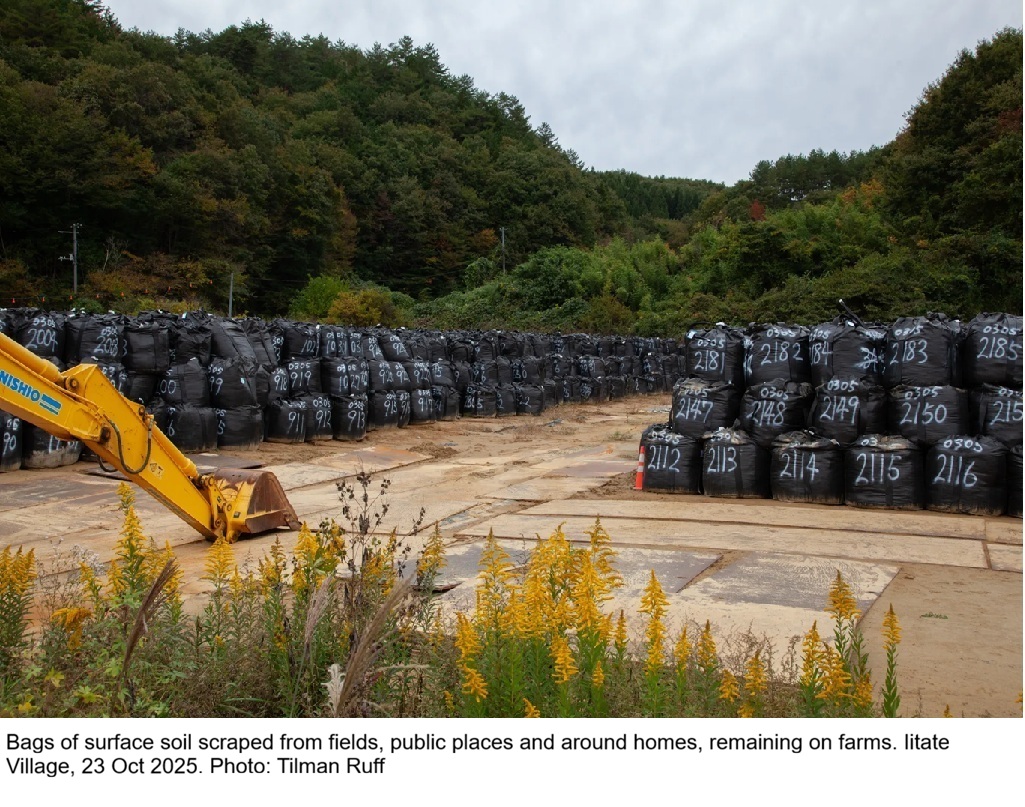
Extensive decontamination by scraping away the upper 5 cm of surface soil for 20m around houses, in fields and gardens, in schools, childcare centres, parks and public gathering places, resulting in the accumulation of 14 million m³ of contaminated soil, has denuded areas and reduced fertility of agricultural land, but has had some useful effect in reducing radiation exposure to residents and contamination of vegetables grown in decontaminated areas. Use of potassium-rich fertiliser has also contributed to reducing caesium absorption by crops. However, forested areas, which comprise 70% of Fukushima, particularly covering hills and mountains which received higher fallout than valleys and low-lying areas, act as reservoirs of radioactivity, which is constantly washed down by rain and snow to flatter and lower-lying areas where people’s homes, farms, paddies and fields lie, and also washes into estuaries and beach sands. This contributes to patchiness and high variability of contamination at a local level, and hence the importance of localised and ongoing measurement.
Hot caesium-laden particles
An important discovery was made by Japanese geochemists, particularly Satoshi Utsunomiya, that caesium-rich microparticles 2-3 microns in diameter, small enough if inhaled to be retained in the alveoli of the lung, were not only widely present in hotspots in Fukushima, but also widely deposited in Tokyo on 15 March 2011, when the most intensely radioactive fallout cloud passed over Tokyo following the explosion of the Unit 3 reactor.
These particles, assessed to be formed by the interaction of molten reactor fuel with concrete surrounding and supporting Fukushima Daiichi reactors 1 and 3, are intensely radioactive, more so than spent nuclear fuel. Contrary to conventional assumptions about the highly soluble nature of caesium and therefore (as a potassium analogue) its even dispersal in organisms and organs, these particles are insoluble, meaning they can deliver a much greater localised radiation dose to surrounding cells, and for a longer period. The main scientific publication of these findings was delayed some years because of academic infighting and political sensitivity. Their significant implications for human radiation exposures and radiation protection related to the Fukushima disaster, including the identification and isolation of radioactive hot-spots, have hardly been explored.
Public health and safety continue to be sidelined
National and regional government policies are still negligent in failing to prioritise public health and safety. In the early weeks after the disaster, the Japanese government, arbitrarily and without scientific justification, increased the maximum permissible radiation exposure for a member of the public from 1 to 20 mSv per year. This unacceptably high level is still in place, 15 years later, as the basis for government policy, including clean-up standards and the designation of areas suitable for residents to return to and ending their eligibility for government support. No other government has accepted such a continuing high radiation level for its population, including the most vulnerable, particularly children. The government is now even countenancing some return to areas where doses estimated to be received are up to 50 mSv/yr.
The Japanese government also continues other weakened protection standards, for example before the disaster, waste and soil with radioactivity more than 100 Bq/kg was regarded as strictly controlled waste, whereas since the disaster, soil which is contaminated up to 8000 Bq/kg has been classified as suitable to be treated as ordinary waste, suitable for incineration and reuse in construction works around the country.
In August 2023, Japan began discharging processed radioactive Fukushima wastewater into the Pacific Ocean. As of 22 Dec 2025, according to TEPCO, 127,000 m3 of contaminated water has been dumped, containing about 31.2 TBq of tritium. Such discharges are planned to continue for at least 30-40 years, in breach of Japan’s obligations under the UN Convention on the Law of the Sea, which expressly prohibits ocean dumping of radioactive waste. This will no doubt include not only the 1.4 million m3 of wastewater already accumulated, but contaminated wastewater which continues to accumulate for the forseeable future, at a current average of 50 m3/day, containing a raft of radioactive contaminants. Alternatives such as prolonged storage in purpose-built large tanks, or incorporating treated wastewater into concrete for underground construction use, were given no serious consideration.
An epidemic of thyroid cancer in children ……………………………………………………………………………………………………………………………………………………………………………………………………………………………………………… https://peaceandhealthblog.com/2026/04/02/the-ongoing-fukushima-nuclear-disaster-15-years-on-a-photoessay/#more-7185
America’s Suicide Pact

Trump is not an outlier. He is the naked, stripped-down expression of this suicidal pact. He does not pretend the system he inherited works. He lies with less finesse. He crassly enriches himself and his family. He speaks in crude vulgarities. He dismantles any government agency dedicated to the common good, including the Environmental Protection Agency, the Department of Education and the U.S. Postal Service. But he embodies what came before him, albeit without the liberal façade.
America’s suicidal march began long before Donald Trump. Trump and the buffoons around him are the inevitable final chapter of the decaying empire.
Chris Hedges, May 9, 2026 , https://scheerpost.com/2026/05/09/americas-suicide-pact/
Civilizations, as the historian Arnold J. Toynbee famously argued, “die from suicide, not by murder.” They collapse from within. They fall prey to moral, social and spiritual decay. They are seized by a parasitic ruling class. Democratic institutions seize up. The citizenry is immiserated, wealth is funneled upwards to the ruling class and coercion is the principle form of control.
Our suicidal march began long before Donald Trump and his bizarre court of buffoons, sycophants, grifters and Christian fascists took power. It began when the ruling class, especially under the Reagan and Clinton administrations, set out to harvest the country and empire for personal profit.
There is a word for these people. Traitors.
These traitors, ensconced in the leadership of the two ruling parties, stripped us of assets and power slowly. They used subterfuge, lies and legalized bribery. They pretended to honor electoral politics, checks and balances, a free press and the rule of law while subverting all of these democratic pillars. That old system, however flawed, was hollowed out. It was turned over to the amoral and the idiotic — look at the Supreme Court or Congress — those willing to do the bidding of the billionaire class.
Armed with billions by the mortal enemy of the demos — the oligarchs and corporations — the political elites, Republicans and Democrats, destroyed the careers of those politicians who resisted. They crushed labor unions. They blacklisted honest journalists and consolidated the press into the hands of a handful of corporations and oligarchs. They slashed regulations that constrained unfettered greed and protected the population from predatory corporations and environmental toxins. They passed legislation that created a de facto tax boycott for the rich — Trump famously paid no federal income taxes in 10 of the 15 years prior to his presidency — while stripping the country of its industry and throwing some 30 million people out of work. Wealth is no longer created by producing or manufacturing. It is created by manipulating the prices of stocks and commodities and imposing a crippling debt peonage on the public.
These parasites cut or abolished social programs, militarized the police, built the largest prison system in the world and pumped funds into a bloated and out-of-control war industry. German socialist and politician Karl Liebknecht, on the eve of the suicidal folly of World War I, called German imperialists “the enemy at home.” Our rulers, our enemies at home, mounted a series of futile wars that degraded the empire’s global hegemony and poured trillions of dollars of taxpayer money into their bank accounts. Iran is the most recent example.
Trump is not an outlier. He is the naked, stripped-down expression of this suicidal pact. He does not pretend the system he inherited works. He lies with less finesse. He crassly enriches himself and his family. He speaks in crude vulgarities. He dismantles any government agency dedicated to the common good, including the Environmental Protection Agency, the Department of Education and the U.S. Postal Service. But he embodies what came before him, albeit without the liberal façade.
“Trump is not an anomaly,” I wrote in “America: The Farewell Tour”
He is the grotesque visage of a collapsed democracy. Trump and his coterie of billionaires, generals, half-wits, Christian fascists, criminals, racists, and moral deviants play the role of the Snopes clan in some of William Faulkner’s novels. The Snopeses filled the power vacuum of the decayed South and ruthlessly seized control from the degenerated, former slaveholding aristocratic elites. Flem Snopes and his extended family — which includes a killer, a pedophile, a bigamist, an arsonist, a mentally disabled man who copulates with a cow, and a relative who sells tickets to witness the bestiality — are fictional representations of the scum now elevated to the highest level of the federal government. They embody the moral rot unleashed by unfettered capitalism.
The Epstein files, a window into the degeneracy of our ruling class, included not only Trump, but former U.S. president Bill Clinton — who allegedly took a trip to Thailand with Epstein — Prince Andrew, Microsoft founder and billionaire Bill Gates, hedge fund billionaire Glenn Dubin, the former New Mexico governor Bill Richardson, former secretary of the treasury and former president of Harvard University Larry Summers, cognitive psychologist and author Stephen Pinker, Epstein’s lawyer and arch Zionist Alan Dershowitz, billionaire and Victoria’s Secret CEO Leslie Wexner, the former Barclays banker Jes Staley, former Israel prime minister Ehud Barak, magician David Copperfield, actor Kevin Spacey, former CIA director William Burns, real estate mogul Mort Zuckerman, former Maine senator George Mitchell and disgraced Hollywood producer and convicted rapist Harvey Weinstein. They all orbited Epstein’s perpetual Bacchanalia.
Anand Giridharadas, who wrote “Winners Take All: The Elite Charade of Changing the World,” notes that the circle of powerful men, and a handful of women who surrounded Epstein, are emblematic of a privileged caste that lack empathy in the suffering and abuse of others, whether that is sexual abuse, including that of children, financial meltdowns they orchestrate, wars they back, addictions and overdose they enable, the monopolies they defend, the inequality they turbocharge, the housing crisis they milk and the intrusive technologies they refuse to protect people against:
People are right to sense that as the emails lay bare, there is a highly private merito-aristocracy at the intersection of government and business, lobbying, philanthropy, start-ups, academia, science, high finance and media, that all too often takes care of its own more than the common good. They are right to resent that there are infinite second chances for members of this group even as so many Americans are deprived of first chances. They are right that their pleas often go unheard, whether they are being evicted, gouged, foreclosed on, A.I.-obsolesced — or, yes, raped.
“The Epstein emails, in my view,” Giridharadas writes, “together sketch a devastating epistolary portrait of how our social order functions, and for whom. Saying that isn’t extreme. The way this elite operates is.”
“If this neoliberal-era power elite remains poorly understood,” he continues, “it may be because it is not just a financial elite or an educated elite, a noblesse-oblige elite, a political elite or a narrative-making elite; it straddles all of these, lucratively and persuaded of its own good intentions.”
“These people are,” Giridharadas reminds us, “on the same team. On air, they might clash. They promote opposite policies. Some in the network profess anguish over what others in the network are doing. But the emails depict a group whose highest commitment is to their own permanence in the class that decides things. When principles conflict with staying in the network, the network wins.”
You can see my interview with Giridharadas here.
The entire system is rotten. It will not reform itself.
The Democratic Party has hit on the novel campaign issue of reducing taxes to win this year’s midterm elections. It will, no doubt, anoint another vapid, issue-less and genocide-supporting presidential nominee. Democratic donors pumped a staggering $1.5 billion into Kamala Harris’s abridged 15-week celebrity-fueled presidential campaign. She became the first Democratic presidential candidate to lose the national popular vote in two decades and be defeated in every battleground state.
The Democratic Party is not a functioning political party. It is a corporate mirage. Its members can, at best, select preapproved candidates and act as props in choreographed conventions and rallies. Party members have zero influence on party politics.
The more the diminishing power of the empire becomes apparent, evidenced in Trump’s debacle with Iran, the more a confused population retreats into a fantasy world, a world where hard and unpleasant facts do not intrude.
In the final days of a civilization, a population wallows in self-delusional hubris and trumpets false virtues. It looks for scapegoats to explain its failures — Muslims, undocumented workers, Mexicans, African-Americans, feminists, intellectuals, artists and dissidents.
Magical thinking and the myth of American exceptionalism dominate public discourse and are taught in schools. Art and culture are degraded to nationalist kitsch. Science is dismissed, even in the midst of the environmental crisis. Cultural and intellectual disciplines that allow us to see the world from the perspective of the other, that foster empathy, understanding and compassion, are replaced by a grotesque and cruel hypermasculinity and hypermilitarism.
Trump is perfectly tailored for these death throes. He is not a freak or an anomaly. He is the naked visage of our pathological sickness.
War Dividends: Potential U.S. Arms Sales to the Middle East Surge in Q1 2026

On March 19, the U.S. approved $8.5 billion in potential sales to the UAE, split across four potential deals. These approvals included a $4.5 billion sale of a Long Range Discrimination Radar (LRDR) for integration with the Terminal High Altitude Area Defense (THAAD) air-defense system, a $2.1 billion sale of counter-UAS equipment, a $1.2 billion deal for 400 AIM-120C AMRAAM air-to-air missiles, and a $644 million sale of F-16 munitions. Kuwait was approved to purchase eight Lower Tier Air and Missile Defense Sensor (LTAMDS) radars on the same day, at a cost of $8 billion. The U.S. also signed off on $70.5 million in aircraft and munitions support for Jordan
– by Jon Hemler and Derek Bisaccio, https://dsm.forecastinternational.com/2026/04/23/us-foreign-military-sales-q1-2026-middle-east-iran-war/
During the first quarter of 2026, the U.S. government approved over $45 billion in potential Foreign Military Sales (FMS) with the overwhelming majority supporting Middle Eastern allies. Of total global approvals, the region garnered 81 percent, or over $36.6 billion in estimated sales value for defense equipment.
Direct comparisons between first-quarter FMS approvals and the combat systems currently being used by the United States, Israel, and allied Arab states are imperfect. Approved agreements do not automatically translate into deliveries. Follow-on contracts, payments and shipments might not materialize for months or years, if at all. Even so, FMS activity can be a meaningful indicator of geopolitical and industrial trends. This is increasingly true given the scale of combat, stakeholders involved, and weapons consumption driven by the Iranian War.
Middle East
Countries in the Middle East spend heavily on defense, devoting some $177.5 billion to military expenditure in their FY26 budgets by conservative estimates. Many of the region’s governments, moreover, possess immense reserve assets that can be leveraged to support procurement when needed.
Over 81 percent of FMS approvals in the first quarter of 2026 covered potential sales to American partners in the Middle East, corresponding with the deterioration in the regional security environment during this timeframe. These approvals can be generally grouped into two tranches, with the first set announced around the end of January. On January 30, the U.S. approved a Saudi request for 730 Patriot PAC-3 MSE missiles, which, together with support equipment, carry an estimated price tag of $9.0 billion. That same day, the U.S. also approved four sales to Israel worth a combined $6.6 billion, with the largest being a potential $3.8 billion sale of 30 AH-64E attack helicopters.
The U.S. and Israel began military operations against Iran on February 28, beginning a weeks-long air campaign in retaliation for the country’s brutal crackdown on protesters the month before and aiming to dismantle Iran’s offensive military capabilities and nuclear program. Iran retaliated with missile and drone salvoes targeting Israel, regional U.S. military bases, and the Gulf Cooperation Council (GCC) countries. According to some estimates, Iran fired as many as 6,400 missiles and drones at the GCC countries and Jordan across 41 days of operations. The majority of these attacks were intercepted, but Iranian attacks did manage to penetrate Gulf air defenses and hit sensitive sites. Amid these barrages, the GCC countries made a series of requests for ammunition and radar systems from the U.S., leading to a group of FMS approvals in mid-March.
On March 19, the U.S. approved $8.5 billion in potential sales to the UAE, split across four potential deals. These approvals included a $4.5 billion sale of a Long Range Discrimination Radar (LRDR) for integration with the Terminal High Altitude Area Defense (THAAD) air-defense system, a $2.1 billion sale of counter-UAS equipment, a $1.2 billion deal for 400 AIM-120C AMRAAM air-to-air missiles, and a $644 million sale of F-16 munitions. Kuwait was approved to purchase eight Lower Tier Air and Missile Defense Sensor (LTAMDS) radars on the same day, at a cost of $8 billion. The U.S. also signed off on $70.5 million in aircraft and munitions support for Jordan
All six of the deals announced on March 19 were approved under an emergency exception to Section 36(b) of the Arms Export Control Act, waiving the typical Congressional review requirement. That process would normally take roughly 30 to 40 days, during which the sides would be unable to move forward with contract negotiations.
Europe
Around $3.8 billion in FMS approvals in the first quarter of 2026 – 8.5 percent of the overall total – target European requirements. A sizable chunk of this total comes from Spain’s $1.7 billion request for mid-life upgrades to its Álvaro de Bazán-class frigates. The upgrade program will principally include integrating the AEGIS weapon system to expand the warships’ air-defense capabilities.
On March 10, the State Department approved the sale of 20 M142 High Mobility Artillery Rocket Systems (HIMARS) to Sweden, with a price tag of $930 million. Should Stockholm move forward with a purchase agreement, it would become the eighth or ninth European customer for the multiple rocket launcher, joining Croatia, Estonia, Italy, Latvia, Lithuania, Poland, and Romania. (Hungary, another potential customer, announced plans to acquire HIMARS on April 9, ahead of the incumbent government’s loss in general elections several days later.)
The U.S. also approved an FMS deal with Denmark, blessing the sale of 100 AGM-114R HELLFIRE air-to-surface missiles at a possible cost of $45 million. Relations between Washington and Copenhagen have become turbulent in the second Trump administration over Greenland’s political future, but beneath the headlines, the two countries remain strong defense partners.
Only one FMS approval for Ukraine (which Forecast International groups in the Eurasia region) was announced in the first quarter of 2026, on February 6. Kyiv requested to buy spare parts for its U.S. Army-supplied vehicles and weapons, at an expected cost of $185 million.
Over time, European countries are aiming to reduce their dependency on the U.S. for military equipment, pursuing various national and intra-European projects to improve the continent’s own defense industry. This process was jump-started in 2022, in the wake of Russia’s invasion of Ukraine, and has accelerated over the past year as European capitals increasingly worry that the U.S. may withdraw from the NATO Alliance.
Europe (not including Ukraine and Russia) is expected to spend $508.9 billion on defense in FY26, up from around $300 billion on the eve of Russia’s war on Ukraine. Five years ago, only a handful of NATO countries met the Alliance’s 2 percent of GDP target, but most are now at least at that threshold, if not well exceeding it.
Industry Trends
From a weapons systems standpoint, missiles and related equipment represent the largest category of approved potential sales from the quarter at nearly $16.0 billion and 35 percent of the total. Relatedly, the three highest-cost possible deals involve various offensive and defensive missile and networked electronic systems that have featured prominently in military operations during the war in Iran.
Of these, American defense giants Lockheed Martin and RTX are well-positioned to capitalize on a prospective windfall of over $21 billion in the aforementioned FMS to Saudi Arabia, Kuwait, and the UAE. Domestically, Lockheed Martin and RTX both emerged as beneficiaries of several historic multi-year framework agreements with the Pentagon during Q1 2026, to boost precision munitions and interceptor production for the U.S
Like FMS approvals, these agreements do not indicate signed contracts or solid revenue. However, subsequent large-scale contacts are likely to follow in the coming years as the U.S. moves to surge critical munitions production. Some related contracts are already unfolding. In early April, Lockheed Martin received a $4.76 billion award supported by U.S. Army and FMS allocations for PAC-3 Missile Segment Enhancement missiles.
Raytheon, an RTX company, also won a handful of LTAMDS contracts from the U.S. government during the first quarter, including a $905 million production contract on April 16 that contributes to an overall $5.36 billion cumulative framework.
Strategic pivot
The awards to Lockheed Martin and RTX, alongside FMS approvals for key systems emerging from the Iranian War, underscore a broader shift in Washington’s approach to weapons deals. On February 6, 2026, the White House issued an Executive Order entitled “America First Arms Transfer Strategy” to reshape priorities for foreign military equipment sale policy.
Though the Trump Administration’s order references arms transfers as a foreign policy tool, the text primarily focuses on strengthening the U.S. defense industrial base. Indeed, the order states that the strategy “will ensure that future arms sales prioritize American interests by using foreign purchases and capital to build American production and capacity.” A deeper read of the subsections signals a reprioritization of strategy – one that emphasizes utilizing arms sales to bolster domestic industry over foreign policy objectives.
Genocide Is Still The Political Test That Matters
May 9, 2026 , Nate Bear, https://www.donotpanic.news/p/genocide-is-still-the-political-test
Yesterday elections were held in parts of England to elect local councillors, and in Scotland and Wales to elect their devolved parliaments.
Fearing a challenge from the left, Starmer’s ruling Labour party spent the campaigning period, in coordination with Britain’s legacy media, confecting antisemitism slurs about Green party candidates.
The final effort, on the morning of the elections, was to turn a comment by the Green leader, Zack Polanski, that Israel nor any other country has an inherent right to exist, into one final psychodrama about antisemitism.
It hasn’t worked.
According to early results, the Greens are on course to beat pre-election forecasts for how many seats they’d win. Labour has suffered a heavy defeat.
The (very) dark, although not unsurprising lining to the cloud, is that the far-right Reform party is on course to win a large number of seats. Unsurprising because neither Labour nor the UK’s state-corporate media went after Reform with the rabid, ferocious intensity they went after the Greens.
Why?
Because Reform’s imperialist, hyper-capitalist, bigoted policies aren’t a threat to the establishment.
Reform’s promises to mass deport brown people, build private prison camps, privatise what’s left to privatise of public services, plough money into the war machine, support Israel, and cut taxes for oligarchs, are supported by a right-wing establishment.
What the establishment fears are threats to their power and wealth. What they fear are those who will redistribute wealth, expand the social welfare state and tax millionaires to do it. And with Zionism so deeply ingrained within western institutions of power, they fear anti-Zionists.
As absurd and morally depraved as it is, the establishment fear those who oppose genocide.
Which is why the media and political establishment made ‘antisemitism’ (actually anti-Zionism of course) into a central election issue. But when it was becoming clear it wasn’t working, when it was obvious that genocide, not fake claims of antisemitism, was a more salient issue for people of conscience, Labour MPs took desperately to social media to tell people not to think about Gaza when voting.
Despite this, despite the full weight of the British establishment being arrayed against the Greens, they have fought back, and fought back successfully.
The full results won’t be known until tomorrow, but a significant win saw a Green mayor elected in the London borough of Hackney, the first time the Greens have won a mayoralty election, and the first time the area has had anything other than a Labour mayor since it was formed.
More significant was that two days before her victory, Zoe Garbett had refused to praise the police for the violent arrest of the mentally ill man whose attacks on three people were mischaracterised as antisemitism (and weaponised against the Greens).
The bottom line is that genocide for many people is still, rightly, one of the primary, if not the primary political test. A test of character, ethics, morality and judgement.
The argument that local elections have nothing to do with Gaza appears logical on one level, but is an evasion.
Politics is (or at least should be) about all these things. About values.
And if you can’t oppose genocide, if you can’t stand up to genociders, why should anyone trust you to stand up for justice, or for anything decently progressive?
But for so many in Britain’s Labour party, as for those in the Democratic party in the US, and most liberal parties across the west, it’s worse than that. It’s not just that they don’t oppose genocide, it’s that they provide active support for genocide and a genocidal state.
The Labour party has effectively criminalised support for Palestine. An anti-genocide and community activist in the UK is facing fourteen years in prison having been charged under terrorism laws for social media posts. For tweets! And an NHS GP, Dr Rahmeh Aladwan, has been arrested numerous times for tweets opposing Israel and genocide and is facing years in prison. Meanwhile, another NHS GP, a Jewish Zionist who served in the IDF and claimed he didn’t kill enough babies, has faced no consequences and is still a practicing doctor.
And of course the Labour government provided funding, support and arms to Israel during the genocide, which included daily spy flights feeding back info to the Israeli army, helping fuel their genocidal assault. An assault that continues to this day, with the majority of Gaza now living in tents among rats and disease atop the wasteland of their former homes.
It’s a disgrace. More than a disgrace. Gaza is a moral collapse, and should be at the centre of all of our politics.
Gaza and genocide should very obviously be the test.
If you provide material and rhetorical support for genocide and genociders, if you have revealed genocide and apartheid as one of your core values, you should have no place in decent society, let alone be anywhere close to political power.
Which is why earlier this week I revealed that a Labour councillor in the London borough of Waltham Forest is a genocide supporter who at the height of Israel’s campaign of mass slaughter visited the country on an atrocity propaganda tour.
The final count isn’t in, so whether Lewis has lost the seat, and whether Labour lost the council to the Greens, we don’t yet know.
But what we do know is that the pro-Israel, pro-genocide, Zionist ideology Lewis wears proudly is rife within Labour.
And while Labour’s moral collapse has spurred the rise of the Greens, the overall environment being created in the UK is aiding the rise of the far-right Reform party.
Because in a country where being anti-genocide is lampooned and criminalised, and where being pro-genocide is considered the sensible and protected position, the emergence of fascism is hardly surprising. The rise of fascism is downstream, as they say, of pro-genocide sentiment. Which makes perfect sense, given genocide is the peak expression of fascism.
The UK is the perfect incubator for the emergence of hyper reactionary politics.
But these elections at least show us that Zionism may, slowly but surely, be losing its grip on western politics.
They also demonstrate that the power of legacy media to kill popular leftist politics with lies and slurs is waning, if not yet dead.
Why Palantir Australia Sparks Growing Privacy Fears

8 May 2026 AIMN Editorial By Denis Hay
Palantir Australia is expanding into defence, policing, and corporate systems. What dangers could this pose to ordinary Australians?
Introduction – The Surveillance Expansion Most Australians Never Voted For
Palantir Australia is becoming deeply embedded inside Australian government agencies, defence systems, intelligence operations, and potentially private corporate networks. Yet most Australians know little about the company, the technologies it develops, or the long-term consequences these systems could have for privacy, democracy, and civil liberties.
Another intelligence technology company, Babel Street Australia, is also involved in cyber intelligence and AI-driven monitoring systems. Together, these companies represent a rapidly growing surveillance technology Australia industry built around mass data analysis, predictive behaviour modelling, and artificial intelligence.
Supporters argue these technologies improve national security and risk management. Critics warn they may be laying the foundations for a future where governments and corporations can monitor citizens at unprecedented levels.
This debate matters because once surveillance systems become normalised, they are rarely rolled back.
If you value independent, fact-based analysis that challenges concentrated corporate and political power, please consider supporting Social Justice Australia.
What Is Palantir Australia?
A Company Born from Intelligence Agencies
Palantir Technologies was founded in the United States in 2003 with support linked to the CIA investment arm In-Q-Tel.
The company developed software capable of combining enormous amounts of information into highly searchable intelligence platforms.
Its major systems include:
- Gotham, primarily used by military, intelligence, and policing agencies.
- Foundry, used for data integration across governments and corporations.
These systems can combine data from:
- Financial records.
- Communications metadata.
- Government databases.
- CCTV systems.
- Social media platforms.
- Travel records.
- Online activity.
Palantir markets its systems as tools for security, fraud detection, military coordination, and operational efficiency.
What Is Babel Street Australia?
AI Monitoring and Social Media Intelligence
Babel Street is another US-based intelligence technology company specialising in open-source intelligence and AI-driven analysis.
However, civil liberties groups argue the same systems can also enable mass surveillance and excessive concentration of informational power.
According to The Guardian, Palantir has expanded aggressively in
Its technology focuses on:
- Social media monitoring.
- Behavioural analysis.
- Cyber intelligence.
- Risk assessment.
- Investigative analytics.
The company markets its products to:
- Governments.
- Defence agencies.
- Cybersecurity organisations.
- Law enforcement.
- Corporate intelligence sectors.
Unlike Palantir, Babel Street has maintained a much lower public profile in Australia. However, reports suggest it has been connected to cyber intelligence operations and digital risk analysis systems.
The concern raised by critics is not simply the existence of these tools, but how rapidly AI systems are becoming capable of monitoring, analysing, and predicting human behaviour at scale.
How Active Is Palantir Australia?
Expanding Across Government and Defence
Palantir Australia has expanded into several major areas.
Defence and Military Operations
Australia’s Department of Defence has awarded contracts involving:
- Data integration.
- Battlefield analytics.
- Cyber operations.
- Intelligence coordination.
According to Crikey, Palantir has secured substantial Australian defence-related contracts.
Financial Monitoring
AUSTRAC, Australia’s financial intelligence agency, has used Palantir-linked systems for transaction analysis and financial monitoring.
Intelligence and Policing
Reports suggest Australian intelligence agencies have used Palantir software to analyse large volumes of investigative and communications data.
Critics argue this raises serious concerns around:
- Oversight.
- Transparency.
- Privacy protections.
- Data misuse risks.
Government Financial Investments
Australia’s Future Fund has invested heavily in Palantir shares, creating additional debate about public institutions financially benefiting from surveillance technology companies.
Which Australian Corporations Could Be Using These Technologies?
Surveillance Is Not Just a Government Issue
One of the most important aspects of this debate is that surveillance technology Australia is not limited to intelligence agencies.
Around the world, large corporations increasingly use advanced AI analytics systems to:
- Analyse customer behaviour.
- Detect fraud.
- Monitor workers.
- Assess risks.
- Predict trends.
- Track online activity.
Public reporting and procurement records suggest sectors potentially interested in technologies linked to Palantir-style systems include:
- Banking and finance.
- Telecommunications.
- Airports and logistics.
- Mining companies.
- Insurance corporations.
- Defence contractors.
- Major retailers.
In some cases, corporations use these systems for legitimate operational purposes. However, critics warn the same technologies can also create highly invasive forms of digital profiling.
For example:
- Workers could be monitored more aggressively.
- Consumers could be profiled behaviourally.
- Financial risk scoring could become increasingly automated.
- AI systems could make decisions affecting people without transparency.
Ordinary Australians may not even realise these technologies are operating behind the services they use every day.
The Rise of Surveillance Technology Australia
Australians Are Becoming Digital Profiles
Modern surveillance technology Australia extends far beyond traditional policing.
AI systems can now combine information from multiple sources to build extremely detailed digital profiles.
This can include:
- Spending habits.
- Location tracking.
- Social media activity.
- Communication patterns.
- Search histories.
- Online behaviour.
- Travel records.
Supporters argue this improves efficiency and security.
Critics warn it creates unprecedented concentrations of power over ordinary citizens.
The issue is not simply whether people have “something to hide.” The issue is whether democratic societies should allow governments and corporations to collect and analyse massive quantities of personal information.
Predictive Policing and AI Profiling
The Danger of Automated Suspicion…………………………………………………………………………………………
…………………………………… https://theaimn.net/why-palantir-australia-sparks-growing-privacy-fears/
1 This Month



26 September – International Day for the Total Elimination of Nuclear Weapons


PLEASE OPPOSE HR 8255 AND S.3639 – bills would accelerate satellite deployment, with no environmental review or safeguards – https://ncstd5li.quorum.us/campaign/169331/
To see nuclear-related stories in greater depth and intensity – go to https://nuclearinformation.wordpress.com
-
Archives
- September 2026 (269)
- August 2026 (330)
- July 2026 (355)
- June 2026 (287)
- May 2026 (306)
- April 2026 (356)
- March 2026 (251)
- February 2026 (267)
- January 2026 (308)
- December 2025 (358)
- November 2025 (359)
- October 2025 (375)
-
Categories
- 1
- 1 NUCLEAR ISSUES
- business and costs
- climate change
- culture and arts
- ENERGY
- environment
- health
- history
- indigenous issues
- Legal
- marketing of nuclear
- media
- opposition to nuclear
- PERSONAL STORIES
- politics
- politics international
- Religion and ethics
- safety
- secrets,lies and civil liberties
- spinbuster
- technology
- Uranium
- wastes
- weapons and war
- Women
- 2 WORLD
- ACTION
- AFRICA
- Atrocities
- AUSTRALIA
- Christina's notes
- Christina's themes
- culture and arts
- Events
- Fuk 2022
- Fuk 2023
- Fukushima 2017
- Fukushima 2018
- fukushima 2019
- Fukushima 2020
- Fukushima 2021
- general
- global warming
- Humour (God we need it)
- Nuclear
- RARE EARTHS
- Reference
- resources – print
- Resources -audiovicual
- Weekly Newsletter
- World
- World Nuclear
- YouTube
-
RSS
Entries RSS
Comments RSS

