The Nuclear Reactors Coming to a Small Town Near You
As a disruptive new nuclear power project embeds itself in Parsons, Kansas, residents are divided on whether it’s worth the potential risk.
The New Republic Finn Hartnett, June 16, 2026
Parsons, Kansas …… With a population of about
9,600 ………
……………………………………The Parsons Sun had it first: a deal struck between industrial park board members and the nuclear company Deep Fission. A first-of-its-kind nuclear reactor was coming to the park. “I saw it on Facebook, and I thought it was a joke,” Marjorie Reynolds, a home nurse who lives in the area, said. The public was not informed before the deal was completed: Even county commissioners were only told “a week or two” prior, according to Commissioner Terry Weidert. “They just announced it in the newspaper December 4, like it was a done deal,” anti-nuclear activist Ann Suellentrop said. “So arrogant and so dismissive of the public.”
Park officials said they could not inform the public because they were under nondisclosure agreements with Deep Fission and the Department of Energy. “You’ve got intellectual property that … they like to keep under wraps,” Reams said. “If you’re the DOE, it’s a national security risk. It’s an energy project that has national implications.” Zaleski concurred, arguing that the agreement with Deep Fission was a standard one. “That’s just how the cookie crumbles in this industry,” he said.
Holger Meyer, a particle physics professor at Wichita State University with a background in nuclear energy, said the public should have been informed regardless. “There sometimes are good reasons for the desire for nondisclosure agreements,” he said. “But this isn’t something that just impacts the land it is on. It impacts the entire county—the entire region.… There is obvious public interest.”
It didn’t matter. Five days later, park officials, executives of Deep Fission, a smattering of locals, and roughly 40 TV stations gathered in the park for a groundbreaking. Parsons may not have liked it, but it was going nuclear.
Founded three years ago, the California-based start-up Deep Fission was thrust into prominence last August, when its reactor project became one of 11 selected as part of Donald Trump’s “Nuclear Reactor Pilot Program.” The pilot program, created by executive order, fast-tracks the companies’ ability to receive commercial operating licenses. The stated goal at the time was for three reactors to achieve criticality by July 4, 2026; one already has, and the DOE claims two more are on track. Deep Fission is not among them.
This rapid schedule is possible in part because Trump has overhauled the Nuclear Regulatory Commission since the start of his second term, relaxing regulations and inspections to meet demand from data centers.
In May 2025, the president ordered the theoretically independent NRC to submit to the White House’s Office of Management and Budget, and cut the annual hours spent on nuclear inspections by an estimated 38 percent. Hundreds of staff members have since departed the agency, and the two remaining Democrats on its board have expressed fear they could be fired after Democratic Chair Christopher Hanson was canned last year. Suellentrop warned that the NRC will be “gutted” if Trump continues to get his way. “The DOE will rubber-stamp whatever he wants, and to hell with people’s safety, their health, the environment,” she said.
………………….For advocates of Deep Fission, the government’s promotion of the project is evidence of its safety.
But others warned against such implicit trust. Meyer said “industry interest” was behind the Trump administration’s embrace of nuclear power. “Environmental regulations are being dismantled in all areas,” he said. “It’s clear that nuclear safety isn’t prioritized by the Trump administration.” Kent Rowe, a retired professor of aeronautics and anti-nuclear activist from near Parsons, stated that the Deep Fission project was “a scheme to bury [reactors] haphazardly and worry about consequences later.”
A March letter signed by 11 state attorneys general condemned the DOE for creating an exemption allowing certain nuclear projects to skip previously mandated environmental reviews. Paul Gunter, director of the group Beyond Nuclear, said he was concerned the exemption would allow Deep Fission to bypass proper safety measures.
“There should be no question about whether or not a novel nuclear technology without a designed reactor containment system can avoid an environmental review for potential severe accidents and the long-term consequences,” he said. When asked whether Deep Fission would indeed be exempt from the review, a DOE spokesperson said, “No determination has been reached.”
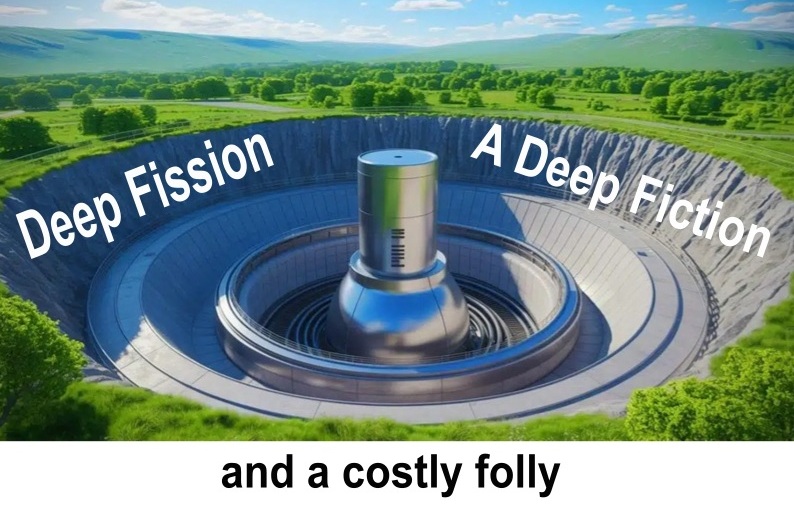
While the other nuclear companies in Trump’s pilot program are working on more or less traditional reactors, Deep Fission is getting weird with it, forecasting a reactor it has described as both “discreet” and “bespoke.” A laudatory Forbes profile on company founders Richard and Liz Muller outlines the plan: “Drill a 30-inch-diameter borehole a mile into the earth, fill it with water, then insert a teeny-tiny nuclear reactor that will boil the water at the bottom and send it up a separate pipe to run a steam turbine. Each hole will generate 15 megawatts, enough to power 12,000 homes.” (The profile fails to note some less savory details from Richard’s past: He was a vocal global warming skeptic until 2012, and has been criticized for taking research funding from the oil and gas tycoon Charles Koch.)
A small, scalable reactor is Deep Fission’s Theranos-esque goal, perfect for supporting Silicon Valley’s new obsession: AI data centers. Seventy in-house reactors can power one data center, according to Forbes. Deep Fission has been open about a desire to “meet the explosive demand for power from artificial intelligence” with a system “designed to scale modularly.” They have already seduced the likes of Palantir co-founder Joe Lonsdale, who owns an 8 percent stake in the company.
Speed is one of the company’s core tenets, which is concerning to some critics. Deep Fission’s website proudly states its reactors take an “estimated six months” to build, and the company told Parsons in December it aimed to have a test reactor running by July. “We have to build fast enough to meet data center demand before they decide to go with something else,” Liz Muller told Forbes.
It turns out, though, that building a nuclear reactor is quite difficult. The company now will not say when its test reactor will be ready, and is unsure on whether it will be able to open a commercial reactor at all. Deep Fission recently completed a test well in Parsons 6,000 feet deep and eight inches in diameter. That may sound impressive, but it’s far smaller than the mile-deep, 30 to 50 inch–wide borehole that will be needed for the real thing.
While a white paper sent to the NRC gives insight into the proposed reactor blueprint, Deep Fission’s design is not final yet. The company has not submitted a preliminary safety analysis to the DOE, nor applied for the NRC license it will need to sell energy, according to federal officials. Deep Fission declined to speak with The New Republic for this piece, with vice president of communications Chloe Frader citing the “active registration process.”
Reams said Deep Fission was never going to hit the deadline it set for itself. “I think even if it had gone perfectly, they probably wouldn’t have hit July 4,” he said. As to why the company may not be selling its energy anymore? “They weren’t sure [of] all the P’s and Q’s that they had to make sure were covered,” Reams said. “It’s been a learning process for them.”
…..some have been vocal in their opposition to Deep Fission, particularly Reynolds, who founded a local group called Prairie Dog Alliance for the express purpose of fighting the development. In a matter of months, Reynolds has assembled a hodgepodge of community members, among them farmers, business owners, activists, and professors. (Suellentrop, Meyer, Rowe, and Gunter have all been in contact with the group.) Prairie Dog Alliance now boasts over 500 Facebook followers and about 15 members who attend regular meetings.
Some locals say Prairie Dog represents the majority opinion. Librarian Heather Fouts estimated that “at most 25 percent” of residents support the nuclear project. “I would say most of Parsons is against the reactor,” echoed Beachner, who recently joined the group. “But I also feel … nobody believes they can do anything.” In contrast, Zaleski and Parsons Sun editor Hannah Emberton cast Prairie Dog as a vocal minority.
The group forced a public meeting with Deep Fission in March after rejecting private talks. There have been a handful of meetings since, but Prairie Dog still wants more transparency. Member Jill Blankinship said the March meeting was “turned into a meet-and-greet”; at a later May in-person meeting where company officials took questions, participants were made to write them down ahead of time. Deep Fission also promotes a “community advisory group” in Parsons, which has no public facing presence at the moment, though Deep Fission says has met twice.*
Deep Fission is also drilling its boreholes at the edge of the Roubidoux aquifer, an underground water source that’s part of the larger Ozark system. While Parsonites get their drinking water from nearby Lake Parsons, the Ozark system is used for commerce, farming, and rural water districts all over the shop. “If something did happen, there’s potential that it could contaminate groundwater, which then contaminates the Neosho River, which goes … all the way down to Oklahoma,” Blankinship said. “Thirty-six towns, all kinds of people.”…………..
There’s also the issue of nuclear waste. Deep Fission’s founders said in April they wanted to just abandon their spent fuel rods underground after each reactor’s six-year lifespan. “Instead of pulling them out of the hole, they’ll pour in a mix of cement and rock to seal it all in place,” the Forbes profile states happily. Activists called the idea dangerous.
A month after the Forbes piece, Deep Fission seemingly changed its tune. Chief Operating Officer Mike Brasel said in a May public meeting that the company will only leave spent fuel underground temporarily and that “we do not plan on disposing fuel down in that hole.” While the federal government is “contractually required to take the fuel,” Brasel said, Deep Fission aims to have a recycling or disposal facility in place before its boreholes begin to collapse in “40 to 50” years.
By then, things could already be going very wrong. Reynolds’s doomsday scenario is that radiation poisoning of the city’s soil and water will turn Parsons into something akin to Picher, Oklahoma, a small town 35 miles away. Once a bastion of lead and zinc mining, the town underwent dangerous corporate practices that caused irreconcilable environmental damage to the land; Picher was soon declared uninhabitable, and the municipality was officially dissolved in 2013.
In the event of a disaster, Deep Fission is seeking liability insurance under the Price-Anderson Act, which indemnifies the company in the event of a nuclear accident, providing costs fall above a certain threshold. “They’re going to … look for being indemnified from an accident that they’re saying will never happen,” Gunter said. “That’s a clear no-confidence vote.”…………………………………………………………..https://newrepublic.com/article/211643/nuclear-reactor-parsons-kansas-safety
No comments yet.
1 This Month
23-25 October – on Zoom – World BEYOND War’s annual global conferenc


Shut down the radiation-damaged Heysham nuclear reactors now
To see nuclear-related stories in greater depth and intensity – go to https://nuclearinformation.wordpress.com

Say No to NASA’s Reckless Nuclear Reactor on the Moon
Say No to NASA’s Reckless Nuclear Reactor on the Moon

-
Archives
- October 2026 (247)
- September 2026 (339)
- August 2026 (330)
- July 2026 (355)
- June 2026 (287)
- May 2026 (306)
- April 2026 (356)
- March 2026 (251)
- February 2026 (267)
- January 2026 (308)
- December 2025 (358)
- November 2025 (359)
-
Categories
- 1
- 1 NUCLEAR ISSUES
- business and costs
- climate change
- culture and arts
- ENERGY
- environment
- health
- history
- indigenous issues
- Legal
- marketing of nuclear
- media
- opposition to nuclear
- PERSONAL STORIES
- politics
- politics international
- Religion and ethics
- safety
- secrets,lies and civil liberties
- spinbuster
- technology
- Uranium
- wastes
- weapons and war
- Women
- 2 WORLD
- ACTION
- AFRICA
- Atrocities
- AUSTRALIA
- Christina's notes
- Christina's themes
- culture and arts
- Events
- Fuk 2022
- Fuk 2023
- Fukushima 2017
- Fukushima 2018
- fukushima 2019
- Fukushima 2020
- Fukushima 2021
- general
- global warming
- Humour (God we need it)
- Nuclear
- RARE EARTHS
- Reference
- resources – print
- Resources -audiovicual
- Weekly Newsletter
- World
- World Nuclear
- YouTube
-
RSS
Entries RSS
Comments RSS


Leave a Reply