Death will kill with its poisonous wings.
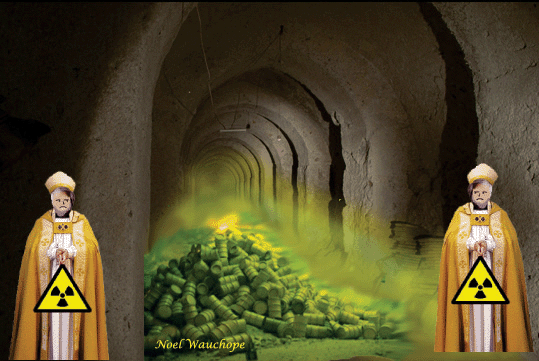
“This place is not a place of honor … no highly esteemed dead is commemorated here … nothing valued is here. What is here was dangerous and repulsive to us. This message is a warning about danger
by Martin McKenzie-Murray, https://www.themonthly.com.au/martin-mckenzie-murray/2026-05-08/death-will-kill-its-poisonous-wings
Very soon, likely within a few weeks, one of the world’s most interesting pieces of infrastructure will open after 22 years of construction and almost half a century of contemplation. Called Onkalo – Finnish for “cavity” – the site will be the world’s first permanent repository for nuclear waste.
By law, Finland obliges that nuclear waste produced domestically must be stored domestically. That will now occur on the island of Olkiluoto at a depth of more than 400 metres within bedrock that’s almost two billion years old. Currently, the repository area is about two square kilometres and comprised of 10 kilometres of tunnels – this number will likely quadruple before the site’s decommissioning in around 2100, when this cavern will be backfilled and sealed, creating a self-maintained nuclear sarcophagus for the approximately 100,000 years it will take for the waste’s radioactivity to have decayed to safe levels.
Perhaps by now you’re beginning to intuit a little about a) the complexity of its design, b) the richness of its semiotic implications, and c) the sobering absence of anything approaching a precedent for this. Consider: after its decommissioning, Onkalo must remain perfectly passive, requiring no active management or monitoring for 100,000 years. Second, its profound danger must be communicated so far into the future that current languages, customs – even genetic dispositions – can no longer be assumed to exist. It’s a strange and disquieting fact that the radioactivity of our nuclear waste might outlive our languages for communicating its danger. Third, no man-made structure has ever lasted anything close to the length of time that Onkalo is hoped to be preserved for.
Let’s start with the simpler facts of the site. Olkiluoto Island was chosen for its geological stability – the low-permeability of its bedrock and its low-risk of seismic tremors. In Michael Madsen’s fascinating 2010 documentary about the site’s design, Into Eternity, one project adviser explains how time down there goes slowly, while up here, on the surface, it passes very, very quickly.
In other words, the crystalline rock 450 metres below ground here looks much the same as it did 500,000 years ago. The surface of our planet, however, would look unrecognisable if we travelled back just 200 years. Our natural, political and material world changes often and quickly – the latter to the whims and passions of its human inhabitants, our creative and destructive ingenuities, and the gravity of civilisational entropy. The natural world, meanwhile, forever remains subject to the whims and passions of storms and droughts and a climate that’s being altered by us.
Currently, the world’s approximately half-a-million tonnes of nuclear waste is kept in temporary storage on the surface of our planet, and is thus subject to war, sabotage or natural calamity. Much safer to secure it deep down where time moves slowly.
There is something lusciously strange and dreamlike about the projections and assumptions Onkalo’s designers were asked to make. They did nothing less than imaginatively commune with a form of humanity far into the future.
The weirdness of this can be emphasised by offering some modest timescale. The birth of Jesus Christ was 2000 years ago. The pyramids of Giza were completed about 4500 years ago. The previous Ice Age ended almost 12,000 years ago and found the peak of its severity about 10,000 years before that. That is still nowhere near 100,000 years, the length of time into the future for which Onkalo must remain independently stable and for which the warnings we write today must travel and remain intelligible.
And so, the niche field of nuclear semiotics: how do we communicate today’s intentions to a civilisation so distant that we presume it to be almost alien and to not share our language? Preceding this question though, is another: should we even try? Can we assume that humanity will, in 80,000 years, say, possess the same curiosity we do today? That is, will they perform the same enthusiastic archaeological excavations as we do now? And, if so, will they treat the nuclear tomb as we might an Incan crypt?
Might it be that by signposting the danger, we simply encourage their curiosity? Would warnings, even if we could guarantee their future intelligibility, serve to appropriately quell curiosity or dangerously arouse it?
The questions only birth more questions. Given that Onkalo is so deeply buried, and its decommissioning would involve erasing all surface infrastructure, can it not be assumed that it would never be accidentally found? Or might some evidence of its existence survive? Physical evidence, or digital? Is it preposterous to think that any digital evidence of our civilisation today could survive so far into the future – when, between now and the safe decay of the waste, there is assumed to fall several new ice ages?
The designers answered at least one big question: they would, via ceramic tablets, leave warnings to our future selves about the site. Detailed warnings, in several languages unlikely to survive several epochs, have been suggested: “This place is not a place of honor … no highly esteemed dead is commemorated here … nothing valued is here. What is here was dangerous and repulsive to us. This message is a warning about danger.”
Also proposed are simple pictographs that are assumed to have a universally intelligible quality: a triangle that includes the radioactive symbol, a skull and crossbones, an arrow pointing away from the danger, and a human stick-figure running in the direction it suggests.
Given the spookiness of radioactivity – and the oddity of communicating its dangers across a chasm of time to unknowable descendants – the project invited some strange proposals. One was rendering the surface above the tomb conspicuously forbidding: lightning bolt sculptures amongst forests of barbed wire. (But optimistically assuming their material survival, how can we assume that their symbolic charge would survive, and not simply invite curiosity as cryptic anachronisms?) Another proposal was made for genetically engineering cats who change colour in the proximity of radiation – a kind of bizarre Geiger counter.
In 2020, the American electronic music producer (and roboticist) Skytree, aka Evan Snyder, released a track called “Atomic Priest” written with rapper Jackson Whalan. Its lyrics were about precisely the problem of communicating danger forward through “deep time”:
This is for the humans living ten thousand years from now
With radioactive capsules, thousands of feet underground
Grabbin’ the mic to warn you of these hazardous sites
For those who lack in the sight in the black of the night
The least good that we could do is form an Atomic Priesthood
To keep the future species from going where no one should
We’ve buried the mistakes of past nuclear waste
Hidden underground for future races to face
It’s our task to leave signs for civilization to trace
But who’s to say what language these generations will embrace?
The American-Hungarian linguist Thomas Sebeok minted the term “atomic priesthood” in the early 1980s. Sebeok thought that, given that radioactivity of our waste would outlive current languages (and God knows what else), the trick to communicating our warnings about it lay in folklore. Sebeok had been commissioned by the US Department of Energy to this end. In 1980, the department had established the “Human Interference Task Force”, which was asked to “investigate the problems connected with the post-closure, final marking of a filled nuclear waste repository. The task of the HITF is to devise a method of warning future generations not to mine or drill at that site unless they are aware of the consequences of their actions.”
In 1984, Sebeok submitted his report. It was called “Communication Measures to Bridge Ten Millenia”. Semiotics were everything here, Sebeok wrote, given its relevance to “the problems of human interference and message exchanges involving long periods of time, over which spoken and written languages are sure to decay to the point of incomprehensibility, making it necessary to utilize a perspective that goes well beyond linguistics”.
Here, then, is the luscious strangeness of nuclear semiotics – a field that overlaps with our formal considerations of communicating with extraterrestrial intelligence, but which seems even stranger to me given that the aliens in this case are our future selves.
Sebeok suggested that the best way to ensure the survival of our warnings deep into the future was through mythology – the enactment of annual rituals and the ratification of legends that were upheld by an “atomic priesthood”. The stories would alter over time, but perhaps the core desire of the transmission – to effectively warn off future excavators – would survive. It wouldn’t matter if the sense of hazard had degraded into superstition, long untethered to science or the danger at hand. Only that a sense of fear and repulsion was maintained.
“A ritual annually renewed can be foreseen, with the legend retold year-by-year (with, presumably, slight variations),” Sebeok wrote in his government report. “The actual ‘truth’ would be entrusted exclusively to what we might call for dramatic emphasis an ‘atomic priesthood’, that is, a commission of knowledgeable physicists, experts in radiation sickness, anthropologists, linguists, psychologists, semioticians, and whatever additional expertise may be called for now and in the future. Membership in this ‘priesthood’ would be self-selective over time.
“The best mechanism for embarking upon a novel tradition … is at present unclear. Folklore specialists consulted have advised that they know of no precedent, nor could they think of a parallel situation, except the well-known, but ineffectual, curses associated with the burial sites (viz., pyramids) of some Egyptian Pharaohs … which did not deter greedy grave-robbers from digging for ‘hidden treasure’.”
Here, then, is the weird world of considering future ones. In a few weeks, Onkalo will become operational, accepting the copper-encased tubes of nuclear waste into its deep tombs of crystalline rock, where things remain more stable than the conditions half a kilometre above.
Declassified: UK Knew NATO Expansion ‘Would Provoke’ Russia War
Kit Klarenberg, Global Delinquents, May 18, 2026
On April 15th, Declassified UK published a bombshell investigation exposing how in the mid-1990s, senior British political and military officials were well-aware NATO expansion into Central and Eastern Europe “would provoke [the] Russians,” and likely trigger all-out war. Hitherto unreported Ministry of Defence files reveal London knew Moscow’s “sensitivities” over a “hostile military alliance” enlarging up to its borders were profound, and based on very “real” concerns. Yet, NATO’s dangerous crusade to absorb Central and Eastern Europe continued apace, ultimately producing the Ukraine proxy conflict.
Since the so-called Special Military Operation’s February 2022 eruption, British officials have relentlessly reiterated the mantra the proxy war was “unprovoked”. However, a declassified March 1995 Foreign Office memo noted “there was a widespread psychological and intellectual perception in Moscow that NATO was a real threat.” In May that year, then-Prime Minister John Major succinctly articulated Russian anxieties to his Irish counterpart John Bruton, as a “fundamental fear…of encirclement.” Concerns about EU membership were comparatively muted:
“For the Russians, NATO had a much more threatening symbolism and political resonance…The Baltics were particularly difficult, with extreme sensitivity for Russia. It would be very hard to have a NATO border directly against Russia.”
Still, in 1997 NATO invited Czechia, Hungary, and Poland to join, which they did two years later. In 2004, Estonia, Latvia and Lithuania simultaneously joined the military alliance. So too did ex-Warsaw Pact members Bulgaria, Romania, Slovakia, and former Yugoslav republic Slovenia. Declassified UK shows how back in August 1996, British Defence Intelligence prepared a NATO enlargement study specifically forecasting that these countries joining could trigger war, and an alliance military operation launched via Article 5 of the NATO treaty in response.
This refers to collective self-defence, under which NATO members are obligated to come to each other’s defence if attacked. In the scenario, Defence Intelligence assumed “Russia has vehemently opposed NATO membership for the Baltic states and has threatened retaliation to preserve her own security against a perceived hostile military alliance on her borders.” In the real world, Boris Yeltsin made at-times irate public statements about NATO enlargement into the Baltics at the time, while lobbying US President Bill Clinton on the issue behind closed doors.
NATO expansion continued regardless. In December 1996, Declassified UK reports then-Russian premier Viktor Chernomyrdin privately warned Major: “Russia could not stop NATO enlarging, but this would create a fragile situation which could explode.” Other declassified files from this time show senior apparatchiks in London were acutely aware of Moscow’s “concern,” “fears,” “hostility,” “negative attitudes,” and “resentment” over alliance enlargement. Both Major and his successor Tony Blair explicitly pledged in person to Kremlin officials that NATO wouldn’t “move up to Russia’s borders.”
However, a secret September 1996 policy paper made clear Britain was committed “to enlarge NATO to the East,” even if “Russian acquiescence is not possible.” In February 1997, Russia’s deputy foreign minister Nikolai Afanasievsky angrily branded public discussions in Western capitals of admitting former Soviet republics to the alliance a “blatant provocation” in a meeting with Jeremy Greenstock, Britain’s ambassador to Moscow. Greenstock reassured his Russian opposite number NATO had “no intention” of admitting former Soviet states “at this stage” – which, technically, was true.
‘Russian Problem’
A March 1997 Foreign Office memo forecast rapid NATO enlargement would “antagonise,” and ultimately “provoke,” Russia into a belligerent counter-response. Yeltsin’s “anxiety” about the “possible accession of Ukraine, the Baltic states and other states of the former Soviet Union” was considered the “most difficult issue” affecting Western relations with Moscow. A more staggered approach was thus required. That month, John Major met with NATO secretary general Javier Solana, who spoke of “Russians fears about NATO troops and equipment moving eastwards.”…………………………………………………………………………………………………………………………………………………………………………………………………………………………..https://www.kitklarenberg.com/p/declassified-uk-knew-nato-expansion
Danger at Europe’s largest nuclear plant ‘near point of no return’ after deadly attack
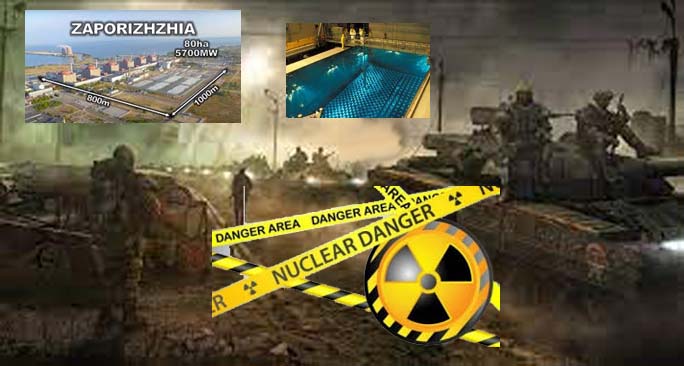
The Zaporizhzhia Nuclear Power Plant in Ukraine was targeted
again last week, with continual concern over its safety since the start of
the war with Russia in 2022. Safety at Europe’s biggest nuclear power plant
is “rapidly deteriorating”, Russia’s nuclear energy chief has warned.
Mirror 18th May 2026 https://www.mirror.co.uk/news/world-news/zaporizhzhia-nuclear-power-plant-ukraine-37171510
First attack on Arab nuclear site sends warning to Gulf, US
The first attack targeting an Arab nuclear site has sent a symbolic warning
to the United Arab Emirates and its allies, even as Iran and the US remain
in negotiations to end the Middle East war, analysts say. An unclaimed
drone struck an electrical generator on Sunday near the Arab world’s first
nuclear power plant in Barakah in the emirate of Abu Dhabi, triggering a
fire but causing no injuries nor radiation leak.
Daily Mail 18th May 2026 https://www.dailymail.com/wires/afp/article-15828501/First-attack-Arab-nuclear-site-sends-warning-Gulf-US.html
Scotland the Dump
A long-term project we have had here at Bella, that is charting the toxic
legacy of the British State. Our map, Scotland the Dump, produced by the
wonderful Magnificent Octopus Illustration is being prepared for shipping
right now. The map details the weapons ranges, munitions dumps, biological
and chemical weapons dumps and nuclear waste scattered around Scotland.
Bella Caledonia 18th May 2026 https://bellacaledonia.org.uk/2026/05/18/scotland-the-dump-4/
Mirrors of Greed: Elon Musk, OpenAI and the Tech Brat Battle

19 May 2026 Dr Binoy Kampmark , https://theaimn.net/mirrors-of-greed-elon-musk-openai-and-the-tech-brat-battle/
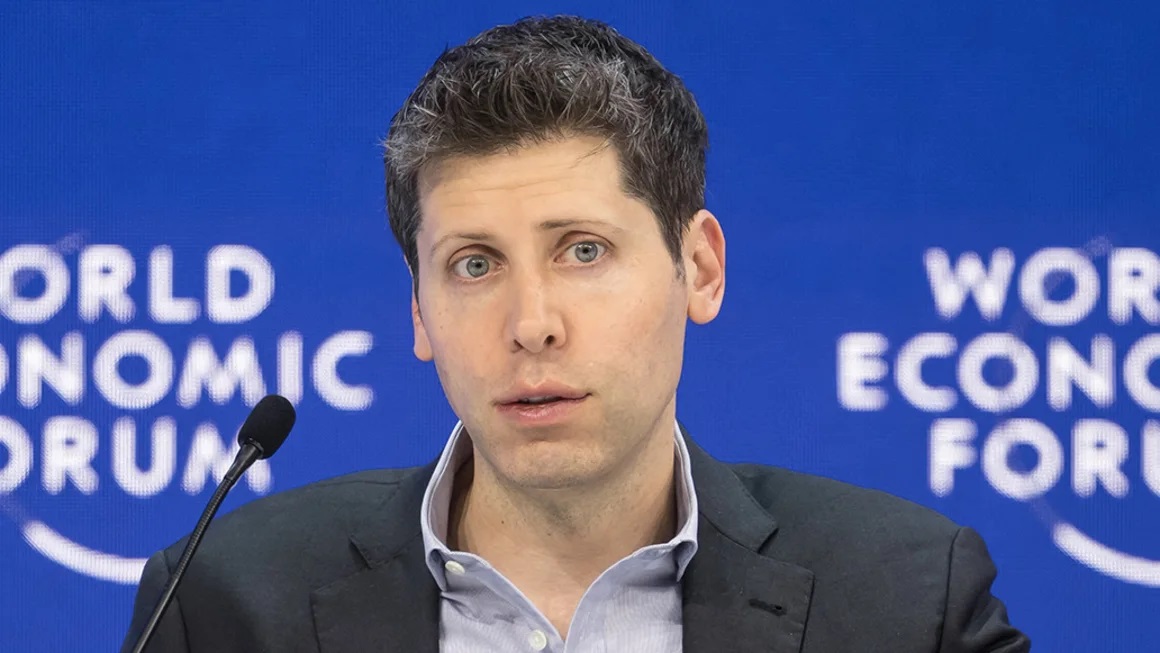
They are a disagreeable bunch, with disagreeable ideas to match. The querulous brats behind the drive for technological servility and plugged in stupidity were always going to scrap over which dystopian vision they most prefer. Elon Musk thought he was onto something hounding OpenAI and its current CEO Sam Altman for supposedly betraying one of those visions. In his $150 billion legal action, Musk alleged that Altman and OpenAI president Greg Brockman deceived him into investing in the company in its initial stages when salad green altruism was modish and humanity mattered. The litigation was a prong in a broader strategy to unseat Altman from OpenAI, sabotage the company’s $852 billion restructuring into a public benefit corporation and direct $134 billion to OpenAI’s non-profit foundation.
The deception centred on maintaining OpenAI as a non-profit entity and pursuing artificial intelligence (AI) ventures in ways beneficial to humanity. (When the tech brats have a stab at humour, they go in hard.) According to Musk, OpenAI had effectively stolen a charity. (Between 2015 and 2017, he had personally put $44 million into OpenAI, funds, he argues, that were essentially misappropriated when the company sloughed its non-profit skin.) In an introductory overview of the company from December 2015, the company badges itself a “non-profit artificial intelligence research company” with the object of advancing “digital intelligence in a way that is most likely to benefit humanity as a whole, unconstrained by a need to generate financial return. Since our research is free from financial obligations, we can better focus on a positive human impact.”
How things change. On May 18, a mere two hours was needed for a nine-jury member in Oakland, California to unanimously find against Musk, basing their decision on that most technical of grounds: the statute of limitations. This left two civil claims – breach of charitable trust and unjust enrichment – untested. Having left OpenAI’s board in 2018, Musk dithered till February 2024 to file suit. Musk claimed to have only discovered the company’s abandonment of its non-profit mission in 2022, when Microsoft showed its interest with an investment of $10 billion. OpenAI’s legal team argued that the pertinent events – the creation of a for-profit subsidiary in 2019 for instance and Microsoft’s initial injection of $1 billion that same year, were already matters of common knowledge. Time on the statute of limitations was running well before 2022. US District Judge Yvonne Gonzalez Rogers of the Northern District of California saw no reason to question the jury’s conclusion. “There’s substantial amount of evidence to support the jury’s finding, which is why I was prepared to dismiss on the spot.”
The trial was impressively ugly and amounted to an insult to the stout intelligence of the public whose welfare both parties claim to be protecting. The legal representatives from both sides jousted over respective views on AI and the credibility of the disputants. Musk’s lawyer, Steven Molo, pressed jurors to consider that several witnesses, including former OpenAI chief scientist Ilya Sutskever, doubted Altman’s candour, going so far as to find him mendacious. Altman had also conceded under cross-examination that he “told the occasional lie”. “Sam Altman’s credibility is directly at issue,” Molo crowed. “If you don’t believe him, they cannot win.”
OpenAI, Musk accusingly asserted, had wrongfully attempted to enrich investors and insiders at the expense of the non-profit. Along the way, it had failed to make AI safety a matter central to its operations. Microsoft, he further argued, had always known that OpenAI cared more about money than altruism. A personal journal entry penned by Brockman in November 2017 was also instructive, baldly revealing that OpenAI could not assert fidelity to its non-profit status if it intended becoming a benefit corporation months later. So it came to pass that Altman, Brockman and OpenAI were accused of the very same temptations, frailties and indifference to safety that could be found in Musk’s own conduct.
On the issue of safety and welfare, Musk’s own xAI, acquired by space and rocket company SpaceX, also part of the South African’s fiefdom of misrule, has drawn the attention of the European Commission and UK watchdog Ofcom over Grok, a product that has been used to create sexualised images. The combine arising from xAI and SpaceX could lead to an initial public offering that would surpass OpenAI in size, which sinks the scurrilous suggestion of altruism. Provided things go smoothly, the world’s first trillionaire might arise.
OpenAI was hardly going to leave Musk’s feeling of tech purity unchallenged. It was he, not OpenAI, who saw the shimmering dollar signs. Going back to 2017, he had floated the idea of a for-profit subsidiary with one caveat: he would have exclusive control. Failing this, he left the board in a huff. OpenAI’s attorney William Savitt suggested that Musk, having failed to “get his way at OpenAI,” filed his lawsuit only after establishing his own competing AI company in 2023. But most saliently, he waited too long to claim breaches of the founding agreement regarding the building of safe artificial intelligence for the benefit of humanity. “Mr Musk may have the Midas touch in some areas, but not in AI,” claimed Savitt.
OpenAI’s predatory reflexes will be boosted by the decision. The non-profit status in this field has been found wanting, and the scramble for profits given much encouragement in this most unprincipled of frontiers. “The decision is likely to reassure investors and the broader AI sector,” opines Sarah Kreps of the Tech Policy Institute at Cornell University, “because it avoids a potentially chaotic outcome that could have challenged OpenAI’s commercial structure, Microsoft partnership, and future fund-raising plans.”
This was by no means the first time Musk had taken to throwing a brief of anger against OpenAI. In March 2024, showing that intelligence can be authentically artificial, he filed a lawsuit citing a contract violation of a contract that did not exist. Using the misguided legal offices of Irell & Manella – the same firm that erroneously claimed on behalf of PETA that a monkey could hold copyright – Musk pursued what Techdirt’s Mike Masnick appropriately called a “vibes based” action. “Elon doesn’t have a contract with OpenAI which the company could have breached. And that’s kinda a problem in a breach of contract lawsuit.” This insuperable logic led Musk to abandon the lawsuit in June that year.
For Musk, the wells of indignation run deep. This is a man in the habit of losing or settling claims, be it with former Twitter executives and employees of the social platform now known as X, losing to investors in that same company for misleading public statements made during his untidy, often chaotic takeover, or having his lawsuit promptly dismissed against advertisers that exited that troubled platform. While such behaviour should draw scorn, those drawing benefit from his litigious pathologies – lawyers, in the main – can only be grateful. “In a lot of ways, he is just another businessperson asserting his rights,” says a credulous Shubha Ghosh, lawyer and law academic at Syracuse University. “I don’t think he’s abusing the legal system. Whether he uses it effectively, I’m not sure.” Wrong, certainly, on the first count.
Republicans should be worrying about millions of fools voting for treason and criminal war destroying the economy – Walt Zlotow.
Walt Zlotow West Suburban Peace Coalition Glen Ellyn IL, 18 May 26
It’s understandable the Chicago Tribune is concerned about the future of the Republican Party (Editorial: Republicans are preparing for the midterms. They should be worrying about the party’s future). Soon after its founding in 1847, the Trib championed creation of an anti-slavery party and its most eloquent spokesman, native son Abe Lincoln. Seven years later that led to founding of the Republican Party and eventual election of Trib favorite Lincoln in 1860.
One hundred seventy-two years on the Trib’s still favorite party is fundamentally opposed to every vestige of its historical legacy. The Trib urges Republicans to reflect on their party “whose historical brand is inextricably linked with patriotism” How did the Trib miss the Republican Party, under Donald Trump, destroyed every vestige of patriotism when it inspired an insurrection at the Capitol in 2021 to overturn the election. The tiny handful of Republican patriots like Liz Cheney and Adam Kinzinger who dared call out Trump’s treason were systematically purged from Republican Party. Trump, cheered on by nearly every Republican congressperson, then pardoned his 1,500 coup brigade who injured over 150 patriotic cops, five of whom died shortly afterwards from injury or suicide, trying to save American democracy from Trump’s treason.
Besides now being the party of treason, Trump’s Republican Party is now the party of senseless criminal war in Iran that, besides being lost with no exit strategy, is systematically degrading the world economy including America’s.
The Trib is anxious to find something of value in the Republican wrecking ball controlling the entire government with no check whatsoever. Alas, it’s not in the claim “There are plenty of rational folks who voted for Trump; 44% of Illinoisans are not fools. “Plenty of rational folks” are not words that befit the 56% to 44 % Illinois blowout against Trump. Every one of Trump’s 2,449,079 Illinois voters in 2024 were fools to vote for the only presidential candidate in US history who sought to destroy American democracy. And when each now forks over an extra 20 or 30 bucks to fill their gas guzzler due to Trump’s criminal war on Iran with no end in sight, they’ll likely ponder the wise words of a 1958 Elvis hit…”Now and then there’s a fool such as I.”
The Chicago Tribune, by spending 1,500 words seeking to salvage the Republican Party without mentioning the Trump GOP treason and criminal war on Iran , may be the biggest fool of all.
Russian nuclear weapons, 2026

Bulletin, By Hans M. Kristensen, Matt Korda, Eliana Johns, Mackenzie Knight-Boyle | May 14, 2026
Russia is in the late stages of a multi-decade-long modernization program to replace all of its Soviet-era nuclear-capable systems with newer versions. However, this program is facing significant challenges that will further delay the entry into force of these newer systems. In this issue of the Nuclear Notebook, we estimate that Russia now possesses approximately 4,400 nuclear warheads for its strategic and non-strategic nuclear forces—a slight increase from the previous year. The significant increase in non-strategic nuclear weapons that the Pentagon predicted five years ago has so far not materialized. A nuclear weapons storage site in Belarus appears to be nearing completion. The Nuclear Notebook is researched and written by the staff of the Federation of American Scientists’ Nuclear Information Project: director Hans M. Kristensen, associate director Matt Korda, and senior research associates Eliana Johns and Mackenzie Knight-Boyle
This article is freely available in PDF format in the Bulletin of the Atomic Scientists’ digital magazine (published by Taylor & Francis) at this link.
Russia is nearing the completion of a decades-long effort to replace most of its strategic and non-strategic nuclear-capable systems with newer versions. But despite Moscow’s continued rhetorical emphasis on its nuclear forces, commercial satellite imagery and other open sources indicate that elements of Russia’s nuclear modernization are proceeding much more slowly than planned: Upgrades to intercontinental ballistic missiles (ICBMs) and bombers face significant delays, and the “significant” increase of Russian non-strategic nuclear weapons that US Strategic Command (STRATCOM) predicted five years ago has so far not materialized (Richard 2020, 5).
As of March 2026, we estimate that Russia has a stockpile of approximately 4,400 nuclear warheads assigned for use by long-range strategic launchers and shorter-range tactical nuclear forces. This number is greater than last year, largely due to a change in our estimate of warheads assigned to non-strategic nuclear forces following STRATCOM’s publication of its estimate for the number of warheads in the Russian arsenal. The estimate, which is the first time in more than three decades that the US government has disclosed how many warheads it believes Russia possesses, stated that “Russia’s nuclear warhead arsenal consists of approximately 4,600 nuclear warheads; 2,600 are intended for its strategic triad and up to 2,000 are warheads intended for theater nuclear weapons” (Correll 2026). Given that the US Intelligence Community for several years has estimated Russia has 1,000–2,000 nonstrategic warheads (US Department of State 2025a), the “approximately” in the STRATCOM statement indicates the stockpile is less than 4,600 and the number of nonstrategic warheads is less than 2,000. We were able to match the estimate for strategic warheads, but the total stockpile number
necessitated a revision of our estimate for nonstrategic warheads closer to the estimate we published in 2023 (Kristensen, Korda, and Reynolds 2023).
Of the estimated 4,400 stockpiled warheads, approximately 1,796 strategic warheads are deployed: about 892 on land-based ballistic missiles, about 704 on submarine-launched ballistic missiles, and about 200 at heavy bomber bases. Another approximately 810 strategic warheads are in storage, along with about 1,794 nonstrategic warheads. In addition to the military stockpile for operational forces, a large number—approximately 1,020—of retired but still largely intact warheads await dismantlement, for a total inventory of approximately 5,420 warheads[1] (see Table 1 on original).
Russia’s nuclear modernization program appears motivated in part by the Kremlin’s strong desire to maintain quantitative and qualitative parity with the United States and to maintain national prestige. ………………………………………………………………………………………………………………………………………………………………………………………………………………………………………………………………………………………………………. https://thebulletin.org/premium/2026-05/russian-nuclear-weapons-2026/?utm_source=ActiveCampaign&utm_medium=email&utm_content=The%20Russian%20nuclear%20arsenal%20today&utm_campaign=20260518%20Monday%20Newsletter
Pentagon quietly shut legally required program to prevent civilian deaths by military, watchdog finds
Trump administration accused of cutting military’s civilian harm program in light of US strike on girls’ school in Iran
Guardian, Joseph Gedeon and Cate Brown in Washington, 16 May 26
The Pentagon has quietly dismantled a program it is legally required to operate to prevent and respond to civilian deaths in US military operations, according to its internal watchdog.
A report released by the department’s inspector general concluded the US military no longer has the people, tools or infrastructure needed to comply with two federal statutes requiring it to maintain a functioning civilian casualty policy, and operate a Civilian Protection Center of Excellence (CP CoE).
Donald Trump’s administration has been accused of making deep cuts to the Pentagon’s civilian harm mitigation and response (CHMR) program, designed to handle training and procedures critical in limiting civilian harm in theaters of war.
While the program has not been officially canceled, the inspector general’s report said that funding had ended for a data management platform; committee meetings had halted; and many dedicated personnel had been lost or reassigned.
“As a result, the DoW [Department of War] may not comply with its civilian casualties and harm policy,” the report read. “A policy required by federal law.”………………………………………………………………….
Pete Hegseth, the Pentagon chief, has recently come under fire over deadly attacks on Iran, including a US strike in Minab that killed at least 175 people, a majority of them children, at an all-girls school.
Limiting casualties has not been a top priority during Hegseth’s tenure at the Department of War, rebranded last September from the Department of Defense. When pressed on civilian casualties in Iran, Hegseth has pivoted to blame the Iranian regime for placing rocket launchers in civilian areas, and also claimed no nation in history had taken more precautions than the US to avoid civilian deaths.
The inspector general’s report, and people familiar with the office, tell a different story.
“My assessment is that they’ve left a semblance of the department because Hegseth was taking heat for illegal operations,” said Wes J Bryant, an air force combat veteran who was the chief of civilian harm assessments on the CP CoE program.
He described a stream of forced resignations and halted investigations since Hegseth assumed his post, saying there were only seven people left reporting to the program, and that they are “locked out of all operations” and have been relegated to “a closet office” in Virginia.
Bryant was forced out of his job last spring, as the Trump administration removed safeguards that once restrained US forces from authorizing the use of lethal force, according to a ProPublica report.
The inspector general’s report, published on 13 May, points to an inflection point in February, when two senior officials – the acting under-secretary of war for policy, Elbridge Colby, and the secretary of the army, Dan Driscoll – separately proposed to Hegseth the program be cut or eliminated.
One proposal went further, according to the report, and recommended scrapping its action plan and its underpinning departmental instruction entirely. Then, without waiting for a response, the military began acting as if the cuts had already been approved……………………………………………………………………………………………………………………………. https://www.theguardian.com/us-news/2026/may/15/pentagon-civilian-death-program
ICC Issues Arrest Warrants For Five Additional Senior Israeli Officials

The Hague-based court previously issued warrants for the arrest of Israeli Prime Minister Benjamin Netanyahu and former War Minister Yoav Gallant
By News Desk, The Cradle., MAY 17, 2026 https://thecradle.co/articles/icc-issues-secret-arrest-warrants-for-five-additional-senior-israeli-officials-report
The International Criminal Court (ICC) has issued secret arrest warrants for three Israeli politicians and two military officials, Haaretz reported on 17 May, citing diplomatic sources.
The International Criminal Court (ICC) has issued secret arrest warrants for three Israeli politicians and two military officials, Haaretz reported on 17 May, citing diplomatic sources.
The timing of their issuance is unknown. The ICC has often issued arrest warrants in secret, publicly announcing them only later to enable a possible arrest of the suspect.
Israel’s Foreign Affairs Ministry and State Attorney’s Office do not respond immediately to requests for comment.
The Hague-based court issued arrest warrants against Prime Minister Benjamin Netanyahu and former War Minister Yoav Gallant in November 2024.
The timing of their issuance is unknown. The ICC has often issued arrest warrants in secret, publicly announcing them only later to enable a possible arrest of the suspect.
Israel’s Foreign Affairs Ministry and State Attorney’s Office do not respond immediately to requests for comment.
The Hague-based court issued arrest warrants against Prime Minister Benjamin Netanyahu and former War Minister Yoav Gallant in November 2024.
ICC prosecutor Karim Khan requested that ICC judges issue the arrest warrants in May 2024, alleging that Netanyahu and Gallant were responsible for war crimes committed by the Israeli military in Gaza.
Netanyahu and Gallant bear criminal responsibility for the war crime of starvation as a method of warfare and the crimes against humanity of murder, persecution, and other inhumane acts, according to the ICC prosecutor.
In response to the issuance of the arrest warrants, the US and Israel carried out a campaign to pressure the ICC to prevent and cancel the arrest warrants issued against the Israeli leaders, Le Monde reported in August 2025.
The campaign, which targeted the ICC chief prosecutor Khan, began in March 2024 after he announced his intention to seek the indictment of Netanyahu and Gallant.
In response, the Israeli prime minister launched a campaign to use “all means” to stop the prosecutor with the help of his allies in London, Washington, and Berlin.
At the end of April 2024, a staff member at the ICC accused Khan of sexual assault.
A source speaking to Le Monde said the allegations were part of an effort to “get rid of the prosecutor” and “hijack the process” of arrest warrants.
In October 2024, while the judges were still determining whether to issue the arrest warrants, a mysterious account named “ICC Leaks” appeared on the social network site X.
The account publicized the allegations of sexual assault made against Karim Khan internally at the ICC the previous May.
The ICC finally issued arrest warrants for Netanyahu and Gallant on 21 November 2024.
In February 2025, Chief Prosecutor Khan was placed under sanctions by the US.
Netanyahu applauded the move, calling the court “anti-Semitic and corrupt.”
Khan continued to work on two other indictments against Israeli Minister of National Security Itamar Ben Gvir and Israeli Minister of Finance Bezalel Smotrich.
However, Khan has been on temporary leave since 16 May 2025, pending the outcome of the investigation into the sexual misconduct allegations, which he strenuously denies.
During its genocide in Gaza, Israel has killed more than 72,000 Palestinians, the majority women and children, while destroying most of the strip.
Jewish settlers insist they will colonize Gaza, as they are colonizing the occupied West Bank.
“We are here on the way to new Jewish communities in Gaza,” settler leader Daniella Weiss stated in an interview at the border of the strip in late April.
“The 2 million or whatever number of Arabs, Gazans, who live here will not live in Gaza,” Weiss added. “It can take a week, it can take maybe a few months. They will not live here.”
5 Stocks That Benefit From the Government’s $94 Million Spending Spree on Nuclear Reactors.

The Trump administration is giving out money to small
nuclear reactor projects, and a handful of public companies should benefit.
The Energy Department announced $94 million worth of cost-sharing grants to
build out America’s nuclear infrastructure.
The government will pay for
up to 50% of the projects. It’s the second such grant given out to
nuclear players. The first one went to the Tennessee Valley Authority, a
federally controlled utility, and Holtec, a privately held nuclear operator
that’s building small reactors. Holtec is expected to go public sometime
this year.
The government’s involvement is meant to fast-track a U.S,
nuclear renaissance, which has moved slowly so far because most private
companies don’t want to take the financial risk.
Barrons 15th May 2026,
https://www.barrons.com/articles/nuclear-reactor-stocks-e23d92f1
The United Arab Emirates said a drone strike caused a fire at the perimeter of its Barakah nuclear power plant
There were no
injuries and radiation levels remained safe. The emirate’s state news
agency said on Sunday that authorities were “handling a fire that broke
out in an electric generator outside the inner perimeter” of the Barakah
power plant “caused by a drone strike”. The UAE did not apportion blame
for the attack and there was no claim of responsibility.
But the emirate
has borne the brunt of Tehran’s retaliatory attacks since the US and
Israel launched the war on Iran on February 28.
FT 17th May 2026,
https://www.ft.com/content/c4b786a6-55d4-4689-b19e-48a48f7946e6
Will there be global war over Taiwan? – Sociology matters
19 May 2026 Noel Wauchope, https://theaimn.net/will-there-be-global-war-over-taiwan/
Will there be global war over Taiwan? Ask a sociologist.
Having never actually studied sociology, I am indeed prepared to be shot down in flames, for my audacity in pronouncing opinions on sociology. But that thought has never stopped me, as I believe that anyone and everyone can have opinions, and should be taken seriously.
Britannica says:
“Sociology, a social science that studies human societies, their interactions, and the processes that preserve and change them… the processes that preserve and change human societies.”
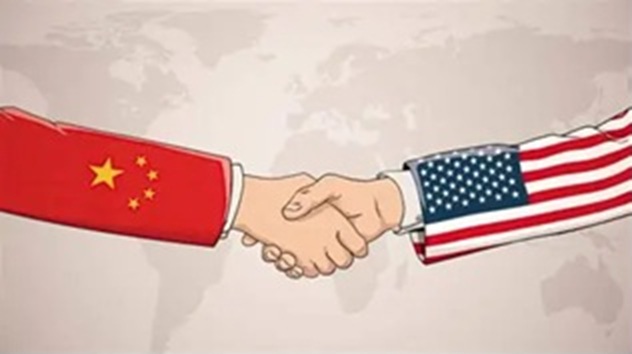
What prompted me to consider this, is the news coverage of Donald Trump’s visit to China, and his interaction (accompanied by business moguls) with President Xi Jinping. Was this the first part of a process that might preserve and change the global society? The general theme of most articles is that not much was achieved in this meeting, and particular concerns were not resolved. The main concern was about Taiwan. Will the USA come to the defence of Taiwan if China were to take it over? There was the need to open up the Strait of Hormuz There were trade concerns, particularly about China’s near monopoly of the rare earths market, about USA’s plan to to sell Taiwan $US14 billion more in weapons, and China’s to send weapons to Iran.
Other touchy topics like climate change and human rights were avoided.
It all looks as if there wasn’t any process, and it all came out with the same stalemate, and the same ambiguity about Taiwan. So we’re back into the old dilemma – will there be global war over Taiwan? But there was an interaction. Whatever we all think of Donald Trump, or of Xi Jinping, they had a courteous and cordial meeting, and Trump is the first American President to visit Beijing twice.
So, I’m thinking that this is the start of something new. Not because these powerful men might have altruistic ideas and plans, but because of another consideration. This was highlighted in an insightful article by ABC journalist Bang Xiao, who wrote:
“This week in Beijing, both Donald Trump and Xi Jinping quietly admitted something the rest of the world has been slow to grasp. Neither of them can afford the collision… Two structurally interdependent superpowers who have decided, for now, to manage their rivalry rather than let it manage them.“
It’s some kind of a comfort to realise that financial realities might now be prioritised over glorious ideals of national pride, the heroism of war, patriotic sacrifices and all those noble ideals which, with modern warfare, are becoming ecocidal. Neither the USA nor China can now afford a global war. Xi Jinping referred to the “Thucydides Trap.” In the 5th century, Greek historian Thucydides described this situation where a rising power challenges an established one, usually leading to a prolonged war.
The significant thing here is that China is no longer seen as a “rising power” – and this really is all about sociology. SL Kanthan writes that: “The Thucydides Trap is no more,” and gives a powerful explanation of China’s debts and its slowing economy. There have been recent articles on China’s current economic decline, but this is not really a new development, but more of a steady decline over years. China’s GDP growth has been decelerating – “the slowing empire, the tired dragon.”
The sociological facts come in here. There’s been quite a dramatic fall in China’s birth rate. With a dwindling population, and with the median age rising, it’s a poor forecast for China’s working-age proportion of the population. The fall in what was a booming real estate industry has resulted in a rapid decline in construction and related industries and the loss of employment opportunities. This job loss has been exacerbated by the loss of jobs for college graduates, with robots now taking over much of their work. China has severe and seemingly intractable debt problems. Finally, China’s military is in some trouble, and not ready for war.
With all the chest-thumping and the rush for new weaponry amongst the military-industrial complex, there’s a lack of concern for sociological realities such as those now affecting China. And China is not the only country affected by population change, economic problems, public and private debt – all factors that dampen enthusiasm for war. I sometimes ponder on what was the greatest scientific achievement of our age. Was it the atomic bomb, rockets, the digital revolution, medical breakthroughs?
I’m thinking that the most influential one might be effective contraception. That is certainly a huge factor in China’s slowdown, and its leadership’s reluctance about war, and its readiness to co-operate, while still competing with the West. The economic realities on both sides are there, on a background of sociological changes that make war look financially unappealing. And we all know that Trump, despite his bombast, is more interested in money than in anything else.
Trump Describes Executions to Kids, While MAGA Bans Lessons Causing “Discomfort”

Trump’s performance of masculine bravado and attacks on transgender athletes were not separate from his broader message — they were central to it. Trump has presented the revival of the Presidential Fitness Test not simply as a health initiative, but as part of rebuilding a “tougher,” more militaristic national character. Within that worldview, rigid masculinity becomes a political ideal associated with aggression, control, and toughness, while vulnerability, peace, or gender nonconformity are treated as signs of weakness and decay.
Trump’s lesson to children was to fear difference, obey power, and treat vulnerable people as threats.
By Jesse Hagopian , Truthout, May 16, 2026, https://truthout.org/articles/trump-describes-executions-to-kids-while-maga-bans-lessons-causing-discomfort/?utm_source=Truthout&utm_campaign=fcdf48b92f-EMAIL_CAMPAIGN_2026_05_16_02_57&utm_medium=email&utm_term=0_bbb541a1db-fcdf48b92f-650192793
Seated behind the Resolute Desk in the Oval Office in early May, Donald Trump delivered a disturbing lecture to a group of children huddled around him — most of them not yet even teenagers. They had been brought to the White House for what was supposed to be a celebratory event marking the reinstatement of the Presidential Fitness Test, dressed in brightly colored T-shirts bearing the government emblem of the rebooted program.
Flanked by a group including cabinet secretaries Linda McMahon, Pete Hegseth, and Robert F. Kennedy Jr., Trump turned the White House into his schoolhouse. Casting himself as a master teacher, he launched into an improvised lesson — part contemporary issues, part history, part geography, and all MAGA mythology.
During his lesson, Trump exposed a central contradiction at the heart of his politics. States and school districts across the country have enacted MAGA education policies — such as the Florida Stop WOKE Act — that prohibit teaching content that might cause students “guilt, anguish, or other forms of psychological distress.” But Trump himself showed no such restraint. During what amounted to an advanced course in authoritarian education, he immersed children in a grotesque curriculum of graphic executions, nuclear annihilation, and the threat of entire societies being wiped out — paired with nationalist triumphalism and the scapegoating of transgender people.
The premise of the event itself rested on the fear that the U.S. has become weak and soft, which could only be remedied by making the country aggressively masculine again. Trump framed the return of the Presidential Fitness Test not merely as a health initiative, but as part of a broader struggle for national strength and power. Warning in a statement to the press that declining youth fitness weakens “our economy, military readiness, academic performance, and national morale,” he cast physical toughness as a prerequisite for a nation prepared for war.
This is not education. It is spectacle, coercion, indoctrination, and the normalization of violence.
Teaching Fear
In one of the most disturbing moments of the event, a reporter asked Trump whether Iranian protesters, with U.S. support, could topple their government. He answered by explaining, in vivid detail, how those protesters might be massacred: “You can have 200,000 people protesting … and when they start shooting them right between the eyes, and you see a guy fall, and another one fall…”
Then Trump raised his hand to his face, pressing his index finger between his brows, marking the place where the bullet would strike. Recalling protests led by Iranian women, he described a demonstrator being shot by snipers as “a woman dropped dead with a bullet right there,” repeatedly pointing between his eyes to show where the bullet struck. He described the panic that could spread through the crowd as “another woman dropped” and protesters began to flee. A boy to his right pursed his lips as Trump narrated the murders. A girl to his left appeared visibly jarred — her eyes widened, her expression tense — as the adults around her stood by silently.
Educators and child psychologists have long warned that exposing children to graphic violence without context or emotional grounding can create anxiety, confusion, and fear. The National Association of School Psychologists advises adults discussing violence with children to keep explanations “developmentally appropriate” and avoid exposing them to “vengeful, hateful, and angry comments.” Trump did the opposite. Rather than helping children process violence with care and understanding, he used graphic imagery to normalize brutality and reinforce the logic of power.
Trump did not stop at describing executions. He escalated from scenes of political murder to warnings of nuclear catastrophe.
He did briefly acknowledge the inappropriateness of his comments, saying, “You might be too young for this,” before warning the children that “you can’t let a bunch of lunatics have a nuclear weapon or the world will be in a lot of trouble.” As Desi Lydic quipped on “The Daily Show”: “No, they’re not too young. I’m sure they’ve already seen the ‘Paw Patrol’ episode where they drop a ballistic missile on Humdinger.”
Organizations focused on child development emphasize that young people need guidance and context when confronting frightening world events. Child advocacy organization Defending the Early Years (DEY) notes that young children “hear headlines and snippets of conversations and are often left to make sense of confusing situations without proper guidance or facilitation.” Rather than ignoring difficult events — or exposing children only to the most disturbing fragments — DEY emphasizes the need for “age-appropriate conversations … so they can understand what is happening.”
A responsible lesson on nuclear weapons, for example, might begin by asking students what they already know and what questions they have. It might include a brief, factual explanation of what nuclear weapons are, paired with age-appropriate historical context — such as the global movements that have worked to limit or eliminate them. Students might examine how ordinary people have organized against nuclear war, or consider what actions communities can take to reduce the risk of these weapons being used.
Rather than helping children process difficult realities, Trump took it even further: “Iran with a nuclear weapon … maybe we wouldn’t all be here right now.”
He amplified the dread by asking the kids to imagine a world in which entire regions are destroyed, and where they themselves would not survive: “I can tell you, the Middle East would have been gone. Israel would have been gone. They would have trained their sights on Europe, first, and then us.”
Counselor Nathaniel N. Ivers notes that fear of nuclear devastation can have a lifelong impact on children. During the Cold War, studies found that children and caregivers often experienced heightened anxiety about nuclear threats — and that when adults expressed more fear, their children tended to become more anxious as well.
Beyond inflicting psychological trauma, Trump’s discussion of nuclear apocalypse also lacked the historical context students would need to understand how the past shapes present conflicts. The United States remains the only country to have ever used nuclear weapons in war — dropping atomic bombs on both Hiroshima and Nagasaki at the end of World War II, killing more than 200,000 civilians. Trump, of course, was not interested in allowing students to consider why many around the world fear the U.S. use of nuclear weapons more than any other country.
Nor did Trump mention the long history of U.S. intervention in Iran itself. As historian Stephen Kinzer explains, after World War II, the people of Iran rose up to achieve a brief period of democracy and “They did something that the United States never likes: They chose a leader who wanted to put the interests of his own country ahead of the interests of the United States.” The leader they elected was Prime Minister Mohammad Mosaddegh, who moved to nationalize the country’s oil industry. In response, the United States and Britain orchestrated the 1953 coup that overthrew him. As Kinzer put it, “this was not just an attack on one person, but an attack on democracy.”
But Trump didn’t teach these truths that could help children understand how those in power have misused it. And just as Trump taught children to fear “enemies” abroad, he also taught them to view transgender people at home as threats to the social order he was trying to defend. Railing against gender-affirming care for trans youth, Trump invoked “transgender mutilization” — mangling the word he was trying to weaponize — in an apparent attempt to frighten the children before abruptly catching himself and saying, “Don’t listen to this, kids.” Then, reversing his decision to have the children disregard him, Trump looked into the eyes of the youth and declared, “I’ve never had one person say it’s important we allow women to be challenged by men in women’s sports…”
Moments later, he resumed the lesson. Turning to one of the boys beside him and slapping him on the arm, Trump said, “I don’t think we are gonna have to worry about you.” He then asked, “Are you a strong person?” When the boy replied yes, Trump followed up: “Do you think you can take me in a fight?”
Again, aggression was the lesson.
Trump’s performance of masculine bravado and attacks on transgender athletes were not separate from his broader message — they were central to it. Trump has presented the revival of the Presidential Fitness Test not simply as a health initiative, but as part of rebuilding a “tougher,” more militaristic national character. Within that worldview, rigid masculinity becomes a political ideal associated with aggression, control, and toughness, while vulnerability, peace, or gender nonconformity are treated as signs of weakness and decay.
Trump’s rhetoric drew on a long bipartisan tradition in U.S. politics in which organized sports and physical fitness were treated not as recreation, but as training grounds for masculine discipline, war, and imperial power. Theodore Roosevelt’s celebration of “The Strenuous Life” warned against national “softness” and argued that athletics cultivated the “virile virtues” needed by a colonizing nation. As sports historian Dave Zirin wrote in A People’s History of Sports in the United States, Roosevelt saw “masculinity and Muscular Christianity as symbiotic with a nation poised to conquer.”
Decades later, Democratic President John F. Kennedy echoed similar fears in his essay “The Soft American,” arguing that the U.S.’s “struggles against aggressors throughout our history have been won on the playgrounds and corner lots and fields of America,” and that military victories “only come from bodies which have been conditioned by a lifetime of participation in sports.” Kennedy’s expansion of the Presidential Fitness program, established under President Dwight D. Eisenhower, was explicitly tied to Cold War anxieties about national decline, military readiness, and the U.S.’s ability to compete with global rivals. Trump’s revival of the Presidential Fitness Test tapped directly into that tradition — one that links fears of national decline to nationalism, militarism, and rigid ideas about masculinity.
“Everyone Is Welcome Here” vs. MAGA Hypocrisy
Taken together, Trump’s lesson was about teaching children who and what to fear — foreign enemies overseas and vulnerable communities at home — while deflecting from the real dangers of war, bigotry, and oppression. As Rethinking Schools argues, education should help students “see injustice, imagine possible remedies, and develop the tools to enact them.” Trump’s lesson taught the opposite: fear difference, obey power, and treat vulnerable people as threats.
For years, Trump and his allies — especially writer Christopher Rufo — have argued that schools should avoid teaching material that is “divisive,” “negative,” or emotionally distressing. Trump and his allies have described lessons on racism and slavery as “toxic,” even likening such teaching to “child abuse.”
The hypocrisy is rank.
In Idaho, middle school teacher Sarah Inama was ordered in January 2025 to take down a classroom poster that read, “Everyone is welcome here.” That demand was the result of Idaho’s 2021 “divisive concepts” law, which restricts how teachers can discuss race, identity, and inequality in schools. In that environment, a message affirming the lives of all children was recast as subversive indoctrination meant to sow division. Across the country, teachers have been reprimanded for displaying Pride flags, forced out of their jobs for acknowledging systemic racism, or warned against teaching that slavery was wrong, for fear that it might make students uncomfortable.
But describing people being shot “right between the eyes” is comforting? Imagining nuclear annihilation prevents psychological distress? Celebrating bombing campaigns is reassuring?
In this upside-down moral universe, empathy is dangerous, human dignity is controversial, and truth itself is suspect. What is condemned is not harm, but the effort to understand and end it.
And yet, there is resistance.
At first when Sarah Inama was told to take down her classroom poster, she complied. But after a student asked if taking it down meant that not all students were welcome, the meaning of the order became undeniable — and she put the poster back up.
After rehanging it, she wrote to her principal that the request “goes against everything that we work towards and the type of community that we dream to have at our school.”
“We (help students learn) by making them feel safe,” she continued. “We do that by making sure they have food. We do that by building relationships with them. And, most importantly, we do that by making sure that they know that they are all welcome there and we want them here … With that being said, I have put my sign back up.”
In putting the sign back up in her classroom, Inama posed a challenge to us all: Will we insist that students deserve classrooms that tell the truth, nurture their humanity, and equip them to challenge injustice — or will we allow fear and violence to become the curriculum
Jesse Hagopian is a Seattle educator, the director of the Zinn Education Project’s Teaching for Black Lives Campaign, an editor for Rethinking Schools, and the author of the book, Teach Truth: The Struggle for Antiracist Education. You can follow him at IAmAnEducator.com, Instagram, Bluesky or Substack.
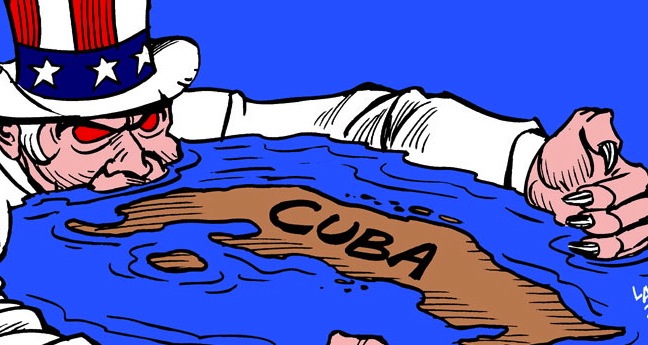
128 years of US exploitation, degradation of Cuba continues on steroids – Walt Zlotow
Walt Zlotow West Suburban Peace Coalition Glen Ellyn IL, 16 May 2026, https://theaimn.net/128-years-of-us-exploitation-degradation-of-cuba-continues-on-steroids/
One must go back to 1898 for the last time the US was not exploiting Cuba and its people to benefit rapacious US capitalism and organized crime. That year the US cooked up fairy tale about Spain blowing up the US Maine, sent to Havana Harbor to intimidate Cuba’s Spanish ruler. The Maine did blow up but from an accidental internal explosion, not a Spanish mine. Those 261 sailors could not to die in vain so President McKinley and his war party blamed Spain in order to declare war, kick Spain out of the Americas and take over Cuba for US exploitation.
But nothing in the previous 126 years compares to the diabolical cruelty, including death, the US has inflicted upon Cuba by President Trump and his bloodthirsty Secretary of State Marco Rubio.
This is not exaggeration. Need a lifesaving operation in Cuba under the Trump, Rubio oil blockade? Faggedaboudit. Much medical care is unavailable in oil starved Cuba when the lights go dark. Food and life sustaining supplies are becoming scares as farmers and merchants cannot get their wares to the people with a transport system largely shut down. Nearly a fifth of Cubans have fled the Trump, Rubio regime change operation.
Trump glories in their death and destruction he’s unleased. “THERE WILL BE NO MORE OIL OR MONEY GOING TO CUBA – ZERO! I strongly suggest they make a deal, BEFORE IT IS TOO LATE.” Trump is simply expanding in more grotesque terms US policy to degrade Cuba into submission going back to 1960. A secret State Department memo back then under Eisenhower promoted overthrowing Castro thru “a line of action, while adroit and inconspicuous as possible, denies money and supplies to Cuba to bring about hunger, desperation and overthrow of the Castro government.” Trump simply dropped the “adroit and inconspicuous” fig leaf.
Ironically, the first US embargo in Cuba was good for the Cuban people. In April, 1958, Eisenhower imposed an arms embargo on the Batista regime. The US had been supporting Batista’s murderous rule for 25 years to insure his support of US economic control, both legal and criminal that enriched US capitalists and Mafia enterprises to the detriment of the Cuban people. Eisenhower didn’t have an epiphany to help the Cuban people. He simply saw the inevitable triumph of Castro’s revolution and sought to curry favor with its eventual rulers.
Twenty months later Castro prevailed, Batista fled and Cuba finally ended 62 years of US cruelty and exploitation. Not quite. Within year the US imposed Cuban embargo 2.0 designed not to facilitate the inevitable revolution but to destroy it. Sixty-six years on, with the entire world community except Israel voting year after year in the UN for the US to stop, America’s endless lust to crush the Cuban revolution continues apace. And under the depraved Trump, Rubio oil embargo, it has become a monumental war crime against the 11 million sorrowful Cuban souls.
1 This Month



26 September – International Day for the Total Elimination of Nuclear Weapons


PLEASE OPPOSE HR 8255 AND S.3639 – bills would accelerate satellite deployment, with no environmental review or safeguards – https://ncstd5li.quorum.us/campaign/169331/
To see nuclear-related stories in greater depth and intensity – go to https://nuclearinformation.wordpress.com
-
Archives
- September 2026 (257)
- August 2026 (330)
- July 2026 (355)
- June 2026 (287)
- May 2026 (306)
- April 2026 (356)
- March 2026 (251)
- February 2026 (267)
- January 2026 (308)
- December 2025 (358)
- November 2025 (359)
- October 2025 (375)
-
Categories
- 1
- 1 NUCLEAR ISSUES
- business and costs
- climate change
- culture and arts
- ENERGY
- environment
- health
- history
- indigenous issues
- Legal
- marketing of nuclear
- media
- opposition to nuclear
- PERSONAL STORIES
- politics
- politics international
- Religion and ethics
- safety
- secrets,lies and civil liberties
- spinbuster
- technology
- Uranium
- wastes
- weapons and war
- Women
- 2 WORLD
- ACTION
- AFRICA
- Atrocities
- AUSTRALIA
- Christina's notes
- Christina's themes
- culture and arts
- Events
- Fuk 2022
- Fuk 2023
- Fukushima 2017
- Fukushima 2018
- fukushima 2019
- Fukushima 2020
- Fukushima 2021
- general
- global warming
- Humour (God we need it)
- Nuclear
- RARE EARTHS
- Reference
- resources – print
- Resources -audiovicual
- Weekly Newsletter
- World
- World Nuclear
- YouTube
-
RSS
Entries RSS
Comments RSS

