Rosatom and Finland’s Fennovoima claim different wins after tribunal ruling
By Reuters,Reporting by Anastasia Lyrchikova, Additional reporting and writing by Alessandra Prentice Editing by Ros Russell, Alexandra Hudosn October 11, 2026,
https://www.reuters.com/business/energy/rosatom-says-it-wins-tribunal-ruling-finnish-nuclear-plant-dispute-2026-10-10/
– Russia’s state nuclear corporation Rosatom and Finnish utility Fennovoima each highlighted different parts of an International Chamber of Commerce (ICC) tribunal ruling as favourable on Saturday, in a long-running dispute over the cancelled Hanhikivi-1 nuclear power project.
The parties have been locked in legal disputes since Fennovoima scrapped the 7-billion-euro ($7.8 billion) project in May 2022, citing significant delays and political risks shortly after Russia launched its conflict in Ukraine.
Rosatom said the tribunal found that Fennovoima had unlawfully terminated the contract for the construction of the planned plant in northern Finland.
“Today’s victory is important, but not final. We will continue to prove that we are right regarding the Finnish project in courts of various instances,” Rosatom Director General Alexey Likhachev said in a statement, which did not refer to any financial outcome.
Fennovoima said the tribunal found that it had not been entitled to terminate the contract, but that it was entitled to receive reimbursements of advance payments and interest in excess of 1 billion euros ($1.12 billion).
It said the tribunal offset both sides’ claims, resulting in Rosatom subsidiaries being ordered to pay Fennovoima a net 606 million euros plus interest.
The ICC did not immediately respond to a request for comment.
The contract to build the 1.2 gigawatt plant was signed in 2013 with Fennovoima, a consortium in which Finnish stakeholders including Fortum, Outokumpu and SSAB originally controlled two thirds through a joint venture, and the Russian side held one third.
After the project’s termination, Fennovoima wound down its operations and is primarily engaged in legal proceedings.
War puts Iran’s nuclear ambiguity under scrutiny
A revisionist argument is emerging in Tehran over Iran’s nuclear strategy:
that its longstanding policy of nuclear ambiguity failed its most important
test when it did not deter the United States and Israel from attacking, and
should now be reconsidered. Nezamoddin Mousavi, a former conservative
lawmaker with longstanding ties to the Islamic Revolutionary Guard Corps
(IRGC), gave unusually explicit expression to that argument this week,
declaring that “nuclear ambiguity did not prevent war” and raising the
prospect of revisiting Iran’s nuclear doctrine and even its membership in
the Nuclear Non-Proliferation Treaty (NPT).
Iran International 10th Oct 2026,
https://www.iranintl.com/en/202610106118
Underground nuclear reactor clears hurdle, but critics say it doesn’t have solid finances

Deep Fission, the company planning a one-mile underground nuclear reactor
in Parsons, Kansas, has passed a regulatory milestone, but at the same time
is facing new financial questions. A financial research organization has
raised questions about the viability of the project.
Then, four stockholder
rights law firms throughout the U.S. launched investigations of the company
after its share price dropped. The progress and challenges could mean an
unclear path forward for the project. Deep Fission’s goal as of right now
is to do further testing at the site. Company officials remain optimistic
and say the criticisms are prompted by financial motivations from the
people making the claims.
LJ World 10th Oct 2026, https://www2.ljworld.com/news/state-region/2026/oct/09/underground-nuclear-reactor-clears-hurdle-but-critics-say-it-doesnt-have-solid-finances/
Fusion – the endless dream

UK Minister for Energy Michael Shanks reportedly said that ‘Fusion has
the potential to provide virtually limitless clean energy’. That’s a dream
that some now see as getting a bit more real. The UK has form in this area.
It was a pioneer in nuclear fusion, with the ZETA device built at Harwell
in the late 1950s getting, briefly, a very good press: there was front-page
newspaper coverage saying it was a breakthrough towards unlimited energy.
Sadly, and embarrassingly, it turned out not to be the case. However, the
UK persevered with fusion over the years, for example playing host to JET,
the Joint European Torus test unit at UKAEA Culham. And now the UK
government has committed more than £2.5 billion over five years to new
nuclear fusion, including £1.3 billion for UK Fusion Energy to deliver the
STEP programme (a spin-off from Culham) in partnership with industry. A
further £740 million is earmarked for research and development
infrastructure and facilities. Unless of course there is a big
breakthrough. Can we afford to wait for that? By contrast, renewables are
ready here and now. Arguably they are a much better bet….using the fusion
reactor we already have- the sun.
Renew Extra 10th Oct 2026,
https://renewextraweekly.blogspot.com/2026/10/fusion-endless-dream.html
Officer numbers rise at Civil Nuclear Constabulary
AN ARMED police force guards some of the UK’s most sensitive sites, including Sellafield in Seascale, and data reveal that over the last six years its officer count has grown by more than 10 per cent.
Carlisle News & Star 10th Oct 2026,
https://www.newsandstar.co.uk/news/26620384.officer-numbers-rise-civil-nuclear-constabulary/
Naomi Klein: End Times Fascism: The Billionaires Are Planning Their Escape—and Leaving Us to Burn
Joshua Scheer, October 9, 2026, https://scheerpost.com/2026/10/09/naomi-klein-end-times-fascism-the-billionaires-are-planning-their-escape-and-leaving-us-to-burn/
The billionaires selling us the future are making plans to escape it. They promise artificial intelligence will liberate humanity while concentrating the wealth and power to decide whose lives are expendable. Their bunkers offer a revealing answer to the question their public relations campaigns avoid: What happens to everyone else?
In this conversation with Doomscroll host Joshua Citarella, Naomi Klein examines what she and co-author Astra Taylor call “end times fascism”—an alliance of religious fundamentalists anticipating Armageddon, tech oligarchs dreaming of transcending humanity, and nationalist movements building fortresses against the people their policies help displace. Klein argues that decades of privatization, austerity and corporate rule prepared the ground for this politics. The respectable centrists who presided over the wreckage now offer more of the same as its cure.
Klein’s warning cuts through Silicon Valley’s salvation racket: concentrated wealth has become a threat to collective survival. An elite that believes it can buy its way out of catastrophe has little reason to prevent it. Fighting back means confronting billionaire impunity, breaking concentrated corporate power and organizing around the things their grand visions keep sacrificing: water, food, dignity and a habitable world.
China’s Uranium Enrichment Expansion: Worrisomely Large
October 5, 2026 Dr. Hui Zhang, Senior Research Associate at Harvard’s Belfer Center, Occasional Paper 2603
China recently significantly expanded its uranium enrichment capacity. The predominant view of experts and respected non-governmental organizations is that this expansion is needed to supply China’s growing civilian nuclear energy sector.
As of September 2026, China had 64 power reactors (64 GWe) in operation and another 38 units (40 GWe) under construction, making it the world leader in new reactor construction. Its 15th Five-Year Plan (2026–2030) calls for installed nuclear capacity of 110 GWe by 2030, and some authoritative Chinese studies recommend reaching roughly 200 GWe by 2040. China’s nuclear power program is therefore expected to grow steadily over the coming decade, and with it the country’s demand for enriched uranium.
To meet this anticipated demand, China has significantly expanded its indigenous enrichment capacity since 2020. Over the same period, however, China has also rapidly enlarged its nuclear arsenal, raising the question of whether its enrichment buildup serves civilian needs alone. The Federation of American Scientists (FAS) estimates that China possessed about 620 warheads in 2026. The US Department of Defense (DoD) assesses that the stockpile remained “in the low 600s” through 2024—roughly triple its 2020 level—and, while noting “a slower rate of production compared to previous years,” projects that China remains on track to field more than 1,000 warheads by 2030. Much of the Western debate has focused on whether China needs additional plutonium to sustain this buildup. Much less attention has been paid to highly enriched uranium (HEU), which China may also need for new warheads, at least for the secondaries of its modern designs.
Assessing these questions is difficult because China does not officially release information on its enrichment capacity. This paper therefore draws on satellite imagery, Chinese publications, and discussions with Chinese experts to reconstruct the scale and trajectory of China’s enrichment program. Building on the author’s earlier estimates, it incorporates several significant developments, including the commissioning of new centrifuge facilities. By the end of 2026, China’s commercial enrichment capacity is estimated to reach about 15.4 million separative work units (SWU) per year—roughly 2.1 times its 2020 capacity of about 7.4 million SWU/year, or more than a doubling in six years.
This growth has not been steady. After an initial construction boom between 2010 and 2015, undertaken to meet the anticipated growth in demand from nuclear power, the China National Nuclear Corporation (CNNC) slowed its expansion between 2016 and 2019, suspending or postponing several planned or partially built projects, largely in response to slower reactor construction. Since around 2020, China has launched a new construction boom. Whereas the earlier expansion was driven primarily by civilian nuclear power, this paper argues that the current wave serves not only civilian needs but also, and importantly, China’s ongoing nuclear weapons buildup.
The remainder of this paper is organized as follows. Section 2 reviews the development of China’s enrichment industry and technology. Section 3 presents the current status of each of China’s enrichment plants and new capacity estimates. Section 4 compares enrichment supply with civilian demand, estimates how much HEU China would need for an arsenal of 1,000 warheads, and examines whether the timing of the enrichment expansion is consistent with China’s nuclear buildup. Section 5 concludes……………………………………………………………………………………………………………………………………………………………………………………………………………………………………………………………………………………………………………………….. https://npolicy.org/wp-content/uploads/2026/10/Chinas-Uranium-Enrichment-Expansion-Worrisomely-Large.pdf
Reactors on the Moon?

“In addition to reactors on the moon, they will next want nuclear reactors to power orbiting battle stations to ‘protect their assets’ on these planetary bodies. This is largely what Trump’s ‘Golden Dome’ is all about. Not so much about protecting us from attack back on Earth. It’s more about controlling the pathway on and off our planet Earth. Deciding who can go out and mine the sky. Like the front gate of a military base.”
Karl Grossman, CounterPunh October 9, 2026
The lead front page story in the New York Times this week was headlined: “Superpowers Racing to Put Nuclear Reactors on Moon.” The nations involved: the U.S., China and Russia. And there was a subhead: “Experts Warn of Radioactive Risks From a Rocket Mishap or Lunar Meltdown.”
The reporter, Selam Gebrekidan, wrote: “Failures could cause a chain reaction with direconsequences. Falling reactor debris could scatter radioactive material….An explosion or a meltdown on the moon’s surface could risk turning entire regions into no-go zones.”
The extensive story quoted Edward Lyman, director of nuclear power safety at the Union of Concerned Scientists, saying: “There will always be a space race going on, and if you enter nuclear power into that mix, then it could take a potentially more dangerous turn.”
Nuclear power and weapons in space have been an unexpectedly extensive part of my journalistic journey. Because of having been deeply involved in reporting about the plans of the Long Island Lighting Company to construct seven to 11 nuclear power plants on Long Island, where I live, I became knowledgeable about atomic energy.
I wrote a book titled “Power Crazy” about this scheme to turn the island into what nuclear promoters termed then a “nuclear park.” I wrote many columns and did television reporting on it.
So, back in 1985, with that experience, I was struck by a piece in the U.S. Department of Energy’s publication, “Energy Insider,” saying that DOE and NASA were partners in the sending up in 1986 two space shuttles—one being the Challenger—with space probes onboard fueled by plutonium, considered the most toxic of all radioactive substances.
Once the shuttles achieved orbit, the probes would be released, the one Challenger carried to survey Jupiter. The plutonium would be in radioisotope thermoelectric generators (RTGs), not for propulsion but to provide electric power for instruments.
In “Energy Insider” there was notice that the government had looked into various sorts of accidents that might happen on the missions. So, I sent Freedom of Information Act requests to DOE, NASA, and the DOE national laboratories involved in these studies asking to learn what was determined.
As the months passed, I began to realize I had hit upon a hot potato. I was denied the information on the grounds it was “technical” which is not a legitimate FOIA exemption. I appealed and won. Finally, to my post office came a box of documents, including a government projection that the likelihood of a “catastrophic” shuttle accident was 1-in-100,00. Those were very high odds, so I didn’t do anything.
That was until January 28, 1986, when on my way to teach my Investigative Reporting class at the State University of New York at Old Westbury, I heard on the car radio that the Challenger had exploded on launch……………………………………………
NASA’s use of nuclear power in space was being done in parallel with the plan for nuclear-powered weaponry in space.
This resulted in another book I authored, “Weapons in Space,” its foreword by Dr. Michio Kaku, and an hour-long TV documentary I wrote and presented, “Nukes in Space: The Nuclearization and Weaponization of the Heavens.” And there have been many articles on this and more TV programs during the ensuing four decades including “Star Wars Returns” (viewable at www.envirovideo.com).
I gave two presentations on this before members of the British Parliament in London, presentations at the United Nations in New York and Geneva, and elsewhere around the U.S. and world.
My most recent article on it, last month on CounterPunch, involved the announcement by the Air Force secretary acknowledging that the U.S. has deployed weapons in space.
In 1992, the Global Network Against Weapons & Nuclear Power in Space was formed in Washington, D.C. and is active worldwide. Bruce Gagnon is coordinator of the Maine-based organization.
He said from India where he is speaking at a conference, during a “Keep Space for Peace Week” that the Global Network is sponsoring, this about the Times story: “Here in India they say that their government is all in on the U.S. Artemis-led coalition to establish a base on the moon with nuclear reactors. So, the new ‘nuclear space race’ is on—the U.S. team versus Russia and China. What are they after? Helium-3 for potential power back on Earth and using the moon as a military staging base to control the ‘Earth-Moon gravity well’ as a way to decide which nations and private corporations can move into space to mine the planetary bodies.”
“We should recall that Obama signed a law to give American companies and wealthy individuals the ‘right’ to mine planetary bodies essentially in violation of the Outer Space and Moon treaties that say that the planetary bodies are the province of all humankind.”
“This is the kick-off of the race to carry the ‘bad seed’ of greed, domination, and colonization that was long ago planted into the soil on Earth into the heavens,” continued Gagnon. “The taxpayers have paid the R & D for these programs and now that the space tech has advanced, the self-centered capitalists are intent on grabbing all they can for themselves.”
“This will move the Earth-bound global war system into the heavens. When they add nuclear power into the equation these people are asking for trouble.”
“In addition to reactors on the moon, they will next want nuclear reactors to power orbiting battle stations to ‘protect their assets’ on these planetary bodies. This is largely what Trump’s ‘Golden Dome’ is all about. Not so much about protecting us from attack back on Earth. It’s more about controlling the pathway on and off our planet Earth. Deciding who can go out and mine the sky. Like the front gate of a military base.”
“In the end it’s a disaster in the making. From the Earth, where the Department of Energy has a horrible track record of worker air and water contamination while fabricating space nuclear devices, and into space, this entire nuclear system is a tragic mistake,” said Gagnon. ”The nuclear industry views space as a new market. They don’t give a damn about the dangers involved. These greedy aerospace corporations are salivating as they look at the profits to be made.”………………………………………………………………………………………………………………………… https://www.counterpunch.org/2026/10/09/reactors-on-the-moon/
Huckabee aide suppressed, doctored US cables to whitewash Israeli crimes: Report

Reports on slain Palestinian US citizens and rampant settler violence were buried or rewritten to praise Netanyahu instead
News Desk, OCT 8, 2026, https://thecradle.co/articles/huckabee-aide-suppressed-doctored-us-cables-to-whitewash-israeli-crimes-report
A senior aide to US Ambassador to Israel Mike Huckabee has been blocking and rewriting embassy reports to Washington to whitewash Israeli crimes in the occupied West Bank and Gaza, the New York Times reported on 8 October.
David Milstein, who joined the US embassy in Jerusalem in April 2025 and serves as a de facto chief of staff to Huckabee, oversees much of the mission’s work on the West Bank and Gaza.
According to a dozen people who deal with him in Jerusalem and Washington, he has used that role to repeatedly suppress or doctor cables on illegal Israeli settlement expansion, settler attacks, the killings of Palestinian US citizens, and deadly aid distribution in Gaza.
Among the reports Milstein buried was a March embassy review of the killings of nine Palestinian US citizens by Israeli settlers and soldiers in the West Bank over four years. The latest, 19-year-old Nasrallah Abu Siyam, was shot dead by a settler in February as he tried to stop the theft of his village’s livestock.
The review was compiled after 30 members of Congress, led by Senator Chris Van Hollen, pressed Secretary of State Marco Rubio for answers. It found that most investigations had gone nowhere, some had been closed, and not one person had been charged.
Rather than send it, Milstein pushed for a reply assuring lawmakers that Israel was handling the cases properly. The State Department letter that reached Van Hollen on 4 May withheld the findings, pointing instead to the embassy’s wartime focus on security cooperation with Israel.
“If you don’t get accountability, you endanger more American citizens,” Van Hollen said.
In the summer of 2025, Palestinians seeking food were being shot dead en masse at the sites of the so-called Gaza Humanitarian Foundation (GHF), a US-Israeli scheme that turned aid distribution into a death trap and killed at least 1,400 aid seekers.
As the killing went on, embassy diplomats warned Washington that the operation risked further mass casualties; however, Milstein rewrote the cable to hail it as a success, erasing the dead from the record entirely.
In April – after senior Israeli commanders warned that surging Israeli settler attacks across the occupied West Bank could spark a new Palestinian uprising – Milstein blocked staff reports relaying the warning, and Washington instead received a cable under his name crediting Netanyahu with cracking down on the violence.
In February, when Israel revoked long-standing legal barriers to Israeli land purchases in the occupied West Bank, a move condemned internationally as fast-tracking annexation, the embassy told Washington the policy served settlers’ “humanitarian needs,” without explaining further.
Milstein also reportedly subjected colleagues to loyalty tests, demanding to know whether they were “pro-Israel” or “pro-Hamas,” four officials said, leaving staff afraid to speak.
Under his watch, some stopped writing reports altogether rather than see them censored, and cables on Palestinian affairs dwindled from several a week to a handful a month.
French submarine fires new nuclear weapon
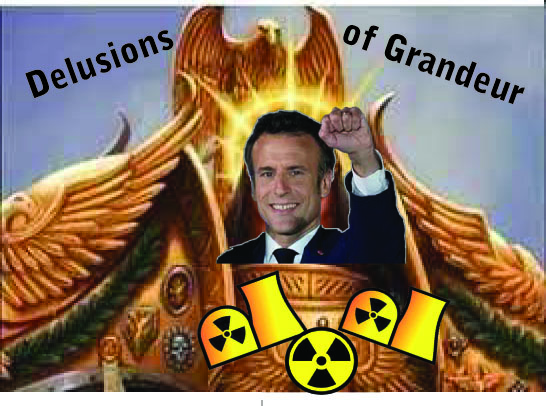
France has fired its latest submarine-launched ballistic missile for the first time from the boat Le Vigilant, with President Emmanuel Macron watching from the deck of a frigate, the president stated in a post published after the launch.
UK Defence Journal 6th Oct 2026,
https://ukdefencejournal.org.uk/french-submarine-fires-new-nuclear-weapon/
Writing in French from aboard the multi-mission frigate Auvergne, Mr Macron said: “Aboard the multi-mission frigate Auvergne, I witnessed the first firing of the new M51.3 ballistic missile from the nuclear-powered ballistic missile submarine Le Vigilant. Very few nations possess such expertise.”
He thanked the defence procurement agency DGA, the Atomic Energy Commission, ArianeGroup, Naval Group and the French Navy, and said: “This technical success is a new demonstration of the credibility of our deterrence, whose sustainability is assured. To be free, one must be feared. And to be feared, one must be powerful.”
The missile was launched off Finistère in western Brittany without a nuclear warhead fitted, and flew to a designated impact area in the North Atlantic several hundred kilometres from any coastline. France has described the trial as validating the operational capability of Le Vigilant’s strategic weapon system after a long refit, and the boat has recently emerged from the major overhaul the French call an IPER before returning to the deterrent patrol cycle.
The M51.3 is the third operational version of the missile, which was declared in service last October with improved range, accuracy and penetration performance over the preceding M51.2, and carrying the newer TNO warhead. ArianeGroup builds the family, which entered service in 2010, and the missiles arm the four boats of the Triomphant class. A further version, the M51.4, was contracted to the same company in August last year and is expected during the next decade, alongside the third-generation submarines that will replace the current fleet.
Published range figures for the M51 run to somewhere between 8,000 and 10,000 kilometres, though France does not confirm them and the real figure is classified.
Mr Macron set the firing against his own record on defence spending, saying he had launched the renewal of French capabilities in 2017 and that the armed forces budget will have doubled over ten years. He added that the programme for hypersonic and manoeuvring strategic missiles that will arm the airborne component of the deterrent was launched this year, a reference to the weapon intended to succeed the ASMP-A carried by Rafale squadrons.
France designs, builds and owns every element of its deterrent, from the warhead through the missile to the boat, whereas the Royal Navy draws its Trident II D5 missiles from a common pool held at King’s Bay in Georgia.
The two countries are also closer on nuclear matters than they have been at any point since the war. Under the Northwood Declaration signed last year, Britain and France agreed to coordinate their deterrents and stated that there is no extreme threat to Europe that would not prompt a response by both, which was the first time either had said so in those terms.
Mr Macron closed by saying that French nuclear deterrence “protects us and will continue to protect us”.
Timeline for Polish nuclear units slips in updated programme

Last October, state-owned public power company PGE signed a preliminary agreement to become the sole shareholder of PGE PAK Energia Jądrowa SA by acquiring the 50% stake held by ZE PAK.
Under the updated programme, the first unit is now scheduled to start commercial operation in 2036, and the plant expected to reach full capacity by 2038 – three years later than previously planned.
WNN, 5 October 2026
Poland’s Council of Ministers has adopted an update to the country’s nuclear power programme – a strategic document outlining the development of nuclear energy in Poland – with the first nuclear power plant now expected to start up in 2036 and the second one in 2040.
In September 2021, it was announced that six large pressurised water reactors with a combined installed capacity of 6-9 GWe could be built by 2040 as part of the country’s plan to reduce its reliance on coal. According to the adopted schedule, the construction of the first nuclear power plant would start in 2026, with the first reactor – with a capacity of 1.0-1.6 GWe – being commissioned in 2033. Subsequent units would be implemented every 2-3 years. The coastal towns of Lubiatowo and Kopalino in Poland’s Choczewo municipality in the province of Pomerania were named as the preferred location for the country’s first large nuclear power plant.
In parallel, work is under way to build a second nuclear power plant with Bełchatów and Konin remaining the preferred locations. The final location selection will be made by the investor after detailed analyses and field studies.
The ministry said a competitive dialogue is under way to select a technology supplier and project contractor. The USA, France, and Canada have joined the process. “The goal is to select a comprehensive offer encompassing both technology and project financing under the best possible terms,” it said. Key milestones for the second power plant are: the selection of strategic partner and technology in 2027; construction to start around 2032; and the first unit to start up around 2040 – one year behind the previous schedule.
………… “It is estimated that Polish companies could contribute approximately 40% of the project’s value during the construction of the first reactor. With the development of subsequent units, as expertise, experience, and the number of certified companies grow, this share could rise to approximately 70%.”
In November 2022, the Polish government announced the first plant, with a capacity of 3,750 MWe, would be built in Pomerania using Westinghouse’s AP1000 technology. An agreement setting a plan for the delivery of the plant was signed in May 2023 by Westinghouse, Bechtel and Polskie Elektrownie Jądrowe (PEJ)…………………………………………………………………..
The ministry said the update provides increased funding for tasks related to the implementation of nuclear energy: support for building competencies in the field of nuclear energy, support for the participation of Polish industry in the Polish Nuclear Power Programme, and strengthening the nuclear regulatory institution, that is, the National Atomic Energy Agency (NAEA). It noted support for the NAEA constitutes the largest financial component of the Polish Nuclear Power Programme………
For the project to construct the first plant – for which preparatory work at the construction site and the implementation of accompanying infrastructure is under way – PLN60.2 billion (USD15.4 billion) has been allocated for the project’s recapitalisation between 2025 and 2030. The financing model assumes a combination of equity and debt financing supported by domestic and international institutions.
Under the updated programme, the first unit is now scheduled to start commercial operation in 2036, and the plant expected to reach full capacity by 2038 – three years later than previously planned.
…….. “It is estimated that Polish companies could contribute approximately 40% of the project’s value during the construction of the first reactor. With the development of subsequent units, as expertise, experience, and the number of certified companies grow, this share could rise to approximately 70%.”
The update to the programme indicates key areas of state action to ensure effective implementation of the programme: development of staff and competences for the nuclear sector; development of transmission infrastructure; increasing the share of domestic industry; strengthening the nuclear and technical supervision system; radioactive waste management; and communication and social education.
Alongside the government’s nuclear power programme, in October 2022, Poland’s Ministry of State Assets, South Korea’s Ministry of Trade, Industry and Energy, ZE PAK and PGE, and Korea Hydro & Nuclear Power signed a letter of intent to develop plans for a nuclear power plant in Pątnów. PGE PAK Energia Jądrowa – a 50/50 joint venture special purpose vehicle formed in April 2023 by ZE PAK and PGE to implement the project – submitted an application for the plant to the Ministry of Climate and Environment in August 2023.
The application included a description of project characteristics, indicating the maximum installed capacity, the planned operating period and details of the APR1400 technology to be used in the construction of the plant. In November 2023, Poland’s Ministry of Climate and Environment issued a decision-in-principle for the plant. Last October, state-owned public power company PGE signed a preliminary agreement to become the sole shareholder of PGE PAK Energia Jądrowa SA by acquiring the 50% stake held by ZE PAK.
There are also plans, led by SGE, for a fleet of as many as 26 BWRX-300 small modular reactors in Poland.
Chernobyl Drone Attacks Gamble With Safety of Millions, UNDP Warns
By Catherine Sadler
Law News 28th Sept 2026
Chernobyl drone attacks are ‘really gambling with the safety of millions of people’, United Nations Development Programme (UNDP) administrator Alexander De Croo warned on Thursday, following a visit to the Chernobyl Nuclear Power Station where he inspected damage firsthand. His warning comes after the International Atomic Energy Agency (IAEA) GOV/2025/11 report concluded that the New Safe Confinement (NSC) enclosing Unit 4 can no longer perform its primary safety function of containing radioactive material from the 1986 explosion.
‘Whether it was a deliberate attack or an accident, this is something which is unacceptable,’ De Croo said. ‘Making sure that drones are not flying above that site is one way of avoiding that things like this could happen.’ He called for urgent international action, stressing that Russia had not been acting in line with international humanitarian law and that ‘even in war, there are rules to be followed.’
The Escalating Pattern of Chernobyl Drone Attacks
The IAEA’s assessment, prepared following a comprehensive safety review requested by Ukraine’s State Nuclear Regulatory Inspectorate (SNRIU), found that a drone strike on 14 February 2025 struck the upper part of the NSC arch, causing fire and structural damage. According to the American Nuclear Society, the strike left a hole larger than 500 square feet in the outer cladding, with efforts continuing to extinguish isolated smouldering areas of the structure’s insulation material.
The pattern of incursions has continued into 2026. According to the IAEA’s GOV/2026/7 report, three drones were detected within five kilometres of the site on 20 January 2026, causing the loss of four off-site power lines for the day; two further drones were detected within five kilometres on 5 February; and eight drones were detected within the monitoring area across 13 and 14 February. On 7 June 2026, a Russian drone struck a building storing spent nuclear fuel near Chornobyl, according to NucNet. …………..
The IAEA has maintained a continuous support and assistance mission at the Chornobyl site since January 2023, deploying additional staff in 2025 to conduct its safety assessment of the damaged NSC, as confirmed in IAEA Director General Update 330. Temporary repairs to restore a degree of confinement function are under way in 2026, with support from the European Bank for Reconstruction and Development (EBRD), according to IAEA Director General Update 331. Full restoration remains contingent on the end of the conflict.
The Chernobyl site’s history makes the current position acutely serious. The 1986 disaster, classified as a level 7 nuclear event, occurred after a reactor went out of control during a poorly managed routine safety test, killing 31 people directly. The IAEA projected that radiation released could lead to around 4,000 cancer-related deaths among those within the affected radius, and between 1991 and 2005 documented at least 5,000 cases of thyroid cancer in children under 14 in Belarus and Ukraine, linked to severe radiation exposure………………………………………………………………………………………………………………………………………………..
With the NSC unable to contain radioactive material and drone incursions continuing, the IAEA’s next reporting cycle and any Security Council response to De Croo’s intervention will indicate whether international pressure translates into enforceable restrictions on airspace above the site. https://www.lawnews.co.uk/legal-news/chernobyl-drone-attacks-gamble-with-safety-of-millions-undp-warns/
British nuclear submarines to use hoses in ‘worst case scenario’ defence despite Russia threat
A Navy source has claimed that high-powered hoses mounted on docked HMS Vanguard submarines are being factored into the defence of the top-of-the-line £3 billion vessels
Liam Doyle, 09 Oct 2026,
https://www.mirror.co.uk/news/uk-news/british-nuclear-submarines-defence-37755122
Britain’s most advanced nuclear submarines only have hoses to protect them from drone incursions, it has been reported.
Vanguard class submarines, the pinnacle of the Navy’s underwater fleet, have “centre-fed reels”, a type of hose connected to a drum that can launch powerful streams of water through a trigger system. They are mainly used to tackle onboard fires, but it has now been claimed that they are also being deployed to fend off drones.
An insider has said submarine crews now “have to use what you’ve got”, while the Government insists its most vital military units are properly protected.
The reels are reportedly placed on deck as a precaution while submarines are tied up alongside the HMNB Clyde in Faslane, Helensburgh, Scotland, a source told the Sun. While there, they are swathed in several layers of defence, including the base’s specialist counter-drone capabilities, patrols, surveillance, monitoring and physical barriers.
But the source claimed the hoses are also meant to factor into the defence, stating: “In a worst case scenario, the plan is to grab the centre fed hose reel and use it to knock a drone off course or even knock it down.”
The hoses, according to official documents, are designed for use primarily to tackle different types of fires and can be found on several different vessel types. An MOD Defence Standard states they are placed on HM Ships, Submarines or Fire Schools “as a first appliance against Class A & B fires”.
Class A fires are caused by solid combustibles, while Class B fires are started by flammable liquids like petrol, diesel or paraffin.
The claims come as drones are increasingly fielded in military conflicts, having found routine use in Ukraine, where they are helping turn the tide of war against Russia, and in Iran. They have also strayed further into eastern Europe, with two ships hit by sea and air drones off the coast of Bulgaria earlier this week.
Officials launched a massive search and rescue operation for missing crewmembers following the incident in the Black Sea on October 6 in which the vessels sent distress signals at around 4am local time (2am BST).
One of the pair “disappeared” from the radar of border police at around 9am local time (7am BST). Rescue teams were able to retrieve 18 sailors on the second vessel, with two of them seriously injured. The remaining 16 crew are reportedly in “good condition”. The origin of the drones has not yet been established.
Bulgarian prime minister Rumen Radev said: “I can’t say yet which country the drones are from, but it’s clear – they’re either Russian or Ukrainian.”
The Royal Navy has also recently brushed with drones, with HMS Dragon having faced them down in the Mediterranean and Red Sea. The Type 45 destroyer spent seven months away protecting UK interests this year by shielding bases in Cyprus, providing maritime security and working with allies and partners across the Middle East.
It returned to Portsmouth today, with General Sir Gwyn Jenkins, the First Sea Lord and Chief of Naval Staff hailing the deployment as showing “the Royal Navy at its best”. Responding to the hose claims, an MoD spokesperson said the Government is taking military security “extremely seriously”.
They said: “The first duty of Government is national security, and we take the security of our people, sites and local communities extremely seriously, in particular those housing nuclear capabilities.
“The protection of our bases is kept under constant review, with a multi-layered approach that includes physical barriers, patrols, surveillance, monitoring, and counter-drone capabilities. Through the Defence Investment Plan, we are investing an additional £470million over the next four years to strengthen the protection of UK military sites.”
Deterring Our Way to Doomsday

Mordor is the fictional realm of the Dark Lord Sauron in J.R.R. Tolkien’s The Lord of the Rings, located in the southeastern part of Middle-earth. [1, 2]
Loving the Bomb Yet Again
by William Astore | Sep 29, 2026 , https://www.antiwar.com/blog/2026/09/29/deterring-our-way-to-doomsday/
Reprinted from Bracing Views with the author’s permission.
It’s amazing the enormous sums of money the U.S. government spends on destructive weaponry in the stated cause of deterring massive destruction. It’s MAD, of course, this notion that peace is only attainable via the promise of annihilating another people. And now we know that annihilation won’t be limited to Russia or China or Iran: that a “general” nuclear strike would likely produce a nuclear winter that would end most life on our planet. Yet the Pentagon persists in nuclear “modernization” and further “investments” in the Triad.
In the early 1960s, the Air Force wanted 10,000 ICBMs but “settled” for 1000 Minuteman missiles. To preserve “the American way,” they built a nuclear command center (Cheyenne Mountain) under 2000 feet of granite, which was rendered obsolete soon after it was built by more accurate Soviet ICBMs with warheads in the megatons.
As a young Air Force officer, I hunkered down in the 1980s in Cheyenne Mountain. I visited Los Alamos. I’ve walked the Trinity Test Site in Alamogordo, New Mexico, site of the first atomic test in 1945. Friends of mine have sat in ICBM silos, ready and able to unleash Armageddon. Imagine young lieutenants and captains in their twenties, sitting underground, waiting for the president’s command to launch missiles that will unleash a nuclear holocaust to kill millions, if not the planet itself.
All this fresh talk of “investment” in “modernized” nuclear weapons is sheer madness – a collective death wish – a “strange love” for world-destroying nukes. Yet again, we’ve come to love the bomb.
Recently, the Chief of Staff of the Air Force (CSAF) spoke of nuclear weapon “recapitalization”: truly an abomination of the English language. You don’t “recapitalize” genocidal weaponry. Both the Sentinel ICBM missile program and the B-21 bomber are unneeded weapons systems that will likely cost $500 billion or more over the next 20 years. Sadly, he isn’t the only general who’s positively gleeful about all the money being thrown at nuclear weapons, the Golden Dome, and weapons in space.
This mad (MAD) glee for money in the cause of mass destruction and madcap militarism is destroying not just our democracy. It’s like our “leaders” are out of Mordor, searching for the One Ring of Power, with AI data centers and surveillance the equivalent to Sauron’s eye that sees all.
I wonder if Sauron spoke of “modernization” and “recapitalization” in Orcs and Nazgûl and Balrogs?
The current CSAF promises to “advocate relentlessly” for new weaponry like the Sentinel ICBM and B-21 Raider. He says “readiness” to fight is an airman’s “first responsibility.” Actually, that first responsibility is to support and defend the U.S. Constitution. We must be guided by the law of the land, not by the beauty of our weapons (Brian Williams) or a warrior’s urge to use them (Pete Hegseth)
America, stop the MADness. A policy of Mutually Assured Destruction means we’re all dead. As the Outlaw Josey Wales said: “Dyin’ ain’t much of a living.” Nor is deterring our way to Doomsday.
Waffling at the UN: OpenAI, Anthropic and Selling Artificial Intelligence

10 October 2026Dr Binoy Kampmark, https://theaimn.net/waffling-at-the-un-openai-anthropic-and-selling-artificial-intelligence/
They are a trying lot, spruiking their overvalued, loss-making firms, sowing discord and fear, and then seeking state collaboration that will serve to implicate all the parties concerned should things sour. And what will the rest of us get? Hardly the promised land. But the United Nations, for the first time in history, became a centre stage for the propagandists from Artificial Intelligence firms during the September deliberations, diplomats hanging off the banal declarations from such figures as Sam Altman, the CEO from OpenAI, and Dario Amodei, his equivalent from Anthropic.
In his September 23 address to the UN Security Council, no less, Altman slipped into that familiar messianic tone about choices to be made, largely because these choices are being made for the rest of humanity by his ilk. “We have a choice in front of us. AI can either be more like a new Renaissance of creativity and discovery, or more like a new Industrial Revolution of upheaval and disarray.” Why the binary proposition? And why the need for the choice in the first place?
Altman is irritatingly condescending, suggesting that “people are much more capable than they imagine themselves to be, but have been held back by limited technology that was meant to empower but instead distracts and often steals attention.” Examples are not forthcoming, but the monotonous tone is set: AI, like the son of the good Lord, is a gift to humankind. “It is about giving people more agency in an ever more complex world: more ability to learn, to create, discover, build, participate.” This is drivel, since AI, even as this is being penned, is imposing disabilities on learning by turning the process into one of lazy, numbing consumption, negating creativity by stealing it from creative human sources, not so much discovering as synthesising what has been scraped and not so much building as demolishing and removing the human subject from participation. The agenda is distinctly anti-human.
Altman, however, had hit his stride, saying that, “AI should be built for the people, not simply to turn the crank of the machines faster for their own sake. Some of the things people working to build AI have said are so dystopian that they sound like the plot of bad science fiction movies.” This bleat is no doubt directed at the effusive warnings of technology researcher Jacob Coxon, who had worked at both OpenAI and Anthropic and found his Damascene conversion. “They are racing straight toward self-improving superintelligence and gambling with our lives,” Coxon said last month on resigning from Anthropic. “The people building AI genuinely believe it could kill us all by the end of the decade.”
These catastrophic forecasts are boons for Altman and the AI fraternity. The greater the risk of a gloomy end, the greater the need to be a leading force in preventing that terminus from being reached. “It doesn’t matter whether people put the risk of catastrophe at 10%, or 1%, or 12%, or .1%. None of these levels are remotely acceptable.” He suggests that “we should not train models that we cannot make an extremely strong case that we will be able to keep under human control.” Risibly, Altman goes on to also warn that such systems could become the preserve of the elite – “too much power in too few hands. No one person or company or country should be able to use the most powerful AI models to impose their worldview on everyone else.” Which is exactly what he was doing at the UN Security Council, showing what concentrated power looks like.
What, then, to do? Altman posits three principles, none particularly profound. The first is to retain a human element at the centre of AI, a delightful proposition from the CEO of a company working to remove the human from the equation, exemplified by the hack of Australia’s Medicare system by an OpenAI agent in June that subverted privacy protections. The second is the corollary of the first: “the benefits of scientific progress and economic growth must be by people and for people.” Tools are not to replace human agency. The third entails a word that really ought to be banished to the lexical mausoleum. Such “technology must empower people individually.” The term “empower” is only ever used by those who ration power to begin with.
Unperturbed, Altman has an advertiser’s pitch. He is selling a product. Governments are to be involved. “If AI is to be democratic, the most important decisions cannot be made by labs in San Francisco alone. They must be shaped through the democratic processes, and by governments accountable to the people that they serve.” He suggests international cooperation and “a mechanism for complementary national and international frontier AI standards. These would measure capabilities, assess risks, determine the adequacy of safeguards “and preserve meaningful human oversight as systems become more autonomous.” Common standards would enable states to compare evidence and verify compliance. A regime to report incidents expeditiously and learn from them rapidly would be vital. Secure channels among governments and what Altman calls “critical infrastructure operators” and “technical experts” (that’s the pitch for his company) would “share emerging vulnerabilities and new threats.”
Amodei’s address was even more blatant in self-advertising, including the virtues of the Claude large language model. “Just today, Anthropic announced the Claude-led discovery of a new molecular machine,” he boasted. This could lead to “a new gene editing mechanism that could have applications in gene therapy.” But risks abounded. AI models might be misused by, for instance, bioterrorists in creating biological weapons. Another risk was the “loss of control, model capabilities accelerating beyond developers’ ability to control them.” As with Altman, a similar theme emerged: all of humanity needed to be concerned, including governments representing it. “If managed poorly, I even believe that AI could be a risk to humanity as a whole.” Then comes his pitch: Anthropic was better placed than any to be the knight in shining armour, given its “best track record in the industry for preventing these risks, both operationally and in our research.” Through testing was taking place for all models regarding dangers and risks. Safeguards were installed in “our most capable models, and we publish our work in these areas.” The company was also without peer in its transparency practices.
This was the prelude for another three-step suggestion. For starters, much like a “food inspector” (these people are truly imaginative), external evaluators should be embedded across AI companies. Second, industrial standards should be set, thereby modulating “the pace of progress.” The final point entails global cooperation across governments “to set international standards.” Specifically for the Security Council, Amodei suggested initial narrow agreements “that every member can support such as a ban on using AI to make biological weapons or permitting your AI technologies to be used to make biological weapons.” (Why the fascination with those weapons?) Evaluation and verification systems should be established to “have visibility into frontier model capability.” And “common global standards for testing AI models for loss of control risks and misuse risks, and a notification system for AI incidents that are significant for global security.” Lecture concluded.
UN officials are certainly in a muddle about how to approach what is both a poisoned chalice and rich cornucopia of opportunity. Volker Türk, the top UN human rights bureaucrat, seems besotted and dismayed all at once. He also seems all too trusting, noting with approval the meaningless, voluntary accord signed by US President Donald Trump and the heads of six AI companies on September 29 regarding safeguards, self-regulation and assessing risk. In what must be a momentous occasion, the president actually used the term “morally binding,” neither word having ever had any truck in his vocabulary. At least Türk acknowledges the need for mandatory human rights safeguards and due diligence in the development of the technology, warning against a creeping, unnoticed dystopia A good start in that regard would be a consensus on banishing machines from the realm of decision making on whether human life is allowed to continue or expire. That sounds like tender hearted naivete, given that human agents are already deferring their responsibilities and ethical compass to AI machines. What Altman and Amodei are doing with brio is playing out their ongoing and proposed crimes against humanity in plain sight.
1 This Month
23-25 October – on Zoom – World BEYOND War’s annual global conferenc


Shut down the radiation-damaged Heysham nuclear reactors now
To see nuclear-related stories in greater depth and intensity – go to https://nuclearinformation.wordpress.com

Say No to NASA’s Reckless Nuclear Reactor on the Moon
Say No to NASA’s Reckless Nuclear Reactor on the Moon

-
Archives
- October 2026 (247)
- September 2026 (339)
- August 2026 (330)
- July 2026 (355)
- June 2026 (287)
- May 2026 (306)
- April 2026 (356)
- March 2026 (251)
- February 2026 (267)
- January 2026 (308)
- December 2025 (358)
- November 2025 (359)
-
Categories
- 1
- 1 NUCLEAR ISSUES
- business and costs
- climate change
- culture and arts
- ENERGY
- environment
- health
- history
- indigenous issues
- Legal
- marketing of nuclear
- media
- opposition to nuclear
- PERSONAL STORIES
- politics
- politics international
- Religion and ethics
- safety
- secrets,lies and civil liberties
- spinbuster
- technology
- Uranium
- wastes
- weapons and war
- Women
- 2 WORLD
- ACTION
- AFRICA
- Atrocities
- AUSTRALIA
- Christina's notes
- Christina's themes
- culture and arts
- Events
- Fuk 2022
- Fuk 2023
- Fukushima 2017
- Fukushima 2018
- fukushima 2019
- Fukushima 2020
- Fukushima 2021
- general
- global warming
- Humour (God we need it)
- Nuclear
- RARE EARTHS
- Reference
- resources – print
- Resources -audiovicual
- Weekly Newsletter
- World
- World Nuclear
- YouTube
-
RSS
Entries RSS
Comments RSS

