Hegseth ‘Responsible’ for ‘Murder’: Family Files Formal Complaint Over Killing of Colombian Fisherman.
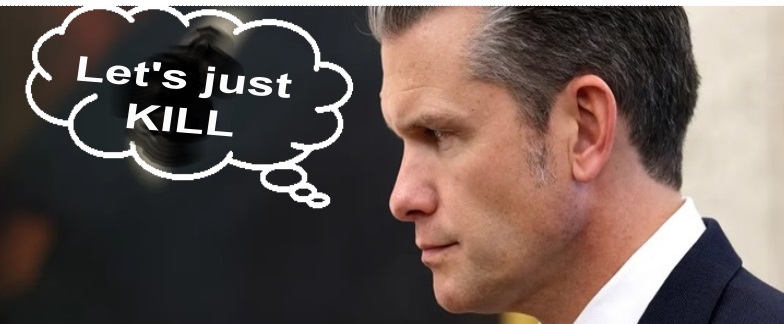
According to the official filing, Trump’s Defense Secretary “has admitted that he gave such orders despite the fact that he did not know the identity of those being targeted for these bombings and extra-judicial killings.”
Jon Queally, Dec 03, 2025, https://www.commondreams.org/news/hegseth-murder-boat-strikes
The family of Colombian fisherman Alejandro Carranza Medina, believed killed by the US military in a boat bombing in the Caribbean Sea on Sept. 15, has filed a formal complaint with the Inter-American Commission on Human Rights accusing US Secretary of Defense Pete Hegseth of murder over the unlawful attack.
“From numerous news reports, we know that [Hegseth] was responsible for ordering the bombing of boats like those of Alejandro Carranza and the murder of all those on such boats,” reads the petition, filed Tuesday on behalf of Carranza’s family by Dan Kovalik, a human rights attorney based in Pittsburgh.
The complaint also notes that President Donald Trump, the commander in chief of the US military, “ratified the conduct of Secretary Hegseth described herein.”
First reported on by The Guardian, the filing of the petition with the IACHR—an autonomous body under the charter of Organization of American States (OAS) designed to uphold human rights in the Western Hemisphere—could result in the initiation of an investigation and the release of findings about the bombing that took the life of Carranza and two other individuals believed to be aboard the vessel.
The petition, the outlet noted, “marks the first formal complaint over the airstrikes by the Trump administration against suspected drug boats, attacks that the White House says are justified under a novel interpretation of law.” Experts in international human rights law have stated from the outset that the administration’s justifications lack legal basis and that the attacks constitute unlawful criminal acts.
According to The Guardian:
Carranza, 42, appears to have been killed in the second strike of the Trump administration’s bombing campaign, on 15 September. The administration has publicly disclosed 21 strikes on alleged drug boats. Carranza’s family says he was a fisher who would often set out in search of marlin and tuna.
On the day of the strike, Trump announced on his Truth Social platform that “This morning, on my Orders, US Military Forces conducted a SECOND Kinetic Strike against positively identified, extraordinarily violent drug trafficking cartels and narcoterrorists in the SOUTHCOM area of responsibility”. Trump attached video marked “unclassified” of a small boat floating in the water before it was struck.
Both Hegseth, the highest-ranked civilian at the Pentagon, and Trump have been under growing scrutiny for the series of boat bombings that have resulted in the extrajudicial killing of over 80 people since September. Experts have said the killings should be seen as “murder, plain and simple.”
New revelations about a strike on Sept. 2, in which two survivors of an initial bombing were later killed as they clung to the exploded boat on which they were traveling, has evelated that concern in Washington, DC this week with lawmakers seeking answers about the attack which, even if one accepted the legality of the initial strike under the construct the Trump administration has tried to claim, would constitute a clear human rights violation amounting to a war crime.
In an interview with Agence France-Presse in October, Katerine Hernandez, Carranza’s wife in Colombia, said her husband was “a good man” devoted to fishing and providing for his family. “Why did they just take his life like that?” she asked.
Hernandez denies that Carranza was involved in drug trafficking, as Trump and Hegseth have alleged without providing evidence, but also suggested that even if drug trafficking was taking place, it would not justify his murder. “The fishermen have the right to live,” she said. “Why didn’t they just detain them?”
In a Tuesday statement, the IACHR urged the US government to “ensure respect for human rights” during any and all extraterritorial military operations in the region, noting the deaths of a high number of persons both in the Caribbean and in the Pacific, where other strikes have taken place.
“While acknowledging the seriousness of organized crime and its impact on the enjoyment of human rights, the Commission recalls that States are obliged to respect and ensure the right to life of all persons under their jurisdiction,” the statement reads.
“According to the Inter-American jurisprudence, this duty extends to situations when State agents exercise authority or effective control, including extraterritorial actions at sea,” it continues. “When lethal force is used by security or military personnel outside national territory, States have the obligation to demonstrate that such actions were strictly lawful, necessary, and proportionate, and to investigate, ex officio, any resulting loss of life. These obligations persist irrespective of where the operations occur, or the status attributed to the individuals affected. Likewise, persons under State control must always enjoy full respect for due process and humane treatment.”
The commission called on the US to “refrain from employing lethal military force in the context of public security operations, ensuring that any counter-crime or security operation fully complies with international human rights standards; conduct prompt, impartial, and independent investigations into all deaths and detentions resulting from these actions; and adopt effective measures to prevent recurrence”
Trump’s AI Push May Hinge on Renewable Energy

By Kyle Stock and Mark Chediak, December 5, 2025 , https://origin.www.bloomberg.com/news/newsletters/2025-12-04/how-trump-s-renewables-roadblocks-can-stall-the-ai-boom
President Donald Trump is pro-AI and anti-renewables. But those two stances are increasingly contradictory: Data centers need quick power on the cheap, and that’s exactly what renewables offer.
Today’s newsletter takes you inside the mismatch and why opposing renewables might do more than hinder the US in the battle for AI supremacy.
The Trump administration is moving to fast-track the construction of power-hungry data centers as a matter of national security. At the same time, it’s adding roadblocks for new solar and wind farms.
But the two policies could be at odds: Hindering renewable energy projects risks slowing the AI boom — and could exacerbate rising electricity prices, a slew of data suggests.
“It’s an all-hands-on-deck moment right now to get the power to supply this,” said Robert Whaley, director of North American power at Wood Mackenzie, an energy consultancy. “In the next 10 years, there’s really nothing to replace renewables.”
The AI explosion — and its energy demands — is happening much faster than the pace at which utilities typically plan and build large power plants. In response, tech giants like Meta Platforms Inc. and Alphabet Inc.’s Google have taken extreme measures to keep up, cobbling together data centers in tents and signing contracts for their own power plants.
Wind and Solar Are Now Cheaper
Cost to build electricity generation in dollars per megawatt hour, based on recent projects and fuel costs
Renewable energy so far remains the fastest and cheapest option to add power to the grid. Nearly 80% of the planned power plant capacity in the pipeline is tied to renewable sources, according to filings with federal regulators and grid operators compiled by Cleanview.co, an energy data company.
The number of applications for natural gas and nuclear facilities, the options President Donald Trump is embracing to power the AI surge, is much smaller, making up about 14% of planned capacity.
The dynamic creates a potential political challenge for Trump, whose goal of using the AI boom as an engine for the American economy risks blowback at the ballot box if voters blame the data centers he’s championed for higher power bills.
“President Trump is expanding base load power from reliable energy sources like natural gas, coal, and nuclear to support growing electricity demand from AI and data centers,” said Taylor Rogers, a White House spokesperson. “Intermittent and unreliable energy sources like offshore wind that were propped up by the Green New Scam simply cannot generate the sustained power needed to make the United States the global leader in cutting-edge technologies like AI and quantum computing.”
US New Electricity
New electrons from solar, storage and wind are expected to outnumber those of new natural gas plants almost six-fold in the next 10 years
But the cost to build solar and wind farms plummeted in the years before those incentives were scrapped. Meanwhile, building up enough gas and nuclear plants to power data centers may prove too slow and expensive. Gas turbines, critical equipment to turn natural gas into electricity, are in short supply, and even though Trump is moving to accelerate permitting of the next generation of small-modular nuclear reactors, the next wave of those aren’t expected to be built until the end of the decade at the earliest.
At this point, battery storage systems, solar arrays and wind farms are faster and cheaper to build per kilowatt of capacity than anything else, according to Lazard.
Another advantage to renewable-powered data centers is that those equipped to supply their own power during heatwaves and other emergencies can begin operations much more quickly than those reliant solely on traditional utility hookups, according to a new study by Princeton University’s ZERO Lab in conjunction with energy software firms Camus Energy and encoord.
Installing onsite natural gas turbines, solar panels or batteries means data centers can achieve a speedier connection to the grid because they will represent less of a demand stress when electricity is tight. In some cases, the wait time can be cut by as much as five years — a significant difference in an industry where grid hookups can stretch up to seven years.
Read the full stories on how renewables projects are quietly getting built
Chernobyl nuclear plant’s shield damaged: UN agency
Canberra Times, December 6 2025, https://www.canberratimes.com.au/story/9128130/chernobyl-nuclear-plants-shield-damaged-un-agency/
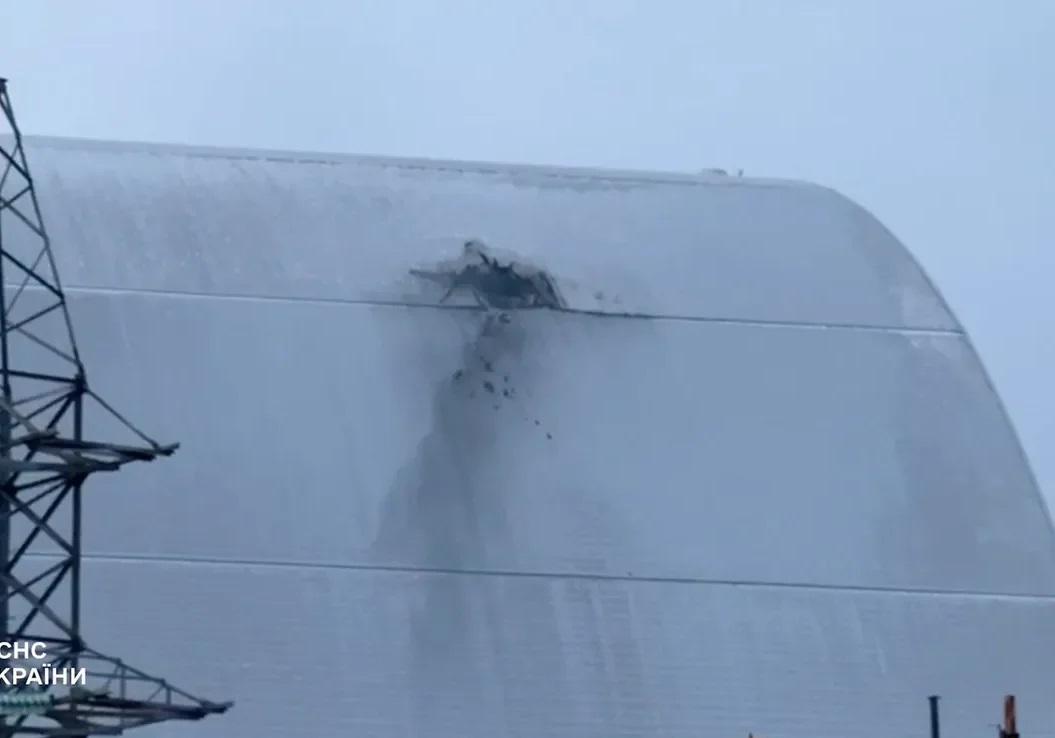
A protective shield at the Chernobyl nuclear plant in war-torn Ukraine, built to contain radioactive material from the 1986 disaster, can no longer perform its main safety function due to drone damage, the UN nuclear watchdog says.
The International Atomic Energy Agency said an inspection last week of the steel confinement structure completed in 2019 found the drone impact in February, three years into Russia’s conflict in Ukraine, had degraded the structure.
IAEA director general Rafael Grossi said in a statement the inspection “mission confirmed that the (protective structure) had lost its primary safety functions, including the confinement capability, but also found that there was no permanent damage to its load-bearing structures or monitoring systems.”……………………………………………………………….. https://www.canberratimes.com.au/story/9128130/chernobyl-nuclear-plants-shield-damaged-un-agency/
What’s behind the peace negotiations for Ukraine?

(President Macron) had indeed pompously signed documents for the sale of 100 Rafale fighter jets, SAMP/T air defense systems, modern air defense radars, air-to-air missiles, and guided bombs to Ukraine. In reality, these were not contracts, but “declarations of intent.” The financing for these extravagant sales was not guaranteed, and their manufacture by Dassault Aviation could not begin for five to ten years.
We don’t know what was said in Washington, but we can assume that the United States took a firm stance toward Ukraine, even if it didn’t want to risk destroying Atlantic solidarity. Thierry Meyssan presents here what transpired during this tumultuous week.
by Thierry Meyssan, Voltaire Network | Paris (France) | 5 December 2025, https://www.voltairenet.org/article223293.html
To understand the week of peace negotiations in Ukraine, it is essential to first dispel the misinformation disseminated by the mainstream press: contrary to what they implied, the Europeans were never allowed to join the Geneva talks.
It is also worth recalling what I explained last week [1]: European governments have no interest in peace; they even fear it: it would undoubtedly bring about their own downfall.
It is therefore no coincidence that the German, British, and French press claimed that the Geneva peace plan was a European document. They asserted this so strongly that we ourselves repeated this falsehood before correcting it.
With that established, let us review the sequence of events:
When the peace plan, drafted by the United States and Russia in Florida, became public [2], the subservient commentators presented it as “outrageously pro-Russian.”
The Geneva Negotiations
The Ukrainians requested to draft a counter-proposal with the United States. Talks were held in Geneva on November 23 and 24.
However, on November 22, EU leaders, along with the British, Norwegians, and Japanese, all attending the G20 summit of heads of state and government in Johannesburg, issued a joint statement. It reads:
“We are ready to commit to ensuring that future peace is lasting. We are clear on the principle that borders must not be changed by force. We are also concerned about the proposed restrictions on the Ukrainian armed forces, which would leave Ukraine vulnerable to future attack.
We reiterate that the implementation of elements relating to the European Union and those relating to NATO would require the consent of the respective EU and NATO members.”
Germany, France, and the United Kingdom therefore sent diplomats—uninvited—to the Intercontinental Hotel where the US and Ukrainian delegations were staying. They were able to speak with both sides but were not admitted to the negotiations.
The document, released after the talks, reiterates only the Ukrainian arguments [3].
It no longer mentions the denazification of Ukraine, the country’s neutrality, or EU participation in its reconstruction. It is therefore unacceptable from a Russian perspective.
Presenting his work to the press, State Secretary Marco Rubio simply stated that things were progressing very well. This is probably because Ukraine had renounced the reconquest of territories occupied/liberated by Russia and accepted their international recognition as Russian.
The “Coalition of the Willing”
On November 25, the Coalition of the Willing, established on March 1, 2025, by General Petr Pavel, Czech President and former Chairman of NATO’s Military Committee, and by Keir Starmer, British Prime Minister, met via videoconference.
Continue readingTogether Against Sizewell C (TASC)’s new legal challenge against Sizewell C’s secret flood defences.
4 Dec 25, https://www.crowdjustice.com/case/sizewell-c-legal-challenge/
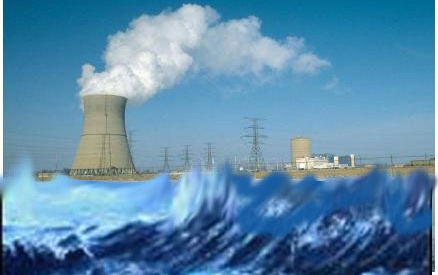
The Sizewell C site will be storing up to 4,000 tonnes of spent nuclear fuel on this vulnerable coastline until the late 2100s. The precautionary principle should surely apply so resilience, potential risks and impacts are assessed on a worst case basis and that should be done now. Sizewell C Ltd seem to believe they can do as they see fit with our Heritage Coast, National Landscape and designated wildlife sites irrespective of the damage they will cause.
On Tuesday 9 December Together Against Sizewell C has a permission hearing at the High Court for their case about the overland flood barriers.
The project now includes a stated commitment by Sizewell C Ltd to the Office for Nuclear Regulation (ONR) to install additional sea defences in a ‘credible maximum’ climate change scenario. These defences in the form of two huge 10 metre high ‘overland flood barriers’ were not included in the approved DCO project. In our opinion, these flood barriers, if installed, will likely have additional adverse impacts on the neighbouring designated wildlife sites including RSPB Minsmere as well as the Heritage Coast and Suffolk Coast & Heaths National Landscape. We need to ensure that the original promotor EDF and the now UK government controlled Sizewell C Ltd are not allowed to use climate change uncertainties as an excuse to delay assessment and avoid public scrutiny of these additional structures for decades. The full impact of the whole project should be assessed now.
There is very little detail about the barriers, but it appears from the above diagram [on original] that, if needed:-
The Southern barrier stretches for nearly 500 metres from the Sizewell A site, across the Sizewell Gap to the start of the cliffs running south to Thorpeness, sited on land not in Sizewell C’s ownership.
The Northern barrier potentially stretches from the north of the Sizewell C site, through the SSSI, then inland over Goose Hill for up to a kilometre.
Together with our lawyers, Leigh Day, we have sought the High Court’s permission to apply for judicial review of the decision of the Secretary of State to refuse TASC’s request to revoke or vary the Sizewell C DCO. The grounds for our legal challenge are set out in Leigh Day’s press release.
How we got here
From documents obtained under a Freedom of Information (FOI) request, TASC found out that EDF knew as far back as 2017 that their chosen nuclear platform height of 7.3m AOD would, along with the adapted sea wall on the eastern flank of the site, require two 10-metre high ‘overland flood barriers’. These will be needed to prevent the nuclear platform from flooding from the west in the event that sea level rise reaches a ‘credible maximum’ scenario. This will lead to a major breach of the low-lying coast to the north of Sizewell C and south of the Sizewell nuclear cluster. However, while EDF rightly included the adaptive design of the eastern sea defences in their DCO application documents, they did not include the southern and northern overland flood barriers in the DCO application, thereby avoiding any public scrutiny. As a result there is no commitment in the approved DCO to install these additional sea defences. This is despite there being a requirement to keep the nuclear site safe for its full lifetime from climate change impacts in a credible maximum scenario i.e. to, at least, 2160 while spent nuclear fuel is stored on site.
TASC’s aim is to ensure that the overland flood barriers, not included by EDF in the DCO application, now form part of the overall project. Therefore we need the Secretary of State to either revoke or change the DCO, in order that a lawful assessment of the potential environmental impacts of the entire project is carried out and subject to public scrutiny.
This is important because the project may be grossly underestimating the potential environmental impact, flood risk and sea-defence costs. This, if unaddressed, could be a major burden on future and far future generations who may be impacted by severe, non-reversible environmental, ecological and human impacts combined with an extreme financial liability if Sizewell C were to flood.
Further background for those that want to know more
The Sizewell C project, originally promoted by EDF, is to build twin EPR nuclear reactors close to the North Sea at Sizewell, Suffolk, one of the fastest eroding coastlines in Europe. The site is in the heart of Suffolk Coast & Heaths National Landscape, largely surrounded by designated wildlife sites including RSPB Minsmere and will be partially built on Sizewell Marshes SSSI.
In 2021, Prof Paul Dorfman’s report stated “…any adaptation efforts to mitigate annual flooding (projected to almost entirely surround the proposed EDF Sizewell C EPR nuclear island by 2050) will inevitably entail significantly increased expense for construction, operation, spent nuclear fuel management, rad-waste storage and eventual decommissioning”.
In line with the ONR’s preference, Hinkley Point C is a ‘dry site’ i.e. its platform height at 14 metres AOD is of sufficient height to prevent it from flooding. However, Sizewell C with a platform height of 7.3m AOD, is a ‘protected site’ which means that Sizewell C must at all times demonstrate that the site can be protected against flooding for its full lifetime by use of ‘permanent external barriers such as levees, sea walls and bulkheads’. Once Sizewell C is constructed with a 7.3m AOD platform height, the platform cannot be raised at a later date. The overland flood barriers need to be assessed now so alternatives can be considered e.g. raising the platform height.
Sizewell C was given DCO approval in July 2022 against the recommendation of the five professional planning inspectors. In TASC’s view, the impacts from the overland flood barriers, if they had been assessed during the DCO examination, may well have resulted in planning permission being refused. In any event, our case argues that the Secretary of State’s ‘Habitats Regulation Assessment’ has not considered the environmental impacts of the full project or alternatives, something that is a lawful requirement.
Documentation published by the ONR supporting their grant of Sizewell C’s nuclear site licence in May 2024, has revealed that, in TASC’s opinion, there are now two materially different projects, the one in the DCO approved by Kwasi Kwarteng, and the one still being considered by the ONR as part of the ‘site safety case’. It was an FOI request to the ONR in late 2024 that provided the documentation from 2017 that shows the project requires the adaptive flood protection in the form of the overland flood barriers in a credible maximum climate change scenario.
The Sizewell C site will be storing up to 4,000 tonnes of spent nuclear fuel on this vulnerable coastline until the late 2100s. The precautionary principle should surely apply so resilience, potential risks and impacts are assessed on a worst case basis and that should be done now. Sizewell C Ltd seem to believe they can do as they see fit with our Heritage Coast, National Landscape and designated wildlife sites irrespective of the damage they will cause.
In an attempt to resolve our concerns, on 6th March 2025 TASC wrote to Secretary of State, Ed Miliband calling on him to make a decision on whether the material change to the Sizewell C project highlighted by TASC, namely the commitment to install ‘overland flood barriers’, ‘amounts to exceptional circumstances that make it appropriate for him to exercise his power to change or revoke the DCO’.
The Energy Minister, on behalf of the Secretary of State, replied on 28th March 2025, refusing TASC’s request to vary or revoke the DCO. As TASC consider this matter to be of great importance, we have been left with no alternative but to challenge the Secretary of State’s decision through the courts.
“Kill Everybody”: War Crimes and Pete Hegseth’s Lust for Blood
5 December 2025 Dr Binoy Kampmark, https://theaimn.net/kill-everybody-war-crimes-and-pete-hegseths-lust-for-blood/
Pete Hegseth, the soap opera styled US Secretary of Defense, sports a questionable sanity. His behaviour before generals is the stuff of low comedy. His mania about sending narco-traffickers making passage on the sea from Venezuela to a watery grave has a millenarian zeal. But psychological coarseness and imperfection have not prevented questions being asked about why he, allegedly, ordered to strike a vessel twice in order to ensure the death of all aboard it.
Some 21 known deadly strikes on such vessels, resulting in the deaths of 83 people, have been orchestrated since September 2, when President Donald Trump stated in a War Powers Resolution notification to Congress that such acts were “self-defense” measures motivated by “the inability or unwillingness of some states in the region to address the continuing threat to United States persons and interests emanating from their territories.” The following month, a presidential notice was issued categorising those killed in alleged drug smuggling as “unlawful combatants,” a dangerously novel interpretation authorising homicide on the high seas.
The September 2 “double-tap” strike was initially reported as involving an order from the Secretary to “kill everybody” upon an alleged Venezuelan drug boat. Two survivors from the initial attack, desperately clinging to the burning remnants of the vessel, were dispatched in the second strike.
A generally mute Congress was aroused into action. The campaign against alleged narcotics smugglers, typified by an absence of due process and having all the markings of summary execution, had come in for inspection. Senator Mark Kelly (D-Ariz.) of the Senate Armed Services Committee demanded an investigation. House Minority Leader Hakeem Jeffries (D–NY) believed that bipartisan investigations would be conducted “in both the House and the Senate in order to determine whether war crimes were committed, and either US law or international law or both, were violated.”
Certain Republicans even went so far as to contemplate the possibility that a war crime had been committed. Rep. Michael R. Turner of Ohio and the Armed Services Committee, agreed that the killing of survivors would have “be an illegal act,” while Rep. Don Bacon could scarce believe that Hegseth would have been “foolish enough to make this decision to say, ‘kill everybody,’ ‘kill the survivors’ because that’s a clear violation of the law of war.” (Bacon has seemingly not seen Hegseth’s social media splashes.)
In a joint statement from Armed Services Committee Chairman Senator Roger Wicker (R-Miss.) and ranking member Jack Reed (D-R.I.), “vigorous oversight” over operations in the Caribbean was promised. “The Committee is aware of recent news reports – and the Department of Defense’s initial response – regarding alleged follow-on strikes on suspected narcotics vessels in the SOUTHCOM area of responsibility.” The Democrats on the same committee have requested that Hegseth and Attorney General Pam Bondi release the Office of Legal Counsel’s written opinion laying the legal basis for the strikes.
The White House proceeded to pour cold water on the suggestion that Hegseth had given the order. US Special Operations Command chief Admiral Frank Bradley was outed as the figure who ordered the second strike. In doing so, he had, according to Press Secretary Karoline Leavitt, “worked well within his authority and the law, directing the engagement to ensure the boat was destroyed and the threat to the United States of America was eliminated.” More broadly, both Trump and Hegseth had “made it clear that presidentially designated narco-terrorist groups are subject to legal targeting in accordance with the laws of war.”
Given some exiting wriggle room, Hegseth heaped praise upon Admiral Bradley as “an American hero, a true professional, and has my 100% support. I stand by him and the combat decisions he has made – on the September 2 mission and all others since then.”
The dubious quality of these strikes has enlivened broader concern in the region. On September 15, a Colombian boat involved in fishing activities was struck, resulting in the death of Alejandro Carranza Medina. Its ruthlessness made Colombian President Gustavo Petro accuse the US government of committing murder and violating sovereignty. A complaint has been submitted to the Inter-American Commission on Human Rights (IACHR)alleging that Hegseth “was responsible for ordering the bombing of boats like those of Alejandro Carranza Medina and the murder of all those on such boats.” These orders were given “despite the fact that they did not know the identity of those being targeted for these bombings and extra-judicial killings”.
The attacks on these vessels in the Caribbean Sea are just another aspect of the Trump reality show. This administration cherishes show before substance, seemingly hoping that the show distracts sufficiently for the substance to change. The withering report by the Pentagon’s inspector general claiming that Hegseth endangered US personnel by sharing details of planned US strikes on Houthi forces in Yemen via a conversation conducted on Signal does just that. (Not only is Signal a commercially available messaging platform: a journalist from The Atlantic, Jeffrey Goldberg, had been unwittingly added to the conversation.)
The substance here is clearly not narcotics. Trump’s outrageous pardon of former Honduran leader Juan Orlando Hernández, serving a 45-year sentence in a West Virginia prison for paving “a cocaine superhighway” to the United States, gave the game away. Regime change in Venezuela, and the world’s largest known oil reserves, await. In the meantime, Hegseth continues to feed his bloodlust.
$400 Million DOE Bailout for “SMRs” at Palisades

Multiple reactors on the tiny 432-acre site also introduce the risk of domino-effect multiple meltdowns
Holtec’s inexperience exacerbates these synergistic old and new reactor risks. Holtec still has no NRC-approved SMR-300 design certification, has never built a reactor, nor operated one, nor repaired and restarted one, let alone a reactor as perpetually problem-plagued as the 60-year old Palisades zombie.
DECEMBER 3, 2025, by Kevin Kamps
regarding the announcement by the U.S. Department of Energy, Holtec International, and Michigan Governor Gretchen Whitmer of a $400 million federal bailout for “Small Modular Reactor” deployments at the Palisades nuclear power plant in Covert Township, Van Buren County, southwest Michigan.
Holtec’s uncertified and untested so-called ‘Small Modular Reactor’ design, the SMR-300, is not small. At 300 megawatts-electric (MW-e) each, the additional 600 MW-e would nearly double the nuclear megawattage at Palisades, given the unprecedented zombie restart of the 800 MW-e, six decade old reactor there. The zombie reactor was designed in the mid-1960s, and ground was broken on construction in 1967, with the learn-as-we-go dangerous design and fabrication flaws at the nuclear lemon baked in, still putting us in peril to the present day.
Just look at the harm smaller infamous 67 MW-e Michigan reactors have caused in the past. At Fermi Unit 1 on the Lake Erie shore in Monroe County, “we almost lost Detroit” when the plutonium breeder reactor had a partial core meltdown on October 5, 1966. John G. Fuller wrote an iconic book about it by that title in 1975. And Gil Scott-Heron wrote a haunting song about it in 1977, two years before he joined Musicians United for Safe Energy (MUSE) in response to the 1979 Three Mile Island Unit 2 meltdown, the worst reactor disaster in U.S. history — thus far anyway.
And at Big Rock Point — Palisades’ sibling reactor — near Charlevoix on the northwest Lower Peninsula’s Lake Michigan shore, the 67 MW-e experimental reactor shockingly released more than 3 million Curies of hazardous ionizing radioactivity into the environment, from supposedly ‘routine operations’ from 1962 to 1997. In the 1970s, local family practitioner, medical doctor Gerald Drake, and University of Michigan trained statistician Martha Drake, documented statistically significant spina bifida in the immediate area downwind. There is also anecdotal evidence of widespread thyroid pathology as well. This is similar to Palisades, where 50 cases of diagnosed thyroid cancer have been alleged by part-time residents of the small, 120-year old Palisades Park Country Club resort community, where there should not be a single such case of this exceedingly rare disease made infamous by Chornobyl and Fukushima.
Given the damage done by 67 MW-e reactors in Michigan in the past, just imagine what havoc could be wreaked by two 300 MW-e reactors — each 4.5 times larger — at Palisades going forward.
Increased breakdown phase risks at the 60-year old zombie reactor, and break-in phase risks at the two SMR-300 new builds, are a recipe for disaster at Palisades.
Palisades has a long list of breakdown phase risks. From the worst neutron-embrittled reactor pressure vessel in the country or perhaps even the entire world, to severely degraded steam generator tubes, a reactor lid that needed replacement two decades ago, lack of fire protection, calcium silicate containment insulation that would dissolve into sludge with the viscosity of Elmer’s Glue blocking emergency core cooling water flow, the worst operating experience in industry with control rod drive mechanism seal leaks from 1972 to 2022, etc., the Palisades zombie reactor has multiple pathways to reactor core meltdown, which would unleash catastrophic amounts of hazardous ionizing radioactivity into the environment, on the beach of Lake Michigan, drinking water supply for 16 million people along its shores, and more than 40 million people downstream and downwind, up the food chain, and down the generations throughout the Great Lakes region.
Chornobyl in Ukraine in 1986, and Three Mile Island-2 in Pennsylvania in 1979, are examples of brand new reactors causing catastrophes. Through design and construction flaws, and operator inexperience, Holtec’s SMR-300s will introduce increased break-in phase risks at the Palisades nuclear power plant, located on the Great Lakes shoreline. The Great Lakes comprise 21% of the planet’s, 84% of North America’s, and 95% of the United States’ surface fresh water.
Multiple reactors on the tiny 432-acre site also introduce the risk of domino-effect multiple meltdowns, as happened at Fukushima Daiichi, Japan in March 2011.
A 1982 U.S. Nuclear Regulatory Commission (NRC) study the agency unsuccessfully tried to suppress reported that a Palisades meltdown would cause a thousand acute radiation poisoning deaths, 7,000 radiation injuries, 10,000 latent cancer fatalities, and $52 billion in property damage. Adjusting for inflation alone, property damage would now exceed $168 billion. And since populations have increased around Palisades in the past 43 years, casualty figures would be significantly worse, as more people now live in harm’s way.
Holtec’s inexperience exacerbates these synergistic old and new reactor risks. Holtec still has no NRC-approved SMR-300 design certification, has never built a reactor, nor operated one, nor repaired and restarted one, let alone a reactor as perpetually problem-plagued as the 60-year old Palisades zombie. Holtec’s incompetence and corruption has been on full display in just the past several weeks, including a leak of large amounts of ultra-toxic hydrazine into Lake Michigan, the unprecedented fall by a worker into the radioactive reactor cavity, and evidence of potential alcohol consumption and/or drug impairment, including in the protected area, and by a supervisor. Despite all this, NRC has rubber stamped weakened work hour limitations, meaning overworked employees will be more fatigued, as Holtec races to restart the zombie reactor, in order to hold its announced Initial Public Offering, hoping to raise another $10 billion in private investment, for SMR-300 deployment across the country and around the world, with Palisades as the dangerously dubious prototype to be followed.
Speaking of money, Holtec has, thus far, been awarded $3.52 billion (with a B!) in public funding at Palisades alone. But it has requested another $12 billion (with a B!) more. These bailouts significantly impact the pocketbooks of hard working Americans — state and federal taxpayers, as well as electric ratepayers. Palisades represents a wealth redistribution scheme, from the American people to Holtec, compliments of Governor Whitmer, the Michigan state legislature, Congress, President Biden, and now President Trump. Abe Lincoln described the ideal of government as “of, by, and for the people.” At Palisades, government seems to be of, by, and for an inexperienced, incompetent, careless, corrupt and greed-driven corporation, playing radioactive Russian roulette, carrying out a large-scale nuclear experiment, with Great Lakes residents as the unwitting Guinea pigs.”
Ukraine’s Energoatom, Holtec International, and the US retreat from fighting corruption abroad

very little about the relationship between Trump’s Washington and Zelenskyy’s Kyiv might be considered ordinary.
President Zelensky moved to dismantle the safeguards meant to protect Ukraine’s institutions from corruption,
Bulletin, By Matt Smith | December 3, 2025,
In 2012, FBI agents stationed themselves in a Trump Tower apartment to wire up a senior official of FIFA, soccer’s world governing body, to record conversations that would become evidence for anti-bribery prosecutions. In 2018, Justice Department officials seized the yacht Equanimity in an operation aimed at returning stolen assets to Malaysia. In 2023, the United States sent a veteran US prosecutor to Kyiv to strengthen Ukraine’s anti-corruption agencies, which America had earlier helped establish.
In a functioning international order, we might see this type of global collaboration in the wake of a recent investigative piece I wrote for the Bulletin about a US company, Holtec International, that has had substantial dealings with a state-owned nuclear company now under investigation in Ukraine.
In more normal times, the government of Ukrainian President Volodymyr Zelenskyy might request assistance under the US-Ukraine Treaty on Mutual Legal Assistance in Criminal Matters. The FBI established a liaison office at the headquarters of the National Anti-Corruption Bureau of Ukraine (aka NABU) in 2017, under a memorandum of understanding to cooperate on “investigations related to money laundering, international asset recovery, and Ukrainian high-level officials’ bribery and corruption.” These are word–for–word what investigators are now pursuing in Ukraine’s nuclear power agency.
A professionalized Justice Department could respond to a formal Ukrainian request by issuing subpoenas seeking information from US firms that might be relevant to the Ukrainian probe.
But we are no longer in anything like normal times.
Here’s the context: NABU—an agency the United States helped create and train—is investigating an alleged $100 million corruption scheme inside Energoatom, the governmental body that oversees nuclear energy and spent fuel storage in Ukraine. This scandal has consumed Zelenskyy’s inner circle and led to the resignation of his chief deputy and lead peace negotiator.
Holtec International, a Florida company that established an office in Kyiv in 2007, became a prime contractor and subcontractor for Energoatom on complex, multi-year spent nuclear fuel storage projects.
Holtec executives met repeatedly with Energoatom leadership. They navigated Ukraine’s procurement systems. They hired local subcontractors. They managed complex, multi-year construction projects in a business environment that Ukrainian prosecutors now say has been compromised. Holtec has files that could matter: Ukrainian invoices, compliance checks, email communications, and management logs.
In response to my inquiry about whether the company had heard from the Justice Department regarding Ukraine, Holtec issued a statement saying it witnessed no corruption: “Our operations center in Kyiv, Holtec Ukraine, has worked with our client, Energoatom, to provide safe storage systems and technology to ensure the spent fuel in Ukraine is stored safely and protected from external threats. At no time have we had any interactions that would have led us to believe in any impropriety with our work and contracts.”
As with any such company statement, this one merits checking. Holtec email communications might show whether American executives interacted with the officials now under investigation. Compliance audits might reveal whether the company flagged irregularities. Payment records might reveal inflated costs prosecutors have identified elsewhere. Internal management logs might document which Ukrainian officials controlled access to Holtec’s projects and whether those officials match the outside “shadow managers” prosecutors have identified as having gained control of Energoatom and then having demanded bribes from contractors.
The Bulletin’s investigation, published November 20, did not find evidence that Holtec was involved in Ukrainian misconduct. In fact, subpoenaing Holtec’s records would neither require nor imply allegations of corporate wrongdoing; such subpoenas require only the recognition that a US entity could possess evidence material to a foreign corruption prosecution. The legal mechanisms for seeking Holtec’s records exist. The precedents for doing so are well-established. Such a procedure has previously been seen as an ordinary step.
But very little about the relationship between Trump’s Washington and Zelenskyy’s Kyiv might be considered ordinary.
Since Trump took office in January, his administration has pursued a quiet dismantling of America’s ability to provide this kind of aid. On February 5, Attorney General Pam Bondi formally disbanded Task Force KleptoCapture, the unit established after the Russian invasion of Ukraine and dedicated to seizing assets of Russian oligarchs. Five days later, President Donald Trump signed Executive Order 14209, explicitly “pausing” enforcement of the Foreign Corrupt Practices Act—the very statute that authorizes investigations into potential bribery of foreign officials by US companies.
Deregulation even extended to tools of crime, as Russia increasingly relies on cryptocurrency to bypass sanctions. The Justice Department has turned away from prosecuting digital asset violations while the US established a “Strategic Bitcoin Reserve,” giving legitimacy to a cryptocurrency known as a key sanctions-evasion tool.
Scores of federal prosecutors have left Justice as colleagues were fired for perceived political slights. Trump’s highest-priority prosecutions—i.e., the politicized ones—are pursued by unqualified loyalists who have ended up, in many matters, embarrassing a once-storied agency.
The diminished US interest in corruption prosecution has had foreseeable consequences in Kyiv. Concurrent with the shift in Washington, President Zelensky moved to dismantle the safeguards meant to protect Ukraine’s institutions from corruption, signing legislation in July to strip NABU of independence. Ukrainians took to the streets. Most reports about international pressure to restore NABU’s status concerned European countries that sprang to the defense of the anti-corruption agency America helped build. The United States recently rotated a new FBI liaison to the NABU offices as part of the cooperation agreement. The Ukrainian press said a recent meeting concerned the Energoatom bribery case.
Typically, the next steps might seem clear. But nobody involved seems to be operating in a typical way.
The Justice Department press office did not respond to questions asking whether Holtec’s files sit in Florida, untouched. https://thebulletin.org/2025/12/ukraines-energoatom-holtec-international-and-the-us-retreat-from-fighting-corruption-abroad/?utm_source=ActiveCampaign&utm_medium=email&utm_content=Ukraine%20s%20Energoatom%2C%20Holtec%20International%2C%20and%20the%20US%20retreat%20from%20fighting%20corruption%20abroad&utm_campaign=20251201%20Monday%20Newsletter%20%28Copy%29
Europe could be on the hook for $160 billion to keep Ukraine afloat.
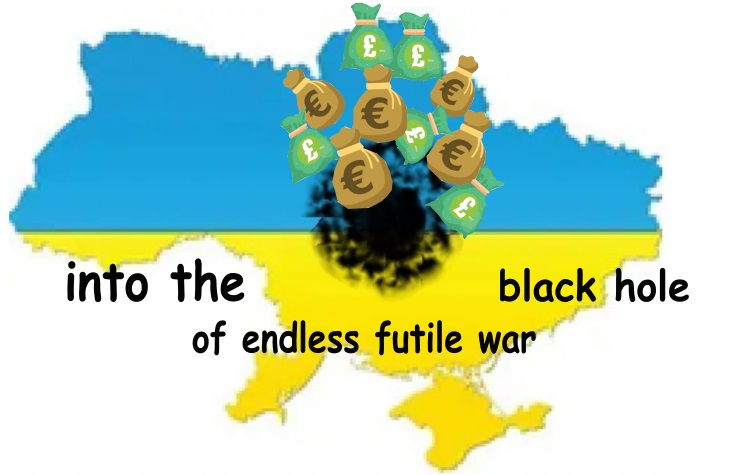
Belgium is holding the line on using Russia’s frozen assets for now, which leaves Europe obligated to keep the lights on and the war going
Ian Proud, Dec 04, 2025, https://thepeacemonger.substack.com/p/europe-could-be-on-the-hook-for-160?utm_source=post-email-title&publication_id=3221990&post_id=180637110&utm_campaign=email-post-title&isFreemail=true&r=1ise1&triedRedirect=true&utm_medium=email
Below my article of yesterday in Responsible Statecraft on the issue of the spuriously named ‘reparations loan’ to Ukraine. Since going to print, the European Central Bank has come out to torpedo the Commission’s expropriation of $140 bn in immobilised Russian assets to fund the Ukrainian war effort. This should come as no surprise, as Christine Lagarde pointed out the risks at the October European Council meeting, and Bart de Wever leaned heavily on her advice in his subsequent remarks to the media.
Not surprisingly, western mainstream pro-war hacks have come out a-howling at this outrage. The eternally moronic Anders Aslund questioning the ECB’s right to have an opinion on European financial assistance to Ukraine. Bill Browder simply suggesting Europe should expropriate the funds anyway, even though they are housed in Belgium, and the Belgians won’t permit it.You can see why he made so much money in Russia in the nineties. Less clear which clown in Whitehall decided he should be knighted.
The level of idiocy is truly off the charts. And the clamour now is so loud simply because Ukraine will shortly run out of money, Europe will need to tip more money into the bottomless pit at Bankova, and they may well have to use funds from national budgets (even if it is packaged up as common EU debt).
Meanwhile, Belgian police have raied the premises of hte former EU foreign policy chief, Federica Mogherini, arresting her on suspicion of fraud at the College of Europe. Who is surprised that yet another unelected, unaccountable EU apparatchik is on the make?
Perhaps that’s why the Commission is so desperate to support the corrupt regime in Kyiv, as they are kindred spirits. More likely, they are merely stupid and have no self-awareness. Ursula von der Leyen seems to be carrying on regardless, as if nothing is untowards. driving towards the cliff edge at breakneck speed with her and Kaja Kallas’ feet firmly on the accelerator pedal. You couldn’t make it up….
I hope you find the article interesting.
Even if war ended tomorrow, Europe could be on the hook for 135 billion euros (nearly $160 billion) over the next two years to keep Ukraine afloat. Brussels does not appear to have a plan B up its sleeve.
I first warned in September 2024 that using immobilized Russian assets to fund war fighting in Ukraine would disincentivize Russia from suing for peace. Nothing has changed since then. Russia maintains the battlefield advantage, has the financial reserves, extremely low levels of debt by Western standards, and can afford to keep fighting, despite the human cost. Putin is self-evidently waiting the Europeans out, knowing they will run out of money before he does.
For now, his strategy appears to be working, because Ukraine has no money and Europe — unwilling to see Ukraine pushed into an unfavorable peace — is groaning under the obligation to find an answer. In May I also reported that “Ukraine is already asking for more money to continue fighting into 2026, a sure sign that President Volodmyr Zelensky has no plans to end the war.”
At that time, the likely cost of war fighting for another year was estimated at around $43.3 billion. The bill has since gone up to $63 billion in 2026 and, according to the IMF, $136.6 billion over the next four years.
Europe simply does not have this level of funding freely available. As a result, European political leaders are descending into panic mode as the chicken of Ukraine’s enormous budget shortfall comes home to roost.
That chicken, to quote the prime minister of Belgium, Bart de Wever, in remarks after the October European council meeting, is the $140 billion in immobilized Russian assets that the European Commission would like to use to back a “reparations loan” to Ukraine. Self-evidently, this money isn’t intended for reparations, but rather to soak up Ukraine’s expected deficits going forward.
All of the money would be pumped into Ukraine’s treasury to meet day to day expenses, with the defense bill alone costing $172 million every day right now, compared to $140 million per day one year ago. And on the basis that Ukraine’s budget estimates only ever go up and not down, that money won’t last forever.
At this point, one might be tempted to think that Ukraine’s vast defense spending, which accounts for around 63% of the Ukrainian government’s budget, will fall away if the war ends this year, in response to President Trump’s peace initiative. But such an assumption is, I fear, misplaced. Europe has been pressuring the U.S. not to cap the size of Ukraine’s near one million strong army in any peace deal. In a best-case scenario, Ukraine might decide in a graduated way to reduce the size of its army over time. But that would still leave a large budget black hole for some years to come. Yet a large army won’t pay for itself and the Europeans will be left to pay the bill.
Perhaps not surprisingly, the Belgians are saying “non” to the use of immobilized assets in its country to fund Ukraine’s fiscal deficit. Prime Minister de Wever claims that doing so will derail U.S.-led efforts to bring the near four-year long war to a close, by disincentivizing Russia from settling, which takes us back to the point I made 15 months ago.
However, the deeper issue for Belgium is a fear that sanctioning the expropriation of Russian sovereign assets on shaky legal ground would shred its financial reputation and scare off investors from the developing world. Belgium-based Euroclear, where the immobilized Russian assets are held, has a stock of $4 trillion in sovereign assets from around the globe. Starting to eat the chicken of these assets, as Belgium’s prime minister puts it, by essentially lending those assets to Ukraine, could “damage Belgium’s reputation as a reliable financial hub and erode trust in the euro and the EU financial system.”
Predictably, that has led to a storm of protest from other European states that are piling increasing pressure on Belgium to relent and so free up the monies for Ukraine’s cause. But as de Wever has pointed out on numerous occasions, those European states, for example, Germany, France, the Netherlands and Luxembourg, are not offering to unleash immobilized Russian assets in their jurisdictions and so share the financial risk. Nor are they willing to back the loan of assets held in Belgium with guarantees to repay a proportion of the cost, should Russia mount a successful legal challenge after the war ends. So, for now, Belgium is holding out and blocking the loan, with few signs that it will back down.
As a result, the matter has been kicked back to December for a final decision buying time for the Eurocrats in Brussels to sway their recalcitrant Belgian hosts. If agreement cannot be reached, Ukraine faces the prospect of running out of money to fight, on the basis that it is locked out of access to Western capital markets, given its moratorium on the repayment of debt.
That leaves the European Commission in the position of possibly having to raise capital on the markets to make a non-repayable grant to Ukraine to cover its financing needs in 2026.
How did we end up here? Since 2024, Western sponsors of the war in Ukraine have progressively shifted from offering free cash to loans, most notably the last big G7 loan of $50 billion that was agreed in June of 2024. But with Ukraine’s national debt to GDP having risen from 49% in 2021 to 109% now, piling more debt on the war-ravaged country may literally equate to killing Ukraine with kindness.
The reparations loan was clearly intended as a means to make Russia pay so that neither Ukraine, nor Europe, had to. Efforts to find off-budget means to pay for the war in Ukraine have always been “an unseemly quest for alternatives to western taxpayers funding.” Put simply, cash-strapped European governments can’t easily afford to give Ukraine their own money at a time when their governments face rising political headwinds at home from nationalist parties.
Mainstream European political leaders have remained implacably set against the idea of bringing the senseless war in Ukraine to a much-needed close. They will pay the price for this at the polls in the coming years, as the big fiscal chicken of war spending pecks away at their legitimacy at home. This is all the more depressing for having been so utterly predictable.
Israeli army shells east of Gaza Strip, detonates buildings despite ceasefire.
November 30, 2025 , https://www.middleeastmonitor.com/20251130-israeli-army-shells-east-of-gaza-strip-detonates-buildings-despite-ceasefire/
The Israeli army carried out airstrikes and home demolitions in the military-controlled yellow zone across the Gaza Strip early Sunday, Anadolu reports.
Israeli aircraft struck several areas in Rafah, while naval vessels fired shells toward the city’s coastline, local sources and witnesses told Anadolu.
Israel’s military vehicles stationed near the Morag Axis, norx`theast of Rafah, conducted sweeping operations and heavy gunfire in the area.
Israeli artillery shelled eastern Khan Younis, and helicopters launched fire on buildings amid home detonations in the area, according to witnesses.
An Israeli airstrike hit east of Al-Bureij refugee camp in Deir al-Balah, central Gaza, an Anadolu correspondent said.
In the northern Gaza Strip, the Israeli strikes targeted eastern Gaza City, and intense gunfire from Israeli helicopters was reported from eastern Jabalia.
There were no immediate reports of casualties.
Israel continues to violate the ceasefire agreement it signed with the Palestinian group Hamas, having committed nearly 500 violations and killed 354 Palestinians since Oct. 10, according to the Gaza government figures.
Since October 2023, the Israeli army has killed more than 70,000 people in Gaza, mostly women and children, and injured nearly 171,000 people in the over two-year war that has left much of the enclave in ruins.
The looming missile crisis in the Arctic
Bulletin, By Vladimir Marakhonov | December 4, 2025
By invading Ukraine in 2014 and then again in 2022, Russia has created devastating strains in the global balance of power. It also opened new frontiers of tension, some visible to the naked eye and others harder to discern, yet all highly unpleasant for Moscow.
Ukraine’s spectacular attack in June on Russian bombers at air bases in northern and western Russia, using cheap drones, has revealed new threats to Russia’s strategic capabilities and forced it to redeploy its bombers to Far East bases. The recent decisions by Finland and Sweden to join NATO and defense cooperation agreements between the Nordic countries and the United States have also put Russia’s Northern Fleet naval forces at risk. These forces can’t be easily relocated, increasing the risk of a missile crisis in Northwest Russia, near the Barents Sea. Simply put, a variety of military agreements now give the United States the ability to quickly deploy missiles in Norway and Finland that could reach Russia’s Northern Fleet and other strategic assets in a matter of minutes.
Any decision to make such a deployment could create a Cuban Missile Crisis situation between NATO and Russia that could lead to war.
Russia’s Northern naval bases. Russia’s fleet of nuclear-powered, nuclear-armed ballistic missile submarines—an important part of Russia’s nuclear triad—is roughly equally divided between the Northern Fleet (in the Arctic Ocean) and the Pacific Fleet. Historically, the Northern Fleet’s bases have had a serious strategic vulnerability due to geographic and climatic features of the Russian part of the Barents Sea, where they are located. These bases are concentrated in the Murmansk region on the Kola Peninsula, the northwestern-most part of Russia. The region is bordered by Norway to the northwest, Finland to the west, the Barents Sea to the northeast, the White Sea to the southeast, and only a narrow strip connecting to mainland Russia to the southwest.
Moving these naval bases further east is hardly possible because the Gulf Stream keeps only a limited area of the Barents Sea from freezing all year round, approximately up to Cape Svyatoy Nos, located west of the entrance to the White Sea. Everything located further east freezes in winter, although the extent and duration of the seasonal freezing vary each year, and sea ice is declining in the Barents Sea due to surface warming in the Gulf Stream. Therefore, the most convenient bays for Russia to base its fleet are located west of the Kola Bay, on the shores closest to Norway and Finland…………………………………..
Cold War restraint is over. During World War II and the post-war years, the entire Russian Northern Fleet infrastructure was built around Murmansk, which was Russia’s only ice-free northern port with good connections to the railway system. At the time, this proximity to Finland and Norway was of little importance. But with strengthened Nordic-US military ties and the development of short-range missiles, the Northern Fleet’s location became a real danger for both sides as missiles could be rapidly moved around and loaded on ships and submarines.
Finland maintained its neutral status throughout the Cold War and was bound to the Soviet Union by several international treaties. Norway—which had joined NATO in 1949 but had numerous overlapping interests with Russia in the Barents Sea—voluntarily imposed restrictions on NATO ground forces and NATO air flights in the Finnmark area east of the Porsanger fjord, which borders Russia. This self-imposed restraint helped Norway to sign a maritime border demarcation agreement with Russia in 2010 on terms that some Russian experts considered favorable to Oslo. Hawks in Russia even accused then-President Dmitriy Medvedev of betraying Russian interests after he signed the treaty.[1] But perhaps one of the benefits for Russia was the continuation of Norway’s border policy of restraint, which Oslo had observed until May, when it started easing these restrictions on NATO training, and September, when it allowed a US Air Force Global Hawk remotely-operated surveillance drone to fly over Finnmark, raising some concerns………………………………………………………………………………………………………………………………..
The deployment by the United States of advanced short-range ballistic missile systems to Norway’s Finnmark or Finland’s Lapland regions could lead to a crisis that resembles the 1962 Cuban missile crisis—this time, however, in the opposite way. Should Russia detect the presence of US missiles in these regions, the tensions would more certainly soar, with Moscow probably issuing a warning to Washington to immediately remove these missiles or else risk being attacked.
The defense cooperation agreements that the United States signed with the Northern European countries have certainly advanced US security interests. But their implementation could lead to a more dangerous situation in which conventional forces—not limited by any agreements—may alter the effective balance of strategic forces in the region………………………https://thebulletin.org/2025/12/the-looming-missile-crisis-in-the-arctic/?utm_source=ActiveCampaign&utm_medium=email&utm_content=Ukraine%20s%20Energoatom%2C%20Holtec%20International%2C%20and%20the%20US%20retreat%20from%20fighting%20corruption%20abroad&utm_campaign=20251201%20Monday%20Newsletter%20%28Copy%29
First strike on small, unarmed boat off Venezuela, not second, makes Trump and Hegseth war criminals.
Walt Zlotow West Suburban Peace Coalition Glen Ellyn IL , 3 Dac 25, substack.com/@waltzlotow
Some sensible US congresspersons, government officials, pundits and others are furious over reports Defense Secretary Pete Hegseth ordered a second strike on a mysterious little boat off Venezuela September 1 that killed 2 hapless souls clinging to the US inflicted wreckage.
They correctly point out that bombing survivors of a wrecked boat is against the Pentagon’s own Law of War Manual. “Persons who have been rendered unconscious or otherwise incapacitated by wounds, sickness, or shipwreck, such that they are no longer capable of fighting, out of combat. “It would be dishonorable and inhumane to make them the object of attack.”
Hegseth initially denied there was a second bombing killing the survivors, invoking the Trumpian charge “fake news.” Under intense criticism Pete pivoted admitting it happened but only after he’d left the room following the first strike, giving him plausible deniability. Then, despicably, he blamed the fatal order on Adm. Frank M. Bradley, the commander of US Special Operations Command. Hegseth didn’t condemn Bradley for ordering the second strike. He praised him saying he’s “got his back.”
The second strike on survivors upset congressional Republicans and Democrats enough to consider investigating it as a possible war crime. What that implies is that the 22 boats sunk, killing over 80 unidentified soles is OK as long as the US does not bomb survivors clinging to the wreckage of America’s dastardly war crimes. That first boat obliterated September 1 was a war crime repeated 21 times in 3 months,
Hegseth, Trump and every officer involved in these strikes are war criminals. Every serviceman ordered to commit these dastardly crimes should refuse those orders. Recently 6 morally centered congresspersons publicly implored all service members to do just that, no doubt with the illegal Trump/Hegseth boat obliterations in mind. Trump’s response? Maybe these congresspersons should be executed.
Focusing on the murder of survivors clinging to wreckage detracts from the monumental war crimes Trump commits nearly every day of his presidency.
By providing the bombs that have killed over 100,000 Palestinians in Gaza, bombing Somalia over 100 times this year, bombing imaginary Iranian nuclear sites, and most recently sending 22 small unarmed boats with 83 innocents down to Davy Jones Locker, Trump and Hegseth deserve indictment and prosecution for directing the most murderous administration in America’s 250 years.
Microsoft Faces Reckoning for Assisting Israel’s Genocide in Gaza.

The tech giant could face legal liability for aiding and abetting “atrocity crimes” in Palestine, legal groups say.
By Mike Ludwig , Truthout, December 3, 2025
head of its annual shareholders meeting on December 5, Microsoft is coming under mounting pressure to reconsider its relationship with the Israeli military, which has used the tech giant’s products to carry out the genocide in Gaza and ethnic cleansing of the West Bank.
In an open letter to the company released on Tuesday, December 2, an international coalition of legal aid groups said Microsoft and its executives potentially face legal liability for “aiding and abetting … atrocity crimes” committed by the Israeli military against Palestinian civilians.
“Over the last few months, it has become exceedingly clear that Microsoft’s services and technologies have been used to violate Palestinian human rights, and shareholders should be aware of just how much this opens up the company to legal liability,” said Eric Sype, U.S. national organizer at 7amleh–The Arab Center for Social Media Advancement, in a statement on December 2.
Microsoft provides “major services” to other Israeli ground, air, and naval forces despite widespread agreement among experts that Israel is committing genocide in Gaza, according to the legal aid groups. The letter lists multiple examples, including Mamram, the Israeli military’s central computing system and “weapons platform” that assisted the assault on Gaza with AI support and cloud services. Microsoft provided “rapid support” to Mamram during the initial months of the genocide to keep systems from crashing, according to the letter.
As Truthout has reported, products provided by Big Tech are so integral to Israel’s brutal occupation of Palestine that the mass killings and near-total destruction of infrastructure in Gaza are often described as “the first AI-powered genocide.”
By providing technology services to the Israeli government, Microsoft has exposed both the company and its leadership to “wide-ranging criminal and civil legal liability” both internationally and within domestic courts in the United States and European Union, the legal aid groups say.
“The EU dimension is devastatingly critical here — significant infrastructure powering Israel’s military targeting is hosted and processed in Europe, including by Microsoft,” …………………………………………………………………………… https://truthout.org/articles/microsoft-faces-reckoning-for-assisting-israels-genocide-in-gaza/?utm_source=Truthout&utm_campaign=19a0adacba-EMAIL_CAMPAIGN_2025_12_03_10_02_COPY_01&utm_medium=email&utm_term=0_bbb541a1db-0614adc67f-650192793
Towards a transparent and responsible management of radioactive waste

Ottawa, December 4, 2025, www.ccnr.org/release_radwaste_transport_2025.pdf
Bloc Québécois spokesperson for the Environment and Climate Change, Patrick Bonin, held a press conference on December 2 on Parliament Hill in Ottawa, alongside Lance Haymond, Chief of the Kebaowek First Nation, Lisa Robinson, Chief of the Wolf Lake First Nation, and representatives of several environmental and anti-radioactive-pollution groups to co-sign a letter along with more than 80 environmental associations, elected officials, trade unions, and First Nations representatives in Ontario, Quebec and the Rest of Canada, calling for a moratorium on the transport of radioactive waste over public roads and bridges to the Chalk River site located beside the Ottawa River. [See the letter in English and French at www.ccnr.org/letter_e_f_2025.pdf ]
The signatories are calling on the federal government to ban, among other things, all imports of radioactive waste from other countries, including disused medical sources, expired tritium light sources, and irradiated nuclear fuel.
They are also calling on the Minister of Environment and Climate Change to conduct a strategic assessment of the transport of high-level and intermediate-level radioactive waste on public roads.
Quotes:
Ginette Charbonneau, spokesperson for the Coalition Against Radioactive Pollution, deplores the fact that “it is irresponsible to transport all radioactive waste under federal jurisdiction to Chalk River. It is doubly dangerous to transport the waste twice: once for temporary storage at Chalk River and a second time to its final destination.”
Gordon Edwards, Ph.D., president of the Nuclear Watchdog Canadian Coalition for Nuclear Responsibility, states that “The Age of Nuclear Waste is just beginning. It’s time to stop and think. First, we must stop moving the waste. This only increases the costs and the risks without solving the problem. Second, we must think of the need for three things – justfiication, notification, and consultation – before moving any of this dangerous human-made cancer-causing material over public roads and bridges.”
Jean-Pierre Finet of the Regroupement des organismes environnementaux en énergie (Alliance of Environmental Organizations on Energy) states, “We wholeheartedly support the call for a moratorium on the transport and importation of waste and the request for a strategic environmental assessment. We believe that Chalk River must cease to be our government’s nuclear waste dump.”“
“In 2017, Ottawa residents were denied a regional environmental impact assessment of radioactive wastes accumulating alongside the Ottawa River. Given all the proposed waste transfers underway and yet to be implemented, a strategic assessment is more urgent than ever,” explains Dr. Ole Hendrickson of the Ottawa River Institute.
“The government is willing to accept unacceptable risks, to silence affected nations, and to operate without any transparency or accountability,” says Lance Haymond, Chief of the Kebaowek First Nation. “We have learned long ago: Silence is Consent. We will not be silent.”
Lisa Robinson, Chief of the Wolf Lake First Nation, Canada, says, “We are all calling on Canada to do better with the nuclear situation in storage and transportation, and we call on all Canadian to insist on complete accountability for the tens of billions of dollars of public money that is being spent by those hired to manage these indestructible radioactive wastes.”
Contacts :
English
Gordon Edwards, Canadian Coalition for Nuclear Responsibility, Montreal
– ccnr@web.ca 514-839-7214
Ole Hendrickson, Concerned Citizens of Renfrew County and Area, Ottawa
– oleqhendrickson@gmail.com 613-735-4876
Brennain Lloyd, Northwatch, We the Nuclear Free North, North Bay, Ontario
– brennain@onlink.net 705-493-9650
French/English
Ginette Charbonneau Ralliement contre la pollution radioactive Oka (Québec)
– ginettech@hotmail.ca 514=246-6439
Jean-Pierre Finet, Regroupement des organismes environnementaux en énergie, Montréal
– pierre.finet@gmail.com 514-515-1957
Eva Schacherl, Council of Canadians – Ottawa
– evaschacherl@gmail.com 613-316-9450
Article: Transferts de déchets radioactifs à Chalk River | Le Bloc québécois reçoit de
nombreux appuis et ravive son appel à un moratoire | La Presse
Watch the press conference : Le Bloc demande un moratoire sur le transport de matières nucléaires | À la une | CPAC.ca
Link to the letter:letter_e_f_2025.pdf
Signatories of the letter…………………………………………………………………….
1 This Month
19 February – VIRTUAL EVENT-Decision Time: AI and Our Nuclear Arsenal
12:45 p.m. Central / 1:45 p.m. Eastern
To see nuclear-related stories in greater depth and intensity – go to https://nuclearinformation.wordpress.com

-
Archives
- February 2026 (161)
- January 2026 (308)
- December 2025 (358)
- November 2025 (359)
- October 2025 (376)
- September 2025 (258)
- August 2025 (319)
- July 2025 (230)
- June 2025 (348)
- May 2025 (261)
- April 2025 (305)
- March 2025 (319)
-
Categories
- 1
- 1 NUCLEAR ISSUES
- business and costs
- climate change
- culture and arts
- ENERGY
- environment
- health
- history
- indigenous issues
- Legal
- marketing of nuclear
- media
- opposition to nuclear
- PERSONAL STORIES
- politics
- politics international
- Religion and ethics
- safety
- secrets,lies and civil liberties
- spinbuster
- technology
- Uranium
- wastes
- weapons and war
- Women
- 2 WORLD
- ACTION
- AFRICA
- Atrocities
- AUSTRALIA
- Christina's notes
- Christina's themes
- culture and arts
- Events
- Fuk 2022
- Fuk 2023
- Fukushima 2017
- Fukushima 2018
- fukushima 2019
- Fukushima 2020
- Fukushima 2021
- general
- global warming
- Humour (God we need it)
- Nuclear
- RARE EARTHS
- Reference
- resources – print
- Resources -audiovicual
- Weekly Newsletter
- World
- World Nuclear
- YouTube
-
RSS
Entries RSS
Comments RSS
 nuclear-news