Declassified cable reinforces proliferation concerns about high-assay low-enriched uranium fuel (HALEU)
in 1977, the US government recommended to the IAEA that, contrary to its previous position, the agency should consider enriched uranium in the HALEU range to be a material “of direct utility in an … explosive device.” That is, the United States advised that HALEU should be treated similarly to HEU and be subject to stricter safeguards
Bulletin, By Edwin Lyman | November 7, 2025
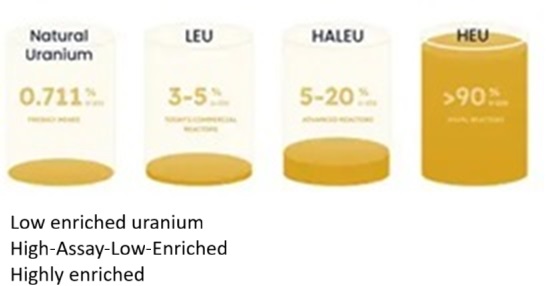
A recently declassified document from nearly 50 years ago provides an important piece of the puzzle for open-source researchers seeking to understand the murky origins of the International Atomic Energy Agency (IAEA) system for safeguarding against the diversion of civil nuclear materials for weapons. The document also reinforces concerns about the proliferation potential of small modular reactors that require fuels using uranium enriched from 10 to less than 20 percent uranium 235—that is, fuels that contain the material known as high-assay low-enriched uranium (HALEU).[1]
HALEU is a subcategory of low-enriched uranium (LEU), which is uranium enriched to below 20 percent uranium 235, and the IAEA has long considered LEU, including HALEU, to be “indirect-use material.” For the agency, HALEU cannot be used to make a nuclear weapon without converting it to highly enriched uranium (HEU) by further enriching it to 20 percent or above—a significant technical barrier for all but a few countries. Consequently, HALEU is subject to far less stringent international safeguards than HEU.
But the newly uncovered document reveals that, in 1977, the US government recommended to the IAEA that, contrary to its previous position, the agency should consider enriched uranium in the HALEU range to be a material “of direct utility in an … explosive device.” That is, the United States advised that HALEU should be treated similarly to HEU and be subject to stricter safeguards—a recommendation that the IAEA apparently rejected. But given the current international push for rapid deployment of reactors that will need large quantities of HALEU fuel, it is time for the IAEA to reconsider that decision.
Proliferation risk of HALEU fuel. The Energy Department, with bipartisan support from Congress, is now vigorously promoting the global deployment of “advanced” nuclear power reactors that require HALEU-based fuels, as well as the facilities needed to enrich and fabricate those fuels. For example, nearly all of the 11 reactor designs selected by the Energy Department for its New Reactor Pilot Program will use HALEU fuel. And Russia, which has already deployed two barge-mounted small modular reactors (SMRs) using HALEU fuel, is planning to deploy others in Uzbekistan and elsewhere around the globe.
But without appropriate constraints, large-scale production and use of HALEU may greatly increase the risks of nuclear proliferation and terrorism…………………………………………………….
earlier this year, the late Richard Garwin and I—along with professors Scott Kemp of MIT, Mark Deinert of the Colorado School of Mines, and Frank von Hippel of Princeton— presented evidence in a letter to Science that HALEU may be used to make nuclear weapons without the need to enrich it further, and we called for further study of the issue by the US government. The concern is that a state or a terrorist group that illicitly obtained enough HALEU—typically, one reactor core’s worth or less, depending on the design—could have a far easier path to acquiring a bomb than if it only had access to conventional LWR fuel………………………………………………………………………………………
The document reveals that the United States apparently sought to lower the enrichment threshold that the IAEA had formerly used to define direct-use enriched uranium from 20 percent to 10 percent—thereby including the enrichment range now known as HALEU. To my knowledge, this information was not previously known to the public, and a cursory web search does not turn up any other mention of the new terms proposed in the cable………………………………………………………………………….
the cable strongly suggests that other US government agencies were concerned enough about the weapon usability of enriched uranium in the HALEU range to challenge the status quo and recommend that it be safeguarded as intensely as HEU. Such concerns should be even more salient today. An international review of HALEU’s proliferation risks is urgently needed before any more power reactors running on HALEU fuel are deployed. https://thebulletin.org/2025/11/declassified-cable-reinforces-proliferation-concerns-about-high-assay-low-enriched-uranium-fuel/?utm_source=ActiveCampaign&utm_medium=email&utm_content=Can%20Latin%20America%20find%20common%20ground%20at%20COP30%3F&utm_campaign=20251110%20Monday%20Newsletter
No comments yet.
-
Archives
- October 2026 (112)
- September 2026 (339)
- August 2026 (330)
- July 2026 (355)
- June 2026 (287)
- May 2026 (306)
- April 2026 (356)
- March 2026 (251)
- February 2026 (267)
- January 2026 (308)
- December 2025 (358)
- November 2025 (359)
-
Categories
- 1
- 1 NUCLEAR ISSUES
- business and costs
- climate change
- culture and arts
- ENERGY
- environment
- health
- history
- indigenous issues
- Legal
- marketing of nuclear
- media
- opposition to nuclear
- PERSONAL STORIES
- politics
- politics international
- Religion and ethics
- safety
- secrets,lies and civil liberties
- spinbuster
- technology
- Uranium
- wastes
- weapons and war
- Women
- 2 WORLD
- ACTION
- AFRICA
- Atrocities
- AUSTRALIA
- Christina's notes
- Christina's themes
- culture and arts
- Events
- Fuk 2022
- Fuk 2023
- Fukushima 2017
- Fukushima 2018
- fukushima 2019
- Fukushima 2020
- Fukushima 2021
- general
- global warming
- Humour (God we need it)
- Nuclear
- RARE EARTHS
- Reference
- resources – print
- Resources -audiovicual
- Weekly Newsletter
- World
- World Nuclear
- YouTube
-
RSS
Entries RSS
Comments RSS


Leave a Reply