What do you need to know to run a nuclear power plant?
13 July 2026 by Matthew Lockwood, By Siegfried Evens, Visiting Fellow, SPRU and SEG, https://blogs.sussex.ac.uk/sussexenergygroup/2026/07/13/what-do-you-need-to-know-to-run-a-nuclear-power-plant/
Governments around the world revisit nuclear energy as part of the race to net zero. But an important question often remains overlooked: how do we train the people who make nuclear technology possible?
I have studied how nuclear engineering education developed in the United States and Sweden between the 1950s and 1970s to draw lessons from history. The research shows that nuclear engineering did not emerge as a standalone field overnight. Instead, it grew through collaboration between physicists, chemists, mechanical engineers, materials scientists, and other specialists working together to solve complex problems they could not figure out on their own.
The study also reveals that the skills expected of nuclear engineers changed over time. Early training focused heavily on nuclear physics and radiation. As nuclear power plants became larger and more sophisticated, engineers increasingly needed expertise in areas such as heat transfer, materials performance, and reactor safety.
The comparison between the US and Sweden shows the importance of political culture in nuclear engineering. The United States built nuclear expertise through a decentralized network of national laboratories, industry, and emerging nuclear engineering departments. Sweden, meanwhile, pursued a more centralized model in which existing technical universities worked closely with state-led nuclear institutions.
The study is a reminder that nuclear expertise is something we actually have to organize as a society. And for a future in which nuclear power is built and used safely, we do not only need engineers with broad technical knowledge, but also the ability to address broader challenges related to safety, policy, economics, and society.
This research was published in the journal Nuclear Technology, accessible here.
Two Geothermal Bets Are Starting to Undercut Nuclear on Cost
By ZeroHedge – Jul 13, 2026,
- Fervo’s third-generation well design cut drilling time 70%, with its latest well reaching 19,448 feet in just 21 days.
- Quaise Energy closed the first tranche of a $134 million Series B, pushing total funding to roughly $230 million for its superhot geothermal plant in Oregon.
- Fervo’s Cape Station is tracking toward $5,500/kW installed, well below the $10,000 to $15,000/kW final cost of Georgia’s Vogtle nuclear reactors.
…………………………………………………………………………….. https://oilprice.com/Alternative-Energy/Geothermal-Energy/Two-Geothermal-Bets-Are-Starting-to-Undercut-Nuclear-on-Cost.html
Is London shifting from nuclear deterrence to war-fighting?

The deployment of high-precision, variable-yield counter-force weapons signals a willingness to carry out retaliatory or pre-emptive nuclear strikes on an adversary.
Bulletin, By S.M. Amadae, Tom Stevenson | Analysis | July 10, 2026
For most of the past three decades, one might almost have said the United Kingdom had a glowing record on nuclear non-proliferation: Britain was the only major nuclear power to operate a minimum deterrent based on a single delivery system; it supported international non-proliferation initiatives; and the UK government had spent 30 years reducing its nuclear stockpile. No more. Instead, London now builds momentum supporting a new wave of nuclear proliferation under the auspices of NATO’s nuclear sharing.
In the last five years, Britain has quietly moved to increase the maximum size of its nuclear stockpile and revise its nuclear doctrine, and it is now acquiring an additional nuclear capability. In concert with the United States, the UK government is expanding the deployment of non-strategic (tactical) nuclear weapons in a way that could destabilize the strategic balance in Europe.
In doing so, London is reversing decades of gradual progress on disarmament without serious analysis of the strategic implications or public consultation, and at a time when there is less support for nuclear diplomacy than at any point in recent history.
New systems and more weapons. In June 2025, the United Kingdom announced plans to acquire Lockheed Martin F-35As that are the first stealth fighter jets certified to carry variable-yield thermonuclear B61-12 gravity bombs. The 12 F-35As would be ordered in place of F-35B fighter jets, which are designed for use on aircraft carriers but are not nuclear-capable. At the Hague summit last year, the United Kingdom then announced it would be joining NATO’s air-launched nuclear mission and putting those planes to work carrying US nuclear bombs. Though it has still not been officially confirmed, US B61-12s were almost certainly moved to RAF Lakenheath in July 2025.[1] Media briefings at the time suggested the UK government was also in talks with Washington on acquiring non-strategic B61-12 bombs of its own, but no such agreement has publicly emerged yet.
On the surface, the United Kingdom’s decision to acquire tactical nuclear capability appeared to be part of a natural evolution in European strategic planning prompted by Russia’s invasion of Ukraine in 2022. But London’s acquisition of F-35As and the deployment of US B61-12s are just the latest examples of a longer trend in the United Kingdom’s nuclear posture. In 2022, RAF Lakenheath had already undergone infrastructure modernization necessary for the return of US nuclear weapons.
Before that, in 2021, the UK government decided to raise the maximum cap on the number of warheads in its arsenal by more than 40 percent. In 2010, the UK government stated that it would continue to reduce its warhead stockpile—at the time numbering 225 warheads—and cap its future arsenal at a maximum of 180 warheads. But in 2021, it suddenly raised the cap to 260 warheads. Despite being a reversal of decades of gradual reductions in the United Kingdom’s projected nuclear stockpile, that decision was slipped onto page 76 of the government’s Integrated Review of Security, Defence, Development, and Foreign Policy.
Policy implications. The United Kingdom has also made a quiet change to its nuclear doctrine, introducing a “right to review” the use of nuclear weapons against non-nuclear states under certain circumstances. Together with the decision to raise the warhead cap, this constituted a dramatic strategic change for which there was no discernible democratic mandate and no public discussion.
At the time, even the best-informed commentators on UK nuclear affairs were unaware of the motivation. One argument, put forward by nuclear historian Lawrence Freedman, was that a larger stockpile of 260 warheads might allow the United Kingdom to have two fully armed nuclear submarines (each potentially carrying a maximum of 128 warheads on 16 missiles) on patrol at once. That the increase in stockpile size was motivated by plans for the United Kingdom to have the option of acquiring a non-strategic nuclear capability only emerged later.
The decision to station B61-12s on UK soil amounts to a de facto settlement of the long‑running debate over adopting a doctrine of no‑first‑use or sole‑purpose, and over the future of tactical nuclear weapons in NATO. The deployment of high-precision, variable-yield counter-force weapons signals a willingness to carry out retaliatory or pre-emptive nuclear strikes on an adversary.
Due to their enhanced guidance systems, B61-12 bombs, coupled with the dual-capable stealth F-35A, also have the potential to alter the geopolitical balance in Europe. The UK B61-12 adoption paves the way for further proliferation of these weapons throughout Europe, cements the normalization of nuclear weapons, and challenges the guaranteed second-strike survivability of adversaries’ nuclear command and control and strategic weapons systems.
Since the end of the Cold War, the United States and, by extension, NATO have become, in the words of the now Under Secretary of Defense for Policy Elbridge Colby, “accustomed to escalation dominance,” the strategic objective of achieving battlefield superiority on all rungs of escalation. This aim relies on maintaining asymmetrical advantage, which is not a sound doctrine against a nuclear peer competitor: It is destabilizing and stokes further arms races.
The combination of F-35A fighter jets and B61-12 bombs gives NATO a stealth-enabled, precision counterforce tool designed to deter by denial by holding Russian nuclear and nuclear command and control assets at credible risk. In theory, they provide limited escalation-control options, such as pre-emptive or tit-for-tat strikes at tailored yield. These technological developments make Russian nuclear forces and command systems both more vulnerable in crisis and less certain for guaranteeing second-strike capability.
From arms control hero to nuclear war fighter. Until recently, UK efforts on exemplary disarmament were comparatively good. The United Kingdom was the only major nuclear state that had limited itself to a single deterrence system (the Trident submarine-launched ballistic missile). The UK government had made incremental reductions in its nuclear stockpile since 1980. With US B61s having returned to the United Kingdom, that record has now been overturned…………………………………………………………………………………………………………………………………………………………………………….
No rationale, real danger. The strategic need for the United Kingdom to operate air-launched tactical nuclear weapons has not been clearly presented either by US officials or the UK government. In addition, these weapons arguably increase the United Kingdom’s reliance on US weapons platforms at a time of transatlantic political divergence…………………………………………………………………………………………………….
The UK government and the United States should carefully revisit the assumptions that led to this point. There is no justifiable reason for the United Kingdom and NATO to expand non-strategic capabilities while also maintaining a no-first-use doctrine unless they are planning a pre-emptive nuclear strike deep into Russian territory, or the territory of another nuclear weapons state, or against a non-nuclear weapons state. NATO member states, like Finland and Poland, are promoting their participation in nuclear sharing and planning. Both understandably perceive an existential threat from Russia, and they are now also considering hosting US nuclear weapons and joining France’s forward deterrence initiative. But with the United Kingdom having already made that choice, it has the dubious distinction of leading the way in normalizing more first-use tactical nuclear capabilities in Europe without comprehensive analysis of the strategic implications. This nuclear brinkmanship, directly pertinent to the Ukraine war, offers the false promise of security for some at the cost of dooming security for all. https://thebulletin.org/2026/07/is-london-shifting-from-nuclear-deterrence-to-war-fighting/?utm_source=ActiveCampaign&utm_medium=email&utm_content=Is%20London%20shifting%20from%20nuclear%20deterrence%20to%20war-fighting%3F&utm_campaign=20260709%20Thursday%20Newsletter%20%28Copy%29
The hidden military pressures behind the new push for small nuclear reactors
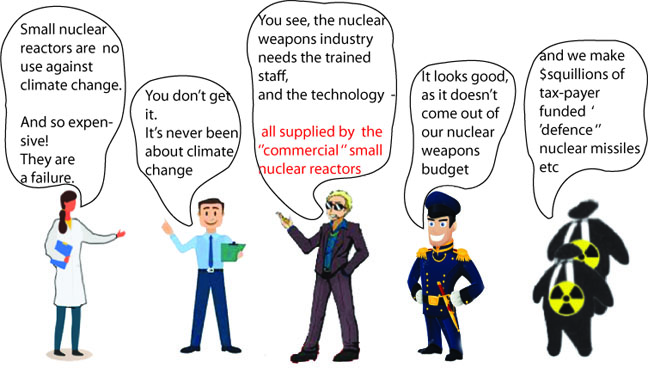
The neglected factor is the military dependence on civil nuclear industries.
By funding civil nuclear projects, taxpayers and consumers cover military uses of nuclear power in subsidies and higher bills – without the added spending appearing in defence budgets
October 28, 2025, Phil Johnstone, Visiting Fellow, School of Global Studies, University of Sussex; University of Tartu; Utrecht University, Andy Stirling, Professor of Science & Technology Policy, SPRU, University of Sussex Business School, University of Sussex, https://theconversation.com/the-hidden-military-pressures-behind-the-new-push-for-small-nuclear-reactors-266301
Donald Trump’s recent visit to the UK saw a so-called “landmark partnership” on nuclear energy. London and Washington announced plans to build 20 small modular reactors and also develop microreactor technology – despite the fact no such plants have yet been built commercially anywhere in the world.
The UK prime minister, Keir Starmer, promised these plans will deliver a “golden age” of nuclear energy that will also “drive down bills”. Yet the history of nuclear power has been decades of overhype, soaring costs and constant delays. Around the world, the trends point the wrong way.
So why the renewed excitement about going nuclear? The real reasons have less to do with energy security, or climate change – and far more to do with military power.
At first sight, the case may seem obvious. Nuclear supporters frame small modular reactors, or SMRs, as vital for cutting emissions, meeting rising demand for electricity from cars and data centres. With large nuclear plants now prohibitively expensive, smaller reactors are billed as an exciting new alternative.
But these days even the most optimistic industry analyses concede that nuclear – even SMRs – is unlikely to compete with renewables. One analysis in New Civil Engineer published earlier this year concluded that SMRs are “the most expensive source per kilowatt of electricity generated when compared with natural gas, traditional nuclear and renewables”.
Independent assessments – for instance by the formerly pro-nuclear Royal Society – find that 100% renewable systems outperform any energy system including nuclear on cost, flexibility and security. This helps explain why worldwide statistical analysis shows nuclear power is not generally linked to carbon emissions reductions, while renewables are.
Partly, the enthusiasm for SMRs can be explained by the loudest institutional voices tending to have formal pro-nuclear remits or interests: they include the industry itself and its suppliers, nuclear agencies, and governments with entrenched military nuclear programmes. For these interests, the only question is which kinds of nuclear reactors to develop, and how fast. They don’t wonder if we should build reactors in the first place: the need is seen as self-evident.
At least big nuclear reactors have benefited from economies of scale and decades of technological optimisation. Many SMR designs are just “powerpoint reactors”, existing only in slides and feasibility studies. Claims these unbuilt designs “will cost less” are speculative at best.
Investment markets know this. While financiers see SMR hype as a way to profit from billions in government subsidies, their own analyses are less enthusiastic about the technology itself.
So why then, all this attention to nuclear in general and smaller reactors in particular? There is clearly more to this than meets the eye.
The hidden link
The neglected factor is the military dependence on civil nuclear industries. Maintaining a nuclear armed navy or weapons programme requires constant access to generic reactor technologies, skilled workers and special materials. Without a civilian nuclear industry, military nuclear capabilities are significantly more challenging and costly to sustain.
Nuclear submarines are especially important here as they would very likely require national reactor industries and their supply chains even if there was no civil nuclear power. Barely affordable even vessel by vessel, nuclear submarines become even more expensive when the costs of this “submarine industrial base” is factored in.
Rolls-Royce is an important link here, as it already builds the UK’s submarine reactors and is set to build the newly announced civil SMRs. The company said openly in 2017 that a civil SMR programme would “relieve the Ministry of Defence of the burden of developing and retaining skills and capability”.
Here, as emphasised by Nuclear Intelligence Weekly in 2020, the Rolls-Royce SMR programme has an important “symbiosis with UK military needs”. It is this dependency that allows military costs (in the words of a former executive with submarine builders BAE Systems), to be “masked” behind civilian programmes.
By funding civil nuclear projects, taxpayers and consumers cover military uses of nuclear power in subsidies and higher bills – without the added spending appearing in defence budgets.
When the UK government funded us to investigate the value of this transfer, we put it at around £5 billion per year in the UK alone. These costs are masked from public view, covered by revenues from higher electricity prices and the budgets of supposedly civilian government agencies.
This is not a conspiracy but a kind of political gravitational field. Once governments see nuclear weapons as a marker of global status, the funding and political support becomes self-perpetuating.
The result is a strange sort of circularity: nuclear power is justified by energy security and cost arguments that don’t stand up, but is in reality sustained for strategic reasons that remain unacknowledged.
A global pattern
The UK is not unique, though other nuclear powers are much more candid. US energy secretary Chris Wright described the US-UK nuclear deal as important for “securing nuclear supply chains across the Atlantic”. Around US$25 billion a year (£18.7 billion) flows from civil to military nuclear activity in the US.
Russia and China are both quite open about their own inseparable civil-military links. French president Emmanuel Macron put it clearly: “Without civilian nuclear, no military nuclear, without military nuclear, no civilian nuclear.”
Across these states, military nuclear capabilities are seen as a way to stay at the world’s “top table”. An end to their civilian programme would threaten not just jobs and energy, but their great power status.
The next frontier
Beyond submarines, the development of “microreactors” is opening up new military uses for nuclear power. Microreactors are even smaller and more experimental than SMRs. Though they can make profits by milking military procurement budgets, they make no sense from a commercial energy standpoint.
However, microreactors are seen as essential in US plans for battlefield power, space infrastructure and new “high energy” anti-drone and missile weaponry. Prepare to see them become ever more prominent in “civil” debates – precisely because they serve military goals.
Whatever view is taken of these military developments, it makes no sense to pretend they are unrelated to the civil nuclear sector. The real drivers of the recent US-UK nuclear agreement lie in military projection of force, not civilian power production. Yet this remains absent from most discussions of energy policy.
It is a crucial matter of democracy that there be honesty about what is really going on.
Heatwave: EDF will once again shut down nuclear reactors.
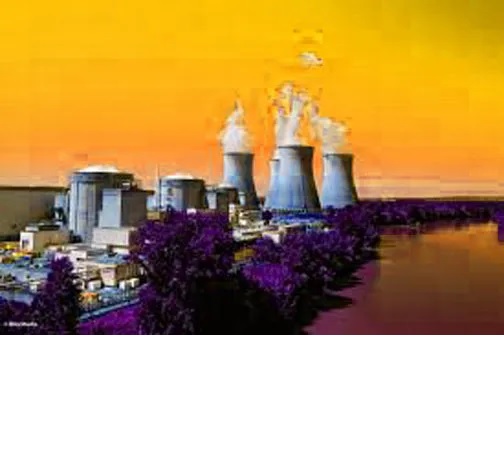
Two weeks after the latest heatwave, EDF has had to halt production at several reactors to prevent further warming of the rivers. The electricity company is planning new upgrades at Golfech on the Garonne and at Chooz on the Meuse in response to climate change.
By Amélie Laurin, July 9, 2026
The respite was short-lived for EDF’s nuclear power plants. After the exceptional heatwave at the end of June which had put three reactors out of service, the public electricity company will again stop two of them on Thursday evening, due to the high temperatures: Bugey 3, on the Rhône, from 9 p.m., then Golfech 2, on the Garonne, at 11:45 pm.
Their reconnection to the grid is scheduled for July 17, after the Bastille Day holiday weekend, which is expected to reduce national electricity consumption by several GW per day, according to forecasts from RTE, the high-voltage transmission network operator. A power reduction is also planned for this Thursday for environmental reasons at Saint-Alban 2, on the Rhône River, according to regulatory announcements from EDF., the operator of high-voltage lines. A power
reduction is also planned this Thursday for environmental reasons at
Saint-Alban 2, on the Rhône, according to EDF’s regulatory messages………. (Subscribers only)
Les Echos 9th July 2026 https://www.lesechos.fr/industrie-services/energie-environnement/canicule-edf-va-de-nouveau-arreter-des-reacteurs-nucleaires-2241469
Government U turn as Sizewell B is to get a fixed-price government contract.
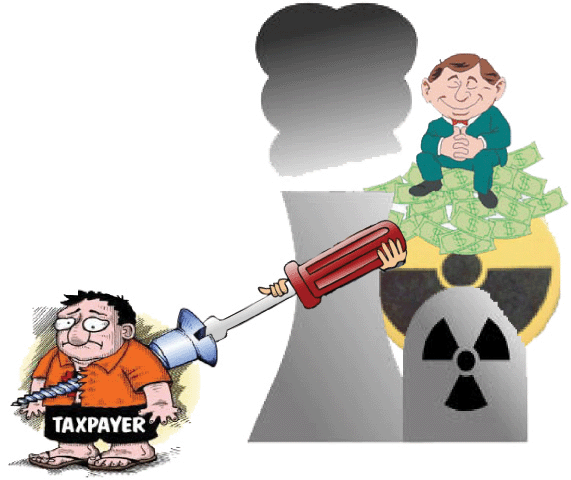
Government awards the last UK nuclear power station a fixed power
contract, backing away from its shift towards a new model of funding.
The UK energy department has extended the life of the Sizewell B nuclear power
plant in Suffolk by 20 years with a fixed-price government contract, after
energy price shocks following the war on Iran.
Chancellor of the Exchequer,
Rachel Reeves, called the nuclear power project “a vital part of
Britain’s energy future”. French project owner EDF said it has secured
a 20-year fixed price power contract from the UK government that will last
from 2035 to 2055.
Previously EDF had planned to commence decommissioning
of the plant in 2035. The French power company said it is “funding a
refurbishment of the nuclear power station during planned outages over the
next fifteen years, costing around £800 million”.
British Gas owner Centrica also said it is investing an undisclosed amount in the extension
of the 1.2 GW operational nuclear power project in Suffolk. It is the first
time that the Sizewell B nuclear power project will operate under a fixed
government power contract, priced at £70.50 per megawatt, after delayed
project Hinkley Point C was awarded such a contract a decade ago.
The energy department has since moved to shift nuclear power projects onto a
regulated asset base (RAB) structure for funding, the model that will be
used to finance Sizewell C at the Suffolk coastal site, a replica of yet to
be finalised nuclear power station Hinkley Point C in Somerset.
Energy Voice 8th July 2026,
https://www.energyvoice.com/renewables-energy-transition/600397/government-u-turn-as-sizewell-b-is-first-nuclear-plant-to-get-cfd/
Jeffrey Sachs: We’re Led by the Most Incompetent Leaders Imaginable
July 10, 2026, ScheerPost Staff, https://scheerpost.com/2026/07/10/jeffrey-sachs-were-led-by-the-most-incompetent-leaders-imaginable/
The latest NATO summit was presented as a demonstration of Western unity. Instead, according to economist Jeffrey Sachs, it revealed something far more dangerous: an alliance increasingly consumed by militarism, detached from strategic thinking, and drifting toward a direct confrontation between nuclear powers. While leaders celebrated record defense spending, reaffirmed support for expanding the war in Ukraine, and doubled down on confrontation with Russia, Sachs argues that almost no serious discussion took place about diplomacy, de-escalation, or the catastrophic risks of continued escalation.
In a wide-ranging interview with political scientist Glenn Diesen, Sachs delivered one of his most scathing assessments yet of the current Western political establishment. He described NATO as an alliance “in disarray,” led by politicians who, in his view, mistake escalation for strategy while serving the interests of what he calls the “military-industrial-digital complex”—a network of defense contractors, intelligence institutions, and increasingly Silicon Valley firms whose profits expand alongside global conflict. Rather than charting a coherent foreign policy, Sachs contends, Western governments are stumbling from crisis to crisis, normalizing reckless rhetoric, abandoning diplomacy, and treating the possibility of nuclear confrontation with alarming complacency.
For Sachs, the concern extends well beyond Donald Trump. While he is sharply critical of Trump’s erratic leadership and broken promises to end America’s wars, he argues that the deeper problem lies within a bipartisan foreign policy establishment that has remained committed to military primacy regardless of who occupies the White House. As public support for continued escalation declines across the United States and Europe, Sachs warns that political leaders appear increasingly disconnected from both public opinion and geopolitical reality, raising the unsettling possibility that the greatest threat to global security is no longer a lack of military power, but a profound absence of strategic thinking.If anyone was still searching for evidence that NATO has abandoned even the pretense of being a defensive alliance or a forum for serious diplomacy, this year’s summit provided it in abundance. Rather than confronting the growing dangers of direct confrontation between nuclear powers, Western leaders gathered to celebrate higher military spending, pledge deeper involvement in ongoing wars, and reaffirm a geopolitical strategy that appears increasingly disconnected from both reality and public opinion.
“I think the NATO alliance is largely in disarray. This is not a serious group, and it’s not seriously strategizing. The summit was essentially two days of Trumpisms. Donald Trump is mentally unstable. We normalize it, we laugh about it, we call it a tactic, but he’s really something awful—and everyone plays along. You watch two days of increasingly bizarre exchanges: Trump says Spain is awful and that the United States should cut off all trade with Spain, and Spain responds by saying they had a wonderful conversation. He says Greenland should belong to the United States, and everyone simply moves on. This is not really an alliance right now, and these are not meetings of serious people.” Jeffery Sachs
Walt Zlotow – Chicago Tribune misleads its readership with Bob Kustra’s imaginary commentary ‘What Ronald Reagan would do today for the people of Ukraine’.
Walt Zlotow West Suburban Peace Coalition Glen Ellyn IL, 13 July 26
It’s fitting Tribune commentator Bob Kustra would go all the way back to 1980’s “virulent anti-communist” Ronald Reagan to argue Reagan would have squandered another $175 billion to keep Ukraine destroying itself in America and NATO’s lost proxy war to weaken, isolate Russia from the European economy.
Kustra is clearly locked in virulent 1980’s anti-communist ideology that he’s transferred to non-communist Russia, ignoring 35 years of NATO expansion that doubled NATO membership to keep Russia isolated and fearing NATO’s nukes on its doorsteps. This was after the USSR vanished into the dustbin of history.
Kustra imagines Russia had nothing to fear from adding Ukraine to NATO, a red line of Russian security concern that Russian leader Putin had been warning the US and NATO about since 2007. Kustra has apparently erased the US promoted Ukraine coup in 2014 that toppled Russian leaning Ukraine President Victor Yanukovych, provoking a civil war in the Donbas that killed thousands of Russian leaning Ukrainians there. In Kustra’s worldview, Obama didn’t greenlight the coup, Trump didn’t gift Ukraine with hundreds of millions in weapons to polish off the Donbas separatists. and Biden didn’t ramp up NATO membership to Ukraine and tell Russia it was none of their damn business.
Claiming Reagan would still be arming the collapsing, failed Ukraine state is preposterous. Reagan spending $20 million in black market smuggling networks to inundate Poland with “1eaflets, posters, magazines, newspapers and radio break-ins” is a quantum leap away from funding a war with $175 billion that has near utterly destroyed Ukraine in their lost war the US provoked. As conservative as Reagan was. he was foremost a pragmatist in foreign affairs. He was out of office and battling mental decline when the Soviet Union collapsed in 1991 so everything Kustra offers is conjecture. But Reagan’s record argues strongly he’d never have engaged in the madness Obama, Trump in term one and Biden did to send Ukraine to the scrapheap of nations.
Bob Kustra knows better. So does the Chicago Tribune. Its readership deserves something a tad better than Bob Kustra’s ‘The Russians are coming, The Russians are coming.’
Eight NATO allies to create new satellite mega-constellation
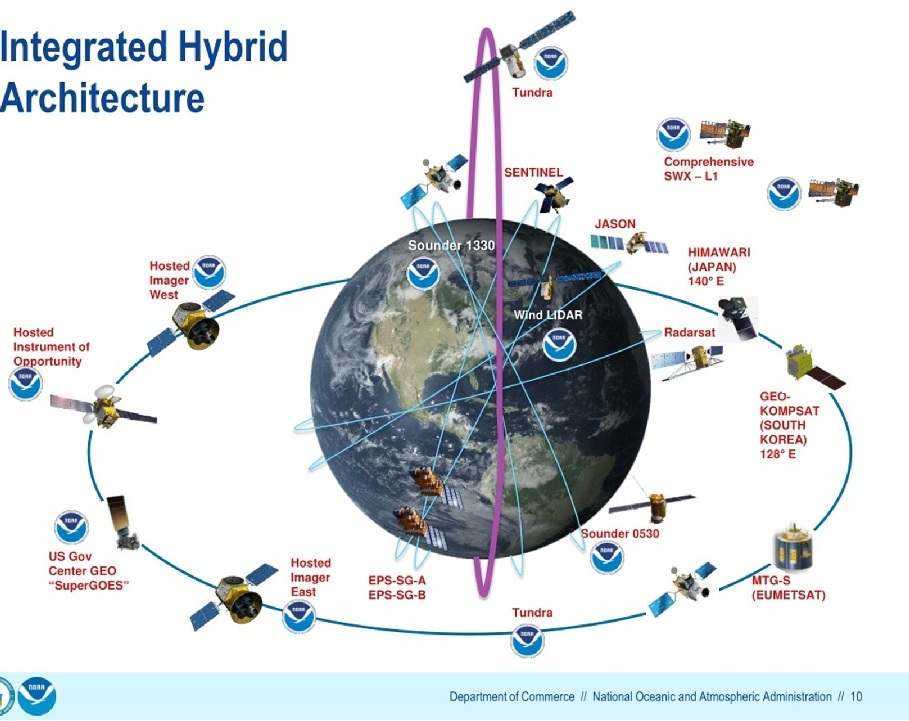
The network will involve Denmark, Canada, Finland, Germany, Norway, the Netherlands, Sweden and Turkey.
Breakig Defense, By Theresa Hitchens on July 08,
WASHINGTON ― Eight NATO countries plan to link their military satellites into a “mega-constellation” to enable “high-speed communications, intelligence and missile tracking,” the alliance announced on Tuesday at its Summit Defence Industry Forum in Ankara, in a move that joins a number of other a new initiatives aimed at improving NATO space capabilities.
Connecting multiple national satellites will “overcome the cost, time and coverage limitations of single-nation satellite fleets,” a NATO press release said.
The new network, called the Hybrid Alliance Layered Operations in Space (HALO), initially will involve Denmark, Canada, Finland, Germany, Norway, the Netherlands, Sweden and Turkey, a NATO official told Breaking Defense today.
“But we expect more to come,” the official added, explaining that NATO is “in the early stages of the initiative.”………………………………………………………………….
APSS, created in 2023 and formally integrated into NATO in 2024, includes a”virtual” intelligence, surveillance and reconnaissance (ISR) constellation, called Aquila that initially involved 17 allies. Member nations also have pledged to jointly fund commercial imagery and ISR products such as 3D maps.
APSS is supported by the NATO Communications and Information Agency (NCIA), which provides program management, digital infrastructure, data integration and a user interface for allies. Data collected from the network further is funneled into NATO Headquarters via the NATO Intelligence Enterprise. APSS achieved initial operational capability last December…………………………………
Finally, the NATO press release stated that Canada became the 15th member of NATO’s Starlift multinational initiative, “which explores ways to develop a network of launch capabilities that will help Allies launch assets at short notice from spaceports across the Alliance. This will boost NATO’s ability to react more quickly to threats from space.”
Starlift was launched in October 2024 by 14 allies: Belgium, Finland, France, Germany, Hungary, Italy, Luxembourg, the Netherlands, Norway, Spain, Sweden, Turkey, the United Kingdom and the United States. https://breakingdefense.com/2026/07/eight-nato-allies-to-create-new-satellite-mega-constellation/
Canada’s Federal Government in Disarray Over Nuclear Waste Project Assessment .
We the Nuclear Free North is an alliance of people and groups opposing a Deep Geological Repository for nuclear waste in Northern Ontario. We oppose the transport, burial and abandonment of this radioactive waste in our northern watersheds.
| Thunder Bay – Intervenors in the federal assessment of a nuclear waste transportation and burial plan are saying that the federal government is in disarray over the assessment of nuclear projects. This follows the Impact Assessment Agency of Canada’s release, last week, of the Tailored Impact Statement Guidelines for the Nuclear Waste Management Organization’s (NWMO’s) proposed deep geological repository for nuclear fuel waste. The NWMO plan incudes the transportation, processing, burial and abandonment of all of Canada’s high-level nuclear waste in an underground repository proposed for a site between Ignace and Dryden in northwestern Ontario. The Impact Assessment Agency posted the Guidelines to a public registry on July 3rd, following a 30-day comment period in April. The same day, a Notice of Commencement was issued, signaling the start of the assessment statement phase of the multi-year process. In this phase, the Nuclear Waste Management Organization must prepare an Impact Statement and supporting documents to meet the requirements set out in the Guidelines. “Overall, the guidelines set out a reasonable set of requirements. We were pleased to see that the Agency rejected NWMO’s pitch that long-distance transportation and long-term safety of the project should be excluded – those are fundamentally important issues – but we are disappointed that NWMO will not be required to present alternatives to the project,” commented Wendy O’Connor, a volunteer with We the Nuclear Free North. The assertion that the federal government is in disarray stems from the series of overlapping and – in some respects – contradictory messages and announcements issued by them in recent months related to the assessment of nuclear projects. In May, the federal government released a discussion paper proposing that the impact assessment of nuclear projects be handed over to the Canadian Nuclear Safety Commission (CNSC), rather than conducted by the independent Impact Assessment Agency of Canada. The CNSC is the licensing body for nuclear facilities and is described by both academics and industry observers as a “captured regulator”. CNSC is led by nuclear industry insiders and has never refused a licence application since its inception. In June, the federal government announced that it would potentially designate the NWMO’s Deep Geological Repository (DGR) as a “Project of National Interest” under the Building Canada Act. Such a designation would mean guaranteed approval of the DGR, even in the absence of evidence to support the safety of the project. The announcement defined the implications for the DGR project as including “streamlining” of the review and “issuing a document outlining the conditions under which the project may proceed.” According to the federal government, listing the DGR as a “Project of National Interest” would result in “shifting Canada’s regulatory focus from ‘whether’ the project should proceed to ‘how’ it will proceed.” In July, the federal Impact Assessment Agency issued a Notice of Commencement of a full impact assessment of the NWMO’s proposed deep geological repository to be delivered by the Impact Assessment Agency. “While the Guidelines are imperfect, they do provide at least a fighting chance of the public and Indigenous peoples being able to contribute to a thorough assessment of the NWMO’s project, and to have the NWMO’s proposal tested in front of a (hopefully) impartial hearing panel”, said Brennain Lloyd, project coordinator with Northwatch. “This is a massive and unprecedented project. The risks will be widespread – along the transportation route, in the vicinity of the repository, and downstream from the site – and long-lasting. These radioactive wastes remain significantly dangerous for a million years. Let’s not rush to any unsupported conclusions about the project’s safety”, added Charles Faust, speaking on behalf of Nuclear Free Thunder Bay. The comment period on the May discussion paper closes on July 22nd. The federal government is expected to decide by this fall whether the NWMO project is to be designated as a “Project of National Interest”, which would circumvent the impact assessment process. The NWMO is required to provide the Impact Assessment Agency with a workplan for the development of their Impact Statement by the first week of October. Contacts: Brennain Lloyd, 705-493-9650, brennain@northwatch.org Charles Faust, 807-633-0202, cfaust@tbaytel.net Wendy O’Connor, 807-358-6711, wendywoodswalker@rocketmail.com |
Trump Says Iran Deal Is “Over,” Signals More US Strikes Are Likely Coming

July 9, 2026, By Chris Walker, https://scheerpost.com/2026/07/09/trump-says-iran-deal-is-over-signals-more-us-strikes-are-likely-coming/
“Negotiators keep talking if they want, but I don’t see it,” Trump said on the status of future discussions.
In remarks at the NATO summit in Turkey on Wednesday, President Donald Trump claimed that the Memorandum of Understanding (MOU) between the U.S. and Iran, negotiated last month, was no longer in effect, citing the resumption of military attacks between the two countries.
Trump’s comments come as the U.S. and Iran have exchanged fire over the past several days, with U.S. Central Command announcing on Tuesday night that they had completed strikes on around 80 targets.
The president was visibly upset when responding to questions from reporters about the war.
“I think it’s over. I don’t want to deal with them anymore,” Trump said.
The U.S. president engaged in name-calling against Iran’s leaders, calling them “sick people” and “scum” — a noted departure from his positive descriptions of them when negotiations were going better.
The MOU was not a final peace deal, but rather an agreement between the U.S. and Iran that aimed to end hostilities while a larger agreement was being brokered. Trump derided Iran for denying negotiated deals he claimed were being made during those discussions.
“We make a deal. They [Iran] go outside, talk to the press, they say ‘we never even talked about it,’” Trump complained.
Over the past month, Trump has made several baseless claims about the dealmaking process without confirmation from Iran, including that Iran had agreed to give up control of the Strait of Hormuz and that the country would agree to destroy its enriched nuclear materials.
Asked whether he would engage in future negotiations with Iran, Trump demurred. “I don’t care,” he said, adding that he’d let “negotiators keep talking if they want, but I don’t see it.”
He also indicated that the U.S. would conduct more military attacks later on. “We hit them very hard last night. Probably hit them hard again tonight,” Trump said.
On Tuesday, Iran’s Foreign Minister Abbas Araghchi warned that the U.S.’s continued threats and attacks against Iran, which violate parts of the MOU, would impede “negotiations on a final deal.”
CENTCOM said it hit 80 targets on Tuesday, with one U.S. official calling the strikes bigger than previous retaliatory ones. While the U.S. insisted its targets are military posts, the attacks are happening near larger cities and close to civilian infrastructure.
Iran media reported explosions near military targets in Bushehr early on Wednesday morning, a port city near the northern edge of the Persian Gulf that has a population close to 250,000 people. The city is home to the only civilian nuclear power plant in the country.
The U.S. also appeared to bomb the city of Bandar Abbas, near the Strait of Hormuz, which has a population of over 526,000 people. Early morning footage showed fires from explosions and large smoke plumes over the city.
And Iranian media said several explosions were seen in Sirik, a port city in the southern part of the country, with attacks reportedly hitting commercial and fishing piers. Several people also suffered injuries from shrapnel due to the attacks.
According to figures compiled by Al Jazeera, around 3,468 Iranians have been killed in the U.S.-Israeli war on Iran since February 28. More than 26,500 Iranians have been injured due to the war. The true number of casualties is likely higher, as the figures were last updated in mid-June.
Nuclear Power is Now Trump Power…What Could Go Wrong?

Karl Grossman – Harvey Wasserman, July 10, 2026, https://www.counterpunch.org/2026/07/10/nuclear-power-is-now-trump-power-what-could-go-wrong/
Donald Trump is now the ultimate face of the U.S. nuclear power industry.
What could go wrong?
If you are advocating atomic energy in any form, you are promoting The Donald’s latest and largest fiscal fleecing of the American people. It mirrors his mega swindles in crypto and so much more—except this time with apocalyptic impact.
It’s a hyper-push for nuclear power.
As The New York Times this week headlined the “Climate Forward” column of Claire Brown: “Trump’s plans for nuclear power lurch ahead.”
Her July 7th piece began: “President Trump wants to quadruple nuclear power production in the United States by 2050. To get there, developers would need to build about a hundred times as much nuclear capacity in the next 25 years as they did in the past 25. In recent weeks, a series of government announcements have nudged the country a bit closer to that goal.”
It continued: “Nuclear power has broad bipartisan support in Congress, and many climate experts have embraced it as a low-emissions source of energy. Other experts remain opposed, arguing that it is too expensive or that the safety risks are too high.”
Through its Truth Social corporate front, the Trump Family has bought a major interest in TAE Technologies, a $6 billion California-based plunge into nuclear fusion.
To serve that investment, Trump is scamming his presidency to funnel billions of public dollars into a “Peaceful Atom” from which he expects to personally profit.
Right now, he’s pushing through Congress a $17.5 billion interest-free slush fund to promote more U.S. reactor construction.
Similar handouts from George W. Bush and Barack Obama fed two new nuclear power plants in Georgia. Originally promised at around $15 billion, the two plants fired up last year some seven years late and nearly $25 billion over budget. Their most recently reported price tag approaches $40 billion. Their output will never compete with renewables. They’ll bleed Peach State mega-cash as long as they operate.
Two abandoned nuclear plants in South Carolina blew $9 billion outright. The double debacle bankrupted Westinghouse, once the world’s leading reactor producer.
Meanwhile Trump pushes so-called Small Modular Reactors, hyped to power data centers that produce his beloved crypto. Projected to operate around 2030, SMR cultists hope their juice might (at best) cost a mere three times the proven cost of solar panels, and four times or more than that of currently operating onshore wind turbines.
But despite Trump’s frantic efforts to kill it, the real-world transition to green “Solartopian” renewables may be. Epic advances in battery technology essentially eliminate any need for the base-line power nuclear plants produce when they don’t break down or blow up. California’s battery capacity is now seven times as large as the maximum output that can be produced by the state’s last two hyper-expensive Diablo Canyon nuclear power plants.
Those dangerously decrepit reactors are surrounded by at least a dozen earthquake faults. They sit just 45 miles from the San Andreas fault.
In 2013, U.S. Nuclear Regulatory Commission site inspector Dr. Michael Peck warned that Diablo might not withstand a credible quake from the seismic faults surrounding it. Peck’s warning was ignored. Now he is gone from the commission. In the Trump era, no such report could be written in the first place.
In 2018, California adopted a comprehensive plan to shut Diablo and to phase in renewables. The transition was hugely accelerated by massive advances that have dropped battery prices while expanding their capabilities. Through at least part of most days now, California gets 100% of its electricity from renewables, much of it coming from solar panels in the Central Valley.
But “green” Governor Gavin Newsom is trashing the transition. In 2022, he handed Diablo’s owner, PG&E, billions in Trump-style grift while promoting his own run for The White House. As a result, California’s electric rates are now the highest in the continental U.S.
Meanwhile, Trump attacks the green competition with billions of public dollars to buy out leases from wind and solar projects, which threaten to produce electricity far cheaper than his beloved nukes. With the epic spread of cheap batteries (which are also fueling a global boom in electric vehicles) more than 80% of the world’s newly installed electric generating capacity now comes from renewables. All Trump’s mob-style assaults in the U.S. are being challenged in court and at the grassroots. But the global market push remains unrelenting.
Despite the growing danger as they deteriorate from age and maladministration, atomic reactors have been federally shielded from accident insurance requirements since 1957. Amidst escalating safety concerns, Congress has extended the liability exemption to SMRs, meant to power thousands of the crypto-loving data centers now being vehemently opposed by grassroots citizens throughout the US.
Last year Trump became the first U.S. president to fire a chair of the Nuclear Regulatory Commission. The U.S. Supreme Court has now confirmed the royal prerogative of a sitting president to fire any regulatory official. In the wake of Musk’s DOGE purge of at least 100 technical experts at the NRC, Trump is now sole arbiter of health and safety regulations, which are now in terrifying free fall at the 94 licensed U.S. nuclear power plants.
Trump also wants to put new reactors on military reservations, shredding residual NRC restraints through the even looser Department of Energy.
Two operating U.S. nuclear power plants (at North Anna in Virginia and Perry in Ohio) have already been significantly damaged by earthquakes (Perry twice). With neither accident insurance nor credible safety regulation, Trump/Nukes Inc. is a sitting duck for terror attacks. Russian drones have already damaged reactors and fuel storage sites at Ukraine’s Zaporizhia and Chernobyl. Others have been under fire.
Trump has infamously launched outright war on Iran’s nuclear weapons production. But as in Ukraine, a single drone could turn any of the world’s 400-plus reactors into a radioactive weapon of mass destruction, plunging us into an economic, ecological and health abyss from which we might never recover.
Meanwhile, an industry that hypes itself as “climate friendly” burns at 500 to 600 degrees Fahrenheit. In France, the U.S. and elsewhere, commercial reactors super-heat lakes and rivers that can no longer cool them, while boiling billions of marine organisms.
Seven decades after the first commercial reactor opened in Pennsylvania, The Donald is the undisputed self-dealing face of the “Peaceful Atom.”
He’s its top investor. He rules the shell of the Nuclear Regulatory Commission. He’s the presidential purveyor of taxpayer grift and chief hit man aiming to kill the renewable competition.
If you are for nuclear power, you are for Trump power.
What could go wrong?
Harvey Wasserman wrote the books Solartopia! Our Green-Powered Earth and The Peoples Spiral of US History. He helped coin the phrase “No Nukes.” He co-convenes the Grassroots Emergency Election Protection Coalition at www.electionprotection2024.org Karl Grossman is the author of Cover Up: What You Are Not Supposed to Know About Nuclear Power and Power Crazy. He the host of the nationally-aired TV program Enviro Close-Up with Karl Grossman (www.envirovideo.com)
Europe’s Nuclear Plants Can’t Beat the Heat
By Haley Zaremba – Jul 10, 2026, https://oilprice.com/Alternative-Energy/Nuclear-Power/Europes-Nuclear-Plants-Cant-Beat-the-Heat.html
- France is cutting output at up to five nuclear plants this week as record heat pushes river temperatures too high to cool reactors safely.
- Last month’s heat wave already knocked out power to 70,000 households on France’s hottest day ever, 44°C, and Germany and the UK both rely on French nuclear exports.
- More than 1,000 heat-related deaths in France and stalled EU adaptation funding show the grid crisis is outpacing the response.
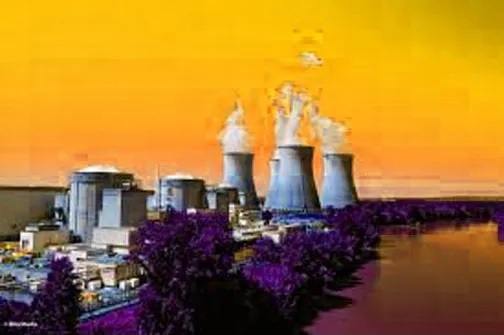
Europe’s blistering heat wave is threatening energy security across the continent as power plants shut down and the risk of rolling blackouts rises. Electric grids are overstressed, and ecosystems are too. Rivers are greatly affected by soaring temperatures, which in turn impacts the energy industry and power plants that rely on that water supply for their cooling systems. Just this week, France announced that it will reduce production at as many as five nuclear power plants, with two already curbing output this week.
France is expected to receive the worst of a coming high-pressure heat dome over the next few weeks, with temperatures soaring to as high as 42 Celsius (107.6 Fahrenheit) in some parts of the country on Wednesday. When Europe experienced a similar heat wave last month, a transformer failed, leaving nearly 70,000 households without power as temperatures reached deadly levels. The country recorded its hottest day ever on record, with temperatures reaching a blistering 44 °C (111 °F).
These temperatures are not only deadly to humans, they are also a huge threat to the ecosystem. Rivers are growing hotter under these conditions, and one of the impacts of that change is that their waters are no longer as effective for cooling down nuclear power plants, which serve as the backbone of France’s energy mix. As a result, the country anticipates needing to curb production at plants around the country at the very same time that demand is surging.
It’s a sad irony that just as electricity is needed more than ever to keep indoor temperatures at survivable levels, the power grid is most likely to fail. “As it gets hotter, things stop working quite so well,” Iain Staffell, associate professor of sustainable energy at Imperial College London, was recently quoted by DW. “I think we do need to adapt the power system to cope with the changing weather,” he went on to add.
The reduction of nuclear power output in France could greatly affect energy availability and affordability within France and in neighboring countries such as Germany and the United Kingdom, which import electricity generated by the nation’s sizable nuclear power sector. And nuclear is only part of the story. The heat wave is also impacting the output of hydropower and limiting the cooling abilities of coal and gas plants.
Europe can expect this kind of strain to be the new normal as global warming alters climatic patterns around the world and increases the frequency and intensity of extreme weather. Policies will need to be put into place, and enacted quickly, in order to prepare European grids to withstand these kinds of temperatures at regular intervals going forward.
“Utilities can adapt by planning for summer peaks, making cooling demand more flexible, reinforcing grids for high temperatures, deploying batteries and demand response, and climate-proofing power plants’ cooling systems,” Simone Tagliapietra, senior fellow at Bruegel, an economic and policy think tank, recently told MIT Technology Review via email.
However, all of these imperatives are massively costly and difficult to implement, leading to inaction on the part of European leadership and widespread vulnerabilities of the continent’s energy infrastructure. Last year, the European Environment Agency reported that all 27 countries in the European Union have climate adaptation plans, but noted that “insufficient long-term funding” has stifled implementation.
This has led to frustration and resentment amongst the public, not to mention over 1,000 unnecessary deaths. “Everyone is asking, why are we not ready?” Francois Gemenne, an environmental politics professor at French business school HEC Paris, recently told the New York Times. “We are becoming aware of our own vulnerability.”
2009 quake may have prompted data rigging by central Japan nuclear operator

July 10, 2026 (Mainichi Japan),
https://mainichi.jp/english/articles/20260710/p2g/00m/0bu/008000c
NAGOYA (Kyodo) — Chubu Electric Power Co. may have begun manipulating earthquake resistance data for its nuclear power plant in central Japan after a 2009 earthquake subjected one of its reactors to shaking beyond its design limits, a source familiar with the matter said Thursday.
The latest revelation came after the utility admitted earlier this year that it had, by no later than 2012, begun cherry-picking favorable data to set earthquake-resistance standards for the Nos. 3 and 4 reactors at its Hamaoka nuclear power plant, which it has been seeking to restart.
The data rigging was initially believed to have begun under tougher safety requirements imposed after the Fukushima Daiichi nuclear power plant disaster, which was triggered by a massive earthquake and tsunami in 2011. But the source said the practice may have begun even before the disaster, as part of efforts to restart the No. 5 reactor after it was shut down following the 2009 earthquake.
In the magnitude-6.5 earthquake that struck Omaezaki, Shizuoka Prefecture, in August 2009, the No. 5 reactor experienced seismic shaking several times stronger than that recorded at the Nos. 1 to 4 reactors, partially exceeding its design limits.
Chubu Electric found that unusual ground conditions had amplified the seismic waves. After the No. 5 reactor automatically shut down in the quake, the company allegedly began generating seismic data and selecting favorable results to avoid being ordered by the government to implement additional earthquake-resistance measures, according to the source.
The company switched to a different contractor around the same time, allowing it to generate seismic wave data more quickly and “creating the perfect circumstances and motive,” the source said.
The nuclear regulator at the time approved the safety of the No. 5 reactor in late 2010, paving the way for its restart in February 2011.
The fresh allegation could mean Chubu Electric engaged in data manipulation involving the Hamaoka plant’s three operable reactors, further undermining confidence in the country’s nuclear safety screening process.
“Details of what happened will be determined through a third-party investigation. We will cooperate sincerely with the inquiry,” Chubu Electric said in a statement.
Located on the Pacific coast in central Japan, the Hamaoka complex sits near the expected epicenter of a potential massive earthquake in the Nankai Trough. It was shut down in May 2011 at the request of then Prime Minister Naoto Kan over safety concerns.
Chubu Electric applied for state safety screenings between 2014 and 2015 to restart the Nos. 3 and 4 reactors, but the review process has been halted amid the scandal.
According to a report compiled by Chubu Electric in March this year on its data misconduct involving the Nos. 3 and 4 reactors, the utility told regulators it had generated 20 sets of seismic motion data under different conditions and selected the one closest to the average — known as the “representative wave” — to establish a benchmark for earthquake-resistant design.
In reality, however, the company had been generating numerous combinations of seismic motion data and representative waves before selecting a set from among them. In 2018, it began deliberately selecting the representative wave and ensuring the other data were consistent with it.
The Nuclear Regulation Authority also recently revealed it had learned from an external source that Chubu Electric continued manipulating data even after the investigation began in May 2025.
The Patriot Trap
The goal of the West has always been to trap Russia in an endless conflict that saps the economic, military, and moral strength of the nation and its people.
the economic, military and moral collapse it anticipated isn’t transpiring inside Russia, but rather in Ukraine and its European partners.
Donald Trump has given the thumbs up for the licensed production of Patriot missiles by Ukraine. This is a trap that will not end well for those looking to the Patriot missile for salvation.
Scott Ritter, Jul 10, 2026, https://scottritter.substack.com/p/the-patriot-trap
Persistence pays off, or so it would seem. Less than a week before NATO convened its annual summit in Ankara, Ukrainian President Volodymyr Zelensky renewed his call for the establishment of a domestic production facility for Patriot air-defense missiles. Zelensky’s plea came in the aftermath of one of Russia’s largest missile attacks on Kiev. Unlike previous Russian attacks, where the Ukrainian side claimed the vast majority of the Russian missiles had been intercepted by Ukraine’s western-supplied air defenses, this attack exposed the harsh reality that Ukraine had no defensive response to the Russian attacks.
Ukraine was out of missiles.
“To reliably protect lives, we need our own production,” Zelensky said.
The Ukrainian President was echoing a call he had been making for months. In May, Zelensky observed “I asked the previous administration, I am asking todays administration, give Ukraine licenses. We will increase the production of Patriot missiles. It will be very helpful for us, it will be very helpful for the Middle East, for everybody whom the United States will decide to help.”
On July 8, during a meeting with US President Donald Trump on the sidelines of the Ankara Summit, Zelensky got his wish.
“We’re going to give a license to you to make Patriots,” Trump told a beaming Zelensky. “That’s pretty cool, right? This way you can’t complain that we’re not giving them enough.”
Trump noted that he still needed to inform the “company” before adding “but that’ll work out all right.”
Problem solved?
Not even close.
Trump and Zelensky had fallen into what can only be called “The Patriot Trap”—the notion that a singular technology can somehow transform the fate of a nation.
The problem faced by Ukraine and their western sponsors—to include an apparently reinvigorated Trump-led United States—isn’t solved by pouring more resources into a war of attrition that favors Russia. This would imply that Ukraine has the potential of prevailing in the ongoing proxy war being waged between the collective West and Russia.
It doesn’t.
The goal of the West has always been to trap Russia in an endless conflict that saps the economic, military, and moral strength of the nation and its people.
The problem faced by the collective West is that the economic, military and moral collapse it anticipated isn’t transpiring inside Russia, but rather in Ukraine and its European partners.
And the other problem is that the United States is more than willing to allow both Ukraine and Europe to further deplete what remains of their respective strength on a gamble that Russia is somehow even more depleted.
A massive information warfare campaign has been underway concurrent with the Zelensky plea for the right to produce Patriot missiles. Centered on a drone-based offensive which has targeted critical Russian infrastructure, this campaign has been paired with a propaganda effort without precedent, designed to transform pleasing visuals of burning Russian oil infrastructure, destroyed trucks, and long-lines at gas stations into an endless thematic declaring Russia unable to defend itself and, as such, the Russian leadership weakened and desperate for an off-ramp to a war which cannot be won.
The purpose of this campaign is straightforward—arm Ukraine.
Give Ukraine the weapons it needs to defend itself.
Ignore the costs accrued by Ukraine to date in terms of lost lives and squandered resources.
Ignore the fact that Russia maintains the strategic advantage across the broad spectrum of issues that define this conflict—on the battlefield, in the defense factories, in the boardroom of companies, and in the hallways of global decision making—Russia is dominating across the board.
Ignore the reality that neither Ukraine nor its western sponsors can win this war.
Just create the perception that they can.
Because perception creates its own reality.
Especially if Russia falls victim to this information warfare campaign, and starts doubting itself.
The problem is that, at least when it comes to the issue of Ukrainian production of the Patriot missile, the perception the perpetrators of this scheme are seeking to manufacture has zero chance of manifesting itself.
It is doomed by the very ineptitude of those who have hatched this scheme to begin with.
Given the realities associated with Patriot production today, the most likely candidate for Ukrainian licensed production is the MIM-104F Guidance Enhanced Missile-Tactical (GEM-T) interceptors. Under normal conditions, a GEM-T interceptor costs $3-4 million each to manufacture. Accelerated production costs could raise the per-unit cost to between $6–7 million. Licensed production, requiring new facilities, could raise the costs to over $10 million per missile.
A missile which is not designed to shoot down the modern threats posed by Russia, such as the Iskander-M, the Kinzhal, the Zircon, or the Oreshnik.
Which means from the start, the US-Ukrainian license deal is designed not to actually improve the ability of Ukraine to defend itself, but create the impression among those susceptible to such flights of fantasy that Ukraine could actually accomplish this.
If only they were given the resources to to so.
The Ukrainian license will likely closely track with existing licensed production of the GGEM-T by Germany, where a new GEM-T production facility was built in the city of Schrobenhausen. The facility is operated by COMLOG, a joint venture between Raytheon and MBDA Deutschland. COMLOG is designed to handle the production and modernization of Patriot PAC-2 GEM-T missiles for European users, including Ukraine.
It is highly likely that the Ukrainian license will be an extension of the existing German license Such an arrangement would streamline many export control issues.
GEM-T interceptors contain guidance electronics, propulsion components, warhead assemblies, and launcher interface equipment that are sourced from a network of suppliers that already exist when it comes to the German license. Lead times on some of these components exceed six months.
The Schrobenhausen facility broke ground in 2022. The plan was to build six new buildings at the site by 2026: an assembly building, warehouse, combustion chamber preparation, technical center, extension of the existing technical service building and a new office wing. According to MBDA, a usable area of 6500 square meters will have been created. The Schrobenhausen facility is strictly an assembly facility; over 50 Bavarian and German suppliers are involved in the qualification and series production phase of all of the components used to produce the final product. Among the subcontractors is Bayern-Chemie, whose Aschau, Germany facility has been tasked to produce solid motors for the GEM-T interceptors. Bayern-Chemie produced Patriot motors between 1987 and 1996, and has the infrastructure conducive to resumption of its past work.
The rudder control system of the GEM-T missiles manufactured in Germany will no longer be hydraulic, but electro-mechanical. Modifications a for the upper part of the rocket, the so-called forebody, as well as the installation of a new computer, which will come from Europe, underscore the reality that the German GEM-T is a standalone product, not influenced by the availability of US components—another reason why a modification of the COMLOG license is the most likely path the US will take regarding Ukraine.
But all of this is part of the hype that such a deal is feasible, that there is hope for Ukraine once these Ukrainian-produced missiles start rolling off the production line.
Under ideal conditions, a Ukrainian assembled GEM-T could not manifest itself in reality until 2028 at the earliest.
This is assuming Congress permits this transfer to take place.
But this would require one to believe that Russia would stand by idly while Ukraine builds from scratch a new 6500 square meter facility, or modifies existing facilities to take on the task of assembling GEM-T Patriots.
That Russia would neither identify or seek to violently interdict this assembly facility, or the numerous supporting facilities involved in supporting the importation and/or manufacture of subcomponents.
Russia, simply put, will not be idle.
And any GEM-T production facility built on Ukrainian soil would have a lifetime measured in days—weeks at best.
The Ukrainian GEM-T Patriot will never see the light of day.
And anyone selling this fantasy—including Zelensky and Trump—know this to be true.
The Ukrainian GEM-T is a myth—a chimera—designed to break the spirit of the Russian nation by propagating the myth of a never-ending conflict.
But this is a trap neither the Russian people or their leadership will fall into.
Sadly, the same cannot be said about either Zelensky or Trump.
And the price for their error will be measured in the blood of both Russian and Ukrainian victims.
1 This Month



26 September – International Day for the Total Elimination of Nuclear Weapons


PLEASE OPPOSE HR 8255 AND S.3639 – bills would accelerate satellite deployment, with no environmental review or safeguards – https://ncstd5li.quorum.us/campaign/169331/
To see nuclear-related stories in greater depth and intensity – go to https://nuclearinformation.wordpress.com
-
Archives
- September 2026 (219)
- August 2026 (330)
- July 2026 (355)
- June 2026 (287)
- May 2026 (306)
- April 2026 (356)
- March 2026 (251)
- February 2026 (267)
- January 2026 (308)
- December 2025 (358)
- November 2025 (359)
- October 2025 (375)
-
Categories
- 1
- 1 NUCLEAR ISSUES
- business and costs
- climate change
- culture and arts
- ENERGY
- environment
- health
- history
- indigenous issues
- Legal
- marketing of nuclear
- media
- opposition to nuclear
- PERSONAL STORIES
- politics
- politics international
- Religion and ethics
- safety
- secrets,lies and civil liberties
- spinbuster
- technology
- Uranium
- wastes
- weapons and war
- Women
- 2 WORLD
- ACTION
- AFRICA
- Atrocities
- AUSTRALIA
- Christina's notes
- Christina's themes
- culture and arts
- Events
- Fuk 2022
- Fuk 2023
- Fukushima 2017
- Fukushima 2018
- fukushima 2019
- Fukushima 2020
- Fukushima 2021
- general
- global warming
- Humour (God we need it)
- Nuclear
- RARE EARTHS
- Reference
- resources – print
- Resources -audiovicual
- Weekly Newsletter
- World
- World Nuclear
- YouTube
-
RSS
Entries RSS
Comments RSS
 nuclear-news