8 peaceful protestors arrested at the Nevada National “Security” Site

Nonviolent Activism, North America
By Nevada Desert Experience, April 8, 2023 https://worldbeyondwar.org/8-arrested-at-the-nevada-national-security-site/
On Good Friday, April 7, 2023 , 8 concerned citizens were arrested and cited for trespass at the Nevada National “Security” Site insisting on nuclear weapons abolition. On April 10, 2023 Brian Terrell and John Amidon will appear in Beatty Justice Court for trespass citations from October 2022.
The NDE Sacred Peace Walk engaged the Department of Energy and the Nye County Sheriff’s department in dialogue and civil resistance. Jacques Linder, Philadelphia, PA, Richard Bishop, Missoula, MT, Sylver Pondolfino, Staten Island, NY, Tessa Epstein, Salt Lake City, Utah, Mark Babson, Salem, Oregon, George Killingsworth, Berkeley, CA, Theo Kayser, St. Louis, MO, Catherine Hourcade, Stockton, CA were arrested, cited for trespass and released at the NNSS.
Mark Babson said “I felt the arresting officers were listening to us. It is so vital we continue this work because we have the ability to make a significant choice that will effect the survival of our species and that of other living beings.”
Brian Terrell and John Amidon will appear in Beatty Justice Court, Monday morning for previous trespass citations at the NNSS from last October, 2022. Both have pleaded not guilty as both had permission and land use permits from the Western Shoshone National Council, the legal owners of this land.
Four arrested after blockade of two gates at Trident nuclear base in Scotland
Posted on April 6, 202, by Margaret Ferguson Burns http://www.nukeresister.org/2023/04/06/four-arrested-after-blockade-of-two-gates-at-trident-nuclear-base-in-scotland/?fbclid=IwAR0_QXUS6bh8GFYojhTTaBg7cF7qqXkt2NTNnuDBjGJUVg92m7CVSfxUc_M
This morning, 5th April – an early start and a fine action.
Lying in a lock-on, enjoying the sounds of the gate sliding shut behind us, the warning klaxon overhead, high above the electrified, barbed wire topped main entrance to HMNB Clyde (home of the UK’s nuclear powered and armed submarines of mass destruction) – and the merry call of “Bandit Alarm; North Gate closed; traffic within the base divert to…” blaring out from the loudspeakers.
The heavy rain splashing chill on our faces in the dull coldness, and creeping through the many layers of clothing.
Clad in an International Campaign to Abolish Nuclear Weapons (ICAN) “Nuclear Weapons ARE BANNED” banner (what else could it be?).
And a little later the even merrier message of “Both North and South Gates now closed – all traffic use the Fire Engine Gate” – loudly hailed into the air. So the second team in successful lock-on too.
And then a Ministry of Defence police truck arriving with blue lights flashing; and the cutting crew truck appearing on the scene too.
So it was, for two lock-on teams from Faslane Peace Camp – the four arrested (Alexander, Finlay, Willemien, Margaret), handcuffed and taken off to Clydebank Polis Station (still wearing the ICAN banner through check-in at the Sergeant’s desk – aye). And it’ll be off to Dumbarton Sherriff Court in the morning.
All to protest the UK Government’s plans to provide depleted uranium munitions to Ukraine in its defence against the Russian invasion – it’s known to cause leukaemia, birth defects and much more.
Success was enabled by welfare support from other camp members during the action; and tasty hot food and a blazing hot stove on return to camp late – after release on signing an “Undertaking” to appear in court next day (including the acceptance of various conditions until then e.g. not to go within 20 metres of the base).
[Update – All four activists were out by late afternoon, Thursday, 6th April – court proceedings to follow at some point.]
Campaigners continue to take a stand against the plan for new nuclear power at Bradwell
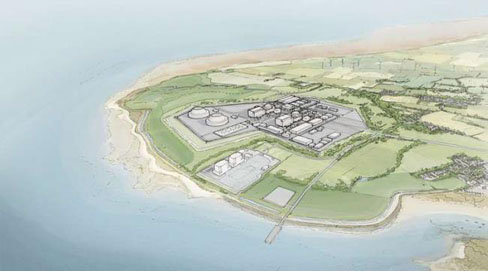
CAMPAIGNERS have promised to continue to protect the people and
environment until a village site is ruled out for use as a nuclear power
site. The Government has said it is “committed to a programme of new
nuclear projects beyond Sizewell C”.
The current government nuclear
policy statement identifies Bradwell as a site for nuclear energy until the
end of 2025. Despite the stop to the plans for a Chinese-led nuclear power
station in Bradwell, campaigners are continuing to take a stand against the
site being considered for nuclear use.
Maldon Standard 6th April 2023
Opponents pack Pilgrim Nuclear meeting as potential discharge of radioactive water looms

CAI | By Jennette Barnes, March 28, 2023
Opponents of the proposed discharge of radioactive water from the Pilgrim Nuclear Power Station packed a meeting on the future of the station last night.
Ryan Collins of Bourne received a standing ovation from the audience when he presented a thick binder of signatures from his Change.org petition. The petition calls for a stop to the discharge plan. It garnered more than 200,000 signatures.
The state’s Nuclear Decommissioning Citizens Advisory Panel hosted the meeting at Plymouth Town Hall as part of its regular calendar.
…………………………………… opponents argue that the terms of a state settlement with Holtec would make a release of contaminated water illegal, with or without a permit.
Many members of the audience held orange signs that read, “Protect our bays! No permit!” in reference to the proposed modification of Holtec’s permit under the National Pollutant Discharge Elimination System.
Jo-Anne Wilson-Keenan, of East Dennis, said she’s concerned about contamination. Speaking from the podium, she raised her arm to show the shape of Cape Cod and the location of Dennis.
“We live right here in the elbow, and when the radioactive water comes down from Plymouth, it’s going to land right on our beaches,” she said.
Jim Cantwell, state director for U.S. Sen. Ed Markey, discussed Markey’s March 17 letter to Holtec asking the company to use the ratepayer-funded decommissioning trust fund to pay for an independent scientific study of the risks of discharging the radioactive water stored at Pilgrim.
Last May, at a field hearing hosted by Markey in Plymouth, Singh agreed to allow independent testing.
Meanwhile, state-supervised testing of the Pilgrim water is set to begin with a collection of samples on April 5. Senior staff from the Massachusetts Department of Environmental Protection and Department of Public Health are scheduled to observe, along with a representative of the town of Plymouth.
But Seth Pickering, a deputy regional director with DEP, said the state no longer plans to use the previously identified Colorado lab, Eurofins, to test for non-radioactive pollutants.
The agency will instead rely on Gel Laboratories of South Carolina, which Pickering disclosed is a lab Holtec uses as well.
Members of the audience objected to the idea of using the same lab as Holtec……………. https://www.capeandislands.org/local-news/2023-03-28/opponents-pack-pilgrim-nuclear-meeting-as-potential-discharge-of-radioactive-water-looms
Canadian First Nations do not want small nuclear reactors on their lands

Decolonizing energy and the nuclear narrative of small modular reactors https://policyoptions.irpp.org/magazines/february-2022/decolonizing-energy-and-the-nuclear-narrative-of-small-modular-reactors/
Kebaowek First Nation is calling for an alternative to a planned SMR project, one that won’t undermine proper consultation and leave a toxic legacy.
by Lance Haymond, Tasha Carruthers, Kerrie Blaise, February 7, 2022 In early 2021, the Canadian Nuclear Safety Commission began reviewing the application from a company called Global First Power to build a nuclear reactor at the Chalk River Laboratories site about 200 kilometres northwest of Ottawa.
This project, known as a micro modular reactor project, is an example of the nuclear industry’s latest offering – a small modular reactor (SMR).SMRs are based on the same fundamental physical processes as regular (large) nuclear reactors; they just produce less electricity per plant. They also produce the same dangerous byproducts: plutonium and radioactive fission products (materials that are created by the splitting of uranium nuclei). These are all dangerous to human health and have to be kept away from contact with people and communities for hundreds of thousands of years. No country has so far demonstrated a safe way to deal with these.
Despite these unsolved challenges, the nuclear industry promotes SMRs and nuclear energy as a carbon-free alternative to diesel for powering remote northern communities. The Canadian government has exempted small modular reactors from full federal environmental assessment under the Impact Assessment Act. Many civil society groups have condemned this decision because it allows SMRs to escape the public scrutiny of environmental, health and social impacts.
The proposed new SMR in Chalk River, like the existing facilities, would be located on Algonquin Anishinabeg Nation territory and the lands of Kebaowek First Nation – a First Nation that has never been consulted about the use of its unceded territory and that has been severely affected by past nuclear accidents at the site.
At this critical juncture of climate action and Indigenous reconciliation, Kebaowek First Nation is calling for the SMR project at Chalk River to be cancelled and the focus shifted to solutions that do not undermine the ability of First Nations communities to be properly consulted and that do not leave behind a toxic legacy.
While these reactors are dubbed “small,” it would be a mistake to assume their environmental impact is also “small.” The very first serious nuclear accident in the world involved a small reactor: In 1952, uranium fuel rods in the NRX reactor at Chalk River melted down and the accident led to the release of radioactive materials into the atmosphere and the soil. In 1958, the same reactor suffered another accident when a uranium rod caught fire; some workers exposed to radiation continue to battle for compensation.
What makes these accidents worse – and calls into question the justification for new nuclear development at Chalk River – is that this colonized land is the territory of the Algonquin Anishinabeg Nation territory (which consists of 11 First Nations whose territory stretches along the entire Ottawa River watershed straddling Quebec and Ontario). Kebaowek First Nation, part of the Algonquin Nation, was among those First Nations never consulted about the original nuclear facilities on their unceded territory, and is still struggling to be heard by the federal government and nuclear regulator. Its land has never been relinquished through treaty; its leaders and people were never consulted when Chalk River was chosen as the site for Canada’s first nuclear reactors; and no thought was given to how the nuclear complex might affect the Kitchi Sibi (the Ottawa River).
History is being repeated at Chalk River today as the government pushes ahead with the micro modular reactor project without consent from Kebaowek. Assessments of the project have been scoped so narrowly that they neglect the historical development and continued existence of nuclear facilities on Kebaowek’s traditional territory. The justification for an SMR at this location without full and thorough consideration of historically hosted nuclear plants – for which there was no consultation nor accommodation – is a tenuous starting point and one that threatens the protection of Indigenous rights.
The narrative of nuclear energy in Canada is one of selective storytelling and one that hides the reality of the Indigenous communities that remain deeply affected, first by land being taken away for nuclear reactor construction, and later by the radioactive pollution at the site. All too fitting is the term radioactive colonialism coined by scholars Ward Churchill and Winona LaDuke, to describe the disproportionate impact on Indigenous people and their land as a result of uranium mining and other nuclear developments. In country after country, the uranium that fuels nuclear plants has predominantly been mined from the traditional lands of Indigenous Peoples at the expense of the health of Indigenous Peoples and their self-determination.
Kebaowek First Nation has been vocal in its objection to the continuation of the nuclear industry on its lands without its free prior and informed consent, as is its right under the United Nations Declaration on the Rights of Indigenous Peoples (UNDRIP). Despite requests for the suspension of the SMR project, pending adequate provisions for Indigenous co-operation and the Crown’s legal duty to initiate meaningful consultation, Kebaowek has yet to see its efforts reflected in government decisions and Crown-led processes.
Nuclear is a colonial energy form, but it is also bio-ignorant capitalism – a term coined by scholars Renata Avila and Andrés Arauz to describe the ways in which the current economic order ignores the planetary climate emergency, human and ecological tragedies, and the large-scale impact on nature. The narrative of nuclear as a “clean energy source” is a prime example of this bio-ignorance. Decision-makers have become fixated on carbon emissions as a metric for “clean and green,” ignoring the radioactive impacts and the risks of accidents with the technology.
It is more than 70 years since Chalk River became the site for the splitting of the nucleus. The continuation of nuclear energy production on unceded Indigenous territory without meaningful dialogue is a telling example of continued colonial practices, wherein companies extract value from Indigenous land while polluting it; offer little to no compensation to impacted communities; and abide by timelines driven by the project’s proponents, not the community affected. We need to move away from this colonial model of decision-making and decolonize our energy systems.
The challenge of climate change is urgent, but responses to the crisis must not perpetuate extractivist solutions, typical of colonial thinking, wherein the long-term impacts – from the production of toxic waste to radioactive releases – lead to highly unequal impacts.
The authors thank Justin Roy, councilor and economic development officer at Kebaowek First Nation, and M.V. Ramana, professor at the School of Public Policy and Global Affairs at the University of British Columbia, for contributing to this article.
Over 100 Canadian organisations oppose funding for small modular nuclear reactors in federal budget .

Ottawa, Monday, March 27, 2023 – Environmental and civil society groups are giving a thumbs-down after the federal government announced new funding on Friday towards the development of small modular nuclear reactors (SMRs). The groups will be looking closely at the numbers in Tuesday’s budget.
The “Prime Minister Trudeau and President Biden Joint Statement,“ issued on Friday March 24, committed Canada to provide funding and in-kind support for a US-led program to promote SMRs.
The Canadian government’s Strategic Innovation Fund has already given close to $100 million to corporations working on experimental SMR technologies. In addition, the Canada Infrastructure Bank has committed $970 million to Ontario Power Generation’s plan for a 300-megawatt SMR at Darlington. Federal funding is benefiting US-based companies GE-Hitachi and Westinghouse, and Canada’s SNC-Lavalin, among others.
All the funded SMR projects are still in the research and development phase. Worldwide, no SMRs have ever been built for domestic use.
In addition, the federal government is giving Atomic Energy of Canada Limited $1.35 billion a year to conduct nuclear research and development and to manage its toxic radioactive waste. Nearly all this funding is transferred to a consortium of SNC-Lavalin and two US-based companies (Fluor and Jacobs) that that are heavily involved in nuclear weapons and SMR research.
Over 100 groups from all across Canada have criticized the federal government’s plan to promote SMR nuclear technology, stating that:
- SMRs are a dirty, dangerous distraction that will produce radioactive waste of many kinds. Especially worrisome are those proposed reactors that would extract plutonium from irradiated fuel, raising the spectre of nuclear weapons proliferation.
- SMRs will take too long to develop to address the urgent climate crisis in the short time frame necessary to achieve Canada’s goals.
- SMRs will be much more expensive than renewable energy and energy efficiency. Small reactors will be even more expensive per unit of power than the current large ones, which have priced themselves out of the market.
- Nuclear power creates fewer jobs than renewable energy and efficiency. Solar, wind and tidal power are among the fastest-growing job sectors in North America. The International Energy Agency forecasts that 90% of new electrical capacity installed worldwide over the next five years will be renewable.
The federal government needs to invest urgently in renewables, energy conservation and climate action, not slow, expensive, speculative nuclear technologies.
QUOTES:
“Taxpayer dollars should not be wasted on a future technology whose time is past, like nuclear reactors, when truly clean renewable solutions are up-and-running and getting more affordable all the time.” – Dr. Gordon Edwards, Canadian Coalition for Nuclear Responsibility
“Let’s compete to be world leaders in renewables. Pouring public funding into speculative reactor technologies is sabotaging our efforts to address the climate crisis.” – Dr. Ole Hendrickson, Sierra Club Canada Foundation
The SMR technologies are all at the early R&D stage, yet the funding is not following good governance practices by requiring high standards of peer review.“ – Dr. Susan O’Donnell, Coalition for Responsible Energy Development in New Brunswick
Second U.S. Citizen Headed to German Prison for Anti-Nuclear Weapons Actions
BY JOHN LAFORGE. 23 Mar 23, https://www.counterpunch.org/2023/03/23/second-u-s-citizen-headed-to-german-prison-for-anti-nuclear-weapons-actions/
While dread of nuclear war between Russia and NATO states over Ukraine have reached new heights, especially in Europe, a second U.S. citizen has been ordered to serve prison time in Germany for protest actions demanding that U.S. nuclear bombs stationed at Germany’s Büchel NATO base, southeast of Cologne, be withdrawn.
Dennis DuVall, 81, member of Veterans for Peace, U.S. Air Force veteran of the war in Vietnam, and veteran anti-nuclear activist, is to report to the federal prison in Bautzen, Germany, 32 miles east of Dresden (JVA Bautzen, Breitscheid Str. 4, 02625 Bautzen, Germany), on Thursday March 23 to begin a 60-day sentence.
On July 15, 2018, DuVall was one of 18 people who clipped through the chain link fence and enter the base in order to — as the group said in a statement — “bring an end to the ongoing criminal conspiracy to unleash uncontrollable and indiscriminate heat, blast, and radiation with every B61 nuclear bomb deployed at Büchel NATO base.”
Charged with trespass and damage to property, DuVall explained to German trial and appeals courts that he has a legal obligation under the Nuremberg Principles to join in nonviolent protests to prevent or halt the planning and preparation for nuclear attacks which is taking place at Büchel. Well-reported exercises like the annual “Steadfast Noon” are often described as nuclear attack rehearsals.
Today, with NATO materially at war in Ukraine, the needless forward-basing of U.S. H-bombs at six European NATO base’s facing Russia has never been more provocative or destabilizing. NATO’s latest “Strategic Concept” (June 2022) reaffirmed its ever-present threat to launch nuclear first-use attacks using U.S., French and British weapons.
In Cochem District Court on May 11, 2020, DuVall was the first U.S. citizen to be convicted in Germany for civil resistance against the ongoing threat to attack Russia with the U.S. nuclear weapons stationed at Büchel, 170-kiloton B61-3, and 50-kiloton B61-4 free-fall hydrogen bombs.
For years, Büchel protest defendants have warned of the base’s threat of nuclear annihilation, and have urged court authorities “to send a message to the German government to remove B61 H-bombs from Büchel NATO base, and return them to the United States for dismantling and disposal.” In trial testimony on May 11, 2020, DuVall reminded the District Court Judge that “the threat of nuclear weapons is a clear and present danger to the European community, and nuclear war is an existential threat to the web of life on our planet.”
In refusing to pay a court-imposed fine, DuVall explained to the public prosecutor in the case that “it is a matter of conscience I share with many other U.S., Dutch, and German Büchel defendants not to pay money to those who willingly protect weapons of mass murder deployed at Büchel NATO base.”
The first U.S. citizen to be jailed in similar protests, yours truly (writer John LaForge), was released February 28 from Glasmoor prison near Hamburg after serving 50 days.
“It is my right and my duty,” says DuVall, “to work toward the abolition of nuclear weapons, and it is the responsibility of the German government to sign and ratify the Treaty on the Prohibition of Nuclear Weapons, and to ensure the prompt removal of U.S. B61 thermonuclear weapons from Büchel NATO base.”
John LaForge is a Co-director of Nukewatch, a peace and environmental justice group in Wisconsin, and edits its newsletter.
Campaign for Nuclear Disarmament condemns UK decision to send depleted uranium shells to Ukraine

The UK government is sending depleted uranium shells for use in the Challenger 2 tanks gifted to Ukraine, a move CND has condemned as an additional environmental and health disaster for those living through the conflict.
First reported by Declassified UK, Defence Minister Baroness Goldie admitted in the answer to a written question that armour piercing rounds containing depleted uranium (DU) were included in its tank package for Kiev. She added that the rounds “are highly effective in defeating modern tanks and armoured vehicles.”
A byproduct of the nuclear enriching process used to make nuclear fuel or nuclear weapons, DU emits three quarters of the radioactivity of natural uranium and shares many of its risks and dangers. It is used in armour piercing rounds as it is heavy and can easily penetrate steel. However on impact, toxic or radioactive dust can be released and subsequently inhaled.
READ MORE: CND’s briefing paper on depleted uranium
DU shells were used extensively by the US and British in Iraq in 1991 and 2003, as well as in the Balkans during the 1990s.
It is thought that the extensive use of these shells is responsible for the sharp rise in the incidence rate of some cancers like breast cancer or lymphoma in the areas they were used. Other illnesses linked to DU include kidney failure, nervous system disorders, lung disease and reproductive problems. However, a lack of reliable data on exposure to DU means no large-scale study on its true impact exists.
CND General Secretary Kate Hudson said:
“Like in Iraq, the addition of depleted uranium ammunition into this conflict will only increase the long-term suffering of the civilians caught up in this conflict. DU shells have already been implicated in thousands of unnecessary deaths from cancer and other serious illnesses. CND has repeatedly called for the UK government to place an immediate moratorium on the use of depleted uranium weapons and to fund long-term studies into their health and environmental impacts. Sending them into yet another war zone will not help the people of Ukraine.”
Bi -Partisan measure opposes Canadian plan to store nuclear waste long term near Lake Huron
Melissa Nann Burke, The Detroit News
Washington ― A bipartisan group of Great Lakes lawmakers introduced a resolution in Congress on Wednesday to oppose a Canadian proposal to permanently store spent nuclear fuel waste in the Great Lakes Basin.
The move comes ahead of President Joe Biden’s first trip to Canada as president this week to meet with Prime Minister Justin Trudeau.
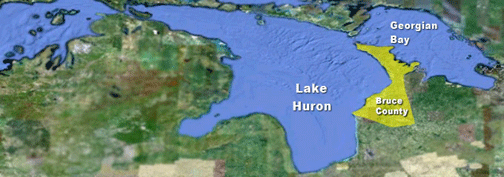
The resolution is concerned with Canada’s Nuclear Waste Management Organization, which plans to decide next year on one of two potential sites for a nuclear waste facility, either Ignace, Ontario, or South Bruce, which is in the Great Lakes basin and less than 40 miles from Lake Huron.
The resolution says that Biden and Secretary of State Antony Blinken should ensure that the government of Canada does not permanently store nuclear waste in the Great Lakes Basin.
It goes on to warn that a “spill” of such waste into the lakes during transit to a deep geological repository “could have lasting and severely adverse environmental, health and economic impacts on the Great Lakes and the individuals who depend on the Great Lakes for their livelihoods.”
The measure is led by U.S. Reps. Dan Kildee, D-Flint Township, and John James, R-Farmington Hills, in the House and U.S. Sen. Debbie Stabenow, D-Lansing, in the Senate.
“Storing hazardous nuclear waste in our shared waterways threatens the drinking water of millions of people in the United States and Canada, and jeopardizes jobs in the fishing, boating and tourism industries,” Kildee said in a statement. “I urge President Biden to address Canada’s plan to permanently bury nuclear waste in the Great Lakes basin as he meets with Canadian Prime Minister Trudeau.”
The resolution has 15 other House co-sponsors including Michigan Reps. Jack Bergman of Watersmeet, John Moolenaar of Caledonia, Bill Huizenga of Holland, Lisa McClain of Bruce Township, Debbie Dingell of Ann Arbor, Elissa Slotkin of Lansing, Hillary Scholten of Grand Rapids, Haley Stevens of Birmingham and Shri Thanedar of Detroit as well as five Senate co-sponsors, including Sen. Gary Peters of Bloomfield Township………………………………………………………………………………. https://www.detroitnews.com/story/news/politics/michigan/2023/03/22/measure-opposes-canadian-plan-to-store-nuclear-waste-near-lake-huron/70036108007/
Fukushima nuclear water plan is a new blow to fishermen
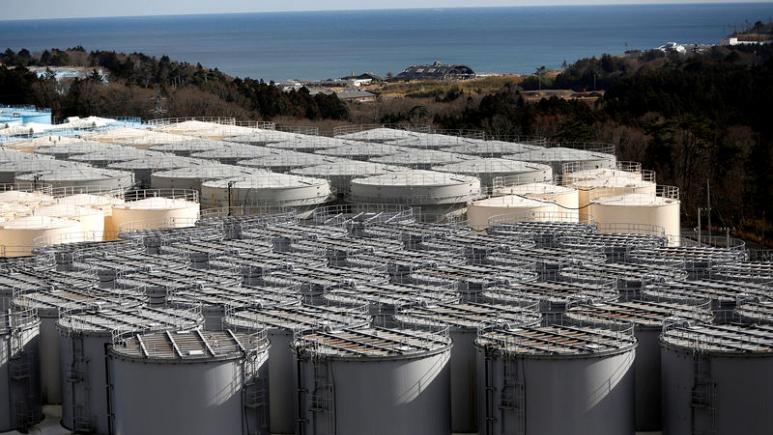
Locals believe livelihoods are at risk as authorities attempt to tackle
contamination 12 years on from the disaster. The authorities are about to
begin pumping contaminated water from the Fukushima nuclear power plant
into the Pacific Ocean.
More than a million tons of water will be released
into the sea over the next thirty years. The waste water will be treated
and diluted to remove most radioactive contaminants, but will still contain
traces of the isotopes, tritium and carbon-14.
The governments of China,
South Korea and Pacific island nations have protested against the decision.
But none are affected more directly than the fishermen of Fukushima. Twelve
years after the catastrophe, there is no clear timeline for the
decommissioning of Fukushima Daiichi, which is decades away from being
safely dismantled.
In the meantime, 130 tons of water is contaminated by it
every day. Some of this is poured directly onto the broken reactors to cool
them. Much is natural ground water which flows through the earth towards
the sea, picking up radiation from the exposed reactors on the way.
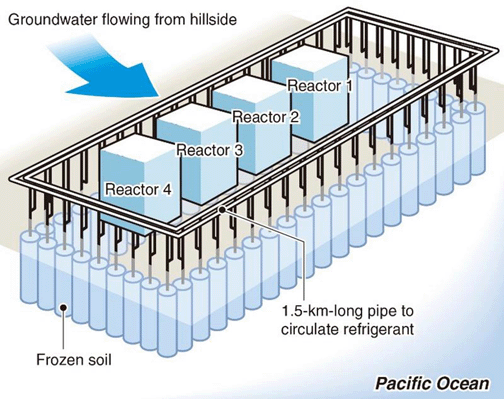
To prevent the groundwater reaching the plant in the first place, the
authorities built an underground “ice wall” of frozen earth, but this
has been only partly effective. Filtering is supposed to remove all the
radioactive elements except for tritium, which is routinely released into
the sea in diluted form from nuclear plants around the world
. But carbon-14
and trace elements of more dangerous radioactive substances, including
strontium-90 and iodine-129, have also been detected in the water. The
Japanese government says that tritium will be diluted to less than one-40th
of the concentration permitted under Japanese safety standards and
one-seventh of the World Health Organisation’s permitted level for safe
drinking water.
According to Tepco, the radiation in the tritium in the
water amounts to some 860 trillion becquerels — less than half the 1,620
trillion becquerels released from Britain’s Sellafield plant in 2015. The
theory is that the water will quickly and harmlessly dissipate into the
vastness of the Pacific Ocean.
But environmentalists and some scientists
disagree. The US National Association of Marine Laboratories claims that
the statistics, assumptions and models used in the Tepco projections are
flawed. It points to the danger of concentrated clusters of radiation
accumulating on the ocean floor.
Shaun Burnie, a nuclear expert at
Greenpeace, says that the water should be stored longer in tanks, allowing
time for the tritium to reduce, and that the decision to release into the
ocean is as much as about saving money as science. It also gives an
illusion of concrete progress.
Even if it is safe, it makes little
difference to the fishermen of Soma, for whom even just the perception of a
danger is enough to harm their business. Among them opinion is divided.
Some oppose the release under any circumstances; others, including Konno,
reluctantly accept it as the least worst option given that only complete
decommissioning, decades in the future, will solve the problem.
Times 10th March 2023
In Taiwan, strong opposition to extending life of nuclear reactor
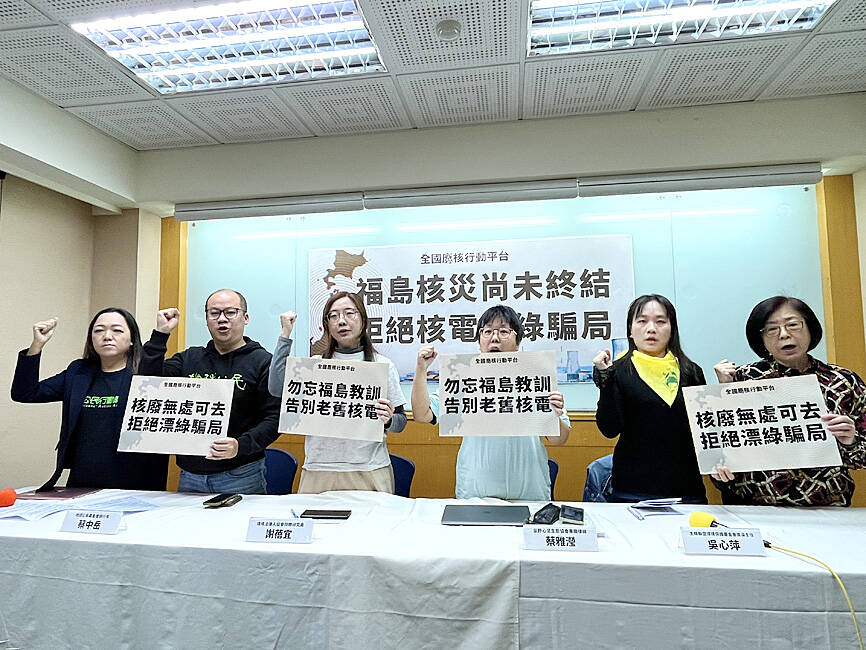
Proposed 20-year nuclear plant extension opposed
NO WASTE STORAGE: Renewable energy last year contributed more than the output of nuclear sources, but the nation risks moving backward, critics said
By Chen Chia-yi and Kayleigh Madjar / Staff reporter, with staff writer 10 Mar 23 https://www.taipeitimes.com/News/taiwan/archives/2023/03/10/2003795851
The National Nuclear Abolition Action Platform yesterday criticized calls by politicians to extend the service of the Guosheng Nuclear Power Plant’s No. 2 reactor, saying it disregards public sentiment and does not address problems with waste storage.
Some lawmakers have suggested a 20-year extension of the No. 2 reactor at the plant in New Taipei City’s Wanli District (萬里), which is set to reach the end of its lifespan on Tuesday, the groups told a news conference in Taipei.
More than 12 years after the Fukushima Dai-ichi nuclear power plant disaster in Japan, issues with contamination and wastewater have yet to be resolved, Green Citizens’ Action Alliance secretary-general Tsuei Su-hsin (崔愫欣) said.
The disaster occurred just as the plant turned 40 years old, said Tsai Ya-ying (蔡雅瀅), an attorney with the Wild at Heart Legal Defense Association.
Although the main cause was a tsunami triggered by an earthquake, an underlying weakness that exacerbated the disaster was the age of its facilities, Tsai said.
The second reactor at the Guosheng plant is about to turn 40 next week and should be decommissioned, she said.
Without locations identified to store nuclear waste, there is no basis for discussing continued use of the reactor, Environmental Jurists Association researcher Hsieh Pei-yi (謝蓓宜) said.
Politicians and corporate leaders — including Taipei City Councilor Wang Hung-wei (王鴻薇) and Broadcasting Corp of China chairman Jaw Shaw-kong (趙少康) — have been using “false, one-sided information” to call for its extension, Citizen of the Earth, Taiwan executive director Tsai Chung-yueh (蔡中岳) said.
They have not addressed the issue of waste storage sites at the plant being filled to capacity, he said, adding that they have evading the question whenever asked.
They are not only disregarding public concern about nuclear waste, but also ignoring legal provisions that require extension requests to be made at least five years before a nuclear plant’s decommission date, Tsai said.
Japan’s experience with restarting its nuclear plants was much different than perceived, the groups said.
In 2011, Japan had 54 nuclear generating units, 24 of which had been decommissioned, they said.
In the years since, seven have been restarted, and more planned restarts were canceled due to public opposition, the groups said.
Last year, renewables contributed close to that of nuclear in the nation’s power mix, at 8.3 percent, the groups said, adding that Taiwan should not to “move backward” on energy transition.
Renewable energy should be made a more viable long-term goal, Homemakers United Foundation director Wu Hsin-ping (吳心萍) said.
Solar and small-scale hydropower are being used in many communities, Wu said.
For example, one small 20-kilowatt solar installation in Taipei, despite frequent overcast weather in the capital, is able to produce a month of power in a year for about 70 households, she said.
Canadian environmental watchdog group ROEE does not support expansion of nuclear power
Le Regroupement des organismes environnementaux en énergie (ROEE) is a voluntary association of Quebec groups with a fine professional team:
ROEE is funded to intervene in hearings of the Régie de l’Énergie on matters related to energy and the environment and toeducate the public on such matters in a regular way. The ROEE was founded in 1997 following a public debate on energy policy in Quebec that led to the creation of the
Régie de l’Énergie
on matters related to energy and the environment and to educate the public on such matters in a regular way.
The ROEE was founded in 1997 following a public debate on energy policy in Quebec that led to the creation of the Régie.
The Canadian Coalition for Nuclear Responsibility, known in
Quebec as le Regroupement pour la surveillance du nucléaire,
is one of the founding members of the ROEE.
The ROEE is a champion of “soft energy paths” based on energy
efficiency and renewable energy sources, and has recently decided
to adopt a policy on nuclear power although Quebec phased out of
nuclear power in 2012 with the closure of the only operating nuclear
power reactor in Quebec called “Gentilly-2”. (Gentilly-1 was retired
many years beforehand).
Quebec also adopted a one-year moratorium
on uranium mining in 2014, leading to a year-long series of hearing in
Quebec conducted by the BAPE (Bueau des audiences publiques
sur l’environnement), who recommended in 2015 that the moratorium
on uranium exploration and mining be made permanent. So far this
has not been done but uranium exploration has been terminated in the
province of Quebec – hence we have an informal moratorium in effect.
Membres du ROEE (2023)
Association madelinienne pour la sécurité énergétique et environnementale
Canot Kayak Québec
Écohabitation
Fondation Coule pas chez nous
Fondation Rivières
Nature Québec
Draft Policy on nuclear power
(English original and French translation are copied below).
ROEE does not support the expansion of nuclear power based on the fissioning of uranium or plutonium as an energy source. The unsolved problems associated with nuclear fission technology are far more significant than any benefits it is supposed to offer, and there are now more affordable alternatives such as energy efficiency and renewable energy sources that are easier and faster to deploy than nuclear.
Background
•Nuclear fission inevitably creates a long-lived legacy of human-made radioactive wastes that will continue to challenge the health and safety of humans and the environment for hundreds of thousands of years. By far the most intensely radioactive wastes are contained in the used nuclear fuel. These wastes cannot be eliminated or neutralized but only contained, and safe containment over such long time periods cannot be assured.
•Materials such as stainless steel and concrete in the core area of a nuclear reactor also become long-lived radioactive wastes and therefore cannot be recycled. This debris cannot be decontaminated, it must be kept out of the environment for many generations after dismantling the reactors, which is delayed for decades to protect workers from excessive exposure. Canada has no strategy for dealing with these wastes over the very long term.
The risk of catastrophic nuclear accidents cannot be eliminated. Even if the risk is small, the consequences can be unacceptable, leading to radioactive contamination of large land areas and large volumes of water, as well as the permanent evacuation of large populations.
• The risk of proliferation of nuclear weapons using plutonium created in nuclear reactors, as India did in 1974, is not negligible. Such proliferation remains a significant danger for thousands of years after the last reactor is shut down.
• The proliferation risk becomes more acute when “advanced” nuclear reactors require the extraction of plutonium from used nuclear fuel to create more nuclear fuel – an operation called “reprocessing”. Reprocessing is now being considered by the Canadian government in coinnection with new reactors proposed for New Brunswick.
• ROEE supports the movement to ban reprocesssing – plutonium extraction – in Canada. Non-proliferation experts are agreed that ready access to plutonium should not be encouraged. In 1977, US President Carter banned reprocessing in the USA because of the proliferation risk.
• ROEE opposes uranium mining as well. The only significant uses of uranium are as an explosive for nuclear weapons and as a fuel for nuclear reactors. ROEE is opposed to both.
• Uranium mining also leaves a long-lived radioactive waste legacy. Canada currently has over 120 million tonnes of radioactive waste left over from uranium mining. These wastes will rmain danberous for hundreds of thousands of years.
• Uranium wastes, called “tailings”, contain some of the deadliest naturally occurring toxic materials known to science, such as radium, polonium, and radon gas. Mining brings these materials to the surface and makes them much more accessible to the environment.
ROEE Positions
ROEE disagrees wth the promotion of a new generation of nuclear reactors to deal with the climate emergency. Compared with energy efficiency and renewables such as solar and wind, nuclear power is at least 4 to 7 times more costly and much too slow to reduce greenhouse gas emissions in a timely fashion. In contrast to the proven performance and declining price of alternatives, new nuclear reactors are uncertain in performance and sometimes are completely unusable, while experience has shown a pattern of major price escalations and construction delays for nuclear projects.
ROEE applauds the decision to close down the Gentilly-2 reactor at Bécancour in 2012, thereby phasing out nuclear power in Québec. ROEE urges government to make this phase-out permanent by banning the construction of any new nuclear power reactors in the province.
A severe nuclear accident in either Ontario or New Brunswick can have serious airborne and water-borne consequences in Quebec as well as in those provinces. ROEE urges the government to encourage the phaseout of nuclear power in neighbouring provinces for safety reasons, while continuing to offer them sales of excess hydroelectric power from Quebec.
ROEE welcomes the 2015 recommendation of the BAPE for the government to declare a permanent moratorium on uranium mining in Quebec. ROEE urges the government to accept this recommendation fully by passing a law that bans uranium exploration and mining in the province, similar to the law passed by Nova Scotia on the same matter.
ROEE supports Quebec’s determination not to accept the import of long-lived radioactive waste from other jurisdictions for permanent storage in Quebec.
In addition, ROEE opposes current federal plans to construct a permanent radioactive storage facility on the surface at Chalk River, just one kilomete from the Ottawa River, close to the Quebec border. This landfill operation is intended to house one million cubic metres of radioactive wastes and other toxic materials such as asbestos and lead, some of it imported from as far away as Manitoba. As of 2022, over 130 municipalities, including the members of the Montreal Agglomeration Council, have opposed the planned Chalk River dump. ROEE supports their efforts to prevent it also urges the government of Quebec to do likewise.
Nuclear Free Local Authorities call on Secretary of State to end ‘wanton vandalism’ of environment at Sizewell

The UK/Ireland Nuclear Free Local Authorities have joined forces with local
campaigners in protesting against the destruction of the local environment
around the Sizewell C site now being carried out by developer, EDF.
The Chair of the NFLA Steering Committee, Councillor Lawrence O’Neill has
written to the Secretary of State for the Environment, Dr Therese Coffey,
asking her to intercede to stop the destruction.
The Sizewell C project has
yet to receive site approvals from the Office of Nuclear Regulation and the
Environment Agency or achieve financial close (the so-called Financial
Investment Decision) and the decision by government ministers to give the
go-ahead last year is being challenged in the High Court by Together
Against Sizewell C in late March.
Despite this, developer EDF has been busy
felling ancient trees and destroying wet woodland, in a Protected site of
Special Scientific Interest, despite previously promising to only carry out
preparatory works that were ‘reversible’ at this time. Councillor O’Neill
said: “It appears that EDF are playing fast and loose with the word
‘reversible’. It is way too early to be carrying out such drastic acts of
destruction against the natural environment, such as uprooting
irreplaceable ancient trees, when there are still many uncertainties about
whether Sizewell C will go ahead and when the plans are still subject to a
major legal challenge.
NFLA 28th Feb 2023
There has never in history been a greater need for a large Anti-War Movement

Caitlin Johnstone 27 Feb 23 Caitlin’s Newsletter,
Things are escalating more and more rapidly between the US-centralized power structure and the few remaining nations with the will and the means to stand against its demands for total obedience, namely China, Russia, and Iran. The world is becoming increasingly split between two groups of governments who are becoming increasingly hostile toward each other, and you don’t have to be a historian to know it’s probably a bad sign when that happens. Especially in the age of nuclear weapons.
The US State Department’s Victoria Nuland is now saying that the US is supporting Ukrainian strikes on Crimea, drawing sharp rebukes from Moscow with a stern reminder that the peninsula is a “red line” for the Kremlin which will result in escalations in the conflict if crossed. On Friday, Ukraine’s President Zelensky told the press that Kyiv is preparing a large offensive for the “de-occupation” of Crimea, which Moscow has considered a part of the Russian Federation since its annexation in 2014.
As Anatol Lieven explained for Jacobin earlier this month, this exact scenario is currently the one most likely to lead to a sequence of escalations ending in nuclear war. In light of the aforementioned recent revelations, the opening paragraph of Lieven’s article is even more chilling to read now than it was when it came out a couple of weeks ago:
The greatest threat of nuclear catastrophe that humanity has ever faced is now centered on the Crimean peninsula. In recent months, the Ukrainian government and army have repeatedly vowed to reconquer this territory, which Russia seized and annexed in 2014. The Russian establishment, and most ordinary Russians, for their part believe that holding Crimea is vital to Russian identity and Russia’s position as a great power. As a Russian liberal acquaintance (and no admirer of Putin) told me, “In the last resort, America would use nuclear weapons to save Hawaii and Pearl Harbor, and if we have to, we should use them to save Crimea.”
| And that’s just Russia. The war in Ukraine is being used to escalate against all powers not aligned with the US-centralized alliance, with recent developments including drone attacks on an Iranian weapons factory which reportedly arms Russian soldiers in Ukraine, and Chinese companies being sanctioned for “backfill activities in support of Russia’s defence sector” following US accusations that the Chinese government is preparing to arm Russia in the war. Israel’s Prime Minister Benjamin Netanyahu has reportedly been holding multiple meetings with top military officials regarding potential future attacks on Iran to neutralize the alleged threat of Iran developing a nuclear arsenal, a “threat” that Netanyahu has personally been lying about for years. If you’ve been reading Antiwar.com (and if you care about this stuff you probably should be), you’ve been seeing new articles about the latest imperial escalations against China on a near-daily basis now. Sometimes they come out multiple times per day; this past Thursday Dave DeCamp put out two completely separate news stories titled “US Plans to Expand Military Presence in Taiwan, a Move That Risks Provoking China” and “Philippines in Talks With US, Australia on Joint South China Sea Patrols“. Taiwan and the South China Sea are two powderkeg flashpoints where war could quickly erupt at any time in a number of different ways. If you know where to look for good updates on the behavior of the US-centralized empire and you follow them from day to day, it’s clear that things are accelerating toward a global conflict of unimaginable horror. As bad as things look right now, the future our current trajectory has us pointed toward is much, much, much worse. Empire apologists will frame this trajectory toward global disaster as an entirely one-sided affair, with bloody-fanged tyrants trying to take over the world because they are evil and hate freedom, and the US-centralized alliance either cast in the role of poor widdle victim or heroic defender of the weak and helpless depending on which generates more sympathy on that day. These people are lying. Any intellectually honest research into the west’s aggressions and provocations against both Russia and China will show you that Russia and China are reacting defensively to the empire’s campaign to secure US unipolar planetary hegemony; you might not agree with those reactions, but you cannot deny that they are reactions to a clear and deliberate aggressor. This is important to understand, because whenever you say that something must be done to try and avert an Atomic Age world war, you’ll get empire apologists saying “Well go protest in Moscow and Beijing then,” as though the US power alliance is some kind of passive witness to all this. Which is of course complete bullshit; if World War III does indeed befall us, it will be because of choices that were made by the drivers of the western empire while ignoring off-ramp after off-ramp. This tendency to flip reality and frame the western imperial power structure as the reactive force for peace against malevolent warmongers serves to help quash the emergence of a robust anti-war movement in the west, because if your own government is virtuous and innocent in a conflict then there’s no good reason to go protesting it. But that’s exactly what urgently needs to happen, because these people are driving us to our doom. In fact, it is fair to say that there has never in history been a time when the need to forcefully oppose the warmongering of our own western governments was more urgent. The attacks on Vietnam and Iraq were horrific atrocities which unleashed unfathomable suffering upon our world, but they did not pose any major existential threat to the world as a whole. The wars in Vietnam and Iraq killed millions; we’re talking about a conflict that can kill billions. Each of the World Wars was in turn the worst single thing that happened to our species as a whole up until that point in history. World War I was the worst thing that ever happened until World War II happened, and if World War III happens it will almost certainly make World War II look like a schoolyard tussle. This is because all of the major players in that conflict would be armed with nuclear weapons, and at some point some of them are going to be faced with strong incentives to use them. Once that happens, Mutually Assured Destruction ceases to protect us from armageddon, and the “Mutual” and “Destruction” components come in to play. None of this needs to happen. There is nothing written in adamantine which says the US must rule the world with an iron fist no matter the cost and no matter the risk. There is nothing inscribed upon the fabric of reality which says nations can’t simply coexist peacefully and collaborate toward the common good of all beings, can’t turn away from our primitive impulses of domination and control, can’t do anything but drift passively toward nuclear annihilation all because a few imperialists in Washington convinced everyone to buy into the doctrine of unipolarism. But we’re not going to turn away from this trajectory unless the masses start using the power of our numbers to force a change from warmongering, militarism and continual escalation toward diplomacy, de-escalation and detente. We need to start organizing against those who would steer our species into extinction, and working to pry their hands away from the steering wheel if they refuse to turn away. We need to resist all efforts to cast inertia on this most sacred of all priorities, and we need to start moving now. We’re all on a southbound bus to oblivion, and it’s showing no signs of stopping. Read Caitlin’s Newsletter in the app Listen to posts, join subscriber chats, and never miss an update from Caitlin Johnstone. © 2023 Caitlin Johnstone 548 Market Street PMB 72296, San Francisco, CA 94104 Unsubscribe |
Group calls for the stoppage of works at Sizewell C nuclear site, as Sizewell project is not yet authorised, and works are damaging the environment
EDF continues its programme of eco-vandalism. TASC calls on SoS for Defra
to intervene. Despite an EDF statement on 18th January, claiming that,
“[Its] Advance [preparatory] works [for Sizewell C] are reversible in the
unlikely event Sizewell C will not proceed to a Final Investment Decision
and full construction”, TASC is shocked and disgusted to discover that
EDF will renege on that promise when, on 1st March, EDF begins to destroy
wet woodland, a legally protected priority ‘Biodiversity Action Plan’
habitat, located in Sizewell Marshes Site of Special Scientific Interest.
Despite EDF knowing full well that we are now entering the bird, bat and
reptile breeding season, it has already begun felling woodland in Goose
Hill, as part of its plan to clear over 40 hectares – including the
felling of some ancient trees – to make way for Sizewell C’s car park.
TASC’s Chair, Jenny Kirtley said “These actions create permanent and
irreversible environmental loss to East Suffolk’s Heritage Coastal
biodiversity and is in direct contradiction of the government’s ‘green
agenda’. Despite EDF’s claim, it is not possible to reverse such losses
and represents further eco-vandalism which goes hand-in-glove with the
construction of a redundant and unnecessary nuclear plant which may never
commence construction.
Sizewell C has yet to make a Final Investment
Decision, does not have a site licence from the Office for Nuclear
Regulation, nor three outstanding environmental permits needed from the
Environment Agency. Furthermore, the project’s DCO approval is subject to
TASC’s judicial review proceedings scheduled to take place in the High
Court on 22nd and 23rd March.
We have asked the Secretary of State for
Defra and the MP for Suffolk Coastal to intervene and to stop the work at
least until these uncertainties around Sizewell C’s various
authorisations have been granted.’.
TASC 24th Feb 2023
1 This Month



Shut down the radiation-damaged Heysham nuclear reactors now
To see nuclear-related stories in greater depth and intensity – go to https://nuclearinformation.wordpress.com

Say No to NASA’s Reckless Nuclear Reactor on the Moon
Say No to NASA’s Reckless Nuclear Reactor on the Moon
-
Archives
- October 2026 (256)
- September 2026 (339)
- August 2026 (330)
- July 2026 (355)
- June 2026 (287)
- May 2026 (306)
- April 2026 (356)
- March 2026 (251)
- February 2026 (267)
- January 2026 (308)
- December 2025 (358)
- November 2025 (359)
-
Categories
- 1
- 1 NUCLEAR ISSUES
- business and costs
- climate change
- culture and arts
- ENERGY
- environment
- health
- history
- indigenous issues
- Legal
- marketing of nuclear
- media
- opposition to nuclear
- PERSONAL STORIES
- politics
- politics international
- Religion and ethics
- safety
- secrets,lies and civil liberties
- spinbuster
- technology
- Uranium
- wastes
- weapons and war
- Women
- 2 WORLD
- ACTION
- AFRICA
- Atrocities
- AUSTRALIA
- Christina's notes
- Christina's themes
- culture and arts
- Events
- Fuk 2022
- Fuk 2023
- Fukushima 2017
- Fukushima 2018
- fukushima 2019
- Fukushima 2020
- Fukushima 2021
- general
- global warming
- Humour (God we need it)
- Nuclear
- RARE EARTHS
- Reference
- resources – print
- Resources -audiovicual
- Weekly Newsletter
- World
- World Nuclear
- YouTube
-
RSS
Entries RSS
Comments RSS

