Second U.S. Citizen Headed to German Prison for Anti-Nuclear Weapons Actions
BY JOHN LAFORGE. 23 Mar 23, https://www.counterpunch.org/2023/03/23/second-u-s-citizen-headed-to-german-prison-for-anti-nuclear-weapons-actions/
While dread of nuclear war between Russia and NATO states over Ukraine have reached new heights, especially in Europe, a second U.S. citizen has been ordered to serve prison time in Germany for protest actions demanding that U.S. nuclear bombs stationed at Germany’s Büchel NATO base, southeast of Cologne, be withdrawn.
Dennis DuVall, 81, member of Veterans for Peace, U.S. Air Force veteran of the war in Vietnam, and veteran anti-nuclear activist, is to report to the federal prison in Bautzen, Germany, 32 miles east of Dresden (JVA Bautzen, Breitscheid Str. 4, 02625 Bautzen, Germany), on Thursday March 23 to begin a 60-day sentence.
On July 15, 2018, DuVall was one of 18 people who clipped through the chain link fence and enter the base in order to — as the group said in a statement — “bring an end to the ongoing criminal conspiracy to unleash uncontrollable and indiscriminate heat, blast, and radiation with every B61 nuclear bomb deployed at Büchel NATO base.”
Charged with trespass and damage to property, DuVall explained to German trial and appeals courts that he has a legal obligation under the Nuremberg Principles to join in nonviolent protests to prevent or halt the planning and preparation for nuclear attacks which is taking place at Büchel. Well-reported exercises like the annual “Steadfast Noon” are often described as nuclear attack rehearsals.
Today, with NATO materially at war in Ukraine, the needless forward-basing of U.S. H-bombs at six European NATO base’s facing Russia has never been more provocative or destabilizing. NATO’s latest “Strategic Concept” (June 2022) reaffirmed its ever-present threat to launch nuclear first-use attacks using U.S., French and British weapons.
In Cochem District Court on May 11, 2020, DuVall was the first U.S. citizen to be convicted in Germany for civil resistance against the ongoing threat to attack Russia with the U.S. nuclear weapons stationed at Büchel, 170-kiloton B61-3, and 50-kiloton B61-4 free-fall hydrogen bombs.
For years, Büchel protest defendants have warned of the base’s threat of nuclear annihilation, and have urged court authorities “to send a message to the German government to remove B61 H-bombs from Büchel NATO base, and return them to the United States for dismantling and disposal.” In trial testimony on May 11, 2020, DuVall reminded the District Court Judge that “the threat of nuclear weapons is a clear and present danger to the European community, and nuclear war is an existential threat to the web of life on our planet.”
In refusing to pay a court-imposed fine, DuVall explained to the public prosecutor in the case that “it is a matter of conscience I share with many other U.S., Dutch, and German Büchel defendants not to pay money to those who willingly protect weapons of mass murder deployed at Büchel NATO base.”
The first U.S. citizen to be jailed in similar protests, yours truly (writer John LaForge), was released February 28 from Glasmoor prison near Hamburg after serving 50 days.
“It is my right and my duty,” says DuVall, “to work toward the abolition of nuclear weapons, and it is the responsibility of the German government to sign and ratify the Treaty on the Prohibition of Nuclear Weapons, and to ensure the prompt removal of U.S. B61 thermonuclear weapons from Büchel NATO base.”
John LaForge is a Co-director of Nukewatch, a peace and environmental justice group in Wisconsin, and edits its newsletter.
Campaign for Nuclear Disarmament condemns UK decision to send depleted uranium shells to Ukraine

The UK government is sending depleted uranium shells for use in the Challenger 2 tanks gifted to Ukraine, a move CND has condemned as an additional environmental and health disaster for those living through the conflict.
First reported by Declassified UK, Defence Minister Baroness Goldie admitted in the answer to a written question that armour piercing rounds containing depleted uranium (DU) were included in its tank package for Kiev. She added that the rounds “are highly effective in defeating modern tanks and armoured vehicles.”
A byproduct of the nuclear enriching process used to make nuclear fuel or nuclear weapons, DU emits three quarters of the radioactivity of natural uranium and shares many of its risks and dangers. It is used in armour piercing rounds as it is heavy and can easily penetrate steel. However on impact, toxic or radioactive dust can be released and subsequently inhaled.
READ MORE: CND’s briefing paper on depleted uranium
DU shells were used extensively by the US and British in Iraq in 1991 and 2003, as well as in the Balkans during the 1990s.
It is thought that the extensive use of these shells is responsible for the sharp rise in the incidence rate of some cancers like breast cancer or lymphoma in the areas they were used. Other illnesses linked to DU include kidney failure, nervous system disorders, lung disease and reproductive problems. However, a lack of reliable data on exposure to DU means no large-scale study on its true impact exists.
CND General Secretary Kate Hudson said:
“Like in Iraq, the addition of depleted uranium ammunition into this conflict will only increase the long-term suffering of the civilians caught up in this conflict. DU shells have already been implicated in thousands of unnecessary deaths from cancer and other serious illnesses. CND has repeatedly called for the UK government to place an immediate moratorium on the use of depleted uranium weapons and to fund long-term studies into their health and environmental impacts. Sending them into yet another war zone will not help the people of Ukraine.”
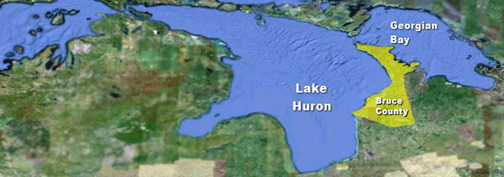
Bi -Partisan measure opposes Canadian plan to store nuclear waste long term near Lake Huron
Melissa Nann Burke, The Detroit News
Washington ― A bipartisan group of Great Lakes lawmakers introduced a resolution in Congress on Wednesday to oppose a Canadian proposal to permanently store spent nuclear fuel waste in the Great Lakes Basin.
The move comes ahead of President Joe Biden’s first trip to Canada as president this week to meet with Prime Minister Justin Trudeau.
The resolution is concerned with Canada’s Nuclear Waste Management Organization, which plans to decide next year on one of two potential sites for a nuclear waste facility, either Ignace, Ontario, or South Bruce, which is in the Great Lakes basin and less than 40 miles from Lake Huron.
The resolution says that Biden and Secretary of State Antony Blinken should ensure that the government of Canada does not permanently store nuclear waste in the Great Lakes Basin.
It goes on to warn that a “spill” of such waste into the lakes during transit to a deep geological repository “could have lasting and severely adverse environmental, health and economic impacts on the Great Lakes and the individuals who depend on the Great Lakes for their livelihoods.”
The measure is led by U.S. Reps. Dan Kildee, D-Flint Township, and John James, R-Farmington Hills, in the House and U.S. Sen. Debbie Stabenow, D-Lansing, in the Senate.
“Storing hazardous nuclear waste in our shared waterways threatens the drinking water of millions of people in the United States and Canada, and jeopardizes jobs in the fishing, boating and tourism industries,” Kildee said in a statement. “I urge President Biden to address Canada’s plan to permanently bury nuclear waste in the Great Lakes basin as he meets with Canadian Prime Minister Trudeau.”
The resolution has 15 other House co-sponsors including Michigan Reps. Jack Bergman of Watersmeet, John Moolenaar of Caledonia, Bill Huizenga of Holland, Lisa McClain of Bruce Township, Debbie Dingell of Ann Arbor, Elissa Slotkin of Lansing, Hillary Scholten of Grand Rapids, Haley Stevens of Birmingham and Shri Thanedar of Detroit as well as five Senate co-sponsors, including Sen. Gary Peters of Bloomfield Township………………………………………………………………………………. https://www.detroitnews.com/story/news/politics/michigan/2023/03/22/measure-opposes-canadian-plan-to-store-nuclear-waste-near-lake-huron/70036108007/
Fukushima nuclear water plan is a new blow to fishermen
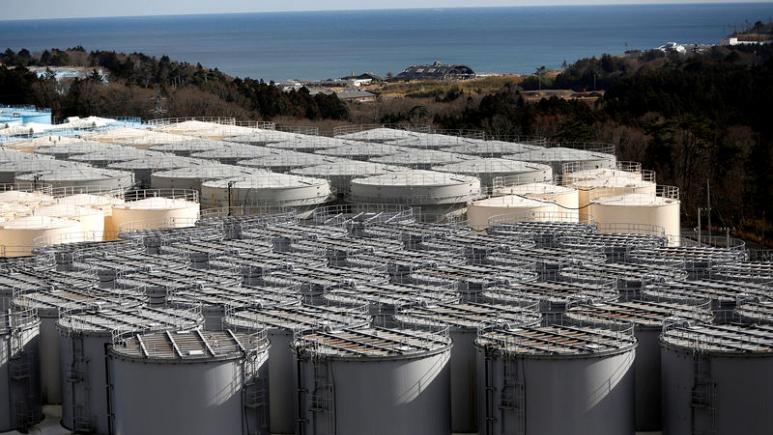
Locals believe livelihoods are at risk as authorities attempt to tackle
contamination 12 years on from the disaster. The authorities are about to
begin pumping contaminated water from the Fukushima nuclear power plant
into the Pacific Ocean.
More than a million tons of water will be released
into the sea over the next thirty years. The waste water will be treated
and diluted to remove most radioactive contaminants, but will still contain
traces of the isotopes, tritium and carbon-14.
The governments of China,
South Korea and Pacific island nations have protested against the decision.
But none are affected more directly than the fishermen of Fukushima. Twelve
years after the catastrophe, there is no clear timeline for the
decommissioning of Fukushima Daiichi, which is decades away from being
safely dismantled.
In the meantime, 130 tons of water is contaminated by it
every day. Some of this is poured directly onto the broken reactors to cool
them. Much is natural ground water which flows through the earth towards
the sea, picking up radiation from the exposed reactors on the way.
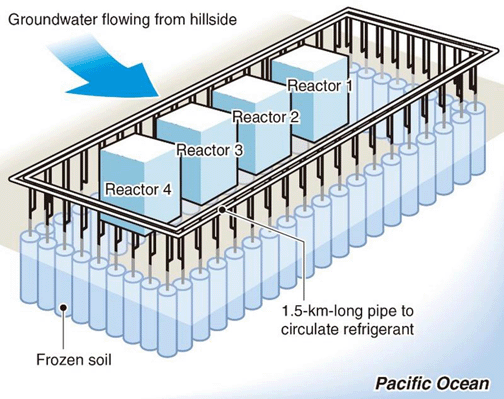
To prevent the groundwater reaching the plant in the first place, the
authorities built an underground “ice wall” of frozen earth, but this
has been only partly effective. Filtering is supposed to remove all the
radioactive elements except for tritium, which is routinely released into
the sea in diluted form from nuclear plants around the world
. But carbon-14
and trace elements of more dangerous radioactive substances, including
strontium-90 and iodine-129, have also been detected in the water. The
Japanese government says that tritium will be diluted to less than one-40th
of the concentration permitted under Japanese safety standards and
one-seventh of the World Health Organisation’s permitted level for safe
drinking water.
According to Tepco, the radiation in the tritium in the
water amounts to some 860 trillion becquerels — less than half the 1,620
trillion becquerels released from Britain’s Sellafield plant in 2015. The
theory is that the water will quickly and harmlessly dissipate into the
vastness of the Pacific Ocean.
But environmentalists and some scientists
disagree. The US National Association of Marine Laboratories claims that
the statistics, assumptions and models used in the Tepco projections are
flawed. It points to the danger of concentrated clusters of radiation
accumulating on the ocean floor.
Shaun Burnie, a nuclear expert at
Greenpeace, says that the water should be stored longer in tanks, allowing
time for the tritium to reduce, and that the decision to release into the
ocean is as much as about saving money as science. It also gives an
illusion of concrete progress.
Even if it is safe, it makes little
difference to the fishermen of Soma, for whom even just the perception of a
danger is enough to harm their business. Among them opinion is divided.
Some oppose the release under any circumstances; others, including Konno,
reluctantly accept it as the least worst option given that only complete
decommissioning, decades in the future, will solve the problem.
Times 10th March 2023
In Taiwan, strong opposition to extending life of nuclear reactor
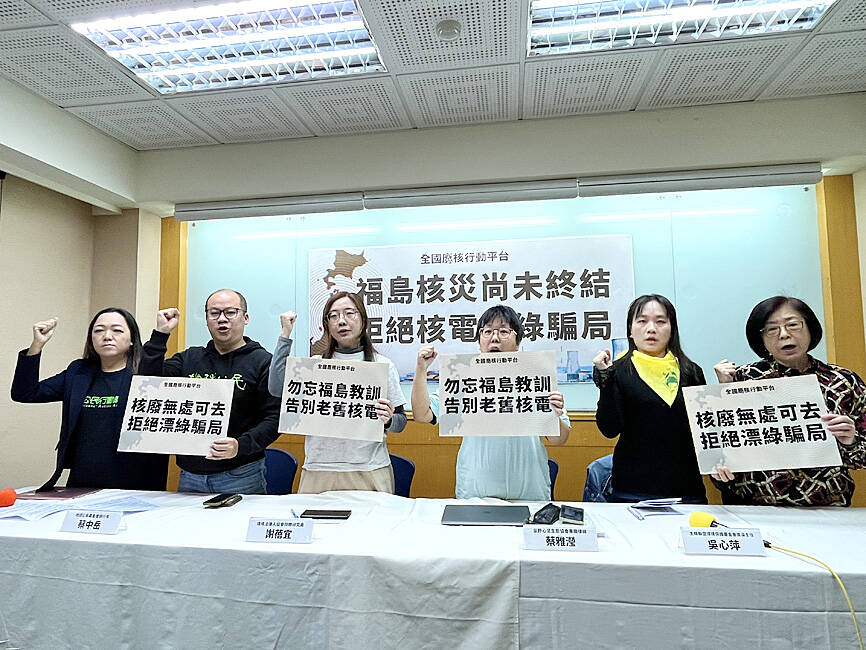
Proposed 20-year nuclear plant extension opposed
NO WASTE STORAGE: Renewable energy last year contributed more than the output of nuclear sources, but the nation risks moving backward, critics said
By Chen Chia-yi and Kayleigh Madjar / Staff reporter, with staff writer 10 Mar 23 https://www.taipeitimes.com/News/taiwan/archives/2023/03/10/2003795851
The National Nuclear Abolition Action Platform yesterday criticized calls by politicians to extend the service of the Guosheng Nuclear Power Plant’s No. 2 reactor, saying it disregards public sentiment and does not address problems with waste storage.
Some lawmakers have suggested a 20-year extension of the No. 2 reactor at the plant in New Taipei City’s Wanli District (萬里), which is set to reach the end of its lifespan on Tuesday, the groups told a news conference in Taipei.
More than 12 years after the Fukushima Dai-ichi nuclear power plant disaster in Japan, issues with contamination and wastewater have yet to be resolved, Green Citizens’ Action Alliance secretary-general Tsuei Su-hsin (崔愫欣) said.
The disaster occurred just as the plant turned 40 years old, said Tsai Ya-ying (蔡雅瀅), an attorney with the Wild at Heart Legal Defense Association.
Although the main cause was a tsunami triggered by an earthquake, an underlying weakness that exacerbated the disaster was the age of its facilities, Tsai said.
The second reactor at the Guosheng plant is about to turn 40 next week and should be decommissioned, she said.
Without locations identified to store nuclear waste, there is no basis for discussing continued use of the reactor, Environmental Jurists Association researcher Hsieh Pei-yi (謝蓓宜) said.
Politicians and corporate leaders — including Taipei City Councilor Wang Hung-wei (王鴻薇) and Broadcasting Corp of China chairman Jaw Shaw-kong (趙少康) — have been using “false, one-sided information” to call for its extension, Citizen of the Earth, Taiwan executive director Tsai Chung-yueh (蔡中岳) said.
They have not addressed the issue of waste storage sites at the plant being filled to capacity, he said, adding that they have evading the question whenever asked.
They are not only disregarding public concern about nuclear waste, but also ignoring legal provisions that require extension requests to be made at least five years before a nuclear plant’s decommission date, Tsai said.
Japan’s experience with restarting its nuclear plants was much different than perceived, the groups said.
In 2011, Japan had 54 nuclear generating units, 24 of which had been decommissioned, they said.
In the years since, seven have been restarted, and more planned restarts were canceled due to public opposition, the groups said.
Last year, renewables contributed close to that of nuclear in the nation’s power mix, at 8.3 percent, the groups said, adding that Taiwan should not to “move backward” on energy transition.
Renewable energy should be made a more viable long-term goal, Homemakers United Foundation director Wu Hsin-ping (吳心萍) said.
Solar and small-scale hydropower are being used in many communities, Wu said.
For example, one small 20-kilowatt solar installation in Taipei, despite frequent overcast weather in the capital, is able to produce a month of power in a year for about 70 households, she said.
Canadian environmental watchdog group ROEE does not support expansion of nuclear power
Le Regroupement des organismes environnementaux en énergie (ROEE) is a voluntary association of Quebec groups with a fine professional team:
ROEE is funded to intervene in hearings of the Régie de l’Énergie on matters related to energy and the environment and toeducate the public on such matters in a regular way. The ROEE was founded in 1997 following a public debate on energy policy in Quebec that led to the creation of the
Régie de l’Énergie
on matters related to energy and the environment and to educate the public on such matters in a regular way.
The ROEE was founded in 1997 following a public debate on energy policy in Quebec that led to the creation of the Régie.
The Canadian Coalition for Nuclear Responsibility, known in
Quebec as le Regroupement pour la surveillance du nucléaire,
is one of the founding members of the ROEE.
The ROEE is a champion of “soft energy paths” based on energy
efficiency and renewable energy sources, and has recently decided
to adopt a policy on nuclear power although Quebec phased out of
nuclear power in 2012 with the closure of the only operating nuclear
power reactor in Quebec called “Gentilly-2”. (Gentilly-1 was retired
many years beforehand).
Quebec also adopted a one-year moratorium
on uranium mining in 2014, leading to a year-long series of hearing in
Quebec conducted by the BAPE (Bueau des audiences publiques
sur l’environnement), who recommended in 2015 that the moratorium
on uranium exploration and mining be made permanent. So far this
has not been done but uranium exploration has been terminated in the
province of Quebec – hence we have an informal moratorium in effect.
Membres du ROEE (2023)
Association madelinienne pour la sécurité énergétique et environnementale
Canot Kayak Québec
Écohabitation
Fondation Coule pas chez nous
Fondation Rivières
Nature Québec
Draft Policy on nuclear power
(English original and French translation are copied below).
ROEE does not support the expansion of nuclear power based on the fissioning of uranium or plutonium as an energy source. The unsolved problems associated with nuclear fission technology are far more significant than any benefits it is supposed to offer, and there are now more affordable alternatives such as energy efficiency and renewable energy sources that are easier and faster to deploy than nuclear.
Background
•Nuclear fission inevitably creates a long-lived legacy of human-made radioactive wastes that will continue to challenge the health and safety of humans and the environment for hundreds of thousands of years. By far the most intensely radioactive wastes are contained in the used nuclear fuel. These wastes cannot be eliminated or neutralized but only contained, and safe containment over such long time periods cannot be assured.
•Materials such as stainless steel and concrete in the core area of a nuclear reactor also become long-lived radioactive wastes and therefore cannot be recycled. This debris cannot be decontaminated, it must be kept out of the environment for many generations after dismantling the reactors, which is delayed for decades to protect workers from excessive exposure. Canada has no strategy for dealing with these wastes over the very long term.
The risk of catastrophic nuclear accidents cannot be eliminated. Even if the risk is small, the consequences can be unacceptable, leading to radioactive contamination of large land areas and large volumes of water, as well as the permanent evacuation of large populations.
• The risk of proliferation of nuclear weapons using plutonium created in nuclear reactors, as India did in 1974, is not negligible. Such proliferation remains a significant danger for thousands of years after the last reactor is shut down.
• The proliferation risk becomes more acute when “advanced” nuclear reactors require the extraction of plutonium from used nuclear fuel to create more nuclear fuel – an operation called “reprocessing”. Reprocessing is now being considered by the Canadian government in coinnection with new reactors proposed for New Brunswick.
• ROEE supports the movement to ban reprocesssing – plutonium extraction – in Canada. Non-proliferation experts are agreed that ready access to plutonium should not be encouraged. In 1977, US President Carter banned reprocessing in the USA because of the proliferation risk.
• ROEE opposes uranium mining as well. The only significant uses of uranium are as an explosive for nuclear weapons and as a fuel for nuclear reactors. ROEE is opposed to both.
• Uranium mining also leaves a long-lived radioactive waste legacy. Canada currently has over 120 million tonnes of radioactive waste left over from uranium mining. These wastes will rmain danberous for hundreds of thousands of years.
• Uranium wastes, called “tailings”, contain some of the deadliest naturally occurring toxic materials known to science, such as radium, polonium, and radon gas. Mining brings these materials to the surface and makes them much more accessible to the environment.
ROEE Positions
ROEE disagrees wth the promotion of a new generation of nuclear reactors to deal with the climate emergency. Compared with energy efficiency and renewables such as solar and wind, nuclear power is at least 4 to 7 times more costly and much too slow to reduce greenhouse gas emissions in a timely fashion. In contrast to the proven performance and declining price of alternatives, new nuclear reactors are uncertain in performance and sometimes are completely unusable, while experience has shown a pattern of major price escalations and construction delays for nuclear projects.
ROEE applauds the decision to close down the Gentilly-2 reactor at Bécancour in 2012, thereby phasing out nuclear power in Québec. ROEE urges government to make this phase-out permanent by banning the construction of any new nuclear power reactors in the province.
A severe nuclear accident in either Ontario or New Brunswick can have serious airborne and water-borne consequences in Quebec as well as in those provinces. ROEE urges the government to encourage the phaseout of nuclear power in neighbouring provinces for safety reasons, while continuing to offer them sales of excess hydroelectric power from Quebec.
ROEE welcomes the 2015 recommendation of the BAPE for the government to declare a permanent moratorium on uranium mining in Quebec. ROEE urges the government to accept this recommendation fully by passing a law that bans uranium exploration and mining in the province, similar to the law passed by Nova Scotia on the same matter.
ROEE supports Quebec’s determination not to accept the import of long-lived radioactive waste from other jurisdictions for permanent storage in Quebec.
In addition, ROEE opposes current federal plans to construct a permanent radioactive storage facility on the surface at Chalk River, just one kilomete from the Ottawa River, close to the Quebec border. This landfill operation is intended to house one million cubic metres of radioactive wastes and other toxic materials such as asbestos and lead, some of it imported from as far away as Manitoba. As of 2022, over 130 municipalities, including the members of the Montreal Agglomeration Council, have opposed the planned Chalk River dump. ROEE supports their efforts to prevent it also urges the government of Quebec to do likewise.
Nuclear Free Local Authorities call on Secretary of State to end ‘wanton vandalism’ of environment at Sizewell

The UK/Ireland Nuclear Free Local Authorities have joined forces with local
campaigners in protesting against the destruction of the local environment
around the Sizewell C site now being carried out by developer, EDF.
The Chair of the NFLA Steering Committee, Councillor Lawrence O’Neill has
written to the Secretary of State for the Environment, Dr Therese Coffey,
asking her to intercede to stop the destruction.
The Sizewell C project has
yet to receive site approvals from the Office of Nuclear Regulation and the
Environment Agency or achieve financial close (the so-called Financial
Investment Decision) and the decision by government ministers to give the
go-ahead last year is being challenged in the High Court by Together
Against Sizewell C in late March.
Despite this, developer EDF has been busy
felling ancient trees and destroying wet woodland, in a Protected site of
Special Scientific Interest, despite previously promising to only carry out
preparatory works that were ‘reversible’ at this time. Councillor O’Neill
said: “It appears that EDF are playing fast and loose with the word
‘reversible’. It is way too early to be carrying out such drastic acts of
destruction against the natural environment, such as uprooting
irreplaceable ancient trees, when there are still many uncertainties about
whether Sizewell C will go ahead and when the plans are still subject to a
major legal challenge.
NFLA 28th Feb 2023
There has never in history been a greater need for a large Anti-War Movement

Caitlin Johnstone 27 Feb 23 Caitlin’s Newsletter,
Things are escalating more and more rapidly between the US-centralized power structure and the few remaining nations with the will and the means to stand against its demands for total obedience, namely China, Russia, and Iran. The world is becoming increasingly split between two groups of governments who are becoming increasingly hostile toward each other, and you don’t have to be a historian to know it’s probably a bad sign when that happens. Especially in the age of nuclear weapons.
The US State Department’s Victoria Nuland is now saying that the US is supporting Ukrainian strikes on Crimea, drawing sharp rebukes from Moscow with a stern reminder that the peninsula is a “red line” for the Kremlin which will result in escalations in the conflict if crossed. On Friday, Ukraine’s President Zelensky told the press that Kyiv is preparing a large offensive for the “de-occupation” of Crimea, which Moscow has considered a part of the Russian Federation since its annexation in 2014.
As Anatol Lieven explained for Jacobin earlier this month, this exact scenario is currently the one most likely to lead to a sequence of escalations ending in nuclear war. In light of the aforementioned recent revelations, the opening paragraph of Lieven’s article is even more chilling to read now than it was when it came out a couple of weeks ago:
The greatest threat of nuclear catastrophe that humanity has ever faced is now centered on the Crimean peninsula. In recent months, the Ukrainian government and army have repeatedly vowed to reconquer this territory, which Russia seized and annexed in 2014. The Russian establishment, and most ordinary Russians, for their part believe that holding Crimea is vital to Russian identity and Russia’s position as a great power. As a Russian liberal acquaintance (and no admirer of Putin) told me, “In the last resort, America would use nuclear weapons to save Hawaii and Pearl Harbor, and if we have to, we should use them to save Crimea.”
| And that’s just Russia. The war in Ukraine is being used to escalate against all powers not aligned with the US-centralized alliance, with recent developments including drone attacks on an Iranian weapons factory which reportedly arms Russian soldiers in Ukraine, and Chinese companies being sanctioned for “backfill activities in support of Russia’s defence sector” following US accusations that the Chinese government is preparing to arm Russia in the war. Israel’s Prime Minister Benjamin Netanyahu has reportedly been holding multiple meetings with top military officials regarding potential future attacks on Iran to neutralize the alleged threat of Iran developing a nuclear arsenal, a “threat” that Netanyahu has personally been lying about for years. If you’ve been reading Antiwar.com (and if you care about this stuff you probably should be), you’ve been seeing new articles about the latest imperial escalations against China on a near-daily basis now. Sometimes they come out multiple times per day; this past Thursday Dave DeCamp put out two completely separate news stories titled “US Plans to Expand Military Presence in Taiwan, a Move That Risks Provoking China” and “Philippines in Talks With US, Australia on Joint South China Sea Patrols“. Taiwan and the South China Sea are two powderkeg flashpoints where war could quickly erupt at any time in a number of different ways. If you know where to look for good updates on the behavior of the US-centralized empire and you follow them from day to day, it’s clear that things are accelerating toward a global conflict of unimaginable horror. As bad as things look right now, the future our current trajectory has us pointed toward is much, much, much worse. Empire apologists will frame this trajectory toward global disaster as an entirely one-sided affair, with bloody-fanged tyrants trying to take over the world because they are evil and hate freedom, and the US-centralized alliance either cast in the role of poor widdle victim or heroic defender of the weak and helpless depending on which generates more sympathy on that day. These people are lying. Any intellectually honest research into the west’s aggressions and provocations against both Russia and China will show you that Russia and China are reacting defensively to the empire’s campaign to secure US unipolar planetary hegemony; you might not agree with those reactions, but you cannot deny that they are reactions to a clear and deliberate aggressor. This is important to understand, because whenever you say that something must be done to try and avert an Atomic Age world war, you’ll get empire apologists saying “Well go protest in Moscow and Beijing then,” as though the US power alliance is some kind of passive witness to all this. Which is of course complete bullshit; if World War III does indeed befall us, it will be because of choices that were made by the drivers of the western empire while ignoring off-ramp after off-ramp. This tendency to flip reality and frame the western imperial power structure as the reactive force for peace against malevolent warmongers serves to help quash the emergence of a robust anti-war movement in the west, because if your own government is virtuous and innocent in a conflict then there’s no good reason to go protesting it. But that’s exactly what urgently needs to happen, because these people are driving us to our doom. In fact, it is fair to say that there has never in history been a time when the need to forcefully oppose the warmongering of our own western governments was more urgent. The attacks on Vietnam and Iraq were horrific atrocities which unleashed unfathomable suffering upon our world, but they did not pose any major existential threat to the world as a whole. The wars in Vietnam and Iraq killed millions; we’re talking about a conflict that can kill billions. Each of the World Wars was in turn the worst single thing that happened to our species as a whole up until that point in history. World War I was the worst thing that ever happened until World War II happened, and if World War III happens it will almost certainly make World War II look like a schoolyard tussle. This is because all of the major players in that conflict would be armed with nuclear weapons, and at some point some of them are going to be faced with strong incentives to use them. Once that happens, Mutually Assured Destruction ceases to protect us from armageddon, and the “Mutual” and “Destruction” components come in to play. None of this needs to happen. There is nothing written in adamantine which says the US must rule the world with an iron fist no matter the cost and no matter the risk. There is nothing inscribed upon the fabric of reality which says nations can’t simply coexist peacefully and collaborate toward the common good of all beings, can’t turn away from our primitive impulses of domination and control, can’t do anything but drift passively toward nuclear annihilation all because a few imperialists in Washington convinced everyone to buy into the doctrine of unipolarism. But we’re not going to turn away from this trajectory unless the masses start using the power of our numbers to force a change from warmongering, militarism and continual escalation toward diplomacy, de-escalation and detente. We need to start organizing against those who would steer our species into extinction, and working to pry their hands away from the steering wheel if they refuse to turn away. We need to resist all efforts to cast inertia on this most sacred of all priorities, and we need to start moving now. We’re all on a southbound bus to oblivion, and it’s showing no signs of stopping. Read Caitlin’s Newsletter in the app Listen to posts, join subscriber chats, and never miss an update from Caitlin Johnstone. © 2023 Caitlin Johnstone 548 Market Street PMB 72296, San Francisco, CA 94104 Unsubscribe |
Group calls for the stoppage of works at Sizewell C nuclear site, as Sizewell project is not yet authorised, and works are damaging the environment
EDF continues its programme of eco-vandalism. TASC calls on SoS for Defra
to intervene. Despite an EDF statement on 18th January, claiming that,
“[Its] Advance [preparatory] works [for Sizewell C] are reversible in the
unlikely event Sizewell C will not proceed to a Final Investment Decision
and full construction”, TASC is shocked and disgusted to discover that
EDF will renege on that promise when, on 1st March, EDF begins to destroy
wet woodland, a legally protected priority ‘Biodiversity Action Plan’
habitat, located in Sizewell Marshes Site of Special Scientific Interest.
Despite EDF knowing full well that we are now entering the bird, bat and
reptile breeding season, it has already begun felling woodland in Goose
Hill, as part of its plan to clear over 40 hectares – including the
felling of some ancient trees – to make way for Sizewell C’s car park.
TASC’s Chair, Jenny Kirtley said “These actions create permanent and
irreversible environmental loss to East Suffolk’s Heritage Coastal
biodiversity and is in direct contradiction of the government’s ‘green
agenda’. Despite EDF’s claim, it is not possible to reverse such losses
and represents further eco-vandalism which goes hand-in-glove with the
construction of a redundant and unnecessary nuclear plant which may never
commence construction.
Sizewell C has yet to make a Final Investment
Decision, does not have a site licence from the Office for Nuclear
Regulation, nor three outstanding environmental permits needed from the
Environment Agency. Furthermore, the project’s DCO approval is subject to
TASC’s judicial review proceedings scheduled to take place in the High
Court on 22nd and 23rd March.
We have asked the Secretary of State for
Defra and the MP for Suffolk Coastal to intervene and to stop the work at
least until these uncertainties around Sizewell C’s various
authorisations have been granted.’.
TASC 24th Feb 2023
Fury as Japan plans to dump a million tonnes of contaminated water in the Pacific
Japan has a serious problem it can no longer control – and the “solution” has horrified our nearest neighbours, who say a catastrophe is coming.
Alexis Carey@carey_alexis, news.com.au February 23, 2023
Outrage is growing over an “unjust” plan to dump more than a million tonnes of contaminated wastewater on Australia’s doorstep – within months.
In 2011, Japan was rocked by the Fukushima nuclear disaster – the worst of its kind since Chernobyl in 1986.
Responders scrambled to stop damaged reactors at Fukushima’s Daiichi nuclear plant from overheating by pumping massive amounts of water through them, with the contaminated water then being stored in massive tanks at the site.
But now, Japan has run out of space, and in 2021, announced plans to dump 1.3 million tonnes of the contaminated wastewater into the Pacific Ocean.
The water would be treated before being released over a period of several decades, with Prime Minister Yoshihide Suga saying at the time it was “a realistic solution”.
“We will do our utmost to keep the water far above safety standards,” he vowed.
In the almost two years since, Japan has been working out the finer details of the release, which is now due to begin as soon as the northern hemisphere’s spring or summer – Australia’s autumn or winter.
And countries across the Pacific are furious.
Kenichi Takahara, risk communicator of the Fukushima Daiichi decontamination and decommissioning engineering company, visits the Fukushima Daiichi nuclear power plant. Picture: Philip Fong/AFP
‘Catastrophic harm’
Writing for The Guardian soon after the plan was first announced, youth advocates from the region Joey Tau and Talei Luscia Mangioni described it as an “unjust act”.
“To Pacific peoples, who have carried the disproportionate human cost of nuclearism in our region, this is yet another act of catastrophic and irreversible trans-boundary harm that our region has not consented to,” they wrote.
They were referring to the long history of the Pacific being used as the world’s nuclear waste dumping ground, with hundreds of nuclear tests being carried out across the region in the decades since the Second World War.
High-profile individuals and groups from across the Pacific – including from Vanuatu, Fiji, the Marshall Islands and French Polynesia – have also spoken out against Japan’s plan for months on end.
“If it is safe, dump it in Tokyo, test it in Paris, and store it in Washington, but keep our Pacific nuclear-free,” Vanuatu stateswoman and veteran activist of the Nuclear Free and Independent Pacific (NFIP) movement Motarilavoa Hilda Lini said soon after Japan’s plan was unveiled.
“We are people of the ocean, we must stand up and protect it.”
In another moving statement released last year, environmental advocacy group Youngsolwara Pacific likened the release to “nuclear war”.
“How can the Japanese government, who has experienced the same brutal experiences of nuclear weapons in both Hiroshima and Nagasaki, wish to further pollute our Pacific with nuclear waste? To us, this irresponsible act of trans-boundary harm is just the same as waging nuclear war on us as Pacific peoples and our islands.”
But their pleas have fallen on deaf ears – and a string of experts have even voiced support for Japan’s controversial move.
………………………………….But for many critics of the plan, plenty of concerns remain.
“We must prevent actions that will lead or mislead us towards another major nuclear contamination disaster at the hands of others,” the former prime minister of the Cook Islands Henry Puna said just last month, as the deadline for the release looms. https://www.news.com.au/technology/environment/fury-as-japan-plans-to-dump-a-million-tonnes-of-contaminated-water-in-the-pacific/news-story/fbf0c9c3ab7a4414c7e41713a4b0c628
Scotland’s campaign groups call on government to reject plans for nuclear power at new Green Freeports.
NORTH campaigners have called on the Scottish Government to reject plans
to build nuclear plants at the country’s two new Green Freeports.
John O’Groat Journal 14th Feb 2023
THE convener of Scotland’s nuclear-free local authorities (NFLAs) has
written to Net Zero Minister Michael Matheson asking him to reject nuclear
power at Scotland’s two new green freeports.
The National 15th Feb 2023
No to US nukes in Britain: CND is returning to Lakenheath, 20 May 2023!
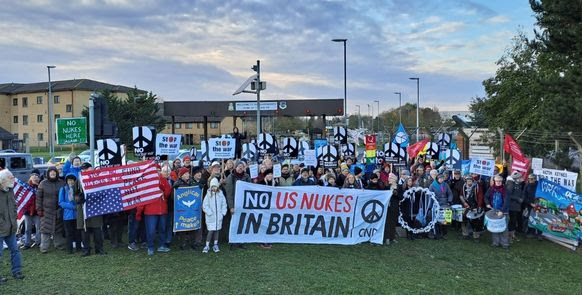
CND is returning to the US airbase at Lakenheath in Suffolk, to say no to the return of US nuclear bombs to Britain!
With reports last year that the nuclear weapons bunkers at the US-run Lakenheath airbase were undergoing multi-million pound upgrades, alarm bells rang: the US is planning to deploy upgraded B61-12 nuclear bombs to Britain. We must oppose this dangerous and destabilising development!
Hundreds of you joined us for two demonstrations at the base last year. On Saturday, 20 May, we will return with our biggest protest yet! More information to follow. Coaches are being arranged from around the country, please let us know if you are coordinating transport. For all queries, contact information@cnduk.org.
Highlands Against Nuclear Power (HANP)
A NORTH campaign group, which was set up ten years ago to oppose the
transport of nuclear material from Dounreay, plans to broaden its remit and
change its name. Highlands Against Nuclear Transport (HANT) is set to
become Highlands Against Nuclear Power (HANP) in a bid to extend its role
to include proposed new nuclear plants, nuclear weapons and the proposed
Geological Disposal Facility (GDR).
However, HANT chairman, Tor Justad,
stressed the new body would continue to campaign on nuclear transport
issues as well. He said: “Producing electricity with nuclear power is twice
as expensive as with renewables, poses unacceptable risks of accidents,
provides bi-products for nuclear weapons, produces carbon at all stages of
development and is the technology of the past with no solution to dealing
with the 100 tonnes of UK nuclear waste stored at Sellafield as the
proposed GDR is only at an early consultation stage.”
John O’Groat Journal 9th Feb 2023
Nuclear must not be part of Cromartry Firth freeport vision
YOUR VIEWS: ‘Nuclear should not be part of freeport vision’. A reader and
campaigner reacts to news that small nuclear reactors could be built in the
north. The Courier carried comments from Global director Steve Chisholm
that small modular nuclear reactors could be built in the Cromartry Firth
after the award of green freeport status for the area.
Nuclear should not be part of freeport vision I refer to the article headed “Nuclear Reactor
is in the freeport mix “(Inverness Courier, January 20) and was very
surprised that this proposal has now emerged. HANT (Highlands Against
Nuclear Transport) has raised concerns since 2013 about many safety
concerns related to the transport of nuclear waste by rail from Georgemas
Junction (near Dounreay) to Barrow and on to the Sellafield Nuclear plant.
There have been a number of incidents of concern related to both rail and
sea transport.
Inverness Courier 31st Jan 2023
Japan’s Plan To Discharge Water From Fukushima Nuclear Plant Faces Pacific Opposition
By BenarNews, By Stephen Wright
Officials from Pacific island nations will meet Japan’s prime minister in March in an effort to halt the planned release of water from the tsunami-damaged Fukushima Daiichi nuclear plant into the Pacific Ocean, a regional leader said.
Plans to dispose of Fukushima water over four decades are a source of tension between Japan and Pacific island nations and a possible complication for the efforts of the United States and its allies to show a renewed commitment to the Pacific region as China’s influence grows.
The planned discharges “are a very serious issue that our leaders have accepted must be stopped at all costs,” Henry Puna, secretary-general of the 18-nation Pacific Islands Forum, said Thursday at a press conference in the Solomon Islands capital Honiara.
The Japanese government’s timetable for disposal of Fukushima water indicates that releases could begin as soon as April this year – part of an effort to decommission the stricken power station over several decades. Water contaminated by the nuclear reactors damaged in a 2011 tsunami is stored in dozens of large tanks at the coastal Fukushima plant.
Japan’s method involves putting the contaminated water through a purification process known as the Advanced Liquid Processing System, which it says will reduce all radioactive elements except tritium to below regulatory levels. The treated water would then be diluted by more than 100 times to reduce the level of tritium – radioactive hydrogen used to create glow-in-the-dark lighting and signs……………………………
Data doubts
Five scientists working with the Pacific Islands Forum last week criticized the quality of data they had received from Tokyo Electric on the treated water in the tanks and expressed doubts about how well the purification process works.
Over more than four years, only a quarter of tanks had been tested for radiation, and testing rarely covered more than nine types of radiation out of 64 types that should be tested for, said the five scientists, who include Woods Hole Oceanographic Institution’s senior scientist Ken Buesseler.
“The accident is not over; this is not normal operations for a reactor. Therefore, extraordinary efforts should be made to prove operations are safe and will not cause harm to the environment,” the scientists’ presentation said.
The Pacific Islands Forum has described the scientists as independent nuclear experts. The forum’s secretariat didn’t respond to a question about whether the scientists are compensated for their work with the forum.
Nigel Marks, a materials scientist at Australia’s Curtin University and former nuclear reactor engineer, who is not advising the forum, said he is sympathetic to concerns that Tokyo Electric’s data could be more complete.
“But at the same time some recognition for Japan’s unique situation must be acknowledged,” he said. “The authorities have done their very best that technology allows. Eventually they reach a point where there is too much water to store.”
Puna said the Pacific islands delegation would meet with Japanese Prime Minister Fumio Kishida around March 7. They want a delay in water releases, at the very least, while more research is carried out, he said.
“There are serious gaps in the scientific evidence on the safety or otherwise of the proposed release,” Puna said. “I am pleased that the Japanese prime minister has finally agreed to meet with a high-level delegation from our region.”
Decades of Fukushima water discharges, Puna said, could “damage our livelihoods, our fisheries livelihoods, our livelihood as people who are dependent very much and connected to the ocean in our culture and identity.”
Mihai Sora, a Pacific analyst at Australia’s Lowy Institute, said it’s hard to imagine a more alarming proposition for Pacific island nations given the “toxic legacy” of nuclear weapons testing and waste dumping in the Pacific.
The timing, amidst regional geopolitical competition that has traditional powers falling over themselves to demonstrate who’s a better partner to the Pacific, could scarcely be worse,” Sora said.
The United States, United Kingdom and France carried out more than 300 nuclear detonations in the Pacific from 1946 to 1966, according to the International Disarmament Institute at Pace University in New York, which exposed thousands of military personnel and civilians to radiation and made some atolls uninhabitable.
“Decades of hard-won regional goodwill towards Japanese Pacific engagement are at risk with this single policy initiative,” Sora said……………….
Japan’s embassy in Suva, Fiji didn’t respond to a request for comment. https://www.eurasiareview.com/28012023-japans-plan-to-discharge-water-from-fukushima-nuclear-plant-faces-pacific-opposition/
1 This Month
6 June – WEBINAR- Get Inspired by Protests Against Military Bases!


Cuba Is Not a Failed State – It Is a Besieged State
PETITION: “Global Appeal to Endorse Palestinian Right of Return of Refugees”


of the week– Nuclear Reactor Information Task Force
To see nuclear-related stories in greater depth and intensity – go to https://nuclearinformation.wordpress.com
-
Archives
- June 2026 (27)
- May 2026 (306)
- April 2026 (356)
- March 2026 (251)
- February 2026 (268)
- January 2026 (308)
- December 2025 (358)
- November 2025 (359)
- October 2025 (376)
- September 2025 (257)
- August 2025 (319)
- July 2025 (230)
-
Categories
- 1
- 1 NUCLEAR ISSUES
- business and costs
- climate change
- culture and arts
- ENERGY
- environment
- health
- history
- indigenous issues
- Legal
- marketing of nuclear
- media
- opposition to nuclear
- PERSONAL STORIES
- politics
- politics international
- Religion and ethics
- safety
- secrets,lies and civil liberties
- spinbuster
- technology
- Uranium
- wastes
- weapons and war
- Women
- 2 WORLD
- ACTION
- AFRICA
- Atrocities
- AUSTRALIA
- Christina's notes
- Christina's themes
- culture and arts
- Events
- Fuk 2022
- Fuk 2023
- Fukushima 2017
- Fukushima 2018
- fukushima 2019
- Fukushima 2020
- Fukushima 2021
- general
- global warming
- Humour (God we need it)
- Nuclear
- RARE EARTHS
- Reference
- resources – print
- Resources -audiovicual
- Weekly Newsletter
- World
- World Nuclear
- YouTube
-
RSS
Entries RSS
Comments RSS
 nuclear-news