Fury as Japan plans to dump a million tonnes of contaminated water in the Pacific
Japan has a serious problem it can no longer control – and the “solution” has horrified our nearest neighbours, who say a catastrophe is coming.
Alexis Carey@carey_alexis, news.com.au February 23, 2023
Outrage is growing over an “unjust” plan to dump more than a million tonnes of contaminated wastewater on Australia’s doorstep – within months.
In 2011, Japan was rocked by the Fukushima nuclear disaster – the worst of its kind since Chernobyl in 1986.
Responders scrambled to stop damaged reactors at Fukushima’s Daiichi nuclear plant from overheating by pumping massive amounts of water through them, with the contaminated water then being stored in massive tanks at the site.
But now, Japan has run out of space, and in 2021, announced plans to dump 1.3 million tonnes of the contaminated wastewater into the Pacific Ocean.
The water would be treated before being released over a period of several decades, with Prime Minister Yoshihide Suga saying at the time it was “a realistic solution”.
“We will do our utmost to keep the water far above safety standards,” he vowed.
In the almost two years since, Japan has been working out the finer details of the release, which is now due to begin as soon as the northern hemisphere’s spring or summer – Australia’s autumn or winter.
And countries across the Pacific are furious.
Kenichi Takahara, risk communicator of the Fukushima Daiichi decontamination and decommissioning engineering company, visits the Fukushima Daiichi nuclear power plant. Picture: Philip Fong/AFP
‘Catastrophic harm’
Writing for The Guardian soon after the plan was first announced, youth advocates from the region Joey Tau and Talei Luscia Mangioni described it as an “unjust act”.
“To Pacific peoples, who have carried the disproportionate human cost of nuclearism in our region, this is yet another act of catastrophic and irreversible trans-boundary harm that our region has not consented to,” they wrote.
They were referring to the long history of the Pacific being used as the world’s nuclear waste dumping ground, with hundreds of nuclear tests being carried out across the region in the decades since the Second World War.
High-profile individuals and groups from across the Pacific – including from Vanuatu, Fiji, the Marshall Islands and French Polynesia – have also spoken out against Japan’s plan for months on end.
“If it is safe, dump it in Tokyo, test it in Paris, and store it in Washington, but keep our Pacific nuclear-free,” Vanuatu stateswoman and veteran activist of the Nuclear Free and Independent Pacific (NFIP) movement Motarilavoa Hilda Lini said soon after Japan’s plan was unveiled.
“We are people of the ocean, we must stand up and protect it.”
In another moving statement released last year, environmental advocacy group Youngsolwara Pacific likened the release to “nuclear war”.
“How can the Japanese government, who has experienced the same brutal experiences of nuclear weapons in both Hiroshima and Nagasaki, wish to further pollute our Pacific with nuclear waste? To us, this irresponsible act of trans-boundary harm is just the same as waging nuclear war on us as Pacific peoples and our islands.”
But their pleas have fallen on deaf ears – and a string of experts have even voiced support for Japan’s controversial move.
………………………………….But for many critics of the plan, plenty of concerns remain.
“We must prevent actions that will lead or mislead us towards another major nuclear contamination disaster at the hands of others,” the former prime minister of the Cook Islands Henry Puna said just last month, as the deadline for the release looms. https://www.news.com.au/technology/environment/fury-as-japan-plans-to-dump-a-million-tonnes-of-contaminated-water-in-the-pacific/news-story/fbf0c9c3ab7a4414c7e41713a4b0c628
Scotland’s campaign groups call on government to reject plans for nuclear power at new Green Freeports.
NORTH campaigners have called on the Scottish Government to reject plans
to build nuclear plants at the country’s two new Green Freeports.
John O’Groat Journal 14th Feb 2023
THE convener of Scotland’s nuclear-free local authorities (NFLAs) has
written to Net Zero Minister Michael Matheson asking him to reject nuclear
power at Scotland’s two new green freeports.
The National 15th Feb 2023
No to US nukes in Britain: CND is returning to Lakenheath, 20 May 2023!
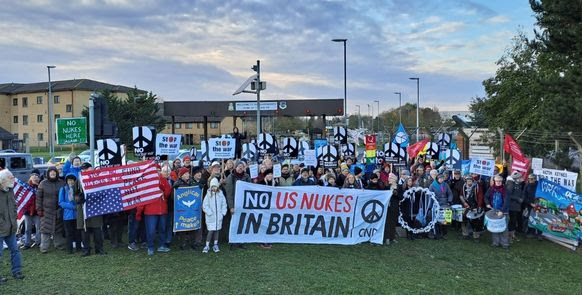
CND is returning to the US airbase at Lakenheath in Suffolk, to say no to the return of US nuclear bombs to Britain!
With reports last year that the nuclear weapons bunkers at the US-run Lakenheath airbase were undergoing multi-million pound upgrades, alarm bells rang: the US is planning to deploy upgraded B61-12 nuclear bombs to Britain. We must oppose this dangerous and destabilising development!
Hundreds of you joined us for two demonstrations at the base last year. On Saturday, 20 May, we will return with our biggest protest yet! More information to follow. Coaches are being arranged from around the country, please let us know if you are coordinating transport. For all queries, contact information@cnduk.org.
Highlands Against Nuclear Power (HANP)
A NORTH campaign group, which was set up ten years ago to oppose the
transport of nuclear material from Dounreay, plans to broaden its remit and
change its name. Highlands Against Nuclear Transport (HANT) is set to
become Highlands Against Nuclear Power (HANP) in a bid to extend its role
to include proposed new nuclear plants, nuclear weapons and the proposed
Geological Disposal Facility (GDR).
However, HANT chairman, Tor Justad,
stressed the new body would continue to campaign on nuclear transport
issues as well. He said: “Producing electricity with nuclear power is twice
as expensive as with renewables, poses unacceptable risks of accidents,
provides bi-products for nuclear weapons, produces carbon at all stages of
development and is the technology of the past with no solution to dealing
with the 100 tonnes of UK nuclear waste stored at Sellafield as the
proposed GDR is only at an early consultation stage.”
John O’Groat Journal 9th Feb 2023
Nuclear must not be part of Cromartry Firth freeport vision
YOUR VIEWS: ‘Nuclear should not be part of freeport vision’. A reader and
campaigner reacts to news that small nuclear reactors could be built in the
north. The Courier carried comments from Global director Steve Chisholm
that small modular nuclear reactors could be built in the Cromartry Firth
after the award of green freeport status for the area.
Nuclear should not be part of freeport vision I refer to the article headed “Nuclear Reactor
is in the freeport mix “(Inverness Courier, January 20) and was very
surprised that this proposal has now emerged. HANT (Highlands Against
Nuclear Transport) has raised concerns since 2013 about many safety
concerns related to the transport of nuclear waste by rail from Georgemas
Junction (near Dounreay) to Barrow and on to the Sellafield Nuclear plant.
There have been a number of incidents of concern related to both rail and
sea transport.
Inverness Courier 31st Jan 2023
Japan’s Plan To Discharge Water From Fukushima Nuclear Plant Faces Pacific Opposition
By BenarNews, By Stephen Wright
Officials from Pacific island nations will meet Japan’s prime minister in March in an effort to halt the planned release of water from the tsunami-damaged Fukushima Daiichi nuclear plant into the Pacific Ocean, a regional leader said.
Plans to dispose of Fukushima water over four decades are a source of tension between Japan and Pacific island nations and a possible complication for the efforts of the United States and its allies to show a renewed commitment to the Pacific region as China’s influence grows.
The planned discharges “are a very serious issue that our leaders have accepted must be stopped at all costs,” Henry Puna, secretary-general of the 18-nation Pacific Islands Forum, said Thursday at a press conference in the Solomon Islands capital Honiara.
The Japanese government’s timetable for disposal of Fukushima water indicates that releases could begin as soon as April this year – part of an effort to decommission the stricken power station over several decades. Water contaminated by the nuclear reactors damaged in a 2011 tsunami is stored in dozens of large tanks at the coastal Fukushima plant.
Japan’s method involves putting the contaminated water through a purification process known as the Advanced Liquid Processing System, which it says will reduce all radioactive elements except tritium to below regulatory levels. The treated water would then be diluted by more than 100 times to reduce the level of tritium – radioactive hydrogen used to create glow-in-the-dark lighting and signs……………………………
Data doubts
Five scientists working with the Pacific Islands Forum last week criticized the quality of data they had received from Tokyo Electric on the treated water in the tanks and expressed doubts about how well the purification process works.
Over more than four years, only a quarter of tanks had been tested for radiation, and testing rarely covered more than nine types of radiation out of 64 types that should be tested for, said the five scientists, who include Woods Hole Oceanographic Institution’s senior scientist Ken Buesseler.
“The accident is not over; this is not normal operations for a reactor. Therefore, extraordinary efforts should be made to prove operations are safe and will not cause harm to the environment,” the scientists’ presentation said.
The Pacific Islands Forum has described the scientists as independent nuclear experts. The forum’s secretariat didn’t respond to a question about whether the scientists are compensated for their work with the forum.
Nigel Marks, a materials scientist at Australia’s Curtin University and former nuclear reactor engineer, who is not advising the forum, said he is sympathetic to concerns that Tokyo Electric’s data could be more complete.
“But at the same time some recognition for Japan’s unique situation must be acknowledged,” he said. “The authorities have done their very best that technology allows. Eventually they reach a point where there is too much water to store.”
Puna said the Pacific islands delegation would meet with Japanese Prime Minister Fumio Kishida around March 7. They want a delay in water releases, at the very least, while more research is carried out, he said.
“There are serious gaps in the scientific evidence on the safety or otherwise of the proposed release,” Puna said. “I am pleased that the Japanese prime minister has finally agreed to meet with a high-level delegation from our region.”
Decades of Fukushima water discharges, Puna said, could “damage our livelihoods, our fisheries livelihoods, our livelihood as people who are dependent very much and connected to the ocean in our culture and identity.”
Mihai Sora, a Pacific analyst at Australia’s Lowy Institute, said it’s hard to imagine a more alarming proposition for Pacific island nations given the “toxic legacy” of nuclear weapons testing and waste dumping in the Pacific.
The timing, amidst regional geopolitical competition that has traditional powers falling over themselves to demonstrate who’s a better partner to the Pacific, could scarcely be worse,” Sora said.
The United States, United Kingdom and France carried out more than 300 nuclear detonations in the Pacific from 1946 to 1966, according to the International Disarmament Institute at Pace University in New York, which exposed thousands of military personnel and civilians to radiation and made some atolls uninhabitable.
“Decades of hard-won regional goodwill towards Japanese Pacific engagement are at risk with this single policy initiative,” Sora said……………….
Japan’s embassy in Suva, Fiji didn’t respond to a request for comment. https://www.eurasiareview.com/28012023-japans-plan-to-discharge-water-from-fukushima-nuclear-plant-faces-pacific-opposition/
Nuclear waste project in New Mexico opposed in recent poll, company asserts local support
Adrian Hedden, Carlsbad Current-Argus, 14 Jan 23,
New Mexicans in every region of the state allegedly opposed storing high-level nuclear waste in their state, according to a recent poll, as a New Jersey company hoped to build a facility to do so near Carlsbad.
The poll, commissioned by Albuquerque-based Southwest Research and Information Center in a partnership with the Center for Civic Policy surveyed 1,015 voters across the state from Dec. 7 to 14.
It found 60 percent of those surveyed were in opposition to the project, with 30 percent supporting and 10 percent undecided.
Holtec International applied in 2017 for a license from the federal Nuclear Regulatory Commission (NRC) to build and operate what it called a consolidated interim storage facility (CISF) in a remote area near the border of Eddy and Lea counties.
Last year, the NRC published its final environmental impact statement (EIS), contending the project would have little impact on the environment, and recommending the license be issued.
The CISF would temporarily store up to 100,000 metric tons of spent nuclear fuel rods, expected to be brought into the site via rail from nuclear power plants around the country through a 40-year license with the NRC.
The 1,000-acre plot of land where the facility would be built was owned by the Eddy-Lea Energy Alliance, a consortium of local leaders from the cities of Carlsbad and Hobbs, and Eddy and Lea counties.
The Alliance recruited Holtec and set up a revenue-sharing agreement with the company once the CISF goes into operations.
Despite the poll, Holtec officials argued the project was largely supported by New Mexico, after spokesman Gerges Scott said representatives traveled to local governments throughout the state.
Ed Mayer, Holtec project manager of the CISF said the company had adequate support for the project, after he and other representatives met with local leaders and first responders both around the site and along the rail lines.
“We are educating the affected populations, not only from the facility perspective in southeast New Mexico, but from a state perspective on the rail lines,” Mayer said. …………………………….
But opponents, including Southwest Research – a frequent critic of Holtec and the nearby Waste Isolation Pilot Plant repository for transuranic (TRU) nuclear waste – maintained the project would bring an undue risk to New Mexicans nearby and Americans along the waste transportation routes.
That’s why opposition was spread across political parties, gender and ethnicity, said Nuclear Waste Program Manager Don Hancock at Southwest Research and Information Center.
The poll showed more than half of those surveyed in the region were against the project, with opposition also coming irrespective of political affiliation. About 70 percent of Democrats polled opposed Holtec, along with 51 percent of Republicans and 55 percent of Independents.
When broken down by gender, more men supported the project than women, according to the poll.
A majority of Republican men polled were in favor at 51 percent, while 61 percent of Republican women were against the project, read the poll
White men were mostly for the project overall at 49 percent of voters polled in favor, while 71 percent of white women were against.
Hispanic men and women both mostly opposed the project at 51 and 78 percent against, respectively read the poll.
Central, northeast and southwest New Mexico showed opposition of 60 percent or more, while more conservative regions in the southeast and northwest showed 57 and 56 percent against, respectively, the poll showed.
Critics argue storing nuclear waste puts undue risk on New Mexico
Hancock said the poll showed temporary nuclear waste storage was not supported by New Mexico voters, arguing it was opposed through decades of proposals like Holtec’s.
“I’m not surprised by the results because for more than 45 years New Mexicans have strongly opposed high-level waste in New Mexico, whether the waste is proposed for the Waste Isolation Pilot Plant in the 1970s and ‘80s, for Mescalero Apache land in the 1990s, or by Holtec,” he said.
Opposition to the project also came from some of New Mexico’s highest-ranking state officials, and its Congressional delegation, with New Mexico Gov. Michelle Lujan Grisham calling the proposal “economic malpractice” for its potential, she said, of imperiling nearby oil and gas and agriculture industries.
U.S. Sen. Martin Heinrich (D-NM) co-sponsored a bill introduced in the U.S. Senate last year to block any federal funds from supporting such a project.
At the state level, New Mexico Sen. Jeff Steinborn (D-36) was a lead opponent of Holtec’s in the Legislature.
While Texas lawmakers recently passed a bill to ban high-level waste storage in their state, Steinborn said New Mexico policymakers should consider a similar measure to prevent the project coming to fruition.
“From the very beginning this has been a dangerous plan pushed on New Mexico, with real risks for all of our communities, and no end in sight,” Steinborn said. “It’s time for this project to be canceled and be replaced by the federal government committing to a true consent based siting process for the permanent storage of this waste.” https://www.currentargus.com/story/news/2023/01/14/nuclear-waste-project-new-mexico-opposed-recent-statewide-poll-holtec-international-energy/69802597007/
Significant environmental victory for Savannah River Site Watch in stopping import of high level nuclear waste from Germany
A decade-long effort to export a large volume of highly radioactive nuclear
waste from Germany to the U.S. Department of Energy’s Savannah River Site
(SRS) in South Carolina has been terminated, resulting in a significant
environmental victory.
The German company managing the waste at the Juelich
research site informed the public-interest group Savannah River Site Watch
(SRS Watch) that “the option to ship the aforementioned spent fuel has
indeed been terminated…” These definitive words bring an end to a
decade-long effort by DOE to import an unusual form of highly radioactive
spent fuel to SRS.
Savanah River Site Watch 10th Jan 2023
Does anyone know why I get this message? When I try to find out about Savanah River Site Watch, and especially when I try to find out about “a significant
environmental victory” . – Savanah River Site Watch 10th Jan 2023
https://srswatch.org/3832-2/
Scottish campaign groups hit back over claims nuclear power is cheaper and more reliable.
Anti-nuclear campaigners say that Caithness could drive the
“green energy” revolution thanks to the skills in the region – largely
due to the decommissioning of the Dounreay plant.
Wick and East Caithness councillor Andrew Jarvie said last month that it was time for the SNP-led
government to ditch its opposition to new nuclear after a breakthrough in
fusion experiments. He claimed the region was missing out on skilled jobs
and future opportunities “because of the SNP and Greens’ illogical
opposition to one of the most reliable and cheap sources of energy”.
Highlands Against Nuclear Transport (HANT) and the Scottish Nuclear Free
Local Authorities (NFLA) hit back, saying Cllr Jarvie was “completely
mistaken” in his assertion that nuclear is the “most reliable and cheapest”
source of energy.
John O’Groat Journal 11th Jan 2023
Civil society groups urge feds to ban reprocessing used nuclear fuel.

Natasha Bulowski / Local Journalism Initiative / Canada’s National Observer, 30 Dec 22,
Canada’s forthcoming radioactive waste policy should include a ban on plutonium reprocessing, a national alliance of civil society organizations says.
Plutonium — a radioactive, silvery metal used in nuclear weapons and power plants — can be separated from spent nuclear reactor fuel through a process known as “reprocessing” and reused to produce weapons or generate energy.
The federal government is expected to release its policy for managing radioactive waste early next year. On Dec. 15, a handful of organizations urged Ottawa to include a ban on plutonium reprocessing because of its links to nuclear weapons proliferation and environmental contamination.
The World Nuclear Association says reprocessing used fuel to recover uranium and plutonium “avoids the wastage of a valuable resource.”
Ottawa has yet to take a definitive stance on the process. A draft policy released last February said: “Deployment of reprocessing technology … is subject to policy approval by the Government of Canada.”
But in 2021, a New Brunswick company, Moltex Energy, received $50.5 million from the federal coffers to help design and commercialize a molten salt reactor and spent fuel reprocessing facility. Commercial plutonium reprocessing has never been carried out in Canada, and we should not start now, according to Nuclear Waste Watch, a national network of Canadian organizations concerned about high-level radioactive waste and nuclear power. The group is among those pushing for a plutonium reprocessing ban.
More than 7,000 Canadians submitted letters including a demand to ban plutonium reprocessing throughout the consultation process, according to a Nuclear Waste Watch news release.
The group points to a 2016 report by Canadian Nuclear Laboratories stating reprocessing would “increase proliferation risk.”
“There is no legitimate reason to support technologies that create the potential for new countries to separate plutonium and develop nuclear weapons,” Susan O’Donnell, spokesperson for the Coalition for Responsible Energy Development in New Brunswick, said in Nuclear Waste Watch’s news release. “The government should stop supporting this dangerous technology.”
China, India, Japan, Russia, the United Kingdom and some European countries, like France, reprocess their spent nuclear fuel.
Canada’s forthcoming radioactive waste policy should include a ban on plutonium reprocessing, a national alliance of civil society organizations says. Plutonium separated from used nuclear fuel can be reused in power generation or nuclear weapons
In protecting the biosphere from plutonium and other wastes, the first step is to stop producing them

paulrodenlearning 27 Dec 22, We have all of the wastes from the nuclear weapons and nuclear power program. We don’t know what to do with it and it and they must be kept out of the biosphere forever. So, the first step is to stop making more wastes. Shut down the nuclear weapons and nuclear power industry.
The second step is to store the waste in a secure, stable facility that can withstand earthquakes, accidents, terrorist, and or nuclear/conventional attack for billions of years. As the former Congressman John Hall and former rock star wrote in his 1980 solo album, “Power” in his song, “Plutonium is Forever.”
Has everybody forgotten about Fukushima, Chernobyl and Three Mile Island? Nuclear power is too dangerous, too expensive and totally unnecessary for our energy needs. Just go to the Websites of The Solutions Project and the Rocky Mountain Institute.
We have the resources and the technology to transition to renewable energy now. All we lack is the political will to do so, because the elected leaders in Washington, DC and in our State Houses have all been bought off by the nuclear and fossil fuel industries by their unlimited and unregulated campaign PAC donations, which remain anonymous. They have the best Congress and State Legislatures that money can buy. “Money talks, B.S. walks and we are all running a “very distant” third.”
Mothering a Movement: Notes from India’s Longest Anti-Nuclear Struggle

It was striking how these women activists situated their politics in motherhood and in their responsibility as the guardians for future generations. Prayers to Lourde Matha at the main church, floral tributes to Kadalamma, and protests against the nuclear plant all lie on a continuum as acts of reverence for life. While this politics around maternity might not sit well with a certain progressive outlook, these women are clear about their feminist goals.
A time will come. We will take over the village and remove the nuclear power plant.
Radiowaves Collective, Half-Life, December 2022
‘……………………………………………………………………… Both Idinthikarai and Kudankulam, the other settlement that abuts the northern boundary of the nuclear plant, lie off the beaten path for the tourists that come to Kanyakumari—a narrow strip of “Land’s End” with an old temple, newer memorials to regional and national personages, and the Indian Ocean—located a little over twenty-five kilometers away. Yet in 2011 and 2012, Kudankulam and its nearby villages had commanded significant media attention. Putting aside their caste and religious differences, the locals around Kudankulam had put up a remarkable non-violent resistance against the nuclear establishment. We want to find out what has happened to that movement a decade later.
Next morning, en route to Kudankulam, our bus lurches past the bustling town of Anjugramam and other smaller settlements, surrounded by farmlands and coconut and palmyra trees. But it is the giant windmills, mushrooming all over, that dominate the landscape and serve as a reminder that India is a country hungry for energy. All of this area, Anjugramam onwards, falls under what is called the emergency planning zone: a sixteen-kilometer radius around the nuclear plant that would need evacuation in case of a disaster. Our fellow passengers include some non-locals, who form the bulk of the workforce at the plant. When we do not get off at either the Anuvijay— “Victory of the Atom”— town, a gated community for staff and their families, or the plant some seven kilometers away, the few remaining people on the bus start eyeing us.
Once at the busy main market in Kudankulam, our local guide and a few other men quickly whisk us away to a house where we are scheduled to interview women activists who were involved in the 2012 protests. However, before we can start a conversation with them, a man in a striped blue shirt asks us to write down our names and contact details. “CID [Criminal Investigation Department],” he replies softly when we ask why. “He is a policeman. He is just doing his job,” another man chimes in, matter of factly. The sprawling nuclear plant across the road reaches far into the lives of the people here. Police surveillance is part and parcel of the architecture of the nuclear establishment.
The KKNPP is India’s largest nuclear power plant, housing two Russian VVER-1000 reactors—similar to the ones under siege now in Zaporizhzhya, Ukraine—and has four others in the pipeline. As far as one can tell, it has little to do with nuclear weapons, but the Department of Atomic Energy (DAE)—the agency which oversees all things nuclear in India—makes it easy to indulge in wild speculations. Right from its inception in 1954, the DAE has been notoriously opaque, with little independent or public scrutiny, and prone to misinformation and grandiose statements.
While the US launched its “Atoms for Peace” program in 1953, the motto of the DAE has always been “Atoms in the service of the nation.” But the nebulous nature of these slogans is often put on display. For instance, in 1974, the DAE tested nuclear weapons in the guise of a peaceful nuclear program, calling them “peaceful nuclear explosives” for the development of the nation.1 Things have been equally farcical in the case of the civilian nuclear energy program, where, in the name of national security, the DAE has refused to share details about basic public matters such as energy costs and nuclear safety. And even though the DAE is currently (and consistently) decades behind in meeting its own projections for power generation, it still proclaims a fifty-fold increase in nuclear power by 2050.2 The message is loud and clear: the future is nuclear, and only fools worry about the past—or the present.
“If we say anything against [the plant], they will file a case against us,” says a young woman who teaches science at a nearby school. “We don’t have permission to talk about this issue with the students. We can only teach things that are mentioned in the books,” she continued. While adding that the KKNPP supports some schools in its vicinity, like many others in Kudankulam, she is more concerned about the dismal state of affairs. “We do not have any facilities, we have long power cuts, we receive drinking water only once every ten days, and there are all sorts of diseases. Now, it is not possible to remove the plant, but at least our people should get better jobs. Outsiders have all the permanent positions there.” She is sympathetic to the DAE’s rhetoric of nation-building, but dismayed with the lopsidedness of it all. Why should people who live in metropolitan India receive the benefits of nuclear energy while people from Kudankulam take on the risks?
“People protested a lot, and nothing happened. Many who protested can’t get jobs there. It was a waste,” the teacher concluded. “People have accepted that they must live with the diseases. They have made up their mind to live happily until they die. They have started building bigger houses. And since people have come from other places, the land rates have increased, like in the big cities.” Indeed, right outside the nuclear plant, locals have opened new shops selling food, cellphones, and other sundry items. The area has become a real estate hotspot………………..
The region has seen sporadic protests ever since India and the erstwhile Soviet Union had signed an agreement to build these reactors in 1988, as part of post-Chernobyl nuclear diplomacy.3 With the fall of Soviet Union, the project went nowhere for a decade. In the wake of its Pokhran-II nuclear weapons tests in May 1998 and the sanctions that followed, however, India sought Russia’s help. Construction work at the Kudankulam plant finally began in 2000. However, it was the 2011 Fukushima accident in the aftermath of a tsunami that hit close to home…….
A few days after the Fukushima accident, a senior DAE official announced that “there [was] no nuclear accident or incident [in Fukushima],” instead claiming that “it was purely a chemical reaction and not a nuclear emergency.”4 Such technocratic stonewalling, typical of the DAE, did little to allay the anxieties of people living around the plant. Following a test run at the nuclear plant in July 2011, which involved generating high pressure steam to check safety mechanisms, residents started protesting non-violently. The DAE sought to further counter the heightened fear of locals with high-handedness and by flexing its scientific, economic, and legal authority.
Former Indian president A. P. J. Abdul Kalam—uniquely positioned as both a leading defense scientist and a member of the coastal fishing community in Tamil Nadu—visited KKNPP in November 2011. He declared the nuclear plant to be safe and recommended introducing four-lane highways, hospitals, jobs, and bank subsidies to the area. However, the former President refused to meet those in the village with anti-nuclear sentiments, declaring instead that “history is not made by cowards. Sheer crowd cannot bring about changes. Only those who think everything is possible can create history and bring about changes.”
Months later, tired of intransigent protestors, the state enlisted the help of India’s leading mental health hospital to counsel them. Meanwhile, the police and additional security agencies dealt with dissenting locals in their own style. By the first anniversary of the non-violent protests in August 2012, nearly 7,000 people had been accused of sedition and waging war against the state. Many in Idinthakarai still refuse to forgive the state for how they responded to the protests.
Mildred, a fifty-year-old leader of the Idinthikarai protests with dozens of legal cases against her recounted the day they had marched on the nuclear plant in September 2012. “We were frightened by the gun fire. I was in the front with other women and the hot gas fell between our legs. We couldn’t breathe. We couldn’t see for many days. They captured six other women, but I escaped by swimming into the sea,” For Mildred and other villagers from Idinthikarai, marching on the plant was a last-ditch effort to stop the loading of the nuclear fuel rods and the commissioning of the first reactor at KKNPP.
“That changed everything. We decided to protect the village by destroying the roads. We rang the church bell to warn people about the arrival of the police. We were hurt in our hearts,” Mildred continued. Throughout, the state could only see the irrationality and naïveté of this resistance, with the Prime Minister and Home Minister alleging that “foreign NGOs” were instigating the locals against the KKNPP. However, most apprehensions of the women activists we met in Kudankulam and Idinthakarai were grounded in their personal experience and knowledge…………
In Idinthakarai, this fierce sense of belonging to the soil and sea is a common refrain, even among different generations of women. A senior government official once put this down to their “primitive” mindset—calling them a “sea-tribe”—and to their inability to understand modern society. This framing is, of course, an attempt to dismiss these people as relics of a bygone era. “Mobile phones came around [the protest] time. We started googling the effects [of radiation]. Only then did we realize how dangerous this could be. We saw the fate of Chernobyl, of Fukushima,” a twenty-seven-year-old nurse, Preeka, who was shortly leaving to work at a hospital in Qatar, told us.
…………………there is little substantive dialogue around nuclear safety with the local communities. To date, let alone independent monitoring, plant authorities do not make their environment survey lab reports publicly available.
Albeit without recourse to scientific data, these women read the nuclear plant and its effects on their lives in anecdotal terms and in stories that make sense to them. The fish catch, the illnesses, the changing climate, and the sea all have become signs of things to come. Preeka observed, “the sea is my favorite. But now it is not good and it angers me. Many babies are affected with diseases, such as cancer and thyroid, these diseases are coming to our people… And since people get affected by diseases without doing anything wrong, they can’t control it. It makes me very sad.”
…………………….. these women are not far off from the scholars who see human-made radioactive nuclides as a marker of the Anthropocene.
Even though the authoritarian techniques of the nuclear establishment have prevailed, the activists in Idinthakarai have faith in their own powers………………………………………….. It was striking how these women activists situated their politics in motherhood and in their responsibility as the guardians for future generations. Prayers to Lourde Matha at the main church, floral tributes to Kadalamma, and protests against the nuclear plant all lie on a continuum as acts of reverence for life. While this politics around maternity might not sit well with a certain progressive outlook, these women are clear about their feminist goals.
A time will come. We will take over the village and remove the nuclear power plant…………………………….
A few days before we came, Idinthakarai witnessed a showdown between those who wanted to accept money from the nuclear plant to renovate the village playground and others who remain opposed to any such enticements. Even though the voices of the women activists carried the day, it isn’t clear how long this resistance will last. On our way out, we meet a young engineer, and ask him about his future plans. “I don’t blame others who might work at the plant, but I refused to work there. I have seen the people of my village struggle against it… Our people have no say. I am preparing for a government job. We need to take charge.” Perhaps the hopes of the women aren’t too far-fetched, for people’s movements too have long half-lives. https://www.e-flux.com/architecture/half-life/508409/mothering-a-movement-notes-from-india-s-longest-anti-nuclear-struggle/
Ineos Grangemouth refinery: Anti-nuclear campaigners will put up a huge fight against any attempt to build small nuclear reactors – Dr Richard Dixon
The talks between Ineos and Rolls Royce about siting a nuclear reactor at the Grangemouth refinery are a huge gift to campaigners opposed to a new generation of nuclear.
https://www.scotsman.com/news/opinion/columnists/ineos-grangemouth-refinery-anti-nuclear-campaigners-will-put-up-a-huge-fight-against-any-attempt-to-build-reactor-dr-richard-dixon-3944799 By Richard Dixon, 8 Dec 22,
The idea contains the perfect combination of elements needed to ensure its own defeat. This is a plan to build an untested type of nuclear reactor on a site with significant explosion risks all around, in the middle of the most densely populated part of Scotland, with a government that is opposed to nuclear, and, best of all, for a man trade unionists and the public love to hate.
Up to now, nuclear reactors have been placed in out-of-the way places in case the worst happens – from leaks and explosions to terrorist attacks. Or even direct military attacks as in Ukraine. This reactor would be in the middle of the Central Belt, with maximum consequences guaranteed if something goes wrong.

The nuclear industry’s latest wheeze is the small modular reactor (SMR). They make it in a factory, bring it in on trucks and bolt it together on site. There are a number of problems. Firstly they aren’t small, needing an area the size of two football pitches and with the latest proposal having a capacity half as big as the full-scale reactors used by the French nuclear fleet.
They will cost an eye-watering sum: the current estimate is £2 billion but the one certainty about the nuclear industry is that the final cost is always several times what they originally told you. And they would produce proportionally more radioactive waste than the bigger versions. And, of course, there is still no permanent solution for nuclear waste, 70 years on from the start of the civil nuclear programme. Oh yes, and it will be well into the 2030s before an SMR could be built.
The UK Government is keen on the idea, having allocated more than £200 million to their development. But the Scottish Government has been implacably opposed to new nuclear, concentrating instead on energy efficiency and renewable energy. Renewable energy is much cheaper, much faster to install and much, much safer. The scenarios drawn up ahead of the imminent Energy Strategy did not contain any new nuclear power, small, large or otherwise, and the Scottish Government has already been quoted in the press as saying it would block any attempt to build a reactor at Grangemouth.
The Grangemouth site is home to a range of hazardous industries, so much so that Falkirk’s football stadium only has stands on three sides because the fourth would have been inside the Grangemouth ‘blast zone’. Aside from an active war zone, there can’t be a more dangerous place to put a pile of super-hot radioactive material.
Then there is Sir Jim Ratcliffe, twice thwarted in his ambition to become the UK’s Fracker in Chief and a hate figure among the unions for the way he treated workers at Grangemouth. The ideal site-based environmental campaign would be based on this being a dangerous proposal in the wrong place, with hostile politics and a really clear bad guy. This proposal has it all and, if it starts to become real, you can expect an almighty fight.
No place for nuclear in New York’s clean energy future
syracuse.com, by Joseph J. Heath & Betty Lyons 2 Dec 22
As New York energy demand and prices spike heading into winter, the state’s Climate Action Council (CAC) works on its final Scoping Plan for implementing New York’s landmark climate legislation, the Climate Leadership and Community Protection Act (CLCPA). The Scoping Plan will lay out the details of how the state will accomplish the transition to clean energy, and how the transition will serve environmental justice.
Justice is a cornerstone of New York’s climate law, which stipulates that actions must not disproportionately burden disadvantaged communities. In a recent meeting, CAC members proposed strengthening Scoping Plan language to explain exactly why such burdens are unacceptable, and why climate and environmental justice must include every community in the state, including serious consultation with Indigenous Nations.
Continued reliance on nuclear plants — both existing and untested “advanced” nuclear or “small modular reactors” — violates these priorities. The Onondaga Nation, Haudenosaunee Environmental Task Force and the American Indian Law Alliance concluded that nuclear power is not viable in combating climate change. The CAC should reach the same conclusion.
The CAC’s Climate Justice Working Group has called on the CAC to draft a serious plan to phase out Oswego County’s three aging nuclear plants (on the traditional territory of the Onondaga Nation): Nine Mile Point (NMP) Unit 1, NMP 2 and FitzPatrick. So far, CAC has not responded to that call.
All three plants are old and obsolete. NMP Unit 1 is the oldest operating U.S. reactor, commissioned in 1969; FitzPatrick in 1975. These two are already past the 40-year lifespan they were designed for. However, their operating licenses are dangerously extended — through 2029 for NMP Unit 1, 2034 for FitzPatrick and 2046 for NMP Unit 2 (commissioned in 1988). These plants require increasing repair and replacement as components age, and, since they cannot compete in an unrigged market, rely on massive state and federal subsidies taken from ratepayers.
The three Oswego plants have GE Boiling Water Reactors, the same flawed design as Fukushima: weak containment vessels and highly radioactive spent fuel stored on an upper floor. The vulnerable pools are packed with more fuel rods than they were designed to hold. If the pools leak or water circulation fails, risk of fire and major radiation rises significantly. Water levels at Lake Ontario in recent years came within one foot of flooding these cement pools, a major problem at Fukushima. With rain events increasing due to climate change, flooding-related catastrophes increase in likelihood…………
The longer the Oswego plants run, the worse their impacts will be. The plants’ day-to-day operation kills millions of fish, causes thermal pollution, withdraws 13 million gallons of water from Lake Ontario a year, and releases tritium (a non-filterable radioactive hydrogen isotope) into air and water, to be absorbed by plants and our skin, lungs and GI tracts.
A leading point in CAC’s consideration of how to serve justice through the Scoping Plan should be that the whole nuclear lifecycle disproportionately harms Indigenous Nations and Peoples.
Seneca Nation citizens living on the Cattaraugus “Reservation” have already been impacted by the West Valley nuclear fuel reprocessing facility south of Buffalo. Tritium and lethal isotopes Cesium 137 and Strontium 90 contaminate the soil, groundwater and surface waters including Cattaraugus Creek, which flows into Lake Erie…………………..
Impacts from existing and proposed nuclear plants are not trivial or dismissible. New York should not waste resources in so-called advanced nuclear plants or even riskier small modular reactors. This is no better than existing technology: They have the same life-cycle impacts, accident risks, high costs and toxic waste. The growing dangers of continuing spent fuel rod accumulation, with no safe storage mechanism and no plan, is enough of a reason for reasonable CAC members to refuse money for new nuclear plants.
Not only is new nuclear not a just option, the state should cease subsidizing Nine Mile Point Units 1 and 2 and FitzPatrick. Nuclear energy harms the environment and public health and violates Indigenous rights and sovereignty. Investing in any nuclear energy goes against New York’s commitment to environmental justice and climate justice.
Joe Heath has served as General Legal Counsel for the Onondaga Nation since 1982. He was a leader in the effort to ban fracking in New York state. Prior to law school, Heath served as an officer on nuclear submarines.
Betty Lyons is the president and executive director of The American Indian Law Alliance (AILA) and an Onondaga Nation citizen. AILA was founded in 1989; it is an Indigenous, nonprofit, nonpartisan organization that works with Indigenous nations, communities and organizations for sovereignty, human rights and social justice for Indigenous Peoples.
Nuclear colonialism: indigenous people say no to uranium mining at Mulga Rock, Western Australia

https://www.greenleft.org.au/content/upurli-upurli-people-say-no-uranium-mining-mulga-rock—
Sam Wainwright, Perth, November 28, 2022
Nuclear Free WA protested outside Deep Yellow’s annual general meeting on November 25 against the company’s plans to mine uranium at Mulga Rock, north west of Kalgoorlie. The Upurli Upurli traditional owners absolutely oppose it.
Deep Yellow holds the only uranium deposit in Western Australia. This was the company’s first AGM following its merger in August with Vimy Resources.
Mia Pepper, Nuclear Free Campaigner at the Conservation Council of WA (CCWA), who has been tracking the mine plans for more than 10 years, said it faces more opposition than ever.
Deep Yellow does not have “any agreement with the Native Title claim groups” and “it doesn’t have the finance”, she said.
It has just started a third Definitive Feasibility Study into the beleaguered project, expected to be completed mid-2024. The latest project delay casts further doubt on the future of the site, campaigners said.
“Deep Yellow is the only company beating the uranium drum in Western Australia and even their own executive team has been clear they have no intention to mine at the current uranium price,” Pepper said.
“For a company with a highly speculative business model, no operating mines, many regulatory hurdles still to clear, and a sizeable pricing disincentive, it’s astounding that shareholders would endorse the proposed remuneration package for the Deep Yellow executive team, with the CEO alone receiving over $1 million,” she continued
First Nations communities have been continuing their protests.
WA Greens Legislative Council member Brad Pettitt read a statement in parliament on November 17 on behalf of Upurli Upurli and Spinifex women.
“We are Upurli Upurli and Spinifex women and we are writing because we face the unprecedented threat of uranium mining at Mulga Rock, east of Kalgoorlie … We have been saying no to uranium mining at Mulga Rock for a long time”
Their statement also detailed concerns about Deep Yellow’s executive who held senior roles in companies responsible for the destruction of Juukan Gorge, as well as several incidents of environmental pollution, industrial relations controversies and workplace fatalities at uranium mines in Malawi and Namibia.
The CCWA is delivering a WA Uranium Free Charter to WA MPs. It demands they “review and remove any approval for uranium mining at Mulga Rock” as well as withdraw the approvals of the stalled proposed uranium mines at Kintyre, Yeelirrie and Wiluna.
.
1 This Month



Shut down the radiation-damaged Heysham nuclear reactors now
To see nuclear-related stories in greater depth and intensity – go to https://nuclearinformation.wordpress.com

Say No to NASA’s Reckless Nuclear Reactor on the Moon
Say No to NASA’s Reckless Nuclear Reactor on the Moon
-
Archives
- October 2026 (256)
- September 2026 (339)
- August 2026 (330)
- July 2026 (355)
- June 2026 (287)
- May 2026 (306)
- April 2026 (356)
- March 2026 (251)
- February 2026 (267)
- January 2026 (308)
- December 2025 (358)
- November 2025 (359)
-
Categories
- 1
- 1 NUCLEAR ISSUES
- business and costs
- climate change
- culture and arts
- ENERGY
- environment
- health
- history
- indigenous issues
- Legal
- marketing of nuclear
- media
- opposition to nuclear
- PERSONAL STORIES
- politics
- politics international
- Religion and ethics
- safety
- secrets,lies and civil liberties
- spinbuster
- technology
- Uranium
- wastes
- weapons and war
- Women
- 2 WORLD
- ACTION
- AFRICA
- Atrocities
- AUSTRALIA
- Christina's notes
- Christina's themes
- culture and arts
- Events
- Fuk 2022
- Fuk 2023
- Fukushima 2017
- Fukushima 2018
- fukushima 2019
- Fukushima 2020
- Fukushima 2021
- general
- global warming
- Humour (God we need it)
- Nuclear
- RARE EARTHS
- Reference
- resources – print
- Resources -audiovicual
- Weekly Newsletter
- World
- World Nuclear
- YouTube
-
RSS
Entries RSS
Comments RSS

