Tensions with First Nations threaten to delay nuclear waste facility
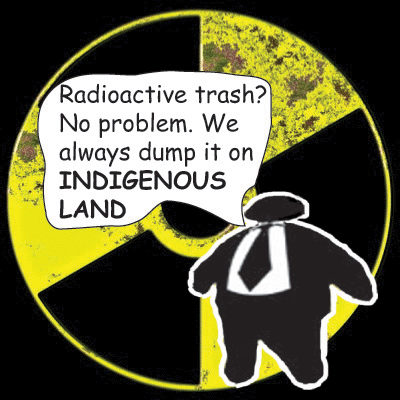
MATTHEW MCCLEARN, 16 June 24 https://www.theglobeandmail.com/business/article-tensions-with-first-nations-threaten-to-delay-nuclear-waste-facility/#:~:text=Prof.%20Leiss%20said%20even%20if,this%20issue%2C%E2%80%9D%20he%20said.
The eight-reactor Bruce Nuclear Generating Station, on the eastern shore of Lake Huron, ranks among the world’s largest nuclear power plants. With four more in the early planning stages, it might become larger still. But for the Saugeen Ojibway Nation (SON), behind its engineering grandeur lies a painful history – which it has described as one “of exclusion.”
Its people were not consulted before the plant’s construction during the 1970s and 80s, which resulted in quantities of radioactive waste stored within what they regard as their traditional territory. Nor did they see many of the economic benefits that flowed to neighbours.
These unresolved tensions threaten to derail – or at least significantly delay – efforts to find a permanent solution for Canada’s nuclear waste, which dates back to the 1970s. As of June, 2023, Canada had accumulated approximately 3.3 million used fuel bundles that were stored temporarily at operating or retired nuclear power plants in Ontario, Quebec and New Brunswick. But there’s nowhere to send them for permanent disposal – a potential stumbling block as the nuclear industry seeks public acceptance for a proposed major expansion.
The Nuclear Waste Management Organization (NWMO), an industry-controlled organization to which the federal government delegated responsibility for nuclear waste management, wants to select a site this year for a proposed, $26-billion underground nuclear waste disposal facility, known as a deep geological repository. The two remaining candidates are the Municipality of South Bruce (about 45 kilometres southeast of Bruce station, and also within SON’s traditional territory) and a site more than 40 kilometres from Ignace, a town of 1,200 northwest of Thunder Bay.
One of the NWMO’s guiding principles is that the repository’s host “must be informed and willing to accept the project.” Ignace’s council will decide that through a resolution; it has agreed to notify the NWMO of its decision by July 30. (It hired a consultant, With Chela Inc., to engage with residents and maintains its decision will be based on public input.) In South Bruce, citizens will vote in a by-election in late October. Both signed hosting agreements with the NWMO this year, under which South Bruce would receive $418-million over nearly a century and a half; Ignace would get $170-million.
Yet all that might well prove a sideshow. The NWMO also seeks consent from Indigenous peoples: Wabigoon Lake Ojibway Nation, in the case of Ignace. SON, which is composed of the Chippewas of Nawash First Nation and Chippewas of Saugeen First Nation, will decide regarding the South Bruce site. NWMO spokesperson Fred Kuntz said the organization is negotiating hosting agreements with both First Nations.
Success is far from assured.
SON’s grievances with the nuclear industry date back to the 1960s, when Ontario Hydro (the predecessor of Ontario Power Generation) began constructing Canada’s first commercial nuclear power plant. For SON, the commissioning of the Douglas Point Nuclear Generating Station marked the beginning of “the nuclear industrialization” of its territory. Douglas Point was followed by the much-larger Bruce station, built immediately next door.
SON ruefully watched its neighbours benefit as tax revenues rolled into local municipalities, while its members were largely shut out. In 2013 SON secured an undertaking from Ontario Power Generation that the utility wouldn’t establish an intermediate-level waste repository (proposed for construction at Bruce station) on its territory without its consent.
That undertaking had far-reaching consequences. It led to a 2020 plebiscite in which SON’s membership overwhelmingly rejected that repository. And it set an important precedent: In 2016, the NWMO granted SON the same ability to veto the South Bruce repository. SON plans to hold a referendum of its members, once it has received all the information it seeks from the NWMO.
“I’d say we’re at least halfway halfway home to having our questions satisfied,” said Gregory Nadjiwon, chief of the Chippewas of Nawash Unceded First Nation, one of SON’s two member nations.
But reaching an agreement this year – or at all – could prove challenging. The NWMO has accepted responsibility for disposing of all Canadian spent fuel, whether from the Point Lepreau station in New Brunswick, or from long-defunct research reactors at Chalk River, or even wastes from reactors yet to be constructed. SON’s leadership, though, is focused on the wastes in its own territory.
“If the [repository] is going to be in the SON territory, why should we be accepting waste that comes from Pickering, Darlington, Chalk River or Point Lepreau?” Chief Nadjiwon said.
“I mean, that’s ludicrous.”
As part of any agreement with NWMO, SON’s leadership seeks resolution to its long-standing concerns, such as the fact that wastes have been stored in its territory for decades without compensation.
“When I go in my truck to a garage in Toronto, I’m charged a cost” to park it, he said. “It’s no different than when you park waste in an Indigenous territory or homeland. We expect an agreement for the cost of doing business.”
William Leiss, an emeritus professor at Queen’s University’s School of Policy Studies, worked as a paid consultant for the NWMO between 2002 and 2011. He wrote a book, Deep Disposal, about the site selection process; the book is scheduled for publication in September. Prof. Leiss said SON’s opposition is so firm that it’s hard to fathom why South Bruce is still in the running.
“Its negatives are so pronounced that one wonders if it is being kept alive solely as a negotiating card so that Ignace does not regard itself as the only viable option,” he wrote.
“It has all the markings of an elaborate charade.”
But Prof. Leiss said the Ignace site is a long shot, too.
The Wabigoon Lake Ojibway Nation has roughly 1,000 members, 200 of which live on a reserve 20 kilometres from the Ignace area site. Its chief, Clayton Wetelainen, said the community has been negotiating a hosting agreement with the NWMO for roughly eight months.
The community has had far less interaction with the nuclear industry than SON has, so its historical baggage is perhaps lighter. Whereas the Ignace and South Bruce agreements would prevent future councils from backing out of the project, Wabigoon Lake’s leadership does not regard the agreement it’s negotiating as irrevocable – in part because there’s insufficient information available on many aspects of the project.
“The current vote that we’re talking about is just to go down to one site,” Chief Wetelainen said.
“This has to go through regulatory approvals, and our own approval, when we get more information about the detailed site.”
Some, he added, have misconstrued the vote as final and binding, “but that’s not the case.”
Prof. Leiss said even if Wabigoon Lake voted in favour of the project, other First Nations throughout the region might launch lawsuits to block the project. “There’s intense fighting among the First Nations in the Treaty 3 area over this issue,” he said.
Chief Wetelainen said his goal is to set a date in the fall for his 1,000 members to vote. Some community members began informing themselves about the project a decade ago, but others are only now beginning to ask the same questions. Getting all members up to speed is proving a challenge, he said – and as with SON, his community does not regard itself as bound by the NWMO’s timetable.
This position is admired by some of the repository’s non-Indigenous opponents. Bill Noll is vice-president of Protect Our Waterways, an opposition group in South Bruce. He said municipal officials have followed the NWMO’s timeline “blindly,” whereas SON is on its own schedule.
“They have a veto capability for the project, which is really an important dimension,” Mr. Noll said.
Prof. Leiss said Ontario is the only logical province for the repository – that’s where the bulk of Canada’s nuclear waste is already stored temporarily. But it’s home to 133 First Nations, whose often-overlapping traditional territories span nearly the entire province. It’s “entirely possible” that no First Nation will agree to accept a repository, he said.
But there’s another wrinkle: The NWMO’s willingness principle is not a legal requirement. OPG’s earlier proposed repository received regulatory approval of its environmental assessment without one. The NWMO’s promise to First Nations, he said, is “not worth the paper it’s written on.”
Prof. Leiss said the NWMO from the outset should have focused on First Nations, which he regards as the repository’s true hosts.
He wrote: “A sardonic take on this siting strategy might go something like this: entice a municipality with a dream of economic riches beyond its wildest imaginings, give it a phone book and tell it to place some calls to the nearest Indigenous communities, and then hope for the best.”
Chief Akagi requests public hearing to review any new governance arrangement for the Point Lepreau nuclear reactor on Peskotomuhkati homeland
Canada adopted the United Nations Declaration on the Rights of Indigenous Peoples (UNDRIP). Article 29 of UNDRIP requires states to take effective measures to ensure that no storage or disposal of hazardous materials takes place in the lands or territories of Indigenous peoples without their free, prior, and informed consent. The CNSC’s decision to grant NB Power a 10-year license renewal does not reflect this commitment.
by Abby Bartlett, June 10, 2024 homeland https://nbmediacoop.org/2024/06/10/chief-akagi-requests-public-hearing-to-review-any-new-governance-arrangement-for-the-point-lepreau-nuclear-reactor-on-peskotomuhkati-homeland/
On May 15, New Brunswick’s Energy Development Minister Mike Holland tabled the first reading of a bill to change the Electricity Act. The change would allow NB Power to enter a partnership with Ontario Power Generation (OPG).
In a letter to the Canadian Nuclear Safety Commission (CNSC) on May 29, Peskotomuhkati Chief Hugh Akagi outlined his initial concerns with the proposed agreement between NB Power and OPG, which reportedly includes a partial ownership stake in the Point Lepreau Nuclear Generating Station.
The letter is from the Passamoquoddy Recognition Group (PRGI) which represents the Peskotomuhkati Nation in Canada and the interests of rightsholders and the Peskotomuhkati ecosystem, including the Point Lepreau Nuclear Station and areas surrounding up to 90 km away.
Any new owners of the Lepreau CANDU nuclear reactor will have rights and responsibilities that PRGI wants clarified. In May 2022, Chief Akagi spoke at a public hearing held by the CNSC in Saint John to discuss NB Power’s request for a 25-year renewal of the license to operate the Point Lepreau nuclear reactor.
At the hearing, PRGI asked the CNSC to reduce the license to three years, stating that the average length of licensing is only 2.44 years. In the end, the CNSC granted a 10-year licence. Given that PRGI has already felt the impact of the proposed change in licence holders, they are rightfully concerned about the possible repercussions that will come from the new proposed changes.
In December 2023, New Brunswick published its new energy strategy, outlining plans to declare that the Point Lepreau reactor will undergo licence “renewals every 10 years.” This statement assumes that the 10-year license length will be the conclusion of future discussions that have not happened yet.
Back in June 2022, Chief Akagi stated that a 10-year license renewal meant that Canada was not meeting its own legal and related obligations to the Nation. “The new licence gives NB Power the ability to create and store 10 more years of fresh and dangerous high-level waste on our territory. This is not acceptable,” Chief Akagi said at the time.
Canada adopted the United Nations Declaration on the Rights of Indigenous Peoples (UNDRIP). Article 29 of UNDRIP requires states to take effective measures to ensure that no storage or disposal of hazardous materials takes place in the lands or territories of Indigenous peoples without their free, prior, and informed consent. The CNSC’s decision to grant NB Power a 10-year license renewal does not reflect this commitment.
Regarding any new governance arrangement for the Point Lepreau reactor, PRGI has many questions outlined in its letter to the CNSC.
PRGI wonders how a new joint ownership entity will fulfill its Indigenous consultation obligations. Will PRGI have any say about these arrangements? How will a joint ownership arrangement for the existing CANDU reactor impact any new reactors on the Point Lepreau site? What will OPG’s responsibilities be for the existing and any further nuclear waste produced by the Point Lepreau plant under a co-ownership arrangement?
NB Power is fraught with 3.6 billion dollars of nuclear debt due to the original building cost of the Lepreau nuclear generating station, the later refurbishment of the reactor, and the poor performance over the course of its operation.
This potential agreement would mean shedding the Lepreau nuclear reactor off to a new entity, which would be co-owned with OPG and NB Power in an agreement that could force New Brunswick customers to pay for expensive nuclear power for decades.
The letter by Chief Akagi ends with two requests. First is the need for the CNSC to commit to holding in-person hearings for the future request to change ownership of the Lepreau nuclear reactor to ensure that the Peskotomuhkati Nation can intervene in its traditional way rather than only through written intervention.
The second request asks the CNSC to remind the New Brunswick Government that a future 10-year license for the Lepreau reactor is not up to the provincial government. Instead, it will be a matter of review and decision made by the CNSC, which will involve public intervenors, including PRGI.
As Chief Akagi outlines, NB Power is required to make an application to the CNSC to authorize the transfer of licence, and under section 40 of the Nuclear Safety and Control Act, they are also required to hold a hearing. The Peskotomuhkati Nation does not want this proposed change to become another injustice that they must bear. The CNSC needs to ensure that Peskotomuhkati people’s voices are heard, understood, and respected in the process.
Abby Bartlett is a research assistant on the CEDAR project at St. Thomas University.
Moving nuclear waste through traditional territories could face opposition, Ontario First Nation says
‘Think about how many treaty territories that waste would have to go through,’ chief says
Colin Butler · CBC News · May 27, 2024
A First Nation in southwestern Ontario says even if the community votes yes on a proposed $26 billion dump for nuclear waste within their traditional territory, it would likely be opposed by other First Nations, through whose territories the more than 5.5 million spent fuel rods would have to pass.
Canada’s nuclear industry has been on a decades-long quest to find a permanent home for tens of thousands of tonnes of highly radioactive waste. The search has narrowed to two Ontario communities — Ignace, northwest of Thunder Bay, and the Municipality of South Bruce, north of London.
Both will vote later this year on whether to build a deep geologic repository, a kind of nuclear crypt, where more than 50,000 tonnes of waste in copper casks will be lowered more than 500 metres underground to be kept for all time, behind layers of clay, concrete and the ancient bedrock itself.
But so will their Indigenous neighbours, whose traditional territories the towns are within, which gives each respective First Nation a veto.
In the case of Saugeen Ojibway Nation in particular, it means the community again finds itself as the future arbiter of a potential nuclear waste site on their traditional lands for the second time in a few years.
In early 2020, its members voted overwhelmingly against the construction of a deep geologic repository outside of Kincardine, that was proposed by Ontario Power Generation.
This time around, Chief Greg Nadjiwon of the neighbouring Chippewas of the Nawash, says the proposal by the Nuclear Waste Management Organization (NWMO), a non-profit industry group, for a similar facility has a better chance, but is still a tough sell…………………………………………………………………………………… https://www.cbc.ca/news/canada/london/nuclear-waste-ontario-south-bruce-saugeen-nation-1.7213878
Indigenous opposition to nuclear waste being transported through their territory

Concerns growing surrounding nuclear waste management
Anishinabek, The voice of the Anishinabek nation. May 22, 2024, By Rick Garrick
FORT WILLIAM — Fort William’s Elysia Lone Elk is raising concerns about the transportation of nuclear materials through Northern Ontario if the proposed nuclear waste site near Ignace in Treaty #3 territory gets the go-ahead.
The Trans-Canada Hwy. was closed for about 20 hours in 2001 after a head-on collision between two transport trucks, one of which was transporting two canisters of radioactive material — iridium — about 25 kilometres east of Dryden, 105 kilometres west of Ignace. The collision resulted in “widespread destruction” and the deaths of four people, two from each vehicle, according to a news report. Officials from the Canadian Nuclear Safety Commission eventually arrived on site, found there was no leakage, and removed the canisters to a safe location.
“Water is life, it’s our most sacred resource,” Lone Elk says. “We need that to survive, animals need that to survive, and I don’t think we should be drilling underground and playing with aquifers with a very toxic harmful material that has a half-life beyond my conception of time.”
The Nuclear Waste Management Organization (NWMO) has been following a process to select a site for Canada’s plan to safely manage used nuclear fuel long-term since 2010, and has since narrowed down the potential sites to two areas for Canada’s deep geological repository, the Wabigoon Lake Ojibway Nation-Ignace area in northwestern Ontario, and the Saugeen Ojibway Nation-South Bruce area in southwestern Ontario. If the Wabigoon Lake Ojibway Nation-Ignace area is selected as the site, nuclear materials would have to be transported across Northern Ontario to the site.
“If it’s so safe, then why are you even transporting it, just bury it where it is? We know how dangerous those highways can be,” Lone Elk says. “The fact that no one on the [potential transportation] corridor gets a say is a democratic problem, very frustrating.”
Lone Elk adds that the nuclear material would be transported across Northern Ontario for the operating life of the proposed deep geological repository. The NWMO states on their website that based on current projections of Canada’s inventory of used nuclear fuel, transportation is anticipated to take about 40 years to complete. The NWMO adds that they are exploring road and/or rail options for transporting used nuclear fuel to the deep geological repository.
“The (Fort William) Band Council has passed two resolutions, one focusing on the proximity principle and then the other one specifically outright stating we do not support nuclear fuel being transported through our traditional territory,” Lone Elk says. “We’re trusting their scientists, we’re trusting industry scientists, we’re trusting industry factors; so when does the First Nation get to participate with Indigenous knowledge?”
Fort William Chief Michele Solomon says Fort William passed two resolutions in the last four years opposing nuclear waste being brought into Fort William territory.
“I think that it’s fair to say we stand with other First Nations in Robinson Superior Treaty territory to say that there’s nothing that gives us comfort that there would be any safety with this being transported through our communities,” Solomon says. “We see the increase in accidents on the highways going through our homelands so we’re strongly opposed to it.”
Solomon adds that their community has not been consulted on this issue.
Based on how the community has responded to other possible threats to our homelands, the people have been strongly opposed to other things that have been proposed for our territory,” Solomon says. “If the government wants to proceed with this, then they need to consult with the rights holders of this territory. So if it needs to pass through Robinson Superior territory, you need to consult with all of those communities.”
Solomon says it is not enough for the Nuclear Waste Management Organization to say that it is safe.
“I think there should be independent research done and that has not happened as far as I know,” Solomon says, noting that unhealthy things have been brought into her community’s airspace and waterways before. “So we are strongly opposed.”
The Assembly of First Nations is holding four Regional Dialogue Sessions: A Dialogue on the Transportation and Storage of Used Nuclear Fuel at locations across the country, including on May 22 at the Delta Hotels by Marriott in Thunder Bay.
--
Russian uranium ban reopens threat of uranium mining escalation in US

Executives from Uranium Energy, Terrapower, Centrus and Energy Fuels couldn’t contain their excitement. Nor can they wait to begin mining, milling, and enriching uranium again in the US, to the detriment most especially of Native American tribes living on the land already permanently scarred and poisoned by previous such operations and who are still waiting for adequate or any cleanup and reparations.
The Navajo Nation, who have banned uranium mining on their territory, was home to more than 500 uranium mines at peak operations, all of which are now abandoned but not cleaned up. (There are more than 4,000 abandoned uranium mine sites across the US.) Tribal members understand all too well what uranium mining can do to the health and wellbeing of a community.
Beyond Nuclear, By Linda Pentz Gunter, 24 May 24
When Russia first invaded Ukraine on February 24, 2022, no one knew how long the fighting would continue and what the outcome might be. Kyiv was expected to fall immediately. It didn’t. More than two years on, the war continues and the rumblings from Russia about nuclear weapons use grow frighteningly louder.
The rush by the United States and its NATO allies at the time of the invasion to help defend — and to some extent arm — Ukraine included a quick decision to sanction Russian fossil fuel imports. On March 8, 2022, just 12 days after the invasion, US president, Joe Biden, signed an Executive Order banning the import of Russian oil, liquefied natural gas, and coal to the United States. Russian uranium was not included.
At the time of the 2022 ban on Russian fossil fuels, many of us in the anti-nuclear movement were agitating for a Russian uranium ban as well. At least 12% of US uranium imports comes from Russia to fuel domestic US reactors. That number rises to close to 50% if you also factor in uranium sourced from Russian satellites Kazakhstan (25%) and Uzbekistan (11%). (Canada is the other major single-source supplier of uranium to the US at 27%.)
On May 13, 2024, President Biden finally signed into law a bipartisan bill — the Prohibiting Russian Uranium Imports Act — banning imports of Russian low-enriched uranium. According to the bill, the ban affects: “Unirradiated low-enriched uranium that is produced in the Russian Federation or by a Russian entity” (read Rosatom operating outside Russia).
When we were pushing for a Russian uranium boycott at the start of the war, it was in the context of highlighting the detriment of nuclear power and fed into our agenda to permanently end the use of this dangerous and discriminatory technology. We asked then why the nuclear sector was getting a pass. Now we have the answer. The bill is a poisoned pill, almost literally.
The bill’s enactment “releases $2.72 billion in appropriated funds to the Department of Energy to invest in domestic uranium enrichment further advancing a secure and resilient global nuclear energy fuel supply consistent with our international obligations,” said the US State Department.
This is all part of the absurd agenda to triple global nuclear capacity by 2050 (too late) and, said the State Department, “to establish a secure nuclear fuel supply chain, independent of adversarial influence, for decades to come.” It will do nothing of the kind.
While the new law may claim to end US dependency on Russian uranium, it does not end American addiction to a fatal energy source that victimizes the communities least resourced to fight back. Furthermore, it will make America’s path to a renewable energy economy all the harder, redirecting funds and precious time toward the most expensive and slowest way to address the climate crisis (nuclear) instead of faster, cheaper renewables.
There are no prizes for guessing who was cheering the loudest as Biden wielded his pen last week.
Executives from Uranium Energy, Terrapower, Centrus and Energy Fuels couldn’t contain their excitement. Nor can they wait to begin mining, milling, and enriching uranium again in the US, to the detriment most especially of Native American tribes living on the land already permanently scarred and poisoned by previous such operations and who are still waiting for adequate or any cleanup and reparations.
One of those places, the Grand Canyon, is already under threat from the Pinyon Plain uranium mine, a project of Canadian-owned Energy Fuels and which started operations in January 2024, against the strong opposition of the Havasupai tribe who live there.
“We have been against uranium mining for decades because of the known risks to land and air, water and people,” said Carletta Tilousi, a leader of the Havasupai tribe who is fighting to cancel the uranium operations at Pinyon Plain, which is located near Red Butte, a sacred site to the Havsupai people.
“Uranium mining in the southwest has scarred and left a horrifying legacy of death in our communities. Thousands of abandoned uranium mines on federal and tribal lands have not been cleaned up,” she said.
“Uranium will continue to poison the Grand Canyon including the aquifers that feed into the Colorado River,” added Tilousi. “Contaminants from the uranium mine are likely to make their way to the deep aquifers that feed Havasu Springs. The mine closure is the only way to avoid this risk.”
The Navajo Nation, who have banned uranium mining on their territory, was home to more than 500 uranium mines at peak operations, all of which are now abandoned but not cleaned up. (There are more than 4,000 abandoned uranium mine sites across the US.) Tribal members understand all too well what uranium mining can do to the health and wellbeing of a community.
“This decision by Biden is terrible news,” said former uranium mine worker, Larry King of the Navajo Nation, a member of Eastern Navajo Diné Against Uranium Mining that has advocated mine cleanup for decades. Added King: “They’ve never returned an aquifer to pre-mining stages,” after extracting uranium through in-situ leach mining, the predominant technique currently used. “The companies got what they want out of Navajo and moved on.”
Despite the ban, the Navajo Nation had already been under a renewed threat of resumed uranium mining when Uranium Resources tried to open a new in situ leach mine at Church Rock, a plan that was defeated by tribal opposition. But Toronto-based Laramide Resources has since bought out Uranium Resources and wants to mine uranium there because the land is surrounded by — but not within — the boundaries of the Navajo reservation.
King’s home lies within view of Laramide’s plans. “The environmental impact statement says there are certain dwellings within the diameter of the project and those people will have to move,” King said. “I’m not moving. This is where I’m from. I’m not moving a foot.”
After Biden signed the Prohibiting Russian Uranium Imports Act, the Washington Post ran a disgracefully slanted article, in which not a single Native American voice was heard. Reporter Maxine Joselow quoted executives from four nuclear corporations and two politicians, all of whom favored the legislation. She made only a glancing reference to mine opponents as “others” and “still others” after prefacing their anonymous mention with “Though some environmentalists support nuclear power…”
But she was more than happy to repeat the utter nonsense spewed by Energy Fuels senior vice president, Curtis Moore, who said the company’s Grand Canyon mine would have “zero” risk to water supplies there and that “Uranium is absolutely essential to the fight against climate change.”
Americans, and especially Native Americans, will pay the price for this bill which, instead of banning uranium imports and transitioning away from nuclear power, seeks instead to stimulate exponential domestic growth of this dirty industry………………………………………………….. more https://beyondnuclearinternational.org/2024/05/19/terrible-news/
Indigenous Senator warns new laws will turn Australia into “the world’s nuclear waste dump”

Giovanni Torre – May 13, 2024, https://nit.com.au/13-05-2024/11377/lidia-thorpe-warns-new-laws-will-turn-australia-into-the-worlds-nuclear-waste-dump?mc_cid=a41a81cd8c&mc_eid=261607298d
Senator Lidia Thorpe has warned new legislation to regulate nuclear safety of activities relating to AUKUS submarines has left Australia open to becoming “the world’s nuclear waste dump”.
Under the AUKUS deal, the federal government agreed to manage nuclear waste from Australian submarines, but under legislation to be introduced in June, Australia could be set to take nuclear waste from UK and US submarines also, Senator Thorpe warned.
The Gunnai, Gunditjmara and Djab Wurrung independent senator for Victoria called on the government to urgently amend the bill to prohibit high-level nuclear waste from being stored in Australia, a call she said is backed by experts in the field and addresses one of the major concerns raised during the inquiry into the bill.
“This legislation should be setting off alarm bells, it could mean that Australia becomes the world’s nuclear waste dump,” Senator Thorpe said on Monday.
“The government claims it has no intention to take AUKUS nuclear waste beyond that of Australian submarines, so they should have no reason not to close this loophole.
“Unless they amend this bill, how can we know they’re being honest? They also need to stop future governments from deciding otherwise. We can’t risk our future generations with this.”
In March, Senator Thorpe questioned Foreign Affairs Minister Penny Wong about the long-term cost from storage of nuclear waste, and whether Australia would take on foreign nuclear waste under the AUKUS deal. The minister responded that this cost is not included in the current $368 billion estimated for AUKUS, and she could not confirm that foreign waste would not be stored in Australia.
Senator Thorpe noted that the US Environmental Protection Agency warns high-level nuclear waste remains dangerous for at least 10,000 years; managing the risk posed by the decommissioned fuel rods from the AUKUS submarines would require storage and management that is future-proof, something that has proven challenging even in countries with advanced nuclear industries.
She also pointed out on Monday that the bill has also been criticised for lack of transparency and accountability; and allows the Minister of Defense to bypass public consultation and override federal and state laws to determine sites for the construction and operation of nuclear submarines, and the disposal of submarine nuclear waste.
Senator Thorpe said there are serious concerns about a lack of community consultation and the risk of violating First Peoples right to Free, Prior and Informed Consent.
Historically, governments have tried to push the storage of radioactive waste on remote First Nations communities, with successful campaigns in Coober Pedy, Woomera, Muckaty, Yappala in the Flinders Ranges and Kimba fighting off these attempts.
“We’ve seen how far the major parties will go to ingratiate themselves with the US. Labor must amend this bill to prove they’re putting the interests of our country first,” Senator Thorpe said.
“And they need to change the powers that allow the Minister and the Department to choose any place they like for nuclear waste facilities with no oversight or community consultation.
“That’s complete overreach and will undermine First Peoples rights for Free, Prior and Informed Consent under the United Declaration on the Rights of Indigenous Peoples.”
The senator said “time and again” governments have attempted to turn remote communities into nuclear waste dumps, with the risks from nuclear waste always being put on First Peoples.
“I’m concerned that this time it will be no different,” she said.
“The Bill allows the government to contract out liability for nuclear safety compliance, includes no emergency preparedness or response mechanisms, no consideration of nuclear safety guidelines from the Australian Radiation Protection and Nuclear Safety Agency and leaves many other questions on nuclear safety unanswered.”
“This Bill fails to set out a nuclear safety framework for the AUKUS submarines and instead focuses on defence objectives, while sidestepping safety, transparency and accountability. It’s a negligent and reckless bill that should not pass the Senate.”
Russian uranium ban reopens threat of uranium mining escalation in US
Executives from Uranium Energy, Terrapower, Centrus and Energy Fuels couldn’t contain their excitement. Nor can they wait to begin mining, milling, and enriching uranium again in the US, to the detriment most especially of Native American tribes living on the land already permanently scarred and poisoned by previous such operations and who are still waiting for adequate or any cleanup and reparations.
Beyond Nuclear, By Linda Pentz Gunter, 19 May 24
When Russia first invaded Ukraine on February 24, 2022, no one knew how long the fighting would continue and what the outcome might be. Kyiv was expected to fall immediately. It didn’t. More than two years on, the war continues and the rumblings from Russia about nuclear weapons use grow frighteningly louder.
The rush by the United States and its NATO allies at the time of the invasion to help defend — and to some extent arm — Ukraine included a quick decision to sanction Russian fossil fuel imports. On March 8, 2022, just 12 days after the invasion, US president, Joe Biden, signed an Executive Order banning the import of Russian oil, liquefied natural gas, and coal to the United States. Russian uranium was not included.
At the time of the 2022 ban on Russian fossil fuels, many of us in the anti-nuclear movement were agitating for a Russian uranium ban as well. At least 12% of US uranium imports comes from Russia to fuel domestic US reactors. That number rises to close to 50% if you also factor in uranium sourced from Russian satellites Kazakhstan (25%) and Uzbekistan (11%). (Canada is the other major single-source supplier of uranium to the US at 27%.)
On May 13, 2024, President Biden finally signed into law a bipartisan bill — the Prohibiting Russian Uranium Imports Act — banning imports of Russian low-enriched uranium. According to the bill, the ban affects: “Unirradiated low-enriched uranium that is produced in the Russian Federation or by a Russian entity” (read Rosatom operating outside Russia).
When we were pushing for a Russian uranium boycott at the start of the war, it was in the context of highlighting the detriment of nuclear power and fed into our agenda to permanently end the use of this dangerous and discriminatory technology. We asked then why the nuclear sector was getting a pass. Now we have the answer. The bill is a poisoned pill, almost literally.
The bill’s enactment “releases $2.72 billion in appropriated funds to the Department of Energy to invest in domestic uranium enrichment further advancing a secure and resilient global nuclear energy fuel supply consistent with our international obligations,” said the US State Department.
This is all part of the absurd agenda to triple global nuclear capacity by 2050 (too late) and, said the State Department, “to establish a secure nuclear fuel supply chain, independent of adversarial influence, for decades to come.” It will do nothing of the kind.
While the new law may claim to end US dependency on Russian uranium, it does not end American addiction to a fatal energy source that victimizes the communities least resourced to fight back. Furthermore, it will make America’s path to a renewable energy economy all the harder, redirecting funds and precious time toward the most expensive and slowest way to address the climate crisis (nuclear) instead of faster, cheaper renewables.
There are no prizes for guessing who was cheering the loudest as Biden wielded his pen last week.
Executives from Uranium Energy, Terrapower, Centrus and Energy Fuels couldn’t contain their excitement. Nor can they wait to begin mining, milling, and enriching uranium again in the US, to the detriment most especially of Native American tribes living on the land already permanently scarred and poisoned by previous such operations and who are still waiting for adequate or any cleanup and reparations.
One of those places, the Grand Canyon, is already under threat from the Pinyon Plain uranium mine, a project of Canadian-owned Energy Fuels and which started operations in January 2024, against the strong opposition of the Havasupai tribe who live there.
“We have been against uranium mining for decades because of the known risks to land and air, water and people,” said Carletta Tilousi, a leader of the Havasupai tribe who is fighting to cancel the uranium operations at Pinyon Plain, which is located near Red Butte, a sacred site to the Havsupai people.
“Uranium mining in the southwest has scarred and left a horrifying legacy of death in our communities. Thousands of abandoned uranium mines on federal and tribal lands have not been cleaned up,” she said.
“Uranium will continue to poison the Grand Canyon including the aquifers that feed into the Colorado River,” added Tilousi. “Contaminants from the uranium mine are likely to make their way to the deep aquifers that feed Havasu Springs. The mine closure is the only way to avoid this risk.”
The Navajo Nation, who have banned uranium mining on their territory, was home to more than 500 uranium mines at peak operations, all of which are now abandoned but not cleaned up. (There are more than 4,000 abandoned uranium mine sites across the US.) Tribal members understand all too well what uranium mining can do to the health and wellbeing of a community.
“This decision by Biden is terrible news,” said former uranium mine worker, Larry King of the Navajo Nation, a member of Eastern Navajo Diné Against Uranium Mining that has advocated mine cleanup for decades. Added King: “They’ve never returned an aquifer to pre-mining stages,” after extracting uranium through in-situ leach mining, the predominant technique currently used. “The companies got what they want out of Navajo and moved on.”
Despite the ban, the Navajo Nation had already been under a renewed threat of resumed uranium mining when Uranium Resources tried to open a new in situ leach mine at Church Rock, a plan that was defeated by tribal opposition. But Toronto-based Laramide Resources has since bought out Uranium Resources and wants to mine uranium there because the land is surrounded by — but not within — the boundaries of the Navajo reservation.
King’s home lies within view of Laramide’s plans. “The environmental impact statement says there are certain dwellings within the diameter of the project and those people will have to move,” King said. “I’m not moving. This is where I’m from. I’m not moving a foot.”
After Biden signed the Prohibiting Russian Uranium Imports Act, the Washington Post ran a disgracefully slanted article, in which not a single Native American voice was heard. Reporter Maxine Joselow quoted executives from four nuclear corporations and two politicians, all of whom favored the legislation. She made only a glancing reference to mine opponents as “others” and “still others” after prefacing their anonymous mention with “Though some environmentalists support nuclear power…”
But she was more than happy to repeat the utter nonsense spewed by Energy Fuels senior vice president, Curtis Moore, who said the company’s Grand Canyon mine would have “zero” risk to water supplies there and that “Uranium is absolutely essential to the fight against climate change.”
Americans, and especially Native Americans, will pay the price for this bill which, instead of banning uranium imports and transitioning away from nuclear power, seeks instead to stimulate exponential domestic growth of this dirty industry………………………………………………………..
it’s unclear how deeply the boycott will actually harm Russia and when. As bne IntelliNews clarified in a January 19, 2024 article: “even though Kazakhstan is the world’s biggest player in uranium supply, much of its milled uranium travels through Russian conversion plants before it is exported to global markets.” Russia has “control of over 26% of Kazakh uranium deposits and holds rights to an additional 22% of annual production.”
However, the Russia uranium ban doesn’t specifically include Uzbekistan or Kazakhstan and the “Russian entity” wording in the bill leaves the situation vague.
Kazakhstan seems to have no doubt about the opportunity presented by the Russia ban and is eager to fill the void. “This bill represents a significant opportunity for Kazakhstan, the world’s largest producer of uranium, which could potentially step into the breach and provide the mineral necessary to meet the U.S.’ nuclear energy needs,” reported The Times of Central Asia in January after the bill had passed the US House last December.
Furthermore, there is a pretty big waiver included in the bill which could keep the door wide open to Russian uranium. It states that imports can continue if “no alternative viable source of low-enriched uranium is available to sustain the continued operation of a nuclear reactor or a United States nuclear energy company; or importation of low-enriched uranium described in paragraph (1) is in the national interest.”
This is in place to insure against a resulting shortage of uranium fuel supplies that could cause US reactors to shut down prematurely or permanently. The waiver extends until January 2028. So a win-win for Rosatom, Kazatomprom, North American uranium corporations, the US Congress and the Biden Administration, and another tragic betrayal of Native American people.
Linda Pentz Gunter is the international specialist at Beyond Nuclear and writes for and edits Beyond Nuclear International. https://beyondnuclearinternational.org/2024/05/19/terrible-news/
Land Defence Alliance stands united against the burial of nuclear waste
The group held a rally in Waverley Park on Tuesday afternoon.
NWO Newswatch, Clint Fleury, Apr 30, 2024
THUNDER BAY – With the decision on where Canada will store its nuclear waste looming, four of the six First Nations representatives from the Land Defence Alliance held a rally in Waverley Park to voice their concerns and dangers of this controversial project.
“We’re concerned about future leaks and accidents and we’re very concerned that if that should happen, it could contaminate the local environment like the animals and also the air and the grounds,” said Grassy Narrows Chief Rudy Turtle in an interview with Dougall Media.
Turtle was the first to take the microphone and send out a profound message of solidarity with his fellow First Nations who are opposed to the burial of used nuclear waste in the Revell Lake area.
Currently, Ignace Township and nearby Wabigoon Lake Ojibway Nation are each in a “willingness process” to decide whether they will be hosts for a deep geological repository between their communities.
Outside of Ignace and Wabigoon Lake Ojibway Nation, no other municipality or First Nation communities have a right to vote on their willingness to allow the storage of nuclear waste in Northwestern Ontario.
In southern Ontario, the municipalities of South Bruce and Saugeen Ojibway Nation are also considering being willing hosts to the repository where it is situated near them.
For many, there are too many variables and “what if” questions as the deep geological repository project slowly becomes less like a science fiction concept.
The trouble is that for many First Nation communities, the government’s track record of leaving contaminated industrial sites on treaty land has given way to skepticism. ……………………………………………………………………..
Turtle explained: “It’s coming from down south which is like 28 hours of driving, or whether it’s coming by train, it’s still like over 20 hours and there’s always the possibility of an accident. We’ve seen it happen with other chemicals. We’ve seen it happen with oil transportation.
“So, the potential, the possibility is there of an accident and people should be concerned about that. The towns that are in between during those 20-hour travel times. Those towns should be concerned. Those towns should be worried about the potential of having nuclear waste dumped or accidentally dumped along their communities.”
At the end of the rally, the Land Defence Alliance stood united to say no to the burial of nuclear waste in Northwestern Ontario. https://www.nwonewswatch.com/local-news/land-defence-alliance-stands-united-against-the-burial-of-nuclear-waste-8676906
Nuclear Waste Management Organization (NWMO) responds to Land Defence Alliance protest
In response to the recent Land Defence Alliance protest where a coalition of First Nations said “no” to burying nuclear waste in Northwestern Ontario, Vince Ponka, NWMO’s regional communications manager, attempts to dispel concerns surrounding the deep geological repository project.
Clint Fleury, May 2, 2024
THUNDER BAY – At a protest on Tuesday, Grassy Narrows Chief Rudy Turtle shared his strong opposition to the Nuclear Waste Management Organization’s (NWMO) proposed deep geological repository where Canada’s used nuclear fuel will potentially be stored.
In an interview with Dougall Media, Chief Turtle said the Land Defence Alliance has reached out to NWMO to speak with them about the project, but NWMO had a scheduling conflict which prevented them from attending a meeting.
“Well, the Land Defence Alliance just finished meeting these past couple of days and we had invited NWMO to come and sit with us but they didn’t show up, and they had a change of schedule or something and we were looking forward to talking to them,” said Chief Turtle.
Turtle stated they would like to set up a future meeting, but there was no date set at this time.
Vince Ponka, regional communications manager with the NWMO, said the organization was aware of the protest, however they were attending the final day of the “willingness process” in Ignace.
Ponka said the NWMO did reach out to Grassy Narrows to schedule a meeting. According to Ponka, the chief and council asked to meet with NWMO’s chief executive officer, Laurie Swami, the next day.
“Unfortunately, she just wasn’t able to make that quick of a turnaround,” said Ponka.
Ignace Township and nearby Wabigoon Lake Ojibway Nation are two of four potential hosting communities for the DGR. The other two are the municipalities of South Bruce and Saugeen Ojibway Nation.
Once the “willingness process” is complete in all four host communities, NWMO will start the site selection process.
Ponka said NWMO will have a site selected by the end of the year.
In the meantime, Ponka said he would like to meet with the Land Defence Alliance at any point in the future………………………….
The Land Defence Alliance is concerned about limiting the “willingness” vote to residents of Ignace and Wabigoon Lake Ojibway Nation. However, Ponka did say once the site selection process is finished, NWMO will branch out to the surrounding region to gather input on the next part of the process……………………………………………. https://www.nwonewswatch.com/local-news/nwmo-responds-to-land-defence-alliance-protest-8683263
First Nations leaders voice opposition to nuclear power plants
By Angel Moore, Apr 30, 2024, https://www.aptnnews.ca/national-news/first-nations-leaders-voice-opposition-to-nuclear-power-plants/
Leaders from three First Nations in New Brunswick made the trip to Ottawa to voice their opposition to the expansion of a nuclear power plant in the province.
The federal government, which is pushing the concept of small modular reactors, or SMRs, and the province are proposing to put new nuclear power plants on the Point Lepreau nuclear site.
The plant sits next to the Bay of Fundy and is Atlantic Canada’s only nuclear facility.
“Our people were never consulted or asked about our input or concerns about nuclear so we’re sitting here today talking about nuclear waste and where to put it, where to place it,” said Wolastoq Council Grand Chief Rom Tremblay.
The plant also sits on the traditional territory of the Passamaquoddy nation.
“Every child needs to see what I saw, they need see those fish they need to see those trees they need healthy air and they do not need nuclear contamination for thousands of years,” said Chief Hugh Akagi at the news conference in Ottawa.
The power plant has been operating since 1983 and provides New Brunswick with 40 per cent of its power.
Like other plants, it uses uranium processed in refineries such as the d’uranium de Blind, located in Blind River, Ont., a small community west of Sudbury on the traditional land of the Mississauga First Nation.
Band Councillor Peyton Pitawanakwat said her band council issued a resolution that said, “To declare opposition to any future use of the Blind River refinery site that would see these lands being used as a disposal site for radioactive wastes unfortunately that challenges faced by our first nation are not unique, and the environmental discrimination is happening all across the country.”
Pitawanakwat said the community is consulting with the Canada Nuclear Safety Commission and that their treaty rights are not being upheld.
“There’s a lot of more in-depth discussions that need to be had and we really are at a point where we need to re-set the relationship and ensure that our rights are being upheld,” she said.
New Brunswick Power didn’t respond to a request for an interview. The Canada Nuclear Safety Commission said an interview was not possible.
Indigenous leaders decry lack of consent for nuclear waste on their homelands
OTTAWA, April 30, 2024 — Today, leaders of Indigenous communities in New Brunswick, Quebec and Ontario express their strong concern about the lack of Indigenous consent for nuclear waste, uranium mining and refining on their homelands.
Article 29(2) of the United Nations Declaration on the Rights of Indigenous Peoples (UNDRIP) states: “States shall take effective measures to ensure that no storage or disposal of hazardous materials shall take place in the lands or territories of Indigenous peoples without their free, prior and informed consent.”
The Government of Canada is promoting an expansion of nuclear energy across the country without the free, prior and informed consent of Indigenous Nations affected. Like the existing reactors, new nuclear reactors will leave a toxic legacy for all living things for thousands of years.
Already, dozens of communities have radioactively contaminated sites on their homelands, and they and others must carefully consider the impacts of proposed permanent repositories for nuclear waste on the next seven generations.
Hugh Akagi is Chief of the Peskotomuhkati Nation in Canada, whose homeland is the unwilling host of the Point Lepreau Nuclear Generating Station on the world-renowned Bay of Fundy in New Brunswick. The reactor was built and later refurbished without the Nation’s consent. Now the federal and New Brunswick governments are spending public funds to develop two new nuclear reactors on the Point Lepreau site.
Chief Akagi has written several times to the Minister of Environment and Climate Change Canada, to express concerns about the proposed projects and ask questions about the high-level used nuclear fuel waste in temporary storage at the Point Lepreau site.
“The nuclear fuel chain – mining uranium, chemically processing the ore, fabricating the fuel, fissioning uranium in a reactor creating toxic radioactive waste remaining hazardous for tens of thousands of years – leaves a legacy of injustices disproportionately felt by Indigenous peoples and all our relations,” says Chief Akagi.
In 2021, the Wolastoq Grand Council in New Brunswick published a resolution on nuclear energy and nuclear waste on traditional Wolastoq homeland.
Grand Council Chief Ron Tremblay, says: “Wolastoqewi-Elders define Nuclear in their language as ‘Askomiw Sanaqak,’ which translates as ‘Forever Dangerous.’ That’s why we called for First Nation alternative energy solutions, including renewables and energy efficiency, as well as no more public funding for nuclear and the phasing out of the Point Lepreau reactor.”
The Blind River uranium refinery owned and operated by Cameco is located on lands which since AD 800 have been the site of vibrant Indigenous occupation and life, including as the ancestral lands of the people of Mississauga First Nation (MFN), and MFN’s access to these lands and waters has been barred by virtue of Cameco’s nuclear operations at the site.
Mississauga First Nation has never consented to the lands being used for nuclear activities nor as disposal grounds for radioactive wastes and there continues to be no equitable redress for this loss of access to their ancestral lands located on the Mississauga Delta.
“The existence of nuclear operations on our ancestral lands has contributed to our loss of culture and spiritual traditions and has been detrimental to our health and well-being of our First Nation, said Mississauga First Nation Councillor Peyton Pitawanakwat. “Cameco has materially benefitted and continues to benefit, from the operations at Blind River, which remains the world’s largest uranium refinery. The proposal to now site radioactive wastes on our lands would perpetuate an existing environmental injustice and amount to environmental racism.”
The Kichi Sibi or Ottawa River, which forms the boundary between Ontario and Quebec, is another site of conflict. The Chiefs of Kebaowek and Kitigan Zibi Anishinabeg First Nations in Quebec last year made public their Indigenous-led assessment of a million-cubic-metre radioactive waste mound to be built at Chalk River Laboratories on the shores of the Kichi Sibi on unceded Algonquin territory. Their assessment covered the project’s impact on their culture, land, water and wildlife. An experimental nuclear reactor is also planned for Chalk River.
“The Kichi Sibi is sacred to our peoples and at the heart of our unceded homeland,” said Chief Lance Haymond, of Kebaowek First Nation. “The Algonquin peoples never consented to the Chalk River site being used for over 75 years for nuclear reactors and research, and now being the site for a permanent radioactive waste dump. Consultation was far too late and inadequate, and we reject the plan.”
In spite of the clear opposition to the project by ten Algonquin First Nations, the Canadian Nuclear Safety Commission approved the Near Surface Disposal Facility in January 2024. Two First Nations have launched a legal challenge to the decision, as have several citizen groups.
The federal government says that reconciliation is a priority. How UNDRIP will be respected by the Government of Canada – which signed it in 2016 and passed the United Nations Declaration on the Rights of Indigenous Peoples Act in 2021 – remains to be seen.
Speaking with one voice -tribes call for cleanup, remediation and an end to uranium mining and milling
The early uranium they mined was for atomic bombs dropped on other brown people far away. Later, the mined uranium was used to fuel nuclear power plants whose radioactive releases increase leukemia rates in children living nearby and whose waste is targeted at, yes, more Native communities.
By Linda Pentz Gunter, Beyond Nuclear 7 Apr 24
They were there to tell their stories. The contamination of air, land and water. The sicknesses. The displacement. The loss of community, culture and language. The deprivation of fundamental human rights. And they spoke with one voice in their plea for justice, the voice of Indigenous peoples in the United States and their lived experience of uranium mines and mills.
The occasion was a thematic hearing before the Inter-American Commission on Human Rights (IACHR) at the Organization of American States. The topic was: United States: Impacts of uranium exploitation on indigenous peoples’ rights.
The speakers came from Navajo, Arapaho, Havasupai, Ute and Oglala Lakota.
And, across the room, they came from the Environmental Protection Agency, the Nuclear Regulatory Commission and the Department of the Interior.
The Native American speakers made the same plea they have reiterated for decades: effective cleanup and removal of the radioactive waste that has poisoned their communities and people, and will do so again as long new uranium mines are allowed to go forward. And no new mines.
The personal stories they told the listeners — representatives from the US government, the IACHR panel and members of the public in the audience —were those of universal injustice against Indigenous communities, stories that have been told before and, seemingly, have to be told over and over. They are stories that are listened to and not heard, often not responded to and almost never acted upon.
“We used to drink the spring water,” said Anfreny Badback of the Ute Mountain Ute Tribe, a member of the White Mesa Concerned Community who oppose operations at the White Mesa uranium mill near Blanding, Utah. “We don’t anymore.”
The mill belongs to Energy Fuels and is the last remaining such facility in the United States. It receives uranium tailings and other radioactive materials for “processing” and dumping. The mill was built right next to the tribal community on top of hundreds of culturally significant sites, a consideration that is routinely ignored.
Teracita Keyanna, a Navajo woman from the Red Water Pond Road Community Association, described how she had to take her family out of their home community because of the health risks to her children due to the continued failure to clean up the radiological contamination from the Church Rock uranium mine and mill. The mill suffered a devastating tailings pond dam break in 1979 that resulted in the biggest accidental release of radioactive waste in US history. As a result of the relocation, Keyanna said, her children are losing touch with their language and culture.
“We are the poorest community in the country but rich in cultural practices” said Tonia Stands, an Oglala Lakota who testified with her small daughter at her side. ……………………………………………………………………….
All of the stories were those of erasure. To be erased does not necessitate a massacre. It can just be decades-long neglect by the US government to make right a terrible wrong. The loss of a safe environment; no access to clean water or healthy food; the neglect of adequate or even any cleanup; the destruction of a culture; the deprivation of tradition and language. All of these constitute a genocide. No one called it that at the hearing. But that is what it is.
From the government spokespeople we heard mainly that they were doing their best; that they had listened; had held consultations; or that it fell outside their jurisdiction.
But, as Christopher Balkhan from the IACHR panel pointed out, there seemed to be some sort of disconnect between the official regulations “and what is actually happening”. He noted the difference between free, prior and informed consent and consultation. Was the former being offered to these communities? “If not, why not?” he asked.
On the government side, tossed bones were presented as lavish gifts. Clifford Villa, Deputy Assistant Administrator, U.S. Environmental Protection Agency, sought to reassure the communities that cleanup operations in their communities would deliver an abundance of jobs to residents as if somehow the opportunity to clean up a toxic mess not of their making and which had sickened and killed their families for decades should be accepted as some sort of honor.
Similarly, Bryan Newland, assistant secretary for Indian Affairs at the Department of the Interior, praised the uranium mining carried about by tribes as part of a “long-lasting contribution to the national security of the United States.”
But it was nothing of the kind. The early uranium they mined was for atomic bombs dropped on other brown people far away. Later, the mined uranium was used to fuel nuclear power plants whose radioactive releases increase leukemia rates in children living nearby and whose waste is targeted at, yes, more Native communities.
The cleanup requests have “fallen on deaf ears” said Edith Hood, also of the Navajo Red Water Pond Road Community. Many wondered if the same was happening at the IACHR hearing. The collective presentations of both the civil society and government sides were squeezed into 20 minutes apiece, with another 12 minutes for follow-up to questions from the commission.
“I’ve been a leader for 20 years and I have not seen a single response from any state or fed agency to my tribe on our pleas to stop Pinyon mine,” said Carletta Tilousi of the Havasupai Tribal Council at a press conference after the event. She and her tribe are fighting the newly active Pinyon Plain uranium mine at the edge of the Grand Canyon and the headwaters of Havasu Creek, owned by Energy Fuels Resources…………………………………………………….
Eric Jantz, legal director at the New Mexico Environmental Law Center and representing the tribal speakers, summed up their requests in his opening remarks, noting in particular the absence of consent. What they wanted, he said, were three things:
- For the United States to place a moratorium on all new uranium mining and processing on Indigenous lands or near culturally important sites until it has remediated all legacy waste and implemented laws governing uranium development that are consistent with its human rights obligations;
- That the US begin phasing out ongoing uranium mining and processing in Indigenous communities. The only exception to this moratorium would be when an Indigenous nation has given its free, prior and informed consent to develop mineral resources within its jurisdiction. Free, informed and prior consent should especially include the right to say ‘no’.
- Finally, during a moratorium, federal agencies responsible for regulating uranium production and remediation should review and change as necessary their policies, and regulations should be consistent with the United States’ human rights obligations.
………………………………………………………………………………………….. The IACHR can recommend a corrective course to the U.S. government. The big question now is will they?
Linda Pentz Gunter is the international specialist at Beyond Nuclear and writes for and edits Beyond Nuclear International https://beyondnuclearinternational.org/2024/04/07/speaking-with-one-voice/
Heavy resistance to Canada’s 1st nuclear waste repository, while Nuclear Waste Management Organization (NWMO) says it is safe.
Nuclear Waste Management Organization (NWMO) reaffirms safety of Canada’s 1st nuclear waste repository but there’s still heavy pushback
Preferred site, in either southern or northwestern Ontario, to be chosen by year’s end
Sarah Law · CBC News Mar 18, 2024
The body tasked with selecting the future storage site for Canada’s nuclear waste has reaffirmed its confidence in the project’s safety, but others remain concerned about the potential risks of burying spent nuclear fuel hundreds of metres below the earth’s surface.
By the end of this year, the Nuclear Waste Management Organization (NWMO) is expected to decide on its preferred site for the country’s first deep geological repository for used nuclear fuel.
The potential locations are:
- The Wabigoon Lake Ojibway Nation-Ignace area, about 250 kilometres northwest of Thunder Bay.
- The Saugeen Ojibway Nation-South Bruce area in southern Ontario, about 130 kilometres northwest of London.
Earlier this month, the NWMO released updated “Confidence in Safety” reports, which say both sites are suitable for the safe, long-term storage of spent nuclear fuel.
However, We the Nuclear Free North and the First Nations Land Defence Alliance, for example, remain concerned about what’s known as the Revell site in northwestern Ontario.
The alliance issued a letter to NWMO president and CEO Laurie Swami on March 5, saying: “Our Nations have not been consulted, we have not given our consent, and we stand together in saying ‘no’ to the proposed nuclear waste storage site near Ignace. We call on you to respect our decision.”
……. “They’re both good sites. We think that both of the sites would be safe,” said Paul Gierszewski, technical subject matter expert with the NWMO and lead author of the “Confidence in Safety” reports.
Brennain Lloyd is project co-ordinator with Northwatch, which is part of We the Nuclear Free North. Members of the organization feel less confident about the project’s safety, she said.
“I think this newest report from the NWMO tries to put the best face possible on a project which is absolutely loaded with risk and uncertainty, and uses a lot of language that’s difficult for the public, for non-technical leaders to work through,” Lloyd said.
“There are no resources available in any part of this process for the public to be able to get technical assistance from independent third-party peer reviewers.
While Gierszewski says the 2023 reports expand on the previous year’s findings, Lloyd questions whether they contain new information or airbrushed statements that “paint a better picture.” …………………………………
Demand for in-person meetings
Chief Rudy Turtle of Grassy Narrows First Nation, 250 kilometres northwest of Ignace, said no one from the NWMO has met with him in person to discuss the proposed nuclear waste site.
Grassy Narrows has a particular interest in which Ontario site is chose, given the First Nation’s experiences dealing with contaminated fish in the 1960s and ’70s. Mercury from a Dryden pulp and paper mill was dumped into the English Wabigoon River, upstream from the First Nation. Research indicates past mercury exposure continues to impact the health of people in the community.
In the case of a nuclear waste repository, Turtle said, “Should there be any leak or if the containment fails, there is the possibility that [toxic chemicals] can leak downriver again.”
Turtle would like to see a series of in-person meetings so people can better understand the safety measures being proposed and the potential risks………………………………………..
Chief Michele Solomon of Fort William First Nation said it is unlikely her community’s position against the site will change.
Band council passed a resolution last September calling for the Ontario government to adopt the proximity principle, which means nuclear waste would be stored at the point of generation and not transported elsewhere.
“Anything that has the potential to get into our waterway that would cause harm to the fish or to the animals or to our people … we take that very seriously,” Solomon said.
………………………………………………. https://www.cbc.ca/news/canada/thunder-bay/nuclear-waste-repository-safety-reports-1.7145240
—
Northwestern Ontario First Nations Chiefs Unite Against Nuclear Waste Proposal
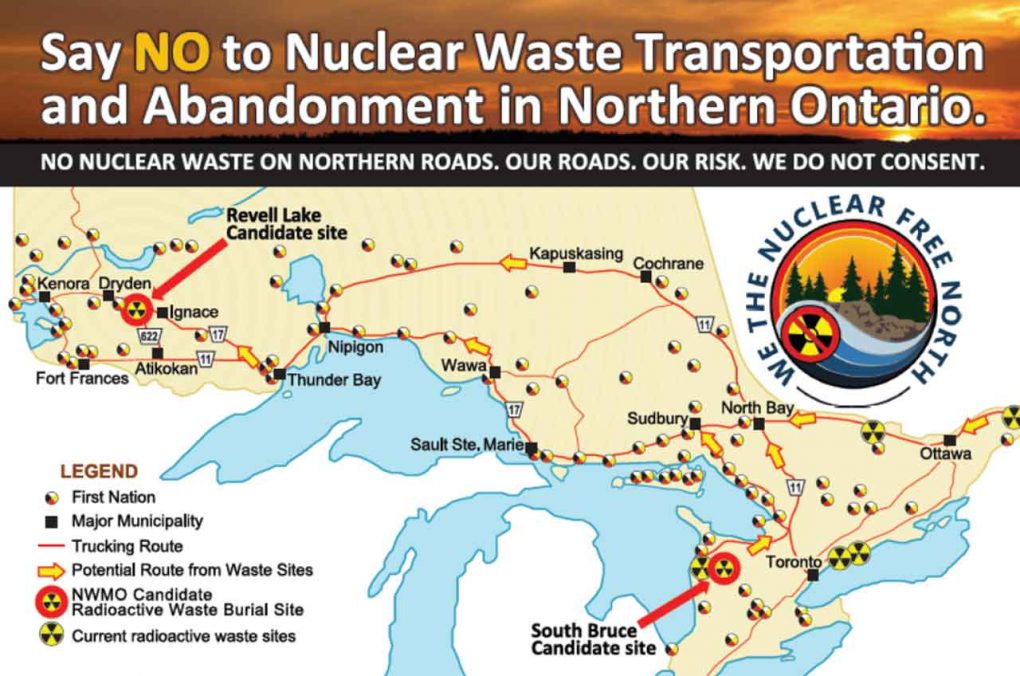
By NNL Digital News Update, March 14, 2024
Kitchenuhmaykoosib Inninuwug – Environment – Leaders from five First Nations communities in Northwestern Ontario have voiced a resolute opposition to the prospect of nuclear waste storage within their territories.
In a concerted message to the Nuclear Waste Management Organization (NWMO), these chiefs have articulated a clear rejection of any plans to introduce nuclear waste facilities into the region.
A Firm Stand on Environmental Protection
The stance against nuclear waste storage is captured in a letter addressed to Laurie Swami, President and CEO of the NWMO, an industry-funded body tasked with managing Canada’s nuclear waste. The letter outlines grave concerns about the potential for spills or leaks that could irreversibly harm the environment, disrupt the natural way of life, and have lasting impacts on future generations.
Letter to Nuclear Waste Management Organization
Signed by chiefs from Kitchenuhmaykoosib Inninuwug, Asubpeeschoseewagong (Grassy Narrows), Wapekeka, Neskantaga, and Onigaming, the letter embodies the collective apprehension of these communities.
These leaders, forming part of the First Nations Land Defence Alliance, are standing firm in their resolve to protect their lands and waters from the risks posed by nuclear waste.
Concerns Over Potential Environmental Impact Chief Donny Morris of Kitchenuhmaykoosib Inninuwug highlighted the risks associated with disturbing the Canadian Shield rock to construct an underground storage facility.
Morris emphasized the importance of environmental preservation over financial compensation and stressed the right of all regional First Nations to be involved in the consultation process.
Calls for Consideration of Alternative Sites In a pointed critique of the proposed locations for the nuclear waste repository, Steven Chapman, Kitchenuhmaykoosib Inninuwug’s lands and environment director, suggested that such facilities should first be considered in areas closer to Canada’s political centers, such as Toronto or Ottawa.
This suggestion underscores a broader call for equity and responsibility in the siting of facilities that pose environmental risks.
The NWMO has narrowed its search to two potential sites, one near Ignace and another in Southern Ontario, with a final decision expected later this year. The chiefs’ letter firmly states their lack of consultation and consent, urging the NWMO to respect their collective decision against the proposed site near Ignace.
Chiefs in the Ottawa region have also rejected the plans to store nuclear waste in their traditional territories.
As these communities stand united in their opposition, the debate over nuclear waste management in Canada continues to raise important questions about environmental stewardship, indigenous rights, and the principles of equitable decision-making in the context of national infrastructure projects.
Text of the Letter Written by Chiefs………………………………… https://www.netnewsledger.com/2024/03/14/northwestern-ontario-first-nations-chiefs-unite-against-nuclear-waste-proposal/
1 This Month
23-25 October – on Zoom – World BEYOND War’s annual global conferenc


Shut down the radiation-damaged Heysham nuclear reactors now
To see nuclear-related stories in greater depth and intensity – go to https://nuclearinformation.wordpress.com

Say No to NASA’s Reckless Nuclear Reactor on the Moon
Say No to NASA’s Reckless Nuclear Reactor on the Moon

-
Archives
- October 2026 (247)
- September 2026 (339)
- August 2026 (330)
- July 2026 (355)
- June 2026 (287)
- May 2026 (306)
- April 2026 (356)
- March 2026 (251)
- February 2026 (267)
- January 2026 (308)
- December 2025 (358)
- November 2025 (359)
-
Categories
- 1
- 1 NUCLEAR ISSUES
- business and costs
- climate change
- culture and arts
- ENERGY
- environment
- health
- history
- indigenous issues
- Legal
- marketing of nuclear
- media
- opposition to nuclear
- PERSONAL STORIES
- politics
- politics international
- Religion and ethics
- safety
- secrets,lies and civil liberties
- spinbuster
- technology
- Uranium
- wastes
- weapons and war
- Women
- 2 WORLD
- ACTION
- AFRICA
- Atrocities
- AUSTRALIA
- Christina's notes
- Christina's themes
- culture and arts
- Events
- Fuk 2022
- Fuk 2023
- Fukushima 2017
- Fukushima 2018
- fukushima 2019
- Fukushima 2020
- Fukushima 2021
- general
- global warming
- Humour (God we need it)
- Nuclear
- RARE EARTHS
- Reference
- resources – print
- Resources -audiovicual
- Weekly Newsletter
- World
- World Nuclear
- YouTube
-
RSS
Entries RSS
Comments RSS

