Trident celebrations ignore Aboriginal victims of British nuclear weapons testing
https://www.greenleft.org.au/content/trident-celebrations-ignore-aboriginal-victims-british-nuclear-weapons-testing, Linda Pearson, April 26, 2019 Issue 1218, Scotland
Campaign for Nuclear Disarmament (CND) General Secretary Kate Hudson said the plan is “morally repugnant” and the organisation is urging supporters to convey their opposition to Defence Secretary, Gavin Williamson. Two Bishops and more than 20 priests have called on Westminster Abbey to cancel the service, which is set to take place on May 3……
The rhetoric of “deterrence” and “defence” is routinely invoked by nuclear-armed states to obscure the horrifying truth about nuclear weapons and justify national security doctrines that rely on them. Nuclear weapons are unique in their destructive power; “designed to indiscriminately kill and destroy thousands of innocent civilians”, as the Bishop of Colchester told The Times last week. This reality was recognised by most of the world’s countries, which voted to ban nuclear weapons in 2017.
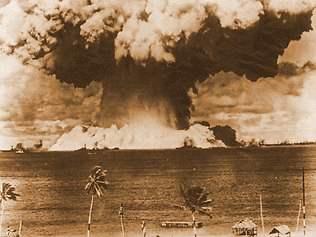
Britain’s nuclear weapons program has already destroyed the lives of countless innocent civilians. More than 1200 Indigenous Australians were exposed to radiation during British nuclear weapons testing in the 1950s and 1960s, while many others were displaced. The effects continue to be experienced by their families today. Some are now calling on the British government to apologise for the testing, instead of celebrating Trident.
Nuclear testing in Australia
Britain conducted 12 major nuclear weapons tests in Australia at the Montebello Islands, and at Emu Field and Maralinga in South Australia.
After securing the agreement of the Australian government, the British established a permanent test site at Maralinga in 1955. Seven major and several hundred “minor” tests were carried out there, releasing 100kg of radioactive materials into the surrounding area.
The British and Australian governments of the day demonstrated a callous disregard for the lives of Aboriginal people that is characteristic of the settler-colonial mindset. Permission to conduct the testing was not sought from Aboriginal landowners and the Australian government decided they should not be informed of the risks.
When an Australian scientist asked British authorities about the potential danger to local Aboriginal people, the response was that “a dying race couldn’t influence the defence of Western civilisation”.
Many Aboriginal people were forcibly removed from their land prior to the tests, destroying their way of life. Others experienced serious health issues as a result of their exposure to radiation.
Yankunytjatjara man Yami Lester went blind after a “black mist” from the explosions enveloped his country. Others experienced skin rashes, diarrhea and vomiting. Today, Aboriginal communities in the area experience high rates of diseases associated with the effects of radiation poisoning.
Yami Lester’s daughter, Karina Lester, and her family played a crucial role in the International Campaign to Abolish Nuclear Weapons (ICAN). They collected and shared stories from the survivors of nuclear weapons testing that were instrumental in convincing 122 states that the only safe way to deal with nuclear weapons is to eliminate them.
ICAN won the Nobel Peace Prize for its efforts to bring about the 2017 United Nations Treaty on the Prohibition of Nuclear Weapons. The historic treaty recognises “the disproportionate impact of nuclear-weapon activities on Indigenous peoples”. The British and Australian governments boycotted the UN negotiations, however, and have ruled out signing the treaty.
No cause for celebration
Karina Lester said “survivors of the British Nuclear Tests carried out on Australian soil in the 1950’s and 1960’s in South Australia’s outback are still haunted. The Indigenous communities still suffer with high numbers of deaths, cancers, respiratory illnesses and autoimmune disease.”
Several attempts to clean up the Maralinga site have been made by British and Australian governments, thanks to the campaigning of survivors like Yami Lester, but contamination at the site remains. In 1995, Aboriginal peoples received just £7.5 million for the loss and contamination of their land. Only £110,000 has been paid to five Aboriginal people to compensate for their exposure to radiation. A class action was blocked by Britain’s Supreme Court in 2013.
Karina Lester said that the affected communities “have had no apology for the wrongdoings on our traditional lands to this day. As the British Government celebrates 50 years with nuclear weapons, Australia’s Indigenous communities in South Australia wear the scars.”
Instead of celebrating, Lester said, “we Indigenous South Australians urge the British government to own up and apologise for your actions
Aboriginal communities in South Australia now fear that they will be forced to bear the risks of radioactive contamination again. The Australian government is currently considering three sites for the location of a national nuclear waste dump, two on Barngarla land, near Kimba, and one on Adnyamathanha land at Wallerberdina Station, near the Finders Ranges.
The dump will host nuclear material currently stored at different sites in Australia, plus waste from Britain pursuant to a 2012 agreement between the British and Scottish governments. The agreement relates to waste generated by the reprocessing of Australian nuclear fuel at Dounreay. However, that waste is to remain where it is and a substituted amount will be shipped from the Sellafield nuclear reprocessing and decommissioning site, located on the coast of the Irish Sea.
The views of traditional owners have been sidelined throughout the process for choosing the dump’s location and Adnyamathanha’s traditional owners say that federal government contractors have already damaged sacred sites. As a result, two separate human rights complaints are outstanding in Australian courts.
Campaigners have called on the British and Scottish governments to halt the shipment while there is a risk that it will end up dumped on Aboriginal land without the consent of the Traditional Owners. However, the British government said the shipment “will comply with all relevant international laws” and the eventual destination of the waste is “a matter for the Australian authorities”. The British Environment Agency has so far failed to respond to requests to halt the shipment of waste from Sellafield.
The Scottish government has also failed to act to stop the shipment, despite expert advice it commissioned, which states that the Scottish Environment Protection Agency and, ultimately, Scottish ministers could refuse to authorise the shipment on human rights grounds.
Britain’s plans to celebrate 50 years of at-sea nukes erases the experience of Indigenous people affected by nuclear weapons testing. Those experiences should be front and centre in any discussion about nuclear weapons, as ICAN recognised.
Instead of celebrating, we should be looking at ways to redress the past and prevent future harm. Britain should apologise for its nuclear weapons testing and pay adequate compensation to those affected. The shipment of nuclear waste from Sellafield should be stopped.
But there is only one way we can prevent more lives being destroyed by nuclear weapons and that is by eliminating them altogether. https://www.greenleft.org.au/content/trident-celebrations-ignore-aboriginal-victims-british-nuclear-weapons-testing
Revealingthe horror of white Australia’s massacres of Aboriginal people
|
As the toll of Australia’s frontier brutality keeps climbing, truth telling is long overdue, The myth of benign, peaceful settlement persists today – even as historians reveal a far more sinister picture• The Killing Times: the massacres of Aboriginal people Australia must confront
• A massacre map of the frontier wars – interactive Guardian by Paul Daley, 4 Mar 19 “………… The Australian Museum estimates that pre-European invasion in 1788, about 750,000 Indigenous people (representing some 700 language groups) inhabited the continent that would become Australia. This figure may well be an underestimate. Little over a century later, by federation in 1901, the Aboriginal and Torres Strait Island population had diminished to some 117,000. Black-white warfare and organised massacres, no matter how you define them, with police, British soldiers, native police, militia and raiding parties as the perpetrators, accounted for many tens of thousands of deaths. Individual acts of violence – including shootings, poisonings, torture and illegal incarceration – killed many more. Battle wounds, starvation (owing to the depletion of traditional hunting grounds) and disease – all of which can also be directly linked to invasion and frontier conflict – killed countless others. Yet the historiographic confect of benign, peaceful settlement and the unexplained “passing” or “extinction” of the “natives” pervaded well into the 1960s, replete with the deception that very few Aboriginal people died violently during pastoral and urban expansion and dispossession. Things began to change with the emergence of a new, more inquisitive, less empire-centric cohort of historians and writers who, not content with the Anglophile colonial trope of terra nullius and benevolence to the Indigenes, began to commit truth to the page……….. In the 1970s and 1980s a number of historians – among them Henry Reynolds, Marilyn Lake and Richard Broome – began focusing on frontier violence, using the colonial records, newspaper archives and family histories (including generational oral accounts of killings). Reynolds is acknowledged as the first Australian historian to make a calculated continental estimate of the number of Aboriginal and Torres Strait Islanders who died violently in Australian frontier conflict. In his 1981 book, The Other Side of the Frontier, and after at least a decade’s research Reynolds estimated the figure at about 20,000………. Reynolds speaks of the significance of Evans and Ørsted-Jensen’s research on the numbers of killings in colonial Queensland. Based on an extrapolation of native police documentation, they estimated (conservatively) that as many as 60,000 Aboriginal people died in frontier violence in Queensland alone. The national implications of the figure are profound; the wars that raged across this continent from 1788 did, it seem, claim more Indigenous lives than 62,000 Australian service personnel who died in the first world war………… https://www.theguardian.com/australia-news/2019/mar/04/as-the-toll-of-australias-frontier-brutality-keeps-climbing-truth-telling-is-long-overdue |
|
Remembering the success of an indigenous fight against nuclear waste dumping
Fight against nuclear waste dump remembered at Ward Valley Spiritual Gathering http://www.mohavedailynews.com/needles_desert_star/fight-against-nuclear-waste-dump-remembered-at-ward-valley-spiritual/article_90eb72d6-389e-11e9-b4f7-9f6fab400ac1.html. By GENTRY MEDRANO Director, Fort Mojave Indian Tribe Public Relations Department, 25 Feb 19,
Scotland kow tows to UK and Australian govts – rejects courageous Aboriginal appeal against nuclear waste transport
Last ditch aborigine appeal to Scotland to stop nuclear waste transfers to Australia, https://www.heraldscotland.com/news/17391290.last-ditch-aborigine-appeal-to-scotland-to-stop-nuclear-waste-transfers-to-australia/?ref=fbshr&fbclid=IwAR3r2Lqdv0V66rc7I8PrKJme4mkAsIx2Wtd5bv-Vy_XeT1i3GOgi_Mr By Martin Williams @MWilliamsHT 29 Jan 19, SOME of the Aborigines who live in and around a sacred burial place in South Australia can still remember the clouds of poison that were the result of Britain’s nuclear bomb tests in the 1950s.
Nuclear waste finally removed from Sequoyah Fuels site
Nuclear waste removed from Sequoyah Fuels site Cherokee Nation, GORE, Okla. 30 Nov 18— A semitrailer quietly left the former Sequoyah Fuels Corporation site near Gore this week, hauling away the last of 511 loads of nuclear waste that has plagued Sequoyah County and its citizens for decades.
The Cherokee Nation and Oklahoma attorney general’s office worked for 18 months to ensure the off-site disposal of 10,000 tons of radioactive material were removed from the Sequoyah Fuels site. The waste was transported to a disposal site in Utah where the uranium will be recycled and reused, leaving the area near the Arkansas River free of this nuclear waste for the first time in nearly 50 years.
“It is a historic day for the Cherokee Nation and the state of Oklahoma. Our lands are safe again, now that we have removed a risk that would have threatened our communities forever,” Cherokee Nation Secretary of State Chuck Hoskin Jr. said. “This would not have been possible if the tribe and state had not worked tirelessly together in court to ensure removal of this material.”
The uranium processing plant was opened by Kerr-McGee in 1970. It converted yellowcake uranium into fuel for nuclear reactors. The plant changed ownership more than once and was eventually sold to General Atomics under the name Sequoyah Fuels Corporation.
An accident at the plant killed one worker and injured dozens of others in 1986. Another accident in 1992 injured about three dozen workers. Following that accident and years of violating numerous environmental rules and nuclear safety standards, the plant was closed in 1993.
Tons of radioactive waste remained at the facility when it closed, so in 2004 the Cherokee Nation and state of Oklahoma entered into a settlement agreement that required the highest-risk waste be removed from the site. The owners of Sequoyah Fuels Corporation announced in 2016 their intention to bury the waste on site, but a judge forced the company to comply with the original agreement. Removal of the material is now complete.
“The Cherokee Nation has been in and out of court with Sequoyah Fuels since 2004, and now this material is no longer a ticking time bomb on the banks of the Arkansas River, one of our most precious natural resources,” Cherokee Nation Secretary of Natural Resources Sara Hill said. “Decommissioning this plant was never enough to satisfy our goals for a clean and safe environment. Removal of this highly contaminated waste was our goal, and we’re pleased that goal has finally been achieved.”
The plant is located where the Arkansas River and Illinois River meet.
“Today’s announcement is another example of the strength behind the continued partnership between the state of Oklahoma and the Cherokee Nation,” said Attorney General Mike Hunter. “The successful outcome is also affirmation of my office’s commitment to finding avenues of collaboration with tribal governments to ensure our state’s natural resources remain protected and our citizens and communities remain safe.”
Sequoyah County is home to 41,000 residents. Many of those residents are Cherokee and were once employed at the plant, where dozens of workers were injured over the years…….http://webtest2.cherokee.org/News/Stories/20181130_Cherokee-Nation-state-of-Oklahoma-city-of-Gore-announce-nuclear-waste-removed-from-Sequoyah-Fuels-site
Aboriginal group’s unwavering struggle against uranium mining in Western Australia
Fighting for life in the “place of death”https://beyondnuclearinternational.org/2018/08/27/fighting-for-life-in-the-place-of-death/ August 27, 2018
Traditional owners won’t give up 40-year opposition to Yeelirrie uranium mine, By Linda Pentz Gunter
In the local Aboriginal language, the name Yeelirrie means to weep or mourn. It is referred to as a “place of death.” Yeelirrie is on Tjiwarl Native Title lands in Western Australia, where it has long been faithfully protected by Aboriginal traditional owners. The Seven Sisters Dreaming songline is there. It is home to many important cultural sites. And for 40 years, due to resolute indigenous opposition, and thousands of community submissions of protest, it had been spared plans by the Canadian mining company, Cameco, to plunder it for uranium.
The earth guardians know that such a desecration would cause the extinction of multiple species of subterranean fauna. It would release death. It would destroy Yeelirrie.
Now the fate of those tiny creatures hangs in the balance, their future in the hands of three brave women, backed by environmental organizations, after the outgoing Western Australian government decided to allow the Yeelirrie uranium mine project to go forward.
That decision was made in January 2017, despite the fact that, in August 2016, the Western Australia Environmental Protection Agency (WAEPA) had recommended that the Yeelirrie project be rejected.
The Conservation Council of Western Australia (CCWA), which is engaged in contesting the uranium mining permit for Yeelirrie, said the WAEPA had rejected the Yeelirrie mine plan “on the grounds that the project is inconsistent with three of the objectives of the Environmental Protection Act — the Precautionary Principle, the Principle of conservation of biological diversity, and the Principle of intergenerational equity. The EPA decision was based on the overwhelming evidence that the project would make several species of subterranean fauna extinct.”
But former Minister for Environment, Albert Jacob, threw all that aside to approve the Yeelirrie mine in the waning days of Western Australia’s Liberal government, now replaced by Labor, which came in on a mandate to end uranium mining that it now may not be able to enforce.
In February 2018, CCWA and three members of the Tjiwarl community initiated proceedings in the Western Australia Supreme Court in an attempt to invalidate the approval decision made by Jacob. The case was dismissed by the court, a decision said CCWA executive director, Piers Verstegen, that shows that “our environmental laws are deeply inadequate,” and “confines species to extinction with the stroke of a pen.”
However, while the decision was a set-back, Verstegen said, “it’s absolutely not the end of the road for Yeelirrie or the other uranium mines that are being strongly contested here in Western Australia.”
Accordingly, CCWA and the three Tjiwarl women — Shirley Wonyabong, Elizabeth Wonyabong, and Vicky Abdullah (pictured left to right above the headline) vow to fight on, and have begun proceedings in the WA Court of Appeal to review the Supreme Court decision.
“I grew up here, my ancestors were Traditional Owners of country, and I don’t want a toxic legacy here for my grandchildren,” Abdullah told Western Australia Today in an August 2017 article.
“We have no choice but to defend our country, our culture, and the environment from the threat of uranium mining — not just for us but for everyone.”
Yeelirrie is one of four uranium mines proposed for Western Australia. The other three are Vimy’s Mulga Rock project, Toro Energy’s Wiluna project, and Cameco’s and Mitsubishi’s Kintyre project. Each of them is home to precious species, but Yeelirrie got special attention from the WAEPA because the proposed mine there would cause actual extinctions of 11 species, mostly tiny underground creatures that few people ever see.
According to a new animated short film, produced by the Western Australia Nuclear-Free Alliance, all four of these proposed mines could irreparably damage wildlife, habitat and the health of the landscape and the people and animals who depend on it. The film highlights Yeelirrie, but also describes the other three proposed uranium mines and the threats they pose.
At Mulga Rock, in the Queen Victoria Desert, the site is home to the Sandhill Dunnart, the Marsupial Mole, the Mulgara and the Rainbow Bee Eater, according to the film.
Wiluna, a unique desert lake system, could see uranium mining across two salt lakes that would leave 50 million tonnes of radioactive mine waste on the shores of Lake Way, which is prone to flooding.
The Kintyre uranium deposit was excluded from the protection of the Karlamilyi National Park within which it sits so that uranium could be mined there. It is a fragile desert ecosystem where 28 threatened species would be put at risk, including the Northern Quoll, Greater Bilby, Crest Tailed Mulgara, Marsupial Mole and Rock Wallaby.
At Yeelirrie, says the CCWA, “Cameco plans to construct a 9km open mine pit and uranium processing plant. The project would destroy 2,421 hectares of native vegetation and generate 36 million tonnes of radioactive mine waste to be stored in open pits.”
The mine would likely operate for 22 years and use 8.7 million litres of water a day.
Under Australian laws, ‘nuclear actions’ like the Yeelirrie proposal also require approval by the Federal Environment Minister. CCWA and Nuclear-Free Western Australia, have launched a campaign directed at Federal Environment Minister, Josh Frydenberg, calling for a halt to the Yeelirrie mine, given the immense risk it poses to “unique subterranean fauna that have been found nowhere else on the planet.” They point out that the Minister has the opportunity to “protect these unique species from becoming extinct.
“Species have a right to life no matter how great or small,” they wrote. “One extinction can massively disrupt an entire ecosystem. No one should have the right to knowingly eliminate an entire species from our planet forever.”
Australian Aboriginal group win injunction to halt vote on nuclear waste dumping
South Australian Aboriginal group wins injunction to halt nuclear ballot http://www.abc.net.au/news/2018-08-16/aboriginal-group-wins-injunction-to-halt-nuclear-ballot/10129292, By Claire Campbell
Small Australian town to vote on nuclear waste dump, but Aboriginal land owners excluded from vote
Traditional owners “locked out” of nuclear waste vote, InDaily, 3 Aug 18 Stephanie Richards The head
of the Adnyamathanha Traditional Lands Association says the majority of Adnyamathanha people have been denied a vote on a proposed radioactive waste management facility near the town of Hawker in the Flinders Rangers.
Wallerberdina Station, located approximately 30km northwest of Hawker on Adnyamathanha country, has been shortlisted by the Federal Government for a facility that will permanently hold low-level nuclear waste and temporarily hold intermediate level waste.
It is one of three sites, the other two situated close to Kimba, that were shortlisted by the Federal Government to store nuclear waste.
The selection process is entering its final stages, with a postal ballot beginning on August 20 to measure community support for the three nominated sites.
But ATLA CEO Vince Coulthard said the voting guidelines were disrespectful to traditional owners, as the majority of Adnyamathanha people do not live close enough to the proposed Wallerberdina site to be eligible to vote.
The voting range includes residents of the Flinders Ranges Council and those who live within a 50km radius of the Wallerberdina site.
According to Coulthard, there are approximately 2500 Adnyamathanha people in total but only about 300 Adnyamathanha people who live in the voting range.
Coulthard said about 50 Adnyamathanha people who lived outside the voting range had expressed interest in voting, but when ATLA asked Federal Resources Minister Matt Canavan during a consultation trip to Hawker last week if those people could be granted a vote, Coulthard said Canavan told him that only those living in the prescribed voting range could participate.
“It’s a crazy situation,” Coulthard said.
“This is Adnyamathanha country and it is a very important place to the Adnyamathanha nation.
“People have strong connections to land. There’s a large amount of people, many who don’t live on the land but they go back on a regular basis to travel around the land.”
……… Coulthard said he was disappointed that Canavan had not consulted with all ATLA members during his consultation visit.
He said Adnyamathanha people had been “locked out” from the vote, despite holding native title rights over the land.
“Canavan is saying this will strengthen our culture, that this will be good for us, but what it is actually doing is punishing the environment.
“This is a place where we have gone to get bush tucker, where we have come as traditional owners for thousands of years.
They’ve shown us disrespect and this is very hurtful.”
The proposed site holds sacred meaning for Adnyamathanha people, as it is located close to the Hookina Waterhole and ancient burial sites.
…….. Last month, the Federal Government tripled the incentive package for the community that hosts the nuclear waste repository.
The Government had promised to spend more than $10 million in the district where the facility is built, but under new incentives announced by Canavan, the Government increased funding to $31 million.
……. The Government has previously indicated it wants to choose a preferred site before the end of this year. https://indaily.com.au/news/2018/08/03/traditional-owners-locked-out-of-nuclear-waste-vote/
Navajo Nation urges wider availability of compensation for radiation exposure due to Cold War nuclear testing
Navajo Nation urges expansion of radiation exposure law https://www.nhonews.com/news/2018/jul/17/navajo-nation-urges-expansion-radiation-exposure-l/ SHIPROCK, N.M. (AP) 17 July 18 — From the end of World War II to the mid-1980s, about 30 million ton of uranium ore were extracted from lands belonging to the nation’s largest American Indian reservation. Today, across the Navajo Nation, sit dozens of abandoned uranium mines and the high risk to residents of contamination exposure.
Now, the Navajo Nation is urging the U.S. Congress to expand a federal law that compensates people who were exposed to radiation resulting from nuclear bomb tests stemming from the Cold War.
Currently, the law only covers people who lived downwind from nuclear test sites in Nevada, Arizona and Utah, as well as workers in the uranium mining industry in a dozen states. But the tribe says it’s time for Navajo Nation workers after 1971 to be included.
“Many members of the federal government are not aware of the effects uranium mining has had on Navajo people,” Navajo Nation President Russell Begaye said. “They don’t see the consequences of radiation exposure.”
Most claims under the Radiation Exposure Compensation Act come from the Four Corners region where New Mexico, Arizona, Colorado and Utah meet. Proposed amendments would expand the cutoff for uranium mining workers from 1971 to 1990.
Navajo officials say those workers were exposed to the same harmful conditions.
The push by the Navajo Nation comes as residents of the New Mexico village of Tularosa near the site of the world’s first atomic bomb test also want to be covered under the law. The Tularosa Basin Downwinders and Navajo Nation Vice President Jonathan Nez testified before a U.S. Senate committee last month examining potential changes to the law.
A bill proposed by U.S. Sen. Tom Udall of New Mexico would expand eligibility for payouts under the Radiation Exposure and Compensation Act of 1990.
Tina Cordova, co-founder of the Tularosa consortium, said many who lived in the area weren’t told about the dangers of the first atom bomb test, known as the Trinity Test, on generations of residents and later were diagnosed with rare forms of cancer.
Scientists working in Los Alamos developed the atomic bomb as part of the Manhattan Project, which provided enriched uranium for the weapon. The secret program also involved facilities in Oak Ridge, Tennessee, and Hanford, Washington.
The bomb was tested in a stretch of desert near towns with Hispanic and Native American populations.
Federal and tribal officials support proposed amendments to the Radiation Exposure Compensation Act

Officials seek support for radiation exposure compensation amendments https://www.daily-times.com/story/news/local/navajo-nation/2018/06/30/officials-seek-support-radiation-exposure-compensation-amendments/740239002/,
Adivasis (indigenous people) in a remote area of India, suffer health effects from the nuclear industry?
News Click 21st June 2018 , Sanjay Gope, a 13-year-old boy from Bango village near Jadugora town in
East Singhbhum district of Jharkhand, cannot move or speak because he has
been suffering from muscular dystrophy – a group of disorders that
involves a progressive loss of muscle mass and consequent loss of strength
– for the past nine years. At least one person of his family has to be
with him all the time to look after him. He cannot be left unattended.
Eighteen-year-old Parvati Gope from the same village is suffering from
lumbar scoliosis – a C-shpaed curve formation of her vertebral column.
Rakesh Gope, a 13-year-old school-going boy, is also suffering from
muscular dystrophy. Although he is active and walks with arched feet and
soles, he is unable to speak normally.
A three-year-old child Kartik Gope has been having seizures since birth and is developing muscular dystrophy
too. These examples are not enough; there are hundreds of such cases of
congenital illness and other birth defects in addition to high incidence of
infertility, miscarriages and pre-mature deliveries.
Now, a pertinent question arises here: why are such large number of health hazards being
reported from this remote and overlooked corner of the country? While India
is dreaming to become energy efficient by 2032 by generating 63 Gigawatts
of nuclear power, it is taking a major toll on human lives in a small
township of Jharkhand. Jadugora has the deposits of world’s best quality
uranium ore, magnesium diuranate. It is because of the rich deposits of the
region, India is capitalising its nuclear dreams. The whole belt of the
reactors is affecting the Adivasis (indigenous people) disproportionately
in and around the uranium mining operational area.
https://newsclick.in/uranium-mining-jharkhand-radioactive-poisoning-ravaging-lives-villages
Measures to compensate Arizona “Downwinders” approved by USA Congress
U.S. House Approves Measure to Compensate Arizona ‘Downwinders’ http://knau.org/post/us-house-approves-measure-compensate-arizona-downwinders, By RYAN HEINSIUS 31 May 18 • Many Southwesterners sickened by Cold War nuclear weapons testing were excluded from a 1990 federal compensation program. Now the U.S. House has approved a measure aimed at providing relief to the residents known as downwinders. KNAU’s Ryan Heinsius reports.
The original Radiation Exposure Compensation Act left out parts of Mohave County, the Hualapai Reservation, and southern Nevada, despite high rates of cancer and other diseases thought to be caused by nuclear fallout. The new House amendment orders the National Cancer Institute and the Centers for Disease Control and Prevention, to assess whether thousands are eligible for assistance.
“The American government made a promise with RECA, with the bill, and, by darn, we ought to follow through with it to make sure that anybody that was affected to be included in this process,” says Arizona Republican Paul Gosar who authored the measure.
Residents who’ve developed some diseases could be eligible for a $50,000 payment, and have until July 9, 2022 to file claims.
Nearly 200 atmospheric weapons were tested north of Las Vegas between 1945 and 1962. In the last three decades, more than 20,000 downwinder claims have been filed with the Justice Department, totaling more than $2 billion.
South Australia’s Aboriginal people fight against nuclear waste dumping – again and again
EXTRACT from: A journey to the heart of the anti-nuclear resistance in Australia: Radioactive Exposure Tour 2018, NUCLEAR MONITOR Author: Ray Acheson ‒ NM859.4719, May 2018 “……The federal government of Australia wants to build a facility to store and dispose of radioactive waste in South Australia, either at Wallerberdina Station near Hawker or on farming land in Kimba.
Wallerberdina Station is located in the Flinders Ranges, the largest mountain range in South Australia, 540 million years old. Approaching from the north on our drive down from Lake Eyre can only be described as breathtaking. The red dirt, the brown and green bush, and the ever-changing purples, blues, and reds of the mountains themselves are some of the most complex and stunning scenes one can likely see in the world.
Most people might find it shocking that the federal government would want to put a nuclear waste dump smack in the middle of this landscape. But after visiting other sites on the Rad Tour, it was only yet another disappointment ‒ and another point of resistance.
What is known is that the Wallerberdina site is of great cultural, historical, and spiritual significance to the Adnyamathanha people. It borders the Yappala Indigenous Protected Area, which is a crucial location for biodiversity in the Flinders Ranges. Its unique ecosystem provides a refuge for many native species of flora and fauna, contains many archaeological sites as well as the first registered Aboriginal Songline of its type in Australia, and is home to Pungka Pudanha, a natural spring and sacred woman’s site.
In case that isn’t enough, the area is a known floodplain. Our travels around the proposed site contained ample evidence of previous floods that sent massive trees rushing down the plain, smashing into each other and into various bridges and other built objects. The last big flood occurred in 2006.
The Adnyamathanha Traditional Owners were not consulted before their land was nominated for consideration by the government for the waste dump. “Through this area are registered cultural heritage sites and places of huge importance to our family, our history and our future,” wrote Adnyamathanha Traditional Owners in a 2015 statement. “We don’t want a nuclear waste dump here on our country and worry that if the waste comes here it will harm our environment and muda (our lore, our creation, our everything).”
We met Adnyamathanha Traditional Owners Vivianne and Regina McKenzie, and Tony Clark, at the proposed site. They invited us into the Yappala Indigenous Protected Area to view the floodplains and swim in the beautiful Pungka Pudanha. We’d just been camping at Wilpena Pound in the Flinders Ranges National Park only a few kilometres away. It is impossible to understand the government’s rationale for wanting to build a toxic waste dump on this land so cherished by its Traditional Owners, local communities, and tourists alike.
The McKenzies have been working tirelessly to prevent the proposed dump from being established, as have other local activists. Fortunately, they have some serious recent successes to inspire them. In 2015, the federal government announced a plan to import 138,000 tonnes of high-level nuclear waste from around the world to South Australia as a commercial enterprise. But Traditional Owners began protesting immediately, arguing that the so-called consultations were not accessible and that misinformation was rife. In 2016, a Citizen’s Jury, established by then Premier Jay Weatherill and made up of 350 people, deliberated over evidence and information. In November that year, two-thirds of the Jury rejected “under any circumstances” the plan to import or store high-level waste.24 They cited lack of Aboriginal consent, unsubstantiated economic assumptions and projections, and lack of confidence in the governmental proposal’s validity.
Other battles against proposed nuclear waste dumps have been fought and won in South Australia. From 1998 to 2004, the Kupa Piti Kungka Tjuta, a council of senior Aboriginal women from northern South Australia, successfully campaigned against a proposed national nuclear waste dump near Woomera. In an open letter in 2004, the Kungkas wrote: “People said that you can’t win against the Government. Just a few women. We just kept talking and telling them to get their ears out of their pockets and listen. We never said we were going to give up. Government has big money to buy their way out but we never gave up.”
Connected communities
The attempts by the Australian government and the nuclear industry to impose a waste dump in the Flinders Ranges, just like their attempts to impose waste dumps and uranium mines elsewhere in the country, or their refusal to compensate victims and survivors of nuclear testing, are all mired with racism. They are rooted in a fundamental dismissal and devaluation of the lives and experiences of indigenous Australians, and of proximity to cities but more importantly, to power.The industry and government’s motivations for imposing nuclear violence on these people and this land are militarism and capitalism.
Profit over people. Weapons over wellbeing. Their capacity for compassion and duty of care has been constrained by chronic short-termism ‒ a total failure to protect future generations. The poison they pull out of the earth, process, sell, allow others to make bombs with, and bury back in the earth, wounds us all now and into the future.
But nuclear weapons are now prohibited under international law. New actors are challenging the possession of nuclear weapons in new ways, and nucleararmed states are facing a challenge like never before.
The nuclear energy industry ‒ and thus the demand for uranium ‒ is declining. Power plants are being shuttered; corporations are facing financial troubles. Dirty and dangerous, the nuclear industry is dying.
This is in no small part due to the relentless resistance against it. This resistance was fierce throughout all of the country we visited, from Woomera up to Lake Eyre, from Roxby Downs to the Flinders Ranges. We listened to stories of those living on this land, we heard their histories, witnessed their actions, and supported their plans…..
Holtec’s nuclear colonialism in New Mexico
Proposed nuclear storage site in southeast New Mexico accused of ‘nuclear colonialism’
-
Archives
- April 2026 (338)
- March 2026 (251)
- February 2026 (268)
- January 2026 (308)
- December 2025 (358)
- November 2025 (359)
- October 2025 (376)
- September 2025 (257)
- August 2025 (319)
- July 2025 (230)
- June 2025 (348)
- May 2025 (261)
-
Categories
- 1
- 1 NUCLEAR ISSUES
- business and costs
- climate change
- culture and arts
- ENERGY
- environment
- health
- history
- indigenous issues
- Legal
- marketing of nuclear
- media
- opposition to nuclear
- PERSONAL STORIES
- politics
- politics international
- Religion and ethics
- safety
- secrets,lies and civil liberties
- spinbuster
- technology
- Uranium
- wastes
- weapons and war
- Women
- 2 WORLD
- ACTION
- AFRICA
- Atrocities
- AUSTRALIA
- Christina's notes
- Christina's themes
- culture and arts
- Events
- Fuk 2022
- Fuk 2023
- Fukushima 2017
- Fukushima 2018
- fukushima 2019
- Fukushima 2020
- Fukushima 2021
- general
- global warming
- Humour (God we need it)
- Nuclear
- RARE EARTHS
- Reference
- resources – print
- Resources -audiovicual
- Weekly Newsletter
- World
- World Nuclear
- YouTube
-
RSS
Entries RSS
Comments RSS