Adivasis (indigenous people) in a remote area of India, suffer health effects from the nuclear industry?
News Click 21st June 2018 , Sanjay Gope, a 13-year-old boy from Bango village near Jadugora town in
East Singhbhum district of Jharkhand, cannot move or speak because he has
been suffering from muscular dystrophy – a group of disorders that
involves a progressive loss of muscle mass and consequent loss of strength
– for the past nine years. At least one person of his family has to be
with him all the time to look after him. He cannot be left unattended.
Eighteen-year-old Parvati Gope from the same village is suffering from
lumbar scoliosis – a C-shpaed curve formation of her vertebral column.
Rakesh Gope, a 13-year-old school-going boy, is also suffering from
muscular dystrophy. Although he is active and walks with arched feet and
soles, he is unable to speak normally.
A three-year-old child Kartik Gope has been having seizures since birth and is developing muscular dystrophy
too. These examples are not enough; there are hundreds of such cases of
congenital illness and other birth defects in addition to high incidence of
infertility, miscarriages and pre-mature deliveries.
Now, a pertinent question arises here: why are such large number of health hazards being
reported from this remote and overlooked corner of the country? While India
is dreaming to become energy efficient by 2032 by generating 63 Gigawatts
of nuclear power, it is taking a major toll on human lives in a small
township of Jharkhand. Jadugora has the deposits of world’s best quality
uranium ore, magnesium diuranate. It is because of the rich deposits of the
region, India is capitalising its nuclear dreams. The whole belt of the
reactors is affecting the Adivasis (indigenous people) disproportionately
in and around the uranium mining operational area.
https://newsclick.in/uranium-mining-jharkhand-radioactive-poisoning-ravaging-lives-villages
Measures to compensate Arizona “Downwinders” approved by USA Congress
U.S. House Approves Measure to Compensate Arizona ‘Downwinders’ http://knau.org/post/us-house-approves-measure-compensate-arizona-downwinders, By RYAN HEINSIUS 31 May 18 • Many Southwesterners sickened by Cold War nuclear weapons testing were excluded from a 1990 federal compensation program. Now the U.S. House has approved a measure aimed at providing relief to the residents known as downwinders. KNAU’s Ryan Heinsius reports.
The original Radiation Exposure Compensation Act left out parts of Mohave County, the Hualapai Reservation, and southern Nevada, despite high rates of cancer and other diseases thought to be caused by nuclear fallout. The new House amendment orders the National Cancer Institute and the Centers for Disease Control and Prevention, to assess whether thousands are eligible for assistance.
“The American government made a promise with RECA, with the bill, and, by darn, we ought to follow through with it to make sure that anybody that was affected to be included in this process,” says Arizona Republican Paul Gosar who authored the measure.
Residents who’ve developed some diseases could be eligible for a $50,000 payment, and have until July 9, 2022 to file claims.
Nearly 200 atmospheric weapons were tested north of Las Vegas between 1945 and 1962. In the last three decades, more than 20,000 downwinder claims have been filed with the Justice Department, totaling more than $2 billion.
South Australia’s Aboriginal people fight against nuclear waste dumping – again and again

EXTRACT from: A journey to the heart of the anti-nuclear resistance in Australia: Radioactive Exposure Tour 2018, NUCLEAR MONITOR Author: Ray Acheson ‒ NM859.4719, May 2018 “……The federal government of Australia wants to build a facility to store and dispose of radioactive waste in South Australia, either at Wallerberdina Station near Hawker or on farming land in Kimba.
Wallerberdina Station is located in the Flinders Ranges, the largest mountain range in South Australia, 540 million years old. Approaching from the north on our drive down from Lake Eyre can only be described as breathtaking. The red dirt, the brown and green bush, and the ever-changing purples, blues, and reds of the mountains themselves are some of the most complex and stunning scenes one can likely see in the world.
Most people might find it shocking that the federal government would want to put a nuclear waste dump smack in the middle of this landscape. But after visiting other sites on the Rad Tour, it was only yet another disappointment ‒ and another point of resistance.
What is known is that the Wallerberdina site is of great cultural, historical, and spiritual significance to the Adnyamathanha people. It borders the Yappala Indigenous Protected Area, which is a crucial location for biodiversity in the Flinders Ranges. Its unique ecosystem provides a refuge for many native species of flora and fauna, contains many archaeological sites as well as the first registered Aboriginal Songline of its type in Australia, and is home to Pungka Pudanha, a natural spring and sacred woman’s site.
In case that isn’t enough, the area is a known floodplain. Our travels around the proposed site contained ample evidence of previous floods that sent massive trees rushing down the plain, smashing into each other and into various bridges and other built objects. The last big flood occurred in 2006.
The Adnyamathanha Traditional Owners were not consulted before their land was nominated for consideration by the government for the waste dump. “Through this area are registered cultural heritage sites and places of huge importance to our family, our history and our future,” wrote Adnyamathanha Traditional Owners in a 2015 statement. “We don’t want a nuclear waste dump here on our country and worry that if the waste comes here it will harm our environment and muda (our lore, our creation, our everything).”
We met Adnyamathanha Traditional Owners Vivianne and Regina McKenzie, and Tony Clark, at the proposed site. They invited us into the Yappala Indigenous Protected Area to view the floodplains and swim in the beautiful Pungka Pudanha. We’d just been camping at Wilpena Pound in the Flinders Ranges National Park only a few kilometres away. It is impossible to understand the government’s rationale for wanting to build a toxic waste dump on this land so cherished by its Traditional Owners, local communities, and tourists alike.
The McKenzies have been working tirelessly to prevent the proposed dump from being established, as have other local activists. Fortunately, they have some serious recent successes to inspire them. In 2015, the federal government announced a plan to import 138,000 tonnes of high-level nuclear waste from around the world to South Australia as a commercial enterprise. But Traditional Owners began protesting immediately, arguing that the so-called consultations were not accessible and that misinformation was rife. In 2016, a Citizen’s Jury, established by then Premier Jay Weatherill and made up of 350 people, deliberated over evidence and information. In November that year, two-thirds of the Jury rejected “under any circumstances” the plan to import or store high-level waste.24 They cited lack of Aboriginal consent, unsubstantiated economic assumptions and projections, and lack of confidence in the governmental proposal’s validity.
Other battles against proposed nuclear waste dumps have been fought and won in South Australia. From 1998 to 2004, the Kupa Piti Kungka Tjuta, a council of senior Aboriginal women from northern South Australia, successfully campaigned against a proposed national nuclear waste dump near Woomera. In an open letter in 2004, the Kungkas wrote: “People said that you can’t win against the Government. Just a few women. We just kept talking and telling them to get their ears out of their pockets and listen. We never said we were going to give up. Government has big money to buy their way out but we never gave up.”
Connected communities
The attempts by the Australian government and the nuclear industry to impose a waste dump in the Flinders Ranges, just like their attempts to impose waste dumps and uranium mines elsewhere in the country, or their refusal to compensate victims and survivors of nuclear testing, are all mired with racism. They are rooted in a fundamental dismissal and devaluation of the lives and experiences of indigenous Australians, and of proximity to cities but more importantly, to power.The industry and government’s motivations for imposing nuclear violence on these people and this land are militarism and capitalism.
Profit over people. Weapons over wellbeing. Their capacity for compassion and duty of care has been constrained by chronic short-termism ‒ a total failure to protect future generations. The poison they pull out of the earth, process, sell, allow others to make bombs with, and bury back in the earth, wounds us all now and into the future.
But nuclear weapons are now prohibited under international law. New actors are challenging the possession of nuclear weapons in new ways, and nucleararmed states are facing a challenge like never before.
The nuclear energy industry ‒ and thus the demand for uranium ‒ is declining. Power plants are being shuttered; corporations are facing financial troubles. Dirty and dangerous, the nuclear industry is dying.
This is in no small part due to the relentless resistance against it. This resistance was fierce throughout all of the country we visited, from Woomera up to Lake Eyre, from Roxby Downs to the Flinders Ranges. We listened to stories of those living on this land, we heard their histories, witnessed their actions, and supported their plans…..
Holtec’s nuclear colonialism in New Mexico

Proposed nuclear storage site in southeast New Mexico accused of ‘nuclear colonialism’
Fears of a proposed nuclear waste repository between Carlsbad and Hobbs extended beyond the two cities, stirring anxiety from residents across New Mexico and west Texas.
Leona Morgan, co-coordinator of the Albuquerque-based Nuclear Issues Study Group and a Diné activist, said the potential horrors of nuclear exposure were already felt by Native American residents in the Four Corners Region of New Mexico, where uranium was mined until the late 1990s.
Morgan said the concerns of Native Americans, such as the Navajo Nation, are often ignored by the federal government.
“I’ve heard a lot of warm sentiments about how this part of the state knows about nuclear science, and how much you all welcome it,” she said.
“In our part of the state, we know about the cancers, and the contamination of our lands and our water. We know this will impact us for generations to come.”
Holtec International, a New Jersey-based company specializing in nuclear storage, applied to the U.S. Nuclear Regulatory Commission in March 2017 for the first phase of an interim storage facility for spent nuclear fuel rods.
The first phase would include 500 canisters of spent nuclear fuel rods, brought in by rail cars from nuclear power plants across the country, and stored at the property about 35 miles east of Carlsbad.
In total, 10,000 canisters could be stored at the site, totaling up to 120,000 metric tons of spent nuclear fuel.
 The Holtec project is intended as a temporary storage facility, until a permanent repository is developed. [i.e. stranded wastes – just as is planned for Kimba, South Australia]
 The concept of interim storage was first devised as a proposal for a permanent disposal facility in Yucca Mountain, Nevada, recently stalled.
Opponents of Holtec’s proposal contended the waste should be stored at the generator sites on an interim basis, and only moved when a permanent repository is available.
…. Morgan said the project was an example of “nuclear colonialism,” forcing low-income and minority-majority regions to unfairly bear the risk of storing nuclear waste.
“The contamination that was left by the United States government is an atrocity. It is a sin,” she said. “It is a violation of our human rights, and it is a form of genocide. New Mexico should not be proud of its nuclear legacy. It is the birth place of nuclear colonialism.”
Myriad activists, scientists, local leaders and business owners spoke for and against the project at Thursday’s meeting.
The debate centered around a potential canister leak, and contamination of nearby soil and natural resources.
Karen Hadden, executive director for the Sustainable Energy and Economic Development Coalition said even with monitoring, the risk of radiation exposure was too high to support the project.
A similar, smaller interim storage facility was proposed near Andrews, Texas – about 40 miles across the eastern state line, by Waste Control Specialists (WCS) and French nuclear company Orano.
The project was re-docketed by the NRC earlier this year, after it stalled.
“They’re both a risk to our communities,” Hadden said of the facilities. “This is a project of huge magnitude that could impact this entire country. It cannot be taken lightly.”
She said the consequence of Holtec’s proposal could be felt across the nation, and residents from outside Carlsbad, and along the transport paths, deserve a place at the table.
“I am unhappy about some of the statements made earlier that some who do not favor bringing the nation’s waste here are uninformed, or fear mongering,” she said. “This site (Holtec) poses more risk to the people of Texas than WCS. All the trains would come through our state. It’s a shared concern.” ……. Adrian Hedden can be reached at 575-628-5516,achedden@currentargus.com or @AdrianHedden on Twitter. https://www.currentargus.com/story/news/local/2018/05/04/nuclear-storage-site-southeast-new-mexico-navajo-nation-nuclear-colonialism/581529002/
A voice from the heart – on the exploitation of indigenous people in the cause of nuclear weaponry
 Why do we desperately need to listen to voices from the heart?
The corporate dominated world does not like to hear voices from the heart. Oh no, there must be no emotion. We must all stick to technical jargon, statistics, the “accepted” facts, in appropriately respectable academic language.
Of course statistics, facts, and technical language have their place in the nuclear-free movement. But as long as the anti-nuclear voices remain boring, the corporate global empires do not need to worry.
This voice came as a comment today on our sister ship antinuclear.net

Jan – Janotine@asia.com– 6 May 18 -My grandad was half kiowa. His father married a native american lady, to expand his spread. She was his last wife. The other two died in child-birth. All, so he could have more slave kids to work his spread. May grandad ran away from home at age 12.
I am a westerner. I used to think the west was so grand! My family is from the west. Places like Utah, Arizona, Nevada, New Mexico, Washington, Oregon, Idaho, and yes parts of California.
Later, i realized, our frikin government, used the west as a sacrifice zone for open air nuclear bomb testing, biological and chemical warfare testing, uranium mining and processing, nuclear bomb testing.
I have been to every native nation in the west and, most in Alaska as a professional. No sane person thinks the anglos did the west any favors!
People ask me if natives or, even anglos are better off from the europeans coming in and taking america. The anglos used their rascist-Monroe Doctrine, as an excuse for the environmental destruction and genocides of the once pristine, western United States!
In the end, is the west better off? Hell no! They ruined turtle island, and the whole northern hemisphere with their insanity!
Shockley was the dumnest, white rascist ever! He might have helped invent transisters, but the genetics of Europeans and Americans are forever ruined, by the white evil-war-monkey obession, with the magic rocks.
There are very few radionuclide toxicologists in the world because, of the nuclear cosa nostra. Radionuclides are a billion times more genotoxic, teratogenic, mutagenic, carcinogenic, than the most dangerous manmade-mutagenic, chemicals, like agent orange.
Anything factual about radionuclides is verboten! Environmental health professionals, are pariahs in the war-monging, capitalist-paradigm. Health physics is nuclearist propaganda. Superior Northern-European culture and technology, is a sick-cosmic-joke.
The northern europeans culture, with it’s insane blood-lust and psychopathy, has made Europeans genetically inferior and, That’s a Fact Jack! That is the cruel irony
Time for scientists to learn from the profound ecological knowledge of indigenous people

Native Knowledge: What Ecologists Are Learning from Indigenous People https://e360.yale.edu/features/native-knowledge-what-ecologists-are-learning-from-indigenous-people
From Alaska to Australia, scientists are turning to the knowledge of traditional people for a deeper understanding of the natural world. What they are learning is helping them discover more about everything from melting Arctic ice, to protecting fish stocks, to controlling wildfires. APRIL 26, 2018
While he was interviewing Inuit elders in Alaska to find out more about their knowledge of beluga whales and how the mammals might respond to the changing Arctic, researcher Henry Huntington lost track of the conversation as the hunters suddenly switched from the subject of belugas to beavers.
It turned out though, that the hunters were still really talking about whales. There had been an increase in beaver populations, they explained, which had reduced spawning habitat for salmon and other fish, which meant less prey for the belugas and so fewer whales.
“It was a more holistic view of the ecosystem,” said Huntington. And an important tip for whale researchers. “It would be pretty rare for someone studying belugas to be thinking about freshwater ecology.”
Around the globe, researchers are turning to what is known as Traditional Ecological Knowledge (TEK) to fill out an understanding of the natural world. TEK is deep knowledge of a place that has been painstakingly discovered by those who have adapted to it over thousands of years. “People have relied on this detailed knowledge for their survival,” Huntington and a colleague wrote in an article on the subject. “They have literally staked their lives on its accuracy and repeatability.”
Tapping into this traditional wisdom is playing an outsized role in the Arctic, where change is happening rapidly.
This realm has long been studied by disciplines under headings such as ethno-biology, ethno-ornithology, and biocultural diversity. But it has gotten more attention from mainstream scientists lately because of efforts to better understand the world in the face of climate change and the accelerating loss of biodiversity.
Anthropologist Wade Davis, now at the University of British Columbia, refers to the constellation of the world’s cultures as the “ethnosphere,” or “the sum total of all thoughts and dreams, myths, ideas, inspirations, intuitions, brought into being by human imagination since the dawn of consciousness. It’s a symbol of all that we are, and all that we can be, as an astonishingly inquisitive species.”
One estimate says that while native peoples only comprise some 4 or 5 percent of the world’s population, they use almost a quarter of the world’s land surface and manage 11 percent of its forests. “In doing so, they maintain 80 percent of the planet’s biodiversity in, or adjacent to, 85 percent of the world’s protected areas,” writes Gleb Raygorodetsky, a researcher with the POLIS Project on Ecological Governance at the University of Victoria and the author of The Archipelago of Hope: Wisdom and Resilience from the Edge of Climate Change.
Tapping into this wisdom is playing an outsized role in sparsely settled places such as the Arctic, where change is happening rapidly – warming is occurring twice as fast as other parts of the world. Tero Mustonen, a Finnish researcher and chief of his village of Selkie, is pioneering the blending of TEK and mainstream science as the director of a project called the Snowchange Cooperative. “Remote sensing can detect changes,” he says. “But what happens as a result, what does it mean?” That’s where traditional knowledge can come into play as native people who make a living on the landscape as hunters and fishers note the dramatic changes taking place in remote locales – everything from thawing permafrost to change in reindeer migration and other types of biodiversity redistribution.
The Skolt Sami people of Finland, for example, participated in a study that was published in the journal Science last year, which adopted indicators of environmental changes based on TEK. The Sami have seen and documented a decline in salmon in the Näätämö River, for instance. Now, based on their knowledge, they are adapting – reducing the number of seine nets they use to catch fish, restoring spawning sites, and also taking more pike, which prey on young salmon, as part of their catch. The project is part of a co-management process between the Sami and the government of Finland.
It’s not only in the Arctic. Around the world there are efforts to make use of traditional wisdom to gain a better and deeper understanding of the planet – and there is sometimes a lot at stake.
Record brush fires burned across Australia in 2009, killing 173 people and injuring more than 400. The day the number of fires peaked – February 7 – is known as Black Saturday. It led to a great deal of soul searching in Australia, especially as climate warming has exacerbated fire seasons there.
Land managers in Australia have adopted many of the fire-control practices of the aborigines and have partnered with native people.
Bill Gammage is an academic historian and fellow at the Humanities Research Center of the Australian National University, and his book, The Biggest Estate on Earth: How the Aborigines Made Australia, looks at the complex and adept way that aborigines, prior to colonization in 1789, managed the landscape with “fire and no fire” – something called “fire stick farming.”
They used “cool” fires to control everything from biodiversity to water supply to the abundance of wildlife and edible plants. Gammage noted five stages of the indigenous use of fire – first was to control wildfire fuel; second, to maintain diversity; third, to balance species; fourth, to ensure abundance; and five, to locate resources conveniently and predictably. The current regime, he says, is still struggling with number one.
“Controlled fire averted uncontrolled fire,” Gammage says, “and fire or no-fire distributed plants with the precision of a flame edge. In turn, this attracted or deterred grazing animals and located them in habitats each preferred, making them abundant, convenient, and predictable. All was where fire or no-fire put it. Australia was not natural in 1788, but made.”
While the skill of aborigines with fire had been noted before the giant brushfires – early settlers remarked on the “park-like” nature of the landscape – and studied before, it’s taken on new urgency. That’s why Australian land managers have adopted many of the ideas and partnered with native people as co-managers. The fire practices of the aborigines are also being taught and used in other countries.
Scientists have looked to Australian natives for other insights into the natural world. A team of researchers collaborated with natives based on their observations of kites and falcons that fly with flaming branches from a forest fire to start other fires. It’s well known that birds will hunt mice and lizards as they flee the flames of a wildfire. But stories among indigenous people in northern Australia held that some birds actually started fires by dropping a burning branch in unburned places. Based on this TEK, researchers watched and documented this behavior.
“It’s a feeding frenzy, because out of these grasslands comes small birds, lizards, insects, everything fleeing in front of the fire,” said Bob Gosford, an indigenous rights lawyer and ornithologist, who worked on the research, in an interview with the Australian Broadcasting Corporation in 2016.
Another recent study down under found that an ancient practice of using fire to clear land to improve hunting also creates a more diverse mosaic of re-growth that increases the number of the primate prey species: monitor lizards and kangaroos.
“Westerners have done little but isolate ourselves from nature,” said Mark Bonta, an assistant professor at Penn State Altoona who was on a co-author on the paper on fire and raptors. “Yet those who make a point of connecting with our earth in some form have enormous knowledge because they interact with a species. When you get into conservation, [that knowledge] is even more important.” Aboriginal people “don’t see themselves as superior to or separated from animals. They are walking storehouses of knowledge,” he said.
The Maya people of Mesoamerica have much to teach us about farming, experts say. Researchers have found that they preserve an astonishing amount of biodiversity in their forest gardens, in harmony with the surrounding forest. “The active gardens found around Maya forest villagers’ houses shows that it’s the most diverse domestic system in the world,” integrated into the forest ecosystem, writes Anabel Ford, who is head of the MesoAmerican Research Center at the University of California at Santa Barbara. “These forest gardeners are heroes, yet their skill and sophistication have too long been set aside and devalued.”
Some native people have the ability to adopt the “perspective of many creatures and objects – rocks, water, clouds,” a researcher says.
Valuing these life ways is an important part of the process. For the Skolt Sami, writes Mustonen, “seeing their language and culture valued led to an increase in self-esteem and power over their resources.”
It may not just be facts about the natural world that are important in these exchanges, but different ways of being and perceiving. In fact, there are researchers looking into the relationship between some indigenous people and the very different ways they see the world.
Felice Wyndham is an ecological anthropologist and ethnobiologist who has noted that people she has worked with can intimately sense the world beyond their body. “It’s a form of enhanced mindfulness,” she says. “It’s quite common, you see it in most hunter-gatherer groups. It’s an extremely developed skill base of cognitive agility, of being able to put yourself into a viewpoint and perspective of many creatures or objects – rocks, water, clouds.
Among the most important messages from traditional people is their equanimity and optimism. There “is no sense of doom and gloom,” says Raygorodetsky. “Despite dire circumstances, they maintain hope for the future.”
Indigenous, environmental, groups warn that Canada is mismanaging nuclear wastes
Toronto Star 23rd April 2018 , Canada mishandling nuclear waste plans, Indigenous, environmental groups
warn. First Nations leaders say they have not been properly consulted about
the prospect of a nuclear waste disposal site being established northwest
of Ottawa near a prominent nuclear research centre.
Environmental groupsalso say the controversy over the site near Chalk River, Ont., illustrates
the fact that the federal government lacks suitable policies to regulate
the handling of nuclear waste. Glen Hare, deputy grand chief of the
Anishinabek Nation, says his people were not consulted about the proposed
dump site, which is located less than a kilometre away from the Ottawa
River.
https://www.thestar.com/news/canada/2018/04/23/canada-mishandling-nuclear-waste-plans-indigenous-environmental-groups-warn.html
20 years ago Australian indigenous land owners stopped Jabiluka uranium mine
Guardian 2nd April 2018, One of Australia’s proudest land rights struggles is passing an important
anniversary: it is 20 years since the establishment of the blockade camp at
Jabiluka in Kakadu national park.
This was the moment at which push would
come to shove at one of the world’s largest high-grade uranium deposits.
The industry would push, and people power would shove right back.
The blockade set up a confrontation between two very different kinds of power:
on the one side, the campaign was grounded in the desire for
self-determination by the Mirarr traditional Aboriginal owners,
particularly the formidable senior traditional owner Yvonne Margarula. They
were supported by a tiny handful of experienced paid staff and backed by an
international network of environment advocates, volunteer activists and
researchers. https://www.theguardian.com/commentisfree/2018/apr/03/20-years-on-from-the-jabiluka-mine-protest-we-can-find-hope-in-its-success
Navajo, Havasupai resist uranium mining
By Williams-Grand Canyon News , 27 Feb 18, SUPAI, Ariz. – Vice President Jonathan Nez joined Arizona State Rep. Eric Descheenie and six other runners on a run to the village of Supai Feb. 14 to collect handwritten letters from the students of Havasupai Elementary School.
The letters are addressed to U.S. President Donald Trump in response to speculation that he plans to lift a 20-year ban on uranium mining in the greater Grand Canyon region, which was established by the Obama administration in 2012.
“We came to support the efforts of Representative Eric Descheenie and the Havasupai tribe to elevate the voice of the Havasupai youth.” Vice President Jonathan Nez said. “Their voice needs to be heard, especially on issues that impact their health and way of life.”
“Uranium has killed fathers and grandfathers and great-grandfathers across the Navajo Nation. It has contaminated the water supply in numerous areas poisoning plants, animals and people. For this reason, mining and transportation of uranium are banned on Diné Bikéyah, said Vice President Nez.
At an assembly held at the school Rep. Descheenie said, “We are going to make sure your words are received and read by the president of the United States so when he makes decisions that impact your lives he does so with you in mind. You have a powerful voice and it must be heard.”
Rep. Eric Descheenie and Havasupai Chairwoman Carletta Tilousi are scheduled to hand-deliver the letters to the White House Feb. 14 at 9 p.m. …….. https://www.grandcanyonnews.com/news/2018/feb/27/navajo-havasupai-resist-uranium-mining/
Research into effects of uranium waste exposure on Native Americans
 Albuquerque Journal 5th Feb 2018, Researchers hope to measure the effects of mixed metals and uranium waste
exposure on Native American populations living in close proximity to
abandoned mines, and better understand how these toxins spread through the
environment.
That’s the objective of the newly created Superfund Research
Center at the University of New Mexico, which is funded by $1.2 million a
year for five years from the National Institute of Environmental Health
Sciences.
There are more than 4,000 abandoned uranium mines — some 500 on
the Navajo Nation alone — and some 160,000 abandoned hard rock mines
scattered throughout the West, and some 600,000 Native Americans who live
within about six miles of those sites, said center director Johnnye Lynn
Lewis, a research professor in the UNM College of Pharmacy.
https://www.abqjournal.com/1129580/researchers-to-measure-mixed-metals-mining-contamination-on-native-americans.html
Shame on Trump – Uranium mines in Bears Ears?
The implications of the story written by Hiroko Tabuchi were staggering: an area of long-held federal land only recently protected by President Barack Obama at the end of his administration for its significance to five Native American tribes could one day be pocked with uranium mines.
Tabuchi found that there are more than 300 uranium mining claims inside Obama’s boundaries for the national monument, nearly a third of which are tied to the Lakewood-based Energy Fuels Resources.
“The vast majority of those claims fall neatly outside the new boundaries of Bears Ears,” Tabuchi wrote…….
The valleys, buttes and desert landscape of Bears Ears are largely untouched and full of historical significance to the five Indian nations whose ancestors left their artifacts, ruins and hieroglyphics across the land as evidence that they were there first. Bears Ears deserves protection.
As Trump celebrated shrinking Bears Ears last month at the Utah Capitol, he said: “I’ve come to Utah to take a very historic action to reverse federal overreach and restore the rights of this land to your citizens.”
Trump is wrong. The land is still all federally owned, outside of the control and taxation of local entities. What Trump’s ruling did do was open up the possibility of private interests taking what they want from the land. Until Tabuchi’s reporting, we were all supposed to believe no one wanted this land for private gain. Now we all know the sad truth. https://www.denverpost.com/2018/01/20/uranium-mines-in-bears-ears-shame-on-trump/
Forcible displacement of Indian villagers to make way for unnecessary, uneconomic, nuclear reactors
The Kovvada Nuclear Reactor was to be built by US nuclear reactor maker, Westinghouse. But, in March 2017, Westinghouse filed for bankruptcy. The company was bled to death because of cost-escalations in two of the four nuclear power plants it designed and is constructing in the United States. “Kovvada will benefit only Westinghouse, and no one else. Not the people. Not India’s energy security,” said EAS Sarma, former Union Energy Secretary.
“India is being bamboozled by the multinationals into signing these agreements with foreign companies”
 “It is not just the US, even Europe is not gung-ho about nuclear. So, Westinghouse and GE have very little business,” said Dr Sarma. “They are looking for a market and India is fertile ground of them”
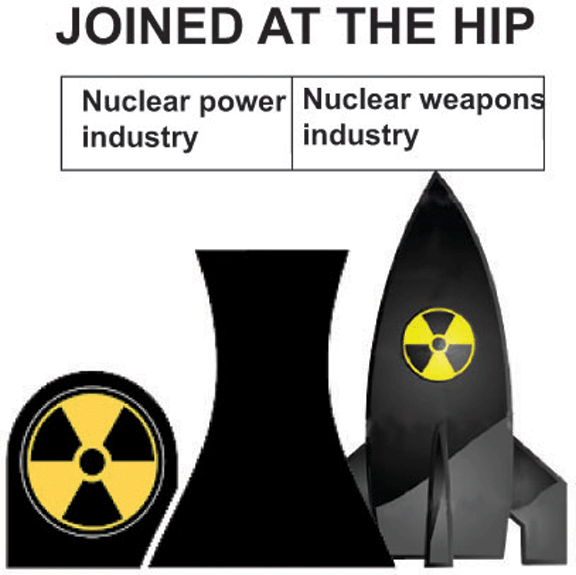
If nuclear energy is not as safe or inexpensive then why invest in it? “Because nuclear energy is a possible front for weaponisation
In Kovvada, villagers displaced forcibly even as the prospects of Westinghouse’s nuclear project remain uncertain, DiaNuke.org, JANUARY 19, 2018 Raksha Kumar | The News Minute
The coast curves through northern Andhra Pradesh and forms a giant U. Deep in the womb of this horseshoe lies Ranastalam mandal of Srikakulam district. During the light winter showers in November, this region takes on a darker shade of green. Small fishing villages are sprinkled across the uneven coast.
People here consider the vast sea their sole asset. “We have been fishermen for generations,” said Juggle Mailapally, ex-sarpanch of Chinna Kovvada village. “I was taught how to stitch a fishing net when I was 9,” he added.
Since 2008, when the Indo-US Nuclear Deal was signed, there have been rumours in the air about a giant nuclear plant taking over their idyllic existence. However only in 2015 did those rumours get confirmed.The District Collector of Srikakulam came to their village to talk to them about relocation, recollected Mailapally.
First, the villagers protested. Then they went on a year long hunger strike, which got the support of several political parties. However, their resilience proved to be weak in front of the government’s grit to see the project through.
Soon there will be six 1000MW nuclear reactors lining the coast. Over 2,074 acres in seven villages – Kovvada, Ramachandrapuram, Gudem, Kotapalem, Maruvada, Tekkali and Jeerukovvada – will house the reactors, displacing about 10,000 people.
Lands acquired
While questions about the viability of the project still persist, people of Ranastalam have had to give up their lands. The Andhra Pradesh government announced in December 2017 that the land acquisition for the project was completed successfully.
In 2014, before the current Telugu Desam Party government was voted into power for the first time in divided Andhra Pradesh, Chief Minister Chandrababu Naidu made a campaign promise to relocate the nuclear power plant from Kovvada and neighbouring villages. “Immediately after he was sworn in, he changed his stance,” said Mailapally.
After his election, efforts on the nuclear plant only accelerated. “Only TV channels owned by the opposition party showcase the hypocrisy and treachery,” said Rajesh of National Alliance for People’s Movements, who is researching the power plant. “Otherwise, the media is fairly jubilant about the project.”
According to the World Nuclear Industry Status Report 2017, the Prototype Fast Breeder Reactor (PFBR) in India has been listed as “under construction” for a decade or more. “The average construction time of the latest 51 units in ten countries that started up in the past decade, since 2007, was 10.1 years with a very large range from 4 to over 43 years,” the report reads.
In Maharashtra, work is yet to begin on the Jaitapur Nuclear Plant whose agreement was signed in December 2010.
According to the Land Acquisition, Rehabilitation and Resettlement Act of 2013, if the government does not use the land acquired for the purposes it was taken, the lands should be returned to the people. “Since nuclear energy is seeing a downward slide across the world, most proposed nuclear plants are tentative. Might never be built at all,” said Dr K Babu Rao, retired scientist, IICT.
Acquiring lands to construct a nuclear facility has certain additional rules. Atomic Energy Regulatory Board (AERB) is the national authority which is responsible for approving construction, commissioning, operation and decommissioning of nuclear power facilities in the country.
As per the AERB guidelines, 1.6 kilometres from the periphery of the project’s rim is exclusive zone – no one can inhabit that zone. Beyond that, upto 30 kilometres, the place needs to be monitored and evacuation-ready. Even though people living within those 30-odd kilometres will be exposed to high doses of radiation, compensation is given only to those whose lands are taken away.
Add to this, India has a weak Civil Nuclear Liability law, which guarantees lower compensation in case of a disaster.
Seven hundred and ninety one acres of the required 2074 acres are government lands, therefore easier to acquire for the nuclear project. However, 684 acres are lands assigned to landless poor, with a condition that they be sold only to the government. And 599 acres are private lands………
Bankruptcy
The Kovvada Nuclear Reactor was to be built by US nuclear reactor maker, Westinghouse. But, in March 2017, Westinghouse filed for bankruptcy. The company was bled to death because of cost-escalations in two of the four nuclear power plants it designed and is constructing in the United States. “Kovvada will benefit only Westinghouse, and no one else. Not the people. Not India’s energy security,” said EAS Sarma, former Union Energy Secretary………
“India is being bamboozled by the multinationals into signing these agreements with foreign companies,” said Dr Sarma. Since the 1979 Three Mile Island nuclear accident in the US, when a Pennsylvania-based nuclear plant malfunctioned, the US has been cautious in using nuclear energy. “It is not just the US, even Europe is not gung-ho about nuclear. So, Westinghouse and GE have very little business,” said Dr Sarma. “They are looking for a market and India is fertile ground of them,” he added.
Westinghouse is not alone. In May 2015, weeks after Modi’s visit to France, a French company announced it was going into loss. Areva, the French nuclear reactor manufacturer, is to design the nuclear reactor in Jaitapur, Maharashtra. The French government is desperately trying to breathe life into Areva. “Again, it is in their favour to woo India. And India is being naive,” said Dr Sarma………
A more basic question remains in the minds of most villagers. Is the nuclear power plant necessary at all? Should we invest in nuclear energy?
As on date, nuclear power constitutes only 1.83% of the total installed electricity generation capacity in India. Moreover, nuclear energy generates only 3.23% of the total electricity. With renewable sources like solar and wind energy becoming cheaper, the moot question is should the country invest in nuclear energy at all?
“Since India is planning to depend heavily on such foreign reactor suppliers, the future trajectory of nuclear development in the country is going to be uncertain and highly expensive,” said Dr Sarma.
If nuclear energy is not as safe or inexpensive then why invest in it? “Because nuclear energy is a possible front for weaponisation,” said Sukla Sen, a Mumbai-based activist.
Villagers in Kovvada have no time to think about all that. They are busy trying to think alternate modes of employment in the villages they would have to move into. http://www.dianuke.org/kovvada-villagers-displaced-forcibly-even-prospects-westinghouses-nuclear-project-remain-uncertain/
Indigenous Canadians oppose “insanity” of planned nuclear waste disposal near Ottawa River
 ‘Insanity’ to allow nuclear waste disposal near Ottawa River, Indigenous groups say http://www.cbc.ca/news/canada/ottawa/chalk-river-nuclear-waste-indigenous-1.4492937
Canadian Nuclear Laboratories facility in Chalk River, Ont., could be up and running in 2020, CBC News Jan 18, 2018 Indigenous groups say a plan to dispose of nuclear waste near the Ottawa River in eastern Ontario is “insanity” and want the federal government to intervene.
Canadian Nuclear Laboratories, a private company, wants a 10-year licence to keep running the Chalk River nuclear labs in eastern Ontario.
- Protest to oppose Chalk River nuclear licence renewal
- Waste disposal site in Chalk River raises concerns
In 2014, the federal government gave Canadian Nuclear Laboratories (CNL) control over nuclear operations at Chalk River. The government continues to own the nuclear assets.
CNL has plans for a permanent nuclear waste disposal site at Chalk River, plans that have been criticized by a concerned citizen’s group as being “cheap, dirty, unsafe and out of alignment with International Atomic Energy Agency guidance.”
Nuclear waste in Chalk River will cost billions to deal with and leave a legacy that will last centuries, opponents say.
“Trying to build this giant mound of radioactive waste … is insanity,” said Patrick Madahbee, grand council chief of the Anishinabek Nation, which advocates for around 40 communities representing around 65,000 people across Ontario.
He said CNL has an obligation under the United Nations Declaration on the Rights of Indigenous Peoples to consult Indigenous people about storing hazardous materials in their territory, but CNL hasn’t talked to them about it.
The waste facility could be operational by 2020.
“We understand this is a complex file, but clearly the risks here are to people’s drinking waters and traditional territories,” said Patrick Nadeau, executive director of the Ottawa Riverkeeper.
CNL’s licence to run the Chalk River labs expires on March 31 and the consortium has asked the regulator, Canadian Nuclear Safety Commission, for a 10-year licence agreement, rather than the usual five-year term.
The Canadian Nuclear Safety Commission will hold public hearings in Pembroke, Ont., from Jan. 23 to 25 to consider CNL’s licence.
Dozens of delegations have registered to comment at the hearings. But Mark Lesinski, president of Canadian Nuclear Laboratories said among those posed to present submissions at the hearings, there are a number of “misunderstandings.”
Uranium miners keen to pollute Navajo land even more in the Grand Canyon
 Uranium Miners Pushed Hard for a Comeback. They Got Their Wish. NYT, MONUMENT VALLEY, Utah — Garry Holiday grew up among the abandoned mines that dot the Navajo Nation’s red landscape, remnants of a time when uranium helped cement America’s status as a nuclear superpower and fueled its nuclear energy program.
It left a toxic legacy. All but a few of the 500 abandoned mines still await cleanup. Mining tainted the local groundwater. Mr. Holiday’s father succumbed to respiratory disease after years of hacking the ore from the earth.
But now, emboldened by the Trump administration’s embrace of corporate interests, the uranium mining industry is renewing a push into the areas adjacent to Mr. Holiday’s Navajo Nation home: the Grand Canyon watershed to the west, where a new uranium mine is preparing to open, and the Bears Ears National Monument to the north.
The Trump administration is set to shrink Bears Ears by 85 percent next month, potentially opening more than a million acres to mining, drilling and other industrial activity. But even as Interior Secretary Ryan Zinke declared last month that “there is no mine within Bears Ears,” there were more than 300 uranium mining claims inside the monument, according to data from Utah’s Bureau of Land Management office that was reviewed by The New York Times.
The vast majority of those claims fall neatly outside the new boundaries of Bears Ears set by the administration. And an examination of local B.L.M. records, including those not yet entered into the agency’s land and mineral use authorizations database, shows that about a third of the claims are linked to Energy Fuels, a Canadian uranium producer. Energy Fuels also owns the Grand Canyon mine, where groundwater has already flooded the main shaft.
Energy Fuels, together with other mining groups, lobbied extensively for a reduction of Bears Ears, preparing maps that marked the areas it wanted removed from the monument and distributing them during a visit to the monument by Mr. Zinke in May.
Energy Fuels’ lobbying campaign, elements of which were first reported by The Washington Post, is part of a wider effort by the long-ailing uranium industry to make a comeback.
The Uranium Producers of America, an industry group, is pushing the Environmental Protection Agency to withdraw regulations proposed by the Obama administration to strengthen groundwater protections at uranium mines. Mining groups have also waged a six-year legal battle against a moratorium on new uranium mining on more than a million acres of land adjacent to the Grand Canyon.
For the Navajo, the drive for new mines is a painful flashback.
“Back then, we didn’t know it was dangerous — nobody told us,” Mr. Holiday said, as he pointed to the gashes of discolored rocks that mark where the old uranium mines cut into the region’s mesas. “Now they know. They know.”
Supporters of the mining say that a revival of domestic uranium production, which has declined by 90 percent since 1980 amid slumping prices and foreign competition, will make the United States a larger player in the global uranium market.
It would expand the country’s energy independence, they say, and give a lift to nuclear power, still a pillar of carbon-free power generation. Canada, Kazakhstan, Australia, Russia and a few other countries now supply most of America’s nuclear fuel.
……….President Trump has prioritized scrapping environmental regulations to help revitalize domestic energy production. His executive order instructing Mr. Zinke to review Bears Ears said that improper monument designations could “create barriers to achieving energy independence.”
In theory, even after President Barack Obama established Bears Ears in 2016, mining companies could have developed any of the claims within it, given proper local approvals. But companies say that expanding the sites, or even building roads to access them, would have required special permits, driving up costs.
……….
A bill introduced last month by Representative John Curtis, Republican of Utah, would codify Mr. Trump’s cuts to the monument while banning further drilling or mining within the original boundaries. But environmental groups say the bill has little chance of passing at all, let alone before the monument is scaled back next month.
“Come February, anyone can place a mining claim on the land,” said Greg Zimmerman, deputy director at the Center for Western Priorities, a conservation group.
………Fred Tillman, an environmental engineer with the United States Geological Survey, said during a recent visit to the mine that the groundwater flows in the region were too complex to rule out the risk of contamination.
“There are these big unknowns about the potential impacts on cultural resources, on biological resources, on water resources,” Dr. Tillman said.
A senator steps in Even as troubles persist on the ground, the industry pushback has continued.
In court, mining groups led by the National Mining Association have challenged a 20-year moratorium on mining in the Grand Canyon watershed, established in 2012 by the Obama administration. (The Canyon Mine predates the moratorium.)
A federal court of appeals upheld the moratorium last month. But the United States Forest Service has recommended rolling back the protections, meaning the Trump administration could soon reverse them on its own.
The Arizona Chamber of Commerce, which represents mining interests, also backed an effort to defeat a separate proposal that would have permanently banned mining on 1.7 million acres surrounding the Grand Canyon. An Energy Fuels executive testified in Congress against the ban.
And with the help of Republican senators like John Barrasso of Wyoming, the industry has pressed the E.P.A. to withdraw an Obama-era proposalthat would strengthen groundwater protections at uranium mines.
Senator Barrasso has received more than $350,000 in campaign contributions from mining groups over his career. His office did not respond to requests for comment.
The proposal would regulate a mining method called in-situ recovery, which involves injecting a solution into aquifers containing uranium and bringing that solution to the surface for processing — a method criticized by environmentalists as posing wider contamination risks.
……..A town still struggles https://www.nytimes.com/2018/01/13/climate/trump-uranium-bears-ears.html
Navajo town remembers water pollution due to uranium mining – fears of new mines
Uranium Miners Pushed Hard for a Comeback. They Got Their Wish. NYT, JAN. 13, 2018 “………The Navajo town of Sanders, Ariz., a dusty outpost with a single stoplight, is a reminder of uranium’s lasting environmental legacy.
In Sanders, hundreds of people were exposed to potentially dangerous levels of uranium in their drinking water for years, until testing by a doctoral researcher at Northern Arizona University named Tommy Rock exposed the contamination.
“I was shocked,” Mr. Rock said. “I wasn’t expecting that reading at all.”
Mr. Rock and other scientists say they suspect a link to the 1979 breach of a wastewater pond at a uranium mill in Church Rock, N.M., now a Superfund site. That accident is considered the single largest release of radioactive material in American history, surpassing the crisis at Three Mile Island.
It wasn’t until 2003, however, that testing by state regulators picked up uranium levels in Sanders’s tap water. Still, the community was not told. Erin Jordan, a spokeswoman for the Arizona Department of Environmental Quality, said the department had urged the now-defunct local water company for years to address the contamination, but it had been up to that company to notify its customers.
Only in 2015, after Mr. Rock raised the alarm, did local regulators issue a public notice.
The town’s school district, whose wells were also contaminated with uranium, received little state or federal assistance. It shut off its water fountains and handed out bottled water to its 800 elementary and middle-school students.
The schools finally installed filters last May. Parents remain on edge.
“I still don’t trust the water,” said Shanon Sangster, who still sends her 10-year-old daughter, Shania, to school with bottled water. “It’s like we are all scarred by it, by the uranium.”https://www.nytimes.com/2018/01/13/climate/trump-uranium-bears-ears.html
1 This Month

of the week – Nuclear Information and Resource Service



22,000+ miles voyaging for nuclear disarmament
and a radiation-free environment https://vfpgoldenruleproject.org/
To see nuclear-related stories in greater depth and intensity – go to https://nuclearinformation.wordpress.com
-
Archives
- July 2026 (241)
- June 2026 (287)
- May 2026 (306)
- April 2026 (356)
- March 2026 (251)
- February 2026 (267)
- January 2026 (308)
- December 2025 (358)
- November 2025 (359)
- October 2025 (375)
- September 2025 (257)
- August 2025 (319)
-
Categories
- 1
- 1 NUCLEAR ISSUES
- business and costs
- climate change
- culture and arts
- ENERGY
- environment
- health
- history
- indigenous issues
- Legal
- marketing of nuclear
- media
- opposition to nuclear
- PERSONAL STORIES
- politics
- politics international
- Religion and ethics
- safety
- secrets,lies and civil liberties
- spinbuster
- technology
- Uranium
- wastes
- weapons and war
- Women
- 2 WORLD
- ACTION
- AFRICA
- Atrocities
- AUSTRALIA
- Christina's notes
- Christina's themes
- culture and arts
- Events
- Fuk 2022
- Fuk 2023
- Fukushima 2017
- Fukushima 2018
- fukushima 2019
- Fukushima 2020
- Fukushima 2021
- general
- global warming
- Humour (God we need it)
- Nuclear
- RARE EARTHS
- Reference
- resources – print
- Resources -audiovicual
- Weekly Newsletter
- World
- World Nuclear
- YouTube
-
RSS
Entries RSS
Comments RSS
 nuclear-news