Nuclear lobby attacks Australia’s Nuclear Prohibition laws
Jim Green, Online Opinion, 27 Feb 2020, https://onlineopinion.com.au/view.asp?article=20758&page=0
Nuclear power in Australia is prohibited under the Environmental Protection and Biodiversity Conservation (EPBC) Act 1999. A review of the EPBC Act is underway and there is a strong push from the nuclear industry to remove the bans. However, federal and state laws banning nuclear power have served Australia well and should be retained.
 Too cheap to meter or too expensive to matter? Laws banning nuclear power has saved Australia from the huge costs associated with failed and failing reactor projects in Europe and North America, such as the Westinghouse project in South Carolina that was abandoned after the expenditure of at least A$13.4 billion. The Westinghouse / South Carolina fiasco could so easily have been replicated in any of Australia’s states or territories if not for the legal bans.
There are many other examples of shocking nuclear costs and cost overruns, including:
* The cost of the two reactors under construction in the US state of Georgia has doubled and now stands at A$20.4‒22.6 billion per reactor.
* The cost of the only reactor under construction in France has nearly quadrupled and now stands at A$20.0 billion. It is 10 years behind schedule.
* The cost of the only reactor under construction in Finland has nearly quadrupled and now stands at A$17.7 billion. It is 10 years behind schedule.
* The cost of the four reactors under construction in the United Arab Emirates has increased from A$7.5 billion per reactor to A$10‒12 billion per reactor.
* In the UK, the estimated cost of the only two reactors under construction is A$25.9 billion per reactor. A decade ago, the estimated cost was almost seven times lower. The UK National Audit Office estimates that taxpayer subsidies for the project will amount to A$58 billion, despite earlier government promises that no taxpayer subsidies would be made available.
Nuclear power has clearly priced itself out of the market and will certainly decline over the coming decades. Indeed the nuclear industry is in crisis ‒ as industry insiders and lobbyists freely acknowledge. Westinghouse ‒ the most experienced reactor builder in the world ‒ filed for bankruptcy in 2017 as a result of catastrophic cost overruns on reactor projects. A growing number of countries are phasing out nuclear power, including Germany, Switzerland, Spain, Belgium, Taiwan and South Korea.
Rising power bills: Laws banning nuclear power should be retained because nuclear power could not possibly pass any reasonable economic test. Nuclear power clearly fails the two economic tests set by Prime Minister Scott Morrison. Firstly, nuclear power could not possibly be introduced or maintained without huge taxpayer subsidies. Secondly, nuclear power would undoubtedly result in higher electricity prices.
 Nuclear waste streams: Laws banning nuclear power should be retained because no solution exists to for the safe, long-term management of streams of low-, intermediate- and high-level nuclear wastes. No country has an operating repository for high-level nuclear waste. The United States has a deep underground repository for long-lived intermediate-level waste ‒ the only operating deep underground repository worldwide ‒ but it was closed from 2014‒17 following a chemical explosion in an underground waste barrel. Safety standards and regulatory oversight fell away sharply within the first decade of operation of the U.S. repository ‒ a sobering reminder of the challenge of safely managing dangerous nuclear wastes for tens of thousands of years.
 Too dangerous: The Fukushima and Chernobyl disasters results in the evacuation of over half a million people and economic costs in the hundreds of billions of dollars. In addition to the danger of nuclear reactor meltdowns and fires and chemical explosions, there are other dangers. Doubling nuclear output by the middle of the century would require the construction of 800−900 reactors. These reactors not only become military targets but they would produce over one million tonnes of high-level nuclear waste containing enough plutonium to build over one million nuclear weapons.
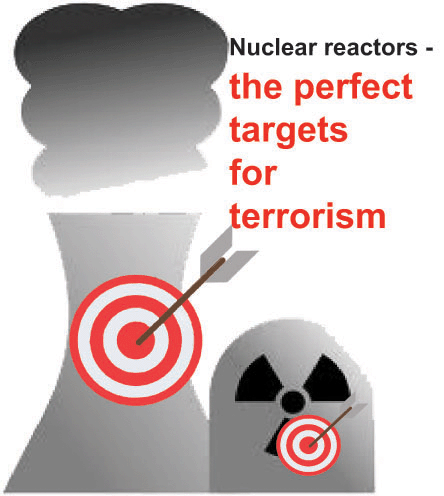 Pre-deployed terrorist targets: Nuclear power plants have been described as pre-deployed terrorist targets and pose a major security threat. This in turn would likely see an increase in policing and security operations and costs and a commensurate impact on civil liberties and public access to information. Other nations in our region may view Australian nuclear aspirations with suspicion and concern given that many aspects of the technology and knowledge-base are the same as those required for nuclear weapons.
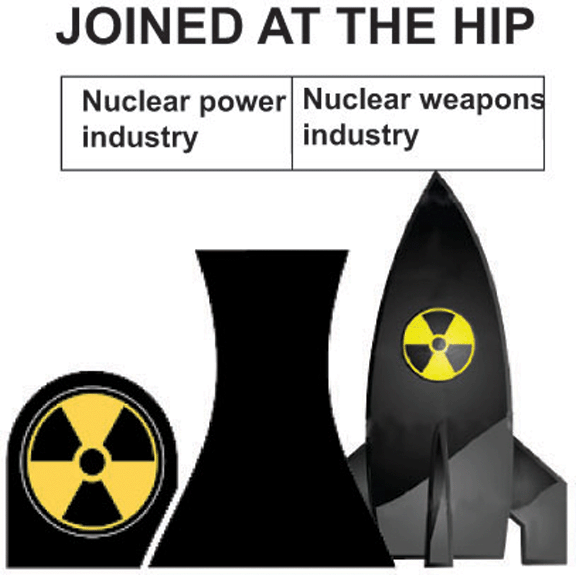 Former US Vice President Al Gore summarised the proliferation problem: “For eight years in the White House, every weapons-proliferation problem we dealt with was connected to a civilian reactor program. And if we ever got to the point where we wanted to use nuclear reactors to back out a lot of coal … then we’d have to put them in so many places we’d run that proliferation risk right off the reasonability scale.”
Too slow: Expanding nuclear power is impractical as a short-term response to climate change. An analysis by Australian economist Prof. John Quiggin concludes that it would be “virtually impossible” to get a nuclear power reactor operating in Australia before 2040. More time would elapse before nuclear power has generated as much as energy as was expended in the construction of the reactor: a University of Sydney report concluded that the energy payback time for nuclear reactors is 6.5‒7 years. Taking into account planning and approvals, construction, and the energy payback time, it would be a quarter of a century or more before nuclear power could even begin to reduce greenhouse emissions in Australia (and then only assuming that nuclear power displaced fossil fuels).
 Too thirsty: Nuclear power is extraordinarily thirsty. A single nuclear power reactor consumes 35‒65 million litres of water per day for cooling.
Water consumption of different energy sources (litres / kWh):
* Nuclear 2.5
* Coal 1.9
* Combined Cycle Gas 0.95
* Solar PV 0.11
* Wind 0.004
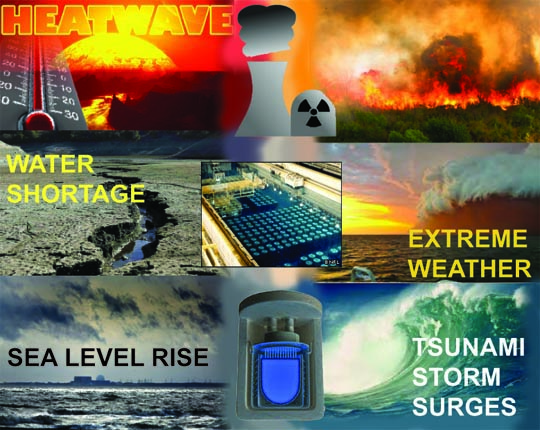
Climate change and nuclear hazards: Nuclear power plants are vulnerable to threats which are being exacerbated by climate change. These include dwindling and warming water sources, sea-level rise, storm damage, drought, and jelly-fish swarms. Nuclear engineer David Lochbaum states. “I’ve heard many nuclear proponents say that nuclear power is part of the solution to global warming. It needs to be reversed: You need to solve global warming for nuclear plants to survive.”
In January 2019, the Climate Council, comprising Australia’s leading climate scientists and other policy experts, issued a policy statement concluding that nuclear power plants “are not appropriate for Australia – and probably never will be”.
By contrast, the REN21 Renewables 2015: Global Status Report states that renewable energy systems “have unique qualities that make them suitable both for reinforcing the resilience of the wider energy infrastructure and for ensuring the provision of energy services under changing climatic conditions.”
 First Nations: Laws banning nuclear power should be retained because the pursuit of a nuclear power industry would almost certainly worsen patterns of disempowerment and dispossession that Australia’s First Nations have experienced ‒ and continue to experience ‒ as a result of nuclear and uranium projects.
To give one example (among many), the National Radioactive Waste Management Act dispossesses and disempowers Traditional Owners in many respects: the nomination of a site for a radioactive waste dump is valid even if Aboriginal owners were not consulted and did not give consent; the Act has sections which nullify State or Territory laws that protect archaeological or heritage values, including those which relate to Indigenous traditions; the Act curtails the application of Commonwealth laws including the Aboriginal and Torres Strait Islander Heritage Protection Act 1984 and the Native Title Act 1993 in the important site-selection stage; and the Native Title Act 1993 is expressly overridden in relation to land acquisition for a radioactive waste dump.
No social license: Laws banning nuclear power should be retained because there is no social license to introduce nuclear power to Australia. Opinion polls find that Australians are overwhelmingly opposed to a nuclear power reactor being built in their local vicinity (10‒28% support, 55‒73% opposition); and opinion polls find that support for renewable energy sources far exceeds support for nuclear power (for example a 2015 IPSOS poll found 72‒87% support for solar and wind power but just 26% support for nuclear power). As the Clean Energy Council noted in its submission to the 2019 federal nuclear inquiry, it would require “a minor miracle” to win community support for nuclear power in Australia.
The pursuit of nuclear power would also require bipartisan political consensus at state and federal levels for several decades. Good luck with that. Currently, there is a bipartisan consensus at the federal level to retain the legal ban. The noisy, ultra-conservative rump of the Coalition is lobbying for nuclear power but their push has been rejected by, amongst others, the federal Liberal Party leadership, the Queensland Liberal-National Party, the SA Liberal government, the Tasmanian Liberal government, the NSW Liberal Premier and environment minister, and even ultra-conservatives such as Nationals Senator Matt Canavan.
 The future is renewable, not radioactive: Laws banning nuclear power should be retained because the introduction of nuclear power would delay and undermine the development of effective, economic energy and climate policies based on renewable energy sources and energy efficiency. A December 2019 report by CSIRO and the Australian Energy Market Operator finds that construction costs for nuclear reactors are 2‒8 times higher than costs for wind or solar. Levelised costs for nuclear are 2‒3 times greater per unit of energy produced compared to wind or solar including either 2 hours of battery storage or 6 hours of pumped hydro energy storage.
Australia can do better than fuel higher carbon emissions and unnecessary radioactive risk. We need to embrace the fastest growing global energy sector and become a driver of clean energy thinking and technology and a world leader in renewable energy technology. We can grow the jobs of the future here today. This will provide a just transition for energy sector workers, their families and communities and the certainty to ensure vibrant regional economies and secure sustainable and skilled jobs into the future. Renewable energy is affordable, low risk, clean and popular. Nuclear is not. Our shared energy future is renewable, not radioactive.
More Information
* Don’t Nuke the Climate Australia, www.dont-nuke-the-climate.org.au
* Climate Council, 2019, ‘Nuclear Power Stations are Not Appropriate for Australia – and Probably Never Will Be’, https://www.climatecouncil.org.au/nuclear-power-stations-are-not-appropriate-for-australia-and-probably-never-will-be/
* WISE Nuclear Monitor, 25 June 2016, ‘Nuclear power: No solution to climate change’, https://www.wiseinternational.org/nuclear-monitor/806/nuclear-power-no-solution-climate-change
Dr. Jim Green is the national nuclear campaigner with Friends of the Earth Australia.
Canada’s Nuclear Waste Management Organization (NWMO) courts indigenous communities

More specifically, the NWMO, which is a consortium of Canadian nuclear industry players created by an act of parliament, is looking for a community willing to allow used nuclear fuel to be placed in what’s called a deep geological repository – or DGR.
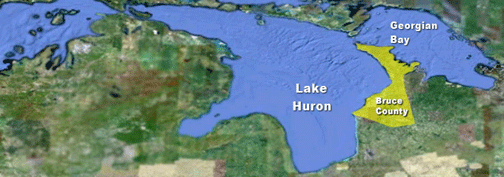
Currently the NWMO is engaging with Ignace, Ontario a small community 250 km northwest of Thunder Bay, as well as the municipality of South Bruce, on Lake Huron northwest of Toronto.
Indigenous communities in both those areas are being courted and having the DGR concept pitched to them by the NWMO.
Indigenous engagement is a major focus at the NWMO.
It has put out an eight-part video series on reconciliation, and it also employs Bob Watts as their vice president of Indigenous Relations.
Watts is a long time major player in Indigenous politics who has held high-level positions with the Assembly of First Nations and the federal government………
Fundamentally, a DGR needs to protect radioactive waste from water, because water could potentially bring the deadly radioactive material back into contact with our environment. …….
not everyone is sold on the safety case made by the NWMO.
Gordon Edwards is president of the Canadian Coalition for Nuclear Responsibility and is likely the nuclear industry’s best known critic in Canada.
Edwards isn’t impressed with the NWMO’s multiple barrier system.
“You can put barrier after barrier after barrier, that doesn’t mean that you have a safe system,” he said. ”The same multiple barrier philosophy is used in nuclear reactors. They say the fuel is inside metal tubes, which are called zirconium, that’s another barrier, it’s called the sheath. And those are inside pressure tubes, which is another barrier. And then that’s inside a calandria, which is another barrier. And that’s inside the reactor building, which is another barrier. Consequently, there cannot be a nuclear accident.
“Well, we’ve seen what happened with that philosophy. Chernobyl exploded and the whole area around Chernobyl is still uninhabitable and will be for at least another hundred years. Fukushima, we’ve had three reactors melting down on the same weekend and those multiple barriers were all in place.”
Edwards said the notion that we can build something to last hundreds of thousands of years, the length of time used nuclear fuel will potentially remain dangerously radioactive – is folly.
“You have to realize that the pyramids of Egypt are only 5,000 years old,” said Edwards. “Go and look at them there. They’re really deteriorated a great deal. So the half-life of plutonium is 24,000 years. The Great Lakes didn’t even exist 24,000 years ago. So we’re talking about periods of time that dwarf the span of human history.”
Edwards said he believes taking a wait-and-see approach is better than putting the used fuel in a DGR.
“We can afford to wait another century or two and see if we can come up with a genuine solution,” he said. “If we can’t come up with a genuine solution, we can continue to look after it. We can continue to transmit the information. We can continue to repackage it periodically into better and better packages, which is going to make sure. And if there is leakage that occurs, failure of containment – we can spring into action right away and fix it and not let it get out of hand. That’s a much better approach.
“This is called rolling stewardship.”………
The NWMO said it hopes to have identified a willing host community for a deep geological repository by 2023.
Nuclear Courtship, Part 2 airs next week, and will be accompanied with a web story which will examine the mood of some of the communities engaging with the nuclear industry.cread@aptn.ca https://aptnnews.ca/2020/02/07/indigenous-communities-courted-as-nuclear-industry-looks-for-place-to-put-used-fuel/
Saugeen Ojibway Nation vote ends company’s plans to store nuclear waste near Lake Huron
The decision came following years of Michigan lawmakers asking Ontario Power Generation to reconsider. It took the vote of the Saugeen Ojibway Nation of Ontario Friday to shift the discussions away from the lake. Of 1,232 ballots cast, 1,058 were against the site and 170 in favor.
We were not consulted when the nuclear industry was established in our Territory,” said a news release on the vote. “Over the past forty years, nuclear power generation in Anishnaabekiing has had many impacts on our Communities, and our Land and Waters, including the production and accumulation of nuclear waste.”
The release said that SON leaders will work with Ontario Power Generation “to find an acceptable solution for the waste.
“We will continue to work with OPG and others in the nuclear industry on developing new solutions for nuclear waste in our Territory,” said Chief Greg Nadjiwon of the Chippewas of Nawash Unceded First Nation. “We know that the waste currently held in above-ground storage at the Bruce site will not go away. SON is committed to developing these solutions with our communities and ensuring Mother Earth is protected for future generations. We will continue to ensure that our People will lead these processes and discussions.” ……….
Site had been sought since 2010
On Jan. 24, the Nuclear Waste Management Organization announced it had signed agreements with landowners east of Lake Huron in South Bruce, Ontario, which would allow land access for studies for the site. …….
In January, southeast Michigan state representatives Gary Howell, R-Lapeer, and Shane Hernandez, R-Port Huron, issued statements against locations near Kincardine and Lake Huron. They said the Kincardine locations are too close to Lake Huron, and expressed concerns about drinking water and public health if something went wrong at the site.
They called on the United States Congress to do everything in its power to stop the development. https://www.thetimesherald.com/story/news/2020/02/03/plans-store-nuclear-waster-near-lake-huron-halted/4587366002/
Indigenous community votes down proposed nuclear waste bunker near Lake Huron,
‘We were not consulted when the nuclear industry was established in our territory’,https://nationalpost.com/news/canada/indigenous-community-votes-down-proposed-nuclear-waste-bunker-near-lake-huron The Canadian Press, Colin Perkel. February 1, 2020
TORONTO — An Indigenous community has overwhelmingly rejected a proposed underground storage facility for nuclear waste near Lake Huron, likely spelling the end for a multibillion-dollar, politically fraught project years in the making.
After a year of consultations and days of voting, the 4,500-member Saugeen Ojibway Nation announced late Friday that 85 per cent of those casting ballots had said no to accepting a deep geologic repository at the Bruce nuclear power plant near Kincardine, Ont.
“We were not consulted when the nuclear industry was established in our territory,” SON said in a statement. “Over the past 40 years, nuclear power generation in Anishnaabekiing has had many impacts on our communities, and our land and waters.”
The province’s giant utility, Ontario Power Generation, had wanted to build the repository 680 metres underground about 1.2 kilometres from Lake Huron as permanent storage for low and intermediate-level radioactive waste. The project was tentatively approved in May 2015.
In August 2017, then-environment minister Catherine McKenna paused the process to ensure buy-in from Indigenous people in the area
While Kincardine was a “willing host,” the relative proximity of the proposed bunker to the lake sparked a backlash elsewhere in Canada and the United States. Politicians, environmentalists and scores of communities expressed opposition.
Successive federal governments have withheld final approval. In August 2017, then-environment minister Catherine McKenna paused the process — the last in a string of delays for the project — to ensure buy-in from Indigenous people in the area.
The generating company, which insisted the stable bedrock would safely contain the waste, items such as contaminated reactor components and mops, said it respected SON’s decision.
“OPG will explore other options and will engage with key stakeholders to develop an alternate site-selection process,” Ken Hartwick, head of OPG, said in a statement shortly after the vote was announced. “Any new process would include engagement with Indigenous peoples as well as interested municipalities.”
The apparent end of the road for the project comes shortly after the federally-mandated Nuclear Waste Management Organization said it was making progress toward choosing a site for storing millions of far more toxic spent nuclear fuel bundles.
The organization, comprising several nuclear plant operators, said it had struck deals with landowners in South Bruce — about 30 minutes east of Kincardine — that will allow it to begin site tests. The only other site under consideration for high-level waste storage is in Ignace in northern Ontario.
Despite the rejection of OPG’s proposal, the utility said it planned to continue a relationship “based on mutual respect, collaboration and trust” with the Saugeen Ojibway Nation, which comprises the Chippewas of Saugeen First Nation and the Chippewas of Nawash Unceded First Nation.
Chippewas of Saugeen Chief Lester Anoquot called the vote — 170 for and 1,058 against — a “historic milestone and momentous victory” for the community.
“We worked for many years for our right to exercise jurisdiction in our territory and the free, prior and informed consent of our people to be recognized,” Anoquot said. “We didn’t ask for this waste to be created and stored in our territory.”
At the same time, Anoquot said, the vote showed the need for a new solution for the hazardous waste, a process he said could take many years.
Ontario depends heavily on nuclear power for its electricity but a permanent storage solution for the increasing amounts of waste now stored above ground has proven elusive. The radioactive material, particular from used fuel, remains highly toxic for centuries.
The utility insists exhaustive science shows a repository in stable and impermeable rock offers the best solution.
“Permanent and safe disposal is the right thing to do for future generations,” Hartwick said.
Ignoring Aboriginal opposition, Australian government chooses nuclear waste dump site
|
Federal Government chooses Kimba farm Napandee on the Eyre Peninsula for nuclear dump, ABC, 1 Feb 2020 The Federal Government has selected a farm on South Australia’s Eyre Peninsula as the site of a controversial nuclear waste dump. Key points:
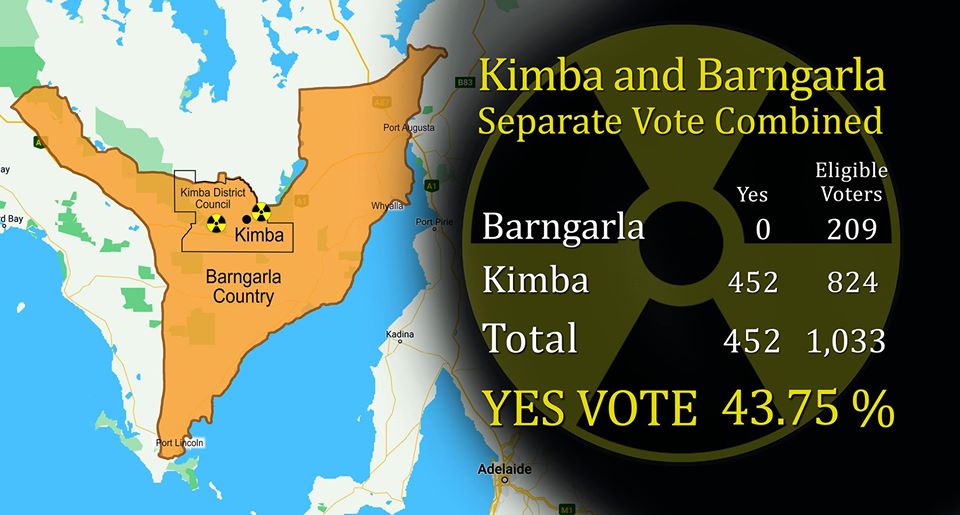
Jeff Baldock’s Napandee property 20 kilometres west of Kimba will be used to permanently store low-level waste and temporarily store intermediate-level waste. The decision to use the 160-hectare area for what the Government calls a “disposal and storage facility” was made after four years of consultation. Nearly 62 per cent of people voted in favour of the site being used in November, while a site near Hawker in the Flinders Ranges was opposed by Aboriginal traditional owners and residents……. Dump to consolidate nuclear wasteLocal federal Liberal MP Rowan Ramsey said waste would come in from more than 100 sites around Australia, such as hospitals and universities, and the Lucas Heights nuclear reactor in Sydney. Processed medium-level nuclear fuel rods from Lucas Heights will be temporarily stored at Kimba while a permanent site is found for them, he said. Mr Ramsey, who tried to nominate his own property near Kimba for the dump but was barred as a federal MP, said there would be no fly-in, fly-out workers at the facility……. Aboriginal group opposed the voteThe Barngarla Determination Aboriginal Corporation launched legal action in 2018 against the District Council of Kimba, arguing it contravened the Racial Discrimination Act by excluding native title holders from a ballot due to be held that year. The Federal Court dismissed the claim last year because it said no contraventions of the Racial Discrimination Act had been established…….. The Howard government proposed a similar dump in South Australia in 1998 but withdrew its plans after losing a fight with the South Australian Labor government in the Federal Court. In 2007, a property called Mukaty Station in the Northern Territory was put forward to host the nuclear waste facility. The plan was abandoned in 2014, again because of legal action, this time by the area’s traditional owners. A group called No Radioactive Waste Facility for Kimba District held a rally against the decision in the town on Sunday.Friends of the Earth national nuclear campaigner Jim Green said the Federal Government promised the facility would not be approved unless it received at least 65 per cent of community support. “They’ve ignored the traditional owners, ignored South Australians. South Australia’s got legislation banning the imposition of nuclear waste dumps and that’s been ignored and it’s just disrespectful from start to finish,” he said. “South Australians have got greater ambitions for our state than to be someone else’s nuclear waste dump.”https://mobile.abc.net.au/news/2020-02-01/kimba-farm-eyre-peninsula-chosen-for-nuclear-dump/11920514 |
|
Indigenous tribe, Saugeen Ojibway Nation, has voted down plans for nuclear waste dump near Lake Huron
Hervé Courtois to C.A.N. Coalition Against Nukes, 1 Feb 2020, Members of  the Saugeen Ojibway Nation (SON) have voted down plans to bury Ontario’s low- and intermediate-level nuclear waste within 1.2 kilometres of Lake Huron….On Friday, 1,232 members of the First Nation band voted. The vote results saw 1,058 ‘no’ votes, with 170 ‘yes’ and 4 spoiled ballots…It means Canada’s first permanent nuclear waste facility will need to be built somewhere else in Ontario…OPG will now have to start searching for a new host community to house over 200,000 cubic metres of low- and intermediate- level nuclear waste…OPG says finding a new site may set the project back 20 to 30 years….https://www.facebook.com/groups/C.A.N.CoalitionAgainstNukes
Opposition to Nuclear Waste Storage Plan Near Lake Huron
|
Canada Nuclear Waste Storage Plan Near Lake Huron Faces Vote, Bloomberg, Jan. 31, 2020,
U.S. lawmakers from the Great Lakes region are weighing in on the fate of two major Canadian nuclear waste facilities, which could hinge on a vote in a First Nation community in western Ontario on Friday. The 4,500-member Saugeen Ojibway Nation, based on Lake Huron’s Bruce Peninsula, is voting on whether to support construction of Ontario Power Generation Inc.’s C$2.4 billion ($1.8 billion) deep geological repository for low- and intermediate-level nuclear waste near the shore of Lake Huron. But several U.S. members of Congress oppose it, claiming it could endanger drinking water for millions. Ontario Power Generation pledged not to move ahead if the First Nation community votes against the repository. The Nuclear Waste Management Organization, which could build a much larger C$23 billion repository for more radioactive spent nuclear fuel in the same region, won’t proceed in the area if it doesn’t have a partnership with the nation. The vote on Friday doesn’t deal with its proposal directly. The two projects together represent the bulk of Canada’s long-term plan to store nuclear waste. Canada has 2.9 million bundles of highly radioactive used nuclear fuel, according to 2015 data, and around 100,000 cubic meters of low and intermediate nuclear waste, according to 2016 figures, the most recent available. U.S. Lawmakers Oppose Both SitesU.S. lawmakers from across Lake Huron in Michigan have long opposed both projects, and environmental groups say storing radioactive materials deep underground near large bodies of water isn’t safe. “Storing high-level nuclear waste could threaten the well-being of the Great Lakes for generations to come and undo progress made to preserve them,” Sen. Gary Peters (D-Mich.) said in a statement Thursday. “This makes no sense,” said Sen. Debbie Stabenow (D-Mich.). “Canada has as much at stake as we do in protecting our Great Lakes. There is no justification for a nuclear waste site so close to Lake Huron to even be under consideration.” At its closest point, the low- and intermediate-level nuclear waste could be stored underground within a mile of the lake’s shoreline. Peters and seven other senators from the Great Lakes region introduced a resolution in the Senate on Jan. 15 calling on Canada’s federal government to stop both projects and for the Trump administration to help find a solution. An identical resolution was introduced in the House of Representatives Jan. 17. The U.S. Environmental Protection Agency has shared concerns about the project’s potential impact on the U.S. and the Great Lakes, the agency said in a statement Thursday. Highly Radioactive Waste SiteThe Nuclear Waste Management Organization repository would be built to store 5.2 million bundles of used nuclear fuel Canada is projected to produce. It could be built in South Bruce, Ontario, or farther north in Ignace, the organization said Jan. 24. The waste is currently stored outside nuclear facilities across four provinces, with 90% of it in Ontario. “We’re working to identify a single, preferred location for a deep geological repository to be located in an area with informed and willing hosts,” spokesperson Bradley Hammond wrote in an email Wednesday. Landowners in South Bruce gave the organization the go-ahead to dig bore holes to test the area’s suitability this month. The joint private-federal agency wants to pick its site by 2023. The U.S. has long wrestled with its own plan to store nuclear waste. First Nation VoteThe vote by the Saugeen Ojibway Nation on the site for low- and intermediate-level nuclear waste is a monumental accomplishment for First Nations having a say over major decisions, the nation’s environment office said in a statement in December. “Never before has a First Nation secured this level of consent on a project of this magnitude,” the nation said. It declined to comment further. Ontario Power Generation has proposed a financial benefit for the nation, but details aren’t public. A Canadian federal review panel approved the Ontario Power Generation project in May 2015, but the then environment minister asked the company to get more information on impacts to the Saugeen Ojibway Nation’s cultural heritage and wait for the results of the community vote. After receiving the new information, the Impact Assessment Agency will write a draft report on the project’s community impacts, Alison Reilander, agency spokeswoman, wrote in an email Jan. 21. Underground StorageCanada’s existing low- and intermediate-level nuclear waste is currently stored at the surface of where the repository will be located, which is also home to the eight-reactor Bruce Power plant……… https://news.bloombergenvironment.com/environment-and-energy/canada-nuclear-waste-storage-plan-near-lake-huron-faces-vote |
|
Historic vote on nuclear waste underway in Bruce County, Ontario
|
Historic vote on nuclear waste underway in Bruce County, Ont.London CTV News, Scott MillerVideographer @ScottMillerCTV Contact, January 31, 2020 SOUTHAMPTON, ONT. — Plans to build Canada’s first permanent home to nuclear waste are being decided by a local First Nations band Friday. Over 4,500 members of the Saugeen Ojibway Nation (SON) were eligible to vote on whether to approve the plan to bury Ontario’s low- and intermediate-level nuclear waste along the shores of Lake Huron. Ontario Power Generation (OPG) plans to bury 200,000 cubic metres of nuclear waste in a facility, 680 metres under the Bruce Power site, north of Kincardine, Ont. The Deep Geological Repository or DGR falls within the traditional territory of the SON, so OPG has committed to not moving forward without the band’s support. Whatever SON members decide, it will have far-reaching impacts. There are over 230 resolutions by various levels of government around the Great Lakes, including London, Sarnia and Toronto, opposing the plan. In Michigan, Congressman Dan Kildee has been leading the charge against the DGR. “Permanently storing nuclear waste less than a mile from Lake Huron just doesn’t make sense. Surely in the vast land mass that comprises Canada, there is a better place to permanently store nuclear waste than on the shores of the world’s largest supply of fresh water,” he says…….. https://london.ctvnews.ca/historic-vote-on-nuclear-waste-underway-in-bruce-county-ont-1.4792113 |
|
White Kimba, Australia, voted “Yes” to a nuclear waste dump, but the traditional Aboriginal owners held a separate ballot, with a “No” result
“Barngarla Speak Out” : vimeo.com/382855709
“SAVE SA Farmland – Kimba, Eyre Peninsula” : vimeo.com/381938156
Prairie Island Indian Community – nuclear refugees
|
Environmental, nuclear worries force Prairie Island tribe to seek new lands, MPR News, Catharine Richert, Welch, Minn. December 13, 2019 Schyler Martin’s job calls for him to worry each day about things that could cripple or destroy the Prairie Island Indian Community, but that he can’t control.The nearby Xcel Energy nuclear power plant that towers over the reservation is high on that list, as is an Army Corps of Engineers lock and dam on the Mississippi River that regularly floods tracts of tribal land upstream.
Martin, the tribe’s emergency management director, can rattle off a list of flooding headaches the tribe faces annually — closing roads, building and maintaining berms, diverting water from Prairie Island’s casino and outdoor amphitheater. This year has been especially difficult with flooding lasting deep into the fall, closing roads to hunting grounds and damaging hay that feeds the tribe’s buffalo herd. “The soil,” said Martin, “is inundated with water.” Prairie Island leaders understand that the dam, the flooding and the nuclear plant will not be leaving anytime soon, which is why they’re taking an extraordinary step — expanding the reservation inland, away from their home on the Mississippi River. Prairie Island last year bought 1,200 acres near Pine Island, Minn., about 35 miles south on U.S. Highway 52. The tribe wants Congress to put the land into trust, adding it to the reservation. In return, the tribe would give up rights to sue the government over flooding caused by the lock-and-dam system. While it’s a logical step for a tribe that continues to grow and prosper, the relocation plan has reopened old wounds over the displacement of Native American people and white encroachment on Native lands. That includes environmental problems on tribal lands created by nonNative people. ……….. Jackson said, the community once again was thrown into upheaval when the Army Corps of Engineers built a lock-and-dam system just downstream to accommodate commercial navigation. The structure flooded reservation land and shrank its footprint to 300 livable acres. “You have a federal undertaking that is proposing to take more land and again displace Dakota people,” said Jackson. “It’s just another example of the encroachment the tribe was facing at that time.” It’s a project that continues to trouble the reservation. The flooding has swamped traditions that help younger generations connect with their history. Floodwaters this year canceled a maple syrup harvesting event for kids. “This is something that the children’s ancestors have been doing for hundreds of years,” Martin said. But it’s the threat of a nuclear disaster that keeps him up at night. Martin said a routine Federal Emergency Management Agency exercise in 2018 opened his eyes to how a mishap at the nuclear power plant could upend the day-to-day operations of the Treasure Island Resort and Casino, the tribe’s primary source of income for years. “How do you relocate a reservation? These are federal trust lands. How do you relocate that?” he said. “And then how do you make up for the economic viability for the tribe? ….. The nuclear plant’s towers rise about 600 yards away from where Lucy “Lu” Taylor played as a kid. Back then, she didn’t understand the potential dangers of living near the plant. As tribal vice president, she understands it well. “Now, I’m an elder and I have grandchildren now, and it could be devastating to my grandchildren,” she said. “It’s not right for our kids to grow up here.” A very powerful thing’The eye-opening worries that surfaced in the 2018 FEMA drill led Prairie Island to buy the Pine Island property, said Shelley Buck, the tribal council’s president. “Part of our culture is you’re supposed to look out for the next seven generations. So, as tribal leaders, we have to do that. With every decision, we need to look out for that and have that in the back of our minds,” said Buck, who also counts among Prairie Island’s potential dangers a nearby rail line that regularly carries hazardous materials……. the Pine Island land and its potential for housing and economic development is so important. Local officials in Pine Island, Rochester and Olmsted County all support Congress putting the land into trust — a necessary step to make the Pine Island land part of the reservation and subject to tribal law. A bipartisan group of lawmakers from Minnesota’s delegation has introduced a bill that would put the Pine Island land into trust. So far, the bill has not been debated in Congress……. Tribal general counsel Jessie Seim said her research suggested the tribe had strong legal claims against the federal government for both the land lost due to flooding and for siting the nuclear power plant so close to the reservation. Rather than pursue that, however, the tribe is ready to drop those legal claims to get the congressional approval needed to move forward on the Pine Island plan. “We wanted to fashion a settlement, sovereign to sovereign,” Seim said. “We wanted the governing bodies of both of these governments to come together and try to resolve the series of wrongs that have happened here at Prairie Island.”………. https://www.mprnews.org/story/2019/12/13/environmental-nuclear-worries-force-prairie-island-tribe-to-seek-new-lands |
|
Ontario’s First Nations to vote on nuclear waste plan near Lake Huron
|
First Nation vote on nuclear waste DGR set for Jan. 31 https://london.ctvnews.ca/first-nation-vote-on-nuclear-waste-dgr-set-for-jan-31-1.4718866 Scott MillerVideographer @ScottMillerCTV Contact
Friday, December 6, 2019 WINGHAM, ONT. — The Saugeen Ojibway Nation (SON) will decide if nuclear waste is buried along the shores of Lake Huron in a little over a month.The First Nation band of approximately 5,000 will hold a binding vote on Jan. 31, 2020 to find out if their members want Ontario Power Generation (OPG) to bury 230,000 cubic metres of low- and intermediate-level nuclear waste under part of the Bruce Power site near Kincardine, or not.
Officials say whatever the people decide, that will be the band’s position on the proposed Deep Geological Repository (DGR). If they vote yes, OPG would still require federal government approval to move forward with the project. If SON votes no, OPG says they’ll start looking for an alternative site in Ontario. There are over 200 resolutions opposing the project, from municipal councils within the Great Lakes Basin, in Canada and the United States. Councils in nearby Bruce County have declared their support for the project. |
|
Indigenous opposition grows against proposal for grand nuclear waste dump in New Mexico
 Some fear the “interim” storage facility could become a de facto permanent storage facility
transport of high-level radioactive waste across the state  could also lead to potentially dangerous nuclear releases, leaving impacted communities responsible for emergency responses.
the proposal fits into a wider pattern of negligence and environmental racism on behalf of the federal government towards one of the United States’ poorest majority-minority states.
|
Nuclear Colonialism: Indigenous opposition grows against proposal for nation’s largest nuclear storage facility in NM Political Report By Kendra Chamberlain 14 Nov 19, A proposal for New Mexico to house one of the world’s largest nuclear waste storage facilities has drawn opposition from nearly every indigenous nation in the state. Nuclear Issues Study Group co-founder and Diné organizer Leona Morgan told state legislators last week the project, if approved, would perpetuate a legacy of nuclear colonialism against New Mexico’s indigenous communities and people of color.Holtec International, a private company specializing in spent nuclear fuel storage and management, applied for a license from the federal Nuclear Regulatory Commission to construct and operate the facility in southeastern New Mexico. The proposal, which has been in the works since 2011, would see high-level waste generated at nuclear power plants across the country transported to New Mexico for storage at the proposed facility along the Lea-Eddy county line between Hobbs and Carlsbad. Continue reading |
Toxic effects of uranium mining on indigenous communities
 Coconino Voices: Solving Our Toxic Nuclear Legacy, https://azdailysun.com/opinion/columnists/coconino-voices-solving-our-toxic-nuclear-legacy/article_b8e2ef35-31fe-5cb0-a844-6c0fba973c19.html, BRYAN BATES, 30 Oct 19,
-
- When creating any system, whether a building, a community or an energy system, waste products need to be safely managed. This should be true if we’re building an energy system where the waste products can cause cancer and genetic mutations in humans or any organism within range of long-lived radioactive particles. However, it hasn’t been.
First discovered in 1895, radiation was shown to kill bacteria in 1898; however, with a high energy potential and money-making promise, radioactivity was not linked to cancer and genetic change until much later and even then its true health effects were hidden from miners and the public.
Because the geologic Chinle Formation on the Navajo Nation is rich in Uranium, Navajo men were put to work without protection from known hazards. Several hundred Navajos became sick from radiation exposure, many at the same time that other Navajos enlisted in the Marines to become Navajo Code Talkers.
Health effects from mining Uranium persist on the Navajo Nation with numerous pit mines still open and potentially affecting water, plants, livestock and Navajo. The amount of pain, illness, death and cost are still unknown. (See Judy Pasternak, 2011, Yellow Dirt.)
With the geologic uplift of the Grand Canyon upwarp, it’s hypothesized that numerous vertical shafts eroded allowing broken rock carrying Uranium from the Chinle Formation to fall into these “breccia pipes”. Left alone, the Uranium and other metals remain isolated from the biotic world; drilled into, these metals can migrate into interconnected aquifers that discharge into the Colorado River, water often used to grow food. The Grand Canyon upwarp has the greatest concentration of Uranium containing breccia pipes in the world.
This region is sacred to the Hopi, Navajo, Pai and other native people. The Canyon Mine has promised to create jobs; however, tourism and outdoor activities “support over 9,000 jobs, contribute over $938 million annually to (local) economies, and generate over $160 million in annual state and local tax revenues. Uranium mining threatens these economic drivers while possessing little capacity to support the regional economy.” (www.grandcanyontrust.org).
Under President Obama, a twenty-year moratorium on Uranium mining was instituted to allow for compilation and review of scientific information and energy policy. President Trump has requested and will receive a proposal from the nuclear industry to assess opening up mining on the Grand Canyon upwarp.
Mined Uranium would be used to generate nuclear electricity in reactors that are at or nearing their engineered lifespan. Building new nuclear reactors is massively expensive and concrete, the primary component of reactors, is the second largest emitter of climate changing CO2. (United Nations, IPCC report). Claims that nuclear energy is climate neutral only look at the internal nuclear reaction and ignore the entire fuel cycle necessary to keep the nuclear system functioning. Currently, nuclear waste is stored on-site at numerous reactors, several of which have moderate security and leaky infrastructure. The one national nuclear repository, Yucca Mountain, has been mothballed after expending $15Billion of taxpayer money.
To be sure, mining engineers are very intelligent people, and if they can pull Uranium out of breccia pipes, they can pull Uranium out of 1940’s open mining pits and then close off any radiation leakage. These same engineers could pull nuclear fuels from corroding storage bins on-site at nuclear reactors across the country. If a future President decides we need fewer nuclear weapons, future engineers could pull those radioactive elements, though it is questionable whether nuclear power will even be necessary given energy conservation and emerging sustainable energy sources.
In short, our country is not at lack of energy, but our current leadership is at lack of offering practical energy options. The best option is to leave the Uranium in the ground and clean up our country’s toxic nuclear legacy.
20 sovereign nations in New Mexico and Texas oppose nuclear facility near Carlsbad
Native American Pueblo leaders oppose nuclear facility near Carlsbad, Hobbs, https://www.oilandgas360.com/native-american-pueblo-leaders-oppose-nuclear-facility-near-carlsbad-hobbs-2/ in Press by— 360 Feed Wire
Oct. 24– Oct. 24–A group of Native American leaders opposed a plan to temporarily store nuclear waste at proposed facilities in southeast New Mexico and West Texas before a permanent repository is available.
The All Pueblo Council of Governors, which represents 20 sovereign nations in New Mexico and Texas held a meeting on Thursday where members affirmed their opposition to the projects, read a Monday news release from the group.
Concerns with the transportation of spent nuclear fuel rods drove the group’s opposition to two proposed consolidated interim storage (CIS) sites, one near the border of Eddy and Lea counties in New Mexico and another in Andrews, Texas. Continue reading
Nuclear waste awareness tour begins
 stories/nuclear-waste-awareness-tour-begins,586462 October 3, 2019
BRATTLEBORO — Leona Morgan isn’t in Vermont this week for leaf peeping, but for environmental justice.
The Navajo woman from Albuquerque, N.M., is an indigenous community organizer and she wants the people of Vermont and New England what getting rid of the nuclear waste from the Vermont Yankee nuclear power plant means to her community.
Morgan, along with a group of anti-nuclear activists are touring New England this week to draw attention to what they concede is an oft-forgotten or ignored problem — where does the nuclear waste go?
Pulling a giant wooden mock cask that was built to resemble a cask used to transport — not store — high level radioactive waste, the activists are hoping the large dumbbell-looking prop will prompt discussion of the unsolved issue.
“It’s our job to wake them up,” Deb Katz, the executive director of the Citizens Awareness Network, said of residents.
Morgan said the nuclear industry — whether it is the existing 14,000-acre Waste Control Specialties (WCS) facility in west Texas, or its proposed expansion or a proposed Holtec nuclear storage facility just over the border in New Mexico — was overwhelming the communities in that region.
She said putting nuclear waste in that area, which she said is geologically unstable from a huge amount of oil and gas drilling, is dangerous and racist. The area is already home to the U.S. Department of Energy’s waste isolation pilot plant, which houses government-generated nuclear waste, including low-level plutonium. All those projects, Morgan said, are within 50 miles.
It is a largely Hispanic and Navajo area, she said, and the companies and politicians who are behind the nuclear project are “old, white men.”
“We are specifically targeted,” Morgan said.
The six-day tour has been organized by Citizens Awareness Network, a regional anti-nuclear organization based in Shelburne Falls, Mass. Katz and others made a brief stopover in Brattleboro on Wednesday with its large mock canister, as the group was making its way from the Vermont Law School to Greenfield, Mass., for a rally and concert.
“It is vital that citizens understand the issues and what’s at stake,” said Katz. “Until the criteria of sound science and environmental justice are the drivers behind any disposition, high-level nuclear waste must remain onsite,” she said.
All three members of Vermont’s congressional delegation have supported consolidated interim storage facilities, Katz said. Their support, she said, is based on the desire to get the high-level radioactive waste out of Vermont.
But she said that inherently unfair and short-sighted.
The stalled construction of a national depository at Yucca Mountain outside Las Vegas is still stalled, despite statements by President Donald Trump that he supports it. The project had been suspended during the Obama administration.
“This is an old bad idea,” said Diane D’Arrigo, the radioactive waste project director for the Nuclear Information and Resource Service in Washington, D.C.
Vermont Yankee emptied its spent fuel pool and completed the transfer of its thousands of spent fuel rods — the most dangerous of the radioactive waste — last year into a storage facility on the grounds of Vermont Yankee in Vernon. The fuel is now in large concrete and steel canisters called dry cask storage and will remain there until the federal Department of Energy builds a nuclear waste facility to store it for the thousands of years it remains dangerous. Yucca Mountain was once targeted as that facility.
But the anti-nuclear activists said a new push for interim waste storage facilities in west Texas and eastern New Mexico would be dangerous and that the nuclear fuel “should only be moved once.”
Moving the waste comes with many complications and potential dangers, Katz said, not to mention that thousands of shipments would come from dozens of nuclear power plants that have either shut down or will be shutting down.
The “Environmental Justice and Nuclear Waste Tour” started in Burlington on Tuesday, and made appearances in Montpelier, South Royalton, Brattleboro and Greenfield, Mass., on Wednesday. On Thursday, there is a legislative briefing at the Massachusetts State House, and afterwards a series of meetings in Massachusetts communities near the now-closed Pilgrim nuclear station. Then on Sunday, it’s back to western Massachusetts for an event and concert in Florence, Mass.
Contact Susan Smallheer at ssmallheer@reformer.com or at 802 254-2311, ext. 154.
1 This Month

of the week – Nuclear Information and Resource Service



22,000+ miles voyaging for nuclear disarmament
and a radiation-free environment https://vfpgoldenruleproject.org/
To see nuclear-related stories in greater depth and intensity – go to https://nuclearinformation.wordpress.com
-
Archives
- July 2026 (241)
- June 2026 (287)
- May 2026 (306)
- April 2026 (356)
- March 2026 (251)
- February 2026 (267)
- January 2026 (308)
- December 2025 (358)
- November 2025 (359)
- October 2025 (375)
- September 2025 (257)
- August 2025 (319)
-
Categories
- 1
- 1 NUCLEAR ISSUES
- business and costs
- climate change
- culture and arts
- ENERGY
- environment
- health
- history
- indigenous issues
- Legal
- marketing of nuclear
- media
- opposition to nuclear
- PERSONAL STORIES
- politics
- politics international
- Religion and ethics
- safety
- secrets,lies and civil liberties
- spinbuster
- technology
- Uranium
- wastes
- weapons and war
- Women
- 2 WORLD
- ACTION
- AFRICA
- Atrocities
- AUSTRALIA
- Christina's notes
- Christina's themes
- culture and arts
- Events
- Fuk 2022
- Fuk 2023
- Fukushima 2017
- Fukushima 2018
- fukushima 2019
- Fukushima 2020
- Fukushima 2021
- general
- global warming
- Humour (God we need it)
- Nuclear
- RARE EARTHS
- Reference
- resources – print
- Resources -audiovicual
- Weekly Newsletter
- World
- World Nuclear
- YouTube
-
RSS
Entries RSS
Comments RSS
 nuclear-news