Resisting nuclear colonialism on Indigenous Peoples’ Day
 Resisting nuclear colonialism on Indigenous Peoples’ Day | NIRS The resistance of Indigenous peoples and their allies has created greater awareness about abuses and injustices that have been perpetrated against Native peoples since European empires colonized their lands. This is one of the reasons why NIRS commemorates this day as Indigenous Peoples’ Day.
As an anti-nuclear organization, we take Indigenous Peoples’ Day as an opportunity to acknowledge and denounce instances of nuclear colonialism committed against Indigenous peoples all over the world.
For over 70 years, the US nuclear power and weapons industry has consistently targeted Indigenous communities for contamination and environmental sacrifice. The radioactive scars of nuclear colonialism affect Indigenous peoples throughout the lands of Turtle Island (also called North America) and the Pacific Islands occupied by the United States of America, including:
Over 15,000 abandoned uranium mines, affecting Indigenous nations throughout the continent, including the Apache, Dine (Navajo), Lakota, Pueblo, and Sioux. Over 200 above-ground nuclear weapons explosions (and nearly 800 below-ground) affecting the Western Shoshone, Apache, Pacific Islanders (Marshall Islands, Northern Marianas, and Guam), and others. The 1979 Church Rock uranium tailings spill, the US’s worst nuclear disaster, which poisoned Dine (Navajo) communities for nearly 100 miles of the Rio Puerco and upper Rio Grande and has never been cleaned up. The West Valley Demonstration Project reprocessing plant, an immensely radioactive site on Seneca Nation land, which has contaminated Cattaraugus Creek and risks spilling into Lake Erie, the Niagara River, and Lake Ontario. Repeated attempts to site a high-level radioactive waste repository for the whole US nuclear power and weapons industries in Yucca Mountain (Nevada), sacred land of the Western Shoshone. A proposed nuclear waste burial ground in West Valley, California, on sacred homelands of the Chemehuevi, Cocopah, Fort Mojave, Quechan and Colorado River Indian Tribes A 1990s program that targeted Native tribes/nations as possible supposedly ‘interim’ storage places for nuclear power high-level radioactive waste.How can we start making things right for the Indigenous victims of nuclear colonialism? Here’s a step in the right direction: Acknowledging and compensating the victims of the first nuclear weapons test in the US, called ‘Trinity’, and workers poisoned by mining and processing uranium for nuclear weapons and power. Those communities, disproportionately Indigenous peoples, are still living with the fallout from Trinity and over 200 similar nuclear weapons tests—and decades of uranium mines, mills, and spills. Too many of them have never been recognized or compensated for their decades of pain and suffering.
In 1990, Congress passed a law meant to compensate victims of atomic bomb testing, but it doesn’t go nearly far enough and will expire in 2022. A bill in the House of Representatives—H.R.3783, the Radiation Exposure Compensation Act Amendments of 2019—would expand compensation more fully to more of those affected by the tests and uranium extraction. But Rep. Jerrold Nadler, chair of the House Judiciary Committee, hasn’t even scheduled a hearing for the bill yet.
The communities that live downwind from nuclear test sites (“Downwinders”) really need our support right now. Whether you’ve already written your member of Congress about this or not, they need to hear urgently from you now. Tell your member of Congress to ask Jerrold Nadler and Rep. Jim Jordan (the committee’s Republican ranking member) to schedule a hearing for this bill.
If our elected leaders truly care about the rights and sovereignty of our Indigenous relatives, they must take action to repair the harms of nuclear colonialism.
We grieve for the victims of the Trinity test and all other instances of nuclear colonialism. But we can do more. We can start setting things right. Compensating the Downwinders and uranium workers is an essential step in the right direction.
The post Resisting nuclear colonialism on Indigenous Peoples’ Day appeared first on NIRS.
Nuclear waste – another great injustice to indigenous people, and people of color
|
Add nuclear waste to list of social injustices, https://calmatters.org/commentary/my-turn/2020/08/add-nuclear-waste-to-list-of-social-injustices/, 31 Aug 20, – By Chelsi Sparti As national attention centers on racial injustices, a report by Rep. Mike Levin of California exposes yet another assault upon Black, Indigenous and people of color: they are especially vulnerable to harm from our handling and storage of radioactive waste. Across the country, as waste from aging nuclear power plants piles up by the ton, investor-owned utilities and their contractors continue to eye Indigenous lands as dumping sites. To reach these sites, the deadly material would travel unannounced on railways through hundreds of socioeconomically-disadvantaged neighborhoods. From the initial extraction of raw uranium to the eventual, millennia-long storage of spent nuclear fuel, the nuclear industry relies upon the exploitation of rural, Indigenous lands, states the June report by Levin, a Democrat from San Juan Capistrano. The “Report of the San Onofre Nuclear Generating Station Task Force” urges Congress to approve a siting process that aligns with recommendations of the Blue Ribbon Commission on America’s Nuclear Future, which calls for tribal leaders and local governments to have a “meaningful consultative role in important decisions” on nuclear waste storage. Those decisions will determine the permanent disposition of nuclear waste from 65 low-quality storage sites in 33 states. Drafted by scientists and policymakers over 18 months, the task force report contains new scientific discoveries and 30 policy recommendations. Action is expected on eight of them this year. Across the nation, Americans of all income levels are surrounded by radioactive material that remains deadly for more than 200,000 years and is impossible to clean up. In California, spent fuel stockpiles have accumulated at the Humboldt Bay, Diablo Canyon, Rancho Seco and San Onofre reactor sites. At San Onofre alone, 3.6 million pounds of radioactive waste is lodged in temporary storage about 100 feet from the rising ocean. Radioactive waste is an issue made worse by decades of inaction. Clearly, the nuclear industry is determined to unload its waste at the doorsteps of working-class, BIPOC communities. Even today, as the federal government deploys forces to U.S. cities to impose its will upon protesters for racial justice, the next generation of nuclear energy – in the form of “advanced reactors” – is poised to move closer to urban centers, according to an NRC memo. Black, Indigenous and people of color communities have a lot to be angry about. Their outrage should include demands to protect people of color from exposure to hazardous waste for the sake of nuclear industry profits.
|
|
|
Nuclear colonialism. ICAN says that France must clean up its nucleat test wastelands in Algeria

France must clean up Algerian nuclear test sites: group, https://www.france24.com/en/20200826-france-must- clean-up-algerian-nuclear-test-sites-group 28 Aug 20, France must clean up nuclear test sites in Algeria where radioactive waste remains from testing in the former colony during the 1960s, a Nobel Peace Prize-winning group said Wednesday.
France carried out 17 nuclear explosions in the Algerian part of the Sahara Desert between 1960 and 1966.
Eleven of the tests came after the 1962 Evian Accords ended the six-year war of independence and 132 years of colonial rule.
“France must give the Algerian authorities the full list of where the contaminated toxic waste was buried,” the International Campaign to Abolish Nuclear Weapons (ICAN) said in a new 60-page report.
“The ‘nuclear past’ must no longer remain deeply buried under the sand,” ICAN said, citing the concerned areas as the western Reggane region and a zone close to the In Ekker village.
The campaign group identified contaminated, radioactive elements that have either been buried, or are easily accessible.
“The majority of the waste is in the open air, without any security, and accessible by the population, creating a high level of sanitary and environmental insecurity,” ICAN said.The 2017 Nobel Peace Prize laureate group added that almost nothing has been done to clean the sites, inform the populations and evaluate the risks.
Exposure to radioactive material can cause cancer.
“This case study shows once more an asymmetry of power and an injustice that we find all through nuclear history,” Giorgio Franceschini, director of the Heinrich Boll Foundation which published the report, said in his forward.
“It is not a coincidence that France tested its first nuclear weapon in Algeria, that was still a French colony in 1960,” he added.
France refused to sign up the UN’s 2017 Treaty on the Prohibition of Nuclear Weapons, whereas Algeria signed and is in the process of ratifying the legally binding agreement.
Since Algeria’s independence, Franco-Algerian relations have been tumultuous.
Algerian President Abdelmadjid Tebboune in July called on France to fully apologise for its colonial past.
An apology could “make it possible to cool tensions and create a calmer atmosphere for economic and cultural relations”, especially for the more than six million Algerians who live in France, he said.
Racism in nuclear bomb testing, bombing of Japanese people, and nuclear waste dumping

Langston Hughes voiced the opinion that until racial injustice on home ground in the United States ceases, “it is going to be very hard for some Americans not to think the easiest way to settle the problems of Asia is simply dropping an atom bomb on colored heads there.”[25] While his statement was made in 1953, near the eighth anniversary of the Hiroshima and Nagasaki bombings, it remains equally relevant today, as we approach the 75th anniversary
Memorial Days: the racial underpinnings of the Hiroshima and Nagasaki bombings , Bulletin of the Atomic Scientists, Elaine Scarry, Elaine Scarry is the author of Thermonuclear Monarchy: Choosing between Democracy and Doom and The Body in Pain: the Making and Unmaking of the World. She is Cabot Profess… By Elaine Scarry, August 3, 2020
This past Memorial Day, a Minneapolis police officer knelt on the throat of an African-American, George Floyd, for 8 minutes and 46 seconds. Seventy-five years ago, an American pilot dropped an atomic bomb on the civilian population of Hiroshima. Worlds apart in time, space, and scale, the two events share three key features. Each was an act of state violence. Each was an act carried out against a defenseless opponent. Each was an act of naked racism. ……….
Self-defense was not an option for any one of the 300,000 civilian inhabitants of the city of Hiroshima, nor for any one of the 250,000 civilians in Nagasaki three days later. We know from John Hersey’s classic Hiroshima that as day dawned on that August morning, the city was full of courageous undertakings meant to increase the town’s collective capacity for self-defense against conventional warfare, such as the clearing of fire lanes by hundreds of young school girls, many of whom would instantly vanish in the 6,000° C temperature of the initial flash, and others of whom, more distant from the center, would retain their lives but lose their faces.[2] The bombing of Hiroshima and Nagasaki initiated an era in which—for the first time on Earth and now continuing for seven and a half decades—humankind collectively and summarily lost the right self-defense. No one on Earth—or almost no one on Earth[3]—has the means to outlive a blast that is four times the heat of the sun or withstand the hurricane winds and raging fires that follow………
Centuries of political philosophers have asked, “What kind of political arrangements will create a noble and generous people?” Surely such arrangements cannot be ones where a handful of men control the means for destroying at will everyone on Earth from whom the means of self-defense have been eliminated……..
When Americans first learned that the people of Hiroshima and Nagasaki had been collectively vaporized in less time than it takes for the heart to beat, many cheered. But not all. Black poet Langston Hughes at once recognized the moral depravity of executing 100,000 people and discerned racism as the phenomenon that had licensed the depravity: “How come we did not try them [atomic bombs] on Germany… . They just did not want to use them on white folks.”[4] Although the building of the weapon was completed only after Germany surrendered on May 7, 1945, Japan had been designated the target on September 18, 1944, and training for the mission had already been initiated in that same month.[5] Black journalist George Schuyler wrote: “The atom bomb puts the Anglo-Saxons definitely on top where they will remain for decades”; the country, in its “racial arrogance,” has “achieved the supreme triumph of being able to slaughter whole cities at a time.”[6]
Still within the first year (and still before John Hersey had begun to awaken Americans to the horrible aversiveness of the injuries), novelist and anthropologist Zora Neale Hurston denounced the US president as a “butcher” and scorned the public’s silent compliance, asking, “Is it that we are so devoted to a ‘good Massa’ that we feel we ought not to even protest such crimes?”[7] Silence—whether practiced by whites or people of color—was, she saw, a cowardly act of moral enslavement to a white supremacist. Continue reading
When it comes to nuclear waste dumping, the Australian government sees black people as flora and fauna, not citizens
 Barngarla continue fight against plan to dump nuclear waste on Country, SBS News 29 July 20, Barngarla mob say they were not properly consulted by federal government for plans to store radioactive waste on Country at Kimba in SA, and that their concerns continue to be ignored. By Royce Kurmelovs, NITV News 29 July 20
The 50-year-old Barngarla woman is talking about the enduring connection she has to Kimba when she tells how on the day she was born, her parents had been waiting for an ambulance that never came.
Forced to make their own way to the hospital, she says her mum made it as far as the tree outside before giving birth.
“So I’m born on Country,” she says.
Though she may not live there today, Jeanne says a part of her has never left. It is a detail that underscores the significance of the moment she learned Kimba was being considered as a dump for radioactive waste.
“I used to be a carer for my mum. When I first heard [about the facility], I told her. She goes: ‘no, no, no’ and got angry,” Jeanne says. “She said; ‘we don’t want it there’. She said to me: ‘you got to fight for this. You got to fight for it, we can’t have that place there. It’s a special place for us.’”
Most among the Barngarla have a similar story about the shock and confusion at learning their traditional Country was under consideration as part of a proposal to build a nuclear waste storage facility that would take in samples from 100 sites across the continent.
No one, they say, from the federal government contacted them beforehand to talk about the proposal, leaving most to find out through the news media or word of mouth.
Instead it was up to the Barngarla themselves, through the the Barngarla Determination Aboriginal Corporation (BDAC) to take the initiative and write to the government in April 2017 to find out what was going on.
‘Wasn’t interested in our views’
That first letter would plunge them into a fight that has so far lasted three years, until it entered a new phase in February when former Industry Minister Matt Canavan announced – a day before he resigned – that he had selected a site just outside of Kimba to situate the nuclear waste facility…….
Over the course of its operating lifetime, the site would house low-to-intermediate level nuclear waste made up of medical waste drawn from 100 sites across the country. This material would include medical waste, but also the more serious TN81 canisters – casks of material once exposed to high levels of radiation that require containment for several hundred years.
If supporters of the proposal celebrated the financial windfall it would bring, critics worried the decision represented the thin end of a wedge that would eventually see the site expand to house higher-level toxic waste.
For the Barngarla people, however, the proposal represented something more significant: yet another decision where they have been overlooked, ignored and overruled in a process they describe as “divide and rule”.
“It’s like the government’s not listening to us,” Jeanne says. “It’s like if the government picks a place where they want to put rubbish like that, they’ll just go and do it and they don’t care what the people think. And that’s wrong. They should be listening to what the people want too.”….
After their early efforts to find out more, the Barngarla say they were stonewalled from the very beginning by both the Department of Industry, Science, Energy and Resources, and the Australian Radioactive Waste Agency (ARWA). That stance would become a pattern…….
They basically created hurdles,” Bilney says. “The catchphrase was ‘rateable property’ – that’s white man’s terms ‘rateable property’. We’re the native title holders. That holds more weight than ‘rateable property’, so we should have been included.”
Around the time the Barngarla filed their lawsuit to challenge the vote, the first meeting with the department took place in August 2018 – a moment Bilney recalls with frustration.
He says Mr Canavan spoke for fifteen minutes before he left, taking all the government representatives with him.
“That’s it,” Bilney says. “He wasn’t interested in our views, he just wanted us to hear what he had to say.”
When the poll of Kimba residents was counted, it returned a result that saw 61.6 per cent of 824 participants vote in favour of the proposal.
BDAC responded by organising is own poll, asking its 209 members the same question that was asked of the broader Kimba residents. The result would be a unanimous “No” from the 83 participants – a turnout figure explained by cultural and logistical factors that make it difficult to gather in any one place…….
Aliens in our own country’
What happens now is up to the Senate economics reference committee and a clutch of Labor, Greens and independent senators.
The Barngarla say the recent approach of the federal government – to legislate the precise location of the site – represents a new twist as it departs from the process established by the Gillard government under the National Radioactive Waste Management Act 2012.
Worse still, the Barngarla say the provisions of the bill will stymie their rights to seek a judicial review of the minister’s decision in the courts. The Parliamentary joint committee on human rights also raised concerns about the bill in April this year that it says may extinguish Native Title……..
So far it has taken two decades for the Barngarla to have their Native Title claim to a 45,000 square kilometre stretch of the Eyre Peninsula recognised by the courts – a process during which they were once informed that they did not exist as a people.
Neither have they forgotten the horror at Maralinga when the British army tested nuclear weapons after falsely declaring there were no Aboriginal people in the area.
To the Barngarla, the government has only decided to talk after the big decisions have been made.
“We’re still flora and fauna to these people,” Bilney says. “They should have included us from the start. We heard about it on the news. We weren’t included in the vote.
“You know, the Barngarla [native title] claim was basically an unwinnable case, they said. It’s taken us 21 years. Twenty-one years to win Native Title under white man’s law. And yet we’re still classed as second-class citizens? Flora and fauna.
“We’re basically aliens in our own Country.” https://www.sbs.com.au/nitv/article/2020/07/29/barngarla-continue-fight-against-plan-dump-nuclear-waste-country
Western Shoshone land stolen for nuclear weapons tests and waste dump
Western Shoshone land stolen for nuclear weapons tests and waste dump, By Ian Zabarte Shoshone land was illegally seized by the U.S government, breaking a historic treaty, first for the atomic test site in Nevada, and then for the planned — but still canceled — Yucca Mountain high-level radioactive waste dump. Throughout, the Shoshone people have paid a terrible price.
To hide the impacts from nuclear weapons testing, Congress defined Shoshone Indian ponies as “wild horses.” There is no such thing as a wild horse. They are feral horses, but the Wild Horse and Burrow Acts of 1971 gave the Bureau of Land Management (BLM) the affirmative act to take Shoshone livestock while blaming the Shoshone ranchers for destruction of the range caused by nuclear weapons testing.
My livelihood was taken and the Shoshone economy destroyed by the BLM. On the land, radioactive fallout destroyed the delicate high desert flora and fauna, creating huge vulnerabilities where noxious and invasive plant species took hold.
Nuclear weapons testing at the Nevada National Security Site has left a dark legacy of radiation exposure to Americans downwind from the battlefield of the Cold War. Among the victims are the Shoshone people, who, by no fault of our own, were exposed to radiation in fallout from more than 924 nuclear tests.
“Yucca Mountain is a serpent…and if you don’t do the things you’re supposed to do the snake will release its poison.” Ian ZabarteToday, the media does not report Native American past exposure to radioactive fallout from US/UK secret nuclear testing and disproportionate burden of risk.
The Shoshone people cannot endure any increased burden of risk from any source including resumption of WMD testing by US/UK, plutonium disposal from the Savannah River Site, depleted uranium disposal, proposed high-level nuclear waste disposal at Yucca Mountain, coal ash uranium or fracking released radiation.
Nuclear testing is a violation of the peace treaty with the Shoshone, the Treaty of Ruby Valley, and the U.S. Constitution, Article 6 Section 2, the treaty supremacy clause. Nothing in the treaty contemplated the secret massacre of Shoshone people with radioactive poison from nuclear weapons testing within our own homelands. My tribe and family are the victims.
The enduring purpose of nuclear technology is the creation of weapons of mass destruction. Their tests within the Shoshone homelands are deliberate acts that destroy the Shoshone people. No Shoshone, not one person, should be sacrificed for the benefit of some Americans and the profit of the military industrial complex.
What the Shoshone people experience is a deliberate intent by the US to systematically dismantle the living life-ways of the Shoshone people for the benefit of the US and the profit of the nuclear industry. This meets the minimum threshold of genocide under both the UN Convention and the US enactments of the crime of genocide.
Nuclear weapons development in Shoshone homelands violates humanitarian law, human rights law and environmental law and is racist. Racism is a crime. It is called genocide, “a crime against humanity.”
To prove intent to commit genocide, we have only to look at the culture of secrecy of the military occupation of Shoshone homelands during and since the Cold War at the test site. The acts committed in nuclear weapons development and testing against the Shoshone people benefit other Americans. The Shoshone people suffer without relief or acknowledgement of our silent sacrifice. Secrecy is not transparent. Secrecy is not democratic and is unconstitutional when the acts are conducted in and upon the Shoshone land and people.
Nothing in the Nuclear Waste Policy Act of 1982, as amended in 1987, considered the fact of Shoshone ownership of the proposed Yucca Mountain high-level nuclear waste repository. Almost $15 billion was spent to characterize the site, giving it the label as, “the most studied piece of real estate in the world.” The Nuclear Regulatory Commission admitted in the licensing proceedings that the Department of Energy has not proven ownership.
Nevada took hundreds of millions of dollars for characterization studies from the federal government in grants equal to taxes from Shoshone property and gave nothing to the Shoshone. A clear case of taxation without representation to defraud the Shoshone people of our property interests.
What is needed now are hearings on and support for the extension and funding of the Radiation Exposure Compensation Act of 2019. The Shoshone people need DNA testing and funding for tribal community health education on radiation basics and information on appropriate protective behavior to mitigate radiation exposure.
The Shoshone people are committed to the enforcement of law in the service of justice and human dignity. That is human growth and development, not nuclear weapons.
Ian Zabarte is Principal Man for the Western Bands of the Shoshone Nation of Indians.
Nuclear bomb testing – the cruellest legacy of environmental injustice and racism
|
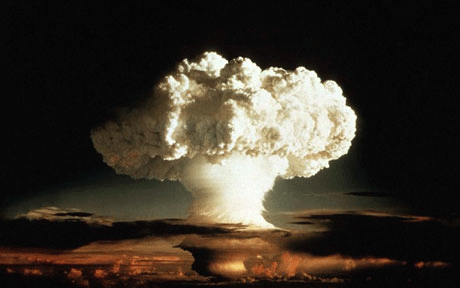
Nuclear testing legacy is ‘cruellest’ environmental injustice, warns rights expert,
https://news.un.org/en/story/2020/07/1068481 16 July 2020
Human RightsThe dangerous legacy of nuclear weapons testing continues to affect many communities, a leading rights expert said on Thursday, on the 75th anniversary of testing in the United States, that heralded the nuclear age.
In an appeal to governments worldwide to get rid of weapons of mass destruction, UN Special Rapporteur on toxics, Baskut Tuncak, said that the Trinity tests in New Mexico on 16 July 1945, were the prelude to “two horrific explosions suffered by (the) innocent people of Japan”, during the Second World War.
They were also followed by the detonation of hundreds of nuclear bombs over vulnerable communities in the Pacific, and the disposal of radioactive waste on lands and territories of indigenous peoples. Paradise lostThis had created a legacy of nuclear testing that “is one of the cruellest examples of environmental injustice witnessed” in “what should be a peaceful island paradise”, said Mr Tuncak, who reports to the Human Rights Council in Geneva. From 1946-58, 67 nuclear bombs were detonated on the Marshall Islands, he said, the equivalent of more than 1.5 “Hiroshima-sized explosions every day for 12 years”. Communities “have suffered unimaginably” from radioactive contamination and this continues today “with a legacy of contamination, illness and anguish”, the expert insisted.
Twin environmental disasters made matters worse, he added, referring to climate change-induced sea level rise and nuclear waste concentrated in a radioactive “tomb”. 200 tests in 30 yearsSimilarly, in French Polynesia, over 200 nuclear tests were conducted over a 30-year period from 1966 to 1996, subjecting inhabitants to associated health and environmental damage, the Special Rapporteur said. From Greenland to the indigenous territories of the United States, he warned that people continued to suffer from the nuclear testing era. Waste not“In recent decades, numerous Native American tribes received funding to store unwanted nuclear waste on their lands,” he said. “Those of Point Hope, Alaska, became recipients of radioactive soil and higher cancer rates that are believed to have been the foreseeable result. And the people of Greenland discovered radioactive waste left by the US military, unbeknownst to them as the ice continues to melt in the Arctic.” This discriminatory approach should be addressed by all States as part of the discussion on “systemic racism” and nuclear disarmament, Mr. Tuncak insisted. “Unaddressed, the dangers of radioactive contamination will persist for centuries, and so too will the harmful legacy of racism that surrounds this tragic chapter of humanity,” he added. |
|
Nuclear bomb testing – a form of racism and colonialism
Danielle Endres: Nuclear testing as a form of colonization, https://www.sltrib.com/opinion/commentary/2020/07/15/danielle-endres-nuclear/ By Danielle Endres ·16 July 20
At 5:29 a.m. on July 16, 1945, scientists in the Manhattan Project detonated the world’s first nuclear weapon in the desert homelands of the Mescalero Apache, a place now known as Alamogordo, New Mexico. As the detonation cloud mushroomed into the sky, the Trinity test ushered in a new era, the atomic age.
A global push for racial justice in the climate movement
A global push for racial justice in the climate movement For years, mainstream environmental movements around the globe have excluded people of color, who are disproportionately impacted by climate change. Today’s global Black Lives Matter protests have amplified calls for institutions of all kinds — including environmental groups — to challenge and dismantle chronic systemic racism., The World, June 30, 2020 By Anna Kusmer
Environmental sociologist Dorceta Taylor remembers being the only Black person in her environmental science class at Northeastern Illinois University in the early 1980s. When she asked her white professor why there weren’t more Black students, he quickly told her that it was “because Blacks are not interested in the environment,” she said.
This assumption ran counter to everything she knew. She had grown up in Jamaica, where people from all backgrounds were passionate about the environment and loved nature.
Taylor, until recently a professor of environmental racism at the University of Michigan, found that underrepresentation exists at environmental organizations across the United States. In 2014, just under 16% of people of color were represented in a survey of hundreds of organizations, compared to about 35% of the population, she said. In the early 1990s, only about 2% of the staff of environmental nongovernmental organizations were people of color.
In the UK, the environmental sector is one of the least diverse sectors of the economy.
Yet, people of color are disproportionately impacted by environmental degradation and climate change, and environmental organizations are being called to focus more than ever before on environmental justice.
In the past few weeks, big international green groups including Greenpeace and 350.org have responded with statements, videos and op-eds supporting Black Lives Matter and calling for racial justice.
Related: Black Lives Matter UK says climate change is racist
But environmental activist Suzanne Dhaliwal is skeptical this will translate into real inclusion, particularly in the UK, where she lives and works. Dhaliwal, who identifies as British Indian Canadian Sikh, grew up partly in Canada and spent much of her 20s working alongside big environmental nonprofits in the UK. ………
So, Dhaliwal started her own environmental nonprofit, UK Tar Sands Network, which works alongside Indigenous communities and organizations to campaign against UK companies investing in oil extraction in Alberta, Canada.
“Now, what I call for is direct funding of Black and Brown and Indigenous organizations and leadership training,” said Dhaliwal. “We need research money so that we can research new strategies.”
Other environmentalists are trying to change environmental organizations from within.
Samia Dumbuya just started a job with the European branch of international nonprofit Friends of the Earth, working on climate justice and energy issues. She lives in the UK.
As a Black person whose parents are refugees from Sierre Leone, talking about racial justice issues within the environmental movement is personal for her. She says she sees how climate change is affecting her parents’ home country with increasingly bad flooding and landslides. ………
Across the globe, the urban spaces that are overpoliced and lack public investment also have the worst air quality and contaminated drinking water. The environmental movement will grow stronger with more diverse representation, but also by making these connections, Taylor said.
“Environmentalists all over the country are really taking note that they need to think of the environment now as not just the trees and the birds and the flowers, but the human relationships that are in them — and how these are really threatening some people way more than they’re threatening others.” https://www.pri.org/stories/2020-06-30/global-push-racial-justice-climate-movement
No nuclear waste dump near Lake Huron: opposition of indigenous people, Saugeen Ojibway Nation, the deciding factor
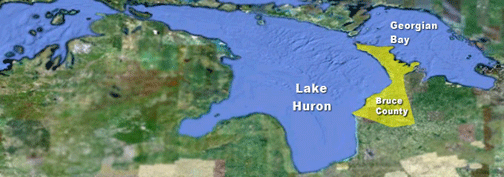
The quest for a deep geologic repository for nuclear waste on the lip of Lake Huron in Ontario is dead.
The 15-plus-year-old effort by Ontario Power Generation to build the underground dump for low and intermediate nuclear waste from Ontario’s 20 reactors appeared to end in January, following the vote of the Saugeen Ojibway Nation against the repository. Eighty-six percent of the first nation voted against the dump, 1,058-170.
SON is made up of the Chippewas of Nawash Unceded First Nation and the Chippewas of Saugeen First Nation. Their territory includes the Bruce Peninsula and runs down the coast of Lake Huron past Goderich and along the shores of Georgian Bay to just beyond Collingwood. SON has roughly 4,500 members.
OPG officially terminated the project on May 27 in a letter to Jonathon Wilkerson, the Federal Minister of Environment and Climate Change, asking for the withdrawal of its application for a building license and ending the environmental impact assessment for the DRG.
“… OPG has informed the Canadian Nuclear Safety Commission that we do not intend to carry out the Project and have asked that the application for a Site Preparation and Construction License be withdrawn,” said Lise Morton, vice president of OPG’s Nuclear Waste Management Division. “Similarly, OPG requests the minister to cancel the environmental assessment for the Project.”
Wilkerson responded on June 15.
“I accept Ontario Power Generation’s request to withdraw the project from the federal environmental assessment process…,” said the minister.
Wilkerson also forwarded his decision to Rumina Velshi, president of the Canadian Nuclear Safety Commission……..
The long term safety of the project — located less than a half-mile from Lake Huron, one of the five Great Lakes that provide drinking water to at least 34 million people in two countries — was at the heart of the controversy. …..
The underground dump was designed to store 200,000 cubic meters of nuclear waste, some of which would remain toxic for at least 100,000 years, roughly 10 times longer than the Great Lakes have been in existence; some of it would remain lethal for more than a million years.
Depositing so much toxic waste on the edge of 20% of the world’s surface fresh water was dubbed as insanity by critics, who pointed to the possibility of the DGR being overtopped by fresh water tsunamis like the Great Lakes Hurricane of 1912, breached by seismic activity in the region, of which there has been a significant amount, threatened by rising lake levels due to climate change, or even targeted by terrorists.
Critics noted that all major underground repositories for nuclear waste to date have failed. https://www.voicenews.com/news/opg-ends-quest-for-nuclear-waste-dump-on-lake-huron/article_9c8334ac-bb07-11ea-8003-7fbee9888ced.html
The Shoshone people and nuclear bomb testing
 Nuclear tests and the Shoshone people, https://www.reviewjournal.com/opinion/nevada-views-nuclear-tests-and-the-shoshone-people-2063105/ By Ian Zabarte June 27, 2020 -REGARDING Gary Martin’s June 15 Review-Journal article, “Nuke test rumors spur Nevada lawmakers”: As a Shoshone, we always had horses. My grandfather always told me, “Stop kicking up dust.” Now I understand that it was because of the radioactive fallout.
To hide the impacts from nuclear weapons testing, Congress defined Shoshone Indian ponies as “wild horses.” There is no such thing as a wild horse. They are feral horses, but the Wild Horse and Burrow Acts of 1971 gave the Bureau of Land Management the affirmative act to take Shoshone livestock while blaming the Shoshone ranchers for destruction of the range caused by nuclear weapons testing. My livelihood was taken and the Shoshone economy destroyed by the BLM. On the land, radioactive fallout destroyed the delicate high desert flora and fauna, creating huge vulnerabilities where noxious and invasive plant species took hold.
Nuclear weapons testing at the Nevada National Security Site has left a dark legacy of radiation exposure to Americans downwind from the battlefield of the Cold War. Among the victims are the Shoshone people, whom, by no fault of our own, were exposed to radiation in fallout from more than 924 nuclear tests. The Shoshone people never consented to the nuclear weapons testing.
Nuclear testing is a violation of the peace treaty with the Shoshone, the Treaty of Ruby Valley, and the U.S. Constitution, Article 6 Section 2, the treaty supremacy clause. Nothing in the treaty contemplated the secret massacre of Shoshone people with radioactive poison from nuclear weapons testing within our own homelands. My tribe and family are the victims.
The enduring purpose of nuclear technology is the creation of weapons of mass destruction. Their tests within the Shoshone homelands are deliberate acts that destroy the Shoshone people. No Shoshone, not one person, should be sacrificed for the benefit of some Americans and the profit of the military industrial complex.
Nuclear weapons development in Shoshone homelands violates humanitarian law, human rights law and environmental law and is racist. Racism is a crime. It is called genocide, “a crime against humanity.”
To prove intent to commit genocide, we have only to look at the culture of secrecy of the military occupation of Shoshone homelands during and since the Cold War at the test site. The acts committed in nuclear weapons development and testing against the Shoshone people benefit other Americans. The Shoshone people suffer without relief or acknowledgement of our silent sacrifice. Secrecy is not transparent. Secrecy is not democratic and is unconstitutional when the acts are conducted in and upon the Shoshone land and people.
Nevada took hundreds of millions of dollars for characterization studies from the federal government in grants equal to taxes from Shoshone property and gave nothing to the Shoshone. A clear case of taxation without representation to defraud the Shoshone people of our property interests.
What is needed now are hearings on and support for the extension and funding of the Radiation Exposure Compensation Act of 2019. The Shoshone people need DNA testing and funding for tribal community health education on radiation basics and information on appropriate protective behavior to mitigate radiation exposure.
The Shoshone people are committed to the enforcement of law in the service of justice and human dignity. That is human growth and development, not nuclear weapons.
Ian Zabarte is Principal Man for the Western Bands of the Shoshone Nation of Indians.
Opposition by Saugeen-Ojibway nation brings end to plan for nuclear waste near Lake Huron
Ontario Power Generation Formally Ends Effort To Place Nuclear Storage Site Near Lake Huron, WKAR
In letters sent in May, Ontario Power Generation officially withdrew from an environmental assessment of the project and an application for a construction license. Those withdrawals were first reported in the Detroit Free Press.
Fred Kuntz is with OPG. He said after fifteen years the company decided to look elsewhere to build a storage facility.
“You need three things in Ontario for a project like this to proceed. You need good geology, which we had, you need municipal support, which we had, and you need indigenous support. Without that, we couldn’t proceed with the project.”
Kuntz said the company will begin looking for alternate locations. …….
In letters sent in May, Ontario Power Generation officially withdrew from an environmental assessment of the project and an application for a construction license. Those withdrawals were first reported in the Detroit Free Press.
Fred Kuntz is with OPG. He said after fifteen years the company decided to look elsewhere to build a storage facility.
“You need three things in Ontario for a project like this to proceed. You need good geology, which we had, you need municipal support, which we had, and you need indigenous support. Without that, we couldn’t proceed with the project.”
Kuntz said the company will begin looking for alternate locations. …..A second, high-level nuclear storage facility could still be built near Lake Huron. The Canadian Nuclear Waste Management Organization is considering two possible sites for a facility, one of which is near the lake.
A spokesperson for the organization said the Saugeen-Ojibway vote was not a referendum on their plan
The organization is expected to select a site for the facility by 2023. https://www.wkar.org/post/ontario-power-generation-formally-ends-effort-place-nuclear-storage-site-near-lake-huron#stream/0
“Get the Hell Off”: The Indigenous Fight to Stop a Uranium Mine in the Black Hills

An unidentified member of AIM Native American woman sits with her rifle at ready on steps of building in Wounded Knee, South Dakota, March 2, 1973. Indians still have control of town having seized it on Tuesday. Eleven hostages they had taken were finally released. (AP Photo/Jim Mone)
Get the Hell Off”: The Indigenous Fight to Stop a Uranium Mine in the Black Hills
Can the Lakota win a “paper war” to save their sacred sites?
Mother Jones, BY DELILAH FRIEDLER; PHOTOS BY DANNY WILCOX FRAZIER, MARCH/APRIL 2020 ISSUE, Regina Brave remembers the moment the first viral picture of her was taken. It was 1973, and 32-year-old Brave had taken up arms in a standoff between federal marshals and militant Indigenous activists in Wounded Knee, South Dakota, on the Pine Ridge Indian Reservation. Brave had been assigned to guard a bunker on the front lines and was holding a rifle when a reporter leaped from a car to snap her photo. She remembers thinking that an image of an armed woman would never make the papers—“It was a man’s world,” she says—but the bespectacled Brave, in a peacoat with hair pulled back, was on front pages across the country the following Sunday……..
In October, Brave spoke at Magpie Buffalo Organizing’s inaugural “No Uranium in Treaty Territory” summit, which offered a crash course on tribal sovereignty. The activists are closely tracking the various Keystone XL permits, which the Rosebud Sioux Tribe is challenging in court as a treaty violation. As the threat of both uranium and gold mining looms, there’s talk of occupying land in the Black Hills, as the American Indian Movement did in 1981.
The lingering horror of the nuclear bomb tests at Maralinga, South Australia
|
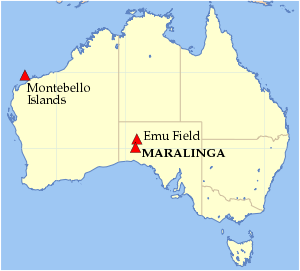
Maralinga is 54 kilometres north-west of Ooldea, in South Australia’s remote Great Victoria Desert. Between 1956 and 1963 the British detonated seven atomic bombs at the site; one was twice the size of the bomb dropped on Hiroshima. There were also the so-called “minor trials” where officials deliberately set fire to or blew up plutonium with TNT — just to see what would happen. One location called “Kuli” is still off-limits today, because it’s been impossible to clean up. I went out to the old bomb sites with a group of Maralinga Tjarutja people, who refer to the land around ground zero as “Mamu Pulka”, Pitjantjatjara for “Big Evil”. “My dad passed away with leukaemia. We don’t know if it was from here, but a lot of the time he worked around here,” says Jeremy Lebois, chairperson of the Maralinga Tjarutja council. Thirty per cent of the British and Australian servicemen exposed to the blasts also died of cancer — though the McClelland royal commission of 1984 was unable to conclude that each case was specifically caused by the tests. It’s not until you stand at ground zero that you fully realise the hideous power of these bombs. Even after more than 60 years, the vegetation is cleared in a perfect circle with a one kilometre radius. “The ground underneath is still sterile, so when the plants get down a certain distance, they die,” explains Robin Matthews, who guided me around the site. The steel and concrete towers used to explode the bombs were instantly vaporised. The red desert sand was melted into green glass that still litters the site. Years ago it would have been dangerous to visit the area, but now the radiation is only three times normal — no more than what you get flying in a plane. The Line of FireAustralia was not the first choice for the British, but they were knocked back by both the US and Canada. Robert Menzies, Australia’s prime minister at the time, said yes to the tests without even taking the decision to cabinet first. David Lowe, chair of contemporary history at Deakin University, thinks Australia was hoping to become a nuclear power itself by sharing British technology, or at least to station British nuclear weapons on Australian soil. “In that period many leaders in the Western world genuinely thought there was a real risk of a third world war, which would be nuclear,” he says. The bombs were tested on the Montebello Islands, at Emu Field and at Maralinga. At Woomera in the South Australian desert, they tested the missiles that could carry them. The Blue Streak rocket was developed and test-fired right across the middle of Australia, from Woomera all the way to the Indian Ocean, just south of Broome. This is known as “The Line of Fire” The Line of Fire from Woomera to Broome is, funnily enough, the same distance from London to Moscow,” Mr Matthews says. Just as the Maralinga Tjarutja people were pushed off their land for the bomb tests, the Yulparitja people were removed from their country in the landing zone south of Broome. Not all the Blue Streak rockets reached the sea. Some crashed into the West Australian desert. The McClelland royal commission showed that the British were cavalier about the weather conditions during the bomb tests and that fallout was carried much further than the 100-mile radius agreed to, reaching Townsville, Brisbane, Sydney and Adelaide. “The cavalier attitude towards Australia’s Indigenous populations was appalling and you’d have to say to some extent that extended towards both British and Australian service people,” Professor Lowe says. There are also questions over whether people at the test sites were deliberately exposed to radiation. “You can’t help but wonder the extent to which there was a deliberate interest in the medical results of radioactive materials entering the body,” Professor Lowe says. “Some of this stuff is still restricted; you can’t get your hands on all materials concerning the testing and it’s quite likely both [British and Australian] governments will try very hard to ensure that never happens.” Project SunshineWe do know that there was a concerted effort to examine the bones of deceased infants to test for levels of Strontium 90 (Sr-90), an isotope that is one of the by-products of nuclear bombs. These tests were part of Project Sunshine, a series of studies initiated in the US in 1953 by the Atomic Energy Commission. They sought to measure how Sr-90 had dispersed around the world by measuring its concentration in the bones of the dead. Young bones were chosen because they were particularly susceptible to accumulating the Sr-90 isotope. Around 1,500 exhumations took place, in both Britain and Australia — often without the knowledge or permission of the parents of the dead. Again, it was hard to prove conclusively that spikes in the levels of Strontium 90 during the test period caused bone cancers around the world. The Maralinga tests occurred during a period that Professor Lowe describes as “atomic utopian thinking”. “Remember at that time Australians were uncovering pretty significant discoveries of uranium and they hoped that this would unleash a vast new capacity for development through the power of the atom,” he says. Some of the schemes were absurdly optimistic. Project Ploughshare grew out of a US program which proposed using atomic explosions for industrial purposes such as canal-building. In 1969 Australia and the US signed a joint feasibility study to create an instant port at Cape Keraudren in the Kimberley using nuclear explosions. The plan was dropped, but it was for economic not environmental or social reasons. The dream (or was it a nightmare?) of sharing nuclear weapons technology with the British was never realised. All Australia got out of the deal was help building the Lucas Heights reactor. The British did two ineffectual clean-ups of Maralinga in the 1960s. The proper clean-up between 1995 and 2000 cost more than $100 million, of which Australia paid $75 million. It has left an artificial mesa in the desert containing 400,000 cubic metres of plutonium contaminated soil. The Maralinga Tjarutja people received only $13 million in compensation for loss of their land, which was finally returned to them in 1984. As we were leaving the radiation zone, the Maralinga Tjarutja people spotted some kangaroos in the distance. Over the years some of the wildlife has started to return. Mr Lebois takes it as a good sign. “Hopefully, hopefully everything will come back,” he says. |
|
1 This Month

of the week – Nuclear Information and Resource Service


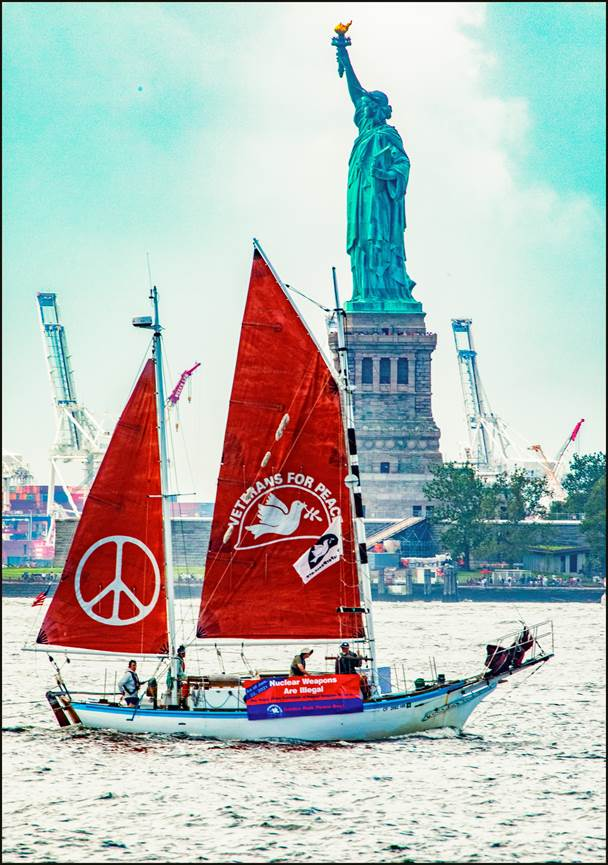
22,000+ miles voyaging for nuclear disarmament
and a radiation-free environment https://vfpgoldenruleproject.org/
To see nuclear-related stories in greater depth and intensity – go to https://nuclearinformation.wordpress.com
-
Archives
- July 2026 (241)
- June 2026 (287)
- May 2026 (306)
- April 2026 (356)
- March 2026 (251)
- February 2026 (267)
- January 2026 (308)
- December 2025 (358)
- November 2025 (359)
- October 2025 (375)
- September 2025 (257)
- August 2025 (319)
-
Categories
- 1
- 1 NUCLEAR ISSUES
- business and costs
- climate change
- culture and arts
- ENERGY
- environment
- health
- history
- indigenous issues
- Legal
- marketing of nuclear
- media
- opposition to nuclear
- PERSONAL STORIES
- politics
- politics international
- Religion and ethics
- safety
- secrets,lies and civil liberties
- spinbuster
- technology
- Uranium
- wastes
- weapons and war
- Women
- 2 WORLD
- ACTION
- AFRICA
- Atrocities
- AUSTRALIA
- Christina's notes
- Christina's themes
- culture and arts
- Events
- Fuk 2022
- Fuk 2023
- Fukushima 2017
- Fukushima 2018
- fukushima 2019
- Fukushima 2020
- Fukushima 2021
- general
- global warming
- Humour (God we need it)
- Nuclear
- RARE EARTHS
- Reference
- resources – print
- Resources -audiovicual
- Weekly Newsletter
- World
- World Nuclear
- YouTube
-
RSS
Entries RSS
Comments RSS
 nuclear-news
