Regular radioactive releases into water, air are “normal” says nuclear industry
Radiological releases are an inevitable part of the nuclear power industry
“Dilution is not the solution to radioactive pollution,” “It rather guarantees a chronic exposure over years and decades to tritium, a known cause of cancer, birth defects and genetic damage, to all those who drink Lake Michigan water.”
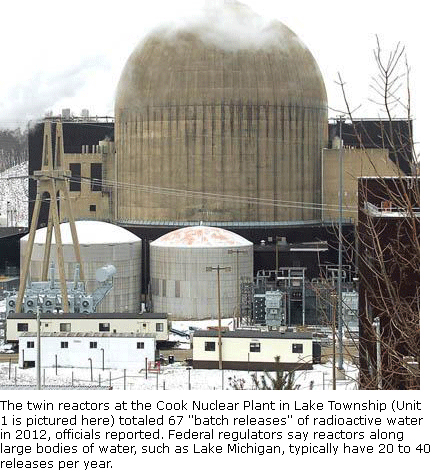 Release of nuclear plant ‘effluents’ into lake described as part of normal cycle Opinions differ on safety of practice Harbor Country News By Andrew Lersten July 17, 2013 COVERT — The May 5 release of about 80 gallons of slightly radioactive water from the Palisades nuclear power plant into Lake Michigan was unusual because it wasn’t planned.
But the incident brought into focus what many Southwest Michigan residents likely didn’t realize: The region’s two nuclear power plants (Palisades and the Donald C. Cook Plant in Lake Township) routinely discharge radioactive material into the air and into Lake Michigan.
In the nuclear industry, it’s called effluents. The federal Nuclear Regulatory Commission allows such releases, as long as they are closely monitored and do not exceed federal radiation release standards set in place by the NRC.
“Plants need to discharge small amounts of radioactive materials to operate,” said Jack Geissner, branch chief for the regional NRC office. Continue reading
How the IAEA negates true medical research on nuclear radiation
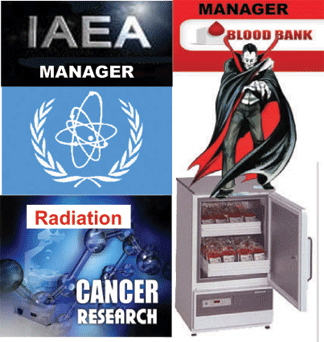 The IAEA wants the people make believe, that the main effect of the atomic catastrophe is psychological.
The Nuclear Cancer inside of the United Nations, blog by Jan Hemmer, June 1, 2013 by Mikkai 妊娠中の日本人女性の避難す
22nd July 1946 – Creation of World Health Organiation (WHO)
10th December 1948 – The UN adopts the Universal Declaration of Human Rights.
July 1957 – Creation of International Atomic Energy Agency (IAEA)
28th May 1959 – Signing of the Agreement WHA 12-40 between WHO and IAEA.
The UN is divided into 7 organisations, of which two are of interest to us, the Economic and Social Council and the Security Council. The “Economic and Social Council” oversees ALL the United Nations agencies with the exception of the “IAEA”. In fact, the IAEA is the only agency that reports directly to the “Security Council” which is made up of representatives of 15 countries, of which 5 are permanent members of the Council : the United States, the Untied Kingdom, the Russian Federation, China and France. These 5 nations are all nuclear powers, both civil and military, and almost all are exporters of nuclear technology.
The 10 remaining members (or countries) have a mandate which lasts for 2 years.
The influence of these 5 permanent members of the Security Council on policy making within the IAEA is enormous and ongoing. With no counterbalancing power, it is almost impossible to claim that the IAEA has an objective view of the nuclear industry and the consequences of its use.
On 28th May 1959, the IAEA (not yet two years old !) and WHO signed an agreement referred to as “WHA 12-40” which, though it might, on paper, appear balanced and reciprocal, in practice, puts WHO in a subordinate position to the IAEA.
The IAEA wants the people make believe, that the main effect of the atomic catastrophe is psychological. This is made in these steps: Continue reading
Radiation sickness: what it is.
With a large enough dose of radiation, for instance, bone marrow will break down almost completely causing major problems with anemia and maintenance of the blood.
this problem is distinct from cancer as caused by radiation.
Geek Answers: What is radiation sickness and why does it happen? GEEK By Graham Templeton Aug. 15, 2013 Acute Radiation Syndrome, more commonly known as radiation sickness, is one of the scarier threats out there, since it’s born of a force we can neither see nor readily detect and its symptoms can be varied and hard to identify. It can range in severity from an upset stomach to a long, painful death, and it often attacks people literally from the inside out. It seems like an almost spooky threat, but there is some very simple science radiation sickness. Essentially, it comes down to the type of radiation that can alter the electrical structure of atoms in the body.

We call such radiation “ionizing radiation” because it carries enough kinetic energy to knock an electron off of an atom it hits, giving that atom a non-standard number of electrons, turning it into an ion. It generally takes quite a bit of energy to achieve this, and ionizing radiation is almost exclusively the result of large and violent events (both manmade and cosmic). A nuclear reactor produces ionizing radiation that must be filtered out with shielding around the core which can — in the event of a disaster — contaminate whole communities, like Chernobyl. Continue reading
Chernobyl’s trees show radiation damage
 Chernobyl’s legacy recorded in trees By Mark Kinver Environment reporter, BBC News Exposure to radiation from the 1986 Chernobyl accident had a lasting negative legacy on the area’s trees, a study has suggested.
Researchers said the worst effects were recorded in the “first few years” but surviving trees were left vulnerable to environmental stress, such as drought.
They added that young trees appeared to be particularly affected.
Writing in the journal Trees, the team said it was the first study to look at the impact at a landscape scale.
“Our field results were consistent with previous findings that were based on much smaller sample sizes,” explained co-author Tim Mousseau from the University of South Carolina, US.
“They are also consistent with the many reports of genetic impacts to these trees,” he told BBC News.
“Many of the trees show highly abnormal growth forms reflecting the effects of mutations and cell death resulting from radiation exposure.”…… Prof Mousseau and his team hope to follow up this study by carrying out similar work in the Fukushima region in Japan, where logging also had considerable economic importance and pine trees were widely dispersed. http://www.bbc.co.uk/news/science-environment-23619870
Nuclear Test Ban Treaty aimed to protect world from radiation
 The Legacy of the Nuclear Test Ban Treaty, counterpunch by JOSEPH J. MANGANO and JANETTE D. SHERMAN, MD, 5 Aug 13, “…….The treaty is often referred to as a peace treaty, a step against nuclear war. While it was a goodwill gesture between hostile nations, it did nothing to prevent a war, since both sides continued to furiously test weapons underground and add to its already-large stockpiles. Only in the 1970s did non-proliferation treaties begin the process of cutting nuclear arsenals.
The 1963 test ban treaty was actually an environmental and public health action to reduce threats of deadly radiation, especially to the more susceptible infants and children. In a speech urging passage of the treaty, Kennedy – whose prematurely born son died that summer after living only 39 hours – made the case to prevent suffering among the youngest members of society:
“The number of children and grandchildren with cancer in their bones, with leukemia in their blood, or with poison in their lungs might seem statistically small to some, in comparison with natural health hazards. But this is not a natural health hazard, and it is not a statistical issue. The loss of even one human life, or the malformation of even one baby, who may be born long after we are gone, should be of concern to us all. Our children and grandchildren are not merely statistics toward which we can be indifferent.” Officials who had downplayed the idea that fallout was causing cancer and other diseases now told the truth. In October 1964, at a campaign stop in New Mexico, President Lyndon B. Johnson triumphantly told a cheering crowd:
“We cannot and will not abandon the test ban treaty to which I just referred, which is the world’s insurance policy against polluting the air we breathe and the milk we give our children.
Already that policy has paid off more than you will ever know, and since this agreement was signed and the tests stopped, the dread strontium-89 and iodine-131 have disappeared from the environment. The amount of strontium-90 and cesium-137 has already been, in a year, cut in half. This is technical language, but what it means is that we can breathe safely again.”
Johnson was correct. U.S. infant mortality had only dropped 13% in the 14-year period from 1951 to 1965, during bomb testing (the fallout peak was 1964). The next 14 years showed a decline of about 50% – the same 50% drop during the prior 14 year period. The years 1951-1965 had the poorest improvement in infant mortality during the 20th century. Cancer cases in children under age five in Connecticut, the only state with a cancer registry, plunged from 58 to 30 from 1963 to 1968. Years later, a 1999 report by the National Academy of Sciences estimated that up to 212,000 Americans developed thyroid cancer from radioactive iodine in bomb fallout. ….. http://www.counterpunch.org/2013/08/05/the-legacy-of-the-comprehensive-test-ban-treaty/

Fukushima’s radioactive leak now reaches emergency stage

Contaminated water could rise to the ground’s surface within three weeks, national newspaper Asahi Shimbun said on Saturday. Mr. Kinjo said the three-week timeline was not based on NRA’s calculations but acknowledged that if the water reaches the surface, “it would flow extremely fast.”
A Tepco official said on Monday the company plans to start pumping out a further 100 tonnes of groundwater a day around the end of the week.
Radioactive leak from crippled Japanese nuclear plant creating ‘emergency’ http://www.theglobeandmail.com/news/world/radioactive-leak-from-crippled-japanese-nuclear-plant-creating-emergency/article13602630/ ANTONI SLODKOWSKI AND MARI SAITO TOKYO — Reuters Monday, Aug. 05 2013 Highly radioactive water seeping into the ocean from Japan’s crippled Fukushima nuclear plant is creating an “emergency” that the operator is struggling to contain, an official from the country’s nuclear watchdog said on Monday.
This contaminated groundwater has breached an underground barrier, is rising toward the surface and is exceeding legal limits of radioactive discharge, Shinji Kinjo, head of a Nuclear Regulatory Authority (NRA) task force, told Reuters.
Countermeasures planned by Tokyo Electric Power Co. (Tepco), the utility that runs Fukushima, are only a temporary solution, he said.
Tepco’s “sense of crisis is weak,” Mr. Kinjo said. “This is why you can’t just leave it up to Tepco alone” to grapple with the ongoing disaster.
“Right now, we have an emergency,” Continue reading
Bahrain to set up nuclear radiation monitoring centre
CENTRE TO MONITOR NUCLEAR RADIATION http://www.gulf-daily-news.com/NewsDetails.aspx?storyid=358742By Ahmed Al Omari , Tuesday, August 06, 2013
MANAMA: Bahrain may soon set up a nuclear radiation monitoring centre.
This comes amidst growing concerns over threats of a fallout from Iran’s disputed nuclear power plant at Bushehr, just 300km away from Bahrain, across the Gulf.
The GCC last month raised concerns about radiation leaks from the facility after a 6.3 magnitude earthquake hit Iran in April earlier this year, killing more than 60 people.
Supreme Council for Environment (SCE) director-general Dr Adel Al Zayani believes a National Centre for Radiation could be approved within a week – the National Disaster Committee is currently studying a SCE proposal in this regard.
He said the nuclear threat has become larger with neighbouring countries moving toward using atomic facilities for energy production.
Saudi Arabia has announced plans to set up 16 nuclear reactors within the next 20 years and two are already being built in the UAE.
Dr Al Zayani said the proposed centre is designed to become a resource for the field of radiation and to prevent local disasters if they occur regionally.
“The centre will give Bahrain a more dedicated and faster radiation warning and reporting system.”
The centre will also give training to Bahrainis in subjects such as nuclear physics..
Discovery of medical records of world’s first nuclear bomb radiation victim
 “The records are invaluable as those reporting in detail on changes in her health condition after she was exposed to a fatal level of radiation.”
Medical records of world’s first radiation victim from A-bomb recovered Asahi Shimbun, By YURI OIWA/ Staff Writer, 4 August 13,
Long-lost medical records detailing the sharply deteriorating health of the world’s first recognized radiation sickness patient have been
recovered 68 years after the victim died within weeks of being exposed to the atomic bomb in Hiroshima.
The patient, Midori Naka, a stage actress, died 18 days after she was injured in the nuclear blast on Aug. 6, 1945. She was staying in Hiroshima as part of a traveling theater troupe. After returning to Tokyo a few days later, Naka died while undergoing treatment, which included blood transfusions, at the University of Tokyo Hospital. She was 36.
The discovery came after decades of efforts by researchers to locate her missing records.The hospital kept updates of her condition leading up to her death and the results of her autopsy. But other vital records have been missing until their recent recovery.
Kazuhiko Maekawa, professor emeritus with the University of Tokyo who is expert in treating patients suffering from radiation exposure, hailed the discovery of Naka’s medical records. Continue reading
Israeli study on risks of electromagnetic radiation from cellphones
Put away that cellphone: Israeli study highlights cancer risk Researchers find evidence that changes leading to cell mutations are much more prevalent among heavy talkers By TIMES OF ISRAEL STAFF July 30, 2013 study by Tel Aviv University has shown, for the first time, a clear connection between cellphone use and higher risk of cancer.
Get The Times of Israel’s Daily Edition by email
and never miss our top stories FREE SIGN UP!
Although cellphones are generally regarded as potentially carcinogenic, scientific studies on the issue have been inconclusive until now, a report on the study posted Monday on Science Blog noted.
A study by Tel Aviv University has shown, for the first time, a clear connection between cellphone use and higher risk of cancer.
Get The Times of Israel’s Daily Edition by email
and never miss our top stories FREE SIGN UP!
Although cellphones are generally regarded as potentially carcinogenic, scientific studies on the issue have been inconclusive until now, a report on the study posted Monday on Science Blog noted.
The study waspublished in the scientific journal “Antioxidants and Redox Signaling.” The results, while dramatic, do not establish a direct relationship between cellphone use and cancer development among users, but rather open up new lines of research and establish a clear connection between long-term cellphone use and potentially detrimental side effects on health that can cause molecular changes that can lead to cancer.
In the study, researchers from TAU, Rabin Medical Center and the Technion studied the salivary glands of 20 long-term heavy cellphone users, defined as a mean of 12 years of 30 hours per week of use, and 20 deaf subjects who did not use cellphones or used them only for text messaging.
The researchers hypothesized that because cellphones are generally placed quite close to the salivary glands when used for calls, the effects on cancer risk could be determined by analyzing the saliva of users.
They found that compared to the non-users, the cellphone users’ saliva showed much higher indications of oxidative stress, a process which is regarded as a major risk factor for cancer………….
Human sperm damaged even by low doses of radiation
 Animal studies have shown serious consequences in the offspring when DNA-damaged sperm fertilizes the egg,
the genetic and epigenetic abnormalities observed in the sperm are serious concerns,” said Adiga.
Epigenetic abnormalities are abnormalities induced by the effect of environment on the expression (functioning) of genes, which in this study refers to the prolonged exposure to radiation.
Radiation exposure affects sperm quality: Study, Daijiworld Manipal, August 1 (IANS): Manipal, August 1 (IANS): Long-term exposure to radiation at the workplace may play havoc with your sperm quality, says new research by Indian medical scientists.
A team of fertility experts, led by Manipal University professor of clinical embryology Satish Adiga, analysed sperm quality of 83 men working for three to 18 years in diagnostic or radiation units at various hospitals.
The results were compared with 51 men, also working in hospitals with a similar lifestyle but not exposed to radiation, US journal Public Library of Science ONE reports.
The men’s semen quality was tested for sperm number, vitality, shape and its DNA quality. The amount of radiation absorbed by health workers was also correlated with sperm quality.
Manipal researchers found more abnormal characteristics in the sperm of men exposed to the radiation, such as decrease in sperm motility, altered shape and vitality. Continue reading
Radiation’s genetic effects
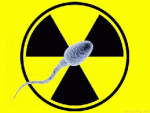 Radiation is Threatening The Formation of Sperm, Cancer Health Centre,
Nuclear radiation: nuclear radiation on the testis, the most powerful destructive effects can easily lead to male infertility. In the testis is the organ most sensitive organ to radiation is one of low doses of radiation are sufficient to significantly lower sperm quality, can cause temporary or even no sperm. 200 to 300 roentgen radiations can cause impaired spermatogenesis, 600 to 800 roentgen doses will enable the complete loss of spermatogenesis, loss of normal fertility.
- X-ray: Studies show that high-dose X-ray can cause sperm abnormalities, reducing the number of low quality, affecting germ cell genes, so that future generations have a serious genetic effects, which cause fetal malformations, miscarriage , premature delivery, mental retardation and so on.http://cancerlive.net/men-health/radiation-is-threatening-the-formation-of-sperm/
Nearly 1000 radioactive cars reached Russia from Japan
Radiation-Contaminated Japanese Cars Still Concern – Russian Customs . VLADIVOSTOK, August 1 (RIA Novosti) – Japanese cars contaminated with radiation in the aftermath of the 2011 Fukushima nuclear disaster is still a concern regarding the importation of such vehicles to Russia, a customs official said Thursday.
According to Russian customs, more than 930 radiation-contaminated vehicles from Japan have been detected at far eastern Russian ports since a magnitude-9 earthquake and subsequent tsunami ravaged the Fukushima nuclear power plant in central Japan…….
A representative of Russia’s federal consumer-protection watchdog, Rospotrebnadzor, told RIA Novosti that it is easier to send such cars back to Japan than to spend money on their decontamination…….http://en.ria.ru/business/20130801/182537097/Radiation-Contaminated-Japanese-Cars-Still-Concern–Russian-Customs.html
Uranium in common airliner parts
 Common Airliner Parts Now Admitted To Be Laced With Uranium http://www.thedailysheeple.com/common-airliner-parts-now-admitted-to-be-laced-with-uranium_0720 www.IntelliHub.com July 25th, 2013 MIAMI — Ten minutes away from the Sun Life Stadium, home of the Miami Dolphins and Florida Marlins, is Opa-locka Executive Airport (OPF), the site of a recent environmental tragedy.
Thursday, a portion of the airport grounds were sealed off due to a radioactive substance leak emitting from an old 55-gallon drum. HAZMAT and fire crews responded just after noon, finding radioactive airplane parts laced with Uranium inside the drum.
The drum was said to be found on the Grounds of the former, now bankrupt, Arrow Cargo. According to Wikipedia Arrow Cargo, “was an American cargo airline (originally known as Arrow Air) based in Building 712 on the grounds of Miami International Airport in unincorporated Miami-Dade County, Florida, USA. It operated over 90 weekly scheduled cargo flights, and had a strong charter business. Its main base was Miami International Airport. Arrow Air ceased operations on June 29, 2010, and filed for Chapter 11 bankruptcy protection on July 1, 2010. It plans to liquidate.”
What is most startling about this is the fact that Miami-Dade’s Fire Rescue spokesman Lt. Arnold Piedrahita, admitted to the press that indeed aircraft “counterbalances” are indeed made with radioactive uranium. The local press went on to downplay the severity of the finding.
Upon further investigation it turns out even the Boing Corporation itself has expressed concerns about certain aircraft parts containing radioactive materials. In fact, Boing even submitted paperwork to the United States Nuclear Regulatory Commission (USNRC) detailing their concerns:
Boeing Company Request Concerning Depleted Uranium Counterweights by Enformable
– See more at: http://www.thedailysheeple.com/common-airliner-parts-now-admitted-to-be-laced-with-uranium_072013#sthash.VzIwAfvb.dpuf
Tim Deere-Jones analyses UK government’s monitoring of marine radiation

On the basis of this review it’s my conclusion that the current programme for monitoring doses of marine derived radioactivity in food lacks the appropriate scientific rigour. It is not fit for current purpose because, owing to the weaknesses described above, it cannot provide sufficiently detailed data to justify the FSA claim that there is a “low risk from radioactivity in food” and that “no food safety risks have been identified”.

 UK government failing to protect population from potentially radioactive food
  http://www.theecologist.org/News/news_analysis/1915331/uk_government_failing_to_protect_population_from_potentially_radioactive_food.html by Tim Deere-Jones 25 July 13, Tim Deere-Jones dissects the UK Government’s system for monitoring doses of marine derived radioactivity in food and concludes that the current programme is deeply flawed.
2013 has seen a major surge in the potential for expansion of UK nuclear power. In February, the Environment Agency (EA) found no objection to the discharge and disposal of radioactive wastes from a proposed nuclear power station with two CPWRs (contained pressurised water reactors) at Hinkley Point on the Somerset coast. It stated that the discharge of gaseous and liquid wastes to the marine environment and atmosphere of the Bristol Channel could proceed.
One month later the UK Government granted permission for the construction of the Hinkley CPWR, paving the way for a three-fold increase in the amount of some radio nuclides discharged to sea and also for the rolling out of planning permissions for another eight stations holding two or three reactors each.
In the same period, the Food Standards Agency (FSA), responsible for monitoring radioactivity in food, stated that, since “an annual monitoring programme has been in place for more than 25 years and no food safety risks have been identified during this period”, it now proposed to “optimise” the monitoring of radioactivity in food by reducing the scope and volume of its annual environmental monitoring and analysis programmes.
The FSA risk estimate for marine radioactivity is based on the outcome of assessment modelling of dietary dose, received from a range of foodstuffs thought to be representative of dietary exposure pathways. Here follows my review of the data inputs quality, upon which such modelling relies for its accuracy and relevance. Continue reading
Richard Wilcox’s personal journey to Fukushima’s irradiated “dead zone”
We also spotted many suspicious looking flowers and other forms of vegetation. According to Yoichi, radiation has affected some flowers in the nuclear zone to go haywire and outgrow their natural size (a
topic for future research). Yoichi noted that radiation affects different plants differently, some are hardy and not affected; others, especially flowers may receive small doses but have big results in terms of mutations.
Below: Yoichi indicates the normal height of this flower compared to this giant version

We already know that the biologist and expert on mutagenetic affects, Tim Mosseau, has shown that in Fukushima prefecture a variety of insects and other species have been affected (1).
My Trip To The Fukushima Nuclear Disaster Zone http://rense.com/general96/trip.html
(Part One) By Richard Wilcox Ph.D. 7-26-13 On July 20, 2013 Yoichi Shimatsu and I departed from Ueno station in Tokyo to visit the Fukushima nuclear disaster region and see what we
could see…..
Undoubtedly Japan’s countryside regions have suffered from brain drain and thus the numbers of passengers do not justify the number of trains. After the Fukushima disaster many people moved out of the immediate area and this has reduced the need for trains.
Beyond that fact, Yoichi speculates that the Japanese government does not want people going up there to snoop around, Fukushima is now a DEAD ZONE and off limits. Indeed it is, even while they are urging
some people to move back in. Families that moved out of the immediate area of the nuclear disaster may now live in safer zones to the south, but they are forced to train their kids back to their original schools during the daytime, if that is where their family property is registered. Continue reading
1 This Month

of the week – Shut Down Drone Warfare!


Tell the Ukrainian Government to Drop Prosecution of Peace Activist Yurii Sheliazhenko

Petition to revoke the licensing of the Near Surface Nuclear Disposal Facility (NSDF) at Chalk River. https://www.ourcommons.ca/petitions/en/Petition/Details?Petition=e-7247
To see nuclear-related stories in greater depth and intensity – go to https://nuclearinformation.wordpress.com
-
Archives
- April 2026 (114)
- March 2026 (251)
- February 2026 (268)
- January 2026 (308)
- December 2025 (358)
- November 2025 (359)
- October 2025 (376)
- September 2025 (257)
- August 2025 (319)
- July 2025 (230)
- June 2025 (348)
- May 2025 (261)
-
Categories
- 1
- 1 NUCLEAR ISSUES
- business and costs
- climate change
- culture and arts
- ENERGY
- environment
- health
- history
- indigenous issues
- Legal
- marketing of nuclear
- media
- opposition to nuclear
- PERSONAL STORIES
- politics
- politics international
- Religion and ethics
- safety
- secrets,lies and civil liberties
- spinbuster
- technology
- Uranium
- wastes
- weapons and war
- Women
- 2 WORLD
- ACTION
- AFRICA
- Atrocities
- AUSTRALIA
- Christina's notes
- Christina's themes
- culture and arts
- Events
- Fuk 2022
- Fuk 2023
- Fukushima 2017
- Fukushima 2018
- fukushima 2019
- Fukushima 2020
- Fukushima 2021
- general
- global warming
- Humour (God we need it)
- Nuclear
- RARE EARTHS
- Reference
- resources – print
- Resources -audiovicual
- Weekly Newsletter
- World
- World Nuclear
- YouTube
-
RSS
Entries RSS
Comments RSS
 nuclear-news