Radiation exposure to be estimated for 61,000 US personnel in Japan
Military to Calculate Radiation Exposure in Japan, Military.com July 20, 2011, by Seth Robson , YOKOTA AIR BASE, Japan — The U.S. military plans to calculate radiation doses received by each of the approximately 61,000 U.S. personnel living and working in Japan during this year’s nuclear disaster, according to the U.S. Pacific Command’s top surgeon. Continue reading
On health and safety grounds, Indian Point Nuclear Plant should be closed
First, to the cancer risk. Even the federal Nuclear Regulatory Commission — an agency that services the industry it is supposed to regulate, if there ever was one — has bowed to growing evidence and backed away from its decades of insisting that nuclear power plants do not cause cancer. …
 The Radiation and Public Health Project, a nonprofit anti-nuclear group, has found increasing levels of Strontium 90, a carcinogen that exists only as a byproduct of nuclear fission, in teeth from babies living close to nuclear plants, including Indian Point…the safety record, plus evidence that the facility already is slowly, steadily poisoning the region, makes clear that it’s time to close Indian Point.
It’s time to close Indian Point, ctpost.com, July 15, 2011 “……….But Hearst Newspapers‘ investigative reporter Bill Cummings in today’s paper presents a hard-to-dismiss examination of the plant closest to us. More than 17 million people live within a 50-mile radius of New York’s Indian Point Energy Center in Buchanan, N.Y., just south of Peekskill.
And incidence of cancer near the center, including in Fairfield County, is higher than the national average, and grow higher still as you get closer. Continue reading
Two patients still irradiated months after medical scans
 The agency said it recently became aware of two patients who underwent PET imaging scans with CardioGen-82 and were later found to have detectable levels of radiation several months after their PET scans. Both patients were crossing the border to or from the United States when radiation detectors identified radiation originating from them.
The FDA said the scans had been performed 2 and 4 months earlier.
FDA Investigating Exposure To Excess Radiation From Certain Heart Scans, WSJ, By Jennifer Corbett Dooren, WASHINGTON (Dow Jones) 16 July 11–-The Food and Drug Administration Friday warned about the potential for excess radiation exposure in patients who underwent heart scans involving a radioactive drug called CardioGen-82. Continue reading
Japanese mothers and pregnant women at risk from Fukushima radiation
 VIDEOS, (scroll down page for videos) http://womennewsnetwork.net/2011/07/13/nuclear-radiation-mothers-japan/Nuclear radiation exposure
concerns mount for mothers Japan Women News Network, Eva Fernández Ortiz and Shubhi Tandon 14 July 11, As parents from Fukushima prefecture line up in Tokyo for public protests and a more recent 7.0 level earthquake hit off shore of the east coast of Honshu, Japan on July 9, the latest data on nuclear power reveals: the amount of radiation inside the plant’s reactor has reached much higher than originally expected levels. Current released figures through JAIN – Japan Atomic Industrial Forum show 4,000 millisieverts per hour of radiation on June 4 was measured in Reactor No. 1 through a steam release rising from a crevice in the floor……
Current radiation release figures from TEPCO, the power company that operates and manages the Fukushima Daiichi nuclear power plant now reveals that larger than originally reported releases of radiation at 770,000 terabecquerels did happen, a level that may hold much more significance as the disabled plant is expected to continue to release radioactive isotopes over an extended period of time. Continue reading
France’s tardy response to Pacific nuclear test victims
FRANCE RESPONDS TO TAHITI ON NUKE COMPENSATION
|
The defence ministry in Paris says work has been started between the French state and the Fund in Tahiti on how those deemed eligible for compensation can be paid.
The ministry says France is yet to get a response to its initiative.
Two years ago, France recognised for the first time that its weapons tests weren’t clean but to date only one compensation claim has been recognised.
France tested nearly 200 nuclear weapons in French Polynesia before winding up its programme in 1996…..http://pidp.eastwestcenter.org/pireport/2011/July/07-08-14.htm
TSA workers exposed to radiation from backscatter airport scanners?
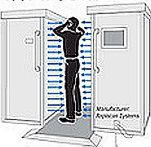 TSA Workers Fear Radiation Dangers From Scanners, 9 News Now, 2 July 11WASHINGTON, DC (WUSA) — After wading through documents he secured with a Freedom Of Information Act filing, the Executive Director of the Electronic Privacy Information Center, Marc Rotenberg told 9NEWS NOW, “We think that the Department of Homeland Security has not been forthcoming with the public about the true extent of radiation risk with the airport body scanners.”
The release of new documents follows concerns of TSA workers that they are being exposed to dangerous levels of radiation as they conduct the screenings. Union representatives in Boston cite an increase in cancer cases among the TSA workforce there and have asked the agency to allow its members to wear radiation monitoring devices……..
“It’s one branch of government that’s made the decision to deploy these devices and it’s the same branch of government which is evaluating its own program. That’s a recipe for a problem,” Rotenberg said… http://wusa9.com/news/article/156513/373/TSA-Workers-Fear-Radiation-Dangers-From-Scanners
30 years radiation health monitoring for 2 million Fukushima residents
Residents in the Fukushima region have expressed growing concern surrounding the possible longterm health risks, in particular for children, triggered by the on-going nuclear power plant crisis.
Two million Fukushima residents to undergo radiation health checks Telegraph By Danielle Demetriou in Tokyo, 21 June 11 More than two million residents living in the region surrounding Japan’s damaged nuclear power plant will undergo longterm health checks starting from this month. 20 Jun 2011 The health of residents in Fukushima prefecture in northeast Japan will be monitored over the next 30 years in order to ease growing concerns surrounding radiation contamination. Continue reading
Unnecessary radiation – too many CT scans in USA hospitals
 Hospitals Nationwide Unnecessarily Perform Double CT Scans, -California Heath Line – June 20, 2011Hundreds of hospitals nationwide routinely perform two chest CT scans on a single patient, needlessly exposing them to double doses of radiation and driving up costs, according to a review of Medicare data, the New York Times reports (Bogdanich/Craven McGinty, New York Times, 6/17).
Unnecessary Testing Patients who receive a double CT scan undergo a contrast and a noncontrast CT scan in succession (Appleby/Rau, Kaiser Health News/Washington Post, 6/18). Although most radiologists say nearly all chest issues can be accurately diagnosed with only one scan, 2008 Medicare data show that some hospitals performed double scans on chest patients more than 80% of the time. According to the Times, a single CT chest scan exposes a patient to 350 times the radiation of a standard chest X-ray (New York Times, 6/17).
Specifically, Medicare data show that 76,781 chest patients, or 5.4%, received double CT scans in 2008. While most hospitals administered them sparingly—a median of 2% of Medicare patients received two scans—618 hospitals performed double scans on at least 10% of Medicare chest patients, and 94 of those hospitals performed double scans on at least 50% of Medicare chest patients (Kaiser Health News/Washington Post, 6/18).
Experts note that double scanning also is common for privately insured patients (New York Times, 6/17). Although the number of overall non-Medicare patients who receive double scans is unknown, HealthPartners, a not-for-profit Minnesota HMO, reports that 7% of its chest patients received double scans in 2010 (Kaiser Health News/Washington Post, 6/18)….http://www.californiahealthline.org/articles/2011/6/20/hospitals-nationwide-unnecessarily-perform-double-ct-scans.aspx
Low dose of radiation causes cataracts
 Eye lens is more vulnerable to radiation: new studies IBN LIVE PTI | Jun 20,2011 There are three main forms of cataract; nuclear, cortical, and posterior sub-capsular (PSC). Among these, PSC is the least common and is associated with exposure to radiation. Till recently, scientists believed that cataract was formed only after the lens received a typical radiation dose, called the threshold dose, of 2Gy for a single dose, and 5 Gy when the exposure occurred in a protracted way. Not any more. Recent studies appear to show that formation of radiation induced cataracts at much lower doses than the current standards. ICRP now considers that the threshold dose for cataract is 0.5Gy. The present ICRP recommendations must serve as a wake-up call for interventional cardiology and radiology professionals, Parthasarathy said. Cataract analysis of 8,607 Chernobyl clean-up workers 12 and 14 years after exposure indicated that posterior sub-capsular or cortical cataracts appeared in 25 per cent of the participants…http://ibnlive.in.com/generalnewsfeed/news/eye-lens-is-more-vulnerable-to-radiation-new-studies/731307.html
Future human generations are affected by nuclear radiation
Ionising radiation – the kind that comes out of bombs and nuclear power plants – has been shown to alter sex ratios in fruit flies and mice, says Karl Sperling, of the Institute for Human Genetics at the University of Berlin. He suspects that radiation exposures might affect DNA in the first few cell divisions around the time of conception, which is known to be a highly vulnerable period.
If radiation can influence sex ratios in this way, he adds, there might be reason to be concerned about other environmental exposures, too.
Nuclear radiation affects future generations, 8 June 2011, ABC Radio Emily Sohn After exposure to nuclear radiation events, women may be more likely to give birth to boys than to girls, suggests a new study. Continue reading
Problems in assessing health effects of Fukushima radiation
some of the radiation to which people are being exposed around Fukushima is inside the body; it comes from radioactive materials that contaminated their food or water.
Radiation’s Unknowns Weigh on Japan, New York Times, By MATTHEW L. WALD June 6, 2011 As officials in Japan agonize over what constitutes a safe radiation dose for people who live near the Fukushima Daiichi nuclear reactors, the state of the science has been a daunting problem. Studies on the effects of exposure are based mostly on large doses delivered quickly by atomic bombs, while radiation from the Fukushima disaster would more likely result in small doses delivered over many years. Continue reading
Sick former uranium miners face hurdles in seeking compensation
Efforts to document Corral’s work history and exposure levels have turned into endless rounds of paperwork for him and volunteer advocate Sandra Belvail. They’ve had to track down decades-old payroll records and medical reports..
Former co-workers who started the claims process gave up.
“If they drag this process out, these guys will be gone,” Belvail said.
Chico Corral blames uranium industry for failing health But as others before him have learned, compensation is elusive The Spokesman Review, Becky Kramer 6 June 11, “….Now 79, Corral’s lungs show signs of scarring. Minor exertion leaves him short of breath. He believes his lung problems resulted from the two decades he spent in the uranium industry. Continue reading
Nuclear ionising radiation the top cancer causer
Top Cancer Doc: Nuclear radiation is the most carcinogenic thing that exists
“Nuclear radiation is the most carcinogenic thing that exists – said AIOM president Carmelo Iacono – and it cannot be kept under control, as the Fukushima tragedy proved. […]“…http://enenews.com/top-cancer-doc-nuclear-radiation-carcinogenic-exists
Radiation over-exposure of medical and other workers
An analysis of an internal government database shows instances in which workers were exposed to doses of radiation well beyond regulatory limits……..an analysis of government dose records found more than 100 instances in the last decade where workers were exposed to more radiation than provinces set out in their yearly limits — sometimes far beyond what is considered safe.
Last year, an office worker in Ontario was exposed to 2,768 mSv of radiation over the month of May. The U.S. Environmental Protection Agency says that’s enough of a dose to cause changes in blood chemistry, nausea, fatigue, vomiting, hair loss, diarrhea and hemorrhaging…. …http://www.google.com/hostednews/canadianpress/article/ALeqM5jJ6nBLb1iN09Vv8d3o483IbjrgXQ?docId=7059812
Airport scanning radiation “acceptable” in USA, not so sure in Europe
US clears naked scanners … Europe not so sure , MICEBTN 26 May 2011USA authorities have cleared full-body scanners deployed at airports, saying the radiation they emit is within acceptable levels.The Transportation Security Administration (TSA) said: “The latest reports confirm previous testing and show that every backscatter unit currently used for passenger screening in US airports is operating well within applicable national safety standards.”There are some 486 full-body scanners in 78 airports in the United States, of which 247 are so-called backscatter machines.Across the pond, the EU says body scanning should be voluntary for passengers at EU airports.If scanners are used, health and fundamental rights must be safeguarded along with personal data, dignity and privacy.No body images should be seen and, for health reasons, no X-ray-based scanners should be allowed at EU airports, say ministers at the European parliament, who also have confirmed they want the current ban on carrying liquids on planes lifted by 2013…. MICEBTN – US clears naked scanners … Europe not so sure
1 This Month

22 June – Virtual Event –Climate Change: New Data, New Debate

Monday, June 22, 2026 2:30 p.m. – 3:15 p.m. CT
YouTube. Register here
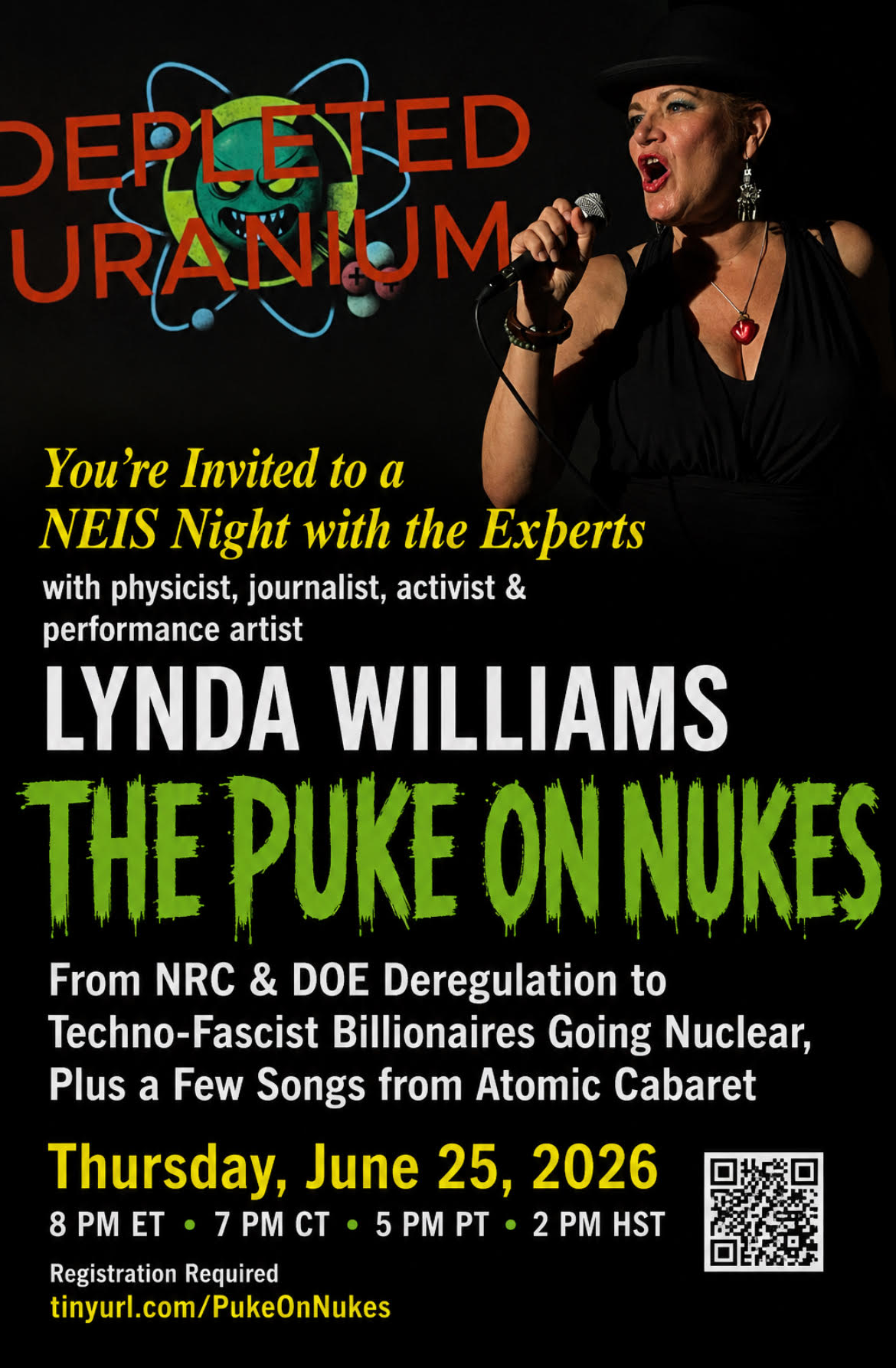
25 June- THE PUKE ON NUKES
Thursday, June 25, 2026
7pm Central Time (8pm ET, 6pm MT, 5pm PT) UTC – 5
From NRC & DOE Deregulation to Techno-Fascist Billionaires Going Nuclear, Plus a Few Songs from Atomic Cabaret REGISTER
26 June – Radiation Trainwreck at the NRC / Join the Protect Better Campaign – https://us02web.zoom.us/meeting/register/4ZlZ5_qLSHGiLSCg8FF6Bg#/registration
1st July – Webinar Waste of Space: The Environmental Harm of Military and Civil Space Activity st July, 7 pm
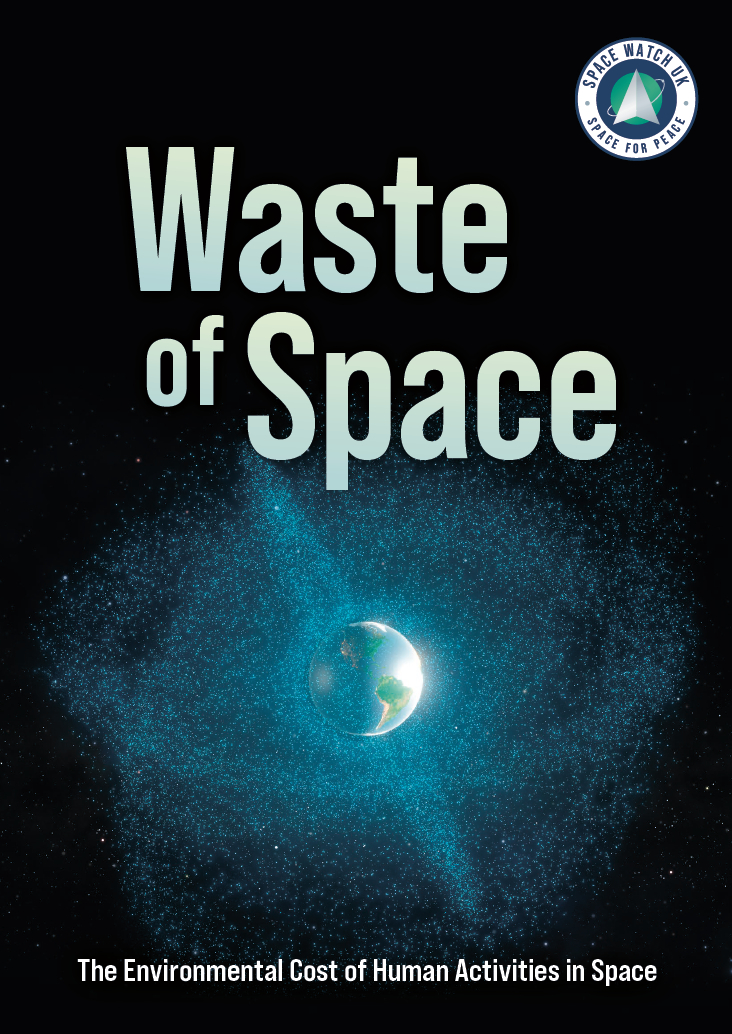
Report Launch Online: We are seeing an increasing exploitation of space for military and commercial purposes. This must change.

Protect Sazan Island from the Trump family! https://secure.avaaz.org/campaign/en/protect_sazan_island_from_the_trump_family_loc/?bqFCVab&v=174511&cl=22707147157&_checksum=5e9dde668860e8231c33699735e16a1fbf22ab2cb01da50c999fe8732b9775ef&utm_source=email&utm_medium=blast_email&utm_campaign=174511

Cuba Is Not a Failed State – It Is a Besieged State
PETITION: “Global Appeal to Endorse Palestinian Right of Return of Refugees”
To see nuclear-related stories in greater depth and intensity – go to https://nuclearinformation.wordpress.com
-
Archives
- June 2026 (221)
- May 2026 (306)
- April 2026 (356)
- March 2026 (251)
- February 2026 (268)
- January 2026 (308)
- December 2025 (358)
- November 2025 (359)
- October 2025 (376)
- September 2025 (257)
- August 2025 (319)
- July 2025 (230)
-
Categories
- 1
- 1 NUCLEAR ISSUES
- business and costs
- climate change
- culture and arts
- ENERGY
- environment
- health
- history
- indigenous issues
- Legal
- marketing of nuclear
- media
- opposition to nuclear
- PERSONAL STORIES
- politics
- politics international
- Religion and ethics
- safety
- secrets,lies and civil liberties
- spinbuster
- technology
- Uranium
- wastes
- weapons and war
- Women
- 2 WORLD
- ACTION
- AFRICA
- Atrocities
- AUSTRALIA
- Christina's notes
- Christina's themes
- culture and arts
- Events
- Fuk 2022
- Fuk 2023
- Fukushima 2017
- Fukushima 2018
- fukushima 2019
- Fukushima 2020
- Fukushima 2021
- general
- global warming
- Humour (God we need it)
- Nuclear
- RARE EARTHS
- Reference
- resources – print
- Resources -audiovicual
- Weekly Newsletter
- World
- World Nuclear
- YouTube
-
RSS
Entries RSS
Comments RSS
 nuclear-news