The myth of safe ionisng radiation
We are in the middle of a terrifying scientific experiment in which we and our children are the subjects. Let’s face the facts that mixing the profit motive with the most dangerous technology is a very bad idea, and that natural forces and human error are reason enough to admit nuclear power is a mistake. It’s time to move on.

The Myth of Low-Level Radiation, Why safe levels are a myth , Radiation Truth All radiation is dangerous, whether it is natural or man-made. There is no “safe” amount of radioactive material or radiation. “The U.S. Department of Energy has testified that there is no level of radiation that is so low that it is without health risks”, reports Jacqueline Cabasso, the Executive Director of the Western States Legal Foundation. (full article) Continue reading
Radiation standards for children should be lower than for adults
 “Safety standards established in nuclear power countries are currently set for adults,” .. “It is a given fact that children are far more vulnerable to exposure.”
 New Radiation Limits Demanded for Children, By Suvendrini Kakuchi TOKYO, Sep 29, 2011 (IPS) – The threat of radioactive contamination faced particularly by children after the Mar. 11 nuclear disaster in Japan has touched the heart of the Japanese public, and become a major political and social issue.
Mothers are inevitably in the forefront of citizen groups working to protect children. At a meeting this week at the Ministry of Welfare, they presented an appeal that included a demand for the world’s first radiation safety standards for minors. Continue reading
The catastrophic level of radiation to Japanese from Fukushima nuclear disaster
In March, 2006, 20 years after the accident, the people whose health had been damaged in Russia, the Ukraine and Belarus numbered 7,000,000.
 excerpt from: Fukushima Meltdown: The World’s First Earthquake-Tsunami-Nuclear Disaster[Kindle Edition] Takashi Hirose http://www.amazon.com/dp/B005OD75J2/?tag=theasipacjo0b-20
Fukushima radiation levels – danger to children
Global resources needed to combat radiation levels, Statesman.journal.com by Warren Binford, Sep. 25, 2011 This month marked the half-year anniversary of the Fukushima earthquake and tsunami, and TEPCO and the Japanese government remain unable to control the nuclear emergency that continues to unfold.
Radiation levels exceed the Chernobyl disaster and now reach a level that is unknown to humans or machines. Radiation leakage from the Fukushima Daiichi Nuclear Power Plant was so high in August it exceeded the monitoring equipment’s maximum measuring capacity. Continue reading
Japan’s nuclear crisis making young Japanese more thoughtful
 young people in Japan have significantly shifted their focus from material gain to altruism….
Previously, the key purpose for finding a career had been to earn money …..respondents said that their views had also changed about nuclear power
Nuclear incidents cause shift in values among young Japanese, Inside Japan Tours, 15th September 2011 A new survey reveals that the earthquake and nuclear disaster that beset Japan earlier this year has led to a shift in attitudes among the country’s young citizens. Continue reading
Caution needed with dental x-raying
 there’s no such thing as a completely safe exposure, and radiation is cumulative over your lifetime. Children are particularly vulnerable,
Are dental X-rays dangerous?, CNN Health, By Elizabeth Cohen, Senior Medical Correspondent, September 15, 2011 “……..Worries about children, thyroid cancer Like many medical procedures, dental X-rays have an upside and a downside. The upside is that an X-ray allows your dentist to see bones, tissue, and hidden surfaces of your teeth that he or she can’t see with the naked eye.
The downside is that X-rays expose you to radiation. Four bitewing X-rays, which is what many people get in a routine exam, give about .005 millisieverts of radiation, according to the American College of Radiology. That’s about the same amount of radiation you get in a normal day from the sun and other sources. A panoramic dental X-ray, which goes around your head, has about twice that amount of radiation. Continue reading
Anxiety in city on border of Fukushima’s no-go zone
Japan city on border of nuclear no-go zone fights for survival, By Antoni Slodkowski, Editing by Tomasz Janowski and Jonathan Thatcher, MINAMI SOMA, Japan Sep 11, 2011 (Reuters) – A line dividing the no-go zone around the Fukushima nuclear plant and the area deemed safe from radiation cuts right across this coastal city but the “good” part is starting to look very much like the ghost town on the other side.
Six months after a magnitude 9.0 earthquake unleashed a deadly tsunami that triggered meltdowns and radiation leaks at the Tokyo Electric Power’s complex, Minami Soma, a city just a half an hour’s drive away, struggles to stay alive. Continue reading
The psychological fallout from Fukushima’s continuing radiation
Low-level radiation is an invisible threat that breaks DNA strands with results that do not become apparent for years or decades. Though the vast majority of people remain completely unaffected throughout their lives, others develop cancer. Not knowing who will be affected and when is deeply unsettling….
Twenty years after the 1986 reactor explosion in Chernobyl, the World Health Organisation said psychological distress was the largest public health problem unleashed by the accident…
the radiation “creates a slow, creeping, invisible pressure” that can lead to prolonged depression.
Fukushima disaster: it’s not over yet Six months after the multiple meltdowns at the Fukushima Daiichi nuclear plant, the streets have been cleared but the psychological damage remains “…...Jonathan Watts, guardian.co.uk, Sept 9 11, ”……..Reiko went on to describe how everything had changed in the wake of the nuclear accident in Fukushima the previous month. Daily life felt like science fiction. She always wore a mask and carried an umbrella to protect against black rain. Every conversation was about the state of the reactors. In the supermarket, where she used to shop for fresh produce, she now looked for cooked food – “the older, the safer now”. She expressed fears for her son, anger at the government and deep distrust of the reassuring voices she was hearing in the traditional media. “We are misinformed. We are misinformed,” she repeated. “Our problem is in society. We have to fight against it. And it seems as hard as the fight against those reactors.” Continue reading
Every extra bit of ionising radiation increases your cancer risk
Nuclear policy experts: No safe radiation level from Fukushima,THE CANADIAN, 11 SEPTEMBER 2011 Daniel Hirsch, a renowned expert on nuclear policy often quoted by major media outlets, spoke at the Stevenson College Event Center on the tragedy at the Fukushima plant and how the U.S. can prevent a similar meltdown at its 104 nuclear reactors, including the two in California.
Hirsch warned that a decades-old study estimated that a meltdown at the Southern California nuclear plant in Onofre could release enough radiation to immediately kill 130,000 people, cause cancer to 300,000 and genetic defects in 600,000 more.
“Every amount of radiation exposure increases your risk of cancer,” he said. “There is no safe level of radiation….”http://www.agoracosmopolitan.com/news/intrnational/2011/09/11/783.html
A start to addressing the scandal of Navajo radiation contamination from uranium mining
 The cleanup at the Skyline Mine represents not only a reduced risk of exposure for Begay and her family, but marks the first significant remediation of a mine on the country’s largest American Indian reservation where such sites number in the hundreds.
Tests have found gamma radiation activity greater than two times the background level at 80 locations on the site. In the traditional Navajo home where Begay once lived with two of her sons, the radiation levels were up to 100 times the acceptable level. The two sons have died — one of lung cancer and the other from a tumor.
Navajo woman helps prompt uranium mine cleanup, Houston Chronicle, FELICIA FONSECA, September 5, 2011 MONUMENT VALLEY, Utah (AP) — The stretch of high desert on the Arizona-Utah border gives way to towering rock formations that resemble huge mittens, chimney spires and castles. But to the west of Monument Valley lies a reminder of what has been blamed for much heartache and tragedy in Elsie Mae Begay‘s family: A mesa stained with a gray streak where uranium was mined decades ago. Continue reading
Kazakhtsan – land of nuclear human nuclear radiation guinea pigs
As for the locals, they were little more than guinea pigs…. it is so hard to prove the link between nuclear fallout and the diseases that may strike afterwards.According to Dr. Marat Sandybaev, head of the local oncology centre, cancer rates in the area are still twice as high as the national average, and it is estimated that birth defects are up to 10 times higher.
Bringing life to a nuclear wasteland Can a nuclear test site be reclaimed? The Soviets detonated hundreds of bombs in Kazakhstan, poisoning the land and people. Louise Gray of the Telegraph travels to the notorious Polygon site and reports on plans to restore the region By Louise Gray, The Telegraph September 4, 2011 “…. Between 1949 and 1989, the Soviet Union detonated more than 456 nuclear devices on the Semipalatinsk test site, better known as the “Polygon.” Continue reading
Children given overdose of diagnostic radioactive substance
X-ray technician overdosed children with radioactive agent ,The Yomiuri Shimbun, 1 Sept, KOFU–-A local hospital said Thursday one of its radiographers had deliberately administered higher-than-recommended amounts of a radioactive substance during examinations of 84 children suffering from kidney ailments since 1999. Continue reading
Chernobyl’s “liquidators” not compensated for radiation caused cancers
neither governments nor nuclear industries have provided any significant funding for researching more controversial health effects of radiation such as breast cancer and heart disease. Whenever you hear that “there are no studies proving any connection between radiation and [insert medical condition]”, you can be pretty sure it’s because no studies have actually been done……
Nuclear Family Bonds, Open Salon 25 Aug 11, “…..Japan has supported Chernobyl studies and projects in Ukraine for years. Though one people suffered from the Bomb, and the other, a civilian nuclear plant explosion, both were bound by scars of the atomic age. That both, after Fukushima, are now also victims of the “peaceful atom” is almost getting weird. Continue reading
Study into second cancer risk for testicular cancer survivors
 Diagnostic radiation and second cancer risk in testicular cancer survivors ” ecancer medical science 30/08/2011 ,by ecancer reporter Clare Sansom The link between radiation exposure and cancer first became evident in studies of survivors of the atomic bombings of Hiroshima and Nagasaki in 1945.
Later studies established a link between therapeutic radiotherapy for cancer and increased risk of a second subsequent malignancy. There have, however, been few large, comprehensive studies to date of the association between the lower radiation levels associated with diagnostic testing and subsequent cancer risk.
Testicular cancer is one of the most treatable solid tumours, but survivors of this disease need regular monitoring for recurrence, generally through repeated X-ray computer tomography (CT) scans……..
As cancers are known to take a minimum of five years to develop following radiation exposure, all patients who received a second cancer diagnosis or died within five years of developing their testicular cancer were also excluded from the study…………. The resulting study population included 2,569 men with a mean age at diagnosis of 34.7 years, and who were observed for a median time of 11.2 years….
Cancer and birth deformities in city near to 456 nuclear bomb tests
City that suffered most calls for an end to nuclear testing, Telegraph, By Louise Gray, Environment Correspondent, Semipalatinsk, 29 Aug 2011, The people of Semey will gather for a strange celebration today. Under a huge statue of a mushroom cloud they will commemorate the end of a chilling experiment on their own people and call for a complete ban on nuclear testing.
Between 1949 and 1989 this area of eastern Kazakhstan was used by the former Soviet Union to test 456 nuclear bombs. The local population was not told about the risks to their lives – or indeed the health of their grandchildren.
It is estimated some 1.5 million people were affected by the fallout and decades on doctors blame high rates of cancer and birth deformity on the continuing effects of radiation. Continue reading
1 This Month

22 June – Virtual Event –Climate Change: New Data, New Debate

Monday, June 22, 2026 2:30 p.m. – 3:15 p.m. CT
YouTube. Register here
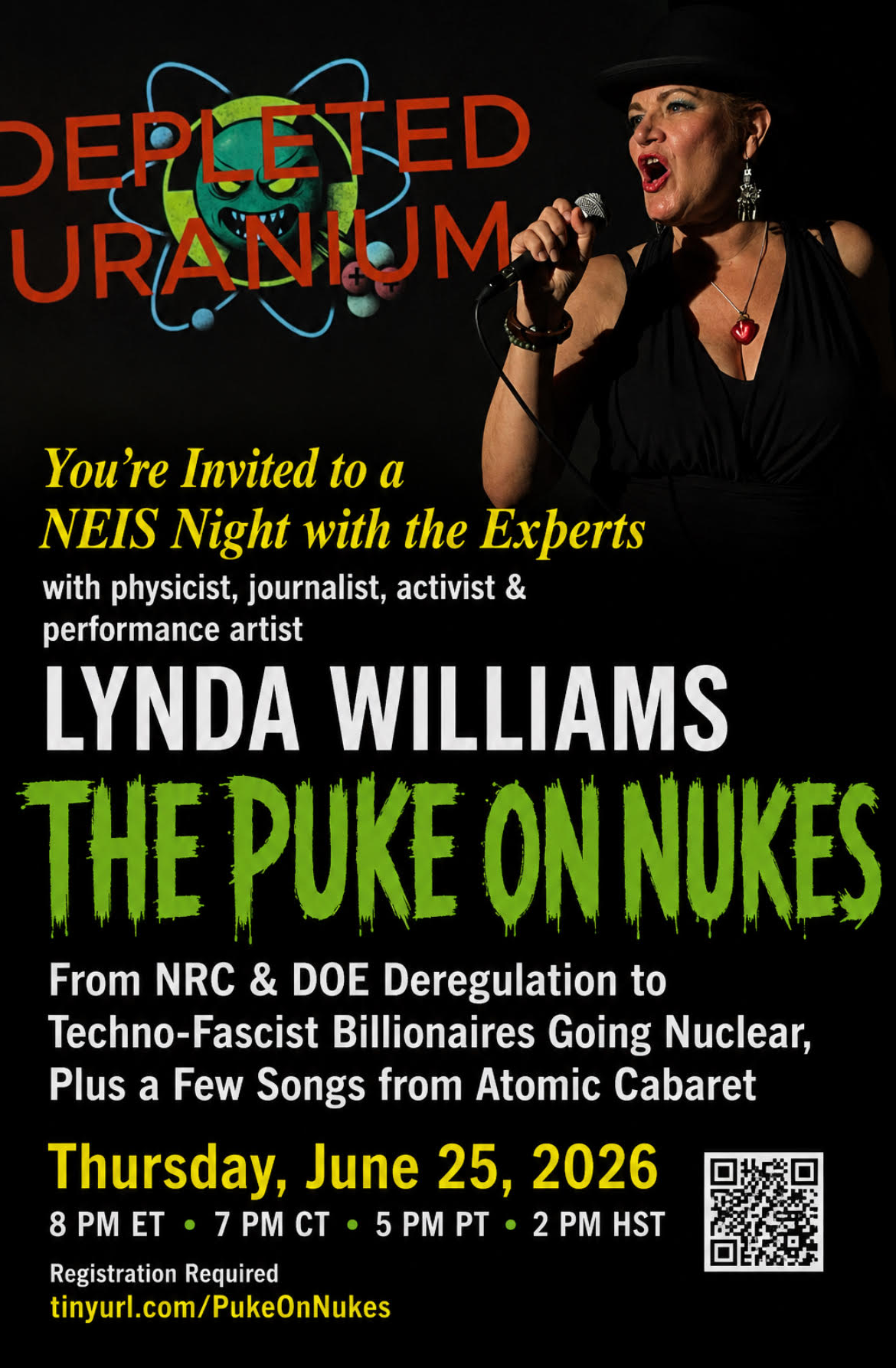
25 June- THE PUKE ON NUKES
Thursday, June 25, 2026
7pm Central Time (8pm ET, 6pm MT, 5pm PT) UTC – 5
From NRC & DOE Deregulation to Techno-Fascist Billionaires Going Nuclear, Plus a Few Songs from Atomic Cabaret REGISTER
26 June – Radiation Trainwreck at the NRC / Join the Protect Better Campaign – https://us02web.zoom.us/meeting/register/4ZlZ5_qLSHGiLSCg8FF6Bg#/registration
1st July – Webinar Waste of Space: The Environmental Harm of Military and Civil Space Activity st July, 7 pm
Report Launch Online: We are seeing an increasing exploitation of space for military and commercial purposes. This must change.

Protect Sazan Island from the Trump family! https://secure.avaaz.org/campaign/en/protect_sazan_island_from_the_trump_family_loc/?bqFCVab&v=174511&cl=22707147157&_checksum=5e9dde668860e8231c33699735e16a1fbf22ab2cb01da50c999fe8732b9775ef&utm_source=email&utm_medium=blast_email&utm_campaign=174511


Cuba Is Not a Failed State – It Is a Besieged State
PETITION: “Global Appeal to Endorse Palestinian Right of Return of Refugees”
To see nuclear-related stories in greater depth and intensity – go to https://nuclearinformation.wordpress.com
-
Archives
- June 2026 (221)
- May 2026 (306)
- April 2026 (356)
- March 2026 (251)
- February 2026 (268)
- January 2026 (308)
- December 2025 (358)
- November 2025 (359)
- October 2025 (376)
- September 2025 (257)
- August 2025 (319)
- July 2025 (230)
-
Categories
- 1
- 1 NUCLEAR ISSUES
- business and costs
- climate change
- culture and arts
- ENERGY
- environment
- health
- history
- indigenous issues
- Legal
- marketing of nuclear
- media
- opposition to nuclear
- PERSONAL STORIES
- politics
- politics international
- Religion and ethics
- safety
- secrets,lies and civil liberties
- spinbuster
- technology
- Uranium
- wastes
- weapons and war
- Women
- 2 WORLD
- ACTION
- AFRICA
- Atrocities
- AUSTRALIA
- Christina's notes
- Christina's themes
- culture and arts
- Events
- Fuk 2022
- Fuk 2023
- Fukushima 2017
- Fukushima 2018
- fukushima 2019
- Fukushima 2020
- Fukushima 2021
- general
- global warming
- Humour (God we need it)
- Nuclear
- RARE EARTHS
- Reference
- resources – print
- Resources -audiovicual
- Weekly Newsletter
- World
- World Nuclear
- YouTube
-
RSS
Entries RSS
Comments RSS
 nuclear-news