Radiation caused illness in Britain’s nuclear veterans and their children
 MoD survey shows three in four nuclear test veterans fear radiation has affected their health, Mirror, by Susie Boniface, 30/10/2011 A devastating new report shows that eight in 10 of Britain’s nuclear test veterans went on to develop multiple medical conditions.
Asked if they believe their health had been affected by being at a nuclear test site, 28 per cent said they were certain it had, 23 per cent thought it had and 24 per cent said it may have done – a total of 75 per cent. Only eight per cent said it definitely had not.
The study, the first MoD funded-research since 1993, vindicates 10 years of campaigning by the Sunday Mirror which has highlighted the crippling legacy of ill health veterans have suffered. Many have developed cancers and rare medical complaints.
Studies have shown they have six times the national rate of leukaemia and 10 times the rate of birth defects among their children. It was only after massive pressure from the veterans and this newspaper that the last government finally agreed to fund a £412,000 study into their health.
SPENDING SLASHED The Coalition slashed the spend to £75,000 but 633 veterans still came forward to answer questions developed by two doctors with the British Nuclear Test Veterans’ Association.
The survey shows only 18 per cent of those polled are in “good health” and of those with a serious condition, only 16 per cent thought it was because of other than radiation. Veterans made a series of demands in the study, including a medical centre, better access to service medical records and a detailed genetic study of their descendants.
But experts did not look at the illnesses of vets’ children and grandchildren, saying the evidence was “of too variable a quality”. Read more: http://www.mirror.co.uk/news/top-stories/2011/10/30/mod-survey-shows-three-in-four-nuclear-test-veterans-fear-radiation-has-affected-their-health-115875-23524038/#ixzz1cOe5PLWA
Japan to decide on level for lifetime exposure to ionising radiation
The report pointed out effects of radiation exposure on children are more serious than those on adults,
 Govt to cap radiation limit / Report recommends lifetime exposure of no more than 100mSv, The Yomiuri Shimbun, 29 Oct 11, A report by the Cabinet Office’s Food Safety Commission has recommended a person’s cumulative lifetime radiation exposure from food should be limited to about 100 millisieverts.
The report compiled Thursday covers possible effects on health from internal exposure from food containing radioactive substances. Based on the report, the Health, Labor and Welfare Ministry will begin considering individual regulatory figures for foods.
It is likely the new limits will be stricter than interim limits, hurriedly implemented shortly after the crisis began at the Fukushima No. 1 nuclear power plant. Continue reading
Nuclear radiation more harmful to women
 ATOMIC RADIATION IS MORE HARMFUL TO WOMEN , Nuclear Information and Referral Service, 27 Oct 11, Women as a group suffer significantly more from the impact of ionizing radiation than do men. Today Nuclear Information and Resource Service published a Briefing Paper that focuses on a dramatic fifty-percent greater incidence of cancer and fifty-percent greater rate of death from cancer among women, compared to the same radiation dose
level to men. To be clear: males suffer cancer and cancer death from exposure to ionizing radiation; but gender difference in the level of harm has been to date underreported.
The data leading to this conclusion originally was reported in the National Academy of Sciences 2006 report, “BEIR VII” which is the seventh report in a series on the Biological Effects of Ionizing Radiation. Continue reading
Study on cancer rates near nuclear power plants
As the nation explores whether to invest more in nuclear energy, the National Academy of Sciences is working on a study of cancer rates among people living near nuclear facilities.
“If you show living near a nuclear facility increases your chances of getting cancer, there will have to be radical changes,”
 Study aims to bring facts to nuclear power debate, including facilty north of Asheville Parts of WNC Citizen Times, ASHEVILLE, 26 Oct 11, — From a small town in east Tennessee to the nation’s capital, scientists studying cancer rates heard a similar call from those who live near nuclear power plants.
“I really would like to see some real science out there that really analyzes and understands the root causes behind this,” Westmont, Ill., resident and mother Shari Katz, said during a Chicago hearing on the study earlier this year. Continue reading
Canada underestimated radiation doses of health care workers
Radiation doses of 1,769 health care workers under-reported for four years The Star. com, 26 oct 11, A system used by 1,769 health care and research workers to measure their workplace radiation exposure may have under-reported radiation levels since 2008, says the Canadian Nuclear Safety Commission. The commission says a “calculation error” in the management system used by the devices is responsible for the low readings. Continue reading
Concern for workers exposed to radioactive uranium
Answers sought on uranium at Bethlehem site, Buffalo Business First, October 19, 2011 Three federal lawmakers are calling on health officials to continue investigating working conditions that existed for nearly a quarter century at the former Bethlehem Steel site in Lackawanna. The concern of Rep. Brian Higgins, D-Buffalo and New York Sens. Senator Charles Schumer and Kirsten Gillibrand is that workers risked their health because of the presence of radioactive uranium at the plant
The lawmakers have written to National Institute for Occupational Safety and Health Director John Howard to further investigate and report on the clean-up at Bethlehem Steel. The highly radioactive uranium was processed at the Lackawanna site during the Cold War. Former Bethlehem Steel workers attest that the facility where uranium was rolled was not adequately decontaminated until 1976, despite earlier company reports claiming that the plant was cleaned up in 1952, meaning hundreds of additional workers may have been exposed to dangerous residual radiation…. http://www.bizjournals.com/buffalo/blog/morning_roundup/2011/10/answers-sought-on-uranium-at-bethlehem.html
South Africa’s shame of radiation caused illness in uranium workers
 Nuclear illness scourge, The new Age, Mel Frykberg, 20 Oct 11, Exposure to uranium at South African nuclear facilities over the years has left dozens of people dead and hundreds of others terminally ill, an investigation by The New Age has revealed. “These nuclear workers have been used and abused like cannon fodder and then abandoned without any care or compensation when they were no longer of any use to the nuclear industry,” said Mashile Phalane, the former coordinator of Earthlife Africa (ELA).
ELA and the Pelindaba Working Group – comprising ex-employees and antinuclear activists – are leading the battle to get compensation for victims. Former nuclear workers claim that they were not provided with protective clothing nor given the necessary medical attention when they were exposed to radiation.
Most claim they were given little or, in many cases, no financial compensation and in many cases were summarily dismissed once their symptoms became known. The country’s nuclear watchdog, the Nuclear Energy Corporation of South Africa (Necsa), stands accused by activists involved in the long-running campaign to ensure justice for victims and their families, of destroying the lives of hundreds of ex-employees.
Japan: the psychological impact of Fukushima nuclear catastrophe
For Japanese, Fukushima spells fear, MARK MACKINNON,TOKYO—Globe and Mail, Oct. 12, 2011 The Fukushima fallout has now spread well beyond what can be measured with a Geiger counter. In the minds of many consumers, Fukushima prefecture – which, at almost 14,000 square kilometres is bigger than Lebanon or Jamaica – and the Fukushima Daiichi nuclear plant are one and the same. Though the Japanese government has evacuated only a 20-kilometre radius around the plant, many inside and outside Japan treat the entire region as though it’s contaminated, unsure of what to make of shifting official assessments of the situation. Continue reading
Experts find USA radiological labs not prepared for nuclear disasters
U.S. Labs Not Equipped to Handle Radiation Disasters, By Shalmali Pal, MedPage Today October 12, 2011 Reviewed by Zalman S. Agus, MD; Emeritus Professor University of Pennsylvania School of Medicine. The U.S. state-based public health community is not ready to address a large-scale radiological event such as the one at Japan’s Fukushima Daiichi nuclear plant, according to recent survey results.
The “serious gaps in U.S. radiological preparedness,” include a shortage of appropriate personnel and a lack of federal certification to conduct sample testing, wrote Megan Weil Latshaw, PhD, and colleagues, from the Association of Public Health Laboratories (APHL) in Silver Spring, Md., in Disaster Medicine and Public Health Preparedness.
APHL is the national professional organization representing state and local government labs. The authors analyzed data from two inhouse surveys, the 2009 All-Hazards Laboratory Preparedness Survey and the 2011 Radiation Capabilities Survey, which were sent to public health labs in 50 states, the District of Columbia, and Puerto Rico…..
The authors called for several initiatives to better prepare public health labs for a radiological event.These plans include funding for the national Laboratory Response Network to continue identifying potential agents of biological and chemical terrorism and funding to develop more advanced lab methods to test radiological specimens…..http://www.medpagetoday.com/PublicHealthPolicy/EnvironmentalHealth/29005
Japan’s plan for 20 year study of 360,000 children’s radiation effects
In Japan, a Long-Term Study On Radiation Leaks’ Effects, NYT, By HIROKO TABUCHI, October 10, 2011 TOKYO — In an effort to track the long-term health effects of the nuclear disaster at Fukushima, Japan has begun a survey of local children for thyroid abnormalities, a problem associated with exposure to radiation.
The study comes in response to concerns over the health consequencesof the serious radiation leaks caused by multiple meltdowns at the Fukushima Daiichi Nuclear Power Station in March. Japanese officials hope to study about 360,000 children who were under 18 at the time of the accident and track their health through their lifetimes, according to Fukushima Prefecture officials.
Children and pregnant women are particularly sensitive to radioactive iodine, which can harm the thyroid, studies after the Chernobyl nuclear disaster in 1986 have shown. According to research presented at a 2006 global conference, at least 4,000 cases of thyroid cancer among children have been linked to Chernobyl’s fallout.
On Sunday, the first day of the Fukushima study, more than 100 children were tested. Specific test results will not be made public, according to Fukushima Prefecture. But the children, who will be tested every two years until they turn 20 and every five years after that, will receive further care if doctors discover abnormalities….. http://www.nytimes.com/2011/10/11/world/asia/japan-studies-radiation-effects-on-children.html
Chernobyl radiation, and breast cancer years later
 Doctors told us our radiation levels were 100 times higher than normal.
Catriona Munro on Chernobyl and her breast cancer, BBC News, 7 Oct 11, Catriona Munro believes her incurable breast cancer is linked to the fall out from the Chernobyl disaster. For a BBC Scotland documentary she has recalled how she may have been exposed to radiation and told of her fears for others whose health may also have been affected. Continue reading
Japan will no longer measure plutonium
 Japan ceases measuring the plutonium, Paul Langley’s Nuclear History Blog, 4 Oct 11, At the press conference of TEPCO and related ministries of Japanese government, Ministry of Education, Culture, Sports, Science and Technology stated they will not measure plutonium anymore.
The measurement of plutonium was abandoned in Japan.It was announced on 10/3/2011 by staff from Ministry of Education, Culture, Sports, Science and Technology.
Now Japanese people are allowed to take 1~10 Bq/kg of plutonium. However, 1 in a million gram of plutonium causes cancer.
They announced that plutonium and strontium were detected in 45km / 79km area on 9/30.They seem afraid of having the contamination situation known by more people. http://fukushima-diary.com/2011/10/breaking-news-the-measurement-of-plutonium-was-abandoned-in-japan/#.Tomr6dmxwk4.facebook
JGov and TEPCO are disgusting.
http://nuclearhistory.wordpress.com/2011/10/03/japan-ceases-measuring-the-plutonium/
Plight of Canada’s veterans with cancer from depleted uranium
 All efforts to get adapted care for his condition lead no where since Veterans Affairs do not acknowledge depleted uranium poisoning.
 Ex Canadian Forces Soldier To Go On Hunger Strike To Protest Against Depleted Uranium Exposure October 2, 2011, Ottawa Citizen Sylvain Bouchard: On November 5th 2011, Pascal Lacoste, an ex-soldier in the Canadian Armed Forces and a very good friend of mine, will go on a hunger strike in front of Steven Blaney’s office at Lévis-Bellechasse 115, route Kennedy, 101 Lévis (Québec) G6V 6C8 Canada.
After 12 years of fighting with the Canadian government to acknowledge that he and other members of the Canadian Forces have been poisoned with depleted uranium while on duty, he no longer sees any alternative than to go out on his terms, go out fighting. Continue reading
Medical radiation treatment necessary, but carries risks
 Radiation treatment meant mother could not touch son Hartlepool Mail, 30 September 2011 A MUM was forced to stay away from her baby son after being given potentially dangerous treatment when she found she had a rare form of cancer. New mum Jill Teasdale could not get close to little son Max just months after he was born after contracting thyroid cancer.
The 30-year-old found a lump in her neck and following hospital tests, was diagnosed with papillary thyroid cancer. Within weeks, she had undergone an operation to remove her thyroid gland and was prescribed a course of radioactive iodine treatment.
“The treatment lasted about a week, but because of the radiation I wasn’t allowed to get close to my little boy,” she said. “I had to have minimum contact.”
Although diagnosed in June 2009, it was not until the following April that Jill was given the all clear…..
Risk of cancer – delayed, but real, in medical radiation
Medical imaging with radiation and cancer: the risk Indy Star.com 3 Oct 11 Ionizing radiation used in medical imaging, such as CT scans and diagnostic X-rays, is high-frequency radiation that has enough energy to remove an electron from an atom or molecule. This is called ionization. Ionized molecules are unstable and quickly undergo chemical changes. Ionizing radiation has enough energy to damage the DNA in cells, which in turn may lead to cancer, says the American Cancer Society.
» The damage takes place in a fraction of a second, but other changes, such as the beginning of cancer, may take years to develop. Radiation studies have shown it takes five to 10 years for blood cancers to develop and 15 to 30 years for solid tumors to develop.
Most studies on radiation and cancer risk have looked at people exposed to very high does of radiation, such as during the Chernobyl nuclear accident…. http://www.indystar.com/article/20111002/LIVING01/110020319/Medical-imaging-radiation-cancer-risk
1 This Month

22 June – Virtual Event –Climate Change: New Data, New Debate

Monday, June 22, 2026 2:30 p.m. – 3:15 p.m. CT
YouTube. Register here
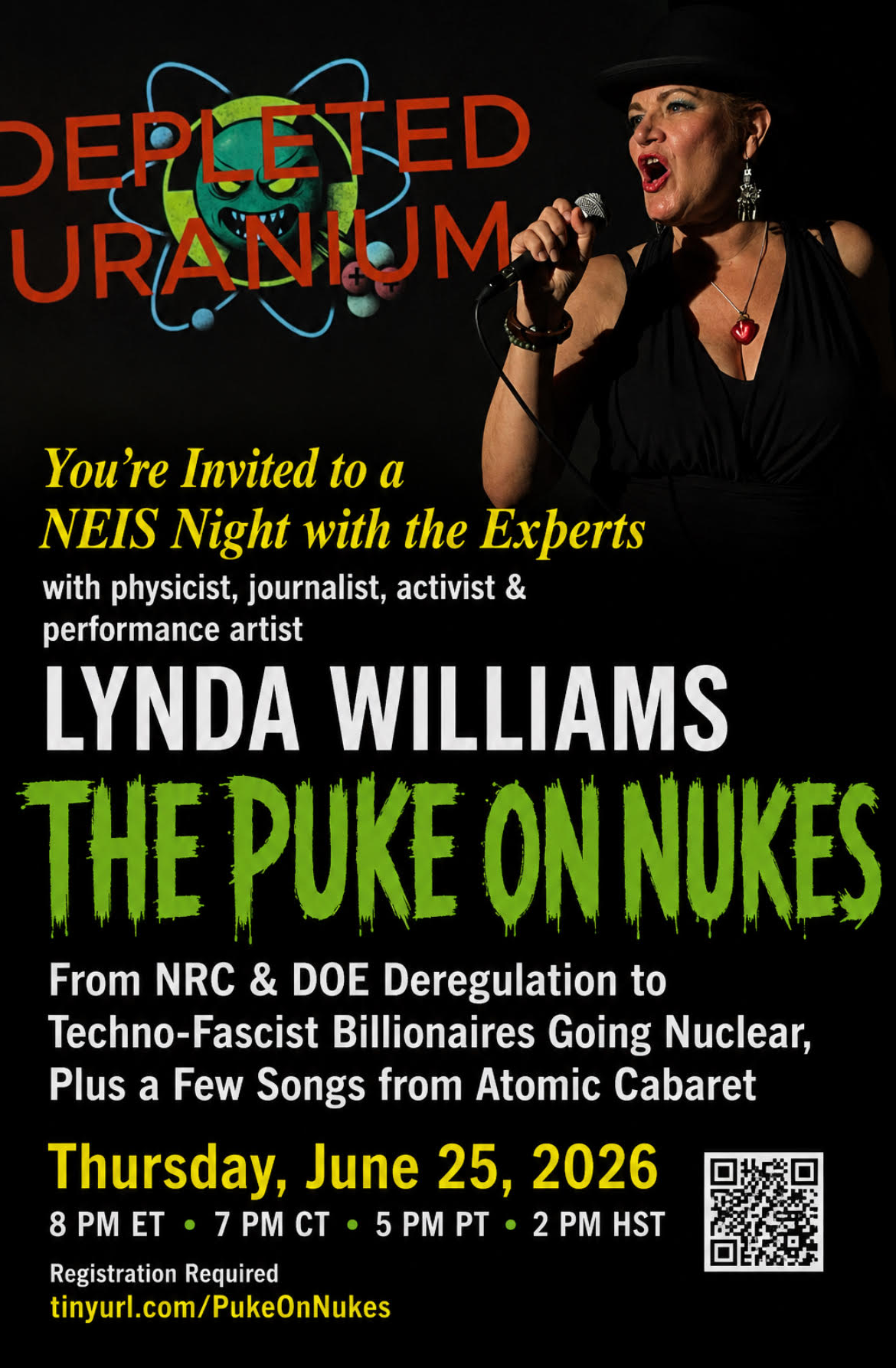
25 June- THE PUKE ON NUKES
Thursday, June 25, 2026
7pm Central Time (8pm ET, 6pm MT, 5pm PT) UTC – 5
From NRC & DOE Deregulation to Techno-Fascist Billionaires Going Nuclear, Plus a Few Songs from Atomic Cabaret REGISTER
26 June – Radiation Trainwreck at the NRC / Join the Protect Better Campaign – https://us02web.zoom.us/meeting/register/4ZlZ5_qLSHGiLSCg8FF6Bg#/registration
1st July – Webinar Waste of Space: The Environmental Harm of Military and Civil Space Activity st July, 7 pm

Report Launch Online: We are seeing an increasing exploitation of space for military and commercial purposes. This must change.

Protect Sazan Island from the Trump family! https://secure.avaaz.org/campaign/en/protect_sazan_island_from_the_trump_family_loc/?bqFCVab&v=174511&cl=22707147157&_checksum=5e9dde668860e8231c33699735e16a1fbf22ab2cb01da50c999fe8732b9775ef&utm_source=email&utm_medium=blast_email&utm_campaign=174511


Cuba Is Not a Failed State – It Is a Besieged State
PETITION: “Global Appeal to Endorse Palestinian Right of Return of Refugees”
To see nuclear-related stories in greater depth and intensity – go to https://nuclearinformation.wordpress.com
-
Archives
- June 2026 (221)
- May 2026 (306)
- April 2026 (356)
- March 2026 (251)
- February 2026 (268)
- January 2026 (308)
- December 2025 (358)
- November 2025 (359)
- October 2025 (376)
- September 2025 (257)
- August 2025 (319)
- July 2025 (230)
-
Categories
- 1
- 1 NUCLEAR ISSUES
- business and costs
- climate change
- culture and arts
- ENERGY
- environment
- health
- history
- indigenous issues
- Legal
- marketing of nuclear
- media
- opposition to nuclear
- PERSONAL STORIES
- politics
- politics international
- Religion and ethics
- safety
- secrets,lies and civil liberties
- spinbuster
- technology
- Uranium
- wastes
- weapons and war
- Women
- 2 WORLD
- ACTION
- AFRICA
- Atrocities
- AUSTRALIA
- Christina's notes
- Christina's themes
- culture and arts
- Events
- Fuk 2022
- Fuk 2023
- Fukushima 2017
- Fukushima 2018
- fukushima 2019
- Fukushima 2020
- Fukushima 2021
- general
- global warming
- Humour (God we need it)
- Nuclear
- RARE EARTHS
- Reference
- resources – print
- Resources -audiovicual
- Weekly Newsletter
- World
- World Nuclear
- YouTube
-
RSS
Entries RSS
Comments RSS
 nuclear-news