USA persists with radiation airport scanners, while Europe bans them
Europe bans X-ray scanners,The Economist, Nov 16th 2011, by A.B. THE X-RAY body-scanners that are found in some airports in America have been banned in the European Union. Doubts have long persisted about the safety of these machines, which emit a minute amount of radiation, and the EU has explicitly linked such doubts to its decision, announced at the start of the week. As the press release has it:
In order not to risk jeopardising citizens’ health and safety, only security scanners which do not use X-ray technology are added to the list of authorised methods for passenger screening at EU airports.
That’s not exactly going to cheer up American travellers, who are already struggling to understand why the Transportation Security Administration decided that the X-ray scanners were suitable for them to use. Another kind of body-scanner is available, which uses radiofrequency technology that has not been linked to cancer scares. These are installed in some American airports, such as Atlanta and Dallas, and will be the scanner of choice in Europe… http://www.economist.com/blogs/gulliver/2011/11/body-scanners-0
Concern in northern Hawaiian island about radiation from Japan
 Why is the Pentagon involved in providing free health care clinics, up to 350 clinical and non-clinical medical personnel, for Kauai’s residents, the north island closest to Japan? Is the Pentagon concerned about radioactive cesium plumes carried by the wind currents across the Pacific Ocean from Fukushima’s nuclear meltdowns?
The big utility lobbyists that pay off our politicians are destroying our lands and our lives. When President Obama says nuclear power is safe, it doesn’t automatically make them safe.
Japan’s Nuclear Radiation and the Pentagon’s Free Medical Clinics in Kauai: Connection? BuzzFlash Blog, JACQUELINE MARCUS , 16 Nov 11 Climate change produced Japan’s catastrophic earthquake and tsunami. Although the corporate media and the U.S. government have swept the Fukushima nuclear disaster under the proverbial censorship rug, it’s important to remember that an earthquake measuring 9.0 on the Richter scale and the ensuing 50-foot high tsunami wave led to a meltdown of three of Japan’s Fukushima Daiichi nuclear reactors. Japan’s nuclear regulatory agency reported that 31 radioactive isotopes were released. In contrast, 16 radioactive isotopes were released from the A-bomb that hit Hiroshima Aug. 6, 1945. The agency also reported that radioactive cesium released was almost 170 times the amount of the A-bomb, and that the release of radioactive Iodine-131 and Strontium-90 was about two to three times the level of the A-bomb. And that information doesn’t include the unknown deadly amount of radioactive water from the Fukushima plants that are being perpetually dumped into the Pacific Ocean since the meltdowns occurred last March 2011….. Continue reading
Iran’s nukes – a matter of national pride
At Tehran University, a group of hard-line students starts a petition urging Iran to withdraw from an international treaty regulating nuclear development. There’s no doubt Iran carefully stage manages much of its backlash to Western pressures over its nuclear efforts. But not all.
Iran’s defiance remains one of the few patches of common ground in a nation with multiple divisions: Hard-liners against opposition groups; power struggles between the ruling clerics and President Mahmoud Ahmadinejad; infighting among various parliament factions.
“Iranians don’t agree on much these days, but you could say the nuclear issue is one where they more or less speak in a common voice,” said William O. Beeman, aUniversity of Minnesota professor who follows Iranian affairs. Continue reading
Radiation from CTs – a bigger risk with repeated scans
CT scans produce widely differing radiation doses, CBC News Nov 15, 2011 A Manitoba study has found the amount of radiation patients receive from a CT scan can vary widely and should be reduced to better protect against the risk of cancer.
CBC News obtained the study through a freedom of information request to CancerCare Manitoba. The study recorded the dose of radiation to patients getting a CT scan at 13 Manitoba hospitals and compared that to similar surveys done elsewhere.
The researchers found that the average effective radiation dose for abdomen-pelvis scans was 21 per cent higher than in Saskatchewan and 15 per cent higher than in British Columbia. For a chest scan, the radiation dose for Manitoba was three per cent higher than in Saskatchewan and 25 per cent higher than in B.C….
The study notes CT — computed tomography — has become an invaluable tool for diagnosing medical conditions but there is increased worry because in recent years several international studies have linked CT radiation to cancer. In the 2009-2010 fiscal year, Manitoba patients underwent more than 160,000 CT scans.
For patients who will need a number of scans during the course of their illness, the study said cumulative radiation doses can be quite large and could reach the threshold associated with an increase in cancer risk…. http://www.cbc.ca/news/canada/manitoba/story/2011/11/14/iteam-ct-scan-radiation-manitoba.html?cmp=rss
Radiation risks in hospitals
Alarm fatigue, radiation overexposure among most dangerous health IT risks Fierce Health Care, November 15, 2011 By Karen M. Cheung Two seemingly innocent, everyday occurrences at hospitals–alarms and CT scans–are among the most dangerous technology hazards, according to a new ECRI Institute report. For all the countless benefits that technology provides, ECRI warns of the top 10 hazards for 2012, including alarm fatigue and overexposure to radiation therapy and CTs, similar to last year’s list. … http://www.fiercehealthcare.com/story/alarm-fatigue-radiation-overexposure-among-most-dangerous-hospital-it-risks/2011-11-15
The psychology of attitudes in Iran to nuclear power
what about Ahmadinejad’s promise to “wipe Israel off the face of the map?” Several problems exist with the idea.
Firstly, scholars of the Persian language say that his oft-cited words have been mistranslated and taken out of context. Ahmadinejad was actually quoting the revolutionary regime’s founder, Ayatollah Khoemeni, not making a policy statement.. (Read here for more on this dispute).
The Threat of a Nuclear Theocracy, Act II. Slate, By Michael Moran , Nov. 15, 2011 As the U.S. debate over Iran’s nuclear program has heated up, an issue of war and peace is being framed in a very dangerous way. The United States, with all its other problems right now, must get this right, because all options on Iran’s nuclear program are laden with risk, and the truth is very inconvenient.
The debate—roughly sanctions and diplomacy versus airstrikes—fails to acknowledge some important facts, the most important of which is that neither a military option—short of the lunacy of an all-out invasion of Iran—nor diplomacy will guarantee that Iran won’t soon gatecrash the nuclear club. Continue reading
Fukushima rescue squad volunteer dies from internal radiation
Dr. Sakiyama cunningly switched the subject to the Fukushima plant workers, but the issue here is not the plant workers. It’s the rescue squad members, it’s the volunteers, it’s the residents, who have been exposed, willing or not, to radiation that could kill over time, and who are without any shred of safeguard for their health. If they die, it is because of “stress”.
 Fukushima rescuer dies from internal radiation, 13 NOVEMBER 2011, THE CANADIAN A woman in a public forum asked a question to the two panelists: Why did my friend die? The event was held in Sapporo City on November 6, 2011.

- VIDEO Transcript On October 26, a friend of mine in Osaka passed away. He was a rescue squad member and had been sent to work in disaster-affected areas for a long time, such as Iwate or Fukushima.
- In July, he was found to have been internally exposed to radiation. All his team members had been, too. But their mission didn’t end. Rescue people are those who went through very hard training and have a strong will to do something for the sake of others. So they continued to carry out their mission, even though they knew they had been exposed to radiation.
Radiation standards for children made stricter in Japan
 Japan to Tighten Radiation Exposure Standard for Minors NTI Global Security Newswire, Nov. 11, 2011 Japan on Friday backed plans to cut by August 2013 the maximum, yearly quantity of radiation minors are allowed to receive in regions impacted by contaminants from the Fukushima Daiichi atomic facility, Kyodo News reported (see GSN, Nov. 9). Continue reading
Parliamentarians taking up the cause of South Africa’s sick former nuclear workers

Political allies for past and present nuclear workers Workers at Necsa are not alone. Support for their plight is at hand. The New Age Mel Frykberg, 10 Nov 11 Former nuclear workers who have died or are suffering ill health, allegedly from working at the Nuclear Energy Corporation of South Africa’s (Necsa) nuclear complex, have found an ally in the DA’s new chief whip.
Wattie Watson, who was sworn in yesterday, has pledged to speed up answers to Parliamentary questions, including those affecting the nuclear workers. “I support the establishment of an independent enquiry into the former nuclear workers’ case,” Gareth Morgan, the DA shadow minister of water and environmental affairs told The New Age. “These workers haven’t received a fair hearing and we want to know how the government is going to respond,” said Morgan.
Watson said at the top of his priority list would be a request to Deputy President Kgalema Motlanthe to pressure government ministers to respond to unanswered questions raised in Parliament. Labour Minister Nelisiwe Mildred Oliphant was asked on July 1 how many workers at Necsa’s Pelindaba, Koeberg and Ithuba laboratories had applied for occupational health compensation since inception and how many had applied annually.
The minister was further asked about the number of successful applications, the number who had received compensation, the amount compensated and the names of the recipients. To date, the DA has still not received a response despite the Parliamentary custom of responding in writing within 10 days.
The Habitat Council, the Pelindaba Working Group (PWG), comprising antinuclear activists and former workers, Earthlife Africa and former Atteridgeville workers, have also called for an independent enquiry, particularly into “Necsa’s suspect rebuttal of workers’ sicknesses”.
The public protector is investigating the case but told The New Age that more medical files were needed to support the compensation claims. However, Judith Taylor, Earthlife Africa Johannesburg’s coordinator, said that the National Nuclear Regulator (NNR), the nuclear watchdog, was largely to blame for the stalemate.
Mariette Liefferlink, a NNR board member, who expressed concern in her capacity as an activist and the CEO of the Federation for a Sustainable Environment, is deeply concerned by the plight of former nuclear workers. http://thenewage.co.za/34642-1007-53-Political_allies_for_past_and_present_nuclear_workers
Doctors who own radiation stress machines order more tests on healthy patients
“We have to remember that unnecessary testing puts patients at
unnecessary risk of exposure to radiation …
Doctors Who Own Stress Machines More Likely to Order Heart Test, By Pat Wechsler Nov. 8 (Bloomberg) –– Doctors who own and bill for nuclear cardiac stress-test technology are twice as likely to order the procedure as those who aren’t paid for it, researchers said.
The widest variation in whether a doctor prescribed a nuclear stress test, which uses radiation to track blood flow, occurred when patients had no symptoms of coronary disease following bypass surgery or other heart procedures, according to a study published today in the Journal
of the American Medical Association. Physicians who owned the equipment ordered tests in 10 percent of the cases versus 4.3 percent
for those who didn’t…… Continue reading
Japanese mothers demand radiation protection, and closure of nuclear power
The women are calling for two things. First, they want to protect children living in highly contaminated areas by giving them the officially sanctioned ‘right to evacuate.’ This would include government compensation and support that would enable children and their families to relocate on a voluntary basis.
Secondly, they want to close down all nuclear power plants in Japan. “Fukushima women feel very strongly that there is no safe nuclear power,” “This is the lesson to be learned from Fukushima.”
The women have asked for a response from the state by Nov. 11—exactly eight months after the deadly quake.
Fukushima Women Demand Better Protection for Children Exposed to Radiation, TIME.com , November 3, 2011 Lucy Birmingham. About 100 women from Fukushima, Japan, have started a week-long sit-in at a government office in Tokyo to demand greater protection for children affected by radiation. “Many children and their families are trapped in Fukushima because they can’t afford to move,” explains Ayako Oga, 38, a housewife living in the prefecture and one of the sit-in organizers. “The government has set the accepted radiation exposure rate too high.” Japan’s standard rate for exposure to radiation is 1 millisievert per year. For Fukushima residents alone the accepted exposure rate is up to 20 millisieverts per year. The International Commission on Radiological Protection considers this rate the top level and says it should not be exceeded over the long term.
National and prefectural governments have determined that until the 20 millisieverts level they are not obligated to offer financial support to residents, certain businesses or schools wanting to relocate outside the irradiated areas. At the heart of the debate is the question of who has a ‘right to evacuate.’ “At Chernobyl, the right to evacuate, which means government support, was given from 1 to 5 millisieverts. In Japan it’s 20,” Continue reading
Canadian army never told soldier about his depleted uranium test results
 The 2001 lab results, copies of which were supplied to The Canadian Press by Lacoste, were performed two years before tests conducted by a civilian doctor also found high levels of uranium in his hair.
Lacoste’s fight is also directed at helping other ex-soldiers he believes might be suffering from the health effects of depleted-uranium exposure, but might not even be aware of it.
Hunger-striking vet says Ottawa never disclosed his positive uranium tests, Winnipeg Free Press, By: Andy Blatchford, The Canadian Press, 11/2/2011 MONTREAL – A former soldier battling a series of health problems says the Canadian Forces failed to inform him that medical tests showed he was carrying an unusually high level of uranium.
Pascal Lacoste eventually filed a request under the Access to Information Act to see his own medical files, which revealed his hair samples contained “abnormally elevated” amounts of the metal. Continue reading
Opt out of the cancer risk X ray scanners at USA airports
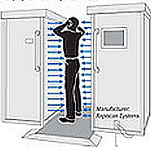 How Homeland Security Increases Your Cancer Risk,The Nation, Jon Wiener on November 2, 2011 In the airport security screening line in Kauai a few months ago, I
asked an American Airlines pilot what he thought about the new X-ray scanners in front of us—the ones that are replacing metal detectors at airports around the country. He offered a startling one-word answer: “reprehensible.”
I said “Usually I opt out, because I didn’t like being X-rayed by people who are not X-ray technicians.” He replied, “If enough people opted out, they’d have to get rid of the scanners.”
Now ProPublica’s Michael Grabell reports that the cancer danger from the new scanners—which look under a traveler’s clothing—is greater than we had feared. “Research suggests that anywhere from six to 100 Americans could get cancer each year from the machines,” Grabell says.
“Still, the TSA has repeatedly defined the scanners as ‘safe,’ glossing over the accepted scientific view that even low doses of ionizing radiation—the kind beamed directly at the body by the X-ray scanners—increase the risk of cancer.”
Nevertheless, millions of Americans are now being sent thru the scanners. Continue reading
Airport radiation scanners are not stringently regulated
 The US government skirted over the radiation safety concerns of airport X-ray machines 109 2 Nov 11One of the most important principles of radiation safety is that X-ray machines should only be used when there’s a clear medical benefit. But now backscatter X-ray machines are found throughout America’s airports. How did we get here?
According to a new report by ProPublica and the PBS NewHour, the US government has gone ahead with the controversial scanners despite serious concerns from radiation safety experts. The scanners are expected to be in place in every American airport security lane by as early as 2014. This is a big reversal from as recently as 1998, when the device’s own inventor, Steven W. Smith, told a panel of radiation safety experts, said he didn’t think such devices would be used at lower-security facilities – such as airports. Continue reading
Electromagnetic radiation from cell phones linked to brain cancer

Christina Macpherson's websites & blogs
This website is concerned with the nuclear industry, and the proven danger of cancer-causing ionising radiation.
The story is not the same for other types of radiation. Therefore we don’t generaly cover these. However, that doesn’t prove them safe. therefore, we should not ignore information on electromagnetic radiation, which might also have its risks. – Christina Macpherson
Researchers Report Alarming Rise in Brain Cancer in Scandinavian Countries,The Investor Relations Group, 11/2/2011 Environmental Health Trust Reports Continued and Unexplained Increases in Brain Cancer Incidence in Nations With Longer-Term Cell Phone Use
New cases of brain tumors have continued to rise throughout the past three decades in some Scandinavian countries with longer-term and heavier cell phone use, according to analyses conducted by Environmental Health Trust scientists. The analyses are based on data provided by the national cancer registries of Finland and Norway to the International Agency for Research on Cancer. Continue reading
1 This Month

22 June – Virtual Event –Climate Change: New Data, New Debate

Monday, June 22, 2026 2:30 p.m. – 3:15 p.m. CT
YouTube. Register here
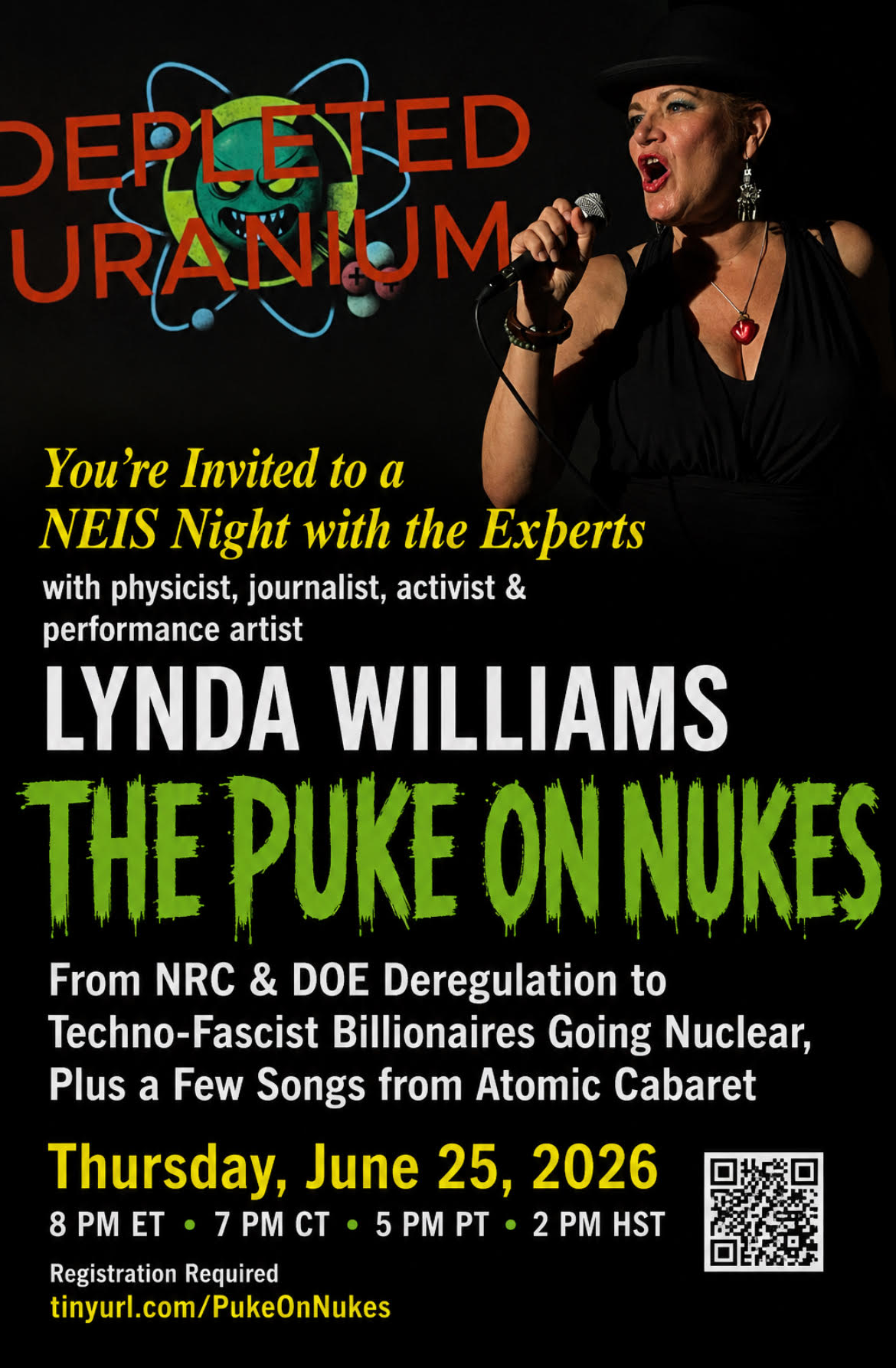
25 June- THE PUKE ON NUKES
Thursday, June 25, 2026
7pm Central Time (8pm ET, 6pm MT, 5pm PT) UTC – 5
From NRC & DOE Deregulation to Techno-Fascist Billionaires Going Nuclear, Plus a Few Songs from Atomic Cabaret REGISTER
26 June – Radiation Trainwreck at the NRC / Join the Protect Better Campaign – https://us02web.zoom.us/meeting/register/4ZlZ5_qLSHGiLSCg8FF6Bg#/registration
1st July – Webinar Waste of Space: The Environmental Harm of Military and Civil Space Activity st July, 7 pm
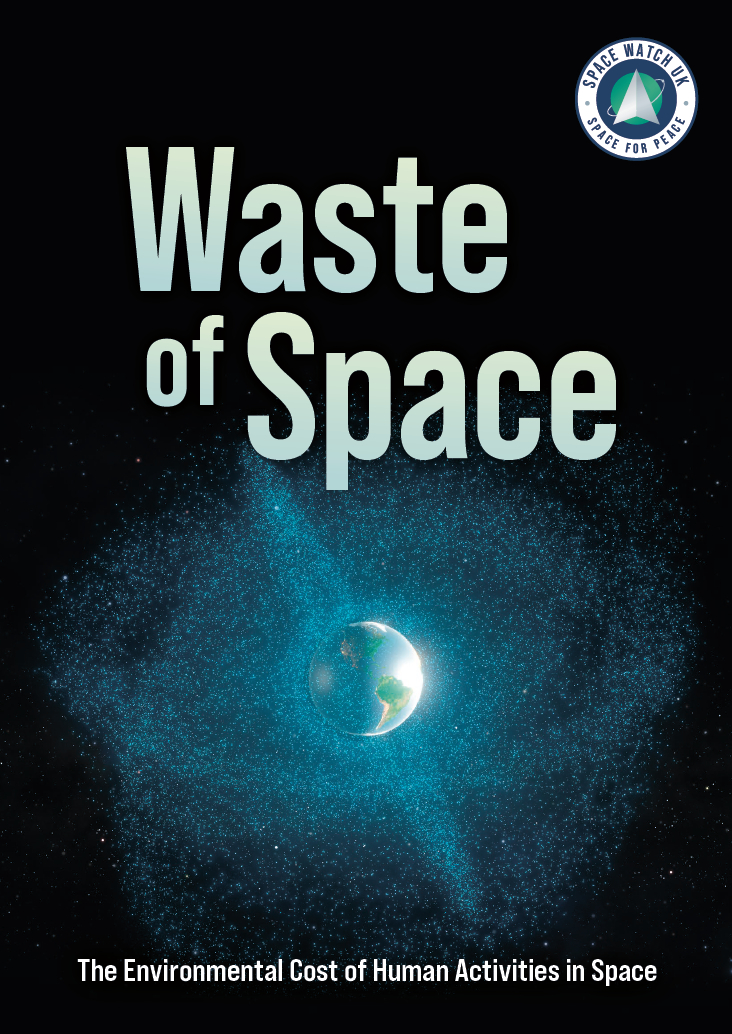
Report Launch Online: We are seeing an increasing exploitation of space for military and commercial purposes. This must change.

Protect Sazan Island from the Trump family! https://secure.avaaz.org/campaign/en/protect_sazan_island_from_the_trump_family_loc/?bqFCVab&v=174511&cl=22707147157&_checksum=5e9dde668860e8231c33699735e16a1fbf22ab2cb01da50c999fe8732b9775ef&utm_source=email&utm_medium=blast_email&utm_campaign=174511


Cuba Is Not a Failed State – It Is a Besieged State
PETITION: “Global Appeal to Endorse Palestinian Right of Return of Refugees”
To see nuclear-related stories in greater depth and intensity – go to https://nuclearinformation.wordpress.com
-
Archives
- June 2026 (221)
- May 2026 (306)
- April 2026 (356)
- March 2026 (251)
- February 2026 (268)
- January 2026 (308)
- December 2025 (358)
- November 2025 (359)
- October 2025 (376)
- September 2025 (257)
- August 2025 (319)
- July 2025 (230)
-
Categories
- 1
- 1 NUCLEAR ISSUES
- business and costs
- climate change
- culture and arts
- ENERGY
- environment
- health
- history
- indigenous issues
- Legal
- marketing of nuclear
- media
- opposition to nuclear
- PERSONAL STORIES
- politics
- politics international
- Religion and ethics
- safety
- secrets,lies and civil liberties
- spinbuster
- technology
- Uranium
- wastes
- weapons and war
- Women
- 2 WORLD
- ACTION
- AFRICA
- Atrocities
- AUSTRALIA
- Christina's notes
- Christina's themes
- culture and arts
- Events
- Fuk 2022
- Fuk 2023
- Fukushima 2017
- Fukushima 2018
- fukushima 2019
- Fukushima 2020
- Fukushima 2021
- general
- global warming
- Humour (God we need it)
- Nuclear
- RARE EARTHS
- Reference
- resources – print
- Resources -audiovicual
- Weekly Newsletter
- World
- World Nuclear
- YouTube
-
RSS
Entries RSS
Comments RSS
 nuclear-news