Nuclear missiles – the ultimate phallic symbol
North Korea’s Performance Anxiety, NYT, By WILLIAM J. BROAD, May 5, 2012 “IT’S a boy,” Edward Teller exulted after the world’s first hydrogen bomb exploded in 1952 with a force 1,000 times more powerful than the bomb that destroyed Hiroshima.
From the start, the nuclear era seethed with sexual allusions. Military officers joked about the phallic symbolism of their big missiles and warheads — and of emasculating the enemy. “Dr. Strangelove” mocked the idea with big cigars and an excited man riding into the thermonuclear sunset with a bomb tucked between his legs.
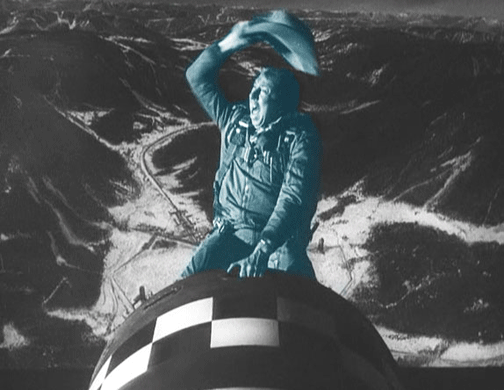
Helen Caldicott, the antinuclear activist, argued in the 1980s that male insecurity accounted for the cold war’s perilous spiral of arms. Her book? “Missile Envy.” Today, the psychosexual lens helps explain why North Korea, in addition to dire poverty and other crippling woes, faces international giggles over its inability to “get it up” — a popular turn of phrase among bloggers and some headline writers.
“Things like this never go away,” Spencer R. Weart, an atomic historian and director emeritus of the Center for History of Physics at the American Institute of Physics, said in an interview. “There’s little doubt that missiles are phallic symbols. Everybody agrees on that.”
On Friday, April 13, North Korea fired a big rocket on a mission to loft the nation’s first satellite into orbit. But it fell back to Earth with a splash……. The phallic symbolism once centered on success. Nowadays, at least with North Korea, it seems as if it’s more about dysfunction. http://www.nytimes.com/2012/05/06/sunday-review/north-koreas-fizzling-missiles.html?pagewanted=2&_r=1
Not all breast cancer cases need radiation therapy
 Radiation May Not Be Needed for All Breast Ca http://www.medpagetoday.com/HematologyOncology/BreastCancer/32523 By Crystal Phend, Senior Staff Writer, MedPage Today May 05, 2012, Radiofrequency ablation of the breast tumor excision site could substitute for radiation therapy in selected patients, a phase II study suggested. Continue reading
Nuclear power plants – unwise for pregnant women and children to live near them?
 Reasonable Doubt, Environmental Research Foundation By Ian Fairlie Among the many environmental concerns surrounding nuclear power plants, there is one that provokes public anxiety like no other: the fear that children living near nuclear facilities face an increased risk of cancer. Though a link has long been suspected, it has never been proven. Now that seems likely to change.
Studies in the 1980s revealed increased incidences of childhood leukaemia near nuclear installations at Windscale (now Sellafield), Burghfield and Dounreay in the UK. Later studies near German nuclear facilities found a similar effect. The official response was that the radiation doses from the nearby plants were too low to explain the increased leukaemia. The Committee on Medical Aspects of Radiation in the Environment, which is responsible for advising the UK government, finally concluded that the explanation remained unknown but was not likely to be radiation.
There the issue rested, until a recent flurry of epidemiological studies appeared. Last year, researchers at the Medical University of South Carolina in Charleston carried out a meta-analysis of 17 research papers covering 136 nuclear sites in the UK, Canada, France, the US, Germany, Japan and Spain. The incidence of leukaemia in children under 9 living close to the sites showed an increase of 14 to 21 per cent, while death rates from the disease were raised by 5 to 24 per cent, depending on their proximity to the nuclear facilities (European Journal of Cancer Care, vol 16, p 355).
This was followed by a German study which found 14 cases of leukaemia compared to an expected four cases between 1990 and 2005 in children living within 5 kilometres of the Krummel nuclear plant near Hamburg, making it the largest leukaemia cluster near a nuclear power plant anywhere in the world (Environmental Health Perspectives, vol 115, p 941).
This was upstaged by the yet more surprising KiKK studies (a German acronym for Childhood Cancer in the Vicinity of Nuclear Power Plants), Continue reading
As nuclear radiation spreads around the world, fewer girl babies are born
the study is ‘the most convincing documentation’ so far that radiation may lead to a gender bias in humans.
Nuclear age has led to millions of fewer baby girls being born http://www.dailymail.co.uk/sciencetech/article-1394553/Is-U-S-heading-baby-boy-boom-Japan-disaster-Study-finds-nuclear-radiation-results-millions-fewer-female-births-worldwide.html Study claims nuclear radiation from bomb testing and power plant leaks hits female birthrate
Japanese nuclear disaster could hit girl births in U.S. Nuclear radiation from power plant leaks and bomb tests resulted in millions fewer baby girls born worldwide, according to a new study.
Scientists noted these types of atmospheric blasts rather than on-the-ground incidents like Chernobyl, effected birth gender across the globe. Continue reading
Controversial brachytherapy treatment for breast cancer
“It’s important for any woman really to discuss with her physician the risks and benefits of either approach,”
More women need breasts removed after brachytherapy By Genevra Pittman NEW YORK May 1, 2012 (Reuters Health) – Women who got seed radiation as part of their breast cancer treatment were more likely to have an infection or breast pain than those who were treated with whole-breast irradiation, in a new study.
And more patients treated with the quicker and more local radiation technique, also called brachytherapy, went on to need a mastectomy as well — but there was no difference in their chance of dying in the few years after treatment. “The decision of whether a patient was treated with brachytherapy or whole-breast irradiation was the single most important factor in whether a patient had a mastectomy,” said study author Dr. Benjamin Smith, who called that result “surprising.” Continue reading
Fukushima: young women at 5 times greater cancer risk than general population
Nuclear Expert: Fukushima risk underestimated ENE News, — 5% of young girls will get cancer living in 20 milliSv/y for 5 years — “Actually worse than that” — Hot particles NOT included & only counts cancers, not other effects : Cancer Risk To Young Children Near Fukushima Daiichi Underestimated Source: Fairewinds Associates, Inc Author: Arnie Gundersen Transcript Excerpts That gets me to the issue of BIER, Biological Effects of Ionizing Radiation. […]
Now in Japan, the Japanese government is allowing people to go back into these radiation zones, when the radiation exposure is 2 rem. What that means is that they are willing to say that your chances of getting cancer are 1 in 500 if you go back into these areas that are presently off limits, and the exposure levels are 2 rem or 20 milisieverts in a year.
But it is worse than that. The number that we are using in the BIER Report is for the entire population, old people and young. And old people are going to die of something else before a cancer gets to them, whereas young people have rapidly dividing cells and they live a longer time, so they are more likely to get cancer. So if you go into the BIER Report and you look at Table 12-D, you will see that young women have a 5 times that number chance of getting cancer than the population as a whole. So young girls in the Fukushima Prefecture are going to get 5 times the exposure they would get from 2 rem. That means that about one in 100 young girls is going to get cancer as a result of the exposure in Fukushima Prefecture. And that is for every year they are in that radiation zone [at 20 milliSv/y]. If you are in there for 5 years, it is 5 out of 100 young girls will get cancer.
Now the BIER Report only addresses cancer, and of course, there are other effects of radiation that are not included in BIER, so it is actually worse than that.
Two more items: The first is that the BIER Report does not address hot particles. Now we have been over that extensively on the site, and you will see that imbibing it (a kid gets radioactive cesium on their hands and they swallow it, or breathing it in), is not included in the BIER Report.
And the last piece brings us over to Ian Goddard’s video, and that is this assumption by the Japanese and International Atomic Energy Agency, that at some point, this radiation is really so hard to measure that it does not count anymore. Well, the data indicates that just the opposite is happening…… http://enenews.com/gundersen-fukushima-cancer-risk-underestimated-5-of-young-girls-will-get-cancer-living-in-20-millisvy-for-5-years-actually-worse-than-that-hot-particles-not-included-only-counts-cance
3.000 of Chernobyl’s most vulnerable children helped to safety and care
 Children of Chernobyl Airlifts 97th Group in Advance of 26th Anniversary http://www.chabad.org/blogs/blog_cdo/aid/1838545/jewish/Children-of-Chernobyl-Airlifts-97th-Group-in-Advance-of-26th-Anniversary.htm, April 25, 2012 By Joshua Runyan One week before the 26th anniversary of the Chernobyl nuclear explosion that rained down fallout across an entire swath of Eastern Europe, Chabad’s Children of Chernobyl brought 26 more children to safety and medical care in Israel, its 97th rescue mission.
“On this significant anniversary, thousands of children every day are still feeling the tragic consequences of the Chernobyl disaster,” said Nancy Spielberg, founding board member of CCOC, in a statement. “They are facing devastating illnesses from radiation contamination –radiation that will be with us for thousands of years. As we’ve seen from the recent Fukushima Daiichi nuclear disaster in Japan, the impact from this kind of radioactivity is as devastating today as it was 26 years ago.”
To date, the Chabad-Lubavitch run organization, which was designed to rescue those most vulnerable from the April 26, 1986 meltdown that left thousands of square kilometers uninhabitable, has helped 2,822 children escape the contaminated living conditions surrounding that portion of Ukraine. Most are brought to a sprawling educational and residential complex in the central Israeli village of Kfar Chabad, where they’re provided  with medical care and social services.
The organization also provides medicine, equipment and other needed items for those who
cannot leave Europe. Spielberg pointed to World Health Organization statistics, which show the rate of thyroid cancer in the contaminated areas surrounding Chernobyl as more than 200 times the world norm.
Belarus’ children – mental, physical, and social effects of Chernobyl nuclear disaster
Figures released by UNICEF in 2010 showed that more than 20% of adolescent children in Belarus suffered from disabilities and chronic illness. Belarus absorbed 70% of Chernobyl’s fallout…..
 VIDEOS http://edition.cnn.com/2012/04/25/world/iyw-chernobyl-children/?hpt=wo_mid 26 years on: helping Chernobyl’s children, By Katie Walmsley, CNN April 25, 2012 Chernobyl refuses to be relegated to the past. Indeed it may still be devastating the lives of millions who continue to live in the fallout zone. Aside from the potential health hazards of living in an area contaminated with radiation, domino socioeconomic effects have caused multiple problems in these regions.
Chernobyl Children International , or CCI, works to help kids in the region whose lives have been impacted by a disaster that happened years before they were born. Many suffer from physical problems such as congenital heart defects. Many kids have chronic illnesses or disabilities, and many live full time in institutions. Continue reading
A window into the very controlled State of North Korea
 (includes video) http://worldnews.msnbc.msn.com/_news/2012/04/24/11365838-north-korea-nuclear-test-ready-soon North Korea nuclear test ready ‘soon’ NBC’s Richard Engel spent two weeks in North Korea and got a rare and revealing look inside this very closed country. World News msnbc, By Reuters 27 April 12 BEIJING – North Korea has almost completed preparations for a third nuclear test, a senior source with close ties to Pyongyang and Beijing told Reuters, which will draw further international condemnation following a failed rocket launch if it goes ahead. Continue reading
90 cancer victims bring lawsuit against nuclear companies
 Radioactive: Revelations on nuclear plants sound a warning http://www.post-gazette.com/stories/opinion/editorials/radioactive-revelations-on-nuclear-plants-sound-a-warning-633299/ April 27, 2012 Pittsburgh Post-Gazette Like a dark family secret long suspected but never confirmed, the shock of discovery is all the more lurid for coming into the light
years later. So it is with the news of radioactive material released into the air — at levels higher than any seen in the nation — at closed nuclear fuels plants in Armstrong County.
Incredulity feeds the first reaction: Surely this could not have happened. But apparently it
did, according to good authority. That would be Joseph P. Ring, a Harvard University radiation safety officer who teaches at Harvard and the University of Massachusetts. He
wrote a 37-page report that was filed Tuesday as part of federal lawsuits brought against plant operators Babcock & Wilcox Co. and Atlantic Richfield Co. by about 90 cancer victims. Continue reading
A new anti nuclear demographic – mothers
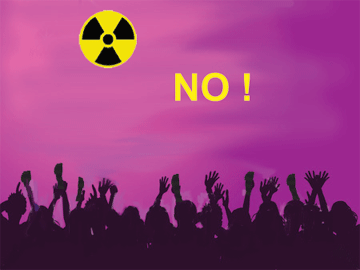 Often, mothers and women want to leave Fukushima and protect their kids, while men tend to accept the line, from the government and the utility, Tepco, that “all is safe.” This can lead to conflict in a culture where women are taught not to challenge their husbands or government, figures of authority.
How a Group of Japanese Mothers Are Saying No to Nuclear Power The Fukushima disaster has brought a powerful new demographic to Japan’s anti-nuclear movement: mothers. AlterNet April 25, 2012 |
On the one-year anniversary of the Fukushima nuclear disaster, Japanese women in New York City gathered for a rally they called Pregnant With Fear of Radiation. Protestors wore fake pregnant bellies, or carried posters with images of pregnant women wearing face masks. Well aware that fetuses, children under five, and women are at the greatest risk from radiation exposure, mothers have emerged as a powerful voice in Japan’s growing anti-nuclear movement. Continue reading
Illness compensation plan for former nuclear workers
Energy Employees Occupational Illness Compensation Program Huntington News, April 26, 2012 – Here are the facilities in or near former Huntington Pilot Plant that have benefit programs for former nuclear workers and survivors. Data provided by Dept. of Labor: Continue reading
Mothers’ movement against nuclear power spreads beyond Japan
How a Group of Japanese Mothers Are Saying No to Nuclear Power AlterNet April 25, 2012 | “…….The movement isn’t confined to Japan’s borders. In September, 2011, a group of Japanese mothers, including Sachiko Sato, an organic farmer who traveled with her youngest two children) Kaori Izumi, and Aileen Mioko Smith came to New York City to protest Prime Minister Noda’s participation in the UN summit on nuclear safety. “How can you talk about safety?” Sachiko shouted to Noda outside the UN. “You don’t even take care of the children of Fukushima.”
Sachiko, Izumi, and Smith spoke at various anti-nuclear events throughout the New York City area during their visit, urging American citizens to learn a lesson from the disaster in Japan. At one event, Smith stated, “Many Americans live far too close tonuclear power plants that sit on earthquake fault lines—Indian Point in Buchanan, New York, only thirty or so miles from New York City, as well as those on the coast in California. Americans must learn from the Fukushima disaster. You must shut down your own plants, 23 of which are the same design as the Fukushima reactors, GE Mark I. Yes, it can happen here.”
In October 2011, hundreds of mothers in Japan began a protest in Tokyo at the Ministry of Economy, Trade, and Industry. The protest will last 10 months and 10 days (the length of time a pregnancy lasts under Japan’s traditional lunar calendar).
Smith, who is executive director of Green Action, an anti-nuclear NGO based in Kyoto, says the Fukushima accident offers a chance to put an end to nuclear power. Most of Japan’s nuclear reactors were taken offline after the disaster; as of this writing, only one nuclear power plant remains online.
Smith says, “For the first time in 30 years, we have a real opportunity” to shut down nuclear reactors in Japan for good. http://www.alternet.org/world/155154/how_a_group_of_japanese_mothers_are_saying_no_to_nuclear_power
Radiation danger to Japan’s reconstruction workers
 Recovery workers to get radiation limits http://www.yomiuri.co.jp/dy/national/T120422002572.htm Jiji Press 23 April 12, The health ministry will introduce radiation exposure control standards for reconstruction workers in areas damaged by last year’s earthquake and tsunami, officials said.
The ministry found it necessary to implement the new standards, as reconstruction work is beginning in earnest in Fukushima Prefecture, home to a nuclear power station crippled by the disasters.
Currently, there are radiation exposure control standards for workers at the Fukushima No. 1 nuclear plant and those engaged in decontamination around the plant but not for construction and other workers. In areas where annual radiation exposure is estimated at greater than 5 millisieverts, employers will be obliged to have each worker carry a dosimeter and receive health checks at least once a year, officials said Friday. In other areas, such individual radiation exposure control will not be required.
Cesium 137 and the follies of Chernobyl and Fukushima
 The Fukushima Nuclear Disaster Is Far From Over HUFFINGTON POST, Robert Alvarez, Senior Scholar, Institute for Policy Studies, 22 April 12, “….It’s been 26 years, since the Chernobyl reactor exploded and caught fire releasing enormous amounts of radioactive debris — seriously contaminating areas over a thousand miles away. Chernobyl revealed the folly of not having an extra barrier of thick concrete and steel surrounding the reactor core that is required for modern plants, in the U.S., Japan and elsewhere. The Fukushima Dai-Ichi accident revealed the folly of operating several nuclear power plants in a high consequence earthquake zone while storing huge amounts of highly radioactive spent fuel in vulnerable pools, high above the ground.
What both accidents have in common is widespread environmental contamination from cesium-137. With a half-life of 30, years, Cs-137 gives off penetrating radiation, as it decays and can remain dangerous for hundreds of years. Once in the environment, it mimics potassium as it accumulates in the food chain. When it enters the human body, about 75 percent lodges in muscle tissue, with, perhaps, the most important muscle being the heart.http://www.huffingtonpost.com/robert-alvarez/the-fukushima-nuclear-dis_b_1444146.html
1 This Month

22 June – Virtual Event –Climate Change: New Data, New Debate

Monday, June 22, 2026 2:30 p.m. – 3:15 p.m. CT
YouTube. Register here

Protect Sazan Island from the Trump family! https://secure.avaaz.org/campaign/en/protect_sazan_island_from_the_trump_family_loc/?bqFCVab&v=174511&cl=22707147157&_checksum=5e9dde668860e8231c33699735e16a1fbf22ab2cb01da50c999fe8732b9775ef&utm_source=email&utm_medium=blast_email&utm_campaign=174511
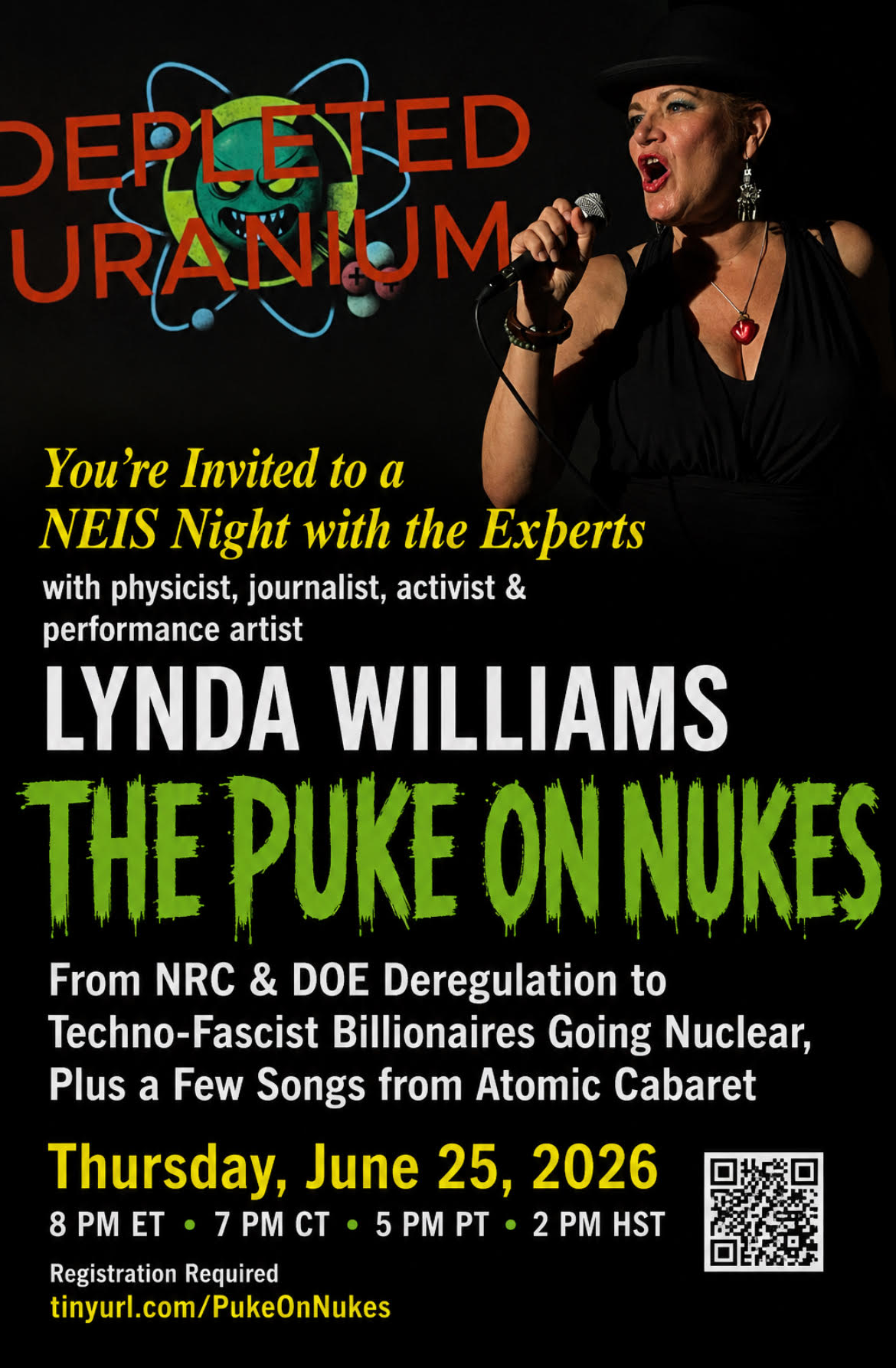
25 June- THE PUKE ON NUKES
Thursday, June 25, 2026
7pm Central Time (8pm ET, 6pm MT, 5pm PT) UTC – 5
From NRC & DOE Deregulation to Techno-Fascist Billionaires Going Nuclear, Plus a Few Songs from Atomic Cabaret REGISTER
26 June – Radiation Trainwreck at the NRC / Join the Protect Better Campaign – https://us02web.zoom.us/meeting/register/4ZlZ5_qLSHGiLSCg8FF6Bg#/registration


Cuba Is Not a Failed State – It Is a Besieged State
PETITION: “Global Appeal to Endorse Palestinian Right of Return of Refugees”
To see nuclear-related stories in greater depth and intensity – go to https://nuclearinformation.wordpress.com
-
Archives
- June 2026 (211)
- May 2026 (306)
- April 2026 (356)
- March 2026 (251)
- February 2026 (268)
- January 2026 (308)
- December 2025 (358)
- November 2025 (359)
- October 2025 (376)
- September 2025 (257)
- August 2025 (319)
- July 2025 (230)
-
Categories
- 1
- 1 NUCLEAR ISSUES
- business and costs
- climate change
- culture and arts
- ENERGY
- environment
- health
- history
- indigenous issues
- Legal
- marketing of nuclear
- media
- opposition to nuclear
- PERSONAL STORIES
- politics
- politics international
- Religion and ethics
- safety
- secrets,lies and civil liberties
- spinbuster
- technology
- Uranium
- wastes
- weapons and war
- Women
- 2 WORLD
- ACTION
- AFRICA
- Atrocities
- AUSTRALIA
- Christina's notes
- Christina's themes
- culture and arts
- Events
- Fuk 2022
- Fuk 2023
- Fukushima 2017
- Fukushima 2018
- fukushima 2019
- Fukushima 2020
- Fukushima 2021
- general
- global warming
- Humour (God we need it)
- Nuclear
- RARE EARTHS
- Reference
- resources – print
- Resources -audiovicual
- Weekly Newsletter
- World
- World Nuclear
- YouTube
-
RSS
Entries RSS
Comments RSS
 nuclear-news