Indian government treats anti nuclear citizens as mentally ill
If anything, then, the really delusion-prone people are on the other side, in the Department of Atomic Energy (DAE) and Nuclear Power Corporation of India Limited (NPCIL). The day the Fukushima crisis took a turn for the worse last year, with hydrogen explosions ripping through three reactors, DAE secretary Sreekumar Banerjee said the blasts were “purely a chemical reaction and not a nuclear emergency …”. NPCIL chairman SK Jain went one better: “There is no nuclear accident….It is a well-planned emergency preparedness programme …“

 No margin for error Hindustan Times Praful Bidwai June 04, 2012 When it comes to thrusting nuclear power down the throats of unwilling people, official India sets a record of violations of dignity and rights that is embarrassing. Which other government but India’s maligns all anti-nuclear protesters as foreign-inspired and lacking any agency? Where else would the police file 107 FIRs against 55,795 peaceful anti-nuclear protesters, but at Koodankulam, charging 6,800 with “sedition” and ”waging war against the State”?
And which other government has asked a psychiatric institution, in this case, the National Institute of Mental Health and Neuro-Sciences (Nimhans), to “counsel” people and convince them that the project, despite the hazards, is good for them?
To its discredit, Nimhans despatched psychiatrists to Koodankulam to ”get a peek into the protesters’ minds” and help these insane people to “understand the importance” of the plant. According to reports quoting its director, Nimhans has “commenced the collection of primary data” and is now seeking “field reactions” to write “multiple strategies” to address “the problem” (the opposition to nuclear power).
Such opposition is thus equated with schizophrenia, fear of sexual intimacy, paranoia or craving for victimhood, to be cured by drastic means. By this criterion, more than 80% of the people of Japan, Germany, France and Russia – who oppose new nuclear plants – must be considered abnormal. Continue reading
Meningiomas are dangerous, ionising radiation is the only clearly known cause
meningiomas are not anywhere near so universal, and, despite the “benign” designation, can be dangerous, leading to severe disabilities, and, in rare cases, death.
 Radiation to the head and neck is the only well-defined cause found so far
No, ‘half of us’ don’t have a brain tumor like Sheryl Crow’s, MSNBC.com 7 June 12 Singer Sheryl Crow recently revealed she had been diagnosed with a meningioma, a type of brain tumor that accounts for nearly 30 percent of brain tumors in the U.S. More than 90 percent of them are benign. NBC’s Dr. Nancy Snyderman reports. By Brian Alexander Continue reading
Radiation therapy can lead to later breast cancer
Radiation treatment has saved countless children from lymphoma, leukemia, soft-tissue tumors and other cancer types, but it can damage the DNA of healthy cells, too, and lead to cancer decades later.
 Study finds breast cancer risk in women treated with radiation as kids, even at lower doses Winnipeg Free Press, By: Marilynn Marchione, The Associated Press 06/4/2012 CHICAGO – Women treated with chest radiation for cancer when they were girls have a higher risk of developing breast cancer than previously thought, doctors warn. Continue reading
Fukushima workers at risk of cancer
Fukushima 1 workers risk cancer, Voice of Russia, May 24, 2012 About 170 people who worked at the Japanese nuclear power plant “Fukushima-1”, received doses of radiation, which have increased their risk of cancer according to reports published on Wednesday covering the results of studies conducted by experts of the Scientific Committee of the UN….
http://english.ruvr.ru/2012_05_24/75768400/
Infants in some areas at risk of thyroid cancer from Fukushima radiation
 Infants in Namie were thought to have received thyroid radiation doses of 100-200 mSv, it added. The thyroid is the most exposed organ as radioactive iodine concentrates there and children are deemed especially vulnerable.
The report did not deal with radiation exposure suffered by emergencyworkers or people closest to the disaster site……
WHO releases mixed Fukushima radiation report Money Control , May 23, 2012 By Stephanie Nebehay GENEVA (Reuters) – Spikes in radiation caused by the Fukushima nuclear disaster were below cancer-causing levels in almost all of Japan, but infants in one town appear to be at a higher risk of developing thyroid cancer, the World Health Organization said on Wednesday. Continue reading
Cancer caused by uranium fuel processing plant, claims big lawsuit
 In recent court filings, plaintiffs provided many tragic stories of living in the Apollo and Parks area in the shadow of the nuclear sites and being diagnosed with cancer.
Mega-lawsuit claims nuke contamination in Armstrong Trib Live News, Mary Ann Thomas Gateway Newspapers , May 17, 2012 The nearly 100 plaintiffs alleging death, cancer and other illnesses from radioactive emissions from two defunct Armstrong County nuclear fuels plants are awaiting a trial date for what is likely to be a second set of a multimillion-dollar federal lawsuit. Continue reading
Low dose radiation and cancer – the Linear No Threshold model holds good
The public, legislators, and journalists are often at a loss to deal with the charges and counter charges that surface in the debate over low-level radiation exposures. It does not help to listen to industry leaders, nuclear activists, or individual researchers, who, one after another, propound their competing images of the underlying truth.
It is now reasonably clear that protracted exposure does not protect against radiation-induced cancer. Rather, it is the cumulative radiation exposure from all sources that must be examined.
There is no longer a convenient excuse to avoid using the LNT to estimate consequences from real or projected releases of radioactive materials, even when the dose of concern is below 0.1 Sv.
 The scientific jigsaw puzzle: Fitting the pieces of the low-level radiation debate http://bos.sagepub.com/content/68/3/13.full Bulletin of the Atomic Scientists, May/June 2012, Jan Beyea “…..One of the biggest paradoxes in the low-level radiation debate is that an individual risk can be a minor concern, while the societal risk—the total delayed cancers in an exposed population—can be of major concern…..
Deconstructing the debate The debate over radiation risks has many tentacles that extend into the fields of biology, epidemiology, medicine, sociology, and political science. The biggest tentacle penetrates directly into the political sphere, wrapping itself around arguments on energy policy and the consequences of radioactive releases like those at Chernobyl and the Fukushima Daiichi Nuclear Power Station…. Continue reading
Research report – low level radiation IS a cancer causer

 Studies of the Mortality of Atomic Bomb Survivors, Report 14, 1950–2003: http://www rrjournal.org/doi/pdf/10.1667/RR2629.1 An Overview of Cancer and Noncancer Diseases
Let’s not forget that old-fashioned danger- ultraviolet radiation to eyes
UV rays can penetrate the internal structures of the eye, causing serious temporary and permanent vision disorders. Short term damage can range from bloodshot or sensitive eyes, to painful conditions like photokeratitis (sunburn of the eye). Meanwhile high doses of UV radiation can lead to long term health issues like cataracts, abnormal eye growths, cancer of the eye and surrounding skin, and macular degeneration.
New Report Outlines UV Danger to Eyes from Missing Sunglasses Market Watch, ALEXANDRIA, Va., May 17, 2012 /PRNewswire via COMTEX/ — More than 55 percent of adults in the United States lose or break their sunglasses every year, according to a new report by The Vision Council. For these and the 27 percent of adults who do not wear
sunglasses, exposure to ultraviolet (UV) radiation could end up costing them a lot more than a new pair of shades.
The report, Finding Your Shades, Protecting Your Vision, outlines the long and short term
effects that can occur as a result of cumulative UV exposure, and the protective measures necessary to prevent them.
UV radiation remains a threat to eye health, yet few understand the
risk and consequences of cumulative UV exposure. The report includes
recent survey findings from The Vision Council that found that 20
percent of people do not feel that their eyes are at risk for sun
exposure and 11 percent do not believe that unprotected exposure to UV
rays causes health problems. The survey also found that many Americans
aren’t protecting their eyes – or their children’s eyes – with proper
use of sunglasses.
UV rays can penetrate the internal structures of the eye, causing serious temporary and permanent vision disorders. Short term damage can range from bloodshot or sensitive eyes, to painful conditions like photokeratitis (sunburn of the eye). Meanwhile high doses of UV radiation can lead to long term health issues like cataracts, abnormal eye growths, cancer of the eye and surrounding skin, and macular degeneration.
“Sunglasses and other UV protective prescription eyewear remain the
best defense against UV damage to vision,” said Paul Michelson, M.D.,
chairperson of the Better Vision Institute. “In my practice, I’ve seen
firsthand the painful and sometimes devastating consequences of
unprotected UV eye exposure, most of which could be prevented by using
UV-blocking sunglasses.”….
http://www.marketwatch.com/story/new-report-outlines-uv-danger-to-eyes-from-missing-sunglasses-2012-05-17
Kazakhstan’s radioactive disaster continues
Radioactive fallout from nuclear blasts have given Semey and neighboring villages abnormally high rates of cancer and birth defects.
Local oncology centers are screening tens of thousands of patients, trying to detect and treat tumors at early stages. People living in the area are still predisposed to breast and pulmonary cancer.
We are getting more and more disabled infants, each passing day their number increases. Environmental factors work slowly – we can see their effects in 10 or 20 years, in the first, second, third or fourth generation.”
 VIDEO Kazakhstan’s Nuclear Legacy Euro News, 14/04/10 http://www.euronews.com/2010/04/14/kazakhstan-s-nuclear-legacy/ At the elderly care home in Semipalatinsk, we met 85 year old Praskovya. Semipalatinsk, or Semey, is a city 150 kilometers from the main Soviet nuclear weapons test site.
Praskovya is a former warehouse manager who used to work in a small town bordering the restricted area in the 1950s. She witnessed one of the nuclear explosions: “We were curious, so we went outside to watch. When the explosion happened, it looked like a large bowl, with black smoke and flames coming from the bowl. Then it rolled into a ball, and
a smoke column went up, and at the top, the mushroom appeared. And then the soldiers came and made us leave the street, shouting “it’s not allowed, it’s not allowed”. But we already saw everything interesting. And then everyone got health problems. Continue reading
Lawsuit against TEPCO, over suicide in Fukushima
 Japan grapples with post-tsunami suicides Daily Mail, By Arata Yamamoto, NBC News , 12 May 12 TOKYO, Japan – More than 60 people have committed suicides related to last year’s 9.0 quake and tsunami, which triggered meltdowns at a nuclear plant in Fukushima, the Japanese government says.
The data comes as a family prepares to file the first lawsuit against the Tokyo Electric Power Co. over the suicide of Hamako Watanabe, a 58-year-old woman who set herself on fire in wake of the disaster.
In 2011, 55 people committed suicide, with another six cases reported since the beginning of 2012. Suicides linked to the Fukushima nuclear accident are included in the numbers, but attribution to the nuclear crisis has been omitted due to privacy concerns. The data was collected using local police reports since last June…..
Watanabe’s family will seek $910,000 in damages in the death of Hamako Watanabe from TEPCO, the operator of the Fukushima nuclear plant, according to The Japan Times and The Mainichi . They plan to file the lawsuit – which would be the first over a suicide linked to the nuclear crisis – on May 18 in Fukushima District Court….
Hamako Watanabe had been a poultry worker until her workplace was shuttered after the tsunami, and she began to show signs of insomnia and had a poor appetite. A group of lawyers representing victims of the nuclear crisis said her depression and suicide were due to the nuclear disaster, The Mainichi reported. http://www.dailymail.co.uk/news/article-2142849/Haunting-shots-Chernobyl-nuclear-disaster-revealed-true-scale-catastrophe–cost-photographers-lives.html?ito=feeds-newsxml
Archival test results of low level radiation do NOT show health benefits
Reactor casualties 4 – The phony lost archive versus the real one. Paul Langley’s Nuclear History Blog, 11 May 12, In a recent issue of “Nature” claims are made of a “lost archive” of Cold War era animal tissue. The animals had been injected with radioactive isotopes in the USSR and the USA. 1,000s of animals were involved. Both nations’ governments wanted to know the effect of internalised substances which were radioactive. The claim in “Nature” involves the supposed recent “discovery” of these lost archives of tissue in both countries. Lo and behold, the quoted scientist claims that the tissue “proves” the health benefits of low dose radiation. Sound familiar?
Caution urged on medical radiation for children
Too much radiation from medical testing is a growing concern, especially for children, because it may increase the risk of cancer later in life.
While there’s no generally accepted safe lifetime radiation dose for children, Schulman tells parents to keep a list of their child’s medical scans – and pull it out every time a doctor considers ordering another one. That’s especially helpful for children with chronic diseases, who truly need more medical scans than the average youngster.
 FDA urges a lower dose of radiation when child undergoes medical scan Boston Globe, By Lauran Neergaard | ASSOCIATED PRESS MAY 10, 2012 WASHINGTON – When your child’s doctor orders a CT scan, X-ray, or similar test, there are two big questions: Is the scan really needed? And if so, will it deliver a child-sized or adult-sized dose of radiation?
That was the message from the Food and Drug Administration on Wednesday as it took steps to help protect children from getting unneeded radiation from these increasingly common tests. Continue reading
Anti radiation pills given to residents near nuclear reactors – just in case
Radiation-blocking potassium iodide pills to be distributed to those within 10 miles of PSEG Nuclear’s generating complex, NJ.com, , May 07, 2012, By Bill Gallo Jr LOWER ALLOWAYS CREEK TWP. — Residents living within 10 miles of the Artificial Island nuclear generating complex can pick up a fresh supply of radiation-blocking potassium iodide pills here this week.
The Salem County Health Department will distribute the potassium iodide, or KI, tablets at the Lower Alloways Creek Municipal Building on Wednesday from 2 to 6:30 p.m.
KI can stop the thyroid from absorbing radioactive iodine, which can cause thyroid cancer, from radiation released from a nuclear power plant during an emergency…. LAC is home to three reactors operated by PSEG Nuclear — Salem 1, Salem 2 and Hope Creek. The plants comprise the second largest nuclear generating complex in the United States.
Areas that lie within the 10-mile radius from the Island in Salem County are Elsinboro and Lower Alloways Creek townships, Salem City and part of Pennsville , Mannington and Quinton townships.
Officials estimate there are approximately 15,810 people on average within the 10-mile radius from the plants, known as the emergency planning zone, in Salem and Cumberland counties during the daytime. ….. http://www.nj.com/salem/index.ssf/2012/05/radiation-blocking_potassium_i_1.html .
500 courageous Indian women join Koodankulam anti nuclear fast
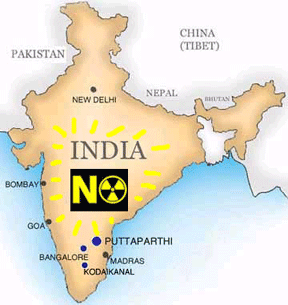 Indefinite hunger strike against KKNPP gains momentum Chennai Online Tirunelveli, Tamil Nadu, May 4 : The ongoing fourth round of indefinite hunger strike against controversial Koodankulam Nuclear Power Project (KKNPP) by the activists of People’s Movement Against Nuclear Energy (PMANE), a civil group spearheading the struggle against the nuclear project, gained momentum, with more number of women activists joining the fasting agitation today.
Nearly 500 women from the coastal hamlets around KKNPP joined the fast with 24 activists who were observing the fast-unto-death stir since May 1 last. The anti-nuclear protesters, including women and children, were assembling in large numbers in the protest venue. Talking to newsmen, M Pushparayan, a key activist of PMANE, claimed though morenumber of women activists were willing to join the fast, they were being prevented and intimidated by the police.
 The women from different villages had enrolled their names to participate in the indefinite fast but did not visit the venue due to possible police harassment, he said. “Police have blocked the entrance of the villages and threaten the hired vehicle drivers not to transport people to Idinthakarai village. Even if they dared, police threaten them to cancel their vehicle licenses. So, the drivers are not willing to come to Idinthakarai.
The police have deployed anti-riot vehicles Vajra and Varun at the entrances of the villages,” he said. Meanwhile, health condition of the 25 activists who were on fast since May 1, had started deteriorating and their pulse rates were going down. One of the activists, Vinoth was admitted to the hospital today, he added.
http://news.chennaionline.com/chennai/Indefinite-hunger-strike-against-KKNPP-gains-momentum/ff5dcb87-d243-4704-8109-783bb9458db3.col
1 This Month

22 June – Virtual Event –Climate Change: New Data, New Debate

Monday, June 22, 2026 2:30 p.m. – 3:15 p.m. CT
YouTube. Register here

Protect Sazan Island from the Trump family! https://secure.avaaz.org/campaign/en/protect_sazan_island_from_the_trump_family_loc/?bqFCVab&v=174511&cl=22707147157&_checksum=5e9dde668860e8231c33699735e16a1fbf22ab2cb01da50c999fe8732b9775ef&utm_source=email&utm_medium=blast_email&utm_campaign=174511
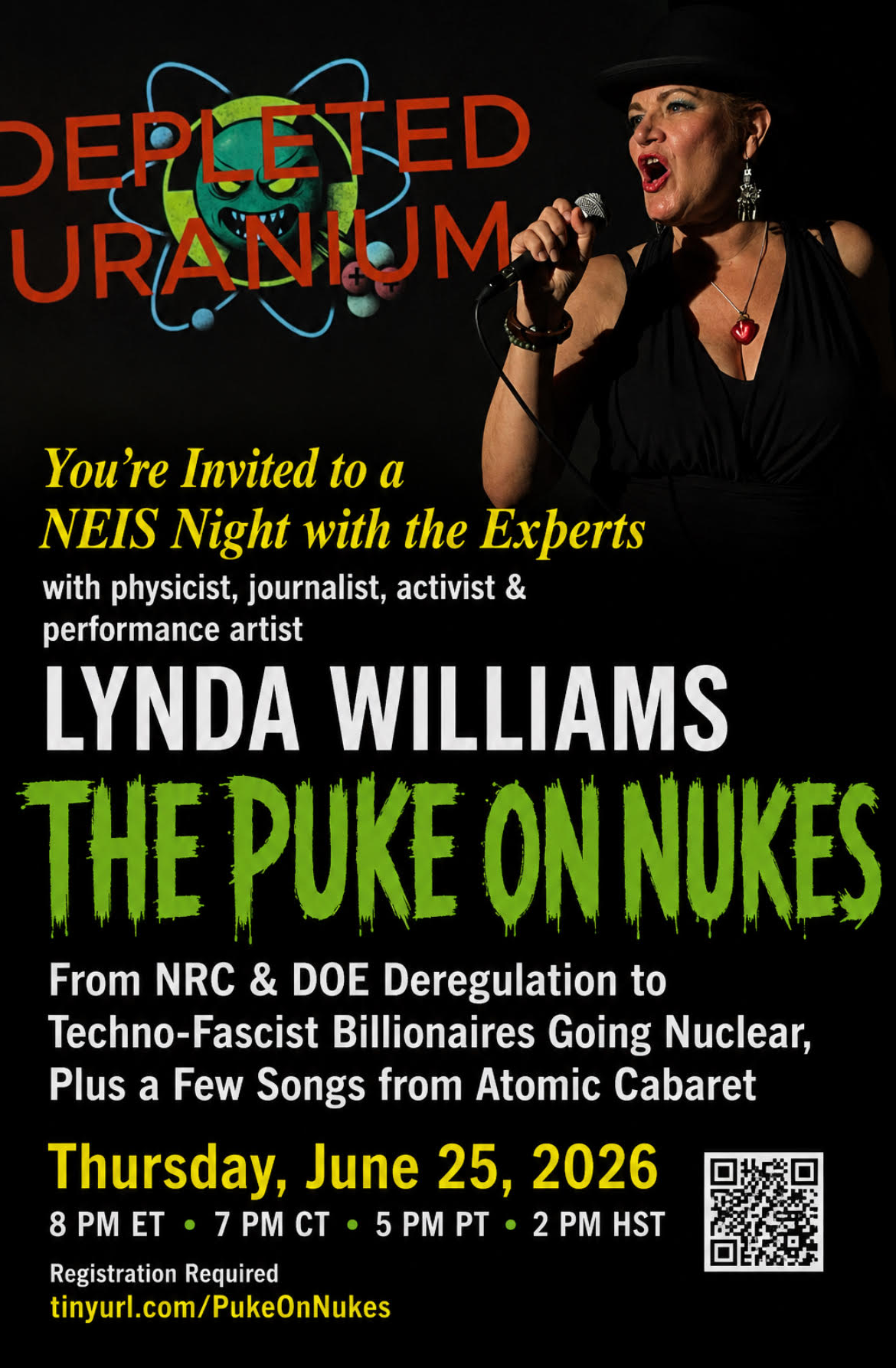
25 June- THE PUKE ON NUKES
Thursday, June 25, 2026
7pm Central Time (8pm ET, 6pm MT, 5pm PT) UTC – 5
From NRC & DOE Deregulation to Techno-Fascist Billionaires Going Nuclear, Plus a Few Songs from Atomic Cabaret REGISTER
26 June – Radiation Trainwreck at the NRC / Join the Protect Better Campaign – https://us02web.zoom.us/meeting/register/4ZlZ5_qLSHGiLSCg8FF6Bg#/registration


Cuba Is Not a Failed State – It Is a Besieged State
PETITION: “Global Appeal to Endorse Palestinian Right of Return of Refugees”
To see nuclear-related stories in greater depth and intensity – go to https://nuclearinformation.wordpress.com
-
Archives
- June 2026 (211)
- May 2026 (306)
- April 2026 (356)
- March 2026 (251)
- February 2026 (268)
- January 2026 (308)
- December 2025 (358)
- November 2025 (359)
- October 2025 (376)
- September 2025 (257)
- August 2025 (319)
- July 2025 (230)
-
Categories
- 1
- 1 NUCLEAR ISSUES
- business and costs
- climate change
- culture and arts
- ENERGY
- environment
- health
- history
- indigenous issues
- Legal
- marketing of nuclear
- media
- opposition to nuclear
- PERSONAL STORIES
- politics
- politics international
- Religion and ethics
- safety
- secrets,lies and civil liberties
- spinbuster
- technology
- Uranium
- wastes
- weapons and war
- Women
- 2 WORLD
- ACTION
- AFRICA
- Atrocities
- AUSTRALIA
- Christina's notes
- Christina's themes
- culture and arts
- Events
- Fuk 2022
- Fuk 2023
- Fukushima 2017
- Fukushima 2018
- fukushima 2019
- Fukushima 2020
- Fukushima 2021
- general
- global warming
- Humour (God we need it)
- Nuclear
- RARE EARTHS
- Reference
- resources – print
- Resources -audiovicual
- Weekly Newsletter
- World
- World Nuclear
- YouTube
-
RSS
Entries RSS
Comments RSS
 nuclear-news