Three Republican EPA administrators: Trump is putting us on a dangerous path, https://www.washingtonpost.com/opinions/three-republican-epa-administrators-trump-is-putting-us-on-a-dangerous-path/2017/05/26/10060ad2-424b-11e7-9869-bac8b446820a_story.html?utm_term=.a8b128b1138eBy William D. Ruckelshaus, Lee M. Thomas and William K. Reilly May 26
William D. Ruckelshaus was administrator of the Environmental Protection Agency from 1970 to 1973 and 1983 to 1985. Lee M. Thomas was EPA administrator from 1985 to 1989, and William K. Reilly was EPA administrator from 1989 to 1993.
More than 30 years ago, the world was faced with a serious environmental threat, one that respected no boundaries. A hole in the ozone layer was linked to potential increases in skin cancer and blindness from cataracts. The ozone layer is a thin band of gas in the stratosphere that protects the Earth and humans from dangerous ultraviolet radiation from the sun, and it was slowly being destroyed by chlorofluorocarbons, or CFCs, which are man-made gases used as aerosol propellants and in refrigeration and cooling.
Despite early skepticism, the risk of a thinning ozone layer was such that an international U.N. conference was convened in Vienna to address this problem. The participating countries and international bodies, including the United States, the European Union and other major producers and users of CFCs, afterward met in Montreal to negotiate an agreement setting out a specific program to reduce the production and use of CFCs.
The Environmental Protection Agency, with strong support from President Ronald Reagan, led the international effort that resulted in a treaty that contained an aggressive schedule of reductions known as the Montreal Protocol. It remains in effect today and has resulted in significant improvement in the ozone layer and greatly reduced the threat to human health. An element critical to the success of the effort was strong reliance on the shared science of the impact of CFCs and a willingness of the countries of the world to work together. They accepted that the risk of not acting was simply not acceptable.
Today, presented with the undeniable warming of the planet, we are faced with a global environmental threat whose potential harm to people and other living things exceeds any we have seen before. The Paris climate agreement is the international response to that threat.
[Six of the worst cuts in Trump’s budget]
In his April 22 Earth Day message, President Trump stated, “My administration is committed to advancing scientific research that leads to a better understanding of our environment and of environmental risks.”
Yet when confronted with broad-based evidence of planetary warming and the almost daily emerging evidence of the impacts of climate change, Trump’s March “skinny” budget and this week’s final 2018 budget plansay we should look the other way; he has chosen ignorance over knowledge. The need for extensive and accelerated scientific research about the nature of the problem and its possible policy solutions should be beyond question. Not to get more information is inexcusable.
Trump’s budget proposals have scrubbed every agency and department of expenditures that would provide us with vital information about the pace and impacts of climate change. Among those severely cut or eliminated altogether are programs in the departments of Energy, State, Interior and Homeland Security, and at the National Science Foundation, National Oceanic and Atmospheric Administration, NASA, and EPA.
The EPA budget released this week cuts science and technology spending by more than $282 million , almost a 40 percent reduction. The Greenhouse Gas Reporting Program is zeroed out; air and energy research are cut by 66 percent. Programs targeted at specific areas with significant climate vulnerabilities, such as the Chesapeake Bay, the Great Lakes and Puget Sound, have been eliminated.
The destruction of irreplaceable research would be staggering. It would put us and the rest of the world on a dangerous path. If our president is wrong about the reality of climate change, we will have lost vital time to take steps to avoid the worst impacts of a warming planet. If those urging collective worldwide accelerated action are wrong, we will have developed alternative sources of clean energy that will enhance our green energy choices for the foreseeable future.
We can see already, in many places here and around the world, concrete evidence of what climate change means. Sea-level rise along the Eastern Seaboard of the United States has increased, and with it have come significant increases in coastal erosion and flooding. Glacier ice melt in the Antarctic and Greenland is increasing. Arctic sea ice is at its lowest level since measurements began. The past three years have been the hottest on record; the 10 hottest years all occurred since 1998. When Glacier National Park in Montana was established in 1910, it contained 150 active glaciers; today there are 26.
With no seeming clue as to what’s going on, the president seems to have cast our lot with a small coterie of climate skeptics and their industry allies rather than trying to better understand the impact of increased greenhouse-gas emissions into the atmosphere. His policy of willful ignorance is a bet-the-house approach that is destructive of responsible government.
The consequences of the president’s being wrong are hard to imagine. All the more reason to respect science and continue the work that better defines the problem and the diminishing options for coping with it.
May 29, 2017
Posted by Christina Macpherson |
climate change, environment, politics, USA |
Leave a comment
French nuclear tests ‘showered vast area of Polynesia with radioactivity’ https://www.theguardian.com/world/2013/jul/03/french-nuclear-tests-polynesia-declassified
Declassified papers show extent of plutonium fall-out from South Pacific tests of 60s and 70s was kept hidden, says French paper, Guardian, Angelique Chrisafis in Paris, Thursday 4 July 2013, French nuclear tests in the South Pacific in the 1960s and 1970s were far more toxic than has been previously acknowledged and hit a vast swath of Polynesia with radioactive fallout, according to newly declassified ministry of defence documents which have angered veterans and civilians’ groups.
The papers, seen by the French paper Le Parisien, reportedly reveal that plutonium fallout hit the whole of French Polynesia, a much broader area than France had previously admitted. Tahiti, above, the most populated island, was exposed to 500 times the maximum accepted levels of radiation. The impact spread as far as the tourist island, Bora Bora.
Thousands of veterans, families and civilians still fighting for compensation over health issues have insisted France now reveals the full truth about the notorious tests whose impact was kept secret for decades.
From 1960 to 1996, France carried out 210 nuclear tests, 17 in the Algerian Sahara and 193 in French Polynesia in the South Pacific, symbolised by the images of a mushroom cloud over the Mururoa atoll. For decades, France argued that the controlled explosions were clean. Jacques Chirac, the French president, controversially resumed nuclear atoll explosions in the South Pacific shortly after being elected in 1995.
Le Parisien said the documents “lifted the lid on one of the biggest secrets of the French army”. It said papers showed that on 17 July 1974, a test exposed Tahiti to 500 times the maximum allowed level of plutonium fallout.
Bruno Barillot, who has investigated the impacts of the nuclear tests for the Polynesian government, complained of the high levels of thyroid cancers and leukaemia in Polynesia. He said the declassified documents revealed Tahiti had “literally been showered with plutonium for two days” during the Mururoa test; from the outset France knew the impact spread further than it publicly admitted. But of the 2,050 pages declassified, 114 remained blacked out.
Richard Oldham, a member of the Polynesia nuclear workers’ association Mururoa e Tatou, told Radio New Zealand International : “It’s the right for our future generations to know what has happened in this country.”
In 2006 a French medical research body found nuclear testing had caused an increase in cancer on the nearest inhabited islands. The French judiciary began investigating health implications. It was not until 2010 that France acknowledged that there could be a compensation process for veterans and civilians. But that is complex and limited to a small geographical area and certain ailments.
About 150,000 veterans and civilians worked on, or were present during, nuclear tests, including 127,000 in Polynesia. But of 800 dossiers, only 11 people have received compensation.
Troops who worked on the tests have described a staggering lack of precaution for workers. During the Mururoa tests in French Polynesia in the late 1960s, one veteran described how he was stationed in shorts and a T-shirt on a boat only about 15 miles from the explosion before having to sail immediately to the area of the vast mushroom cloud to examine the damage.
Others on different tests wore shorts and had no sunglasses; they were told simply to shield their eyes and turn their backs at the time of the explosion.
May 29, 2017
Posted by Christina Macpherson |
environment, OCEANIA, weapons and war |
Leave a comment
 DONALD TRUMP’S PICK FOR EPA ENFORCEMENT OFFICE WAS A LOBBYIST FOR SUPERFUND POLLUTERS https://theintercept.com/2017/05/24/donald-trumps-pick-for-epa-enforcement-office-was-a-lobbyist-for-superfund-polluters/ Sharon Lerner May 24 2017,RESIDENTS OF HOOSICK FALLS, New York, recently took comfort in EPA administrator Scott Pruitt’s announcements that the agency will be prioritizing the Superfund program. This small village northeast of Albany is one of eight sites the EPA last year proposed adding to the National Priorities List, as the list of polluted sites covered by the Superfund is known, because the community’s drinking water had elevated levels of PFOA, which has been associated with kidney cancer, testicular cancer, and thyroid disease, among other health problems.
Since the contamination was discovered in 2014, “there’s been a lot of fear,” said Rob Allen, the mayor of Hoosick Falls. Testing has shown many people in Hoosick Falls, including Allen’s four children, have elevated levels of PFOA in their blood. Allen and others in the town are still awaiting the official Superfund designation, which they hope will help speed the process of cleaning up the pollution and securing a new water source. “We need all the help we can get,” he explained.
Since 1980, Superfund has been the federal government’s answer to the worst cases of toxic pollution. The program assesses giant environmental messes, ranks them according to the hazard they pose to the environment or human health, and if they’re dangerous enough, adds them to the list and arranges to clean them up. At its best, Superfund removes environmental pollution so sites can be used again and measurably alleviates health dangers. According to one 2011 study published in the American Economic Review, babies living near Superfund sites that had yet to be remediated had a 20 to 25 percent increased rate of birth defects. After the cleanups, the rates of birth defects dropped.
But Superfund’s progress has slowed to a near halt in recent years, in part due to a lack of funding. A tax on polluting industries originally paid into a fund for the cleanups (hence the name Superfund) expired in 1995, leaving regular taxpayers to pick up the tab when the government can’t identify a polluter — or when a polluter doesn’t have enough money to pay.
Since then, as fewer cleanups have been completed, the number of people exposed to dangerous pollution has climbed. In 2010, there were 75 Superfund sites where the government had yet to bring toxic exposure to humans under control. By last year, that number was up to 121, according to the most recent EPA data.
Pruitt announced his plans to emphasize Superfund on a visit to a lead-contaminated public housing site in Indiana in April. On May 22, he reiterated his commitment to the program by announcing a new Superfund Task Force, which will “provide recommendations on how the EPA can streamline and improve the Superfund program.” In an accompanying memo, the EPA administrator once again promised to restore Superfund and the EPA’s land and water cleanup efforts “to their rightful place at the center of the agency’s core mission.”
But Pruitt’s pledges to protect human health and the environment by focusing on Superfund are belied by his own priorities and personnel choices for the program…..Albert Kelly, whom Pruitt announced May 22 as his choice to chair the Superfund Task Force, is an Oklahoma banker who has no prior experience with the program or with environmental issues at all, according to his résumé. Kelly, who has donated twice to Pruitt’s campaigns in Oklahoma, has spent the past 33 years working at Spiritbank, which is headquartered in Tulsa, and most recently served as its chairman. The “core competencies” listed on his résumé, which The Intercept obtained by FOIA, include motivational speaking, business development, and “political activity.”
Meanwhile, Susan Bodine, whom Trump nominated on May 12 to be assistant administrator for the EPA’s Office of Enforcement and Compliance Assurance, does have plenty of experience with environmental issues — though most of it representing polluting industries. According to her LinkedIn account, from 2009 until 2015, Bodine was a partner at Barnes & Thornburg LLP, the same firm that is representing FRRC, the group of industries directly affected by EPA cleanup rules. While at Barnes & Thornburg, Bodine represented the American Forest and Paper Association from 2011 to 2014. Member companies in that industry group have hundreds of EPA enforcement actions against them, including violations of the Clean Water Act and Clean Air Act.
Bodine’s close ties to these companies make her a poor choice to lead the enforcement office, according to Frank O’Donnell, president of Clean Air Watch. “She is the classic revolving door appointment,” said O’Donnell.“The office of enforcement is responsible for everything — clean air, clean water, toxic waste — the core of our environmental protections. Companies will cut corners if they think they won’t get caught.” Bodine’s nomination comes while the Trump administration is blocking efforts to disclose waivers granted to former lobbyists working in federal agencies and the White House.
Because the enforcement office handles negotiations between the companies responsible for the pollution and the EPA, Bodine would be in a position to decide how extensive some cleanups are — and how much polluters have to spend cleaning them.
Bodine’s past lobbying could also compromise her role with the Superfund program. Seven of the companies that belong to the American Forest and Paper Association are named as responsible parties in dozens of Superfund sites, according to the EPA website. International Paper, one member of the group Bodine represented — whose CEO met with Pruitt last week to discuss jobs, according to a tweet from Pruitt — is a responsible party in 12 Superfund sites
May 27, 2017
Posted by Christina Macpherson |
climate change, environment, politics, USA |
Leave a comment
‘The great unknown’: New climate change data lifts the sea-level threat, SMH , Peter Hannam, 23 May 17 The giant ice sheets of Antarctica and Greenland are melting faster than scientists previously estimated, raising the prospect of faster sea level rise placing at risk low-lying areas of Sydney and similar exposed cities around the world.
New research, including from the US National Oceanic and Atmospheric Administration (NOAA), has lifted the “plausible” sea level rise by 2100 to as much as two metres to 2.7 metres.
That has superseded earlier estimates, such as the 2013 Intergovernmental Panel on Climate Change (IPCC), that placed the likely top range of sea level rise at about one metre if greenhouse gas emission rises continued unabated.
Those higher forecasts have now been included in new mapping by Coastal Risk Australia that combines the estimates with national high-tide data and the shape of our coastline.
The resulting maps show airports in Sydney, Brisbane and Hobart will be largely under water by 2100 if that two-metre rise happens.
Other areas at risk in Sydney from such a rise include Circular Quay, Wentworth Park, the Royal Botanic Gardens, Woolloomooloo and Rose Bay. ………
Rising seas
NOAA estimates global mean sea levels have risen about 3.4 millimetres a year since 1993, roughly double the average rate of increase during the 20th century.
Even the last century’s pace of increase was the fastest in at least 2800 years, NOAA said.
Global warming is driving the increase in sea levels by melting land ice – such as glaciers and ice sheets – and from the thermal expansion of the warmer oceans.
John Church, a global sea level expert at the Climate Change Research Centre at the University of NSW, said other new research indicated Antarctica’s contribution to rising seas appears to particularly sensitive to carbon emissions rates – underscoring the urgency to reduce them…….http://www.smh.com.au/environment/climate-change/the-great-unknown-new-climate-change-data-lifts-the-sealevel-threat-20170522-gwa963.html
May 24, 2017
Posted by Christina Macpherson |
AUSTRALIA, climate change, oceans |
Leave a comment
China fears NK nuke leaks, Korea Times, By Oh Young-jin, 2017-05-21 China fears environmental contamination and earthquakes that may be triggered by North Korea’s underground nuclear tests, possibly bringing Beijing to the breaking point of its patience with its blood-sealed but increasingly defiant ally, a Chinese scholar said during an interview Friday.
“Chinese people in the northeast region that borders North Korea are fearful that they will fall victim to contaminated water and seismic disruptions from its nuclear blasts,” Professor Zhu Feng of Nanjing University told The Korea Times. The interview was held before his lecture on the Korea-China-U.S. relationship, sponsored by the Korea Foundation for Advanced Studies.Punggye-ri, North Hamgyong Province, which has served as the site for four of the five nuclear tests and will certainly accommodate a sixth, is within hundreds of kilometers of population centers in northeastern China. It is also quite close to Mt. Baekdu, a volcanic mountain that some experts fear may have another big eruption after the one in 946…….
https://www.koreatimes.co.kr/www/nation/2017/05/120_229715.html
May 22, 2017
Posted by Christina Macpherson |
China, environment |
Leave a comment
Such a hike would make 50-year weather events happen twice as often, according to work by Sean Vitousek, a coastal scientist at the University of Illinois at Chicago, and his colleagues. A 50-year event is an increase in sea level so large that it’s only likely to happen twice a century.
Sea levels are actually projected to rise by more than this – estimates put it at between 10 and 20 centimetres over the next few decades.
“It doesn’t take a ton of sea level rise to significantly change the frequency at which you have flooding,” says
Vitousek.
Extremely high water levels are sometimes caused by storm surges and low pressure atmospheric systems, when the easing of pressure on the sea allows water levels to rise. But normal tides and waves also play a part.
Cities under water
Taking those factors into account in his model, Vitousek found that, by 2050, wave-exposed Indian cities like Mumbai and Kochi, and Abidjan in Ivory Coast would see increased frequency of flooding with just a 5-centimetre rise in seas.
If the rise were 10 centimetres, increased flooding would also hit Shanghai, London and New York.
Sea level rise is a global phenomenon that affects regions differently. The ice sheets in Antarctica and Greenland are so massive that their gravity draws ocean water towards them. As they melt, that water will go elsewhere.
“If you lose Greenland, you’ll have more water in the ocean, which will elevate sea level everywhere. But the effect will be stronger farther away from Greenland,” says Anders Levermann of the Potsdam Institute for Climate Impact Research in Germany. “In Greenland or Antarctica, the water levels may even drop. The tropics always lose because they’re in the middle.”
Sea levels are currently going up by about 3 to 4 millimetres across the globe somewhat uniformly, Vitousek says, but some areas are more susceptible to sea level rise than others because that makes up a larger percentage of their overall water levels.
n the higher latitudes where the difference between high and low sea level in a given year could be 3 metres, a few centimetres may not be noticeable. But in the tropics, that small increase could account for 10 to 20 per cent of the variation, Vitousek says. “It’s not a trivial percentage of the water level,” he says.
Accept the danger
Aimée Slangen, a climate change scientist at the Royal Netherlands Institute for Sea Research, says regional events like El Niño could keep down some of the sea level rise in the tropics, but not forever.
“I think it would only delay the inevitable: at some point, flooding frequencies are going to increase as long as sea level keeps on rising,” she says. Vitousek says possible responses are to retreat from coastlines or to invest in engineering solutions, like building up natural beaches or creating artificial ones or building sea walls that provide shoreline protection.
But over the next few decades, an increase of 10 to 20 centimetres is inevitable, says Levermann. Even with large reductions in emissions, the die has already been cast for the near future.
“No one has to be afraid of sea level rise, if you’re not stupid,” he says. “It’s low enough that we can respond. It’s nothing to be surprised about, unless you have an administration that says it’s not happening. Then you have to be afraid, because it’s a serious danger,” Levermann says.
Journal reference: Nature Scientific Reports, DOI: 10.1038/s41598-017-01362-7
Read more: Unexpected Antarctic melt could trigger 2-metre sea level rise
May 19, 2017
Posted by Christina Macpherson |
2 WORLD, climate change, oceans |
Leave a comment
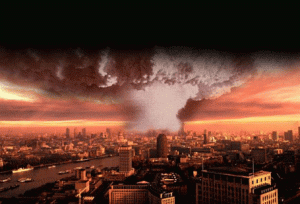 Nuclear attack: ‘A third of the world would die’ https://www.byronnews.com.au/news/nuclear-attack-third-world-would-die/3178772/ Cody Cassidy, Paul Doherty | 17th May 2017, DURING the Cold War it was widely understood that both the United States and the USSR had the capability to destroy the world with nuclear weapons. What people didn’t know was how easily they actually could do it.
Today, thanks to sophisticated weather models built to analyse global warming, we know that even a relatively small nuclear skirmish would be extremely bad news.
Simulations of full-scale war between smaller nuclear-armed countries suggest that a hundred multimegaton bombs would be exchanged, and the simultaneous detonation of a hundred nuclear devices would be bad for you even if you were on the other side of the globe.
Your first problem? Radiation.
When the nukes went off they would irradiate the area and transmute innocuous atoms into dangerous ones. One of the worst of these nuclear bastard children is called strontium-90.
It’s light, so it doesn’t take many explosions for it to coat the globe and get deep into the food supply. Once ingested it’s so similar to calcium that your body absorbs it into your bones.
Children born after the open-air nuclear tests of the 1950s have fifty times the natural level of strontium-90 in their teeth. Fortunately, that’s still below the threshold for serious danger.
Unfortunately, unlike a test, a nuclear battle will blow past that threshold. Once strontium-90 is in your bones its radioactive decay breaks up the DNA of your cells, leading to bone cancers and leukaemia.
So if you survived the initial nuclear exchange, you would have bone cancer to look forward to, but that’s only if you could also survive the more serious smoke, ash, and soot problem.
The second issue, after the dust has cleared from the initial detonations, is that the dust wouldn’t clear.
After a hundred multimegaton bombs exploded in the air, not only would they directly distribute carbon into the upper atmosphere but they would start enormous forest and urban fires that would release massive amounts of smoke.
On top of that, the explosions would lift tons of fine dust – all of which would be heated by the sun to rise and collect in the stratosphere.
The smoke from your typical campfire stays below the clouds where it can be wicked away by rain. In the case of nuclear fallout, smoke and ash would be lifted above the clouds where it wouldn’t be wicked away by rain, so it would stay parked for years and block sunlight.
Even conservative environmental simulations show that a hundred nuclear detonations would block enough sunlight to drop the average global temperature by a few degrees.
A sudden global drop in temperature of even a couple of degrees would be devastating for the world’s food supply, because a single frost kills rice.
A serious disturbance in rice production would kill as many as 2 billion people around the globe.*
In a hundred-bomb nuclear war nearly a third of the world’s population would die from the explosions, starvation, or cancer, but our species would carry on.
In larger, multithousand exchanges of thermonuclear weapons, like the one that almost occurred in November 1983 between the United States and the USSR, however, we probably wouldn’t.
HOW CLOSE THE WORLD CAME TO ENDING
On November 7, 1983, the United States led NATO in a massive training exercise called Able Archer that mimicked a nuclear first strike against the USSR. Unfortunately for nearly everybody, the USSR believed the exercise was a cover for an actual first strike.
So in response the Soviets helicoptered missiles to their silos and mobilised their air force, actions that should have alarmed the U.S. military to respond in kind.
Luckily, Lt. Gen. Leonard Perroots of the U.S. Air Force mistook Russia’s actions for a simple training exercise and took no action. That lack of response convinced the USSR to stand down.
Lt. Gen. Perroots made a “fortuitous, if ill-informed” decision, according to declassified analysis of the scare. It might be the most fortuitous mistake in human history.
If the alarm had been raised and the misunderstanding escalated into full-scale nuclear war, a few thousand multi-megaton bombs would have crisscrossed the globe and detonated over their targets.
Even if you didn’t live in a large city (basically every city with a population of more than 100,000 in the United States and the USSR was targeted) and therefore weren’t killed by the initial blasts, you couldn’t expect to live long.
Within two weeks of something like this happening, 180 million tons of smoke, soot, and dust would coat our globe like black paint, and there it would stay.
Light levels would be reduced to a few per cent of what they are today, so high noon would look like predawn. Midsummer highs in North America would be below zero.
The good news is there would be plenty of dead trees to burn for warmth. The bad news: You would starve. Crops would be wiped out, and those that weren’t would suffer from another problem: Bugs.
Cockroaches and their ilk are quite durable when it comes to radiation, but their predators are not. Without any birds to keep them in check, crop-eating pests would prosper.
Pests would decimate any crops that made it through the freeze.
But there is an upside (sort of). Cockroaches are actually more efficient than cows at turning grain into protein, and even in the new apocalyptic world there would be plenty for them to eat.
They’re also a healthy snack. Cockroaches are high in vitamin C, protein, and fat, so as long as you’re not a picky eater, you may survive a little longer than expected.
You would just need to eat a lot of cockroaches, around 144 per day, to survive. Gross.
This is an extract from And Then You’re Dead: A scientific exploration of the world’s most interesting ways to die by Cody Cassidy and Paul Doherty, published by Allen and Unwin and available now.
Paul Doherty is co-director and senior staff scientist at the San Francisco Exploratorium Museum. He received his PHD in solid state physics from MIT. Cody Cassidy is a writer and editor.
May 17, 2017
Posted by Christina Macpherson |
2 WORLD, environment, weapons and war |
Leave a comment
 The Terrible Things Happening To Children In India’s ‘Nuclear Graveyard’ Will Scar You For Life [PHOTOGRAPHS] scoopwhoop.com, by Era Tangar, 16 May 17 “…….Jadugoda, a town of 19,500 people about 1,370km from New Delhi, is a four-hour drive from Ranchi, Jharkhand. In 1967, this tribal town became the site for India’s first nuclear mine. It is often called India’s best kept secret. The government-owned Uranium Corporation of India (UCIL) mines for uranium in the region. The small township is home to the world’s finest uranium ore, magnesium diuranate,
Locals were initially ecstatic because this would increase employment opportunities. Over the past 40 years, the UCIL has conducted indiscriminate and unchecked uranium mining. This has destroyed local environment and the health of the tribal population. The toxic emission has caused facial tumours, mascular dystrophy, deformed skeletons, lung cancer and curved spines, to name a few.
The crimes of the UCIL have been under-reported in the media. There are articles and documentaries portraying the state of the town and the areas nearby but not much has been done as a follow up while people of Jadugoda continue to suffer for 50 years now. India’s nuclear dream has costed the well-being of Jharkhand’s tribals and made them suffer in silence. …….. Share the word about Jadugoda till it reaches someone who can help these innocent souls.
These photos were featured at the 3rd International Uranium Film Festival, Rio De Janeiro, Brazil, World Uranium Symposium in Quebec City, Canada 2015, World Nuclear Victims Forum, 2015 in Hiroshima, Japan and at UCCJ International Youth Conference in Kyoto, Japan 2017. https://www.scoopwhoop.com/the-dark-truth-about-nuclear-graveyard-jadugoda/#T.t2a4psvnq
May 17, 2017
Posted by Christina Macpherson |
environment, health, India, secrets,lies and civil liberties |
Leave a comment
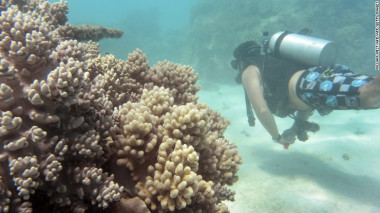
 Dahr Jamail | Coral Reefs Could All Die Off by 2050, May 15, 2017, By Dahr Jamail, Truthout | Report “…… over the last two years, the Great Barrier Reef, which is so dear to Miller and countless others who revel in the beauty and mysteries of the oceans, has been dying off at an unprecedented rate due primarily to warming ocean waters.
Coral bleaching occurs when corals become stressed by warmer-than-normal water, causing them to expel symbiotic algae that live in their tissues, from which they get their energy. Coral turns completely white when it bleaches. If it remains bleached long enough, it dies.
One scientist has already gone so far as to declare the Great Barrier Reef is now in a “terminal stage.” Most of those studying the reef agree that what is happening is unprecedented. This is because, at a minimum, two-thirds of the 1,400-mile long reef bleached out last year, which led to 22 percent of it dying. Now another bleaching event has resulted in at least two-thirds of the reef bleached again.
“The bleaching this year has moved much farther south and has taken scientists by surprise in its severity and extent,” Miller said. And he fears the state of the reef could be even worse than scientists realize, since only aerial surveys have been conducted to assess the damage and no research vessel is currently active on the reef to provide finer details.
With ocean temperatures rising across the globe as anthropogenic climate disruption (ACD) continues to pick up speed, the Great Barrier Reef, the largest coral ecosystem on Earth, may well be an example of what is happening to all of the coral on the planet.
“This Is New for All of Us”……..
Miller is equally stunned by what he is seeing along the Great Barrier Reef, which is eerily similar to what Burdick is seeing on Guam.
“Parts of the reef that didn’t bleach last year are now under immense pressure, and this is totally different because this is back-to-back bleaching,” Miller explained. “The system was already stressed, and this is a new stress event. We are seeing much mortality on reefs in our area…. What didn’t die last year is dying this year.”
In addition to the new bleaching in this year’s event, southern portions of the reef that are typically in cooler waters are now also bleaching out.
“It’s heartbreaking to see,” Miller added. “Seventy thousand direct tourism-related jobs and a $6 billion tourism industry are all at risk, especially on top of the recent damage from Cyclone Debbie.”
A study published this March in the journal Nature found that last year’s bleaching of the Great Barrier Reef was so severe that there was no similar analog in the thousands of years of ancient coral cores scientists use to study past climates.
Another study published in Nature projected that by the year 2050, more than 98 percent of global coral reefs will be afflicted by “bleaching-level thermal stress” every single year.
However, the prognosis could be even worse: The scientists involved in the study from this March speculated that the era of never-ending global coral bleaching may have already arrived, albeit several decades earlier than was predicted even just last year. They explained that the Great Barrier Reef needs 10 to 15 years between bleaching events in order to fully recover, and that recovery time period is “no longer realistic.”
“We Don’t Even Know What We Are Losing”……..
A report by the UN’s Food and Agriculture Organization shows that coral reefs are responsible for producing 17 percent of all globally consumed protein, with that ratio being 70 percent or greater in island and coastal countries like those of Micronesia.
At the time of this writing, Earth has lost nearly half of its coral, and oceanic warming only continues to accelerate.
“We are finding that reefs living under anthropogenic stresses for many years have already lost their more sensitive coral species, and the ones that are there now are already the tough bastards,” Raymundo said. “And when reefs have lower diversity, there is less ecological redundancy; hence, they are more likely to collapse.”
A Future Without Coral?
A 2012 study revealed that half of the Great Barrier Reef had already vanished in just the previous 27 years. Two years later, the world’s most qualified coral reef experts released a report showing that, without dramatic intervention, the Great Barrier Reef would disappear completely by 2030.
Furthermore, a study published and released by NOAA in 2011 warned that, “unless action is taken now to reduce the threats,” 90 percent of all reefs will be “threatened” by 2030, and all of Earth’s coral reefs could be completely gone by 2050. The study, “Reefs at Risk Revisited,” listed human-caused climate disruption, warmer water temperatures, ocean acidification, shipping, overfishing, coastal development and agricultural runoff as the contributing factors.
While that might sound extreme, Miller told Truthout he thought the report actually didn’t go far enough.
“I think it’s too conservative,” he explained. “Corals need many years to adjust to the warmer ocean waters, and we don’t have that kind of time anymore. The warming we are seeing now is happening far too fast to allow for evolution…. So what we’re seeing now is death. That’s what bleaching is.”……..
Back in Australia, Miller is dismayed by the fact that his government is doing very little, if anything, to mitigate the crisis.
Truthout asked Miller what steps the Australian government is taking to save the Great Barrier Reef.
“From what I can tell, virtually nothing,” he answered. “They are not focussed on this at all, but rather are pushing for the Adani Coal Mine to go ahead. We here in Australia can hardly believe it, to be honest. In fact, the government has had almost no comment on the bleaching at all.”
The coal mine he referred to is looking like it is going to move forward, which will, according to Miller, bring an additional 500 ships carrying coal across the Great Barrier Reef every single year.
Truthout interviewed Miller’s colleague, John Rumney, the managing director of Great Barrier Reef Legacy in February, when this year’s bleaching event began.
“This coral is in big trouble,” Rumney said at the time. Like Miller, Burdick and Raymundo, Rumney warned of the extreme loss of biodiversity that comes with the disappearance of reefs.
“When all that coral goes, all that diversity of fish that depends on it goes,” Rumney told Truthout. “The entire food chain is in big trouble.”
Miller concurred, saying, “We might see ecosystem collapse as we know it.” The need for independent research on the Great Barrier Reef during this second mass-bleaching event is needed more than ever, according to Miller. His and Rumney’s organization is striving to get more scientists out to the reef as quickly as possible.
“The world’s greatest natural icon and largest living structure needs our help more than ever, and unless we act as a concerned global population, nothing will be done,” he concluded. “It is not too late. The reef is worth saving — and our actions now will determine the fate of coral reefs in as little as 5 to 10 years. We must act.” http://www.truth-out.org/news/item/40579-coral-reefs-generate-half-of-earth-s-oxygen-and-they-could-all-die-off-by-2050
May 17, 2017
Posted by Christina Macpherson |
2 WORLD, AUSTRALIA, climate change, oceans |
Leave a comment
 THAAD Rocket Fuel: Likely Ground Water Contamination Coming to Seongju, South Korea http://www.globalresearch.ca/thaad-rocket-fuel-likely-ground-water-contamination-coming-to-seongju-south-korea/5589018, By Bruce Gagnon, May 07, 2017 Space4Peace The unwelcome US deployment of the THAAD (Terminal High Altitude Area Defense) missile defense (MD) system in Seongju, South Korea is not only a significant threat to regional peace but is also a major environmental catastrophe waiting to happen.

May 10, 2017
Posted by Christina Macpherson |
environment, South Korea, weapons and war |
Leave a comment
Water is rallying cry for opponents at uranium-mine hearing, Rapid City Journal, Seth Tupper Journal staff, May 9, 2017 The spirit of a recent protest against a crude-oil pipeline energized opponents of a proposed southwest South Dakota uranium mine Monday during a public hearing.
May 10, 2017
Posted by Christina Macpherson |
indigenous issues, USA, water |
Leave a comment
 Miami New Times, BY JERRY IANNELLI, 3 May 17, For the past seven years, Florida Power & Light has battled environmentalists over its plans to build two new reactors and inject their radioactive waste 3,000 feet underground, just below the aquifers where South Florida gets its drinking water. Environmentalists have vigorously argued that science shows the dangerous waste could leech upward into Miami’s drinking water. And yesterday, those green activists finally earned a hearing before the federal Nuclear Regulatory Commission (NRC).
But it turns out the two environmental groups leading the fight aren’t the only ones opposed to the plan: Lawyers for the City of Miami and the nearby Village of Pinecrest both slammed FPL’s plan and urged the NRC to reconsider the electric monopoly’s proposal. Miami Assistant City Attorney Xavier Albán called FPL’s final “environmental impact statement” for the new reactors at the Turkey Point Nuclear Generating Station “deficient” and begged the NRC to force FPL to come up with a waste-storage plan that would not affect Miami’s drinking water.
FPL has failed to adequately demonstrate that the direct effect, indirect effects, and cumulative impact to the natural physical environment are ‘small,'” Albán said. “The environmental impacts will not be ‘small.'”
The risk of possible carcinogens leaking into the city’s source of drinking water “can never be small,” he added.
FPL also spoke in front of the NRC yesterday and argued that the environmentalists and city officials were wrong. Its science was just fine, the company claimed.
“The NRC is not required to look at every potential environmental impact and does not have to consider worst-case scenarios,” an FPL representative said before the NRC board.
In Miami and Pinecrest, FPL has found its two largest opponents to date. The official challenge to the company’s plans was brought by two groups: the Southern Alliance for Clean Energy (SACE) and National Parks Conservation Association (NPCA). The power company had dismissed groups such as SACE as “anti-nuclear” extremist using the wastewater-storage plan as a cover to try to tank a Turkey Point expansion.
“The City of Miami has serious concerns with respect to FPL’s application for a combined operating license for Turkey Point proposed units six and seven,” Albán said. “With respect to the contention before you, this matter specifically relates to the sanctity and protection of a designated source of drinking water, the Upper Floridan Aquifer.”……….
The NRC will likely take weeks, or perhaps months, to issue a ruling. http://www.miaminewtimes.com/news/city-of-miami-slams-fpls-plan-to-inject-radioactive-waste-below-drinking-water-at-turkey-point-9320009
May 6, 2017
Posted by Christina Macpherson |
USA, water |
Leave a comment
Top environmental priority? Nukes https://www.adn.com/opinions/2017/05/01/top-environmental-priority-nukes/ John Havelock Rising sea levels, polluted water, air quality deterioration, climate warming: These are the expressed priorities of the environmental movement. They are easy to understand and maybe it’s not too hard to figure out what to do once persuasion prevails. A far superior priority is too easily neglected: the environmental threat posed by nuclear weapon proliferation and growth in risk of use.
As mathematical theorist and songwriter Tom Lehrer once famously sang, “We’ll all go together when we go, every Hottentot and every Eskimo.” Lehrer was describing the Cold War exploding into a hot war. “Mutually assured destruction,” as it was called at the height of the Cold War, is still far from impossible.
A slightly slower chain reaction of violence can lead to the same result as one vengeful hydrogen bomb is lobbed in response to another. Opportunities for accidentally escalating destruction are still around. Remember World War I.
One of the reasons why the nuclear problem doesn’t get much attention is that the chances of the whole thing going to hell in any one year are variable but low. Current probabilities have caused the Bulletin of the Atomic Scientists to move the needle of their Doomsday Clock back to just a couple of minutes to midnight after enjoying a distance of more than a quarter hour after the Nonproliferation Treaty was signed. Odds on any one year may seem low, but low odds over 20 or 30 years add up to a probability.
The world has been conscious of this risk for some time. The Treaty on the Non-proliferation of Nuclear Weapons came into effect with enough signatures in 1970. Some 191 nations signed the treaty. North Korea tiptoed to the edge before exiting. India, Pakistan, Sudan and Israel never signed. These countries also pose an environmental threat, if not as bombastically declared as North Korea. Even Israel, as rational as its leadership may be, has indicated it will do whatever is required if faced with an “existential threat.”
Under the treaty, countries acknowledging a nuclear arsenal (the Big Boys) agreed that they would reduce their arsenals with the ultimate (if difficult to imagine) goal of completely eliminating weapons of this type, like poisonous gas munitions, to note the 1925 Geneva Protocol as a precedent.
Russia and the United States went through one reduction exercise. That was it. Their bargain was effectively nullified more recently as they “replenished stocks,” not technically an expansion, and invented new, smaller, artillery applications that might make the use of nukes more acceptable in war — say, in the Ukraine.
As a matching treaty trade-off to Big Boy reductions, those who joined up without having developed nukes agreed never to do so, hence the title “Nonproliferation.” The Big Boys agreed also to share peaceful nuclear technology with those who eschewed bomb development. Nonproliferation worked, taking the heat off many countries that otherwise might have had to show their military manhood by developing nuclear arms. It also served as a precedent for the Iran agreement.
Despite the treaty agreement, nations possessing nuclear arms are estimated still to have arsenals totaling around 22,000 weapons, easily enough explosive and radiation capacity to make life on Earth impossible for mammals.
North Korea’s eager embrace of nuclear arms development and expansion should help international policies to catch up on the total environmental risk. Early presidential talk of a U.S. nationalist response, including “on the table” military response via “preemptive war,” was alarming. Anything like that could not be contained. In stage one, we set the stage for millions of South Koreans to die. China may well follow the example, taking Taiwan. The U.S. responds per its agreements, the Russians move on Ukraine, etc.
Kudos to Secretary of State Rex Tillerson for taking the problem to the U.N., and good for U.N. Ambassador Nikki Haley for her sharp attention to the issue. North Korea’s nuclear arms development is an international environmental problem, not just a local military-political problem for the U.S., South Korea and Japan.
It would help if the environmental movement prioritized this concern. As with so many issues of our times, economic, military, social and nationalist responses are outdated, “whack-a-mole” solutions. As Wendell Willkie, the Republican presidential candidate contesting FDR’s last term, forecast, “The world is small and the world is one.”
John Havelock, a vet, former White House Fellow, public official, UAA professor and ADN columnist, has long been a student of international affairs.
May 5, 2017
Posted by Christina Macpherson |
environment |
Leave a comment
 Nuclear Reactor Wastewater Will End Up In Your Drinking Water, KNWA: Erika Hall : May 04 FAYETTEVILLE, Ark. – – Fayetteville City Council on Wednesday approved dumping wastewater from the site of a former nuclear reactor into the city’s sewer system. The water will eventually flow into Beaver Lake, our area’s main source for drinking water.One city council member thinks it’s a bad idea, but others claim it’s perfectly safe. “We are actually dumping our sewage, what’s left of it into our drinking what source,” said Fayetteville City Council member John La Tour.
May 5, 2017
Posted by Christina Macpherson |
USA, water |
Leave a comment
Nuclear Contamination Reaches Earth’s Deepest Water, Could Affect Billionshttps://www.wateronline.com/doc/nuclear-contamination-reaches-earth-s-deepest-water-could-affect-billions-0001 By Sara Jerome, 2 May 17 @sarmje Billions of people may face a threat posed by radioactive materials in water.
“A shocking new study has revealed that groundwater drunk by billions of people may have been contaminated by decades of nuclear weapons testing. Researchers looked at more than 6,000 wells around the globe, some containing water more than 10,000 years old, found more than half had traces of tritium,” the Daily Mail reported.
“Even at low doses, tritium has been linked with increased risk of mutation and cancer because it goes directly into the tissues of organs of the human body,” the report continued.
The study was led by Scott Jasechko of the University of Calgary in Canada. It was published online in Nature Geoscience on April 25, and the university released a statement about the research.
Tritium was spread during nuclear bomb tests in the 1950s, Science News reported, citing the study.
Professor James Kirchner, of the Swiss Federal Institute of Technology, Zurich, said, per the Daily Mail: “Roughly half of the wells contained some fraction of recent groundwater less than 50 or 60 years old. It is a bit like going to a giant old people’s home and suddenly realising there are lots of kids running around. That is great, except if the little kids have the flu!”
The upshot is that even groundwater buried so deep in the earth that is it is accessible by only the world’s deepest wells is not immune to modern contamination. Also known as fossil water, this resource began as snow and rain that fell more than 12,000 years ago.
The scientific community previously believed that fossil water was not contaminated. “The unfortunate finding is that even though deep wells pump mostly fossil groundwater, many still contain some recent rain and snow melt, which is vulnerable to modern contamination,” Jasechko said in a statement. “Our results imply that water quality in deep wells can be impacted by the land management decisions we make today.”
For similar stories visit Water Online’s Source Water Contamination Solutions Center.
May 5, 2017
Posted by Christina Macpherson |
2 WORLD, water |
Leave a comment