Chicago at last to clean up its radioactive thorium pollution
 Chicago park will finally be cleansed of radioactive waste, By MATTHEW MESSNER (@MESSNERMATTHEW) • July 20, 2017
Chicago has a bit of a thorium problem.
The radioactive element, once heavily used in the making of gas light mantels, can now be found in contaminated superfund sites across the city. One of those sites also happens to be the long-delayed and much-anticipated DuSable Park in the downtown Streeterville neighborhood. While the park is on the Chicago Park District’s website, it has not been programmed or developed in any way. Now, 30 years after its founding, the park is set to finally be cleared of its radioactive waste, enabling its development into a usable public space……
Utah’s White Mesa Uranium Mill – will the State allow further pollution from this site?
Don’t let this uranium mill repeat history http://www.hcn.org/articles/opinion-pollution-a-uranium-mill-in-utah-threatens-to-repeat-a-history-of-pollution The White Mesa Mill’s license is up for renewal under the Trump administration. July 19, 2017 Tucked inside the Trump administration’s proposed budget is $703 million in funding for nuclear weapons. Although that’s about 30 percent less than last year, you would hardly know it here in the heart of Utah’s canyon country, where the nation’s last operating conventional uranium mill — the White Mesa Mill — is forging ahead.
Energy Fuels has influential friends, including high-powered lobbyists Andrew Wheeler, who worked on the Trump campaign and was involved with transition planning, and Mary Bono, the former California congresswoman and widow of Sonny Bono. So far, Utah seems to be welcoming the permit renewal as an economic boon for rural San Juan County, though the mill is staunchly opposed by its nearest neighbors — the Ute Mountain Ute Tribe and White Mesa residents who are mostly tribal members. Few have forgotten what happened to two towns and surrounding communities after uranium mills there were shuttered.
When the Monticello uranium mill closed, the environmental mess it left behind became two federal Superfund sites, one of which encompassed the entire community of Monticello. A $250 million taxpayer-funded cleanup effort ensued, even as cancers, respiratory problems, reproductive issues, allergies and birth defects plagued the residents of this small uranium town. In decades earlier, child and adolescent leukemia clusters appeared in the community. Residents suspected these ailments were linked to long-term uranium exposure, and a 2007 Utah Department of Health study found the mill to be a “plausible” cause of elevated rates of certain cancers.
Already, the problems that have emerged at the White Mesa Mill look a lot like the problems plaguing Monticello and Moab. The shallow groundwater aquifer underneath the mill is contaminated with heavy metals, and the bond posted by the company to fund cleanup is laughably low — about $22 million, which is less than a fifth of professional cleanup-cost estimates.
In both 2012 and 2013, the mill’s own reports show that it emitted more radon — a cancer-causing air pollutant — than the Clean Air Act allows. And in 2015, 2016 and 2017, radioactive spills occurred as materials were transported to the mill for processing. Numerous cases of cancer have been reported in White Mesa, although no epidemiological studies have begun.
Still, Utah regulators seem unconvinced that the risks are real, and now, the state has opened the mill’s license renewal to public comment. With Energy Fuels lobbying in Utah and in Washington, D.C., Americans have only until July 31, 2017, to urge regulators to stop continued environmental injustice at White Mesa. Email comments to dwmrcpublic@utah.gov with the subject line: “Public Comment on White Mesa RML Renewal” or submit comments by mail to Scott Anderson, Director, Division of Waste Management and Radiation Control, P.O. Box 144880, Salt Lake City, UT 84114-4850.
Mayak: Russia’s radioactive horror that just keeps on giving

 Russia’s nuclear nightmare flows down radioactive river, http://www.concordmonitor.com/Russia-s-nuclear-nightmare-flows-down-radioactive-
 river-1834751 Monitor, By KATHERINE JACOBSEN Associated Press. Friday, April 29, 2016 At first glance, Gilani Dambaev looks like a healthy 60-year-old man and the river flowing past his rural family home appears pristine. But Dambaev is riddled with diseases that his doctors link to a lifetime’s exposure to excessive radiation, and the Geiger counter beeps loudly as a reporter strolls down to the muddy riverbank.
Some 30 miles upstream from Dambaev’s crumbling village lies Mayak, a nuclear complex that has been responsible for at least two of the country’s biggest radioactive accidents. Worse, environmentalists say, is the facility’s decades-old record of using the Arctic-bound waters of the Techa River to dump waste from reprocessing spent nuclear fuel, hundreds of tons of which is imported annually from neighboring nations
At first glance, Gilani Dambaev looks like a healthy 60-year-old man and the river flowing past his rural family home appears pristine. But Dambaev is riddled with diseases that his doctors link to a lifetime’s exposure to excessive radiation, and the Geiger counter beeps loudly as a reporter strolls down to the muddy riverbank.
Some 30 miles upstream from Dambaev’s crumbling village lies Mayak, a nuclear complex that has been responsible for at least two of the country’s biggest radioactive accidents. Worse, environmentalists say, is the facility’s decades-old record of using the Arctic-bound waters of the Techa River to dump waste from reprocessing spent nuclear fuel, hundreds of tons of which is imported annually from neighboring nations.
The results can be felt in every aching household along the Techa, where doctors record rates of chromosomal abnormalities, birth defects and cancers vastly higher than the Russian average – and citizens such as Dambaev are left to rue the government’s failure over four decades to admit the danger.
“Sometimes they would put up signs warning us not to swim in the river, but they never said why,” said Dambaev, a retired construction worker who like his wife, brother, children and grandchildren have government-issued cards identifying them as residents of radiation-tainted territory. “After work, we would go swimming in the river. The kids would too.”
Thousands already have been resettled by Russia’s Rosatom State Atomic Energy Corp. to new homes a mile inland from the river, leaving Dambaev’s village of Muslyumovo in a state of steady decay as shops close and abandoned homes are bulldozed. The evacuations began in 2008, two decades after Russia started to admit disasters past and present stretching from Mayak’s earliest days in the late 1940s as the maker of plutonium for the first Soviet atomic bombs.
Vladimir Slivyak, an activist for the Russian environmentalist group EcoDefense, has visited villages downstream from Mayak many times to help document the poor health of locals in the area, 870 miles east of Moscow near Russia’s border with Kazakhstan.
The Nuclear Safety Institute at the Russian Academy of Sciences, which oversees safety standards for the country’s nuclear industry, told the AP that Mayak’s nuclear waste processing system presents no danger to the surrounding population. The plant also manufactures a range of radioactive isotopes of use for specialist equipment, medical research and cancer treatments that generate lucrative contracts worldwide.
Rosatom spokesman Vladislav Bochkov, in response to several Associated Press requests seeking an interview to discuss Mayak’s safety standards and operations, sent an email Thursday denying Mayak dumps nuclear waste in the river. Bochkov said the complex “follows all the environmental protection guidelines and has all the approvals it needs for operation.”
“The level of pollution in the Techa River today completely complies with the sanitary standards of the Russian Federation,” he wrote. He said the river water is clean: “You can drink it endlessly.”
But when the AP took a Geiger counter to the riverbank outside Dambaev’s home, the meter reading surged at the water line and the machine began beeping loudly and continuously. Measurements ranged from 8.5 to 9.8 microsieverts — 80 to 100 times the level of naturally occurring background radiation. A typical chest X-ray involves a burst of about 100 microsieverts.
Nuclear Safety Institute member Leonid Bolshov bills these levels as safe, saying: “The level of pollution in the water today is incomparably less to what it used to be.”
What it used to be is pretty bad. Environmentalists estimate that Mayak tossed 76 million cubic meters (2.68 billion cubic feet) of untreated waste — enough to fill more than 30,000 Olympic-sized swimming pools — into the river from 1948 to the mid-1950s as nuclear scientists scrambled to catch up to the U.S. nuclear program.
In September 1957, underground storage tanks of overheating nuclear waste exploded, sending a cloud of nuclear fallout 300 kilometers (200 miles) northeast across 217 towns and villages containing 272,000 people, a minority of which were quietly evacuated over the following two years.
A decade later, a nearby lake used to dispose of nuclear waste dried up amid a summer drought, and high winds whipped the exposed powdery residue to many of the same population centers. Greenpeace estimates the fallout reached 68 towns and villages containing 42,000 people.
Russia suppressed all news of both disasters until the late 1980s, when it acknowledged the two accidents and the Mayak site’s very existence.
In 1993, Russia said the two accidents combined with longer-term dumping of waste into the river meant that an estimated 450,000 people had been exposed to excess radiation from Mayak. It offered no breakdown of immediate deaths, accelerated deaths or increased rates of illness and disease in the populace.
A 2005 criminal case against Mayak’s then-director, Vitaly Sadovnikov, revealed that the plant continued to dump at least 30 million cubic meters (1 billion cubic feet) of untreated nuclear waste into the river from 2001 to 2004. Prosecution documents said the dumping quadrupled the volume of the radioactive isotope strontium-90 in the river.
A study by Greenpeace in 2007, citing hospital records and door-to-door surveys of Muslyumovo residents, reported cancer rates 3.6 times higher than the Russian national average. Russian scientists have reported residents suffer 25 times more genetic defects than the general population.
A decades-long Radiation Research Society study of people living near the Techa River conducted jointly by Russian and American scientists has linked radiation particularly to higher rates of cancer of the uterus and esophagus. In their latest 2015 report, the scientists analyzed 17,435 residents born before 1956, among them 1,933 with cancer. They found that the vast majority of residents had accumulated heightened deposits of strontium-90 in their bones and such “radiation exposure has increased the risks for most solid cancers.”
Such figures come as no surprise to one of Muslyumovo’s longest-serving doctors, Gulfarida Galimova, a gynecologist and family general practitioner who started work in the village’s hospital in 1981. Galimova says she was immediately struck by the exceptional volume of pediatric emergencies involving miscarriages, early and still births, and newborns with malformed limbs and other defects.
Still, like others she did not know Mayak —unmarked on any map at the time and still off-limits to the public today — even existed. She recalls 1980s mornings of blissful ignorance washing her hair in the deceptively soft waters of the Techa.
“The water was nice and not calcified. Soft water. Your hair would be so fluffy,” Galimova recalled.
She was among some 280 households that accepted Rosatom’s offer to abandon their homes in Muslyumovo for new two-story homes away from the river in what today is called New Muslyumovo. But her 2012 move came too late for her own family. A son born in the village in 1985, and a grandson born last year, both have birth defects that she blames on Mayak radiation. Her son has a club foot; her grandson has heart deformities.
One of her neighbors in New Muslyumovo, with its rows of pastel yellow homes with red roofs, blames the new location for her family’s health problems. Alfia Batirshina, 28, says a radon deposit beneath the topsoil of the new settlement gives her chronic headaches and her 8-year-old daughter recurring nosebleeds.
She is loath to discuss her daughter’s own birth defect, a deformed leg, and keeps her out of view of journalists. Her 62-year-old father, Vakil Batirshin, struggles to say anything at all. His neck is painfully swollen from lymph nodes that have grown triple their normal size, leaving his words nearly unintelligible.
The homemaker says she and neighbors are resigned to their medical fate living in Mayak’s nuclear shadow.
“I don’t hope for anything anymore,” she said. “If we get sick, we get sick.” Associated Press reporters Iuliia Subbotovska in Muslyumovo, Jim Heintz in Moscow and Shawn Pogatchnik in Dublin contributed to this story.
Cover-up of the true radiation effects in southern Russian Urals
 In conferences debating the number of victims of the Chernobyl accident, officials who draw paychecks from nuclear lobbies make similar arguments about alcohol abuse and “radiophobia”—stress-related illnesses caused by fear of radiation.
 Strange illnesses in one of the most contaminated towns in the world challenge what we think we know about the dangers of radioactivity.Slate, By Kate Brown, April 18, 2013, “……What do we know about communities living on contaminated terrain? Two years after the meltdown of three reactors in Fukushima, Japan, the World Health Organization forecasts that there will be no significant rise in cancers among people living nearby. These projections are based on guesses from models calculated from prior studies, mostly of Japanese people who survived Hiroshima and Nagasaki. Yet when Japanese scientists and inspected the bodies of 38,000 children living in the Fukushima Prefecture, they found 36 percent had abnormal growths on their thyroids a year after the accident.
We have grown accustomed to this scenario—media attention to nuclear accidents followed by a long, slow quarrel among scientists about whether the spilled fission products will damage human bodies or not. It will take decades to learn the public health impact of the 2011 meltdown. By then, most of the public will have lost interest. But there are other ways to get at this question of what it means to live on earth sullied with decaying radioactive isotopes.
No one has lived longer on contaminated terrain than people in the village of Muslumovo in the southern Russian Urals located downstream from the Maiak plutonium plant, built in 1948 to produce Soviet bomb cores. Unlike the S.T.A.L.K.E.R. game, daily life in Muslumovo is terrifyingly banal: long waits at medical clinics, worries over the price of prescriptions, reams of paperwork related to compensation and disability claims, sick kids, unemployment, poverty, and chronic illness.
I showed up in Muslumovo on a Saturday morning in August 2009. Muslumovo is a big village, sprawled inside a crooked elbow of the Techa River, which is slow, sluggish, and considered to be the world’s most radioactive. The village center has a train station, a few apartment buildings, and a corner store. Marat Akhmadeev met me at the station in his Soviet vintage car, dusty and dented. We jolted up and down on the choppy seas of the unpaved streets. Muslumovo is a strange village—half there and half gone. Many houses are abandoned, some partly dismantled, exposing weathered wallpaper and overturned appliances.
The Techa became a flowing radioactive reservoir in 1949 when engineers at the plutonium plant ran out of underground storage containers for high-level radioactive waste. A Dixie cup of this waste could kill everyone in a large ballroom. Compelled by the arms race, the plant director ordered it dumped in the Techa River. The men running the plant didn’t tell anyone about this decision. The 28,000 Russian, Bashkir, and Tatar farmers living on the river—drinking, cooking, and bathing with river water—had no idea. In the 1950s and ’60s special forces resettled most of the 16 contaminated villages on the Techa, but a few villages were too large and expensive to move, so they stayed. Muslumovo is one.
There’s no work in Muslumovo. A person either commutes 60 miles to the industrial city of Cheliabinsk or farms a patch of land of the long-defunct Muslumovo collective farm. Marat farms, living off the land—a term that takes on new meaning in Muslumovo, where in 2008, an American team found domestic interiors registering radiation at 40 times above the background level. After we pulled up at Marat’s house, his teenage son silently trailed us. Noticing a twitch in the boy’s step, I turned to look at him. His mouth drooped and fingers twisted, as he mouthed a stuttered greeting. Marat explained, “This is Kareem,nash luchevik,” meaning “our radiant one,” said in an off-hand manner, as if every family has a luchevik……
There is a legal contest going on over the health of the people of Muslumovo: whether they are sick and, if so, ill from the radioactive isotopes dumped in the river or from poor diets and alcohol abuse. Medical evidence has been contradictory. In 1959, Soviet scientist A. N. Marei wrote a dissertation in which he argued that the Techa villagers were in poor health because of their poor diets. In 1960, in contrast, local Soviet officials linked the river-dwellers’ illnesses to the contaminated river. This debate between nature (radiation) and nurture (lifestyle) has been going on a long time…….
Over the years, FIB-4 doctors had diagnosed 935 people on the Techa River with chronic radiation syndrome. But as thousands of people in Ukraine worried about their exposures from the Chernobyl blast, Soviet medical officials backpedaled on the FIB-4 doctors’ original findings. In 1991, Angelina Gus’kova, the chief official voice in evaluating Chernobyl health problems, argued that in fact there were only 66 cases of chronic radiation syndrome among the Techa River people. The rest, she claimed, suffered from more prosaic diseases such as brucellosis, tuberculosis, hepatitis, and rheumatism caused by poor diets and sanitation. As American researchers supported by the Department of Energy have taken over as lead researchers of studies in Muslumovo, the diagnosis of chronic radiation syndrome has largely dropped from the radar. Meanwhile, Russian officials, worried about lawsuits, charged that many people in Muslumovo had dreamed up illnesses in order to sue for compensation. These people, they said, had no chronic radiation disease but were chronic welfare cases looking for handouts.
The trope of ignorant, genetically deficient, and drunken villagers is a common one in Russia. In the southern Urals in the past few decades, the cliché has been useful in glossing over the human suffering connected to uncontrolled dumping into the Techa River. In conferences debating the number of victims of the Chernobyl accident, officials who draw paychecks from nuclear lobbies make similar arguments about alcohol abuse and “radiophobia”—stress-related illnesses caused by fear of radiation. It would be a mistake, however, to allow the longstanding politicization of medical studies to overtake this very important, yet overlooked, place for our understanding of radiation’s effects on human bodies. Reprinted from Plutopia: Nuclear Families, Atomic Cities, and the Great Soviet and American Plutonium Disasters by Kate Brown with permission from Oxford University Press USA. http://www.slate.com/articles/health_and_science/medical_examiner/2013/04/nuclear_contamination_in_former_ussr_radioactivity_in_muslomovo_on_techa.html
Climate change is killing Australia’s Great Barrier Reef
The uncomfortable truth: The Great Barrier Reef is doomed, Independent Australia Dr Geoff Davies 14 July 2017 The Great Barrier Reef is unlikely to survive as more than a small, sad remnant of its past glory.
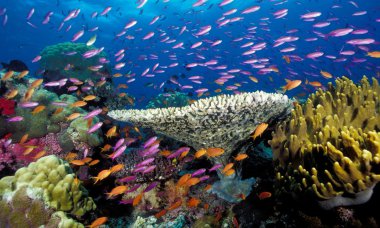
The reason is straightforward. It is well known in climate science that, even if we stopped harmful emissions tomorrow, global warming would not peak for another several decades. By then, most of the Reef will be long gone.
This is not pleasant news and clearly many would prefer it was not said, but there it is, the argument is simple and the conclusion is difficult to avoid.
The recent decision by the United Nations World Heritage Committee not to list the Reef as “in danger” is, of course, farcical. It reflects the crudest of politics, including the blinkered claim that Australia is not reponsible for global warming. Yet Australian governments, state and federal, do everything they can to spruik the coal mining that would ensure the death of the Reef and threaten to tip us into catastrophic warming.
Most news reports of global warming use only words and try for spurious he-said-she-said “balance”, so you don’t get a very clear impression of what is really going on. A good graph is worth millions of such waffle words.
[lengthy explanation given here with graphs]……
Suppose the world suddenly got sane and we set about the emergency reduction of greenhouse gas emissions, as scientists have been urging for several decades now. Even if emissions drop precipitously, there’s still too much already in the atmosphere. It takes a long time for the gases to be absorbed back into the land and ocean. In the meantime, warming will continue for 20 to 40 years — or even longer (the uncertainty is because we don’t know to what depth the oceans carry the extra heat they absorb)…….
Some scientists think corals have some chance of adapting and reversing a portion of the die-off if temperatures peak at “only” 1.5°C, but the corals’ diversity would be greatly reduced. If the peak is above 1.5°C, there is no chance of recovery.
If people like Donald Trump and Tony Abbott continue to be influential then global warming could even accelerate, as we pump out ever-more fossil fuel exhausts. Or natural reinforcings might already be kicking in and tipping the system into runaway. In that case, we would have to forget the Reef and worry about the survival of civilisation.
On the other hand, there is far more we can do to reduce emissions, reduce them quickly and live well as we do it. Leaders like William McDonough and Amory Lovins have long noted our wastefulness and the huge potential of good design and a cycling industrial system. Regenerative agriculture can not only reduce emissions but recapture and store greenhouse gases, all with abundant yields.
The Great Barrier Reef is not just a pretty decoration and earner of tourist dollars. Thousands of ocean species depend on it for food, shelter and breeding — even species that spend most of their lives far away. The effects of the present death will already be reverberating through ocean ecosystems. We depend heavily on the oceans to maintain a habitable planet.
There is a silence about the Reef. The massive bleachings have been prominent in the news, but nothing happens. We know it’s happening, but we don’t want to mention it. Why are we silent?
If our media were functioning properly, this dire prospect could have been widely understood before it became acute. The problem is not just the Murdoch media, which actively obfuscate and lie about global warming.
The media’s interpretation of ‘balance’ is so superficial as to seriously misrepresent the world. For example, paraphrasing a recent report: Much of the northern Great Barrier Reef is dead. But the good news is the southern parts are still mostly healthy. There is no good news. Such a report might reasonably have said, instead: The GBR has begun its death throes………
might there also be shame? We are the generation, out of all of the long history of humanity, that is allowing the glories of a planet to be destroyed. Oh dear, I’m not supposed to make my readers uncomfortable, they might switch off.
The question stares us in the face anyway. How will we face our grandchildren?
Dr Geoff Davies is an author, commentator and scientist. He is a retired geophysicist at the Australian National University and the author of Desperately Seeking the Fair Go (2017). He blogs at BetterNature and tweets at @BetterNatureOz. https://independentaustralia.net/environment/environment-display/the-great-barrier-reef-is-doomed,10501
New Tepco chairman wants to hasten release of radioactively polluted water into the sea

 TEPCO chair: Nuclear plant must release contaminated water, FOX Business , By July 13, 2017 TOKYO – The new chairman of Tokyo Electric Power Co. says the utility needs to stop dragging its feet on plans to dump massive amounts of treated but contaminated water into the sea and make more money if it’s ever going to succeed in cleaning up the mess left by meltdowns more than six years ago at the tsunami-hit Fukushima nuclear power plant.
UNESCO to declare Cumbria’s Lake District a World Heritage Site.
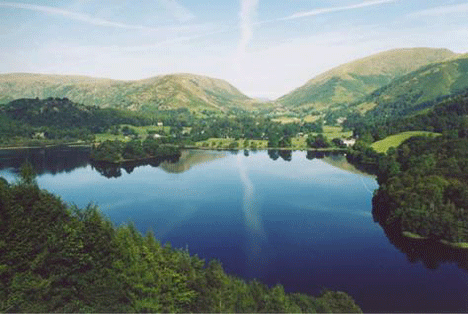 Cumbria Trust 13th July 2017, Cumbria Trust welcomes UNESCO’s decision to make the Lake District a
World Heritage Site. In doing so, UNESCO has recognised the importance of
protecting the landscape for future generations.
It is striking that a global organisation based in Paris is more aware of the need to protect the
Lake District than Copeland and Allerdale Borough Councils, both of which
voted in 2013 to include the Lake District in a search for a burial site
for the UK’s vast stockpile of nuclear waste.
Copeland and Allerdalefailed in their duty to protect the Lake District as well as other special
areas such as the AONB near Silloth. Fortunately Cumbria County Council,
led by Eddie Martin, recognised the failure of the borough councils and
vetoed their decision. https://cumbriatrust.wordpress.com/2017/07/13/lake-district-a-world-heritage-site/
Climate drowning islands north of Australia – eventually to cause climate refugees
‘The island is being eaten’: how climate change is threatening the Torres Strait
In Boigu, part of Australia but just six kilometres from Papua New Guinea, roads are being washed into the sea, Guardian, Ben Doherty and Michael Slezak, 13 July 17, Torres Strait residents face being forced from their homes by climate change, as their islands are lost to rising seas.
On Boigu Island, the most northerly inhabited island in Australia, just six kilometres from Papua New Guinea, the community’s cemetery faces inundation and roads are being washed into the sea. A seawall installed to protect the community is already failing.
Boigu elder Dennis Gibuma says the situation is worsening every season.
“Our seawall is no longer any good,” he says. “When the high tide and strong winds come together, it breaks. We pray we don’t lose our homes. We don’t want to leave this place.”
Masig Island, to the south-east of Boigu, is less than three kilometres long, and just 800m across at its widest point. Also known as Yorke Island, the low-lying coral cay is steadily being lost to the waves.
“In the short term, we can do what we can. We can’t stop the erosion, our hope is to slow it down.”
But he says he has to face the possibility that his people may have to abandon their ancestral home.
“Long term, we may have to evacuate the island,” he says. “But I am not going. Slowly, I see Masig Island getting out of something I can control.”………
The precise sea level rise around the Torres Strait, and the projected inundation, has not been calculated but low-lying islands are expected to experience a much greater flooding risk than mainland Australia. The department identifies the remote islands of the Torres Strait as some of the most vulnerable, as does the Intergovernmental Panel on Climate Change (IPCC), which warns communities they may be forced to relocate………
Displacement caused by climate change is forecast to be a driver of massive forced migration movements in the 21st century.
Low-lying islands in the Pacific – and Torres Strait islands like Masig and Boigu – are likely to be at the forefront of forced displacement but large and densely populated countries such as Bangladesh also face widespread inundation.
Some forecasts have predicted up to 150 million people could be forcibly displaced by climate change by 2040 – larger than the record number of people already forced from their homes globally.
The US and other militaries have said that climate change poses the greatest security threat to the Asia-Pacific.
But the global legal framework for resettling people displaced from their homes lost to natural disasters or climate change is unclear. The refugee convention – established in 1951 to regularise the resettlement of those displaced by the second world war – does not recognise someone forced from their home by rising seas, or natural disaster, as requiring protection.
Already, more than a dozen Pacific Islanders have attempted to claim refugee status in New Zealand on the grounds that their homes are uninhabitable because of rising seas or climate-related disaster. All have had their claims rejected.
On Masig Island, Hilda Mosby says climate change is already affecting the marine ecosystems on which communities depend for their livelihoods. Climate changeis already affecting her community “big time”, she says.
But the greater existential threat for her home lies ahead….https://www.theguardian.com/environment/2017/jul/13/the-island-is-being-eaten-how-climate-change-is-threatening-the-torres-strait
Thorium contamination the likely cause of radioactive pollution at Missouri landfill
Tests Reveal Stormwater Contamination at Missouri Landfill, US News, Missouri test results reveal that stormwater from just outside a landfill complex contains radioactive contaminants. July 11, 2017, BRIDGETON, Mo. (AP) — Missouri test results reveal that stormwater from just outside a landfill complex contains radioactive contaminants.
Radioactive pollution “flowing freely” into the Columbia River, from the decommissioned Hanford nuclear facility
Groundwater contaminated with radioactive waste from the decommissioned Hanford nuclear facility in Washington state is still “flowing freely” into the Columbia River, a program manager with the U.S. Environmental Protection Agency said at a meeting of the Hanford Advisory Board.
Radioactive Waste Still Flooding Columbia River, EPA Says, By Karina Brown, Global Research, July 04, 2017 Courthouse News Service 8 June 2017 KENNEWICK, Wash. (CN) –
The announcement came as part of a five-year review of cleanup measures taken at the Superfund site. Officials with the EPA and the Department of Energy said at a meeting Wednesday that the review showed most of the cleanup actions at Hanford were properly “protective,” meaning the public was shielded from the worst of the site’s estimated 500 million gallons of potentially radioactive waste.
Radioactive sludge in shuttered reactors, contaminated soil in landfill sites and equipment that was once used to refine the uranium that fueled the nuclear bomb dropped on Nagasaki were all properly contained, according to the report.
But there was a glaring exception: groundwater contaminated with hexavalent chromium and strontium-90 was still flowing into the nearby Columbia River, according to a presentation from Mike Cline, director of the Department of Energy’s Soil & Groundwater Division.
“Contaminated in-area groundwater is still flowing freely into the Columbia,” EPA Project Manager Dennis Faulk told members of the board. ……..http://www.globalresearch.ca/radioactive-waste-still-flooding-columbia-river-epa-says/5597591
Wylfa nuclear power project threatens the biodiversity of North Wales nature reserve

Daily Post 21st June 2017, Nature lovers have drawn up battle lines over Anglesey’s planned nuclear
power station amid fears that rare species will be put at risk. North Wales
Wildlife Trust (NWWT) said current proposals for Wylfa Newydd are
“damaging” and could jeopardise Wales’ sole breeding colony of
Sandwich terns.
It said construction work will take place just 110 metres
from an internationally designated nature reserve at Cemlyn, while the
development will drain directly into Tre’r Gof fen, a Site of Special
Scientific Interest.
The Trust has issued a long list of species it
believes are at risk from the power plant, from water voles to otters,
great crested newts and European eels. Local populations of chough, adders,
brown hares, red squirrels and hedgehogs could also be vulnerable, it said.
http://www.dailypost.co.uk/news/local-news/wildlife-groups-fear-rare-species-13217542
The very great difference in effects on the environment between nuclear bombs and nuclear meltdowns
 Nuclear Bombs and Nuclear Reactor Meltdowns Affect the Environment in Very Different Ways, http://www.huffingtonpost.com/entry/nuclear-bombs-and-nuclear-reactor-meltdowns-affect_us_59499845e4b0c24d29f4784306/22/2017, Why do nuclear bombs leave little longtime radiation, while nuclear reactor meltdowns could last for centuries? originally appeared on Quora: the place to gain and share knowledge, empowering people to learn from others and better understand the world.
Answer by Viktor T. Toth, IT pro, part-time physicist, on Quora:
Why do nuclear bombs leave little longtime radiation, while nuclear reactor meltdowns could last for centuries? Well, for starters, there is the amount of fuel involved.
Little Boy (the bomb dropped on Hiroshima) contained 64 kilograms of highly enriched (weapons grade) uranium. Of this, less than a kilogram actually underwent nuclear fission, producing fission products including short-lived but dangerous isotopes, and also producing the neutron radiation “flash” that induced secondary radioactivity in some materials that absorbed those neutrons.
In contrast, an RBMK reactor like the one that blew up in Chernobyl contains 100–150 fuel assemblies, each with over 100 kg of partially enriched uranium. So right there, the amount of fuel in the reactor is several hundred times more than the amount of fission fuel in a nuclear bomb. And whereas a nuclear bomb uses its fuel rather inefficiently (the explosive fission process takes place in milliseconds), a reactor does a more thorough job consuming its fuel over the course of several months before a fuel assembly is replaced.
Furthermore, the fission byproducts remain in the fuel assembly. Depending on the reactor design, these may, in fact, include materials a lot worse than the uranium fuel, such as weapons grade plutonium. Then there are also all the irradiated parts of the reactor that have been continuously exposed to radiation, resulting in secondary radioactivity and more nasty byproducts.
When a nuclear bomb explodes, it is dispersed over a large area. In case of a reactor accident, some of the fuel is dispersed, but a lot of it remains in place, at the reactor site. So this represents a concentration of radioactive materials that just does not occur in case of a bomb. And because all of it sits on the ground, there is the chance of leakage, e.g., into the water table, contaminating the water supply of a large region.
A nuclear reactor site may also contain other sources of radiation. For instance, one of the biggest concerns after the Fukushima accident was due to spent fuel pools located near the meltdown sites.
Having said all that, let us not forget that the Chernobyl Exclusion Zone became possibly the biggest accidental wildlife sanctuary in Europe, if not the world. That is because while radioactive contamination takes its toll, it’s nothing compared to what humans do. Remove most of the humans and even if you add a substantial amount of radiation, Nature thrives.
Study to emphasize individual solutions to big issues as a way to reduce support for government efforts
To emphasize individual solutions to big issues is for sure needed, but it should never be used to discharge corporations and government from their own responsibilities

Emphasizing individual solutions to big issues can reduce support for government efforts
Following the shutdown of the Fukushima power plant, which endured one of the worst nuclear accidents in history in 2011 due to a 9.0 magnitude earthquake and resulting tsunami, Japan began a national initiative that encouraged saving electricity. This created an opportunity for Seth Werfel, a graduate student in political science at Stanford University, to investigate how recognition of individual efforts to improve energy usage might affect support for government-based solutions.
He found that the more people said they curbed energy use on their own, the less they supported a tax increase on carbon emissions.
“At first, I thought this result was counterintuitive because you’d expect people who took those actions to support government action as well,” said Werfel, whose work was published today in Nature Climate Change. “But it is intuitive, just not obvious. When the surveys made people feel like they’d done enough, they said that the government shouldn’t make them do more.”
Although his study was focused on an environmental issue, Werfel said other research suggests this reaction could be highly pervasive, affecting many other issues. He also found that the loss of support for government actions among the people who reported their personal efforts occurred regardless of political ideology.
How surveys changed support
Taking advantage of the energy-saving initiative, Werfel surveyed about 12,000 people in Japan. All surveys included a question about the extent to which people supported a government tax increase on carbon emissions. Half of the surveys contained a checklist that respondents used to indicate energy-saving actions they performed. On average, people who received the checklist surveys were about 13 percent less likely to support the government tax than people who did not receive a checklist.
People who performed the checklist tasks also indicated on the accompanying survey that they felt that individual actions were more important than those of the government for achieving energy sustainability, and that conserving energy and protecting the environment shouldn’t be a top national priority.
Werfel then sent checklist surveys to about 200 respondents who had been in non-checklist groups. Compared to how they responded in the initial, non-checklist survey, the respondents who checked the most boxes in the list of energy-saving actions in this second survey exhibited the greatest increase in their opposition to government actions. Werfel said this seems to indicate that people who perform more of these types of actions are more likely to see individual contributions as sufficient progress toward energy-saving goals.
Additional surveys showed that a checklist containing only one very easy individual action did not affect people’s support of the carbon tax. However, people were 15 percent less likely to support the tax if they checked a box stating that they thought recycling was important – an effect that was largest among people who said they cared most about the environment. Werfel stressed that this, as with all of these results, should lead people to not assume anything about the behavior of any one person.
“It would be way too strong to say these findings apply to someone who spends their life being environmentally conscious and advocating for government support of pro-environment initiatives,” he said.
Werfel also tested whether making people feel morally good about themselves made them more likely to oppose government action, but the results of that survey were inconclusive.
Striking a balance between pride and complacency
Werfel said he believes this phenomenon likely impacts issues beyond environmentalism, such as disease prevention, economic inequality and homelessness, a hypothesis he is currently investigating. Given the evidence so far, Werfel cautions that we should be more aware about the potential downsides of celebrating every individual and private sector contribution we see as benefitting the greater good.
“Sometimes there’s a danger to thinking you’ve done enough,” said Werfel. “We spend a lot of time encouraging people to do these things at home – to care about them and announce that they’ve done them – and there could be some backfire effect.”
More information: Seth H. Werfel. Household behaviour crowds out support for climate change policy when sufficient progress is perceived, Nature Climate Change (2017). DOI: 10.1038/nclimate3316
https://phys.org/news/2017-06-emphasizing-individual-solutions-big-issues.html#jCp

Pacific island leaders at UN Oceans Conference push for nuclear clean-up
FSM and Marshalls urge nuclear clean-up, Radio New Zealand 9 June 17 A number of Pacific leaders have used the UN Oceans Conference to bring global attention to nuclear contamination and World War Two wrecks that have become environment hazards.
Federated States of Micronesia and the Marshall Islands have led the charge in highlighting what they call ‘real concerns’ confronting their people in the event of nuclear contamination or an oil spill from shipwrecks in their territorial waters.
The Secretariat of the Pacific Regional Environment Programme (SPREP) said since 2005, when its regional strategy on marine pollution from World War 2 wrecks was adopted, not much had been implemented because coastal states preferred to deal with the issue bilaterally with the flag states.
The two flag states for most of the 800 wrecks that litter the territorial waters of five Pacific countries are the United States and Japan.
Most of the wrecks are remnants of World War 2……..
Nuclear Contamination
Also speaking at the Oceans Conference the President of the Federated States of Micronesia Peter Christian said nuclear contamination was a serious threat for small island countries in the north Pacific as there were claims the fall-out from the nuclear tests conducted in the Marshall Islands may have reached as far as Palau.
The FSM pointed out a storage dome for radioactive waste on Enewetak Atoll was cracking and leaking and plants around it were dying.
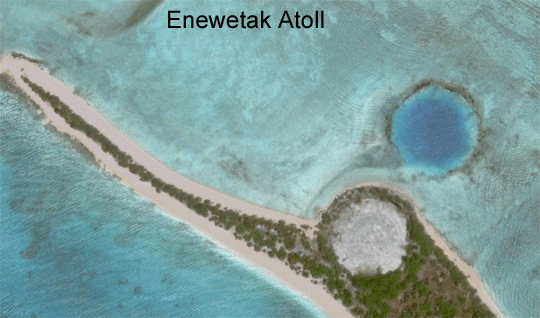
The FSM called for the Pacific Islands Forum to invite countries responsible for the nuclear contamination and Second World War shipwrecks to the Forum leaders’ summit later this year to explain what they intended to do about the waste.
The Samoan Prime Minister and Forum chair Tuilaepa Sailele Malielegaoi said the issue will be on the agenda at the September meeting. http://www.radionz.co.nz/international/pacific-news/332467/fsm-and-marshalls-urge-nuclear-clean-up
Legacy of improperly managed radioactive sites across Russia.
 Russia’s radioactive past continues to haunt its citizens https://news.vice.com/story/russias-radioactive-past-continues-to-haunt-its-citizens By Sara Jerving on Jun 6, 2017 Anton Kolomitsyn has an unusual hobby: He searches the Russian countryside looking for remnants of past wars. Earlier this year, he made an unexpected find.
1 This Month



26 September – International Day for the Total Elimination of Nuclear Weapons


PLEASE OPPOSE HR 8255 AND S.3639 – bills would accelerate satellite deployment, with no environmental review or safeguards – https://ncstd5li.quorum.us/campaign/169331/
To see nuclear-related stories in greater depth and intensity – go to https://nuclearinformation.wordpress.com
-
Archives
- September 2026 (257)
- August 2026 (330)
- July 2026 (355)
- June 2026 (287)
- May 2026 (306)
- April 2026 (356)
- March 2026 (251)
- February 2026 (267)
- January 2026 (308)
- December 2025 (358)
- November 2025 (359)
- October 2025 (375)
-
Categories
- 1
- 1 NUCLEAR ISSUES
- business and costs
- climate change
- culture and arts
- ENERGY
- environment
- health
- history
- indigenous issues
- Legal
- marketing of nuclear
- media
- opposition to nuclear
- PERSONAL STORIES
- politics
- politics international
- Religion and ethics
- safety
- secrets,lies and civil liberties
- spinbuster
- technology
- Uranium
- wastes
- weapons and war
- Women
- 2 WORLD
- ACTION
- AFRICA
- Atrocities
- AUSTRALIA
- Christina's notes
- Christina's themes
- culture and arts
- Events
- Fuk 2022
- Fuk 2023
- Fukushima 2017
- Fukushima 2018
- fukushima 2019
- Fukushima 2020
- Fukushima 2021
- general
- global warming
- Humour (God we need it)
- Nuclear
- RARE EARTHS
- Reference
- resources – print
- Resources -audiovicual
- Weekly Newsletter
- World
- World Nuclear
- YouTube
-
RSS
Entries RSS
Comments RSS

