Even though it’s over 30 years since the 1986 Chernobyl nuclear disaster, radiation levels exceeding 39 706 Bq (becquerel) per kilo have been found in Swedish wild boar meat taken from the Uppland area.
According to the Swedish Radiation Safety Authority, this is the highest ever level measured in wild boar meat in Sweden, way exceeding the 1500 Bq/kg safe limit set by the Swedish Food Agency for meat consumption.
Speaking to The Local, Paul Andersson of the Swedish Radiation Authority explained that “wild boar were practically non-existent outside the southern counties of Skåne and Sörmland, two Swedish counties unaffected by radiation. However, in the years since, the wild boar population has multiplied and migrated to northern areas of Sweden”, which is why the authority is keen to test wild boar meat.
Andersson noted that wild boar may be particularly susceptible to radiation for a number of reasons: ”Wild boar forage for wild mushrooms and have the ability to find truffles in the ground, which may explain why this particular wild hog had such high levels of radiation.”
In contrast, he said elk meat’s radiation levels have consistently gone down since 1986, rarely exceeding the safety limit for meat consumption of 1500 Bq/kg.
The authority is encouraging hunters to send them wild boar meat samples for testing.
Brothers Sam and Gary Bencheghib have taken matters into their own hands. When they moved to Brooklyn, they were shocked to find several of the country’s most polluted waterways weren’t a country away but, literally, in their own backyards. For the earth-loving duo, it was a call to action.
The brothers — along with millions of residents in Queens and Brooklyn — live within a stone’s throw of three Superfund sites. Those are the places the EPA deems so polluted, toxic, or destroyed by a natural disaster that a fund has to be set up to clean up the area as quickly as possible. Among these, Newtown Creek is considered one of the most polluted spots in all of the United States. This is thanks to over a century of industrial waste being spewed into the river, raw sewage still being pumped into the waterway every day, and a semi-continual oil spill that’s seen 30 million gallons spilled into the water.
Add in the usual plastic waste that’s clogging our waterways and you have an American river that’s bafflingly poisoned.
The Gowan Canal is similarly toxic. The freshwater stream has been used for shipping of waster and toxic materials for so long that if you were to fall into the water, you’d have to be rushed to a hospital for decontamination procedures. Drinking the water would risk dysentery, arsenic poisoning, and, eventually, cancer.
The Bencheghib brothers know they cannot clean this up all by themselves. Their task is to bring awareness to the sites through their work with Make A Change World. The group aims to directly involve the average person is cleaning up the messes we’re making around the world — through an overuse of plastics and the under-regulated waste from industry.
Currently, “the bros” are focusing on their own backyard in Brooklyn, by highlighting the Superfund sites of Newtown Creek and Gowan Canal. These two sites are both earmarked for clean up operations to begin, but the process is slow and faces hurdles. Meanwhile, the current White House leadership plans to cut $327 million out of the EPA’s Superfund budget and has forbidden the EPA from speaking with citizens.
Luckily, the administration’s disinterest in the environment won’t have drastic effects on the clean up of Newtown Creek and Gowan Canal, as those sites have responsible parties who have been tasked with funding the lion’s share of the cleanup costs. WNYC reported back in November that the six major polluters of Newtown Creek were identified along with the 30 polluters of Gowan Canal. This means, hopefully, the cleanups will go forward unhindered.
Just down the street from Newtown and Gowan is a site called Wolff-Alport. This was the site of an earth metals extraction facility that shuttered in the 1950s. One of their extractions was the radioactive element thorium. That process has made the Wolf-Alport site the most radioactive spot in New York City. Since the company responsible for the radioactive pollution went out of business over 70 years ago, there’s no one to fine and, thereby, collect the funds to clean up the site. The whole tab falls on the shoulders of the EPA’s Superfund budget. WNYC talked to the EPA and they have an estimated cost of $39.9 million to clean up this radioactive site. Currently, there’s $650,000 in the account designated for that job. The acting deputy regional administrator for EPA said bluntly of the site that “What we do know is that people are actually being exposed.”
It would seem to reason that radioactive exposure to the citizens of New York would be a little higher on the list of sites the EPA and local, state, and the federal government would be rushing to clean up. That’s where Make A Change World comes in. 75 years is too long to wait for a radioactive, oil-soaked, or just plain toxic site to be cleaned up. Like the Bencheghib brothers, it’s time to take action in our backyards, in the voting booths, and in how we live our lives.
I received an email on Dec. 25 from a high school and college friend informing me that his kidney cancer had spread to his bones and that he was now in hospice.
Since we were mostly a close bunch in high school — just 128 grads in 1963 — I thought it appropriate to share my friend’s sad news with other classmates and ask for their good thoughts and prayers. Just 12 days later, my friend’s sister contacted me and said he had died peacefully at home. I relayed this sorrowful update to the class.
Among the responders was a classmate who told me that he and my now-departed friend, as well as other kids from the neighborhood, were all regular playmates. Their “playground” in this blue-collar city on the Delaware River was a swampy landfill that was once the location of a gas mantle factory from the 1890s through the 1940s. Gas mantles were small mesh socks coated with radium and thorium that covered a lamp’s gas jet. When ignited, they brightly illuminated America’s streets and houses before electrification.
Today the mantle factory’s former setting is a Superfund site, as classified by the Environmental Protection Agency in 1996. The feds have spent more than $350 million ridding the area and adjacent locales of hazardous wastes, including that deadly radium and thorium. As these elements decay, they give off gamma radiation and radon gas, both proven carcinogens.
The sensible reaction to this horror story would be to double our efforts to protect the environment so today’s and tomorrow’s kids won’t suffer the same horrible fate as these afflicted adults. But then we don’t live in sensible times.Under EPA Administrator Scott Pruitt, the agency is slowly being dismantled. He and President Donald Trump have already canceled or overridden some key environmental regulations on coal waste and vehicle emissions, and the 2018 appropriations bill cuts the EPA’s budget for the Superfund program and climate change research.
Pruitt is on record denying the existence of global warming and, as a result of his staff’s disgust with his beliefs and a federal job freeze and buy-outs, more than 700 employees — 200 or more of them scientists — have left the agency in the last year. According to the union representing EPA staff, Pruitt’s ultimate goal is to cut “at least 3,100 full-time employees.”
Will this make our environment safer? Better yet, do you pack apples in your kids’ lunches? Last February, Pruitt withdrew a proposed ban on pesticides containing chlorpyrifos, used on apples, oranges and cherries across the country. This was despite the EPA’s own scientists, supported by the 66,000-member American Academy of Pediatrics, arguing that even low exposure levels to chlorpyrifos during early childhood increases the risk of learning disabilities, including reduced IQ and developmental delay, and behavioral problems, like ADHD. For expectant and new mothers, the agency’s scientists concluded that even the smallest amounts of the chemical can impact the brain development of fetuses and infants.
Chlorpyrifos are considered so toxic that their use has been banned in homes, schools, day care facilities, parks, hospitals, nursing homes and malls since 2000. But Pruitt says they are OK for your fruit bowl. The pesticide has also proven hazardous to farmworkers and approximately 1,800 critically threatened or endangered species.
A not-so-much fun fact is that Dow Chemical, the manufacturer of Lorsban which contains chlorpyrifos, underwrote President Trump’s inaugural parties to the tune of $1 million. Draw your own conclusions.
As things go, it’s not an especially big leap from a toxic playground in New Jersey in 1955 to an apple orchard in Maryland in 2018. The difference is that today we are supposed to be more discerning because some of us have reaped a sad harvest of family and friends who didn’t know a Superfund from Superman when they were growing up.
So what lessons have we learned? For me it is the undying power of greed — the greed that once caused a company to bury its toxic wastes instead of properly disposing of them, and the greed evinced by the current administration that’s at the beck and call of its corporate benefactors, whether they produce energy or chemicals. This hasn’t changed over the years, even when the guinea pigs are our own sons and daughters.
Frank Batavick writes from Westminster. His column appears Fridays. Email him at fjbatavick@gmail.com.
There are 10 or eleven towns in Colorado, Wyoming, Utah, Arizona, and New Mexicothat had Uranium mills, right in the middle of town. That means that Uranium dust, polonium, thorium, radium, and radon blew freely, thoughout thewe towns, 24 hours a day for years. Most of the water, drained into the Colorado ariver. Many of these towns were downwinder towns, from open air blasting of nucler bombs in Nevada from 1949 to 1962. Many, of the towns had the misfortune of having underground nuclear bombs detonated close to them as well, to try to track natural gas. Especially in New Mexico and Colorado. In the 60s Hilibutron was also tracking nuclear waste into areas in Nevada, and Wyoming. More recently there has been fracking for oil and gas in UtAh, Wyoming, Colorado, New Mexico, Arizona. This means the radioactive burden to their water tables has been increased again substantially , along with 60 years of radioactive burden on the Colorado River. There are also the 1000 or so uranium mines draining into the Colorado River and Green driver from Utah, the western slope, Shiprock New Mexico, Wyoming, The Grand Canyon Area.
I think Helen Caldicotts and Christina Macphersons estimates of a few million tons of radioactive sediment in Lake Mead and even lake Powell is wrong. https://nuclear-news.net/2017/12/22/uranium-tailings-pollution-in-lake-mead-and-lake-powell-colorado/
Consider underground nuclear destinations in Rangely Colorado and Northen New Mexico. I think it is more like a half billion or billions of ons of nuclear waste sediment in Lake Powell and lake mead..
There were Uranium Mills on the Navajo nation by Ship Rock and Halchita which is by the Colorado river. There were Uranium Mills right in the middle of town in Canyon City.Colorado, Moab.Utah, Uravan.Colorado, White Mesa.Utah, Monticello.Utah, by Grand Junction.Colorado. Many in Wyoming.
Uranium mining in Wyoming – Wikipedia https://en.m.wikipedia.org/wiki/Uranium_mining_in_Wyoming.
There are dense cancer clusters in these little towns on the Navajo Nation, in Utah, in Nevada, in Colorado, in Wyoming, in New Mexico. There are Genetic mutations that should not exist. Some people, like those in St George or Monticello Utah got the mere pittance of 50,000 dollars, after having lived in downwinder areas and surviving cancer. Generations of families wiped-out in many instances. Clarke county Nevada, by Las Vegas has one of the highest incidences of cancer in the US. Is it any wonder, with all the radiation in their primary drinking water supplies?
Many little Colorado Plateau towns, in the west are hit with quintuple curses: bomb blasts above ground, bomb blasts below ground-poisoning their head waters, uranium mills and waste in town, their river water radioacively poisoned from inderground nuclear blasts, from uranium mines, from cold war nuclear bomb detonations.
There has recently, been a great deal of cracking in these areas, releasing radioactivity into their desert rivers and water tables.
Americans live in a grand delusion, thinking how clean the western United States, and the rest of the USA is, with a hundred rickety old nuclear plants belching tritium, into the environment. The United State is the most radioactive shithole in the world. How Trump has the gall to call other countries shitholes, is beyond me.
Uranium Miners Pushed Hard for a Comeback. They Got Their Wish. NYT, By HIROKO TABUCHIMONUMENT VALLEY, Utah— Garry Holiday grew up among the abandoned mines that dot the Navajo Nation’s red landscape, remnants of a time when uranium helped cement America’s status as a nuclear superpower and fueled its nuclear energy program.
It left a toxic legacy. All but a few of the 500 abandoned mines still await cleanup. Mining tainted the local groundwater. Mr. Holiday’s father succumbed to respiratory disease after years of hacking the ore from the earth.
But now, emboldened by the Trump administration’s embrace of corporate interests, the uranium mining industry is renewing a push into the areas adjacent to Mr. Holiday’s Navajo Nation home: the Grand Canyon watershed to the west, where a new uranium mine is preparing to open, and the Bears Ears National Monument to the north.
The Trump administration is set to shrink Bears Ears by 85 percent next month, potentially opening more than a million acres to mining, drilling and other industrial activity. But even as Interior Secretary Ryan Zinke declared last month that “there is no mine within Bears Ears,” there were more than 300 uranium mining claims inside the monument, according to data from Utah’s Bureau of Land Management office that was reviewed by The New York Times.
The vast majority of those claims fall neatly outside the new boundaries of Bears Ears set by the administration. And an examination of local B.L.M. records, including those not yet entered into the agency’s land and mineral use authorizations database, shows that about a third of the claims are linked to Energy Fuels, a Canadian uranium producer. Energy Fuels also owns the Grand Canyon mine, where groundwater has already flooded the main shaft.
Energy Fuels, together with other mining groups, lobbied extensively for a reduction of Bears Ears, preparing maps that marked the areas it wanted removed from the monument and distributing them during a visit to the monument by Mr. Zinke in May.
Energy Fuels’ lobbying campaign, elements of which were first reported by The Washington Post, is part of a wider effort by the long-ailing uranium industry to make a comeback.
The Uranium Producers of America, an industry group, is pushing the Environmental Protection Agency to withdraw regulations proposed by the Obama administration to strengthen groundwater protections at uranium mines. Mining groups have also waged a six-year legal battle against a moratorium on new uranium mining on more than a million acres of land adjacent to the Grand Canyon.
For the Navajo, the drive for new mines is a painful flashback.
“Back then, we didn’t know it was dangerous — nobody told us,” Mr. Holiday said, as he pointed to the gashes of discolored rocks that mark where the old uranium mines cut into the region’s mesas. “Now they know. They know.”
Supporters of the mining say that a revival of domestic uranium production, which has declined by 90 percent since 1980 amid slumping prices and foreign competition, will make the United States a larger player in the global uranium market.
It would expand the country’s energy independence, they say, and give a lift to nuclear power, still a pillar of carbon-free power generation. Canada, Kazakhstan, Australia, Russia and a few other countries now supply most of America’s nuclear fuel.
……….President Trump has prioritized scrapping environmental regulations to help revitalize domestic energy production. His executive order instructing Mr. Zinke to review Bears Ears said that improper monument designations could “create barriers to achieving energy independence.”
In theory, even after President Barack Obama established Bears Ears in 2016, mining companies could have developed any of the claims within it, given proper local approvals. But companies say that expanding the sites, or even building roads to access them, would have required special permits, driving up costs.
……….
A bill introduced last month by Representative John Curtis, Republican of Utah, would codify Mr. Trump’s cuts to the monument while banning further drilling or mining within the original boundaries. But environmental groups say the bill has little chance of passing at all, let alone before the monument is scaled back next month.
“Come February, anyone can place a mining claim on the land,” said Greg Zimmerman, deputy director at the Center for Western Priorities, a conservation group.
………Fred Tillman, an environmental engineer with the United States Geological Survey, said during a recent visit to the mine that the groundwater flows in the region were too complex to rule out the risk of contamination.
“There are these big unknowns about the potential impacts on cultural resources, on biological resources, on water resources,” Dr. Tillman said.
A senator steps in Even as troubles persist on the ground, the industry pushback has continued.
In court, mining groups led by the National Mining Association have challenged a 20-year moratorium on mining in the Grand Canyon watershed, established in 2012 by the Obama administration. (The Canyon Mine predates the moratorium.)
The Arizona Chamber of Commerce, which represents mining interests, also backed an effort to defeat a separate proposal that would have permanently banned mining on 1.7 million acres surrounding the Grand Canyon. An Energy Fuels executive testified in Congress against the ban.
And with the help of Republican senators like John Barrasso of Wyoming, the industry has pressed the E.P.A. to withdraw an Obama-era proposalthat would strengthen groundwater protections at uranium mines.
The proposal would regulate a mining method called in-situ recovery, which involves injecting a solution into aquifers containing uranium and bringing that solution to the surface for processing — a method criticized by environmentalists as posing wider contamination risks.
The UK Government launched on 11 January – with a media fanfare- its long delayed 150-page national environmental strategy (for England) titled ‘A Green Future: Our 25 Year Plan to Improve the Environment (https://www.gov.uk/government/publications/25-year-environment-plan).
Prime Minister May asserted in her foreword: “We hold our natural environment in trust for the next generation. By implementing the measures in this ambitious plan, ours can become the first generation to leave that environment in a better state than we found it and pass on to the next generation a natural environment protected and enhanced for the future.
……. We will use this opportunity to strengthen and enhance the protections our countryside, rivers, coastline and wildlife habitats enjoy, and develop new methods of agricultural and fisheries support which put the environment first.”
In his own foreword, Environment Secretary Michael Gove added:“Environment is – at its roots – another word for nature, for the planet that sustains us, the life on earth that inspires wonder and reverence, the places dear to us we wish to protect and preserve. We value those landscapes and coastlines as goods in themselves, places of beauty which nurture and support all forms of wildlife….We will underpin all this action with a comprehensive set of environmental principles. To ensure strong governance, we will consult on plans to set up a world-leading environmental watchdog, an independent, statutory body, to hold Government to account for upholding environmental standards.”
These warm green words are, however, not backed up with the kind of action that recognizes the real environmental priorities with which ministers need to get a grip.
The most egregious omission for action is anything to halt, reverse and deal with nuclear industry radiological pollution and nuclear waste from power generation, spent irradiate nuclear fuel reprocessing and nuclear warhead production.
Chapter 4 is titled’ Increasing resource efficiency and reducing pollution and waste’ but makes zero mention of nuclear waste or radiological pollution, but does expend time and effort addressing far less ecologically damaging no radiotoxic waste pollution. Here is an extract:
Improving management of residual waste
Since 2000 we have diverted significant quantities of residual waste – i.e. waste that cannot be reused or recycled – from landfill through the development of energy from waste (EfW) facilities. These generally recover energy from the waste to produce electricity. In 2016/17, some 38% of waste collected by Local Authorities went to EfW compared with 16% that went to landfill. More can be done however. We want to make sure that materials ending up in the residual waste stream are managed so that their full value as a resource is maximised and the impact on the environment of treating them is minimised.
We will continue to encourage operators to maximise the amount of energy recovered from residual waste while minimising the environmental impact of managing it, for example by utilising the heat as well as electricity produced. The actions set out in this Plan will help us build on this to ensure that the value of residual waste as a resource is fully realised and that emissions of carbon dioxide during the energy recovery process are kept as low as possible. We must bear in mind that any infrastructure must be able to adapt to future changes in the volume and make-up of residual waste generated and developments in technology. That way, waste is not locked into residual waste treatment processes when it could be reused or recycled. (page 94)
Annex 2 of the two Government reports on Environment 25 titled Government strategies to protect and improve the environment(https://www.gov.uk/government/uploads/system/uploads/attachment_data/file/673160/25-year-environment-plan-annex2.pdf comprises of nearly 50 “strategies and plans for some of the government’s work to protect and conserve the environment,” but contains not one report that addresses environmental protection from radiation or from nuclear industry operations!
However, two days before the 25-year green strategy was issued, the Government quietly released ( to absolutely zero media attention) a 221- page document that explains how it plans to deal with nuclear waste in the UK. Clearly ministers wanted attention on plastic waste policy, but none fon radioactive waste policy.
170 MILLION IN U.S. DRINK RADIOACTIVE TAP WATER. TRUMP NOMINEE FAKED DATA TO HIDE CANCER RISK. https://www.ewg.org/research/170-million-us-drink-radioactive-tap-water-trump-nominee-faked-data-hide-cancer-risk#.WlvAYryWbGgBy Bill Walker, Editor in Chief, and Wicitra Mahotama, Environmental Analyst, 11 Jan 18, Drinking water for more than 170 million Americans contains radioactive elements at levels that may increase the risk of cancer, according to an EWG analysis of 2010 to 2015 test results from public water systems nationwide.
Radiation in tap water is a serious health threat, especially during pregnancy. But the Environmental Protection Agency’s legal limits for several types of radioactive elements in tap water are badly outdated. And President Trump’s nominee to be the White House environment czar rejects the need for water systems to comply even with those outdated and inadequate standards.
The nominee, Kathleen Hartnett White, former chair of the Texas Commission on Environmental Quality, admitted in a 2011 interview that the commission falsified data to make it appear that communities with excessive radiation levels were below the EPA’s limit. She said she did not “believe the science of health effects” to which the EPA subscribes, placing “far more trust” in the work of the TCEQ, which has a reputation of setting polluter-friendly state standards and casually enforcing federal standards.
Last month, after Hartnett White again admitted to the Senate Environment and Public Works Committee she knew the TCEQ had ignored the EPA’s radiation regulations, her nomination was sent back to the White House. But on Jan. 8, the White House renominated her, setting up another confirmation vote before the committee, and then by the full Senate.
EWG’s Tap Water Database compiles results of water quality tests for almost 50,000 utilities nationwide. EWG also mapped the nationwide occurrence of radium, the most common radioactive element found in tap water. From 2010 to 2015, more than 22,000 utilities serving over 170 million people in all 50 states reported the presence of radium in their water.
Radioactive elements enter groundwater from natural deposits in the earth’s crust, and the levels can be higher when uranium mining or oil and gas drilling unearth these elements from the rock and soil. They produce radiation called “ionizing” because it can release electrons from atoms and molecules, and turn them into ions.
The EPA has classified all ionizing radiation as carcinogenic. There is clear evidence that high doses of radiation cause cancer in various organs. The probability of developing cancer decreases with lower doses of radiation, but it does not go away.
The developing fetus is especially sensitive to ionizing radiation. At doses higher than are typically found in drinking water, radiation has been shown to impair fetal growth, cause birth defects and damage brain development. But there is no evidence of a dose threshold below which a fetus would be safe from these effects.
Six radioactive contaminants were included in EWG’s Tap Water Database, including radium, radon and uranium. By far the most widespread are two isotopes of radium known as radium-226 and radium-228, which contaminate tap water in every state. The EPA does not have a separate legal limit for each isotope, only for the combined level of the two.
From 2010 to 2015, 158 public water systems serving 276,000 Americans in 27 states reported radium in amounts that exceeded the federal legal limit for combined radium-226 and radium-228.
But federal drinking water standards are based on the cost and feasibility of removing contaminants, not scientific determinations of what is necessary to fully protect human health. And like many EPA tap water standards, the radium limits are based on decades-old research rather than the latest science.
The EPA’s tap water limits on the combined level of the radium isotopes and the combined level of alpha and beta particles were set in 1976. They were retained in 2000, when the uranium standard was established.
To more accurately assess the current threat of radiation in U.S. tap water, we compared levels of the contaminants detected by local utilities not to the EPA’s 41-year-old legal limits, but to the public health goals set in 2006 by the respected and influential California Office of Environmental Hazard Assessment..
California public health goals are not legally enforceable limits, but guidelines for levels of contaminants that pose only a minimal risk – usually defined as no more than one expected case of cancer in every million people who drink the water for a lifetime.
California has separate public health goals for radium-226 and radium-228 that are hundreds of times more stringent than the EPA limit for the two isotopes combined. The EPA standard for radium-226 plus radium-228 is 5 picocuries per liter of water. The California public health goal for radium-226 is 0.05 picocuries per liter, and for radium-228 it is just 0.019 picocuries per liter. The lifetime increased cancer risk at the EPA’s level is 70 cases per 1 million people.
California has the most residents affected by radiation in drinking water. Almost 800 systems serving more than 25 million people – about 64 percent of the state’s population – reported detectable levels of radium-226 and radium-228 combined.
Texas has the most widespread contamination. More than 3,500 utilities serving more than 22 million people – about 80 percent of the state’s population – reported detectable levels of radium-226 and radium-228 combined.
But while Kathleen Hartnett White was chair of the Texas Commission on Environmental Quality from 2003 to 2007, the state regularly and deliberately lowered the levels of radiation in tap water it reported to the EPA.
A 2011 investigation by KHOU-TV of Houston unearthed TCEQ emails documenting the deception. Instead of reporting the levels measured in laboratory tests, TCEQ would first subtract the test’s margin of error. Because TCEQ’s falsifying of data made it appear that the system met EPA standards, the system did not have to inform its customers that their tap water contained dangerous levels of radiation.
How dangerous?
In 2001, TCEQ reported to top state officials – including Hartnett White and then-Gov. Rick Perry, now Trump’s energy secretary – that some types of radiation in the tap water of some Texas communities posed an increased lifetime cancer risk of 1 in 400. The EPA’s increased lifetime cancer risk for five types of radioactive elements ranges from 2 to 7 in 100,000. But the practice continued until 2008, after an EPA audit caught the state cooking the books.
In a 2011 interview with KHOU-TV, Hartnett White defended the deception, saying the EPA’s standards were too protective and that it would cost small communities millions of dollars to comply. She said TCEQ continued its practice instead of challenging the federal rules in court because it would be “almost impossible” for the state to win:
As my memory serves me, [subtracting the margin of error] made incredibly good sense … We did not believe the science of health effects justified EPA setting the standard where they did … I have far more trust in the vigor of the science by which TCEQ assesses, than I do EPA.
KHOU investigative reporter Mark Greenblatt pressed Hartnett White: “But what if you’re wrong? What if you’re wrong and EPA’s right about there being a danger?”
“It would be . . . it would be regrettable,” she replied.
In November, in her confirmation hearing before the Senate Environment and Public Works Committee, she characterized TCEQ’s falsification of data as “one of these technical issues” and declared: “I would never, ever tell staff to underreport health hazards.”
In her written responses to follow-up questions from the committee, Hartnett White said she was “aware of the EPA’s interpretation of its rule,” but that she did not “recall EPA telling TCEQ during my tenure there that TCEQ’s methodology was not legal.” But KHOU’s investigation documented that in June 2004 the EPA warned the TCEQ if it did not stop the falsification, the federal agency could take over regulation of the state’s water systems.
The Environment and Public Works Committee voted along party lines to send Hartnett White’s nomination to the full Senate. But on Dec. 21, Senate Democrats refused to vote on the nomination before the end of the 2017 legislative session. On Jan. 8 the White House renominated her without comment. She will now face a second confirmation vote before the committee before a vote by the full Senate.
Installing a head of the Council for Environmental Quality who deliberately falsified data to get around federal regulations is an egregious betrayal of public trust. The fact that her deception left people at a serious risk of cancer makes it even more alarming.
The Senate should reject Hartnett White’s nomination. The EPA must also tighten its legal limits for radioactive contaminants and require more extensive radiation testing and better disclosure – including making sure that rogue state regulators like Hartnett White don’t try to hide risks.
More radioactively contaminated cars, trucks found at Hanford, Tri City Herald BY ANNETTE CARY, acary@tricityherald.com, DECEMBER 27, 2017
The number of vehicles contaminated with specks of radioactive material at Hanford’s Plutonium Finishing Plant has jumped to 19 as checks continue.
As of about 2 p.m. Wednesday, 12 government or contractor vehicles had been found with radioactive contamination, with 55 of 86 vehicles still to be surveyed.The number increased from seven contaminated government and contractor vehicles discovered before the Christmas weekend.
The dozen government and contractor vehicles are in addition to seven worker cars or pickups found to have specks of contamination since demolition was completed Dec. 15 on the most contaminated section of the plant, the Plutonium Reclamation Facility.
Post-demolition surveying found specks of radioactive material, some too small to see, had spread outside the demolition zone set up to control the spread of radioactive contamination. The highly contaminated plant has been cleaned out, but demolition with heavy equipment is still high-hazard work. Contamination that can easily become airborne remains after 40 years of work to process plutonium produced at Hanford into hockey-puck sized “buttons” and plutonium oxide powder to be shipped to the nation’s nuclear weapons production facilities…….http://www.tri-cityherald.com/news/local/hanford/article191895614.html
Kyodo News 25th Dec 2017, Radiation cleanup work began Monday in Futaba to make the town that
co-hosts the crisis-hit Fukushima Daiichi nuclear power plant inhabitable again by around spring 2022 under a government-led reconstruction project.
Cleanup work has been carried out in areas contaminated with radioactive substances released from the nuclear plant in the aftermath of the March 2011 huge earthquake and tsunami, with the plant operator Tokyo Electric
Power Company Holdings Inc. being responsible for the cost.
But the latest work in Futaba is the first of the government-led project to make areas designated as special reconstruction zones livable again. The government plans to carry out cleanup work and promote infrastructure development
intensively at national expense in those areas.
CRACKDOWN IN RUSSIA: CRITICS ACCUSE NUCLEAR AUTHORITIES OF SOVIET-STYLE COVER-UPS AND HEAVY-HANDED TACTICS, Newsweek, BY MARC BENNETTSWhen Russia’s FSB security service raided Fyodor Maryasov’s apartment in Siberia last year, the authorities seized his computer and a scathing report he had compiled about Rosatom, the Kremlin-owned nuclear corporation. Among other things, the authorities accused him of inciting hatred against nuclear industry employees, an unusual charge that carries a maximum sentence of five years behind bars. “They accused me of revealing state secrets in my report,” the 49-year-old environmental activist says. “But every single thing in it was taken from open sources.”
The raid came as activists are increasingly criticizing Rosatom over a range of issues, including the way it handles nuclear waste. This fall, for instance, critics alleged that one of its facilities was the source of a mysterious cloud of radioactive pollution that drifted across Europe.
Russian authorities have responded to these critics with tough tactics—including raids and smear campaigns—and in recent years, they’ve employed similar measures against other environmental groups. Rosatom says it was in no way trying to stifle dissent. “We strongly believe that every voice should be heard,” a spokesman for the nuclear agency tells Newsweek, “and we welcome open dialogue with civil society, including with those who are opposed to nuclear power.”
Maryasov says the crackdown is a continuation of the routine cover-ups of nuclear accidents and atomic pollution during the Soviet era and beyond—from the 1957 Kyshtym disaster to the meltdown at Chernobyl in 1986. “Trust in Rosatom and the authorities,” he says, “is at an absolute minimum.”
The activist’s recent troubles began after he spoke out against Rosatom’s plans for a permanent underground nuclear waste repository in his hometown of Zheleznogorsk, in eastern Siberia. If the project goes ahead, Russian authorities would likely begin storing hundreds of thousands of tons of radioactive waste at the site. Zheleznogorsk was built in 1950, under the supervision of Stalin’s secret police chief, Lavrentiy Beria, for the production of weapons-grade plutonium. Until 1992, plant employees regularly disposed of nuclear waste in the nearby Yenisey River, causing health problems for tens of thousands of people in the area. Russian authorities stopped the production of plutonium for nuclear weapons at the Zheleznogorsk plant in 2010.
But critics say the shadow of nuclear catastrophe still hangs over the region. In the event of a massive natural disaster or terrorist attack, the nuclear waste repository plan poses what Maryasov says is a threat to “every living thing” in the region. Zheleznogorsk is a mere 40 miles downstream from Krasnoyarsk, the regional capital, with a population of just over 1 million. And people in the area are concerned. More than 85,000 so far have signed a petition Maryasov drafted calling for Rosatom to scrap its plans for the repository.
The nuclear agency says it is building an underground lab at the Zheleznogorsk site to study the feasibility of its plans. It says those plans are open to public debate, and it points to similar storage sites currently operated in Finland, Sweden and the United States.
Critics, however, say it’s hard to access reliable information about Rosatom’s plans because many of its nuclear facilities are in so-called closed cities, like Zheleznogorsk. There are around 40 of these towns across Russia, the majority of which are sealed off from the outside world by barbed wire, fences and armed guards. Access is forbidden to foreigners, and even Russians who don’t live there have to receive special permission from the authorities to visit.
Those restrictions mean it’s easier for the authorities to ramp up the pressure against critics. Maryasov says he was the victim of a “vicious psychological campaign,” and he accuses the authorities of distributing fake news claiming he had advocated violence against atomic energy workers. The unrelenting pressure, he says, led to the breakup of his marriage of almost two decades.
“The constitution stipulates freedom of information and forbids censorship, as well as guaranteeing the right to everyone to information about the state of the environment,” Greenpeace said in a statement. “In order to realize those rights, someone has to seek out and make public this information, which is what Maryasov was engaged in doing.”
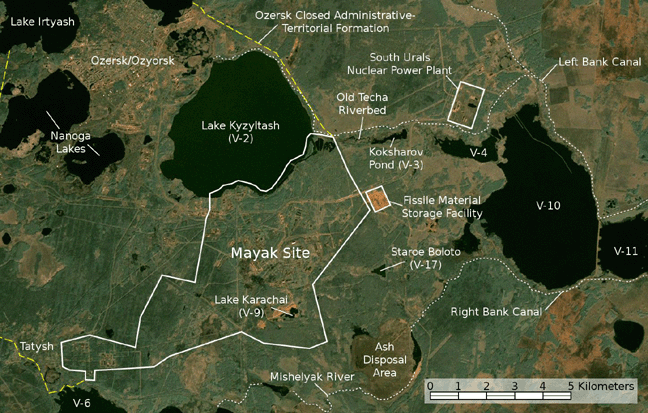
In recent months, critics have hammered Russia’s nuclear industry over allegations that Mayak, a notorious nuclear plant in Ozyorsk, a closed city in central Russia, was the source of radioactive pollution observed over Western Europe in late September. Mayak, which was built in 1948, produces components for nuclear weapons and stores and converts spent nuclear fuel. France’s Institute for Radioprotection and Nuclear Safety said the cloud that passed over Austria, France and other European countries was harmless, but it warned that the estimated level of radiation at the site of the suspected nuclear accident posed a serious threat to human health.
In November, Russian state meteorologists reported that high atmospheric concentrations of the radioactive isotope Ruthenium-106 had been detected around Mayak, triggering accusations that the secretive facility in Ozyorsk was the source of the pollution. However, Rosatom denied an accident had taken place there, said the levels detected by meteorologists were far below the admissible norm and insisted it had not carried out any operations that could have led to the isotope’s release into the atmosphere “for many years.”
Yet on December 13, Yuri Morkov, a senior executive at Mayak, admitted that Ruthenium-106 is routinely released as part of the plant’s processing of spent nuclear fuel. He insisted, however, that levels are so insignificant that there is no cause for concern.
Russian environmentalists are skeptical of his denials, in part because of Mayak’s history. Between 1949 and 1951, the factory dumped radioactive waste from the nuclear facility into the local river, polluting water supplies for tens of thousands of locals. In 1957, a storage tank containing highly radioactive nuclear weapons waste exploded at Mayak, exposing at least 272,000 people to dangerous levels of radiation. The accident was the third most serious nuclear disaster of all time, after far more famous accidents at Chernobyl and Fukushima. Eco-activists say the Soviets sent thousands of people, including some 2,000 pregnant women and hundreds of children, to clean up the disaster site with nothing more than rags and mops.
The atomic catastrophe was shrouded in secrecy: It wasn’t until 1989 that the USSR admitted it had taken place. Cancer rates in the worst affected areas around Mayak are between 2.5 and 3.5 times the national average, according to Greenpeace. In 2007, Russia’s constitutional court ruled that the unborn children exposed to radiation during the clean-up were not entitled to government benefits as adults, as they were not officially employed by the state.
This fall’s reports of the alleged nuclear leak at Mayak rekindled memories of the 1957 disaster. But Rosatom denies there have been any major incidents at its plants in recent years…….
There is no evidence suggesting Rosatom is directly responsible for the harassment of regional activists. A source close to the Russian nuclear industry tells Newsweekthat the “appalling and totally unacceptable” pressure is more likely coming from regional FSB officials trying to please their superiors in Moscow in the lead-up to Russia’s presidential election, a time when there’s increasingly less tolerance for dissent. Another possibility: lower-level officials who stand to benefit financially from Rosatom’s activities. “Russia is Russia,” the source says, asking for anonymity because of the sensitivity of the matter. “They play their own game as always.”
As for Maryasov, the Siberian activist faces an uncertain future as he continues his campaign against the nuclear waste repository. Finding a job has been hard because of his legal troubles, but he has no intention of moving.
In early October, information about a leak of the radioactive isotope ruthenium-106 into the atmosphere appeared in western media. Germany’s radiation watchdog announced that the source of the leak was most probably in the southern Urals, and French experts confirmed that conclusion.
Russia’s state-owned nuclear corporation Rosatom, however, denied the claim, saying that according to Roshydromet, the country’s environmental monitoring body, tests for particulate pollutants carried out between 25 September and 7 October failed to find any traces of Ruthenium, apart from a single instance in St Petersburg.
However, at the end of November, Greenpeace Russia received a response to a query it had sent Rosgidromet. This confirmed the discovery of ruthenium-106 in late September in the Chelyabinsk region, just to the east of the Ural mountains. The element was detected near the Mayak complex, a facility for reprocessing spent nuclear fuel. Ruthenium was also found in the atmospheres of Tatarstan, Bashkortostan, and the Krasnodar, Volgograd, and St Petersburg regions.
Ukrainian scientists also published data about its presence in the Altai, Dubno, Kirov, and Yakutia regions. Roshydromet admitted that in late September and early October atmospheric conditions were right for active movement of air masses, including pollutants, from the southern Urals towards the Mediterranean area and then northern Europe.
This news triggered an instant sensation, with Russia’s media simultaneously advancing all kinds of theories: it wasn’t Mayak at fault, but another Rosatom facility; the ruthenium could have come from a crashed satellite (although no satellites crashed at the time), and you can’t launch a satellite unnoticed; the source of the leak was in Romania, Kazakhstan, China… One theory held that it was an attempt to discredit Russia in the eyes of the world. Instead of releasing information about the accident to the public, Rosatom instead lashed out at western media for daring to report it.
A few days later, Rosatom invited journalists to a press trip where they could have a sniff of Ruthenium and discover how perfectly safe it was. More than 200 took up the offer, but only 17 were admitted. This triggered general anger, especially as the selection criteria were unclear. Then Rosatom created an advert showing a little cartoon lump of Ruthenium with big eyes, declaring how harmless it was: “What have I done to you? There’s nothing bad about me!”
Rosatom’s website then announced that a commission would be established to determine the source of the radiation, but it is unclear when this would happen and who would do it. On 8 December the commission held a press conference, where journalists were once again told that Mayak could not be the source of the emission, and were handed copies of the commission’s conclusion that the culprit had to be an unidentified satellite. Greenpeace sent a petition to the Russian General Prosecutor’s Office: by the next day it had been signed by more than 10,000 people.
Under the carpet
The hype around the ruthenium leak is that Russia has no transparent system for monitoring the state of its environment.
Radiation monitoring is overseen by Rosgidromet, which answers to Russia’s Ministry of Natural Resources and the Environment. The Roshydromet site quotes monthly radiation figures prepared by the Taifun scientific development centre, but they are not very easy to find. Occasionally it publishes other information, but in reality, all you can see is background gamma radiation from a few automatically selected detector elements: you can’t discover anything about the presence of specific radionuclides.
Russia has an automated radiation monitoring system: in other words, all nuclear installations are surrounded by automatic sensors that measure a number of indicators, and Rosatom is responsible for reporting accidents. So, if an accident happens, staff are inevitably made aware of emissions.
Rosgidromet, on the other hand, is only responsible for measuring emissions, but it takes a very long time to process these measurements and in the case of a serious radioactive emission, the publication of the relevant data a month later won’t save anyone from its consequences. For example, we still don’t know what happened in late September near the ruthenium emission zone. And the reports that we do have contain incomplete and sometimes contradictory data, although in faraway France the list of monitoring stations and the measurements around them appeared very fast.
In Russia, by contrast, no one plans to search for the emission’s source, on the supposed grounds that the concentration of ruthenium was too small to monitor. Yet by this logic, we can never learn any lessons from the incident at all. By the time an emission of a larger concentration is detected, it will be too late to look for its source.
Keeping the public happy
It looks as though Russia’s nuclear monitoring and information system is inadequate for the country’s needs. Immediately after the Chernobyl accident in 1986, the Soviet authorities set up a body now known as the federal nuclear and radiation safety authority, a powerful enough watchdog at the time, which even managed to halt work at Mayak. However, in 2004 this body became just a subsidiary arm of Rostekhnadzor, the federal environmental, industrial and nuclear supervision service, thereby losing some of its powers.
Meanwhile, Rosatom goes from strength to strength: it is now responsible for the development of Russia’s North Sea Shipping Route and is expected to acquire yet more functions. But are monitoring organs and systems growing at the same rate? Apparently the opposite is happening, and it’s a dangerous tendency.
The very fact that the source of the ruthenium is still officially unknown reveals, at best, the inadequacy of the current radiation monitoring and public reporting systems and at worst, Rosatom’s ability to lobby for secrecy and lying to the public. The precedents for further problems down the road have already been set.
In 1993, Russia experienced its first nuclear accident after the fall of the Soviet Union. This took place at the Siberian Chemical Combine in Tomsk region, which released ruthenium-106. Greenpeace’s archive contains a telling document of the time: a report on the radiation situation compiled by the Commission of the State Committee on Civil Defence, Emergency Situations and Liquidating Natural Disasters. In the letter that accompanies it, Sergey Shoigu, the head of the committee, notes that “just like the Chernobyl disaster, the Atomic Ministry informed both the immediate area and the capital about the accident with a significant delay, which could have led to serious consequences.” That said, even when this delay had been noted, it wasn’t reflected in the Commission’s reports — “in order to calm public opinion”, according to Shoigu.
Books have been written about how the news of the Chernobyl disaster and the 1957 Mayak accident was kept secret. Time passes, but we still don’t know anything about the radiation situation in our own country.
And so, the billions of tons of silt that has accumulated in Lake Mead and Lake Powell serve as archives of sorts. They hold the sedimental records of an era during which people, health, land, and water were all sacrificed in order to obtain the raw material for weapons that are capable of destroying all of humanity.
Jonathan ThompsonPERSPECTIVE Dec. 18, 2017 This article was originally published on The River of Lost SoulsBeneath the murky green waters on the north end of Lake Powell, entombed within the tons of silt that have been carried down the Colorado River over the years, lies a 26,000-ton pile of unremediated uranium-mill tailings. It’s just one radium-tainted reminder of the way the uranium industry, enabled by the federal government, ravaged the West and its people for decades.
In 1949, the Vanadium Corporation of America built a small mill at the confluence of White Canyon and the Colorado River to process uranium ore from the nearby Happy Jack Mine, located upstream in the White Canyon drainage (and just within the Obama-drawn Bears Ears National Monument boundaries). For the next four years, the mill went through about 20 tons of ore per day, crushing and grinding it up, then treating it with sulfuric acid, tributyl phosphate and other nastiness. One ton of ore yielded about five or six pounds of uranium, meaning that each day some 39,900 pounds of tailings were piled up outside the mill on the banks of the river.
In 1953 the mill was closed, and the tailings were left where they sat, uncovered, as was the practice of the day. Ten years later, water began backing up behind the newly built Glen Canyon Dam; federal officials decided to let the reservoir’s waters inundate the tailings. There they remain today.
If you’re one of the millions of people downstream from Lake Powell who rely on Colorado River water and this worries you, consider this: Those 26,000 tons of tailings likely make up just a fraction of the radioactive material contained in the silt of Lake Powell and Lake Mead.
During the uranium days of the West, more than a dozen mills — all with processing capacities at least ten times larger than the one at White Canyon — sat on the banks of the Colorado River and its tributaries. Mill locations included Shiprock, New Mexico, and Mexican Hat, Utah, on the San Juan River; Rifle and Grand Junction, Colorado, and Moab on the Colorado; and in Uravan, Colorado, along the San Miguel River, just above its confluence with the Dolores. They did not exactly dispose of their tailings in a responsible way.
At the Durango mill the tailings were piled into a hill-sized mound just a stone’s throw from the Animas River. They weren’t covered or otherwise contained, so when it rained tailings simply washed into the river. Worse, the mill’s liquid waste stream poured directly into the river at a rate of some 340 gallons per minute, or half-a-million gallons per day. It was laced not only with highly toxic chemicals used to leach uranium from the ore and iron-aluminum sludge (a milling byproduct), but also radium-tainted ore solids.
Radium is a highly radioactive “bone-seeker.” That means that when it’s ingested it makes its way to the skeleton, where it decays into other radioactive daughter elements, including radon, and bombards the surrounding tissue with alpha, beta, and gamma radiation. According to the Toxic Substances and Diseases Registry, exposure leads to “anemia, cataracts, fractured teeth, cancer (especially bone cancer), and death.”
It wasn’t any better at any of the other mills. In the early 1950s, researchers from the U.S. Public Health Service sampled Western rivers and found that “the dissolved radium content of river water below uranium mills was increased considerably by waste discharges from the milling operations” and that “radium content of river muds below the uranium mills was 1,000 to 2,000 times natural background concentrations.”
That was just from daily operations. In 1960, one of the evaporation ponds at the Shiprock mill broke, sending at least 250,000 gallons of highly acidic raffinate, containing high levels of radium and thorium, into the river. None of the relevant officials were notified and individual users continued to drink the water, put it on their crops, and give it to their sheep and cattle. It wasn’t until five days later, after hundreds of dead fish had washed up on the river’s shores for sixty miles downstream, that the public was alerted to the disaster.
Of course, what’s dumped into the river at Shiprock doesn’t stay in Shiprock. It slowly makes its way downstream. In the early 1960s, while Glen Canyon Dam was still being constructed, the Public Health Service folks did extensive sediment sampling in the Colorado River Basin, with a special focus on Lake Mead’s growing bed of silt, which had been piling up at a rate of 175 million tons per year since Hoover Dam started impounding water in 1935. The Lake Mead samples had higher-than-background levels of radium-226. The report concludes:
“The data have shown, among other things, that Lake Mead has been essentially the final resting place for the radium contaminated sediments of the Basin. With the closure of Glen Canyon Dam upstream, Lake Powell will then become the final resting place for future radium contaminated sediments. The data also show that a small fraction of the contaminated sediment has passed through Lake Mead to be trapped by Lakes Mohave and Havasu.”
And so, the billions of tons of silt that has accumulated in Lake Mead and Lake Powell serve as archives of sorts. They hold the sedimental records of an era during which people, health, land, and water were all sacrificed in order to obtain the raw material for weapons that are capable of destroying all of humanity.
The Russian Villagers Living In The Shadow Of A Nuclear Tragedy, Radio Free Europe, 16 Dec 17, Ramil Mukhamedyarov looks out at the placid waters of the Techa River in Russia’s Ural Mountains.
He says for kids in Novoye Muslyumovo, a mostly ethnic Tatar village, it serves as the local swimming hole. Cattle often lap at its waters and graze near its banks.
It sounds idyllic, but there’s a problem. For decades, radioactive waste has been dumped or seeped into the Techa.
Nearby is the Mayak nuclear installation, one of the largest nuclear complexes in the world, now run by Russian state nuclear regulator and operator Rosatom to reprocess spent nuclear fuel. In 1957, a nuclear accident at Mayak contaminated 20,000 square kilometers and affected an estimated 270,000 people.
It was one of history’s worst obscure nuclear tragedies. Since Mayak was a “secret site” and nearby Chelyabinsk a “closed town,” Soviet authorities didn’t flinch. They initially released no details of what would become known as the Kyshtym disaster, named after the nearest town actually listed on maps.
It was only in the 1990s, after the collapse of the Soviet Union, that the scale of the disaster emerged. And only in 2009, more than a half-century after the incident, were residents of Muslyumovo — the village worst-hit by the spillage at Mayak — relocated.
Mukhamedyarov and his neighbors were given a choice: a new home or a 1 million-ruble (about $30,000 at the time) payout. Announced in the wake of a visit to the area by then-Russian President Dmitry Medvedev, the program was riddled with corruption, however. Many of those who opted for the cash never saw most of it, and those who picked alternative housing were relocated just 2 kilometers down the road in what would become Noveye, or New, Muslyumovo, still well within the contamination zone.
Nice On The Surface…
Compared to other Russian villages of similar size, Noveye Muslyumovo has its appeal. The roads are smooth and paved. The rows of nearly identical, red-roofed, clapboard houses are tidy and clean. There’s a new school and other facilities. A poultry-processing facility, despite the smell wafting from it, provides locals with jobs.
Plus, living in an irradiated zone means residents receive some additional benefits from the federal government. Villagers get 500 rubles a month ($8.50) a month for living there, plus another 400 rubles ($6.80) for medicines……
According to the antinuclear group Bellona, those living near the Techa River suffer cancer rates 3.6 times higher than the national average and birth defects 25 times more frequently than in other parts of the country.
Buried Accident
Eventually details of the accident in the Ural Mountains seeped out. In the early hours of September 29, 1957, a tank containing nuclear-weapons waste exploded on the grounds of the Mayak Chemical Combine, Russia’s primary spent-nuclear-fuel-reprocessing center.
The fallout affected more than 200 towns and villages and exposed more than 240,000 people, a small portion of whom were quietly evacuated over the subsequent two years, to radiation.
Rashida Fattahova, 83, lived in Muslyumovo at the time. “It was horrible. [Ethnic] Russians were resettled right away after the catastrophe, but not the Tatars,” she says of those early Soviet attempts to cope with the accident.
In 2009, Rosatom was given a leading role in relocating villagers from Muslyumovo. Heavy earth-moving equipment was used by Rosatom to raze the village, literally leaving no trace behind. Deep pits were dug. Homes and other articles were demolished and dumped into them before being covered with earth.
“All the things around the house were buried. It was horrible, [the pit] was so deep. I left many things there that were buried,” Fattahova says.
A field of fir trees was planted in its place, but never took root and died.
Not all villagers were given a choice. Lacking documents, some still live in what remains of “Old” Muslyumovo, as the largely empty tract of land is now called……….
For those “lucky” enough to be resettled in Noveye Muslyumovo, life is constantly impacted by Mayak.
Radioactive wastewater is still dumped into ponds around and connected to the Techa River.
Rosatom no longer acknowledges spewing radioactive waste into the Techa or its tributaries. It says waste is deposited in “special industrial ponds” or “objects of nuclear energy use.” Whether that waste is seeping into the Techa is something Rosatom doesn’t address.
A visit to Noveye Muslyumovo by correspondents from RFE/RL’s Idel.Reality stirs the interest of local police, who ask why they are photographing before requesting their documents.
After the encounter with police, one woman, Nailya, pursues the reporters to tell them her story.
Unlike some who may be wary of making such remarks for fear of reprisals from local officials, she speaks openly about allegedly elevated risks of cancer. “People here die, several die a week. Most from tumors. Cancer. Edik was 42. Salavat 52. Just on this street, so many young people have died,” Nailya says…https://www.rferl.org/a/russia-mayak-villagers-living-in-shadow-nuclear-tragedy/28921944.html
Why North Korea’s nuclear test is still producing aftershocks, BBC, 11 December 2017 “…….
Why are aftershocks still happening?
According to the USGS, last weekend’s tremors were “relaxation events”. They measured a magnitude of 2.9 and 2.4.
“When you have a large nuclear test, it moves the earth’s crust around the area, and it takes a while for it to fully subside. We’ve had a few of them since the sixth nuclear test,” an official told Reuters.
The “movement of the earth’s crust” is akin to the very definition of an earthquake and scientists say it is only to be expected in the weeks and months after an explosion of that magnitude.
“These aftershocks for a 6.3 magnitude nuclear test are not very surprising,” Dr Jascha Polet, seismologist and professor of geophysics at California State Polytechnic University, told the BBC.
After any tremor of that size, aftershocks with declining magnitude are common, as the rock moves around and releases stress.
The area around the quake site “experiences deformation, and this creates areas of increased and decreased stress, which affects the distribution of aftershocks,” Ms Polet said.
“The fact that the source of the earthquake is an explosion doesn’t change how we expect the energy to redistribute,” geophysicist and disaster researcher Mika McKinnon, told the BBC.
But research on explosions of a similar magnitude as the North Korea nuclear test at the Nevada Test Site in the US where over decades nuclear tests were carried out, has found that the aftershocks of these events were fewer in number and lower in magnitude.
So each location is unique.
Can tremors destroy the test site?
One of the speculations after the September test was that it would damage the tunnel system North Korea has dug into the mountains at its test site.
“The more energy you put into an area, the more unstable it’s going to get,” Mika McKinnon explained.
“The more tests are happening, the more energy there is, the more redistribution of stress and the more rocks will be breaking.”
There have been some indications of individual tunnel collapses, she explained. “Seismic signals that look more like rock fall than anything else. That will happen more and more.”
But, she adds, there is no way of really knowing whether the entire tunnel system will collapse as this is an engineering problem far more than a scientific one.
It is unclear whether this process already has rendered the current test site unusable but North Korea has hinted its next nuclear test could be above ground…….http://www.bbc.com/news/world-asia-42305161
‘It takes a while for the crust movement to fully subside’, says USGS Jon Sharman 10 Dec 17Geologists have detected two tectonic tremors that they say are probably aftershocks from North Korean nuclear tests conducted over three months ago.
The artificial explosion created near a known nuclear testing site in North Korea had “moved the Earth’s crust” and subsequent seismic activity showed the region’s underlying geology settling back down, experts said.
The aftershocks, of magnitude 2.9 and 2.4, were detected at 6.13am and 6.40am GMT on Saturday respectively, said the US Geological Survey (USGS).
Lassina Zerbo, executive secreta
ry of the Vienna-based Comprehensive Nuclear-Test-Ban Treaty Organisation, said analysts had confirmed that the activity was “tectonic” in origin.
A USGS official said the tremors had occurred near the Punggye-ri nuclear test site, where North Korea conducted its sixth and largest underground nuclear test on 3 September.
“They’re probably relaxation events from the sixth nuclear test,” the official said. “When you have a large nuclear test, it moves the earth’s crust around the area, and it takes a while for it to fully subside. We’ve had a few of them since the sixth nuclear test.”
Pyongyang claimed the September test was of a thermonuclear hydrogen bomb, and experts have estimated it was 10 times more powerful than the US atomic bomb dropped on Hiroshima in 1945.
A series of quakes since then has prompted experts and observers to suspect the test might have damaged the mountainous location of its site in the northwest tip of North Korea, where all of the country’s nuclear tests have been conducted.
South Korea’s spy agency told the country’s lawmakers in October that North Korea might be readying two more tunnels at the site.
North Korea hinted its next nuclear test could be above ground after US President Donald Trump warned in September that the United States would “totally destroy” North Korea if it threatened America.
Another possible obstacle to North Korea’s use of Punggye-ri for tests is the nearby active volcano of Mount Paektu, which North Koreans consider a sacred site. Its last eruption was in 1903, and experts have debated whether nuclear testing could trigger another.
North Korea’s official media reported on Saturday that national leader Kim Jong-un had scaled Mount Paektu with senior military officials to “emphasise his military vision” after completion of the country’s nuclear force.
But pictures released by the official KCNA news agency showed him wearing smart black leather shoes and carrying no specialised equipment.
Mr Kim declared the nuclear force complete after the test of North Korea’s largest ever intercontinental ballistic missile last month, which experts said puts all of America within range.
South Korea said Pyongyang still needed to prove it has mastered critical missile technology, such as re-entry, terminal stage guidance and warhead activation, however.












 nuclear-news