Bird at left normal, at right – Chernobyl bird with facial cancer
Beyond Nuclear International 4th March 2018, It started with wolves. The packs around the Chernobyl nuclear plant, which exploded on April 26, 1986, were thriving, said reports. Benefitting from the absence of human predators, and seemingly unaffected by the high radiation levels that still persist in the area, the wolves, they claimed, were doing better than ever.
Appearances, however, can be deceptive. Abundant does not necessarily mean healthy. And that is exactly what
evolutionary biologist, Dr. Timothy Mousseau and his team began to find out as, over the years, they traveled to and researched in and around the Chernobyl disaster site in the Ukraine.
Then, when a similar nuclear disaster hit in Japan — with the triple explosions and meltdowns at
Fukushima Daiichi on March 11, 2011 — Mousseau’s team added that region to its research itinerary.
Mousseau has now spent more than 17 years looking at the effects on wildlife and the ecosystem of the 1986 Chernobyl
nuclear disaster. He and his colleagues have also spent the last half dozen years studying how non-human biota is faring in the wake of Fukushima. Ninety articles later, they are able to conclude definitively that animals and plants around Chernobyl and Fukushima are very far indeed from flourishing. https://beyondnuclearinternational.org/2018/03/04/not-thriving-but-failing/
Energy Voice 8th March 2018,A leading independent nuclear expert has called for increased monitoring of
a Caithness beach after an “alarming” radioactive fragment was found.
Dr John Large, who oversaw the salvage of Russian nuclear sub Kursk in 2000
and advises governments around the world, said the situation was
“serious” and could threaten local communities.
The tiny particle of reprocessed fuel from Dounreay was discovered to contain radioactive
americium. Dr Large said the first recorded presence of the so-called
“daughter of plutonium” in nuclear waste washed up on Sandside beach,
near Reay, was probably discharged into the sea decades ago.
He added: “The trouble is that 20 or 30 or so years later it has turned up on a
beach. If it reaches the surface – which is quite possible given natural
disturbance by the tide etc – and gets dried out it can become airborne,
thus threatening local communities. It is alarming. “Of course it is
serious.
There’s not a lot you can do either – because finding these
particles is a random process, you cannot predict where they are.
“Monitoring needs to be stepped up because there is a real risk these
particles could end up in areas of population.”
A spokeswoman for Dounreay said: ”Addressing the legacy of radioactive particles in the
marine environment around Dounreay is an important part of the site’s
decommissioning programme. The particle monitoring regime for external
beaches has been carried out for many years and is reported on our
website.”
The particle was the 275th to be unearthed on the beach since
the discovery of the first in 1984. Found 18 centimetres under the surface
during a routine sweep on January 11, it has a caesium 137 count of 110,000
bequerels of radioactivity.
If ingested, americium-241 can work its way
into the bones, liver and, in males, the testicles, and remain in the body
for some time. Sand-sized fragments of irradiated nuclear fuel were flushed
into the sea from Dounreay in the 1960s and 1970s. Particles of irradiated
nuclear fuel were first detected on the Dounreay site coastal strip in 1983
and on the beach at Sandside in 1984. Work to recover particles from the
seabed was done between the 1990s and 2012. https://www.energyvoice.com/other-news/165626/beach-needs-nuclear-monitoring/
What a great article! and magnificent photos!. And Kenneth Weiss has a degree in folklore! Doesn’t that tell us something?
We are in an age where we are constantly being told that STEM (Science Technology Engineering Maths) are what matters most – indeed, are all that matters. Well- yes, they do matter. But what about the humanities – arts, social studies, history literature, cultures? We need more Kenneth Weiss’s – more students of folklore !
Combating Desertification and Drought,TerraViva United Nations Some of the World’s Biggest Lakes Are Drying Up. Here’s Why. [see this article if only for the superb photos] Warming climates, drought, and overuse are draining crucial water sources, threatening habitats and cultures. “
“……………..Around the globe, climate change is warming many lakes faster than it’s warming the oceans and the air. This heat accelerates evaporation, conspiring with human mismanagement to intensify water shortages, pollution, and loss of habitat for birds and fish. But while “the fingerprints of climate change are everywhere, they don’t look the same in every lake,” says Catherine O’Reilly, an aquatic ecologist at Illinois State University and co-leader of a worldwide lake survey by 64 scientists.
In eastern China’s Lake Tai, for example, farm runoff and sewage stimulate cyanobacterial blooms, and warm water encourages growth. The organisms threaten drinking-water supplies for two million people. East Africa’s Lake Tanganyika has warmed so much that fish catches that feed millions of poor people in four surrounding countries are at risk. The water behind Venezuela’s massive Guri hydroelectric dam has reached such critically low levels in recent years that the government has had to cancel classes for schoolchildren in an effort to ration electricity. Even the Panama Canal, with its locks recently widened and deepened to accommodate supersize cargo vessels, is troubled by El Niño–related rainfall shortages affecting man-made Gatun Lake, which supplies not only water to run the locks but also fresh drinking water for much of the country. Low water levels have also forced limits on the draft of ships so the ships don’t run aground in the lake.
Of all the challenges lakes face in a warming world, the starkest examples are in closed drainage basins where waters flow into lakes but don’t exit into rivers or a sea. These terminal, or endorheic, lakes tend to be shallow, salty, and hypersensitive to disturbance. The vanishing act of the Aral Sea in Central Asia is a disastrous example of what can happen to such inland waters. In its case the main culprits were ambitious Soviet irrigation projects that diverted its nourishing rivers.
Africa’s Lake Chad is a sliver of its former self. Iran’s Lake Urmia has shrunk by 80 percent in 30 years. What remain are the carcasses of ships settled into the silt.
Similar scenarios are playing out in terminal lakes on nearly every continent, a combination of overuse and worsening drought. Side-by-side satellite images reveal the shocking toll. Lake Chad in Africa has shrunk to a sliver of its former self since the 1960s, heightening shortages of fish and irrigation water. Displaced people and refugees who now depend on the lake put an additional strain on resources. Shortages as well as tensions in the hot, dry Sahel are driving conflict and mass migration. Utah’s Great Salt Lake and California’s Salton Sea and Mono Lake have undergone periods of recession too, diminishing critical breeding and nesting areas for birds as well as playgrounds for recreational boaters.
After the Caspian Sea, Iran’s Lake Urmia was once the largest saltwater lake in the Middle East. But it has shrunk by some 80 percent over the past 30 years. The flamingos that feasted on brine shrimp are mostly gone. So are the pelicans, egrets, and ducks. What remain are piers that lead nowhere, the rusting carcasses of ships settled into the silt, and white, barren salt flats. Winds that whip across the lake bed blow salt dust to farm fields, slowly rendering the soil infertile. Noxious, salt-tinged dust storms inflame the eyes, skin, and lungs of people 60 miles away in Tabriz, a city of more than 1.5 million. And in recent years Urmia’s alluring turquoise waters have been stained blood-red from bacteria and algae that flourish and change color when salinity increases and sunlight penetrates the shallows. Many of the tourists who once flocked here for therapeutic baths are staying away.
Although climate change has intensified droughts and elevated hot summer temperatures around Urmia, speeding up evaporation, that’s only part of the story. Urmia has thousands of illegal wells and a proliferation of dams and irrigation projects that divert water from tributary rivers to grow apples, wheat, and sunflowers. Experts worry that Urmia could fall victim to the same overexploitation of water as the Aral Sea. ……..
We live in an era of the most forced migration since the Second World War. We are going to need to support those who are ravaged by climate change so they can migrate with dignity.
William Lacy Swing director general of the United Nations’ International Organization for Migration
In sheer numbers those fleeing “natural” calamities have outnumbered those fleeing war and conflict for decades. Still, these figures do not include people forced to abandon their homelands because of drought or gradual environmental degradation; almost two and a half billion people live in areas where human demand for water exceeds the supply. Globally the likelihood of being uprooted from one’s home has increased 60 percent compared with 40 years ago because of the combination of rapid climate change and growing populations moving into more vulnerable areas.
Most of these displaced people stay within their home countries. If they cross a border, they do not qualify for UN protections as refugees because they cannot claim they are fleeing violence or persecution. “We live in an era of the most forced migration since the Second World War,” says William Lacy Swing, director general of the United Nations’ International Organization for Migration. “This time, though, in addition to war, climate is looming as a major driver. We are going to need to support those who are ravaged by climate change so they can migrate with dignity.”……..
When glaciers first begin to melt, they provide an extra flush of water, explains Dirk Hoffmann, a German researcher based in La Paz who co-authored the book Bolivia in a 4-Degree Warmer World. “But we’ve probably reached peak water in most glacial watersheds,” he says, meaning that meltwater from glaciers will now diminish in the region until it is gone. …….
Second World War. We are going to need to support those who are ravaged by climate change so they can migrate with dignity.
William Lacy Swing director general of the United Nations’ International Organization for Migration
In sheer numbers those fleeing “natural” calamities have outnumbered those fleeing war and conflict for decades. Still, these figures do not include people forced to abandon their homelands because of drought or gradual environmental degradation; almost two and a half billion people live in areas where human demand for water exceeds the supply. Globally the likelihood of being uprooted from one’s home has increased 60 percent compared with 40 years ago because of the combination of rapid climate change and growing populations moving into more vulnerable areas.
Most of these displaced people stay within their home countries. If they cross a border, they do not qualify for UN protections as refugees because they cannot claim they are fleeing violence or persecution. “We live in an era of the most forced migration since the Second World War,” says William Lacy Swing, director general of the United Nations’ International Organization for Migration. “This time, though, in addition to war, climate is looming as a major driver. We are going to need to support those who are ravaged by climate change so they can migrate with dignity.”……..
When glaciers first begin to melt, they provide an extra flush of water, explains Dirk Hoffmann, a German researcher based in La Paz who co-authored the book Bolivia in a 4-Degree Warmer World. “But we’ve probably reached peak water in most glacial watersheds,” he says, meaning that meltwater from glaciers will now diminish in the region until it is gone. ……..http://www.ipsnews.net/2018/03/worlds-biggest-lakes-drying-heres/
Bags of radioactive waste during radioactive decontamination process after the daiichi nuclear power plant irradiation, Fukushima prefecture, Iitate, Japan
Uranium and other radioactive materials, such as caesium and technetium, have been found in tiny particles released from the damaged Fukushima Daiichi nuclear reactors.
This could mean the environmental impact from the fallout may last much longer than previously expected according to a new study by a team of international researchers, including scientists from The University of Manchester.
The team says that, for the first time, the fallout of Fukushima Daiichi nuclear reactor fuel debris into the surrounding environment has been “explicitly revealed” by the study.
The scientists have been looking at extremely small pieces of debris, known as micro-particles, which were released into the environment during the initial disaster in 2011. The researchers discovered uranium from nuclear fuel embedded in or associated with caesium-rich micro particles that were emitted from the plant’s reactors during the meltdowns. The particles found measure just five micrometres or less; approximately 20 times smaller than the width of a human hair. The size of the particles means humans could inhale them.
The reactor debris fragments were found inside the nuclear exclusion zone, in paddy soils and at an abandoned aquaculture centre, located several kilometres from the nuclear plant.
It was previously thought that only volatile, gaseous radionuclides such as caesium and iodine were released from the damaged reactors. Now it is becoming clear that small, solid particles were also emitted, and that some of these particles contain very long-lived radionuclides; for example, uranium has a half-life of billions of years.
Dr Gareth Law, Senior Lecturer in Analytical Radiochemistry at the University of Manchester and an author on the paper, says: “Our research strongly suggests there is a need for further detailed investigation on Fukushima fuel debris, inside, and potentially outside the nuclear exclusion zone. Whilst it is extremely difficult to get samples from such an inhospitable environment, further work will enhance our understanding of the long-term behaviour of the fuel debris nano-particles and their impact.”
The Tokyo Electric Power Company (TEPCO) is currently responsible for the clean-up and decommissioning process at the Fukushima Daiichi site and in the surrounding exclusion zone. Dr Satoshi Utsunomiya, Associate Professor at Kyushu University (Japan) led the study.
He added: “Having better knowledge of the released microparticles is also vitally important as it provides much needed data on the status of the melted nuclear fuels in the damaged reactors. This will provide extremely useful information for TEPCO’s decommissioning strategy.”
At present, chemical data on the fuel debris located within the damaged nuclear reactors is impossible to get due to the high levels of radiation. The microparticles found by the international team of researchers will provide vital clues on the decommissioning challenges that lie ahead.
Barents Observer 26th Feb 2018. Finland’s Radiation and Nuclear Safety Authority (STUK) says tiny amounts
of radioactive iodine-131 were measured in the air Kotka, east of Helsinki
in late January. The same isotope was then measured again last week north
to Kajaani. The levels were very low, ranging from 0,7 to 1,6
micro-becquerel per cubic meter air, STUK says in a news release
From where the radioactivity is coming is still unknown. Radioactive iodine-131
has a half-life of only eight days so the measurements are proof of a
rather recent release.
The source could be a nuclear reactor, a facility
producing isotopes for medical purposes or by releases from a nuclear
weapons related test. Norway’s Radiation Protection Authority (NRPA) on
Monday confirms detection of radioactive iodine also at several of the
country’s air-measurement stations. https://thebarentsobserver.com/en/ecology/2018/02/traces-radioactive-iodine-air
The National Nuclear Security Administration (NNSA) Los Alamos Field Office is proposing to install a permanent fire break across the canyon bottom, which includes approximately 300 feet of the 100-year floodplain.
The proposed work will occur in Portrillo Canyon in Technical Area (TA) 36. The purpose of this work is to further reduce wildfire risk in upper Potrillo Canyon from the Lower Slobbovia firing site operations at Los Alamos National Laboratory (LANL).
In accordance with 10 Code of Federal Regulations 1022 Compliance with Floodplain and Wetland Environmental Review Requirements, NNSA has prepared a floodplain assessment for the proposed action.
The Floodplain Assessment for the Proposed Fire Break at the Lower Slobbovia Firing Site at Los Alamos National Laboratory is available in the LANL Electronic Public Reading Room, on the Los Alamos Field Office NEPA Documents webpage or in hard copy at the LANL Public Reading Room, 94 Cities of Gold Road, Pojoaque, NM. The 15-day public comment period for this assessment ends March 2, 2018.
To submit comments or for further information, contact Kristen Dors at the NNSA Los Alamos Field Office at Kristen.Dors@nnsa.doe.gov.
on the future of the West Lake Landfill — a decision that could free the St. Louis area of the seven-decade environmental burden it has borne in America’s quest for nuclear superiority.
For Pruitt, the right decision would be costly and complicated. The wrong decision, though far cheaper and most expedient, would leave in place a radioactive nightmare that would haunt the region for generations to come. The right decision is the only decision.
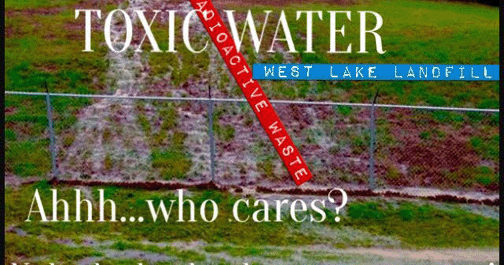
At issue are thousands of tons of radioactive waste left over from secret uranium refinement carried out in St. Louis during the Manhattan Project, the 1940s effort to produce America’s first nuclear bomb. Although officials at the time were well aware of the radioactive dangers, they paid little heed to where they dumped the wastes from years of uranium processing. An uncovered, unlined pit at the West Lake landfill became the dumpsite of choice, two miles northwest of St. Louis Lambert International Airport.
The landfill, uphill and less than two miles from the Missouri River, was never designed for radioactive waste and never would have met today’s federal safety guidelines. Various radioactive hot zones have been discovered in downstream watersheds, as have large cancer clusters among residents. For years, a slow-moving underground fire at an adjacent landfill is believed to be advancing toward the buried nuclear waste.
In tests conducted from 2012 to 2014, groundwater at West Lake contained unsafe levels of radioactive uranium, radium and thorium-230, along with arsenic, manganese, barium and benzene.
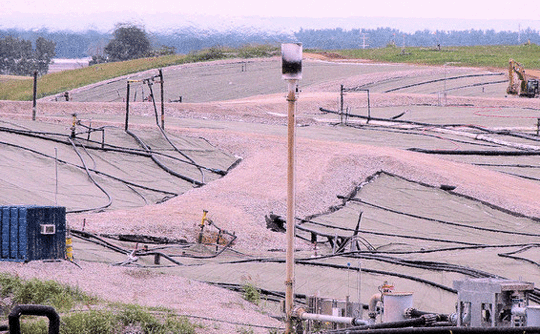
An exhaustive, 814-page EPA study, updated on Jan. 10, outlines the dangers and costs associated with six options Pruitt can choose from for West Lake. One option, doing nothing, is laughable. Three cheaper proposals call for partial excavation of the site at varying depths and capping the site but leaving many toxins behind. The two best options involve full excavation — one would store the waste on-site in a modern, secure containment cell, and the other would transport it offsite to a remote, federally approved storage facility.
Full excavation and removal would keep the region safest over the long term. But it’s also the most expensive option at $695 million. Capping the site would cost about $75 million but also would pose the greatest future cancer risks to farmers and residents downstream.
Pruitt has the comfort of making this decision from Washington, D.C., far from the exposure zone. We urge him to consider all who have suffered so far because of the irresponsible, lazy solutions imposed on St. Louis decades ago. If Pruitt would regard it as unacceptable for his own family to be exposed to such risks, then he must conclude that St. Louisans deserve the same consideration. This radioactive time bomb must go.
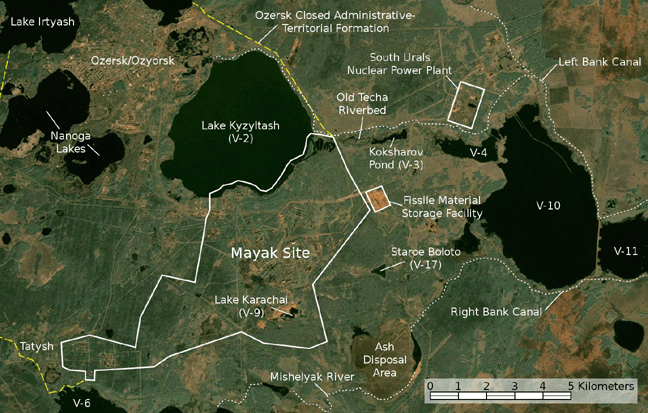
Radiation levels near this Siberian village were 1,000 times above normal last fall. But no one worried much, LA Times, By SABRA AYRES, FEB 16, 2018 sabra.ayres@latimes.com, KHUDAIBERDYNSK, RUSSIA “…. this Siberian landscape on the edge of the Ural Mountains bore the brunt of one of the world’s worst nuclear accidents. On Sept. 29, 1957, decades before Three Mile Island, Chernobyl and Fukushima entered the lexicon of landmark nuclear disasters, a buried cache of liquid radioactive waste from Mayak exploded. More than a quarter-million people were exposed to radiation, and nearly two dozen villages, home to more than 10,000 people, had to be vacated forever.
“The agreement is very assuring, as we will be able to receive support for efforts on the safety and security of the region,” Gov. Masao Uchibori said during the signing ceremony at the prefecture’s office on the same day.
It is the 15th time the unit of Japan Post Holdings Co. has concluded an agreement with a prefectural government.
Under the plan, Japan Post’s delivery minivehicles will be equipped with radiation gauges. Data will be collected automatically and wirelessly transmitted to the prefectural government. The prefecture’s coast was heavily damaged by the March 2011 mega-quake and tsunami, while much larger parts of it were contaminated by radiation by the subsequent core meltdowns at the Fukushima No. 1 nuclear plant, run by Tokyo Electric Power Company Holdings Inc.
In addition, the two parties agreed that posters to promote Fukushima goods will be put up at post offices in areas around Tokyo, in Fukushima and five other prefectures in the Tohoku region.
Japan Post’s delivery staff will also alert the prefectural government and others when several days’ worth of newspapers are seen accumulating outside of the homes of elderly people, and when damage to roads is observed.
“We will provide maximum assistance for Fukushima Prefecture’s revitalization,” said Kunio Yokoyama, president of Japan Post.
For 2 weeks in September and October last year, traces of the humanmade isotope ruthenium-106 wafted across Europe, triggering detectors from Norway to Greece and Ukraine to Switzerland. The radioactive cloud was too thin to be dangerous, containing no more than a few grams of material, but its origin posed an outsize mystery.
Now, scientists at the French Institute of Radioprotection and Nuclear Security (IRSN) in Paris say the isotope may have been released from the Mayak nuclear facility near Ozyorsk in southern Russia. IRSN argues that the leak could have taken place when Mayak technicians botched the fabrication of a highly radioactive component for a physics experiment at the Gran Sasso National Laboratory in L’Aquila, Italy.
The Russian government and state nuclear operator Rosatom have vehemently denied that an accident took place, however. Meanwhile, an international committee set up by the Russian Academy of Sciences’s Nuclear Safety Institute (IBRAE) in Moscow that met on 31 January is divided over the origins of the pollution.
Based on a computer model that used the air-sampling data and weather patterns, IRSN concluded in early October 2017 that the ruthenium most likely originated in the southern Urals; its German counterpart agreed. The French team went on to rule out a number of potential sources, including a mishap at a nuclear reactor. Such an incident would have spewed many other radioactive pollutants besides ruthenium.
The southern Urals are home to the secretive Mayak facility, the scene of one of the world’s worst nuclear accidents 60 years ago, and speculation soon turned to a possible accident at its reprocessing plant, which extracts isotopes from spent nuclear fuel. The IRSN report, made public on 6 February, says Mayak’s attempt to manufacture a capsule of cerium-144 destined for Gran Sasso “should be investigated” as a possible cause. Scientists at Gran Sasso needed the cerium for a search—now called off—for hypothetical particles called sterile neutrinos.
The estimated amount of radioactive ruthenium released could only have come from processing several tons of spent nuclear fuel, IRSN says. What’s more, the ratio of ruthenium-106 to the faster-decaying isotope ruthenium-103, detected in smaller amounts last autumn, reveals that the fuel must have been removed from its reactor only a year or two earlier. Spent fuel is normally cooled for up to a decade before it is reprocessed, so it seems the plant was preparing material for an application requiring high levels of radioactivity, IRSN says.
That fits the description of the sterile neutrino experiment at Gran Sasso, known as SOX and supported by Italy’s National Institute for Nuclear Physics (INFN) and the French Alternative Energies and Atomic Energy Commission. It required a source that was both extremely radioactive and very small, says SOX spokesperson Marco Pallavicini, a particle physicist at the University of Genoa in Italy. He says Mayak Production Association, the only company able to supply it, signed a contract in fall 2016 to produce a cerium capsule, expected to arrive in early 2018.
But in December 2017 the company stated it could not reach the desired radioactivity level. (“The Russians said absolutely nothing” about a radiation leak, Pallavicini says.) That meant SOX would lack the required sensitivity, and on 1 February, INFN announced it had axed the experiment, in what Pallavicini described as “a big blow” for scientists.
Jean-Christophe Gariel, IRSN’s director of health, says an uncontrolled temperature rise during the separation of cerium from the spent fuel at Mayak might have converted some of the ruthenium in the waste to gaseous ruthenium oxide. That gas would have escaped through the facility’s filters and solidified in the cool outside air, he says, turning into small solid oxide particles that could have wafted across Europe.
IBRAE Director Leonid Bolshov calls IRSN’s scenario “a good hypothesis,” but says it’s incorrect. For one thing, he says, the separation process never reached “the hot phase.” And in any case, he adds, “major operations” on the spent fuel at Mayak were done in late October 2017, after the ruthenium release. Bolshov says that a “rather rare meteorological event” might have transported the ruthenium from an as-yet-unidentified place to the southern Urals, from which it then appeared to spread.
Non-Russian members of IBRAE’s international panel, which is due to meet again in April, support IRSN’s conclusion that the southern Urals is the likely source of the leak, says IRSN physicist Jean-Luc Lachaume, a panel member, although some argue that the region is too large to pinpoint an exact location. Russian members claim the leak could have arisen “in the eastern part of the Russian federation,” Lachaume says. He says a representative of the Russian nuclear regulator Rostechnadzor who inspected Mayak in November 2017 told the panel that he saw no anomalies from a month earlier, but didn’t supply data to support that statement.
Princeton University physicist Frank von Hippel, a nonproliferation expert, says he doesn’t see “anything wrong with the IRSN analysis.” He notes that the amount of ruthenium-106 that the French team estimates was emitted—between 1 gram and 4 grams—matches the 30 grams of cerium-144 required for SOX, given that spent fuel contains the two isotopes in a ratio of about one to 14. And although the cloud over Europe was harmless, an accident at Mayak could mean that people living close by took in “potentially significant lung doses,” Von Hippel says.
Trump’s environmental good news, Religion News, ByMark Silk | The good news out of Washington is that the White House has withdrawn the nomination of Kathleen Hartnett White to head the President’s Council of Environmental Quality. A leading shill for the carbon industry, the one-time chair of the Texas Commission on Environmental Quality would have joined Energy Secretary Rick Perry and EPA Administrator Greg Pruitt in a troika of climate change deniers driving the Trump Administration’s environmental policies.
Hartnett White’s confirmation hearing in November did not go well, and although President Trump resubmitted her nomination last month, it can be presumed that he reversed course in the face of threats from at least a couple of Senate Republicans to vote her down……….
while the cause of climate change is hardly restricted to religious folks, it is perhaps the most religiously motivated of all progressive social causes today. Leading the way has been Pope Francis, with his great 2015 encyclical Laudato Si’. But it is a cause that has enlisted the full spectrum of the religious community — Jews and Muslims, Eastern Orthodox and Mainline Protestant, Hindu and Buddhist.
Except for white evangelicals. Outliers, they are now in thrall to a political party that over the past decade has increasingly opposed all efforts to address climate change. Their religious rationalization is that they are standing with a God who promised no more floods against pagan “Earth worshippers.”
“Slavery degrades the Religious Activity of the People,” preached Boston’s leading abolitionist minister Theodore Parker on July 4, 1858. Today it is climate change denial that is degrading the religious activity of the evangelical people. https://religionnews.com/2018/02/06/trumps-environmental-good-news/
Albuquerque Journal 5th Feb 2018, Researchers hope to measure the effects of mixed metals and uranium waste
exposure on Native American populations living in close proximity to
abandoned mines, and better understand how these toxins spread through the
environment.
That’s the objective of the newly created Superfund Research
Center at the University of New Mexico, which is funded by $1.2 million a
year for five years from the National Institute of Environmental Health
Sciences.
EPA orders cleanup at St. Louis nuclear waste site. What does it mean for the nation’s other toxic messes? WP, By Brady DennisFebruary 1 18, The Environmental Protection Agency on Thursday ordered a long-awaited cleanup of a Superfund site northwest of St. Louis, saying residents living near the landfill contaminated with World War II-era nuclear waste deserve action after waiting 27 years for federal regulators to issue a decision.
EPA Administrator Scott Pruitt’s decision to partially excavate tons of radioactive material from the West Lake Landfill over the next five years — at an expected cost of $236 million to the liable companies — goes beyond a 2008 solution proposed by the George W. Bush administration to cover and monitor the waste…….
Thursday’s announcement also was intended to be Exhibit A in demonstrating Pruitt’s commitment to revitalizing the agency’s Superfund program, which includes the nation’s most polluted sites, by streamlining and accelerating cleanups. But it underscored how few Superfund sites have simple answers, though nearly all of them generate intense emotions.
“We were hoping for full, 100 percent excavation. But we know that would be difficult to accomplish,” said Dawn Chapman, a founder of Just Moms STL, an activist group that has long pushed for an extensive excavation with relocation of families near the landfill.
Chapman said her group views the outcome as a hard-fought victory but one that is far from guaranteed, given the public comment and cleanup process likely to unfold over years. “We have to stay here and watch it and see it through,” she said. “I look ahead, and I see these other big battles coming. We’re not going to blink, because you can’t. … We will continue to fight to get even more [radioactive waste] removed.”
……..While the $236 million price tag of the EPA plan is significantly higher than what the firms hoped to spend, it is well below the cost, projected at nearly $700 million, of a full excavation.In a statement, Republic Services said it was “pleased that the EPA has finally ended decades of study and again is issuing a proposed plan for the site.” But the company cautioned that a final decision could take years.
What remains to be seen is whether the decision on West Lake represents how Pruitt is likely to approach other Superfund sites. In recent months, Pruitt has promised aggressive Superfund cleanups and made a public show of butting heads with corporate interests — something he has rarely done on other issues during his first year at the EPA. Yet aside from creating a list of 21 targets needing “immediate and intense” attention, as well as forming a special task force to recommend ways to expedite cleanups and “reduce the burden” on companies involved, Pruitt has explained very little about how he intends to deal with the hundreds of other toxic waste sites around the country……….
Meanwhile, the Trump administration has proposed cutting the Superfund program’s budget by 30 percent, or about $330 million annually. And while there are responsible companies that the EPA can legally force to pay for cleanups at many of the locations Pruitt has mentioned, many others are “orphan” sites where the polluters have gone bankrupt or are no longer legally liable for remedying the problem. At those, the federal government still shoulders most of the tab — and the pot of available dollars keeps shrinking. ………
on the future of the West Lake Landfill — a decision that could free the St. Louis area of the seven-decade environmental burden it has borne in America’s quest for nuclear superiority.
For Pruitt, the right decision would be costly and complicated. The wrong decision, though far cheaper and most expedient, would leave in place a radioactive nightmare that would haunt the region for generations to come. The right decision is the only decision.
At issue are thousands of tons of radioactive waste left over from secret uranium refinement carried out in St. Louis during the Manhattan Project, the 1940s effort to produce America’s first nuclear bomb. Although officials at the time were well aware of the radioactive dangers, they paid little heed to where they dumped the wastes from years of uranium processing. An uncovered, unlined pit at the West Lake landfill became the dumpsite of choice, two miles northwest of St. Louis Lambert International Airport
The landfill, uphill and less than two miles from the Missouri River, was never designed for radioactive waste and never would have met today’s federal safety guidelines. Various radioactive hot zones have been discovered in downstream watersheds, as have large cancer clusters among residents. For years, a slow-moving underground fire at an adjacent landfill is believed to be advancing toward the buried nuclear waste.
In tests conducted from 2012 to 2014, groundwater at West Lake contained unsafe levels of radioactive uranium, radium and thorium-230, along with arsenic, manganese, barium and benzene.
An exhaustive, 814-page EPA study, updated on Jan. 10, outlines the dangers and costs associated with six options Pruitt can choose from for West Lake. One option, doing nothing, is laughable. Three cheaper proposals call for partial excavation of the site at varying depths and capping the site but leaving many toxins behind. The two best options involve full excavation — one would store the waste on-site in a modern, secure containment cell, and the other would transport it offsite to a remote, federally approved storage facility.
Full excavation and removal would keep the region safest over the long term. But it’s also the most expensive option at $695 million. Capping the site would cost about $75 million but also would pose the greatest future cancer risks to farmers and residents downstream.
Pruitt has the comfort of making this decision from Washington, D.C., far from the exposure zone. We urge him to consider all who have suffered so far because of the irresponsible, lazy solutions imposed on St. Louis decades ago. If Pruitt would regard it as unacceptable for his own family to be exposed to such risks, then he must conclude that St. Louisans deserve the same consideration. This radioactive time bomb must go.
Arctic Frontiers forum totes up Russia’s northern nuclear hazards, When Norway assesses potential nuclear risks in Northern Russia, it counts among them not just decades of intentionally scuttled radioactive trash – including two entire nuclear submarines – but also vessels transporting spent nuclear fuel throughout the Arctic, specifically from Andreyeva Bay. Bellona by Charles Digges,
When Norway assesses potential nuclear risks in Northern Russia, it counts among them not just decades of intentionally scuttled radioactive trash – including two entire nuclear submarines – but also vessels transporting spent nuclear fuel throughout the Arctic, specifically from Andreyeva Bay.
These considerations were part of a seminar held at the Arctic Frontiers forum last week in Tromsø, Norway, which tallied up ongoing threats of nuclear environmental contamination in Northwest Russia.
For decades, Norway, along with numerous other donor nations, has invested millions of dollars in improving the safety and security of Northwest Russia’s vast Cold War nuclear legacy sites.
According to Øyvind Selnæs, a senior adviser with the Norwegian Radiation Protection Authority, Norway expects to see a spike in the number of ships passing through the Arctic carrying nuclear fuel and materials as Russia seeks to build new nuclear icebreakers to guide traffic along the Northern Sea Route. He also forecasted an increase the number vessels carrying spent nuclear fuel.









 nuclear-news