High Radiation Along Planned Moscow Highway Route
Greenpeace Finds High Radiation Along Planned Moscow Highway Route, Moscow Times, Oct. 21, 2019, Soil samples taken along the route of a planned highway in Moscow are emitting radiation levels that pose cancer risks to residents, Greenpeace Russia said Monday.
Activists have warned that the eight-lane highway, which authorities hope to start building next year and finish by 2024, will release buried radioactive dust into the air and the Moscow River.
“We now have official proof that radioactive waste lies on the route and not somewhere nearby,” Greenpeace Russia said Monday.
Greenpeace demanded in July that construction be halted, months after state-run safety tests revealed radiation levels near the planned highway 200 times higher than the norm.
The NGO and hired experts found five locations on the highway route between the Moscow Polymetals Plant and the Moskvorechye commuter rail station where topsoil emitted up to eight times the normal level of radiation.
“Borehole measurements half a meter deep showed greater [radiation] values than on the surface,” Greenpeace said…….https://www.themoscowtimes.com/2019/10/21/greenpeace-finds-high-radiation-along-planned-moscow-highway-route-a67834
The “water footprint”of solar and wind power is far less than for coal and nuclear
 Solar, wind power can alleviate water stress https://www.businesstimes.com.sg/energy-commodities/solar-wind-power-can-alleviate-water-stress, MON, OCT 21, 2019 – Solar, wind power can alleviate water stress https://www.businesstimes.com.sg/energy-commodities/solar-wind-power-can-alleviate-water-stress, MON, OCT 21, 2019 –
SOLAR and wind power could be in for another boost once policy makers begin accounting for the vast volumes of water needed to keep the lights on.
That’s the conclusion of research published this week by the European Union’s Joint Research Centre, which is urging the bloc’s leaders to pay closer attention to the amount of water used by traditional coal, natural gas and nuclear power plants. It takes more than 1,300 litres of water – enough to fill four bathtubs – to generate the electricity each European resident uses each day. “For the EU, to decarbonise and increase the share of renewables of its energy supply, it needs to formulate policies that take the water use of energy sources into account,” wrote water and energy researchers led by Davy Vanham. Solar, wind, geothermal and run-of-river hydropower account for a “small fraction” of water used compared with what is consumed by biofuels and traditional thermal plants, they said. The findings focus attention on the rising competition for water resources among households, industry and agriculture, exacerbated by a string of heatwaves and lower rainfall levels that have prompted shutdowns at power plants across the continent during periods of peak strain. Some of those incidents have been traced back to climate change. The issue has been replicated in the US, India and China, underscoring how policies that touch on water, energy and food supplies tend to have impacts in all three spheres. Coal, oil and nuclear plants account for about 30 per cent of the water needed to produce the electricity that Europeans consume. That compares with a 1.7 per cent share for all renewables combined, including solar, wind, geothermal and hydropower combined. “The choice of which renewables to promote is essential to alleviate water stress and maintain ecosystems and their services,” the peer-reviewed paper said. “Policies on future energy investments therefore need to consider which renewables have low unit water footprints.” Thermal power plants need water to cool reactions and use the steam to turn giant turbines for electricity. Solar panels and wind turbines can turn sunshine and air currents directly into electricity without producing the residual heat. The researchers looked at energy consumption and generation data from the 28 EU nations, overlayed with information on climate change and water resources. They pinpointed areas in France, Poland and Spain where big power plants rely on large volumes of water. “Recent summer droughts and heatwaves, such as in 2003, 2006, 2015 and 2018, which will only become more frequent due to climate change, have already led to water being a limiting resource for energy production throughout the EU,” they wrote. BLOOMBERG |
|
|
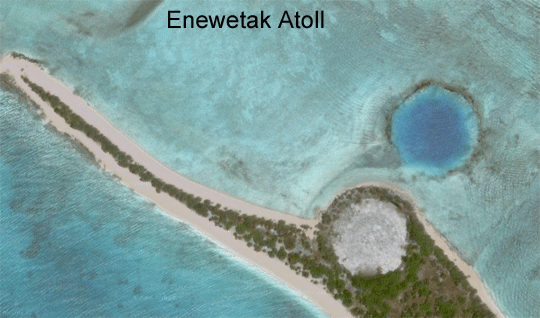
Marshall Islands’ nuclear clean-up workers concerned about radiation leaking
|
Nuclear warning: Toxic waste equivalent to 2,000 Hiroshima bombs could be leaking in sea https://www.express.co.uk/news/science/1191538/nuclear-waste-cold-war-cleanup-hiroshima-us-news-nuclear-bomb
A CONCRETE dome filled with nuclear waste could be leaking into the ocean, with experts urging the US government to act urgently as humans “cannot wait”.By SEAN MARTIN, Wed, Oct 16, 2019 |Enewetak Atoll is a series of small islands in the South Pacific which the US government used to test its nuclear weapons following World War 2 from 1948 to 1958. Over a ten year period, 30 megatons of weapons – equivalent to 2,000 Hiroshima bombs – were dropped on the islands during the Cold War. When the US had finished its testing, it built a concrete barrier known as the Runit dome to store the debris of 43 nuclear explosions in a clean-up operation lasting from 1977 to 1980.
However, employees who worked on the clean-up believe the dome could be leaking radioactive waste into to the ocean.
In response, the US has invested $1,689,000 (£1.32m) in a mission to analyse the dome, but there are claims that it could be too late as the waste could have seeped into the ocean, which would have an effect on the marine ecosystem.
Paul Griego, a former radiochemist who worked on the cleanup operation from June 1977 to October 1978, said: “We need the very same funding and for the very same analysis – the dome can wait for radiochemical analysis but we are human and we cannot wait.
While the US government said staff were subjected to just low-levels of radiation and wore all the necessary protective gear, Mr Griego has said this was not the case. The 62-year old added: “We are certain we have the very same radionuclides in our bodies that that would be found in the dome. “We were bombarded with radiation while building the dome, we drank the contaminated water, inhaled the dust-filled air, absorbed contaminates though our skin, ate the fish we caught and more. “We are not only denied the diagnostic resources, we are denied healthcare to cover our radiation and toxin-related illnesses.
“The government’s refusal to provide radiochemical resources is malicious and feeds into the status quo. “It places the burden of proof of an illness on the individual rather than the moral responsibility of our government.” The mission saw more than 1,000 employees tasked with collecting contaminated soil and radioactive debris, which was then mixed with concrete and placed in a nuclear test crater, which was sealed in a concrete dome.
However, people who were on the scene said that the dome was not lined with concrete, and warn it could be seeping into the ocean. For this reason, the US will embark on an 18 month mission to analyse the dome to see if needs to be reinforced or perhaps completely removed. Doug Domenech, Assistant US Secretary of the Interior for Insular and International Affairs, said: “The US Departments of the Interior and Energy are partnering on this important analysis of Runit Dome so that we can be responsive to both Congress and concerns expressed by the Enewetak community in the Marshall Islands.”
|
|
Radioactive chlorine from nuclear bomb tests still present in Antarctica
|
Radioactive chlorine from nuclear bomb tests still present in Antarctica, Phys Org, by Abigail Eisenstadt, American Geophysical Union 16 Oct 19, Antarctica’s ice sheets are still releasing radioactive chlorine from marine nuclear weapons tests in the 1950s, a new study finds. This suggests regions in Antarctica store and vent the radioactive element differently than previously thought. The results also improve scientists’ ability to use chlorine to learn more about Earth’s atmosphere. Scientists commonly use the radioactive isotopes chlorine-36 and beryllium-10 to determine the ages of ice in ice cores, which are barrels of ice obtained by drilling into ice sheets. Chlorine-36 is a naturally occurring radioactive isotope, meaning it has a different atomic mass than regular chlorine. Some chlorine-36 forms naturally when argon gas reacts with cosmic rays in Earth’s atmosphere, but it can also be produced during nuclear explosions when neutrons react with chlorine in seawater. Nuclear weapons tests in the United States carried out in the Pacific Ocean during the 1950s and the 1960s caused reactions that generated high concentrations of isotopes like chlorine-36. The radioactive isotope reached the stratosphere, where it traveled around the globe. Some of the gas made it to Antarctica, where it was deposited on Antarctica’s ice and has remained ever since. Other isotopes produced by marine nuclear bomb testing have mostly returned to pre-bomb levels in recent years. Scientists expected chlorine-36 from the nuclear bomb tests to have also rebounded. But new research in AGU’s Journal of Geophysical Research: Atmospheres finds the Vostok region of Antarctica is continuing to release radioactive chlorine into the atmosphere. Since naturally produced chlorine-36 is stored permanently in layers of Antarctica’s snow, the results indicate the site surprisingly still has manmade chlorine produced by bomb tests in the 1950s and in the 1960s……… https://phys.org/news/2019-10-radioactive-chlorine-nuclear-antarctica.html |
|
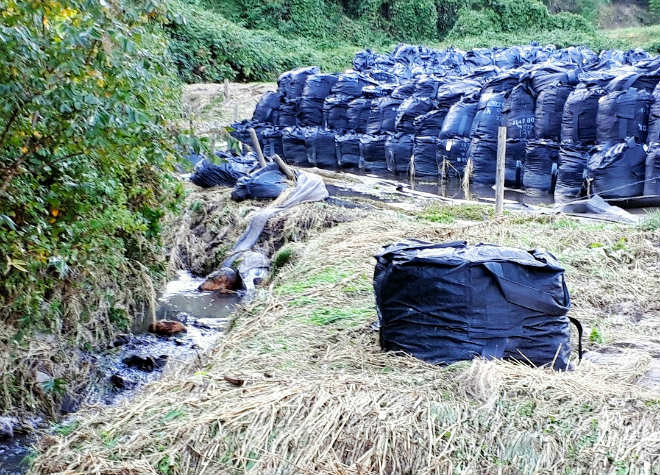
Bags of debris from Fukushima disaster swept away in typhoon
|
Bags of debris from Fukushima disaster swept away in typhoon http://www.asahi.com/ajw/articles/AJ201910140036.htmlBy TARO KOTEGAWA/ Staff Writer, October 14, 2019 Flexible bulk bags containing waste produced from decontamination work around the Fukushima No. 1 nuclear power plant were swept away in flooding during Typhoon No. 19 in Tamura, Fukushima Prefecture. (Hideyuki Miura) TAMURA, Fukushima Prefecture–Bulk bags filled with greenery collected during decontamination efforts after the nuclear disaster at the Fukushima No. 1 nuclear power plant were swept into a river during Typhoon No. 19 on Oct. 12. According to the Tamura city government, the bags were among 2,667 that have been stored temporarily at a site in the Miyakoji-machi district here. The facility was flooded after heavy rains brought by the typhoon, and the water carried an unknown number of the bags to a river about 100 meters away. A city government official received a phone call at around 9:20 p.m. on Oct. 12 from a nearby civil engineering firm, saying six of the bulk bags had been recovered from the river. Each of the bulk bags was 1 cubic meter in size. No sheets had been placed over the bags as a precaution against the rain and wind from the typhoon. A city official said consultations will be held with the Environment Ministry to determine possible effects on the environment. The decontamination effort involved removing debris, such as soil, leaves and plants, containing radioactive substances released after the 2011 triple meltdown at the Fukushima No. 1 plant. |
|
US govt to fund study of Marshall Islands nuclear dome water
However, Marshall Islands officials say the lagoon water is already more contaminated than the dome itself, which has been leaking.
The money announced last week will fund a radiochemical analysis of the water surrounding the crater, and an engineering survey of the structure.
Will Brexit mean a race to the bottom, in UK’s environmental protection standards?
Russell MSP has now written to Michael Gove demanding to know why the Government wishes to move away from these alignment regulations.
https://www.heraldscotland.com/news/17934543.fears-uk-government-race-bottom-environment-protection/
Sizewell C nuclear plan puts iconic British nature reserve in danger

The battle of nature versus nuclear: will Sizewell C destroy Minsmere nature reserve? Sophie Atherton Telegraph 22nd Sept 2019 Almost anywhere you walk at the RSPB’s Minsmere nature reserve, you get a view of the Sizewell nuclear power stations. They are a curiously ambivalent landmark, a somewhat menacing presence on the skyline, but also lending a moody, sci-fi edge to the landscape – especially on grey days when the dome of Sizewell B seems to appear and disappear depending on the passing clouds. It’s impossible not to notice the industrial behemoths, but because Minsmere is such a carnival of wildlife, you can, to a degree, ignore them. For now.
However, French energy company EDF and partner China General Nuclear Power Corporation want to build a nuclear power station to the north of the two already there.
Almost anywhere you walk at the RSPB’s Minsmere nature reserve, you get a view of the Sizewell nuclear power stations. EDF and partner China General Nuclear Power Corporation want to build a nuclear power station to the north of the two already there. Construction is due to start in 2021 and
going on for 10 to 12 years. “The plans EDF have shared have tried to indicate that the visual impact won’t be that great because of this bank of woodland,” says Rowlands, gesturing to a line of trees beyond the water overlooked by the Island Mere bird hide. “We’re trying to ascertain what
that means in reality.
I think at Hinkley – which they are modelling this station on – it’s something like 56 cranes at the peak of the construction but what does that look like – and even if the visual is somewhat obscured,
how does the noise travel? How does that affect the wildlife if it becomes more noisy?” The RSPB feels that EDF’s plans for Sizewell C throw up as many questions as answers and is concerned about the lack of information on the environmental impact of such a huge construction project so close to sites that are internationally renowned for their wildlife importance.
As well as the power station itself, building it requires new roads (for the daily journeys of hundreds of HGV lorries), a new rail link, a double-deck car park for 1,500 vehicles and several three and four-storey accommodation blocks providing 2,400 bed spaces for workers.
That’s merely a flavour, rather than an exhaustive list, of what will happen to this Area of
Outstanding Natural Beauty – on supposedly protected land – if Sizewell C goes ahead. One of the things that makes Minsmere so remarkable is that it has such a variety of different habitats. Some nature reserves are predominantly one type of landscape, but Minsmere has everything. The fate
of its reed beds, wet grassland, scrapes and lagoons, woodland, heath, vegetated shingle and beyond that the sea, along with all the thousands of species that live there, are all inextricably interconnected.
It is like a microcosm of the whole of the UK’s ecology. If one part is damaged, the whole will be affected as creatures and plants lose the conditions and then the food they need to survive.
Nuclear power is supposed to be a part of the UK’s plans for phasing out fossil fuels and moving to sustainable, eco-friendly, renewable energy sources. But if a new power station threatens to destroy the very things we are trying to protect, we have to consider carefully where to put it.
The latest stage of the Sizewell C public consultation closes on Sept 27. Details of how to respond can be found at sizewellc.co.uk
Surface melting causes Antarctic glaciers to slip faster towards the ocean
Direct link between surface melting and short bursts of glacier acceleration in Antarctica
- Date:
- September 20, 2019
- Source:
- University of Sheffield
- Summary:
- Study shows for the first time a direct link between surface melting and short bursts of glacier acceleration in Antarctica. During these events, Antarctic Peninsula glaciers move up to 100% faster than average. Scientists call for these findings to be accounted for in sea level rise predictions…….
https://www.sciencedaily.com/releases/2019/09/190920111355.htm
Nuclear watchdog groups warn legal action over environmental impact of plutonium pit production
|
Federal officials have set a deadline of 2030 for ramped-up production of plutonium pits. The work will be split between Los Alamos National Laboratory in northern New Mexico and the Savannah River Site in South Carolina. Lawyers for the Natural Resources Defense Council, Nuclear Watch New Mexico, Savannah River Site Watch and Tri-Valley Communities Against a Radioactive Environment threatened legal action in a letter sent this week to officials. In June, the National Nuclear Security Administration said it would prepare an environmental impact statement on pit-making at Savannah River. A less extensive review was planned for Los Alamos this week .
|
|
The ozone layer is repairing – international co-operation pays off
|
BY MAANI TRUU, 17 Sept 19, The world’s ozone layer is on track to be completely healed by the 2060s, according to modelling by the UN’s environmental agency (UNEP).
In the past 19-years, parts of the ozone layer have recovered at a rate of one to three per cent every ten years, UNEP has found. If this continues, the Northern Hemisphere’s ozone layer is set to heal completely by the 2030s, the Southern Hemisphere by the 2050s, and the polar regions in the following decade. As we rightly focus our energies on tackling climate change, we must be careful not to neglect the ozone layer and stay alert to the threat posed by the illegal use of ozone-depleting gases,” UN Secretary-General António Guterres said in a statement on Monday. “The recent detection of emissions of one such gas, CFC-11, reminds us that we need continued monitoring and reporting systems, and improved regulations and enforcement.” The ozone layer, made up of three types of oxygen atoms, is located approximately 15 kilometres above the earth and helps to protect the planet from ultraviolet rays that cause skin cancer, crop damage, eye cataracts and other issues. But since the late 1970s, the ozone layer had been consistently thinning due to the overuse of chemicals called chlorofluorocarbons, reaching a crisis point in the 1990s when about 10 per cent of the layer had been eroded. n 1987, UN members signed a treaty – known as the Montreal Protocol – aimed at phasing out ozone-depleting substances and developed replacements. According to the UNEP, the Montreal Protocol has successfully led to the removal of 99 per cent of chlorofluorocarbons, which previously existed in refrigerators, air-conditioners and other consumer products. “The Montreal Protocol is both an inspirational example of how humanity is capable of cooperating to address a global challenge and a key instrument for tackling today’s climate crisis,” Mr Guterres said. “Under this international treaty, nations have worked for 32 years to slash the use of ozone-depleting chemicals, used largely by the cooling industry. As a result, the ozone layer that shields us from the sun’s harmful ultraviolet radiation is healing.” The ozone layer is also instrumental in curbing the effects of climate change, with the barrier stopping approximately 135 billion tonnes of carbon dioxide emissions from entering the atmosphere between 1990 to 2010, UNEP said. Earlier this year, China came under fire for allegedly releasing large quantities of banned chemical Chlorofluorocarbon-11 (CFC-11) into the atmosphere, in violation of the UN treaty. |
|
|

Strong environmental case to scrap Bradwell B new nuclear build
 Mersea Island Courier 16th Sept 2019, Native oysters at risk from new nuclear build. Graham Farley of Mersea Island Environmental Alliance (MIEA) shares why marine life in the
Blackwater Estuary will be at risk if the Bradwell B nuclear new-build goes
ahead.
CHINA General Nuclear Power Group (CGN) and EDF Energy are currently
circulating updates on the proposed Bradwell new-build nuclear project. In
their article they say that members of the public have a chance to win a
photographic competition or even submit their happy memories associated
with the original Bradwell Magnox Station!
My memories of the Bradwell Magnox station include: radioactive leaks, record fines, more leaks and attempts to cover up a catalogue of failures including the failed FED
dumping of radioactive waste in our estuary.
Unsurprisingly, there are no mentions of climate change and environmental protection in their
literature. It was assumed that with the decreasing cost of green energy,
spiralling costs of new nuclear projects and collapse of other UK proposed
nuclear builds that Bradwell would be shelved.
However, this isn’t so, as we have a copy of a Marine Licence application from July this year to
survey the estuary, which confirms that the project is still moving
forward. This document confirms the power station “will likely operate
with cooling water abstracted from the Blackwater Estuary”.
The case I’m making to stop the nuclear new build at Bradwell is environmental:
the Blackwater Estuary is one of the most important wildlife habitats in
the country, therefore safeguarding and preserving this habitat for future
generations is a priority! We must protect of the delicate ecology of the
mud flats, salt marsh and the shallow estuary with its many international
environmental protections and UK Marine Conservation Zone (MCZ) status.
Opposition in Suffolk to Sizewell nuclear plan, which hugely threatens wildlife
ITV 15th Sept 2019, RSPB hosts new festival in response to EDF’s plans to build nuclear reactor
at the edges of a nature reserve. A thousand people attended a festival
today organised by the RSPB in response to EDF’s plans to build a nuclear
reactor in Suffolk. Sizewell C will be built on the boundary of the
Minsmere Nature Reserve which is home to more than five and a half thousand
species of wildlife.
The RSPB manages the site and opposes the energy
giants plans. They say building the reactor so close to the nature reserve
could threaten the thousands of different species of wildlife that call
Minsmere home. EDF say that the environmental impact of the new site would
be kept to a minimum, and argue that new jobs for local people will be
provided.
Among the visitors supporting the festival today (Sunday,
September 15) was television presenter, Bill Turnbull, who lives nearby. He
said: There’s no infrastructure or communications for it here. What is
here, is Minsmere – where the RSPB have been trying really hard to get all
these birds to come back. And we are going to risk it all just simply
because it’s a convenient place to build a power station.” The public
consultation into EDF’s proposal for Sizewell C will end on September 27.
Russia’s nuclear torpedoes at the bottom of the sea
A Dead Russian Submarine Armed with Nuclear Torpedoes was Never Recovered, National Interest, Robert Farley, September 15, 2019
Key point: She rests at a depth of 15,000 feet —too deep to make recovery practical.
The Novembers (627):

Japan says TEPCO will dump more than 1 million tons of radioactive water from Fukushima nuclear plant into Pacific Ocean
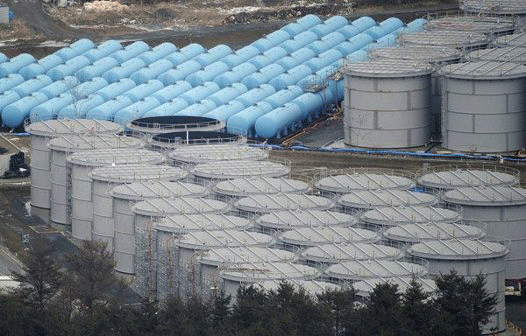
10 Sept 2019 | Japan’s environment minister announced Tuesday that the country will have to dump radioactive water from the Fukushima power plant into the ocean because it is running out of space, Reuters reported. According to Reuters, Tokyo Electric, or Tepco, has collected more than 1 million tonnes of contaminated water from the cooling pipes used to keep fuel cores from melting since the plant was crippled by an earthquake and tsunami in 2011. “The only option will be to drain it into the sea and dilute it,” the minister, Yoshiaki Harada, told a news briefing in Tokyo…The government is awaiting a report from an expert panel before making a final decision on how to dispose of the radioactive water. (The Hill, Reuters)
1 This Month



26 September – International Day for the Total Elimination of Nuclear Weapons


PLEASE OPPOSE HR 8255 AND S.3639 – bills would accelerate satellite deployment, with no environmental review or safeguards – https://ncstd5li.quorum.us/campaign/169331/
To see nuclear-related stories in greater depth and intensity – go to https://nuclearinformation.wordpress.com
-
Archives
- September 2026 (245)
- August 2026 (330)
- July 2026 (355)
- June 2026 (287)
- May 2026 (306)
- April 2026 (356)
- March 2026 (251)
- February 2026 (267)
- January 2026 (308)
- December 2025 (358)
- November 2025 (359)
- October 2025 (375)
-
Categories
- 1
- 1 NUCLEAR ISSUES
- business and costs
- climate change
- culture and arts
- ENERGY
- environment
- health
- history
- indigenous issues
- Legal
- marketing of nuclear
- media
- opposition to nuclear
- PERSONAL STORIES
- politics
- politics international
- Religion and ethics
- safety
- secrets,lies and civil liberties
- spinbuster
- technology
- Uranium
- wastes
- weapons and war
- Women
- 2 WORLD
- ACTION
- AFRICA
- Atrocities
- AUSTRALIA
- Christina's notes
- Christina's themes
- culture and arts
- Events
- Fuk 2022
- Fuk 2023
- Fukushima 2017
- Fukushima 2018
- fukushima 2019
- Fukushima 2020
- Fukushima 2021
- general
- global warming
- Humour (God we need it)
- Nuclear
- RARE EARTHS
- Reference
- resources – print
- Resources -audiovicual
- Weekly Newsletter
- World
- World Nuclear
- YouTube
-
RSS
Entries RSS
Comments RSS
 nuclear-news