Problematic question of Fukushima food at the Olympic Games
Japan grapples with serving Fukushima food at Olympics, Channel News Asia, 20 Nov 19, FUKUSHIMA: For years, Japan’s government has sought to convince consumers that food from Fukushima is safe despite the nuclear disaster. But will it serve the region’s produce at the Tokyo Olympics?
It’s a thorny subject for the authorities. They pitched the Games in part as a chance to showcase the recovery of areas affected by the 2011 tsunami and nuclear disaster.
Government officials tout strict checks on food from the region as evidence that the produce is completely safe, but it remains unclear whether athletes and sports teams from around the world will be convinced.
In the Fukushima region, producers are keen to see their products served at the Olympic village and have submitted a bid to the organisers.
“The Fukushima region has put forward food from 187 producers and is second only to Hokkaido when it comes to meeting the specified criteria in terms of range of products,” said Shigeyuki Honma, assistant director general of the local government’s agriculture and forestry planning division.
“Fukushima wants to serve athletes its rice, its fruits, beef and vegetables. But the committee still has to decide.”……
the figures have only gone some way to reassuring foreign officials: numerous countries including China, South Korea, and the United States maintain restrictions on the import of some or all produce from Fukushima.
South Korea, which is currently locked in a dispute with Japan over wartime issues, has been vocal about its concerns ahead of the Olympics, even raising the possibility of bringing in its own kitchen and food.
“We have requested the Olympic organisers to provide objective data verified by an independent third body,” the South Korean Sports and Olympic Committee said in a statement earlier this year.
“Since Japan repeatedly said its food from Fukushima is safe, we have demanded they provide statistics and data to back up their claims,” an official with the committee told AFP.
The position underlines a long-running problem for Japan: while it points to its extensive, government-mandated checks as proof of safety, many abroad feel the government is not an objective arbiter……..
The International Olympic Committee said it was still weighing how to handle the matter.
“Food menus and catering companies for the Olympic Village are under discussion and have yet to be defined,” a spokesman told AFP.
The Tokyo 2020 organisers said promoting areas affected by the 2011 disaster remains a key goal…….
South Korea’s safety concerns about Fukushima water release
 South Korea Nuclear Regulator Wants Information on Radioactive Fukushima Water Release, By Reuters, 20 Nov. SEOUL — Japan’s reluctance to disclose information about the release of radioactive water from its damaged Fukushima nuclear plant is hampering neighboring countries’ efforts to minimize the impact, the head of South Korea’s nuclear safety agency said on Wednesday.
Since the 2011 earthquake and tsunami caused a meltdown at some of the reactors the Fukushima plant, owner Tokyo Electric Power Co (Tepco) has been storing radioactive water in tanks at the site from the cooling pipes used to keep the fuel cores from melting. The utility will run out of space for the water in 2022.
Japan has not yet decided how to deal with the contaminated water, but its environment minister said in September that radioactive water would have to be released from the site into the Pacific Ocean.
“We have been raising Japan’s radioactive water issue to the international community to minimize the impact … but as Japan hasn’t disclosed any specific plan and process we would need more details to run simulations and study,” Uhm Jae-sik, chairman of the Nuclear Safety and Security Commission, told Reuters.
In addition to the Fukushima crisis, safety concerns about nuclear energy have increased in South Korea following a 2012 scandal over the supply of faulty reactors parts with forged documents, prompting a series of shutdowns of nuclear reactors.
South Korea, the world’s fifth-largest user of nuclear power, targets a long-term phase out of atomic power to allay public concerns.
“Regardless of the government’s energy policy change, our primary goal is ensuring the safety of nuclear power,” Uhm said.
South Korea operates 25 nuclear reactors, which generate about a third of the country’s total electricity. Of the 25 reactors, 10 are offline for maintenance, according to the website of Korea Hydro & Nuclear Power.
(Reporting By Jane Chung; Editing by Christian Schmollinger) https://www.nytimes.com/reuters/2019/11/20/world/asia/20reuters-southkorea-nuclear.html
Japan’s METI says it’s safe to dump radioactive water from Fukushima nuclear disaster into ocean
The industry ministry said Monday it would be safe to release water contaminated by the Fukushima nuclear disaster into the ocean, stressing that on an annual basis the amount of radiation measured near the release point would be very small compared to levels to which humans are naturally exposed.
Discharging the water into the Pacific Ocean over the course of a year would amount to between just one-1,600th and one-40,000th of the radiation to which humans are naturally exposed, the Economy, Trade and Industry Ministry, or METI, told a government subcommittee on the issue.
Water used to cool the melted-down cores and groundwater from close to the damaged plant contain some radioactive materials, and are currently being collected and stored in tanks on the plant grounds.
But space is running out fast, and the government is exploring ways to deal with the waste water — which already totals more than 1 million tons with the volume increasing by more than 100 tons every day.
According to an estimate performed by the ministry, annual radiation levels near the release point after a release would be between 0.052 and 0.62 microsievert at sea, and 1.3 microsieverts in the atmosphere, compared with the 2,100 microsieverts that humans come into contact with each year in daily life.
One member of the subcommittee called on the ministry to provide detailed data showing the impact of different conditions such as ocean currents and weather.
Another member requested more information on the amount of radiation that people will be exposed to internally, depending on how much fish and seaweed they consume.
The waste water is currently being treated using an advanced liquid processing system referred to as ALPS, though the system does not remove tritium and has been found to leave small amounts of other radioactive materials.
The tanks storing the water are expected to become full by the summer of 2022, according to Tokyo Electric Power Company Holdings Inc., the operator of the Fukushima No. 1 nuclear power plant.
The plant was damaged by a magnitude 9.0 earthquake and ensuing tsunami on March 11, 2011.
While government officials stress the safety of releasing the waste water, local fishermen are opposed to discharging it into the ocean due to worries that it would cause reputational damage and impact their livelihoods.
South Korea has also expressed concern over the environmental impact.
In September, Japanese and South Korean officials traded barbs over the issue at a meeting of the International Atomic Energy Agency in Vienna.
A nuclear expert from the IAEA said in 2018 that a controlled discharge of such contaminated water “is something which is applied in many nuclear facilities, so it is not something that is new.”
The “Plutocene” danger – nuclear war, radioactive pollution, global heating
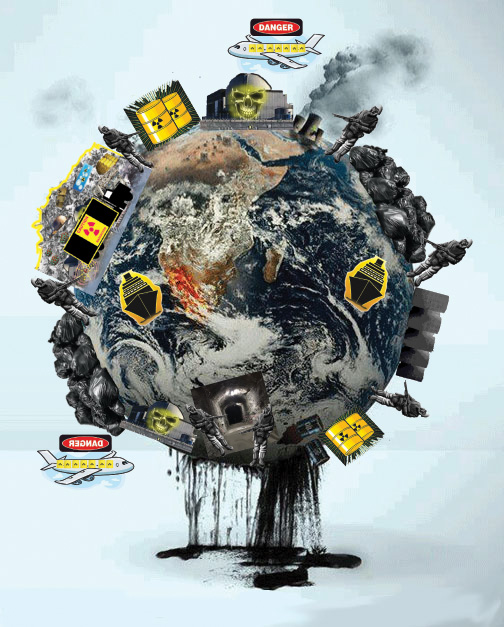
Why are these two facts related? Because they illustrate the two factors that could transport us beyond the Anthropocene—the geological epoch marked by humankind’s fingerprint on the planet—and into yet another new, even more hostile era of our own making.
My new book, titled The Plutocene: Blueprints for a post-Anthropocene Greenhouse Earth, describes the future world we are on course to inhabit, now that it has become clear that we are still busy building nuclear weapons rather than working together to defend our planet.
have coined the term Plutocene to describe a post-Anthropocene period marked by a plutonium-rich sedimentary layer in the oceans. The Anthropocene is very short, having begun (depending on your definition) either with the Industrial Revolution in about 1750, or with the onset of nuclear weapons and sharply rising greenhouse emissions in the mid-20th century. The future length of the Plutocene would depend on two factors: the half-life of radioactive plutonium-239 of 24,100 years, and how long our CO2 will stay in the atmosphere—potentially up to 20,000 years.
During the Plutocene, temperatures would be much higher than today. Perhaps they would be similar to those during the Pliocene (2.6 million to 5.3 million years ago), when average temperatures were about 2℃ above those of pre-industrial times, or the Miocene (roughly 5.3 million to 23 million years ago), when average temperatures were another 2℃ warmer than that, and sea levels were 20 to 40 meters (65-131ft) higher than today.
Under these conditions, population and farming centres in low coastal zones and river valleys would be inundated, and humans would be forced to seek higher latitudes and altitudes to survive—as well as potentially having to contend with the fallout of nuclear conflict. The most extreme scenario is that evolution takes a new turn—one that favors animals best equipped to withstand heat and radiation.
Climates past
While we have a range of tools for studying prehistoric climates, including ice cores and tree rings, these methods do not of course tell us what the future holds.
However, the basic laws of physics, the principles of climate science, and the lessons from past and current climate trends, help us work out the factors that will dictate our future climate.
Broadly speaking, the climate is shaped by three broad factors: trends in solar cycles; the concentration of atmospheric greenhouse gases; and intermittent events such as volcanic eruptions or asteroid impacts.
Solar cycles are readily predicted, and indeed can be seen in the geological record, whereas intermittent events are harder to account for. The factor over which we have the most control is our own greenhouse emissions.
CO2 levels have previously climbed as high as 2,000 parts per million (ppm), most recently during the early Eocene, roughly 55-45 million years ago. The subsequent decline of CO2 levels to just a few hundred parts per million then cooled the planet, creating the conditions that allowed Earth’s current inhabitants (much later including humans) to flourish.
But what of the future? Based on these observations, as reported by the Intergovernmental Panel on Climate Change (IPCC), several projections of future climates indicate an extension of the current interglacial period by about 30,000 years, consistent with the longevity of atmospheric CO2.
If global warming were to reach 4℃, as suggested by Hans Joachim Schellnhuber, chief climate advisor to the German government, the resulting amplification effects on the climate would pose an existential threat both to nature and human civilization.
Barring effective sequestration of carbon gases, and given amplifying feedback effects from the melting of ice sheets, warming of oceans, and drying out of land surfaces, Earth is bound to reach an average of 4℃ above pre-industrial levels within a time frame to which numerous species, including humans, may hardly be able to adapt. The increase in evaporation from the oceans and thereby water vapor contents of the atmosphere leads to mega-cyclones, mega-floods and super-tropical terrestrial environments. Arid and semi-arid regions would become overheated, severely affecting flora and fauna habitats.
The transition to such conditions is unlikely to be smooth and gradual, but may instead feature sharp transient cool intervals called “stadials.” Increasingly, signs of a possible stadial are being seen south of Greenland.
A close analogy can be drawn between future events and the Eocene-Paleocene Thermal Maximum about 55 million years ago, when release of methane from Earth’s crust resulted in extreme rise in temperature. But as shown below, [ diagram on original] the current rate of temperature rise is far more rapid—and more akin to the planet-heating effects of an asteroid strike.
Mounting our defense
Defending ourselves from global warming and nuclear disaster requires us to do two things: stop fighting destructive wars, and start fighting to save our planet. There is a range of tactics we can use to help achieve the second goal, including large-scale seagrass cultivation, extensive biochar development, and restoring huge swathes of the world’s forests.
Space exploration is wonderful, but we still only know of one planet that supports life (bacteria possibly excepted). This is our home, and there is currently little prospect of realising science fiction’s visions of an escape from a scorched Earth to some other world.
Yet still we waver. Many media outlets operate in apparent denial of the connection between global warming and extreme weather. Meanwhile, despite diplomatic progress on nuclear weapons, the Sword of Damocles continues to hang over our heads, as 14,900 nuclear warheads sit aimed at one another, waiting for accidental or deliberate release.
If the clock does strike nuclear midnight, and if we don’t take urgent action to defend our planet, life as we know it will not be able to continue. Humans will survive in relatively cold high latitudes and altitudes. A new cycle would begin.
Andrew Glikson is an Earth and paleo-climate scientist at the Australian National University.
Likely delay in clean-up of radioactive contamination at Dalgety Beach
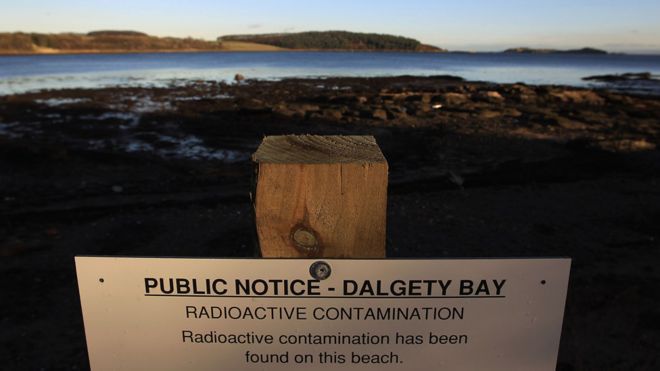
STV 13th Nov 2019, A clean-up operation to deal with radioactive contamination at a Fife beachis being held up by local landowners. Thousands of radioactive particles have been found on the shore at Dalgety Bay since 1990.
The objects are believed to come from eroded landfill that contains debris from Second World War aircraft that originally had radium dials. Stephen Ritchie told councillors: “We actually have had cabinet approval, ministerial approval – we have all the funding we need and authority to proceed. “However, the local stakeholders are dragging their feet. ”
We can’t get on the land to clean up the waste without the landowners’ permission. “There are four stakeholders for the area – one of which is the Crown, which is obviously not an issue. However, the other three have been dragging their feet.” Mr Ritchie told councillors that the MoD were looking to award the contract to a company to remove the waste by December 13, but if talks continued to stall, they could miss their window and the project would be delayed,meaning that the clean-up might not be able to happen in 2020.
https://stv.tv/news/east-central/1442361-work-to-clean-up-radioactive-beach-delayed-by-landowners/
Nuclear tomb: The Runit Dome is chipping and cracking
|
Radioactive ‘Tomb’ in Pacific Filled With Nuclear Waste Is Starting to Crack, Science Alert ARIA BENDIX, BUSINESS INSIDER, 12 NOV 2019
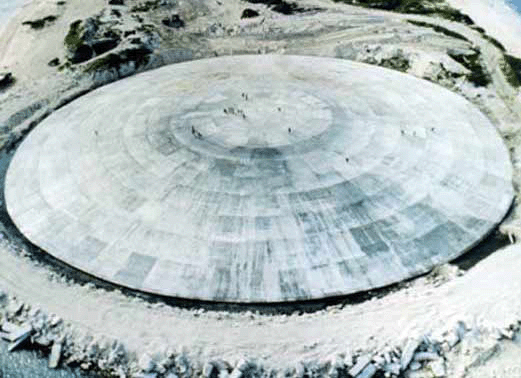
In the Marshall Islands, locals have a nickname for the Runit Dome nuclear-waste site: They call it ‘The Tomb’. The sealed pit contains more than 3.1 million cubic feet (87,800 cubic meters) of radioactive waste, which workers buried there as part of efforts to clean hazardous debris left behind after the US military detonated nuclear bombs on the land. From 1977 to 1980, around 4,000 US servicemen were tasked with cleaning up the former nuclear testing site of Enewetak Atoll. They scooped up the contaminated soil, along with other radioactive waste materials such as military equipment, concrete, and scrap metal. It all went into the Runit Dome, which the servicemen then covered with concrete. In total, the crater holds enough radioactive waste to fill 35 Olympic-sized swimming pools. Most of that is irradiated soil carrying plutonium, an isotope that can cause lung cancer if inhaled. But as seas have gotten higher in the area – the water has risen about 7 millimetres per year since 1993 – water has begun to seep into the soil beneath the dome. Unlike the sealed dome on top, the bottom of the pit was never lined with concrete. So now, rising tides threaten to submerge the tomb – or crack it open. The Runit Dome is chipping and crackingPrior to the nuclear tests in the 1940s and 1950s, residents of Enewetak Atoll were exiled from their homes and relocated to nearby islands. Today, only three of the atoll’s 40 islands have been dubbed safe for human habitation. They are currently home to around 650 residents. The island that hosts Runit Dome remains unoccupied. In 2013, the US Department of Energy reported that radioactive materials could be leaking from the dome into the marine environment, but said such an occurrence would “not necessarily lead to any significant change in the radiation dose delivered to the local resident population.” But sea levels around the Marshall Islands are rising. By 2030, they could be between 1.2 and 6.3 inches (3 cm to 16 cm) higher than they are now, resulting in more storm surges and coastal flooding. By 2100, the dome could be submerged in water. Locals fear that mounting damage to the structure could present a new set of health risks. The dome recently began to crack and chip, increasing the odds that strong waves could force the structure open. A disaster like that would send even more radioactive waste into the nearby ocean or lagoon, which could even force locals to leave the island once again. “If it does [crack] open, most of the people here will be no more,” Christina Aningi, a teacher on Enewetak Atoll, told the Australian Broadcasting Corporation. “This is like a graveyard for us, waiting for it to happen.”…….https://www.sciencealert.com/a-tomb-in-the-marshall-islands-contains-a-huge-amount-of-radioactive-waste |
|
400,000 insect species face extinction

‘Insect apocalypse’ poses risk to all life on Earth, conservationists warn
Report claims 400,000 insect species face extinction amid heavy use of pesticides, Guardian, Damian Carrington Environment editor
A new report suggested half of all insects may have been lost since 1970 as a result of the destruction of nature and heavy use of pesticides. The report said 40% of the 1million known species of insect are facing extinction.
The analysis, written by one of the UK’s leading ecologists, has a particular focus on the UK, whose insects are the most studied in the world. It said 23 bee and wasp species have become extinct in the last century, while the number of pesticide applications has approximately doubled in the last 25 years.
UK butterflies that specialise in particular habitats have fallen 77% since the mid-1970s and generalists have declined 46%, the report said. There are also knock-on effects on other animals, such as the spotted flycatcher which only eats flying insects. Its populations have dropped by 93% since 1967.
But conservationists said that insect populations can be rescued, by introducing firm targets to cut pesticide use and making urban parks and gardens more wildlife friendly. Scientists said insects are essential for all ecosystems, as pollinators, food for other creatures, and recyclers of nutrients.
“We can’t be sure, but in terms of numbers, we may have lost 50% or more of our insects since 1970 – it could be much more,” said Prof Dave Goulson, at the University of Sussex, UK, who wrote the report for the Wildlife Trusts. “We just don’t know, which is scary. If we don’t stop the decline of our insects there will be profound consequences for all life on earth [and] for human wellbeing.”……
The planet is at the start of a sixth mass extinction in its history, with huge losses already reported in larger animals that are easier to study. But insects are by far the most varied and abundant animals, outweighing humanity by 17 times.
Insect population collapses have been reported in Germany and Puerto Rico, and the first global scientific review, published in February, said widespread declines threaten a “catastrophic collapse of nature’s ecosystems”.
Insects can be helped to recover by “rewilding” urban gardens and parks, Goulson said. “There is potential for a huge network of insect-friendly habitats right across the country. Already a lot of people are buying into the idea that they can make their gardens more wildlife friendly by letting go of control a bit. There are also quite a lot of councils going pesticide free.”
But he said: “The bigger challenge is farming – 70% of Britain is farmland. No matter how many gardens we make wildlife friendly, if 70% of the countryside remains largely hostile to life, then we are not going to turn around insect decline.”……. https://www.theguardian.com/environment/2019/nov/13/insect-apocalypse-poses-risk-to-all-life-on-earth-conservationists-warn
The climate crisis is tied up in the dangers of nuclear weapons in ways that nobody predicted
The Climate Crisis Just Went Nuclear https://www.esquire.com/news-politics/politics/a29760935/marshall-islands-nuclear-waste-climate-change/ In the Marshall Islands, local residents are reaping what the United States sowed—which includes tons and tons of nuclear and biological waste from Cold War testing.BY CHARLES P. PIERCE
The climate crisis is the one issue that touches all the other issues. For example, the climate crisis is tied up in the dangers of nuclear weapons in ways that nobody predicted, but that the Los Angeles Times spent some time and money examining. Back in the 1950s and 1960s, the United States set off 67 nuclear bombs in and around the Marshall Islands. This had predictable results: there were now lagoons where there were none before; some islands simply aren’t there any more, and there was a lot of deadly stuff left behind. Which brings us to the climate crisis.
Here in the Marshall Islands, Runit Dome holds more than 3.1 million cubic feet — or 35 Olympic-sized swimming pools — of U.S.-produced radioactive soil and debris, including lethal amounts of plutonium. Nowhere else has the United States saddled another country with so much of its nuclear waste, a product of its Cold War atomic testing program.
U.S. authorities later cleaned up contaminated soil on Enewetak Atoll, where the United States not only detonated the bulk of its weapons tests but, as The Times has learned, also conducted a dozen biological weapons tests and dumped 130 tons of soil from an irradiated Nevada testing site. It then deposited the atoll’s most lethal debris and soil into the dome. Now the concrete coffin, which locals call “the Tomb,” is at risk of collapsing from rising seas and other effects of climate change. Tides are creeping up its sides, advancing higher every year as distant glaciers melt and ocean waters rise.
When people talk about environmental justice, this is what they’re talking about.
Officials in the Marshall Islands have lobbied the U.S. government for help, but American officials have declined, saying the dome is on Marshallese land and therefore the responsibility of the Marshallese government. “I’m like, how can it [the dome] be ours?” Hilda Heine, the president of the Republic of the Marshall Islands, said in an interview in her presidential office in September. “We don’t want it. We didn’t build it. The garbage inside is not ours. It’s theirs.” … They blame the United States and other industrialized countries for global climate change and sea level rise, which threaten to submerge vast swaths of this island nation’s 29 low-lying atolls.
The history behind all this is as tawdry as you might have expected it to be—an endless litany of lies, deception, and bureaucratic three-card monte, all of it designed to dodge any responsibility for the nightmares past, present, and future.
Over the last 15 months, a reporting team from the Los Angeles Times and Columbia University’s Graduate School of Journalism made five trips to the Marshall Islands, where they documented extensive coral bleaching, fish kills and algae blooms — as well as major disease outbreaks, including the nation’s largest recorded epidemic of dengue fever. They interviewed folk singers who lost their voices to thyroid cancers and spent time in Arkansas, Washington and Oregon, where tens of thousands of Marshallese have migrated to escape poverty and an uncertain future.
Over the last 15 months, a reporting team from the Los Angeles Times and Columbia University’s Graduate School of Journalism made five trips to the Marshall Islands, where they documented extensive coral bleaching, fish kills and algae blooms — as well as major disease outbreaks, including the nation’s largest recorded epidemic of dengue fever. They interviewed folk singers who lost their voices to thyroid cancers and spent time in Arkansas, Washington and Oregon, where tens of thousands of Marshallese have migrated to escape poverty and an uncertain future.
One example: The United States did not tell the Marshallese that in 1958, it shipped 130 tons of soil from its atomic testing grounds in Nevada to the Marshall Islands. U.S. authorities also didn’t inform people in Enewetak, where the waste site is located, that they’d conducted a dozen biological weapons tests in the atoll, including experiments with an aerosolized bacteria designed to kill enemy troops. U.S. Department of Energy experts are encouraging the Marshallese to move back to other parts of Enewetak, where 650 now live, after being relocated during the U.S. nuclear tests during the Cold War. But many Marshallese leaders no longer trust U.S. assurances of safety.
Can’t imagine why they’d think that.
Adding to the alarm is a study published this year by a team of Columbia University scientists showing levels of radiation in some spots in Enewetak and other parts of the Marshall Islands that rival those found near Chernobyl and Fukushima. Such discoveries could give Marshallese leaders fresh ammunition to challenge the 1986 compact, which is up for renegotiation in 2023, and also to press the United States to honor property and
health claims ordered by an international tribunal. The tribunal, established by the two countries in 1988, concluded the United States should pay $2.3 billion in claims, but Congress and U.S courts have refused. Documents show the U.S. paid just $4 million.
And what in the hell was this?
A decade later, in 1968, teams from the Department of Defense set up a new experiment. This time, they were testing biological weapons — bombs and missiles filled with bacteria designed to fell enemy troops. According to a 2002 military fact sheet and Ed Regis, the author of “The Biology of Doom,” U.S. government scientists came to Enewetak with “their boats and monkeys, space suits and jet fighter planes” and then sprayed clouds of biologically enhanced staphylococcal enterotoxin B, an incapacitating biological agent known to cause toxic shock and food poisoning and considered “one of the most potent bacterial superantigens.” The bacteria were sprayed over much of the atoll — with ground zero at Lojwa Island, where U.S. troops were stationed 10 years later for the cleanup of the atoll.
I don’t know what happens when the dome gives way, but I feel confident in saying a) it won’t be good, and b) we won’t hear about it for a couple of years, at least.
Frozen nuclear city to ‘seep radiation into environment’ as ice melts
CAMP CENTURY: CLIMATE AND ICE MONITORING
Next Chernobyl? Frozen nuclear city to ‘seep radiation into environment’ as ice melts
A FROZEN underground city could be threatening to seep radioactive materials into the environment as climate change forces the ice to melt. Express UK By CALLUM HOARE Nov 8, 2019
Project Icework was a top secret United States Army programme of the Cold War, aimed at building a network of mobile nuclear missile launch sites below the Greenland ice sheet due to its strategic location near the Soviet Union. To study the feasibility of working under the ice, a highly publicised “cover” project, known as Camp Century, was launched in 1960, but six years later it was cancelled due to unstable conditions. The nuclear reactor was removed before the site was abandoned, but hundreds of tonnes of toxic waste remain buried beneath the ice.
Now, climate change is threatening to expose it, as the ice melts at an alarming rate.
YouTube channel Seeker spoke to William Colgan, who is currently running The Camp Century Climate Monitoring Programme, in the hope of preventing the radioactive material from reaching the surface.
He said in 2018: “The people working at Camp Century did not have an understanding of climate change. “They didn’t have solid records, global climate models, these big data sets so you can see an overview of what’s happening to Earth’s climate.
The moving ice sheet started to destabilise the underground tunnels, prompting the US Army to abort Project Iceworm.
“When Camp Century was decommissioned, only the nuclear reactor was taken out for destructive testing, and the rest of the camp was left in place, and they closed the doors.
“It was abandoned on the assumption that climate wouldn’t change, and it would continue to snow at Camp Century forever and the perpetual snowfall would entomb all of the base infrastructures and eventually bury it.”
The narrator of the series explained why Dr Colgan is so invested in the project.
He said: “The climate has changed and temperatures have reached record highs in the Arctic and Greenland’s ice sheet is melting at an unprecedented rate, which could turn Camp Century’s abandoned waste into a major environmental risk.
So a team of scientists, including William, went back to the site.”
Dr Colgan explained what his team is doing.
He added: “In 2017, the government of Denmark, at the request of the government of Greenland, started the Camp Century Climate Monitoring Programme.
“We set up a bunch of instruments that are erected on the ice sheet surface and then we drill in and we put probes into the ice sheet.
“It keeps a real-time data stream coming from the Camp Century site where we monitor a bunch of things, mainly the temperature of the snow, the temperature of the ice and the air temperature…….https://www.express.co.uk/news/science/1201199/nuclear-warning-cold-war-camp-century-project-iceworm-radiation-climate-change-spt
Farmers oppose plan for groundwater to be taken for nuclear power
 West Valley farmers fight APS attempt to take water for nuclear , RoseLawGroup Reporter, plant https://roselawgroupreporter.com/2019/11/west-valley-farmers-fight-aps-attempt-to-take-water-for-nuclear-plant/ Posted by Staff / November 6, 2019 By Ryan Randazzo | Arizona Republic Arizona Public Service Co. has applied to pump “poor-quality” groundwater from the West Valley that the company says Buckeye farmers are wasting. But the farmers say the water is neither poor nor wasted.
APS wants to take some of the high-saline water from underground and test whether it is cost effective to use at the Palo Verde Nuclear Generating Station about 50 miles west of Phoenix.
Unlike most nuclear facilities that use river or seawater to cool the reactors, Palo Verde uses treated effluent water.
Right now, it gets all of its water from the 91st Avenue Wastewater Treatment Plant. But the cost of that treated effluent water is going to increase over time, so the plant is seeking alternatives.
“If we don’t get some kind of innovative approach to water, 20 or 30 years down the road, the costs would just be prohibitive,” said Jack Cadogan, senior vice president of site operations at Palo Verde for APS. “We’ve always known we would be looking for innovative, cost-effective solutions for water.”…….
Toxic effects of uranium mining on indigenous communities
 Coconino Voices: Solving Our Toxic Nuclear Legacy, https://azdailysun.com/opinion/columnists/coconino-voices-solving-our-toxic-nuclear-legacy/article_b8e2ef35-31fe-5cb0-a844-6c0fba973c19.html, BRYAN BATES, 30 Oct 19,
-
- When creating any system, whether a building, a community or an energy system, waste products need to be safely managed. This should be true if we’re building an energy system where the waste products can cause cancer and genetic mutations in humans or any organism within range of long-lived radioactive particles. However, it hasn’t been.
First discovered in 1895, radiation was shown to kill bacteria in 1898; however, with a high energy potential and money-making promise, radioactivity was not linked to cancer and genetic change until much later and even then its true health effects were hidden from miners and the public.
Because the geologic Chinle Formation on the Navajo Nation is rich in Uranium, Navajo men were put to work without protection from known hazards. Several hundred Navajos became sick from radiation exposure, many at the same time that other Navajos enlisted in the Marines to become Navajo Code Talkers.
Health effects from mining Uranium persist on the Navajo Nation with numerous pit mines still open and potentially affecting water, plants, livestock and Navajo. The amount of pain, illness, death and cost are still unknown. (See Judy Pasternak, 2011, Yellow Dirt.)
With the geologic uplift of the Grand Canyon upwarp, it’s hypothesized that numerous vertical shafts eroded allowing broken rock carrying Uranium from the Chinle Formation to fall into these “breccia pipes”. Left alone, the Uranium and other metals remain isolated from the biotic world; drilled into, these metals can migrate into interconnected aquifers that discharge into the Colorado River, water often used to grow food. The Grand Canyon upwarp has the greatest concentration of Uranium containing breccia pipes in the world.
This region is sacred to the Hopi, Navajo, Pai and other native people. The Canyon Mine has promised to create jobs; however, tourism and outdoor activities “support over 9,000 jobs, contribute over $938 million annually to (local) economies, and generate over $160 million in annual state and local tax revenues. Uranium mining threatens these economic drivers while possessing little capacity to support the regional economy.” (www.grandcanyontrust.org).
Under President Obama, a twenty-year moratorium on Uranium mining was instituted to allow for compilation and review of scientific information and energy policy. President Trump has requested and will receive a proposal from the nuclear industry to assess opening up mining on the Grand Canyon upwarp.
Mined Uranium would be used to generate nuclear electricity in reactors that are at or nearing their engineered lifespan. Building new nuclear reactors is massively expensive and concrete, the primary component of reactors, is the second largest emitter of climate changing CO2. (United Nations, IPCC report). Claims that nuclear energy is climate neutral only look at the internal nuclear reaction and ignore the entire fuel cycle necessary to keep the nuclear system functioning. Currently, nuclear waste is stored on-site at numerous reactors, several of which have moderate security and leaky infrastructure. The one national nuclear repository, Yucca Mountain, has been mothballed after expending $15Billion of taxpayer money.
To be sure, mining engineers are very intelligent people, and if they can pull Uranium out of breccia pipes, they can pull Uranium out of 1940’s open mining pits and then close off any radiation leakage. These same engineers could pull nuclear fuels from corroding storage bins on-site at nuclear reactors across the country. If a future President decides we need fewer nuclear weapons, future engineers could pull those radioactive elements, though it is questionable whether nuclear power will even be necessary given energy conservation and emerging sustainable energy sources.
In short, our country is not at lack of energy, but our current leadership is at lack of offering practical energy options. The best option is to leave the Uranium in the ground and clean up our country’s toxic nuclear legacy.
Warning on ecological impacts of Sizewell nuclear project
coast will have “significant adverse ecological impacts” which will be very
difficult to mitigate. Creating Sizewell C would mean the loss of
nationally important fen habitat and the Suffolk Wildlife Trust (SWT) says
it could hit water-levels, affect coastal erosion, harm rare bats, and have
a profound impact on wildlife.
consultation as part of its preparations to submit its final plans for the
twin reactor. SWT’s head of conservation, Ben McFarland said the trust had
concerns about the potential impact of Sizewell C on wildlife and a lack of
sufficient information accompanying the plans for the development. The main
areas for concern include loss of rare and protected habitats including
land designated as Sites of Special Scientific Interest, a severe impact on
rare bats and a negative impact on birds with noise and lighting during the
10-year construction period likely to displace many specially protected
birds, such as the marsh harrier.
The hazards of nuclear submarines
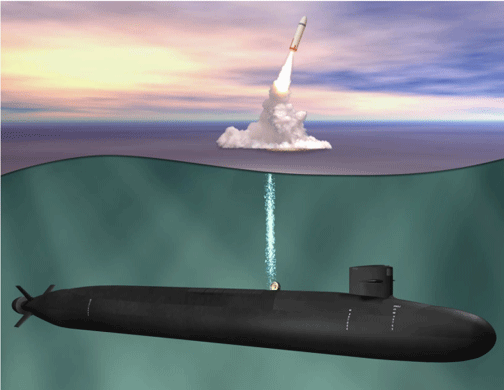
In 2019, a new set of nuclear dangers emerged for Southasia. The growing danger was underscored during the military crisis between India and Pakistan in February 2019, when India put one or more of its nuclear submarines on “operational deployment mode.” During the crisis, the Pakistani Navy claimed to intercept an Indian submarine. No one has confirmed if this interception involved an Indian submarine carrying nuclear weapons. With India and Pakistan on an accelerated programme of acquiring and developing nuclear submarines, Southasia needs to pay urgent attention to the risks of nuclear accidents at sea.
The expansion of nuclear operations to the sea also raises issues about who has the ability to authorise the use of these weapons, especially in a crisis. This is of particular concern in the case of India because it has already deployed such weapons. According to a November 2018 announcement by Prime Minister Narendra Modi, the Arihant nuclear-powered submarine successfully completed its maiden “patrol”.
A further source of concern is the August 2019 announcement by India’s defence minister to the effect that the country’s ‘No First Use’ (NFU) policy – which pledges not to attack with nuclear weapon unless attacked first – “would depend on the circumstances.” His comments, made during a period of increased tension between India and Pakistan following the amendment to Article 370 of India’s Constitution conferring special status to Jammu & Kashmir, underscore these risks.
India’s nuclear submarines……… Strategic competition with China in the Indian Ocean may be another factor. Serving and retired members of India’s Navy publicly express concerns about the deployment of Chinese submarines, warships and tankers in the Indian Ocean.
India’s growing arsenal also makes it a more valuable ally for the United States in its efforts to deal with the growth in China’s political and military power. For some time now, the US and India have been conducting joint naval exercises.
Pakistan’s naval force
Pakistan, for its part, announced the setting up of a Naval Strategic Force Command in 2012. Pakistan’s Navy has started preparing to put nuclear-armed cruise missiles on conventional submarines. The cruise missile is expected to be the 450-kilometer range Babur, which had a successful underwater test launch in 2018. There are reports that Pakistan is seeking to develop or acquire a nuclear-powered submarine…..
Submarine accidents
Almost all the countries operating nuclear-powered or nuclear-armed submarines have experienced accidents, often with significant loss of life and the spread of radioactivity in the environment. There have been over 40 accidents involving nuclear-powered submarines, claiming a total of over 650 lives. Of these accidents, more than half involved Soviet/Russian submarines resulting in over 400 deaths. The United States comes next, with at least a dozen submarine accidents leading to well over 200 deaths.
Two accidents have involved India’s nuclear submarines. …….
It would be unreasonable to expect that no more accidents involving nuclear submarines would ever take place. Nuclear submarines involve many technologies that are susceptible to a range of accidents affecting the submarine, nuclear reactor, missiles and nuclear weapons. All of these are operating under challenging conditions: deep under water, with limited supplies of air and water, possibly under attack. None of these factors is likely to change…….. Should a naval nuclear-reactor accident occur, especially at or near a naval base, coastal city or town the consequences could extend far beyond the vessel and its crew……
Pathways to war
The introduction of nuclear armed submarines, whether diesel or nuclear-fuelled, increases the likelihood of conventional conflicts escalating to a nuclear one. Any use of nuclear weapons would have devastating consequences, especially if the use of nuclear weapons by one country sets off a nuclear response from the other side.
In a military crisis, nuclear armed submarines increase the potential for nuclear war because they open up new risk pathways. The Australian strategist Desmond Ball pointed out in 1985 that “the sea is the only area where nuclear weapon platforms [of adversary states] … actually come into physical contact” and this contact can lead to accidents from several kinds of what seem to be typical naval operations.
There have already been incidents of Indian and Pakistani naval platforms coming into physical contact, for example in 2011, when the Pakistani vessel PNS Babur brushed past India’s INS Godavari. Contact between Navy forces from India and Pakistan might also result from deliberate attempts to attack submarines. Both countries are known to be acquiring anti-submarine warfare capabilities.The consequences of such events could be worse if submarines come into contact with each other during periods of heightened tensions or crises.
During a crisis, there may be inadvertent attacks on submarines carrying nuclear weapons, because these are intermingled with submarines carrying only conventional weapons. One notable instance occurred during the Cuban Missile Crisis, when US ships used practice depth charges against Soviet nuclear-armed submarines. This almost led to the use of nuclear weapons by the Soviet submarine.
Challenges to controlling nuclear weapons
A significant new challenge resulting from the deployment of nuclear weapons at sea is managing command and control. To the extent that such things are publicly known, India and Pakistan were believed to keep their nuclear weapons on land separate from the delivery vehicles, be they missiles or aircraft. This separation makes it harder for the weapons to be used without proper authorisation. With submarines armed with nuclear weapons at sea, this separation may not be possible and so the risk of unauthorised use is greater.
At the same time, one purpose of the nuclear-armed submarine is to be a final fail-safe means of nuclear attack even if a country’s political leadership is killed and its cities destroyed. To serve this role, the nuclear weapons on the submarine cannot rely on timely launch orders from political authorities. A further problem for submarines is that they are supposed to remain hidden from the enemy. Constant communication from the submarine to the military or civilian leadership may make it easier to detect. All of this means that during the time of a crisis, the personnel in a nuclear submarine might be the ones making decisions on whether or not to use nuclear weapons.
Southasians need to consider how they feel about trusting their lives in some future crisis to the restraint of Indian or Pakistani submariners far from home and fearful that their vessel is under attack, trying to decide about launching their nuclear missiles in a ‘use them or lose them’ scenario. The consequences would be devastating.
~Zia Mian is co-director of Princeton University’s Program on Science and Global Security, where he also directs the Project on Peace and Security in South Asia.
~M V Ramana is the Simons Chair in Disarmament, Global and Human Security at the Liu Institute for Global Issues in the School of Public Policy and Global Affairs at the University of British Columbia in Vancouver, Canada.
~Abdul H Nayyar is a physicist and a founder and former President of the Pakistan Peace Coalition, a national network of peace and justice groups. https://himalmag.com/nuclear-dangers-of-the-naval-kind-2019/?fbclid=IwAR0G8NZSV5ANg7Ag7KcuJU_80iv3pNJiqb6E_T12sylV9BaJWIvcZ3Vb_j0
 |
ReplyForward
|
Brexit’s threat to Scotland’s environmental protection
Environment Protection Agency, the national regulator, said there was a
need for a “new and coherent” governance system to act as a safeguard once
EU protections and oversight disappear after Britain’s departure from the
bloc. Last year, The Herald revealed Scottish Environment LINK’s concerns
that Scotland’s rarest species north of the Border face being obliterated
in the fall-out from Brexit unless urgent new laws and funding are brought
in to safeguard vital conservation work.https://www.heraldscotland.com/news/17996856.scots-natural-environment-risk-inadequate-brexit-plans/
Worrying legacy of radioactive trash under planned Moscow roadway
|
Locals fear radiation spikes as Moscow plans road across nuclear waste dump: ‘Everything is very bad’ Greenpeace claims radiation levels at the site are already many times above natural levels – and higher than the levels now seen in the Chernobyl exclusion zone, Independent Oliver Carroll, Moscow @olliecarroll 27 Oct 19,
Up a small hill from the Moskvorechye commuter station in southeastern Moscow, there is a hole in a green corrugated fence. Radioactive warning signs, fly-posted by a group of local activists, are a clue to the mystery on the other side. Equipped with rubber boots, air masks and radiation counters, a motley crew is carrying out an inspection of the radioactive waste dumps behind the fence, on the perimeter of Moscow’s decommissioned Polymetal factory. It’s part of a last-gasp attempt to stop local authorities from building a bridge and eight-lane motorway across part of the site – controversial plans, the activists say, that run the risk of releasing buried radioactive material into the air and adjacent Moskva river. Campaigning group Greenpeace has recently published results from new tests of topsoil from the area immediately affected by the highway construction. Those tests showed radiation levels dozens of times above permissible levels, and pose a cancer risk to local residents, the group claimed. Samples at 0.5 metres below the surface showed significantly higher levels of radiation.
|
|
|
1 This Month



26 September – International Day for the Total Elimination of Nuclear Weapons


PLEASE OPPOSE HR 8255 AND S.3639 – bills would accelerate satellite deployment, with no environmental review or safeguards – https://ncstd5li.quorum.us/campaign/169331/
To see nuclear-related stories in greater depth and intensity – go to https://nuclearinformation.wordpress.com
-
Archives
- September 2026 (245)
- August 2026 (330)
- July 2026 (355)
- June 2026 (287)
- May 2026 (306)
- April 2026 (356)
- March 2026 (251)
- February 2026 (267)
- January 2026 (308)
- December 2025 (358)
- November 2025 (359)
- October 2025 (375)
-
Categories
- 1
- 1 NUCLEAR ISSUES
- business and costs
- climate change
- culture and arts
- ENERGY
- environment
- health
- history
- indigenous issues
- Legal
- marketing of nuclear
- media
- opposition to nuclear
- PERSONAL STORIES
- politics
- politics international
- Religion and ethics
- safety
- secrets,lies and civil liberties
- spinbuster
- technology
- Uranium
- wastes
- weapons and war
- Women
- 2 WORLD
- ACTION
- AFRICA
- Atrocities
- AUSTRALIA
- Christina's notes
- Christina's themes
- culture and arts
- Events
- Fuk 2022
- Fuk 2023
- Fukushima 2017
- Fukushima 2018
- fukushima 2019
- Fukushima 2020
- Fukushima 2021
- general
- global warming
- Humour (God we need it)
- Nuclear
- RARE EARTHS
- Reference
- resources – print
- Resources -audiovicual
- Weekly Newsletter
- World
- World Nuclear
- YouTube
-
RSS
Entries RSS
Comments RSS
 nuclear-news