UK forest to be chopped down for Sizewell C nuclear project, though project approval not yet complete
East Anglian Daily Times 11th Sept 2019, Coronation Wood will now be chopped down to make way for Sizewell C – even though the proposed new twin reactor nuclear power station has not beengiven the go-ahead yet.
The application from EDF Energy, part of major
changes to the Sizewell B estate needed for Sizewell C’s construction,
generated a huge number of objections. However, it was approved by East
Suffolk Council’s (ESC) strategic planning committee by nine votes to
eight. Theberton and Eastbridge Parish Council, supported by a number of
other parish and town councils, will now ask the Secretary of State for
Housing, Communities and Local Government to “call in” the application and
consider it for a planning inquiry.
Paul Collins, of Theberton & Eastbridge
Action Group on Sizewell, said: “We strongly oppose ESC’s decision to
approve this application when the DCO request for Sizewell C has neither
been submitted nor approved. If Sizewell C does not go ahead – and there
are many reasons why it might not, including uncertain financing and major
environmental obstacles – the AONB will have been needlessly damaged.”
https://www.eadt.co.uk/news/sizewell-c-coronation-wood-and-visiting-centre-plan-decision-1-6265010
Environmental, health, threats of USA’s zombie uranium mines

When toxic waste piles — either solid rock or liquid confined behind earthen dams — are left unaddressed, the potential increases for “catastrophic failure
WHILE ‘ZOMBIE’ MINES IDLE, CLEANUP AND WORKERS SUFFER IN LIMBO As the governor of West Virginia and other mine owners warehouse their operations and avoid cleanup, the Trump administration stifles attempts to write rules that could restrict the practice. Center for Public Integrity, 8 Sept 19
……….RADIOACTIVE LEGACY
Remnants of America’s nuclear past litter the Grants Mining District in northwest New Mexico: signs warning of radioactivity, a spiked drill bit outside the New Mexico Mining Museum in Grants, businesses offering to help retired miners get U.S. Department of Labor health benefits.
Mount Taylor — “Tsoodzil” to the Navajo Nation — towers over the landscape. At the base of the 11,305-foot-tall inactive volcano sits the Mount Taylor Mine, idled in 1990 and allowed to flood.
The heyday of Southwestern uranium mining lasted just 30 years. Much of the industry, including this mine, has since remained in standby.
The country’s last operational underground uranium mine shut in 2015, and open-pit mines haven’t produced in decades. Only one mill in Utah and four in-situ-leach operations, in which ore is dissolved belowground and pumped up, are still active. Two other mills and 15 in-situ-leach sites are either officially in standby or not producing. The American uranium industry employed only 372 people last year, down from 1,120 two decades earlier. Production from U.S. uranium mines fell 85 percent during that period, according to the U.S. Energy Information Administration.
At current prices, mining uranium in the Four Corners remains untenable.
But now the Mount Taylor Mine is reopening, at least on paper.
…… the Jackpile-Paguate Uranium Mine, once the world’s largest open-pit uranium mine, is now a Superfund site. In the broader Four Corners region, the U.S. Department of Energy is supposed to clean up more than 20 such Cold War relics, from former mills to waste piles. Some leak arsenic, lead, uranium and other toxic substances into groundwater. Recently, hoofprints were found leading from an unfenced pollution control pond near Slick Rock, Colorado, indicating that cattle likely drink from it.
Just inside the southeastern corner of the Navajo Nation in New Mexico, an unsettling sign hangs from barbed wire: “DANGER. ABANDONED URANIUM MINE,” a pile of mine waste looming behind it. Residents here in the Red Water Pond Road Community are surrounded by two abandoned uranium mines and a mill…….
Living around or working in uranium mines can worsen, or even trigger, autoimmune disorders, kidney disease, respiratory issues, hypertension and cancer. A study by the U.S. Department of Health and Human Services, the University of New Mexico and Navajo agencies found that Navajo Nation citizens, including infants, had elevated levels of uranium in their bodies.
Paul Robinson, Southwest Research and Information Center’s research director, has tracked the industry for more than 40 years. While the New Mexico Mining Act mandates that waste rock and other infrastructure be stabilized before entering standby status, it allows operators to delay reclamation while mining is paused, he said.
“Leaving the wastes that are generated at a mine uncovered is one of the ways to ensure airborne or waterborne release,” Robinson said.
Thompson Bell, a member of the Navajo Nation who spent five years as a mechanic in a uranium mine, grew up here and returned for the study. He said many of his mining coworkers died from lung cancer. The sheep and cattle that used to graze here have all but disappeared, the flocks given up for fear of contamination.
“The thing about uranium, we found out: It destroys humans and land,” Bell said.
Opinion remains split locally about whether the return of relatively high-paying mining jobs — if that ever happened — would be worth the human and environmental consequences. Christine Lowery, a member of the Pueblo of Laguna and a commissioner for the county where the Mount Taylor Mine is located, said she welcomes a cleaner economy.
“Those mines were open for one generation,” she said. “The legacy lasts forever…….
The federal government leaves it to the states to impose limits on uranium-mine idling. The resulting patchwork of state rules are largely anchored on a 147-year-old federal law aimed more at promoting mining than managing it.
Over time, uranium production has dropped, stockpiles remained large, nuclear power’s share of the country’s electricity production fell, and power plants bought more uranium from overseas. Still, mine owners hope for a revival…….
Modern surface mining in Central Appalachia has been linked to health problems ranging from cancer to birth defects. And in a 2012 study, Bernhardt estimated that surface mining impaired about one in three miles of southern West Virginia’s rivers.
But idling poses other risks, Bernhardt said. When toxic waste piles — either solid rock or liquid confined behind earthen dams — are left unaddressed, the potential increases for “catastrophic failure,” she said, even as opportunities to use the land for new purposes are delayed…..
Regulators in Virginia have few options. Justice mine cleanup liabilities in Virginia total as much as $200 million, and taxpayers could get stuck with a large share of that if the state takes over. That’s because those companies have put up only about $51 million for cleanup if the operations are abandoned. Half of that amount would likely be worthless in that scenario because, state records show, it is backed against the value of the companies. A pool of money Virginia set up to close gaps like this at 150 permits across the state, including some of Justice’s, has less than $10 million in it. ……..https://publicintegrity.org/environment/while-zombie-mines-idle-cleanup-and-workers-suffer-in-limbo/?fbclid=IwAR1PsslGwAV0UPxPBIn4qv1JTypoGVk1
Radioactive pollution of beaches and abandoned boats, following Russian nuclear explosion

Russian Nuclear Blast Debris Is Still Emitting Radiation, Reports Say, Moscow Times, Sep. 4, 2019 Journalists in northern Russia have measured high levels of radiation near two abandoned boats that were brought ashore following last month’s mysterious accident during a test at a military site that has raised international concerns and safety fears……
The radiation poisoning of Iraq lingers on
 “The destruction of a society”: First the U.S. invaded Iraq — then we left it poisoned Scientist: Bombs, bullets and military hardware abandoned by U.S. forces have left Iraq “toxic for millennia”, Salon.com DAVID MASCIOTRA 7 Sept 19
The political and moral culture of the United States allows for bipartisan cooperation to destroy an entire country, killing hundreds of thousands of people in the process, without even the flimsiest of justification. Then, only a few years later, everyone can act as if it never happened.
In 2011, the U.S. withdrew most of its military personnel from Iraq, leaving the country in ruins. Estimates of the number of civilians who died during the war in Iraq range from 151,000 to 655,000. An additional 4,491 American military personnel perished in the war. Because the bombs have stopped falling from the sky and the invasion and occupation of Iraq no longer makes headlines, Americans likely devote no thought to the devastation that occurred in their name.
With the exception of Rep. Tulsi Gabbard of Hawaii, who is currently polling at or below 2 percent, no candidate for the Democratic presidential nomination has consistently addressed the criminality, cruelty and cavalier wastefulness of American foreign policy. Joe Biden, the frontrunner in the race, not only supported the war in Iraq — despite his recent incoherent claims to the contrary — but as chair of the Senate Foreign Relations Committee acted as its most effective and influential salesman in the Democratic Party.
The blasé attitude of America toward the death and destruction it creates, all while boasting of its benevolence, cannot withstand the scrutiny of science. Dr. Mozhgan Savabieasfahani, an environmental toxicologist at the University of Michigan and recipient of the Rachel Carson Prize, has led several investigative expeditions in Iraq to determine how the pollutants and toxic chemicals from the U.S.-led war are poisoning Iraq’s people and environment. The health effects are catastrophic, and will remain so long after the war reached its official end.
I previously interviewed Savabieasfahani about her initial research, and recently acquired an update regarding her team’s latest discovery that there is a close correlation between proximity to a U.S. military base and birth defects in Iraqi children.
Average Americans, even many who opposed the war in Iraq, seem to believe that once the military campaign is over the casualties of war stop accumulating. What is the purpose of your general research regarding the toxicity of the Iraqi environment resulting from American bombs, munitions and other materials? How does the American invasion and occupation continue to adversely affect the health of Iraqis?
Bombs and bullets have been used on an extreme scale in Iraq. Dropping tons of bombs and releasing millions of bullets leaves toxic residues the in air, water and soil of the targeted population. These pollutants continue to poison those populations years after the bombing stops
What’s more, the United States imported thousands of tons of military equipment into Iraq to use in their occupation. They include, tanks, trucks, bombers, armored vehicles, infantry weapons, antiaircraft systems, artillery and mortars — some of which are coated with depleted uranium, and much more. These eventually find their way into U.S. military junkyards which remain across Iraq.
There are unknown numbers of military junkyards scattered across the Iraqi landscape.
Fluctuations in temperature facilitates the rusting and weathering of military junk, releasing toxic pollutants [including radioactive uranium compounds, neurotoxic lead and mercury, etc.] into the Iraqi environment.
Uranium and its related compounds remain toxic for millennia and poison local populations through food, air and water contamination.
The exposure of pregnant mothers to the pollutions of war, including uranium and thorium, irreversibly damages their unborn children. We found thorium, a product of depleted uranium decay, in the hair of Iraqi children with birth defects who lived in Nasiriyah and Ur City, near a U.S. military base.
The destruction of a society does not stop after U.S. bombs stop falling. Environmental contamination which the U.S. leaves behind continues to destroy our environment and poison our people decades after the bombs have stopped falling. The U.S. has a long history of irreversibly destroying human habitats. That must end…….
Forty-four years after U.S. forces left Vietnam, there are still Vietnamese babies born with birth defects from the American military’s use of Agent Orange. How long do you believe Iraqis will continue to suffer from the American-led war?
If left unmitigated, the population will be permanently exposed to elevated toxic exposures which can impact the Iraqi gene pool.
Through the use of the scientific method, you are gaining the ability to identify a severe problem in Iraq. Considering that the problem is a result of the U.S. invasion, what could the U.S. do to solve or at least mitigate the problem?
The U.S. must be held responsible and forced to clean up all the sites which it has polluted. Technology exists for the cleanup of radiation contamination. The removal and disposal of U.S.-created military junkyards would go a long way towards cleaning toxic releases out of the Iraqi environment.
You are a scientist, not a political analyst, but you must have some thoughts regarding the political implications of your work. How do you react to the lack of substantive conversation about the consequences of war in American politics and the press, and the American establishment’s evasion of responsibility on this issue?
I expect nothing from the American political establishment or their propaganda machines which masquerade as “news media” and feed uncritically off State Department press briefings.
Fortunately, there is a movement to criminalize environmental contamination caused by war. Damage to nature and the human environment must be considered a war crime.
Scientists are currently asking international lawmakers to adopt a fifth Geneva Convention which would recognize damage to nature as a war crime, alongside other war crimes. I hope that will make a difference in our ability to protect human lives and our environment. …… https://www.salon.com/2019/09/07/the-destruction-of-a-society-first-the-u-s-invaded-iraq-then-we-left-it-poisoned/
Japan nowhere near solving the problem of Fukushima nuclear waste water
Japan briefs diplomats on Fukushima nuclear water concerns, https://abcnews.go.com/Technology/wireStory/japan-briefs-diplomats-fukushima-nuclear-water-concerns-65376017 Japan tried to reassure foreign diplomats Wednesday about safety at the crippled Fukushima nuclear plant amid concerns about massive amounts of treated but radioactive water stored in tanks.
Diplomats from 22 countries and regions attended a briefing at the Foreign Ministry, where Japanese officials stressed the importance of combating rumors about safety at the plant, which was decimated by a 2011 earthquake and tsunami, while pledging transparency.
The plant’s operator, Tokyo Electric Power Co., or TEPCO, said last month that it would run out of storage space for the water in 2022, prompting South Korea to raise safety questions amid tensions with Japan that have intensified over trade and history. South Korea was among those represented at Wednesday’s briefing.
Water must be continuously pumped into the four melted reactors at the plant so the fuel inside can be kept cool, and radioactive water has leaked from the reactors and mixed with groundwater and rainwater since the disaster.
The plant has accumulated more than 1 million tons of water in nearly 1,000 tanks. The water has been treated but still contains some radioactive elements. One, tritium — a relative of radiation-emitting hydrogen — cannot be separated.
Tritium is not unique to Fukushima’s melted reactors and is not harmful in low doses, and water containing it is routinely released from nuclear power plants around the world, including in South Korea, officials say.
The water has been a source of concern, sparking rumors about safety, especially as Japan tries to get countries to lift restrictions on food imports from the Fukushima area ahead of the 2020 Tokyo Olympics. Import restrictions are still in place in 22 countries and regions, including South Korea and China.
“In order to prevent harmful rumors about the Fukushima Dai-ichi plant from being circulated, we believe it is extremely important to provide scientific and accurate information,” Yumiko Hata, a Ministry of Economy, Trade and Industry official in charge of the Fukushima accident response, said at the briefing. “We appreciate your understanding of the situation and continuing support for the decommissioning work at the Fukushima Dai-ichi plant.”
Officials said there were no complaints from the diplomats Wednesday about Japan’s handling of the water.
More than eight years after the accident, Japan has yet to decide what to do with the radioactive water. A government-commissioned panel has picked five options, including the controlled release of the water into the Pacific Ocean.
As disputes between Japan and neighboring South Korea escalated over export controls and colonial-era labor used by Japanese companies, Seoul last month announced plans to step up radiation tests of Japanese food products, and asked about the contaminated water and the possibility of its release into the sea.
Experts say the tanks pose flooding and radiation risks and hamper decontamination efforts at the plant. Nuclear scientists, including members the International Atomic Energy Agency and Japanese Nuclear Regulation Authority, have recommended the water’s controlled release into the sea as the only realistic option scientifically and financially. Local residents oppose this, saying the release would trigger rumors of contamination, which would spell doom for Fukushima’s fishing and agriculture industries.
The panel recently added a sixth option of long-term storage.
The radioactive fallout from Chernobyl continues to impact lives.
The legacy of Chernobyl: Zombie reactors and an invisible enemy ABC News, Foreign Correspondent By Europe correspondent Linton Besser, Mark Doman, Alex Palmer and Nathanael Scott, 3 Sep 2019, As the Soviet Union grappled with the scale of the disaster unfolding at Chernobyl, radioactive material spewed into the environment.
In the immediate aftermath of the 1986 explosion inside reactor number four of the nuclear power plant, dozens of first responders received fatal doses of radiation, forests surrounding the reactor were poisoned, and nearby waterways were contaminated.
Despite attempts to douse the fire in the core with sand, boron and lead, the reactor burnt for 10 days, releasing huge amounts of radioactive materials beyond the plant’s perimeter.
Three decades on from what is considered to be one of the worst nuclear accidents in history, the fallout from Chernobyl continues to impact lives.
Carried in the prevailing weather patterns, the radioactive particles pouring out of reactor four spread rapidly.
The vast majority of particulates fell over parts of Belarus, Russia and Ukraine where more than 5 million people now live in contaminated areas. But modelling by the Met Office, the UK’s national weather service, shows how, within two days of the disaster, the radioactive plume was transported more than 1,000 kilometres.
There’s also the highly contaminated Red Forest to the south and west. It got its name from the colour the trees turned as they died after the blast. Here researchers continue to uncover highly radioactive pockets of soil. Access to this area is largely restricted, but the Safecast data shows areas inside the forest reaching an average of around 30µSv/h. Then of course there’s the reactor itself. A place so irradiated it sits entombed in a giant sarcophagus made of steel and concrete. Some estimates suggest the core will remain radioactive for thousands of years.
There’s no data at the core because access to the area is heavily restricted for safety reasons. Azby Brown, the lead researcher with Safecast, said many of the hardest-hit areas, like the abandoned town of Pripyat, will remain unsafe to live “for generations”.
“If you just look at the half life of Caesium-137, it’s 30 years. So it’s been through one half life, meaning naturally half of it has decayed, so anywhere you went 30 years ago in Chernobyl was twice [as radioactive] as what it is today,” he said.
Despite the lingering risks, there are some who’ve chosen to ignore the warnings and return to live inside the exclusion zone.
Sofia Bezverhaya was living just 30 kilometres from the plant in the village of Kupovate when the plant exploded.
The breach of reactor number four occurred on a Saturday. But Sofia, the local council administrator, heard nothing of it.
“It was only on the Monday that we’ve found out there’d been an accident,” she told Foreign Correspondent. That day, she took a phone call from a Communist Party official. “There’s been an accident,” she was told. “Prepare for the evacuation.”
“They kept telling us, it’s just for three days … [but] all of us had that uneasy feeling creeping into our souls, that we might just leave our homes and never ever come back. And that’s what came to be.”
“Our grand- and great grandparents are buried here. And we also want to be buried here, in our village. It’s our dream.”
The official death toll from Chernobyl is disputed, but a UN report into the “true scale of the accident” found as many as 4,000 people could die as a result of radiation exposure.
Once Sofia returned, despite official warnings to avoid locally grown produce, she had little choice but to continue to plough her own yard for food. And more than three decades later, she’s still doing it.
From the garden bed, which runs beside the length of her blue weatherboard home, she grows tomatoes, zucchinis, pumpkins, capsicum, sorrel, potatoes and onions.
“For me, my resort is my work in the garden … where I can watch a squirrel collecting nuts, and hear the singing of nightingale.”
Kupovate is firmly within the boundaries of the exclusion zone around the reactor. But once a year, Sofia Bezverhaya said, her garden vegetables are tested, and the results are within acceptable limits.
It’s an anomaly which demonstrates the caprice of the fallout; the red lines of the exclusion zone simply do not prescribe the limits of the contamination……… https://www.abc.net.au/news/2019-09-03/chernobyls-radioactive-legacy-zombie-reactors-an-invisible-enemy/11432430
UN warns on need for global action – treaty – as the world’s oceans are in dire trouble
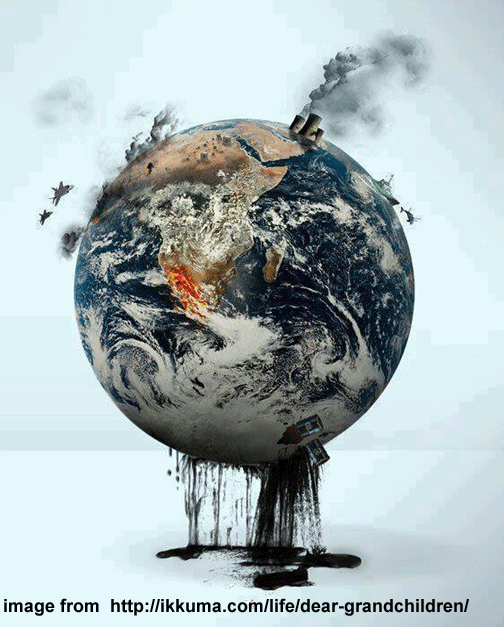 INTERVIEW-Ocean treaty needed to tackle ‘deep trouble’, says UN envoy, http://news.trust.org/item/20190831063635-oygwk/, by Adela Suliman | @adela_suliman | Thomson Reuters Foundation, Saturday, 31 August 2019 The oceans are increasingly threatened by global warming, acidification and pollution, and the impacts will affect us all, warned the U.N. oceans envoy. By Adela Suliman
STOCKHOLM, Aug 31 (Thomson Reuters Foundation) – The world’s seas are increasingly threatened by global warming, acidification and pollution, making it crucial to agree on a global treaty to protect them, the U.N. oceans envoy said.
Peter Thomson warned in an interview with the Thomson Reuters Foundation that the oceans were “in deep trouble”.
“It is worse than we think and there are no easy solutions,” he said at World Water Week in Stockholm this week, as the latest round of talks on a treaty wound up in New York.
The first global ocean treaty is due to be agreed in the first half of 2020. But on Friday environmental group Greenpeace said the negotiations were “disappointing” so far, blaming a lack of political will to secure a “progressive outcome”.
Thomson said a “comprehensive global regime” was needed to accelerate action to protect waters beyond national jurisdictions.
“It is critical in these challenging times for planetary environmental conditions that we develop a binding treaty for the conservation and sustainable use of marine biodiversity in the ocean,” he said.
A flagship scientific report warned this year that two-thirds of the ocean area was already affected by growing human impacts, primarily from stressors linked to global warming.
Climate change and the oceans were “intimately linked”, Thomson said, adding humanity was on a “totally irresponsible course” by not tackling global warming urgently enough. In 2015 nearly 200 nations signed up to the Paris Agreement that aims to keep the rise in average global temperatures to “well below” 2 degrees Celsius (3.6F) above pre-industrial times, and ideally to 1.5C.
“(Climate change) is going to have huge human impact and there will have to be a change of occupations, a change of domiciles,” Thomson warned.
Fishing communities and coastal dwellers would be worse off and needed support to adapt in a warmer world, he added.
A set of global development goals to be met by 2030 include conserving and using oceans, seas and marine resources wisely.
Much of the planet’s rainwater, drinking water, food and weather systems are provided or regulated by the sea.
“Every second breath you take comes from oxygen from the ocean,” said Thomson, a Fijian diplomat.
But seawater warming and acidification could change the chemical composition of the oceans, with profound effects for humans, he warned.
TURNING THE TIDE?
Pollution, including plastic, industrial waste, sewage and fertiliser, poses a serious threat to marine life, Thomson said.
“There are over 500 ‘dead zones’ all over the world where actually no life exists because of what’s coming down those rivers by way of pollution,” he said.
Meanwhile, irresponsible fishing practices have depleted fish stocks and are “part of the human tragedy of ending biodiversity”, he added.
Billions of people depend on oceans for their food and livelihoods, but the U.N. Food and Agriculture Organization has said nearly 90% of fish stocks are over-fished or fully exploited as global demand rises.
Thomson said, however, that pollution and over-fishing were “very fixable” with better environmental management.
Individual action had begun to make inroads – from public beach clean-ups to how people shop and vote.
Climate change, on the other hand, was a more “pernicious” threat to the Earth’s water, he said.
The U.N. climate science panel is due to publish a special report in late September on how climate change is affecting the world’s oceans and frozen water. Thomson said it would be a “guiding light” for future international protection efforts by providing scientific insight on how global warming is affecting life in the sea.
“The report will no doubt provide further support for dramatic scaling up of political ambition (to act),” he said.
“It’s no time to be sitting around philosophising … The changes have to be made now
Expert on birds warns of environmental catastrophe if UK’s planned Sizewell nuclear station goes ahead
if plans for new nuclear power station on wetland nature reserve go ahead.
Chris Packham and campaigners warn against nuclear plant on nature reserve.
reactors. The firm last year axed plan to build a jetty to bring in
materials for site by sea. It is a wetland nature reserve of such beauty
and importance that it became home to the BBC’s popular Springwatch
series for three years.
Royal Society for the Protection of Birds site on the Suffolk coast, faces
catastrophe under plans put forward by French energy firm EDF to build a
new nuclear power station. The site, which attracts numerous species of
rare birds including marsh harriers, lies close to an existing nuclear
power station, Sizewell B – but EDF now wants to build Sizewell C, which
comprises two more giant reactors.
Climate change is destabilising the Earth’s marine environment
|
Oceans turning from friend to foe, warns landmark UN climate report, Phys Org, by Marlowe Hood, Patrick Galey 30 Aug 19, The same oceans that nourished human evolution are poised to unleash misery on a global scale unless the carbon pollution destabilising Earth’s marine environment is brought to heel, warns a draft UN report obtained by AFP. Destructive changes already set in motion could see a steady decline in fish stocks, a hundred-fold or more increase in the damages caused by superstorms, and hundreds of millions of people displaced by rising seas, according to the Intergovernmental Panel on Climate Change (IPCC) “special report” on oceans and Earth’s frozen zones, known as the cryosphere. As the 21st century unfolds, melting glaciers will first give too much and then too little to billions who depend on them for fresh water, it finds. Without deep cuts to manmade emissions, at least 30 percent of the northern hemisphere’s surface permafrost could melt by century’s end, unleashing billions of tonnes of carbon and accelerating global warming even more. The 900-page scientific assessment is the fourth such tome from the UN in less than a year, with others focused on a 1.5-Celsius (2.6-Farenheit) cap on global warming, the state of biodiversity, and how to manage forests and the global food system. All four conclude that humanity must overhaul the way it produces and consumes almost everything to avoid the worst ravages of climate change and environmental degradation. Governments meet in Monaco next month to vet the new report’s official summary. While the underlying science—drawn from thousands of peer-reviewed studies—cannot be modified, diplomats with scientists at their elbow will tussle over how to frame the findings, and what to leave in or out. The final advice to policymakers will be released on September 25, too late to be considered by world leaders gathering two days earlier for a summit convened by UN Secretary-General Antonio Guterres to extract stronger national commitments in confronting the climate crisis. Guterres may be disappointed by what the world’s major greenhouse gas emitters put on the table, according to experts tracking climate politics in China, the United States, the European Union and India……….. 1,000-fold flood damage increase By 2050, many low-lying megacities and small island nations will experience “extreme sea level events” every year, even under the most optimistic emissions reduction scenarios, the report concludes. By 2100, “annual flood damages are expected to increase by two to three orders of magnitude,” or 100 to 1,000 fold, the draft summary for policymakers says. Even if the world manages to cap global warming at two degrees Celsius, the global ocean waterline will rise enough to displace more than a quarter of a billion people. The report indicated this could happen as soon as 2100, though some experts think it is more likely to happen on a longer timescale……… Marine heatwaves Oceans not only absorb a quarter of the CO2 we emit, they have also soaked up more than 90 percent of the additional heat generated by greenhouse gas emissions since 1970. Without this marine sponge, in other words, global warming would already have made Earth’s surface intolerably hot for our species. But these obliging gestures come at a cost: acidification is disrupting the ocean’s basic food chain, and marine heatwaves—which have become twice as frequent since the 1980s—are creating vast oxygen-depleted dead zones. In the Tasman Sea, for example, a 2015-16 heatwave lasted for 251 days, causing disease outbreaks and a die-off of farmed shellfish.https://phys.org/news/2019-08-oceans-friend-foe-landmark-climate.html |
|
MEDIA MATTERS finds that mainstream news is practically ignoring Amazon fires
 The Notre Dame fire garnered wall-to-wall cable news coverage. The Amazon fires are barely breaking through. https://www.mediamatters.org/msnbc/notre-dame-fire-garnered-wall-wall-cable-news-coverage-amazon-fires-are-barely-breaking LIS POWER 23 Aug 19
The current fires raging in the Amazon aren’t garnering anywhere near the same level of coverage on cable news, despite the effects the wildfires will have on the global environment.
As noted in The Washington Post, the Amazon “serves as the lungs of the planet by taking in carbon dioxide,” and the European Union’s Copernicus Climate Change Service is warning that “the fires have led to a clear spike in carbon monoxide emissions as well as planet-warming carbon dioxide emissions, posing a threat to human health and aggravating global warming.”
Despite the serious implications, the Amazon fires haven’t gotten even close to the amount of coverage Notre Dame’s fire received. So far, coverage has peaked at 11 segments that mention the fires per day on cable news networks combined — as opposed to around 150 segments a day that mentioned the cathedral fire during the peak of Notre Dame coverage — according to Media Matters’ internal database. Additionally, the coverage has often come via short headline reads or passing mentions rather than thorough, in-depth analysis about the events and global consequences.
The disparity in coverage is glaring and raises serious questions about cable news priorities when it comes to covering our environment.
Media Matters’ internal database includes weekday cable news programming on CNN, Fox News, and MSNBC between the hours of 6 a.m. and midnight. Segments are coded in near-real time by analysts for pertinent information. We searched our database for segments during the week of April 15 that included “Notre Dame” in the segment notes and segments during the week of August 18 that included “Amazon” in the segment notes.
International concern growing over Fukushima’s radioactive contamination of surface-level soil
 The danger of sourcing food and material from the Fukushima region Ground-
 level nuclear disasters leave much more radioactive fallout than Tokyo is willing to admit Hankyoreh By Seok Kwang-hoon, energy policy consultant of Green Korea Aug.25,2019 International concerns are growing over the Japanese government’s plans to provide meals from the Fukushima area to squads participating in the 2020 Tokyo Olympics. The starting point for the Olympic torch relay, and even the baseball stadium, were placed near the site of the Fukushima Nuclear Power Plant. It seems to be following the model of the Tokyo Olympics in 1964, where Japan’s rise from the ashes of the atomic bombs was underscored by having a young man born the day of the Hiroshima bombing act serve as the relay’s last runner. Here we can see the Shinzo Abe administration’s fixation on staging a strained Olympic reenactment of the stirring Hiroshima comeback – only this time from Fukushima.
Life on Earth threatened by climate change – loss of Amazon Forests
ONE OF the easiest ways to combat climate change is to stop tearing down old trees. This is why it is everyone’s problem that new Brazilian President Jair Bolsonaro seems determined to chop away at the Amazon rainforest, the world’s greatest reserve of old-growth forest.
According to a recent analysis in the New York Times, “enforcement actions by Brazil’s main environmental agency fell by 20 percent during the first six months of the year, compared with the same period in 2018.” Fines, warnings and the elimination of illegal equipment from preservation zones are among the measures Brazil’s authorities are doing less often. “The drop means that vast stretches of the rain forest can be torn down with less resistance from the nation’s authorities.” The result has been a loss of 1,330 square miles of rainforest since January, a loss rate that is some 40 percent higher than a year previous, according to Brazilian government records.
Mr. Bolsonaro has called his own government’s information “lies,” stripped the environment ministry of authorities and slashed the environmental budget. When eight former environment ministers protested in May, current environment minister Ricardo Salles allegedthat there is a “permanent and well-orchestrated defamation campaign by [nongovernmental organizations] and supposed experts, within and outside of Brazil.”
In its reality denial, Mr. Bolsonaro’s brand of right-wing populism closely resembles that of President Trump. Both leaders stoke unfounded suspicions that environmental concerns represent foreign plots to undermine the domestic economy. Both are committed to breakneck resource extraction while dismissing expert warnings. And both lead nations with special responsibilities in the global fight against climate change. Global warming cannot be successfully addressed without the engagement of the United States, the world’s largest historical emitter of greenhouse gases and erstwhile leader. The Brazilian Amazon, meanwhile, is a unique natural treasure, its abundance of plant life inhaling and storing loads of planet-warming carbon dioxide day and night. Without “the world’s lungs,” life on the planet is doomed.
Earlier this month, the journal Science published a paper finding that, if world leaders made reforestation a priority, the planet’s ecosystems could accommodate massive numbers of new trees — perhaps hundreds of billions more. True, reforestation advocates would no doubt have to compete with those who would use land for other purposes, particularly as the world population increases. Even so, the paper’s authors note, their work “highlights global tree restoration as our most effective climate change solution to date.”
This is not to say that the fight against global warming is as easy as planting a few, or even billions, of trees, if such a thing were politically or logistically feasible. As long as humans depend on carbon-emitting sources of fuel for energy, the atmosphere’s chemistry will continue to change and the climate will be in peril. But it does suggest that leaders such as Mr. Bolsonaro, who are leading in the opposite direction, can do particularly extreme damage to the effort to restrain climate change.
Fukushima’s radiation increases over time
 The danger of sourcing food and material from the Fukushima region Ground-level nuclear disasters leave much more radioactive fallout than Tokyo is willing to admit Hankyoreh By Seok Kwang-hoon, energy policy consultant of Green Korea Aug.25,2019 “…………..Fukushima’s radiation increases over time. The Fukushima disaster did not result in mass casualties, but the damages from radiation have only increased over time. The nuclear power plants experiencing core meltdowns had the equivalent of around 12 tons of highly enriched uranium in nuclear fuel – roughly 12,000 times more than the amount of uranium that underwent nuclear fission in the Hiroshima bomb. At one point, the Japanese government announced that Fukushima released 168 times more cesium than the Hiroshima bomb. But even that was merely a difference in emissions; there’s an immeasurable difference between the amount of fallout from Hiroshima, which was left over from a total spread out over the planet at a high altitude, and the amount from Fukushima, which was emitted at ground level. The danger of sourcing food and material from the Fukushima region Ground-level nuclear disasters leave much more radioactive fallout than Tokyo is willing to admit Hankyoreh By Seok Kwang-hoon, energy policy consultant of Green Korea Aug.25,2019 “…………..Fukushima’s radiation increases over time. The Fukushima disaster did not result in mass casualties, but the damages from radiation have only increased over time. The nuclear power plants experiencing core meltdowns had the equivalent of around 12 tons of highly enriched uranium in nuclear fuel – roughly 12,000 times more than the amount of uranium that underwent nuclear fission in the Hiroshima bomb. At one point, the Japanese government announced that Fukushima released 168 times more cesium than the Hiroshima bomb. But even that was merely a difference in emissions; there’s an immeasurable difference between the amount of fallout from Hiroshima, which was left over from a total spread out over the planet at a high altitude, and the amount from Fukushima, which was emitted at ground level.Hiroshima also experienced little to no exposure to cesium-137 and strontium-90 – nuclides with half-lives of around 30 years that will continue to afflict Japan for decades to come. Due to accessibility issues, most of the forests that make up around 70% of Fukushima’s area have been left unaddressed. According to Japanese scholars, around 430 square kilometers of forest was contaminated with high concentrations of cesium-137. The danger of this forest cesium is that it will be carried toward residential or farm land by wind and rain, or that contaminated flora and fauna will be used in processing and distribution. Indeed, cedar wood from Fukushima remains in distribution in the region, and was even shipped off recently to serve as construction material for the Tokyo Olympics. Meanwhile, the incidence of thyroid cancer in children – a rare condition – has risen all the way from one to two cases before the incident to 217 in its wake. Yet the Abe administration has only impeded a study by physicians, using various government-controlled Fukushima-related investigation committees as vehicles for sophistry and controlling media reporting on the issue. http://www.hani.co.kr/arti/english_edition/e_editorial/907055.html
Abe administration hoping to cut costs in nuclear waste disposal The economic consequences have been astronomical as well. From an expert group’s analysis, the Japan Center for Economic Research estimated that the 14 million tons of radioactive waste from collecting Fukushima’s cesium-contaminated soil would result in a financial burden of 20 trillion yen (US$187.98 billion) based on the acceptance costs at the Rokkasho-mura radioactive waste disposal center. Contaminated water from the Fukushima Nuclear Power Plant – which already amounts to 1.2 million tons and is expected to increase to 2 million – was predicted to cost fully 51 trillion yen (US$479.35 billion) in tritium and strontium removal costs alone. Factor in the 10 trillion yen (around US$94 billion) in resident compensation, and the amount is close to the Japanese government’s total annual budget. Hoping to cut costs, the Abe administration announced plans to reuse soil waste in civil engineering, while the contaminated water is expected to be dumped into the Pacific after the formalities of a discussion. But few if any Japanese news outlets have been doing any investigative reporting on the issue.
When Abe declared the situation “under control” during the Olympic bidding campaign in 2013, this truthfully amounted to a gag order on the press and civil society. Having the world’s sole experience of filing and winning a World Trade Organization (WTO) case on Fukushima seafood, South Korea may be in the best position to alert the world to the issue of radioactivity and the Tokyo Olympics. I look forward to seeing efforts from the administration.By Seok Kwang-hoon, energy policy consultant of Green Korea Please direct comments or questions to [english@hani.co.kr] http://www.hani.co.kr/arti/english_edition/e_editorial/907055.html
|
|
Warning on radiation risks at some parts of Fukushima, for Olympic Games 2020
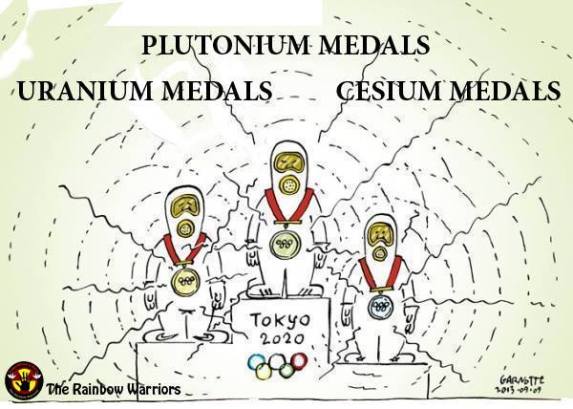
Seeking to break away from Japan’s association with high levels of radioactivity, the Abe government has branded the 2020 Olympics the “Recovery Games.”
But health and environmental risks from high levels of radiation persist in parts of Fukushima after the 2011 nuclear meltdown.
According to Shaun Burnie, a senior nuclear specialist with Greenpeace Germany, those visiting Fukushima for the Summer Games next year should take a proactive approach to educating themselves on which areas of Fukushima are affected by radiation and on the impact of exposure to radiation.
- “In terms of safety, there are certain areas of Fukushima where we would certainly not advise athletes or spectators to spend any time. Those are areas particularly close to the Fukushima Dai-ichi plant, including where the torch processions will be taking place,” Burnie said in an interview with The Korea Herald at Greenpeace Korea’s office in central Seoul last week.
“They are areas that are not safe for people to live. If you visit, you need to follow a radiation protocol. It is a bizarre situation that you are having Olympic events where people are concerned about radiation,” he added.
While noting that not all parts of Fukushima should be off limits, Burnie said athletes and sports bodies need to seek independent assessments on Fukushima, rather than relying on information provided by the Japanese government.
“It’s dangerous to just dismiss the whole of Fukushima as a radioactive disaster zone. It’s much more complex than that. The first thing is … don’t trust the Japanese government, educate yourself. If you’re an organizing body, get independent verification and independent information about what the relative radiation levels are, what the risks are,” Burnie said.As the senior nuclear specialist with Greenpeace Germany, Burnie has followed the Japanese government’s handling of the tsunami and earthquake in March 2011 that resulted in the meltdown of three nuclear reactors at the Fukushima Dai-ichi power plant.
In a report published in January, Burnie alleged that Tokyo plans to dispose of some 1 million metric tons of contaminated water by discharging it into the Pacific Ocean after the Summer Olympics.If Japan follows through with the move, radioactive water is expected to be present in Korea’s East Sea a year later.
“For the past five years we’ve been accessing the process, the discussions, the documents submitted by Tepco (Tokyo Electric Power Company) … we were reviewing some of Tepco’s data (last year) and we looked at it and went ‘there is something wrong here with Tepco’s processing,’” Burnie said.
“It became very clear there has been bad decisions made, not really surprising, by Tepco, by the (Japanese) government over the last five or six years and how to manage the water crisis.”
Last year Tepco acknowledged its Advanced Liquid Processing System, or ALPS, had failed to purify contaminated water stored in tanks at the Dai-ichi power plant.
A committee under Japan’s Ministry of Economy in 2016 put together five scenarios for the Japanese government to deal with the massive volume of pollutants stored at the Fukushima No. 1 plant.
The amount of water stored at the plant is to reach its full capacity of 1.3 million tons by the end of 2020, with about 170 tons accumulating daily.
According to Burnie, Tokyo has chosen to discharge the radioactive water instead of acting on any of the other four suggestions because “it is the most cheap and fast.”
Besides increased levels of radioactive cesium found in Fukushima and in the East Sea, Burnie warned of “cesium-rich micro particles” extremely small in size and inhaled through breathing.
Cesium is one of the largest sources of radioactivity from the 2011 disaster and has a half-life of 30 years.
“There is evidence from samples … some scientific literature has published the results and they found concentrations of these particles in areas 20-30 kilometers from the plant. … The problem is these particles can be inhaled. Then some of them lodge inside your lung at which point you are getting an internal dose, a very focused, very localized, relatively high-exposure dose to individual cells,” Burnie said.
“That’s a real problem because there is very little known about how cesium in that form will affect your long-term health. … Again, the people most at risk are those returning to live in areas of Fukushima affected by these particles. But the Japanese government has not taken into account in any of its assessments what those risks are,” he added.
Stressing that the risks of exposure to radiation should not be exaggerated, Burnie noted there is no safe level of radiation exposure and the long-term effects are unknown.
“The effects you will only see over decades. It won’t be instant, it’s not an acute radiation exposure, it’s low-level radiation,” Burnie said.
“The country that will be next impacted will be Korea, because it’s the geographically closest. … There is no safe threshold for radiation exposure. … Why should you be exposed when there is a clear alternative, which is you store?”
Sea level rise only half the story – climate change is altering ocean waves
If the climate warms by more than 2℃ beyond pre-industrial levels, southern Australia is likely to see longer, more southerly waves that could alter the stability of the coastline.
Scientists look at the way waves have shaped our coasts – forming beaches, spits, lagoons and sea caves – to work out how the coast looked in the past. This is our guide to understanding past sea levels.
But often this research assumes that while sea levels might change, wave conditions have stayed the same. This same assumption is used when considering how climate change will influence future coastlines – future sea-level rise is considered, but the effect of future change on waves, which shape the coastline, is overlooked.
Changing waves
Waves are generated by surface winds. Our changing climate will drive changes in wind patterns around the globe (and in turn alter rain patterns, for example by changing El Niño and La Niña patterns). Similarly, these changes in winds will alter global ocean wave conditions.
Further to these “weather-driven” changes in waves, sea level rise can change how waves travel from deep to shallow water, as can other changes in coastal depths, such as affected reef systems.
Recent research analysed 33 years of wind and wave records from satellite measurements, and found average wind speeds have risen by 1.5 metres per second, and wave heights are up by 30cm – an 8% and 5% increase, respectively, over this relatively short historical record.
These changes were most pronounced in the Southern Ocean, which is important as waves generated in the Southern Ocean travel into all ocean basins as long swells, as far north as the latitude of San Francisco.
Sea level rise is only half the story.…. https://theconversation.com/climate-change-may-change-the-way-ocean-waves-impact-50-of-the-worlds-coastlines-121239
1 This Month



26 September – International Day for the Total Elimination of Nuclear Weapons


PLEASE OPPOSE HR 8255 AND S.3639 – bills would accelerate satellite deployment, with no environmental review or safeguards – https://ncstd5li.quorum.us/campaign/169331/
To see nuclear-related stories in greater depth and intensity – go to https://nuclearinformation.wordpress.com
-
Archives
- September 2026 (245)
- August 2026 (330)
- July 2026 (355)
- June 2026 (287)
- May 2026 (306)
- April 2026 (356)
- March 2026 (251)
- February 2026 (267)
- January 2026 (308)
- December 2025 (358)
- November 2025 (359)
- October 2025 (375)
-
Categories
- 1
- 1 NUCLEAR ISSUES
- business and costs
- climate change
- culture and arts
- ENERGY
- environment
- health
- history
- indigenous issues
- Legal
- marketing of nuclear
- media
- opposition to nuclear
- PERSONAL STORIES
- politics
- politics international
- Religion and ethics
- safety
- secrets,lies and civil liberties
- spinbuster
- technology
- Uranium
- wastes
- weapons and war
- Women
- 2 WORLD
- ACTION
- AFRICA
- Atrocities
- AUSTRALIA
- Christina's notes
- Christina's themes
- culture and arts
- Events
- Fuk 2022
- Fuk 2023
- Fukushima 2017
- Fukushima 2018
- fukushima 2019
- Fukushima 2020
- Fukushima 2021
- general
- global warming
- Humour (God we need it)
- Nuclear
- RARE EARTHS
- Reference
- resources – print
- Resources -audiovicual
- Weekly Newsletter
- World
- World Nuclear
- YouTube
-
RSS
Entries RSS
Comments RSS
 nuclear-news