Thorium and uranium pollution from Rio Tinto’s Madagascar mine
Concerns about radioactive contamination dog Rio Tinto’s Madagascar mine, MONGABAY, by Malavika Vyawahare on 31 December 2019
|
|
|
||||

Trump’s plan to systematically remove environmental protection
 Trump’s 2020 plan: Change the rules on rules, Kelsey Brugger, E&E News reporter Greenwire: Friday, January 3, 2020 In the first half of 2020, Trump officials are hurrying to fundamentally change the way environmental rules are crafted.The administration plans to finalize regulations that could hamstring future presidents from making rules that rely on public health studies or fail to fully consider the benefits to Americans.
Trump’s regulatory plan released last fall showed hundreds of “economically significant” actions that the administration plans to finalize this year. Of those, at least 18 are noteworthy environmental rules — on air pollution and emissions to drilling and water quality.
But it’s Trump’s rules on the rulemaking process itself that could have the most lasting impact, according to experts.
For example, EPA’s proposed rule, “Strengthening Transparency in Regulatory Science,” could restrict the scientific evidence used to write air pollution rules.
The Trump administration also plans to change the way cost-benefit analyses are calculated, weakening future limits on power plant emissions, for example. Both rules are expected to advance in early 2020.
“Those are foundational,” said Betsy Southerland, a former longtime senior EPA career staffer and member of the Environmental Protection Network. “If they are finalized, from now on all environmental rules cannot count co-benefits and cannot use public health studies, then they can paralyze future rulemaking while the litigation slowly winds forward.”
It would take considerable time for a new administration to reverse those rollbacks, and certain Trump actions could get lost in the morass. The Obama EPA similarly could not undo some George W. Bush-era Clean Air Act permits that allowed aging facilities to continue to operate.
But time is running out.
The administration is up against a May deadline: Any regulations completed after that point would be subject to review under the Congressional Review Act. If 2021 ushers in a new president and a left-leaning Congress, the pair could undo many of Trump’s controversial triumphs.
Generally, not much happens in the federal government during an election year, when administrations tend to enter “political lockdown.” But in the Trump era, “unprecedented” is typical. And Trump continues to campaign on aggressive deregulation………
n 2020, the administration is expected to complete several environmental priorities.
The changes most concerning to Southerland included the WOTUS rewrite, the Affordable Clean Energy repeal and other pesticide reviews that are being done under the Toxic Substances Control Act, she said. “They are racing to finalize all of the damaging rollbacks in 2020,” she said.
Other drafts expected to be released in the coming weeks or months include the National Environmental Policy Act, which Trump ordered to be revised to ease permitting requirements when he first entered office; the Mercury and Air Toxics Standards, which would revoke past findings of mercury emissions and other pollutants; and the clean car standards, a joint effort of EPA and the Department of Transportation.
That two-part effort would weaken Obama-era fuel economy standards and prevent California from setting its own stricter standards (Greenwire, Nov. 20, 2019).
The Trump mantra, in a large part, has simply been to undo what Obama did…….Twitter: @kelseybrugger Email: kbrugger@eenews.net https://www.eenews.net/stories/1061984181
UK: legal action against environmental destruction by Sizewell nuclear project
Crowd Justice (accessed) 30th Dec 2019, Together Against Sizewell C (TASC) is an unincorporated citizens’ group
formed to oppose the building of Sizewell C’s twin nuclear reactors and
associated works in Suffolk Coast & Heaths Area of Outstanding Natural
Beauty (AONB) in a legal open, peaceful and fully accountable manner.
TASC has mounted a legal challenge against East Suffolk Council’s decision to
approve the planning application submitted by EDF, the nuclear developer,
to: – chop down 100-year-old Coronation Wood, turn a large area of priority
habitat acidic grassland, known as Pillbox Field, into a 576 space car
park, relocate over 320,000 sq. feet of 7 largely non-essential and
non-operational Sizewell B buildings and an additional 128 car parking
spaces, that will encroach further into the AONB. Most of these
buildings/facilities could be located outside the AONB. The works are
needed to free up land for the construction of Sizewell C as the existing
site is too small and are clearly integral to the wider Sizewell C
development.
https://www.crowdjustice.com/case/save-coronation-wood/
BBC 30th Dec 2019, Campaigners opposing a new nuclear power station are seeking a judicial review over a “premature” decision to allow woodland to be felled. EDF Energy wants to build two reactors next to Sizewell B in Suffolk and in September was told it could chop down Coronation Wood on the site. TogetherAgainst Sizewell C (Tasc) said the area was vital for wildlife. East
Suffolk Council said it would respond to the campaigners’ challenge in due
course.
Nuclear cost and water consumption – The elephants in the control room
 Nuclear cost and water consumption – The elephants in the control room, Open Forum.com.au.
  Peter Farley | December 20, 2019
 These are Plant Vogtle in the US (US$27.5bn, 2.2GW), Framanville France (€12.4bn+, 1.6 GW), Olkiluoto in Finland (around €10 bn+, 1.6 GW) and Hinckley Point in the UK (₤22 bn+, 3.2 GW).
There are two further plants whose power costs have been published, Akkuyu in Turkey US$127/MWh and Barakah in the Emirates US$110/MWh.
It should be emphasised that none of these costs are the full cost recovery. For example in the British case it is estimated that some $10 bn has been spent by others on upgrading the grid and backup power supplies. In Turkey the cost of the plant is just that, and doesn’t include civil works, grid connections, cooling water supply.
In the US plant Vogtle has benefited from some US$8bn of federal government loan guarantees and an unusual form of financing where customers have paid about 8% premium on their bills for 10-12 years before the plant is to be commissioned.
All of the plants get catastrophe insurance and some security from their government and most have inadequate bond structures for long term waste storage. They also rarely pay for cooling water. Many have preferential supply agreements which will require other cheaper sources of power to turn off to allow the nuclear plants to keep running.
However, even on the published information, nuclear power plants in democracies are running at about A$13m/MW………
“…..Cooling Water
A key issue with nuclear plants is cooling. Because of the cost of shutdowns and the degradation of materials by irradiation, the plants are designed to run at lower peak temperatures (260-320 C) than coal (500-670 C), gas turbines (1,300-1430C) or internal combustion plants (2,000 C).
The thermal efficiency of a plant is directly related to the difference between the peak temperature and the cooling medium – what is termed Carnot efficiency.
Lower temperature means lower efficiency, as less of the heat energy is converted into work and more is removed by the cooling system. So for a given amount of electrical energy delivered, more cooling is required in a nuclear plant. Furthermore the warmer the cooling water or air the more coolant is required.
Thus the Barrakah plants require 100 tonnes of Gulf seawater per second for each generator. In higher latitudes with seawater temperatures in the range of 2-12C, water requirements can still be 40-60 tonnes per second per GW…….
It is enough to change the local environment for all sea life, so finding a suitabable site is very difficult. There are currently no nuclear plants operating using warm seawater for cooling although Barrakah is soon to be commissioned.
The problem there is not just the temperature but the accelerated rates of corrosion and biofouling which will mean the heat exchangers need to be larger, pumping losses will be higher and maintenance bills higher still…..
On land in very cold climates, a small number of air cooled plants have been built but the offset is that about 5% of the output of the power plant is used to run the fans. However in warm climates it is virtually impossible to run an air cooled nuclear power plant……
A closer look at Barrakah
There are a range of risks with all nuclear designs, but the business risks assoctiated with the Barrakah style APR 1400 seem even larger than most.
The Barrakah plants were supposed to progressively come on line in early 2017 but they have yet to generate power. This delay is adding US$1.2-2 bn per year to the eventual liabilities that have to be paid off.
They are designed for an 18 month refueling cycle – unlike the AP1000 at plant Vogtle which has a 3 year refueling cycle. This means lower lifetime capacity factors and higher backup requirements with gas or pumped hydro. The design goal is 90% availability.
They have largely been built with very low finance costs from both Korea and the Emirates together with cheap expat Indian and Pakistani labour which significantly understates their real cost of construction.
The Barrakah plant is a 4 unit plant, which allows useful economies of scale, and there is nowhere in Australia where a 4 unit plant can safely be intergrated into the grid.
Recent problems with the single unit 750MW Kogan Creek generator in Queensland have shown that the grid can be destabilised with the failure of a single unit. As demand is gradually falling, a single unit of that magnitude is even harder to manage. The APR 1400 units are 1,350-1,400 MW so would be even more difficult to integrate into the grid.
These reactors have not yet been shown to work in a hot environment so their reliability is unknown, in fact there is only one other reactor of this type operating in the world with two more under construction.
The Moorside project in the UK which was to use KEPCO designs has been abandoned and plans for two more units in Korea have been frozen. KEPCO was offered all the development work already done on the Oldbury and Wyfla plants in the UK and did not take them up.
These plants came with billions of pounds worth of development work already done, project teams and permits in place and an offer from the UK government of a guaranteed ₤75/MWh + inflation for 25+ years.
There is a reasonably held belief that the price was artificially supported by the previous Korean government which viewed nuclear technology as a new export industry and this project as a flagship demonstrator. In contrast the current Korean government was elected on an anti-nuclear program and has pledged to build no more plants after the current two units under construction are completed.
There are some doubts about the level of safety in the design and a new design, APR1400+ was developed to reduce the possibility of a melt down. However no plants of this design have been ordered. So which one would you choose? https://www.openforum.com.au/nuclear-cost-and-water-consumption-the-elephants-in-the-control-room/?fbclid=IwAR2M3NxMjfrDJNWTG9tatKSARHGUKWVcG_CE-bSW5wtnAbwhGnYxd1ElugU
Goats irradiated in 1950s now pose possible environmental danger in Berkshire, UK
Contamination in Berkshire, Berkshire Live 21st Dec 2019, Goats injected with radioactive chemicals could be buried in Berkshire. The
animals, said to have been experimented on in the 1950s and 60s, could now
be buried on land in Shinfield.
Those living nearby have raised concerns
after learning scientists at the University of Reading injected the goats
with radioactive isotopes. The experiments were said to have been looking
into how radiation affected milk and metabolism.
It formed part of research
into milk production and the dairy industry, by The National Institute for
Research in Dairying (NIRD), based in Shinfield and closed in 1985. The
goats were apparently ‘famous in folklore’, according to one American
professor, Margaret Neville. Burying dead livestock is now banned to stop
the spread of disease. But before the 2003 ban, farmers would reportedly
often bury dead animals in pits on their own land.
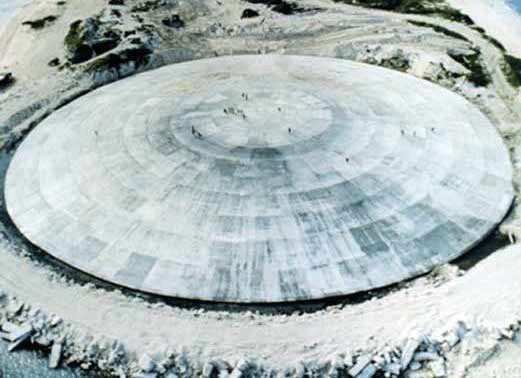
U.S. Congress Demands Investigation Into the U.S.’s Nuclear Coffin, The Runit Dome
|
Congress Demands Investigation Into the U.S.’s Nuclear Coffin, The Runit Dome is leaking radioactive waste into the Pacific Ocean. https://www.popularmechanics.com/military/weapons/a30338371/congress-investigation-runit-dome-nuclear-waste/
Dec 27, 2019
|
|
Seafloor mapping reveals the degradation of ocean floor by Bikini nuclear bomb tests

Bikini Seafloor Hides Evidence of Nuclear Explosions, Seafloor mapping has revealed a crater and several shipwrecks persisting 73 years after the world’s first underwater nuclear test. Eos, Amanda Heidt 28 Dec 19
Seventy-three years after serving as the site of the world’s first underwater nuclear test, the seafloor around the Bikini Atoll remains scarred by finely detailed craters and littered with derelict ships.
Today, an interdisciplinary team of scientists is using sonar to assess the complex submarine environment. The results provide a sobering assessment of humanity’s capacity to alter nature…..
Unleashing the Power of the Atom
In the aftermath of World War II, the U.S. Navy chose the Bikini Atoll for a series of controlled nuclear explosions. Between 1946 and 1958, 23 confirmed tests were conducted throughout the area.
Trembanis and his team studied Able and Baker, a pair of tests conducted in July 1946 as part of Operation Crossroads. Both Able and Baker involved plutonium fission bombs with a yield of between 21 and 23 kilotons, but they were deployed differently……….
Clustering around a laptop, Trembanis and his team witnessed the real-time rendering of an underwater crater more than 800 meters across—big enough to fit three Roman Colosseums. ….
Littered throughout the atoll are the husks of strategically placed ships—decommissioned dreadnaughts, aircraft carriers, and submarines meant to bear the brunt of the Able and Baker explosions. …..
Even independent of their place in nuclear history, the Pilotfish and other Bikini shipwrecks attest to the long-lived effects of human activities on the environment.
As old ships decompose, they become ecological burdens, and researchers found that several wrecks on the Bikini seafloor are leaching plumes of oil. Trembanis and his team looked at sketches from surveys the National Park Service conducted in the late 1980s and saw the degradation of the past 40 years……. https://eos.org/articles/bikini-seafloor-hides-evidence-of-nuclear-explosions
Kyrgyzstan bans uranium, thorium mining

Above – radioactive tailings mountain in Central Asia
|
Kyrgyzstan bans uranium, thorium mining http://www.xinhuanet.com/english/2019-12/16/c_138635832.htm 2019-12-16 BISHKEK, Dec. 16 (Xinhua) –– President of Kyrgyzstan Sooronbai Jeenbekov signed a decree banning the mining of uranium and thorium deposits in the Central Asian country, his press service reported on Monday.The law, aimed at ensuring radiation and environmental safety, prohibits geological exploration and development of uranium and thorium deposits in Kyrgyzstan, as well as dumping and transfer of the material, the report said.
Meanwhile, the import of raw materials and waste containing the two radioactive substances is not allowed by law, it said. Earlier this year, protests arose against the development of uranium deposits after reports that exploration work had begun in the Kyzyl-Ompol area in the Issyk-Kul region. |
|
Devastating array of craters on the ocean floor, from nuclear tests
Enormous Craters Blasted in Seafloor by Nuclear Bombs Mapped for the First Time, Live Science, By Mindy Weisberger – Senior Writer 11 Dec FRANCISCO — Today, all seems quiet in the remote Bikini Atoll, a chain of coral reef islands in the central Pacific. But more than 70 years ago, this region’s seafloor was rocked by powerful atomic bombs detonated by the U.S. Army.
For the first time, scientists have released remarkably detailed maps of this pockmarked seabed, revealing two truly massive craters. This new map shows that the seabed is still scarred by the 22 bombs detonated at Bikini Atoll between 1946 and 1958.
The map was presented yesterday (Dec. 9) at the annual meeting of the American Geophysical Union.
During the 1946 nuclear weapons test known as “Operation Crossroads,” the U.S. wanted to test the impact of nuclear bombs on warships. To that end, the Army assembled more than 240 ships — some of which were German and Japanese — that held different amounts of fuel and munitions, then deployed two nuclear weapons to destroy them, researcher Arthur Trembanis, an associate professor with the College of Earth, Ocean, and Environment at the University of Delaware, said in the presentation.
At the time of the tests, Trembanis said, comedian Bob Hope joked grimly:
“As soon as the war ended, we found the one spot on Earth that had been untouched by war and blew it to hell.”……….
But as powerful as the early atomic tests were, they were dwarfed by the later blasts caused by hydrogen and fusion bomb tests in the 1950s. The researchers investigated a crater that was 184 feet (56 m) deep and had an unusual oblong shape; they determined that it was a composite crater from multiple blasts: “Castle Bravo,” a 15-megaton bomb that was the largest ever detonated by the U.S., and “Castle Romeo,” the first deployed thermonuclear bomb.
These tests left behind a uniquely devastating array of shipwrecks and craters, and the first detailed map of their aftermath will help scientists to tell this untold story and connect to “a moment at the dawn of the nuclear age,” Trembanis said. “Our new findings provide insights into previously unknown conditions at Bikini and allow us to reflect on the lasting consequences from these and other tests.” https://www.livescience.com/mapping-reveals-bikini-atoll-nuclear-craters.html
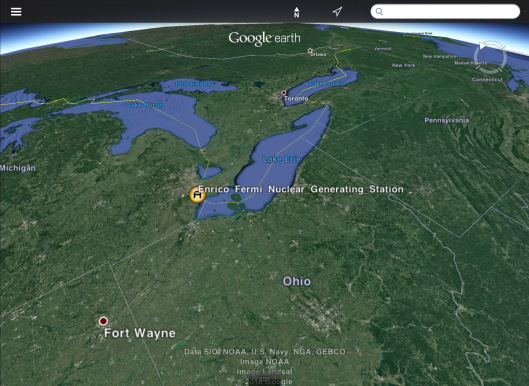
U.S. Congress members call on Trudeau to stop nuclear waste dumping near Great Lakes
|
Upton, Dingell, Kildee and Mitchell Appeal to Trudeau: No Nuclear Waste In the Great Lakes Basin, https://whtc.com/news/articles/2019/dec/10/upton-dingell-kildee-and-mitchell-appel-to-trudeau-no-nuclear-waste-in-the-great-lakes-basin/965368/ When U.S. Representatives Fred Upton and Debbie Dingell joined with a handful of other House members last Friday, Dec. 6, 2019, to decry plans by Canadian officials to put a nuclear waste storage site in the Great Lakes basin, they were hoping to shame Canadian Prime Minister Justin Trudeau into some kind of protective action.
Tuesday, December 10, 2019 But something else happened, Upton explained.
“We’ve got other members now, on a bipartisan basis, coming to us saying, ‘Hey, we want to sign that same letter,'” he said. “So we’re going to be doing another letter, a little bit later this week, that’ll have broader appeal. Because we were sort of under the gun when we learned the news late Friday afternoon.” Upton and Dingell joined two other Michigan representatives, Paul Mitchell and Dan Kildee in signing a letter appealing to Trudeau to oppose any nuclear waste storage plans near the Great Lakes. The complete text of last week’s letter: Dear Prime Minister Trudeau: We write to you out of deep concern regarding reports that Canada is moving closer to selecting a permanent national repository for harmful nuclear waste along the shores of the Great Lakes. Allowing a permanent nuclear waste storage facility anywhere near the Great Lakes basin, for any amount of time, is a risk we cannot afford to take. The recent reporting also has us greatly concerned that the highest levels of radioactive waste would ultimately be stored at the proposed site. We know that there are other Members of Congress representing districts in the Great Lakes basin who are most concerned by this development and will certainly be joining with us in the days ahead. This is a grave concern. These waters have long united us—they should not divide us. In November, the Energy and Commerce Committee favorably advanced H.R. 2699, the Nuclear Waste Policy Amendments Act of 2019, to the House for final consideration and it included an important bipartisan amendment that expresses the Sense of Congress that the governments of the United States and Canada should not allow permanent or long-term storage of spent nuclear fuel or other radioactive waste near the Great Lakes. This amendment was unanimously supported and adopted. We stand in strong opposition to any decision by the Canadian government to select or consider a permanent national repository for nuclear waste storage anywhere near the Great Lakes. This is a treasured natural resource each of our countries share and we urge you to stand with us to protect these waters for future generations. Thank you for your consideration of this important request and we look forward to a timely response. |
Water shortages to hit 1.9 billion people as glaciers melt
1.9 billion people at risk from mountain water shortages, study shows https://www.theguardian.com/environment/2019/dec/09/billion-people-risk-water-supply-rising-demand-global-heating-mountain-ecosystem
Rising demand and climate crisis threaten entire mountain ecosystem, say scientists, Jonathan Watts Global environment editor, @jonathanwatts, Tue 10 Dec 2019 A quarter of the world’s population are at risk of water supply problems as mountain glaciers, snow-packs and alpine lakes are run down by global heating and rising demand, according to an international study.
The first inventory of high-altitude sources finds the Indus is the most important and vulnerable “water tower” due to run-off from the Karakoram, Hindu Kush, Ladakh, and Himalayan mountain ranges, which flow downstream to a densely populated and intensively irrigated basin in Pakistan, India, China and Afghanistan.
The authors warn this vast water tower – a term they use to describe the role of water storage and supply that mountain ranges play to sustain environmental and human water demands downstream – is unlikely to sustain growing pressure by the middle of the century when temperatures are projected to rise by 1.9C (35.4F), rainfall to increase by less than 2%, but the population to grow by 50% and generate eight times more GDP.
Strains are apparent elsewhere in the water tower index, which quantifies the volume of water in 78 mountain ranges based on precipitation, snow cover, glacier ice storage, lakes and rivers. This was then compared with the drawdown by communities, industries and farms in the lower reaches of the main river basins.
The study by 32 scientists, which was published in the Nature journal on Monday, confirms Asian river basins face the greatest demands but shows pressures are also rising on other continents.
“It’s not just happening far away in the Himalayas but in Europe and the United States, places not usually thought to be reliant on mountains for people or the economy,” said one of the authors, Bethan Davies, of Royal Holloway University.
“We always knew the Indus was important, but it was surprising how the Rhône and Rhine have risen in importance, along with the Fraser and Columbia.”
The study says 1.9 billion people and half of the world’s biodiversity hotspots could be negatively affected by the decline of natural water towers, which store water in winter and release it slowly over the summer.
This buffering capacity is weakening as glaciers lose mass and snow-melt dynamics are disrupted by temperatures that are rising faster at high altitude than the global average.
“Climate change threatens the entire mountain ecosystem,” the report concludes. “Immediate action is required to safeguard the future of the world’s most important and vulnerable water towers.”
As well as local conservation efforts, the authors say international action to reduce carbon emissions is the best way to safeguard water towers.
Citing recent research by the UN Intergovernmental Panel on Climate Change, Davies said 75% of high-altitude snow and ice would be retained if global warming could be kept within 1.5C. However, 80% would be lost by 2100 if the world continued on a path of business as usual.
European report: don’t sacrifice the planet’s ecology in the drive for economic growth
Don’t pursue economic growth at expense of environment – report
Europe’s environmental watchdog gives warning as climate crisis continues, Guardian, Fiona Harvey 4 Dec 19, in Madrid Pursuing economic growth at the expense of the environment is no longer an option as Europe faces “unprecedented” challenges from climate chaos, pollution, biodiversity loss and the overconsumption of natural resources, according to a report from Europe’s environmental watchdog.
Europe was reaching the limits of what could be achieved by gradual means, by making efficiencies and small cuts to greenhouse gas emissions, with “transformational” change now necessary to stave off the impacts of global heating and environmental collapse, warned Hans Bruyninckx, executive director of the European Environment Agency…..
The EEA scored 35 key measures of environmental health, from greenhouse gases and air pollution, waste management and climate change to soil condition and birds and butterfly species, and found only six in which Europe was performing adequately.
“Incremental changes have resulted in progress in some areas but not nearly enough to meet our long-term goals,” said Bruyninckx. Further marginal changes would grow only more expensive, he predicted, making large-scale change necessary. “We already have the knowledge, technologies and tools we need to make key production and consumption systems such as food, mobility and energy sustainable.”
Wholesale changes could include banning internal combustion engines and scaling up public transport, abandoning fossil fuels in favour of 100% renewable energy, stipulating that products must be designed and manufactured to create no waste, and changes to our diets and agricultural production. Environmental goals could not be seen as separate to or lesser than economic goals, and accepting environmental damage as an inevitable cost would lead to ecological collapse, Bruyninckx warned.
The old system – of “continuing to promote economic growth and seeking to manage the environmental and social impacts” – would not deliver the EU’s long-term vision of “living well, within the limits of the planet”, the report warned.
The report, known as European Environment – State and Outlook (SOER), is a comprehensive study produced every five years and details the health or otherwise of all natural systems across EU member states and others including Norway, Switzerland and Turkey. The 2020 edition was brought forward to inform the incoming European commission as they discuss a promised “green new deal”, and for delegates at COP25, the UN conference on climate change currently taking place in Madrid.
There has been little improvement since the last report in 2015, despite promises, policies and targets, according to SOER 2020. Fewer than a quarter of protected species and only 16% of habitats are in a good state of conservation. Reduced pollution has improved water quality, but Europe will miss by a long way its goal of having a “good” rating for all water bodies by 2020. Though air quality has improved, about a fifth of the urban population live in areas where concentrations of pollutants exceed at least one EU air quality standard, and 62% of ecosystems are exposed to excessive nitrogen levels.
Global heating has added to the risks to health……https://www.theguardian.com/environment/2019/dec/04/dont-pursue-economic-growth-at-expense-of-environment-report
Antarctic ice sheets could be at greater risk of melting than previously thought
|
|
|

As the Runit nuclear waste dome crumbles, Marshall Islanders want honesty and justice
‘People want justice’: Marshalls’ fury over nuclear information US withheld– https://www.rnz.co.nz/international/programmes/datelinepacific/audio/2018723289/people-want-justice-marshalls-fury-over-nuclear-information-us-withheld From Dateline Pacific, 21 November 2019
|
The caretaker president of the Marshall Islands says it’s unconscionable that the United States kept secret key information about its nuclear tests for decades. New details reveal the US withheld information about the nuclear waste it left behind when the Marshall Islands gained independence, and the extent of the tests it carried out. Now, a dome that contains hundreds of tonnes of nuclear waste is at risk of crumbling into the ocean. But with Washington increasingly jittery about China, the small Pacific country’s finding it might now have some leverage to get something done. TRANSCRIPTEnewetak was once a paradise – a long atoll in the clear blue waters of the north Pacific, white sand and thick green palms. Today, it’s rutted with scars, after the US detonated dozens of nuclear bombs on, in and above it in the 1940s and ’50s. Whole islands were vaporised, deep craters carved into the coral. Jack Ading is a senator from Enewetak. His family was forced to move for the tests, and then allowed to return in the 1980s. “It appears that when we moved back to Enewetak in the 1980s after we were assured by the US government that it was safe. We were actually subjecting ourselves to a risk that we were never warned about.” Government documents reveal that beyond the nuclear blasts, the US also tested biological weapons, including an aerosol bacteria. Jamie Tahana reports. TRANSCRIPTEnewetak was once a paradise – a long atoll in the clear blue waters of the north Pacific, white sand and thick green palms. Today, it’s rutted with scars, after the US detonated dozens of nuclear bombs on, in and above it in the 1940s and ’50s. Whole islands were vaporised, deep craters carved into the coral. Jack Ading is a senator from Enewetak. His family was forced to move for the tests, and then allowed to return in the 1980s. “It appears that when we moved back to Enewetak in the 1980s after we were assured by the US government that it was safe. We were actually subjecting ourselves to a risk that we were never warned about.” Government documents reveal that beyond the nuclear blasts, the US also tested biological weapons, including an aerosol bacteria. But this was kept secret when the people from Enewetak were allowed to return, and other documents show that people were subjected to tests and experiments about the lingering effects of radiation. Last week, the Los Angeles Times also uncovered that the US didn’t tell the Marshallese it had shipped 130 tonnes of soil from its atomic testing grounds in Nevada in 1958 and dumped it at Enewetak. The caretaker president of the Marshall Islands, Hilda Heine, says the new details are disturbing. “To say the least you would have thought that all that information would have been shared with the Enewetak people before they went back to Enewetak. It is unbelievable that such information was held back, and as a result people have gone back and lived there for many years.” The nuclear waste from the era is stored in a pile at the end of the island of Runit, covered in a concrete dome. But a recent study by the Marshall Islands Nuclear Commission found the dome is now at risk of collapsing, and as rising seas erode beneath it, much of that waste is seeping into the lagoon. The commission’s chair, Rhea Moss-Christian, says information about the dome and the testing era was withheld throughout the independence process, while a compact of free association was negotiated in the 1980s. “We signed the compact in 1986 on the understanding that we had all the information we needed to have. It’s pretty hard for us to see this information, to have the level of detail that we now have, and to think that any of those previous agreements could stand.” The Marshall Islands has sought US help to clean up contamination and to shore up the dome, but American officials have declined, saying it’s on Marshallese land and, therefore, is the Marshall Islands’ responsibility. Ms Moss-Christian says that’s ridiculous. “How can it be that this radioactive waste and structure that we didn’t ask for. How can it be that this is ours and ours to deal with?” A Nuclear Claims Tribunal formed by the two countries in 1988 concluded that the US should pay $US2.2 billion in claims and settlements. But documents from both the Nuclear Commission and a 2010 US House inquiry show only $4 million has been paid. Last month, the Marshall Islands parliament – the Nitijela – endorsed a Nuclear Commission strategy which calls for, among other things, full compensation, better healthcare, and environmental protections. The US maintains it is upholding its responsibilities. It says it’s paid nearly a billion dollars, which has gone towards resettlement, rehabilitation and healthcare costs for affected communities, and that it’s funding tests of the water and atmosphere around the Runit dome. But Giff Johnson, the editor of the Marshall Islands journal and an author of books about the nuclear legacy, says that’s not enough. “People want justice for Marshall Islanders. The US government has to step up and address issues that it has addressed for American victims but is ignoring out here.” For the Marshall Islands, a smattering of atolls in the North Pacific – population 53,000 – it might be an opportune time to twist a superpower’s arm. Washington is increasingly nervous about a growing Chinese presence, and the compact of free association – which guarantees relations and funding from the US – expires in three years. Having initially maintained there won’t be a replacement compact, Washington is now keen to open talks for a new one, and has sent a string of high-ranking officials for visits. The caretaker president, Hilda Heine – who a few months ago was invited to the White House to meet President Donald Trump – says that could bode well. “The geopolitical situation in the Pacific is really helpful to the cause of the Marshall Islands. The US is now paying more attention to the Marshall Islands, so our issues around climate change, around our nuclear legacy, I think those will come to the forefront of our discussions going forward with the United States.” Whatever comes from those discussions, the people of Enewetak want more than they’re getting now. |
|
Toxic flushing of nuclear poisons into Lake Winnepeg
 Pinawa’s toxic predicament hurts Lake Winnipeg https://www.winnipegfreepress.com/opinion/analysis/pinawas-toxic-predicament-hurts-lake- Pinawa’s toxic predicament hurts Lake Winnipeg https://www.winnipegfreepress.com/opinion/analysis/pinawas-toxic-predicament-hurts-lake- winnipeg-564698971.html By: Dave Taylor 11/9/2019 winnipeg-564698971.html By: Dave Taylor 11/9/2019 How on Earth did humans ever think nature would absorb the nasty poisons we generate?
By now, we should realize that to bury or flush these toxins will not make them simply disappear. Many are insidious and will be back to bite us in the future. Putting a stop to these practices is paramount considering efforts to ameliorate past mistakes is such an onerous proposition, one that is even more demanding when the original polluter and their profits have disappeared.
We persist in flushing sewage into Lake Winnipeg and resist efforts to reduce phosphorus loads all in the name of financial savings. Ironically, there are no savings to be had, just a deferred payment plan. People will pay, it’s just a matter of when. The nuclear facility near Pinawa was built in the 1960s upon this very strategy of flushing wastes into the Winnipeg River and ultimately Lake Winnipeg, and continues to this day. The justification at that time was that they could dilute the radioactivity to levels that met their vague “as low as reasonably achievable” policy. Efforts continue to clean up the mess left behind in trenches, standpipes and bunkers, many of which are in disrepair and lead to the river. The subcontracting consortium that is attempting to deal with defunct sites across the country is Canadian Nuclear Labs (CNL). It is funded by the federal government and is led by SNC-Lavalin, whose lobbying efforts of the federal government are renowned and include bribery and fraud charges, as well as illegal election financing. The off-loading of the site and its problems have significantly altered the original decommissioning plans of 2001 and expedient shortcuts are being slipped by Canada’s nuclear regulator, the Canadian Nuclear Safety Commission, which we are obliged to trust to provide scrutiny of the cleanup and the ever-changing plans. CNL has applied for a 10-year licence and is being paid a king’s ransom ($1 billion annually) to restore the lands messed up by Atomic Energy of Canada at sites across the country. Placing our trust in CNL or the regulatory watchdog, commission, has never been more difficult. Not only are they administered by the same natural resources minister who advocates the expansion of nuclear power in Canada, but they have received a chastising by the International Atomic Energy Agency (IAEA) for what can only be described as a substandard approach to radioactive-waste disposal. The IAEA conducted a review mission in September and concluded the commission should enhance its policies and “should consider better aligning its radiation-protection requirements with IAEA safety standards.” In other words, shape up. At the very least, the federal watchdog should be placed under the environment portfolio so there is no perception of conflict of interest. The challenges for Pinawa are substantial as radioactive waste has been disposed of in decaying installations, some of which have required significant patching for cracks and, in a recent report made available to the public, they have discovered evidence of plutonium in the sewage lagoon not intended to receive radioactive materials. There are also the remains of Whiteshell Reactor No. 1 this consortium plans to seal up with concrete in hopes that the inevitable leaks will be absorbed by the river. Indigenous elders, including Dave Courchene, have taken a collaborative approach to dealing with this toxic predicament, which is upstream from them and entirely related to the concept of “flushing” wastes into a sacred river. Representatives of the Sagkeeng, Hollow Water and Peguis communities held a ceremony at Pinawa in September in hopes of changing the paradigm and promoting a much better solution. Since there is no solution to the problem of nuclear waste, they advocate isolating, containing, repackaging and consistent monitoring of these poisons over hundreds of years, a proposal that CNL is not likely to embrace as it will cut into their profits. Sagkeeng Chief Derrick Henderson stated: “We must be very careful with what we do to our land; we will be here forever and we all have that responsibility and duty.” Until the federal government assumes this duty of stewardship toward the Winnipeg River, “flushing” of radioactive waste will continue. The elders are sending SNC-Lavalin and friends a clear message. If they aren’t willing to adhere to traditional wisdom, keep them on a short leash with a year-to-year licence. Dave Taylor teaches at the University of Winnipeg.
|
|

1 This Month



26 September – International Day for the Total Elimination of Nuclear Weapons


PLEASE OPPOSE HR 8255 AND S.3639 – bills would accelerate satellite deployment, with no environmental review or safeguards – https://ncstd5li.quorum.us/campaign/169331/
To see nuclear-related stories in greater depth and intensity – go to https://nuclearinformation.wordpress.com
-
Archives
- September 2026 (245)
- August 2026 (330)
- July 2026 (355)
- June 2026 (287)
- May 2026 (306)
- April 2026 (356)
- March 2026 (251)
- February 2026 (267)
- January 2026 (308)
- December 2025 (358)
- November 2025 (359)
- October 2025 (375)
-
Categories
- 1
- 1 NUCLEAR ISSUES
- business and costs
- climate change
- culture and arts
- ENERGY
- environment
- health
- history
- indigenous issues
- Legal
- marketing of nuclear
- media
- opposition to nuclear
- PERSONAL STORIES
- politics
- politics international
- Religion and ethics
- safety
- secrets,lies and civil liberties
- spinbuster
- technology
- Uranium
- wastes
- weapons and war
- Women
- 2 WORLD
- ACTION
- AFRICA
- Atrocities
- AUSTRALIA
- Christina's notes
- Christina's themes
- culture and arts
- Events
- Fuk 2022
- Fuk 2023
- Fukushima 2017
- Fukushima 2018
- fukushima 2019
- Fukushima 2020
- Fukushima 2021
- general
- global warming
- Humour (God we need it)
- Nuclear
- RARE EARTHS
- Reference
- resources – print
- Resources -audiovicual
- Weekly Newsletter
- World
- World Nuclear
- YouTube
-
RSS
Entries RSS
Comments RSS
 nuclear-news