Giant iceberg ‘calves’ from Antarctic ice shelf

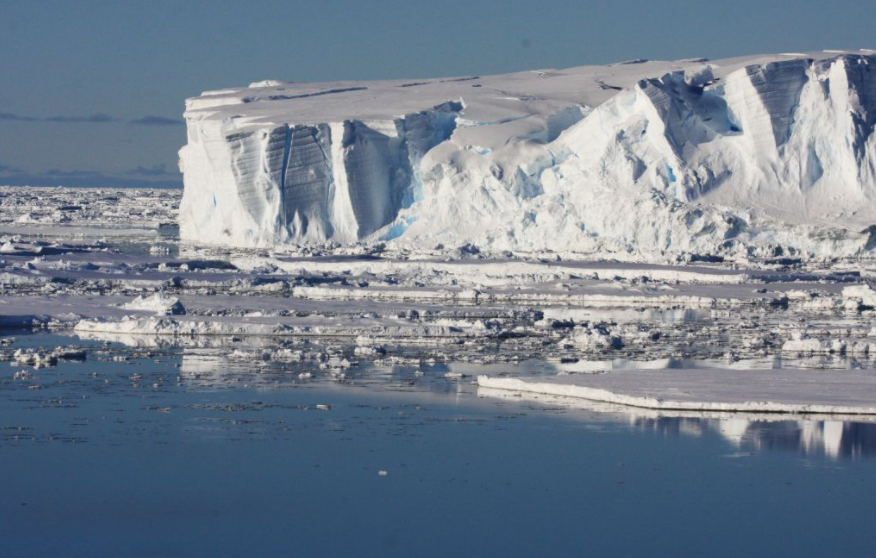
Shrinking Antarctic ice shelf Pine Island Glacier sheds giant iceberg, ABC News, Digital Story Innovation Team By Mark Doman 14 Feb 20, In one of the fastest-changing areas of the Antarctic ice sheet, satellites have captured the formation of a giant, 300-square-kilometre iceberg.
Researchers monitoring satellite imagery of the Pine Island Glacier (PIG), in west Antarctica, first noticed two large rifts forming in the shelf in 2019.
Over the next few months, as the glacier moved out towards the Amundsen Sea, the rifts expanded, eventually leading to the splitting of the iceberg from the glacier on February 9.
Within a day, the iceberg had broken up into smaller pieces.
Only one of the pieces was large enough to be named (B-49) and tracked by the United States National Ice Centre.
It comes just days after a station on the Antarctic Peninsula logged its hottest day on record, registering a temperature of 18.3 degrees Celsius.
The peninsula, which juts out to the north-east of the Pine Island Glacier, is among the fastest-warming regions on the planet. Temperatures there have increased almost 3C over the last 50 years, according to the World Meteorological Organisation.
Last month, scientists also recorded unusually warm water beneath the Thwaites Glacier, a neighbour to Pine Island.
While the calving of icebergs from shelves such as the Pine Island Glacier is a natural process in the life of a giant glacier, the rate at which this glacier and others in the region have been disintegrating is a cause of concern for scientists.
Previously the ice shelf calved once a decade. By the early 2000s, it started calving once every five years. But since 2013, the glacier has calved five times, according to Stef Lhermitte, a remote sensing scientist from the Delft University of Technology in the Netherlands……. https://www.abc.net.au/news/2020-02-13/antarctic-ice-shelf-pine-island-glacier-sheds-giant-iceberg/11957770
Polynesian MP calls on France for “vast project” to withdraw radioactive waste in Mururoa
|
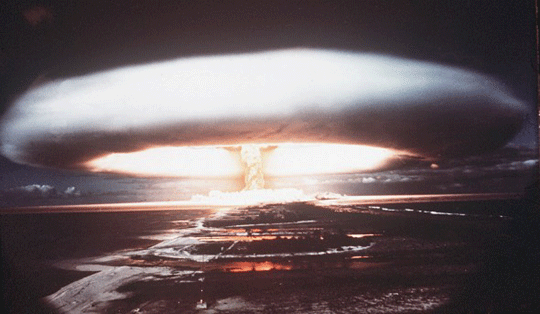
Polynesia: MP Moetai Brotherson asks Macron for a “vast project” to withdraw radioactive waste in Mururoa, 8 Feb 2020 https://la1ere.francetvinfo.fr/polynesie-depute-moetai-brotherson-demande-macron-vaste-projet-retrait-dechets-radioactifs-mururoa-798235.html [machine translate] The deputy of Polynesia Moetai Brotherson asked in a letter to Emmanuel Macron, who will be in April in the Polynesian archipelago, that he undertakes on “a vast project of withdrawal and reprocessing of all radioactive waste and residues from the Moruroa nuclear tests “.
From 1966 to 1996, the Mururoa and Fangataufa atolls were the scene of 193 nuclear tests , which had effects on the health and the environment of the populations. The head of state is expected to visit Polynesia in mid-April, when two summits are being held, “France-Oceania” and “One Planet Summit”.
” Mr. President, rather than ostrich, the French Republic would be honored to commit today to an ambitious and vast project to withdraw and reprocess all radioactive waste and residues from the tests Moruroa nuclear “, explains the deputy attached to the communist group in the Assembly and representative of Tavini Huiraatira, Polynesian separatist party, in a letter which AFP had a copy on Friday. Threats of collapse
He recalls that nuclear tests, ” especially in their underground part, generated a quantity of radioactive waste and residues “. ” Today, a significant proportion of this waste is stored in wells several hundreds of meters deep drilled in the coral ring of Moruroa, or worse, at the bottom of its lagoon, in particular at a place called ‘Colette bench ‘ “.
But ” cracks in the base of the atoll “, “induced by underground tests in particular “, threaten ” collapse part of the atoll. It appears that both the containment wells, as the Colette bank are precisely in the endangered area “,
“Dramatic message”For the Polynesian deputy, not to commit to the depollution of the site ” would be to send a dramatic message to the Polynesians, to the Peoples of the Pacific, but also to the People of France, in particular to his youth who wants to see (…) real strong actions in favor of the environment “. Moetai Brotherson underlines that ” the biggest investment made by the State in French Polynesia in recent years is the TELSITE geomechanical surveillance project of Moruroa. The billions invested still come to underline the reality of this collapse, real sword of Damocles, for the Polynesians first, for the Pacific region then, for the reputation of the French Republic finally
|
|
With 170 tons more radioactive water added each day, Japan’s desperate plan for dumping Fukushima water into Pacific Ocean
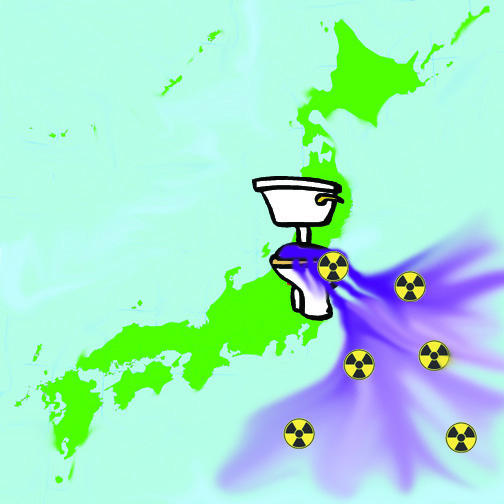 ‘An Appalling Act of Industrial Vandalism’: Japanese Officials Do PR for Plan to Dump Fukushima Water Into Ocean https://www.commondreams.org/news/2020/02/03/appalling-act-industrial-vandalism-japanese-officials-do-pr-plan-dump-fukushima The Japanese government told embassy officials from nearly two dozen countries that releasing the water into the ocean was a “feasible” approach that could be done “with certainty.”
According to Kyodo News, officials from the Ministry of Economy, Trade, and Industry claimed releasing the water and evaporating it are both “feasible methods” but said the former could be done “with certainty” because radiation levels could be monitored.
There’s more than one million tons of contaminated water already stored at the plant, with 170 tons more added each day. Utility TEPCO says there will be no more capacity for tanks holding contaminated water by 2022.
As Agence France-Presse reported, “The radioactive water comes from several different sources—including water used for cooling at the plant, and groundwater and rain that seeps into the plant daily—and is put through an extensive filtration process.”
That process still leaves tritium in the water and “has been found to leave small amounts of other radioactive materials,” Kyodo added.
The session for embassy officials followed Friday’s recommendation by a Japanese government panel that releasing the water into the ocean was the most feasible plan. As Reuters reported Friday:
The panel under the industry ministry came to the conclusion after narrowing the choice to either releasing the contaminated water into the Pacific Ocean or letting it evaporate—and opted for the former. Based on past practice it is likely the government will accept the recommendation.
Local fishermen oppose the plan and Reuters noted it is “likely to alarm neighboring countries.”
They’re not alone.
Nuclear policy expert Paul Dorfman said Saturday, “Releasing Fukushima radioactive water into ocean is an appalling act of industrial vandalism.”
Greenpeace opposes the plan as well. Shaun Burnie, a senior nuclear specialist the group’s German office, has previously called on Japanese authorities to “commit to the only environmentally acceptable option for managing this water crisis, which is long-term storage and processing to remove radioactivity, including tritium.
Why Arctic glaciers are melting away at an accelerating rate
How the ocean is gnawing away at glaciers, https://www.sciencedaily.com/releases/2020/02/200203114350.htm
- Date:
- February 3, 2020
- Source:
- Alfred Wegener Institute, Helmholtz Centre for Polar and Marine Research
- Summary:
- The Greenland Ice Sheet is melting faster today than it did only a few years ago. The reason: it’s not just melting on the surface — but underwater, too. AWI researchers have now found an explanation for the intensive melting on the ice’s underside, and published their findings in the journal Nature Geoscience.
-
The glaciers are melting rapidly: Greenland’s ice is now melting seven times faster than in the 1990s — an alarming discovery, since climate change will likely intensify this melting in the future, causing the sea level to rise more rapidly.
Accordingly, researchers are now working to better understand the underlying mechanisms of this melting. Ice melts on the surface because it is exposed to the sun and rising temperatures. But it has now also begun melting from below — including in northeast Greenland, which is home to several ‘ice tongues’. Each tongue is a strip of ice that has slid down into the ocean and floats on the water — without breaking off from the land ice. The longest ice tongue, part of the ’79° North Glacier’, is an enormous 80 km long. Over the past 20 years, it has experienced a dramatic loss of mass and thickness, because it’s been melting not just on the surface, but also and especially from below.
-
Too much heat from the ocean
A team led by oceanographer Dr Janin Schaffer from the Alfred Wegener Institute, Helmholtz Centre for Polar and Marine Research (AWI) in Bremerhaven has now identified the source of this intense underwater melting. The conclusions of their study, which the experts have just released in the journal Nature Geoscience, are particularly unsettling because the melting phenomenon they discovered isn’t unique to the 79° North Glacier, which means it could produce similar effects elsewhere. For the purposes of the study, the researchers conducted the first extensive ship-based survey of the ocean floor near the glacier, which revealed the presence of a two-kilometre-wide trough, from the bottom of which comparatively warm water from the Atlantic is channelled directly toward the glacier. But that’s not all: in the course of a detailed analysis of the trough, Janin Schaffer spotted a bathymetric sill, a barrier that the water flowing over the seafloor has to overcome. Once over the hump, the water rushes down the back of the sill — and under the ice tongue. Thanks to this acceleration of the warm water mass, large amounts of heat from the ocean flow past the tongue every second, melting it from beneath. To make matters worse, the layer of warm water that flows toward the glacier has grown larger: measured from the seafloor, it now extends 15 metres higher than it did just a few years ago. “The reason for the intensified melting is now clear,” Schaffer says. “Because the warm water current is larger, substantially more warmth now makes its way under the ice tongue, second for second.”
Other regions are also affected
In order to determine whether the phenomenon only manifests at the 79° North Glacier or also at other sites, the team investigated a neighbouring region on Greenland’s eastern coast, where another glacier, the Zachariæ Isstrøm, juts out into the sea, and where a large ice tongue had recently broken off from the mainland. Working from the surface of an ice floe, the experts measured water temperatures near the ocean floor. According to Schaffer: “The readings indicate that here, too, a bathymetric sill near the seafloor accelerates warm water toward the glacier. Apparently, the intensive melting on the underside of the ice at several sites throughout Greenland is largely produced by the form of the seafloor.” These findings will ultimately help her more accurately gauge the total amount of meltwater that the Greenland Ice Sheet loses every year.
Story Source:
Materials provided by Alfred Wegener Institute, Helmholtz Centre for Polar and Marine Research. Note: Content may be edited for style and length.
As forests burn around the world, drinking water is at risk
 As forests burn around the world, drinking water is at risk https://www.westhawaiitoday.com/2020/01/31/features/as-forests-burn-around-the-world-drinking-water-is-at-risk/
In Australia’s national capital of Canberra, where a state of emergency was declared on Friday because of an out-of-control forest fire to its south, authorities are hoping a new water treatment plant and other measures will prevent a repeat of water quality problems and disruption that followed deadly wildfires 17 years ago.
|
“The forest area burned in Australia within a single fire season is just staggering,” said Stefan Doerr, a professor at Swansea University in England who studies the effects of forest fires on sediment and ash runoff. “We haven’t seen anything like it in recorded history.” The situation in Australia illustrates a growing global concern: Forests, grasslands and other areas that supply drinking water to hundreds of millions of people are increasingly vulnerable to fire due in large part to hotter, drier weather that has extended fire seasons, and more people moving into those areas, where they can accidentally set fires. More than 60% of the water supply for the world’s 100 largest cities originates in fire-prone watersheds — and countless smaller communities also rely on surface water in vulnerable areas, researchers say. When rain does fall, it can be intense, dumping a lot of water in a short period of time, which can quickly erode denuded slopes and wash huge volumes of ash, sediment and debris into crucial waterways and reservoirs. Besides reducing the amount of water available, the runoff also can introduce pollutants, as well as nutrients that create algae blooms. What’s more, the area that burns each year in many forest ecosystems has increased in recent decades, and that expansion likely will continue through the century because of a warmer climate, experts say. Most of the more than 25,000 square miles that have burned in Victoria and New South Wales have been forest, including rainforests, according to scientists in New South Wales and the Victorian government. Some believe that high temperatures, drought and more frequent fires may make it impossible for some areas to be fully restored. When rain does fall, it can be intense, dumping a lot of water in a short period of time, which can quickly erode denuded slopes and wash huge volumes of ash, sediment and debris into crucial waterways and reservoirs. Besides reducing the amount of water available, the runoff also can introduce pollutants, as well as nutrients that create algae blooms. What’s more, the area that burns each year in many forest ecosystems has increased in recent decades, and that expansion likely will continue through the century because of a warmer climate, experts say. Most of the more than 25,000 square miles that have burned in Victoria and New South Wales have been forest, including rainforests, according to scientists in New South Wales and the Victorian government. Some believe that high temperatures, drought and more frequent fires may make it impossible for some areas to be fully restored. Very hot fires burn organic matter and topsoil needed for trees and other vegetation to regenerate, leaving nothing to absorb water. The heat also can seal and harden the ground, causing water to run off quickly, carrying everything in its path. That in turn can clog streams, killing fish, plants and other aquatic life necessary for high-quality water before it reaches reservoirs. Already, thunderstorms in southeast Australia in recent weeks have caused debris flows and fish kills in some rivers, though fires continue to burn. “You potentially get this feedback cycle,” where vegetation can’t recolonize an area, which intensifies erosion of any remaining soil, said Joel Sankey, research geologist for the U.S. Geological Survey. The role of climate change is often difficult to pin down in specific wildfires, said Gary Sheridan, a researcher at the University of Melbourne. But he said the drying effects of wildfire — combined with hotter weather and less rainfall in much of Australia, even as more rain falls in the northern part of the country — mean that “we should expect more fires.” But climate change has affected areas such as northern Canada and Alaska, where average annual temperatures have risen by almost 4 degrees since the 1960s, compared to about 1 degree farther south. As a result, the forested area burned annually has more than doubled over the past 20 to 30 years, said Doerr, from Swansea University. Although there might be fewer cities and towns in the path of runoff in those areas, problems do occur. In Canada’s Fort McMurray, Alberta, the cost of treating ash-tainted water in its drinking-water system increased dramatically after a 2016 wildfire. In the Western U.S., 65% of all surface water supplies originate in forested watersheds where the risk of wildfires is growing — including in the historically wet Pacific Northwest. By mid-century almost 90% of them will experience an increase — doubling in some — in post-fire sedimentation that could affect drinking water supplies, according to a federally funded 2017 study. “The results are striking and alarming,” said Sankey, the USGS geologist, who helped lead the study. “But a lot of communities are working to address these issues,” he added. “It’s not all doom and gloom because there are a lot of opportunities to reduce risks.” Denver Water, which serves 1.4 million customers, discovered “the high cost of being reactive” after ash and sediment runoff from two large, high-intensity fires, in 1996 and 2002, clogged a reservoir that handles 80% of the water for its 1.4 million customers, said Christina Burri, a watershed scientist for the utility. It spent about $28 million to recover, mostly to dredge 1 million cubic yards of sediment from the reservoir. Since then, the utility has spent tens of millions more to protect the forests, partnering with the U.S. Forest Service and others to protect the watershed and proactively battle future fires, including by clearing some trees and controlling vegetation in populated areas. Utilities also can treat slopes with wood chips and other cover and install barriers to slow ash runoff. They purposely burn vegetation when fire danger is low to get rid of undergrowth. Canberra’s water utility has built in redundancies in case of fire, such as collecting water from three watersheds instead of two, and it can switch among sources if necessary, said Kristy Wilson, a spokeswoman for Icon Water, which operates the system. Water can be withdrawn from eight different levels within the largest dam to ensure the best-quality water, even if there is some sediment, she said. That is paired with simpler measures such as using straw bales, sediment traps and booms with curtains to control silt, and physically removing vegetation around reservoirs and in watersheds to reduce fire fuel, she said. Eventually, some communities might need to switch their water sources because of fires and drought. Perth, on the western coast, has turned to groundwater and systems that treat saltwater because rainfall has decreased significantly since the early 1970s, said Sheridan of University of Melbourne. But, for now, millions of people will continue to drink water that originates in increasingly fire-prone forests. |
|
Qatar says UAE`s power plant activities are a threat to Gulf stability and the environment
|
UAE nuclear reactor ready; Qatar views it as a threat https://www.middleeastmonitor.com/20200130-uae-nuclear-reactor-ready-qatar-views-it-as-a-threat/ January 30, 2020, The United Arab Emirates Barakah nuclear power plant is ready to operate, the UAE’s state-run Emirates News Agency (WAM) reported on Tuesday.Nawah Energy Company, the operator of the power plant, is concluding the final requirements,” WAM said.
Barakah will be the UAE’s first nuclear plant and the world’s largest when completed, with four reactors and 5,600 megawatts (MW) of capacity, Reuters reported. Sultan bin Ahmad Sultan Al Jaber, a minister of state in the UAE government and also chief executive of Abu Dhabi National Oil Company (Adnoc), drew attention to the nuclear power plants that will start supplying the country’s electricity grid for the first time later this year, WAM reported two weeks ago. Underlining the myriad risks inherent in Barakah’s design, Qatar says UAE`s power plant activities are a threat to Gulf stability and the environment. Last year, in a letter to the International Atomic Energy Agency (IAEA), a Vienna based international organisation founded to promote the peaceful use of nuclear energy, Qatar urged them to create a framework for regional nuclear security, Al Jazeera reported. |
|
New interactive flood-risk map shows that global vulnerability to sea level rise is worse than previously understood.

Eastern Daily Press 23rd Jan 2020, Huge swathes of the Broads, the Fens and even parts of Great Yarmouth and Norwich could be under water in 30 years unless drastic action is taken to halt global warming.
That is the shocking conclusion drawn from a new
interactive flood-risk map built by US-based researchers who claim that
global vulnerability to sea level rise is worse than previously understood.
Japan could decide on fate of radioactive waste water before the Olympics in July

|
Fukushima Water Waste Decision Could Come Before Tokyo Olympics, VOA, 26 Jan 2020, Japanese officials say a decision on how to deal with radioactive water from the Fukushima nuclear plant could come before the Tokyo Olympics begin in July……
TEPCO officials recently guided a Reuters reporter around the plant, which covers about 3.5 million square meters in northeast Japan. The reporter described large cranes being used to break up major parts of the plant’s structure. The reporter also described operations aimed at removing spent fuel from a reactor. Overall, about 4,000 people are taking part in the cleanup effort, Reuters reported. Some Olympic events are set to take place within 60 kilometers of the destroyed plant, Reuters said. One major part of the cleanup has involved treating and storing contaminated water from the area. TEPCO has predicted that Fukushima will run out of all its storage space for water by 2022. A government group studying future storage solutions said last month that it had decided on two main possible solutions. One solution is to treat the water and then control its release into the Pacific Ocean. The other would be to let the water evaporate. Japanese experts say the government may decide on a solution within the next few months. Either process is expected to take years to complete. Joji Hara is a Tokyo-based spokesman for the power company. He told Reuters that TEPCO has already been making preparations to inform the public about any developments related to Fukushima. “The Olympics are coming, so we have to prepare for that, and TEPCO has to disclose all the information – not only to local communities but also to foreign countries and especially to those people coming from abroad,” Hara said….. oji Hara is a Tokyo-based spokesman for the power company. He told Reuters that TEPCO has already been making preparations to inform the public about any developments related to Fukushima. “The Olympics are coming, so we have to prepare for that, and TEPCO has to disclose all the information – not only to local communities but also to foreign countries and especially to those people coming from abroad,” Hara said. The Olympic torch will be carried through a sports center called J-Village. The center served as an operations base for the Fukushima nuclear plant during the first years after the disaster. The torch will then pass through areas near the destroyed power station on its way to Tokyo. Last month, the environmental group Greenpeace said it found radiation “hotspots” at J-Village, about 18 kilometers south of the plant. When Tokyo was chosen for the 2020 Summer Olympics, Prime Minister Shinzo Abe declared that Fukushima was “under control” and would not affect activities related to the Games. https://learningenglish.voanews.com/a/fukushima-water-waste-decision-could-come-before-tokyo-olympics/5254594.html |
|
USA’s National Nuclear Security Administration (NNSA) spurns environmental assessment for plutonium cores
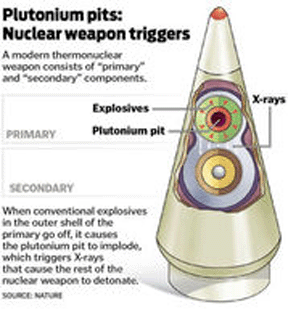
 NNSA Says No EIS Needed to Expand LANL Pit Production, http://nuclearactive.org/ January 24th, 2020 The Department of Energy’s semi-autonomous agency, the National Nuclear Security Administration (NNSA), has determined that a full environmental impact statement is not needed to increase the number of triggers for nuclear weapons manufactured at Los Alamos National Laboratory (LANL) by 50 percent – from 20 to 30. Since 1997, DOE has limited production to 20 triggers, or plutonium pits, per year. Nevertheless, since that time, LANL has not produced anything near 20 pits per year – the most in one year was six. Safety and seismic issues have shut down production for years. Even so, LANL is the only U.S. location for such work. Critics oppose the decision and have stated that litigation may result. NNSA Says No EIS Needed to Expand LANL Pit Production, http://nuclearactive.org/ January 24th, 2020 The Department of Energy’s semi-autonomous agency, the National Nuclear Security Administration (NNSA), has determined that a full environmental impact statement is not needed to increase the number of triggers for nuclear weapons manufactured at Los Alamos National Laboratory (LANL) by 50 percent – from 20 to 30. Since 1997, DOE has limited production to 20 triggers, or plutonium pits, per year. Nevertheless, since that time, LANL has not produced anything near 20 pits per year – the most in one year was six. Safety and seismic issues have shut down production for years. Even so, LANL is the only U.S. location for such work. Critics oppose the decision and have stated that litigation may result.
In 2018, the current administration determined that the U.S. would increase pit production at LANL and begin production at the Savannah River Site, located in South Carolina. Savannah River has never produced plutonium pits, let alone the planned 50 per year. For Savannah River, NNSA has determined that it would follow the National Environmental Policy Act (NEPA) and issue a full environmental impact statement for public review and comment. The federal agencies have refused to conduct a programmatic environmental impact statement for operations at both facilities, including the transportation of nuclear materials between them. For LANL, NNSA said it would produce a supplemental analysis to the 2008 environmental impact statement. A supplemental analysis may not address the impacts of the 2011 Las Conchas fire, increased hexavalent chromium in the regional aquifer, and increased seismic danger on the Pajarito Plateau, which LANL occupies. The 1997 decision to limit the number of pits to 20 is the result of citizen litigation. The Natural Resources Defense Council (NRDC), based in Washington, DC, represented 39 citizens groups from around the country against DOE. CCNS was one of the citizen plaintiffs, along with Tri-Valley Communities Against a Radioactive Environment, or Tri-Valley CARES, located in Livermore, California, where the Lawrence Livermore National Laboratory, LANL’s “sister” nuclear weapons laboratory, is located. Marylia Kelley, Executive Director of Tri-Valley CAREs, said, “NNSA’s refusal to complete programmatic environmental review before plunging ahead with plans to more than quadruple the production authorization for plutonium bomb cores flies in the face of our country’s foundational environmental law, the [NEPA], and a standing federal court order mandating that the government conduct such a review. The order was obtained in prior litigation by [NRDC] on behalf of itself, Tri-Valley CAREs, and additional plaintiffs. Today, I find myself shocked but not surprised that NNSA would so flagrantly flout the law. [] My group stands ready to uphold NEPA and the specific court order.” http://www.trivalleycares.org/ For more information, please see the following documents [links provided by Nuclear Watch New Mexico]: NNSA’s Federal Register Notice of Availability for the final Supplement Analysis is available at https://www.govinfo.gov/content/pkg/FR-2020-01-08/pdf/2020-00102.pdf It provides succinct background. NNSA’s final Supplement Analysis is available at https://www.energy.gov/sites/prod/files/2020/01/f70/final-supplement-analysis-eis-0236-s4-sa-02-complex-transformation-12-2019.pdf The 1998 court order that requires DOE to prepare a supplemental PEIS when it plans to produce more than 80 pits per year is available as Natural Resources Defense Council v. Pena, 20 F.Supp.2d 45, 50 (D.D.C. 1998), https://law.justia.com/cases/federal/district-courts/FSupp2/20/45/2423390/ |
|
2020 Olympic events worryingly close to radioactive areas
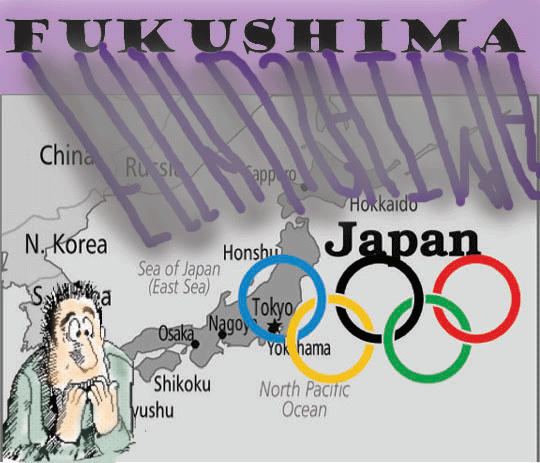
In an Olympic year, Japan faces decision over contaminated Fukushima water Aaron Sheldrick OKUMA, Japan (Reuters)24 Jan 2020, – At the wrecked Fukushima nuclear plant north of Tokyo, workers in protective suits are still removing radioactive material from reactors that melted down after an earthquake and tsunami knocked out its power and cooling nearly nine years ago.
On an exclusive tour of the plant, spread over 3.5 million square meters (865 acres), Reuters witnessed giant remote-controlled cranes dismantling an exhaust tower and other structures in a highly radioactive zone while spent fuel was removed from a reactor.
Officials from Tokyo Electric, which owns the plant, also showed new tanks to hold increasing amounts of contaminated water.
About 4,000 workers are tackling the cleanup, many wearing protective gear, although more than 90% of the plant is deemed to have so little radioactivity that no extra precautions are needed. Photography was highly restricted and no conversations were allowed with the workers.
Work to dismantle the plant has taken nearly a decade so far, but with Tokyo due to host the Olympics this summer – including some events less than 60 km (38 miles) from the power station – there has been renewed focus on safeguarding the venues…….
The buildup of contaminated water has been a sticking point in the cleanup, which is likely to last decades, and has alarmed neighboring countries. In 2018, Tepco said it had not been able to remove all dangerous material from the water – and the site is running out of room for storage tanks.
Officials overseeing a panel of experts looking into the contaminated water issue said in December choices on disposal should be narrowed to two: either dilute the water and dump it in the Pacific Ocean, or allow it to evaporate. The Japanese government may decide within months, and either process would take years to complete, experts say……..
Athletes from at least one country, South Korea, are planning to bring their own radiation detectors and food this summer.
Baseball and softball will be played in Fukushima City, about 60 km (38 miles) from the destroyed nuclear plant. The torch relay will begin at a sports facility called J-Village, an operations base for Fukushima Daiichi in the first few years of the disaster, then pass through areas near the damaged station on its way to Tokyo.
In December, Greenpeace said it found radiation “hotspots” at J-Village, about 18km south of the plant.
When Tokyo won the bid to host the 2020 Summer Olympics Prime Minister Shinzo Abe declared that Fukushima was “under control” in his final pitch to the International Olympic Committee.
In 2016, the Japanese government estimated that the total cost of plant dismantlement, decontamination of affected areas, and compensation would be 21.5 trillion yen ($195 billion) – roughly a fifth of the country’s annual budget at the time.
(Reporting by Aaron Sheldrick: Editing by Gerry Doyle) https://mobile.reuters.com/article/amp/idUSKBN1ZK0CV?__twitter_impression=true
Vast swarm of locusts ruining the livelihood of 1000s in East Africa
Locust swarm 37 miles long and 25 miles wide threatens crops across swathes of east Africa, ITV News, 17 Jan 2020, A swarm of locusts measured at 37 miles long and 25 miles wide has been tracked in Kenya – and the insects are now threatening to decimate crops across swatches of east Africa.
The most serious outbreak of desert locusts in 25 years is posing an unprecedented threat to food security in some of the world’s most vulnerable countries, authorities say.
Unusual climate conditions are partly to blame.
Kenya’s Intergovernmental Authority on Development said: “A typical desert locust swarm can contain up to 150 million locusts per square kilometre.
“Swarms migrate with the wind and can cover 100 to 150 kilometres in a day. An average swarm can destroy as much food crops in a day as is sufficient to feed 2,500 people.”
Roughly the length of a finger, the insects fly together by the millions and are devouring crops and forcing people in some areas to bodily wade through them.
The outbreak of desert locusts, considered the most dangerous locust species, also has affected parts of Somalia, Ethiopia, Sudan, Djibouti and Eritrea and IGAD warns that parts of South Sudan and Uganda could be next.
The “extremely dangerous” outbreak is making the region’s bad food security situation worse, the United Nations’ Food and Agriculture Organisation has warned.
Hundreds of thousands of acres of crops have been destroyed……. https://www.itv.com/news/2020-01-17/locust-swarm-37-miles-long-and-25-miles-wide-threatens-crops-across-swathes-of-east-africa/?fbclid=IwAR1cn3AzYPruUHLGk_0dgXtQvDvh9bjrehBk7AeCTXeru2AjLKdlmmrYz_g
Radioactive micro-particles still a hazard to the Olympics in Japan
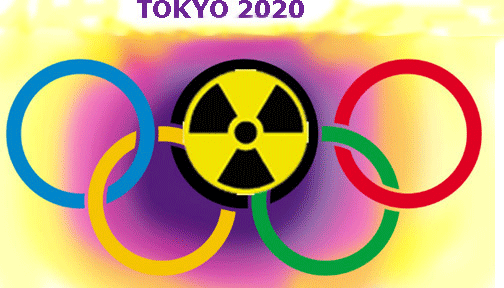 Nukewatch 10th Jan 2020. Hundreds of thousands of people—athletes, officials, media, and spectators—will flood into Japan for the 2020 Olympics.
Soon after the start of the meltdowns in 2011, experts began warning of exposure to radioactive micro-particles or “hot particles”—a type of particle that poses a danger unaccounted for by regulatory agencies. In order to understand the special danger posed by these particles at the Olympics and beyond, we mustfirst understand the current state of radiation exposure standards.
Australian bushfire smoke across the Pacific shows how French nuclear tests spread radiation
fallout from nuclear tests affected islands such as Tahiti. Smoke from Australia this month drifted over the south of French Polynesia after crossing New Zealand.
Mr Temaru said this was more than proof that fallout from France’s atmospheric nuclear weapons tests at Moruroa spread while France maintained they didn’t affect Tahiti.
He again called on France to tell the full truth about this dark chapter of history.
Until 1974 France detonated 46 atomic bombs over Moruroa and Fangataufa before continuing the tests with underground blasts.
France maintained until a decade ago that its nuclear tests were clean and posed no risk to human health.
A law brought in in 2010 offered compensation but its criteria were widely seen as too narrow because most applications by those suffering poor health were thrown out.
Its revision was changed again, leaving veterans organisations still dismayed. Mr Temaru made the comments as his Tavini Huiraatira party campaigned for the March municipal election.
However, Mr Temaru is yet to say whether he will seek re-election to the mayoralty of Faaa which he has held since 1983.
Among the candidates known so far are two assembly members of the ruling Tapura Huiraatira party.
The oceans are getting hot
 Oceans are as hot as humans have known them and we’re to blame. We must use energy more wisely going forward and trust in the actions of our youth, https://www.theguardian.com/environment/climate-consensus-97-per-cent/2020/jan/13/oceans-are-as-hot-as-humans-have-known-them-and-were-to-blame [excellent graph] John Abraham Tue 14 Jan 2020 Oceans are as hot as humans have known them and we’re to blame. We must use energy more wisely going forward and trust in the actions of our youth, https://www.theguardian.com/environment/climate-consensus-97-per-cent/2020/jan/13/oceans-are-as-hot-as-humans-have-known-them-and-were-to-blame [excellent graph] John Abraham Tue 14 Jan 2020 Each year, unfathomable amounts of energy are added to the oceans. Scientists measure heat in joules; the amount of heat in the oceans is so large that we report it in zettajoules. What is a zettajoule? It is 1,000,000,000,000,000,000,000 joules. The amount of heat we are putting into the oceans is equivalent to about five Hiroshima atom bombs of energy every second.
I am part of the team of researchers that published a paper on ocean warming that shows the total heat of Earth is increasing with global heating, as scientists have predicted for decades. Each year, we take Earth’s temperature to try to determine what is happening to our climate. Each year the news is worse than the year before. There is hope, which I will discuss later. But first, let’s talk about the new study. As humans emit heat-trapping gases into the atmosphere, it creates an energy imbalance. There is more heat coming in than going out. That means the Earth is out of balance, and temperatures are rising. The vast majority of the excess energy – more than 90% – ends up in the oceans. Consequently, ocean temperatures are rising, and we can measure it. Global warming is really ocean warming, and it has severe consequences. First, it makes ocean levels rise, because warming water expands. Scientists estimate that by the year 2100, oceans will be about 3ft higher than they were in the year 2000, displacing 150 million people around the world. Warmer oceans also make our weather more extreme. They supercharge typhoons and hurricanes. They make rains more deadly and flooding more severe. The rising temperatures are also threatening sea life. We are experiencing major die-offs of coral reefs, which are incredibly important to ocean biodiversity. Rising ocean water is not just a problem for fish and sea life, it is a problem for everyone. The leader of our team, Dr Lijing Cheng, developed an innovative way to measure ocean temperatures. We only get data where we place temperature sensors, and sophisticated mathematics are used to fill in the gaps and create a continuous picture of what is happening. His method of filling in the data gaps has been shown to be very accurate and scientists around the world have adopted the techniques. Often when scientists report climate data, they try to show trends. It isn’t so important what the ocean temperatures were last year or what they will be this year. What really matters is the trend: are the oceans getting hotter or colder? Using the late 1990s as a reference, we see that years prior are colder and years after are warmer. In fact, we see that the oceans have warmed continuously since about 1990. This long-term trend is what climate breakdown looks like, and it is terrible news for the future of the planet. All reasonable people know that the climate is warming and humans are the cause. Sometimes, I am asked for proof of warming, and there are many things I can point to: ice is melting, air temperatures are increasing, sea levels are rising, etc. But the best proof of warming is in the oceans. No one can dispute the data. The oceans are unequivocally warming. So, what do we do about it? Well, we can begin to use energy more wisely. This will not only help with the climate crisis but save money as well. Secondly, we can maximise our energy from renewable sources such as wind, water, and solar. One of the things that gives me hope is that energy from solar and wind power is now cheaper than dirty coal. The benefits of solar and wind depend, of course, on how sunny or windy the conditions are, but with the drop in green energy prices, it no longer makes economic sense to build coal plants. Another bit of hope is represented by the growing actions of our youth. Make no mistake, the Greta Thunbergs of the world will change things in ways that privileged middle-aged white men like me cannot. Their generation will inherit a dire situation, but they have the passion to act, and decades of unarguable evidence that they must. So yes, 2019 set yet another dire record for Earth’s climate. But the fight continues to make the future more habitable for our children and their children.
|
|
1 This Month



26 September – International Day for the Total Elimination of Nuclear Weapons


PLEASE OPPOSE HR 8255 AND S.3639 – bills would accelerate satellite deployment, with no environmental review or safeguards – https://ncstd5li.quorum.us/campaign/169331/
To see nuclear-related stories in greater depth and intensity – go to https://nuclearinformation.wordpress.com
-
Archives
- September 2026 (245)
- August 2026 (330)
- July 2026 (355)
- June 2026 (287)
- May 2026 (306)
- April 2026 (356)
- March 2026 (251)
- February 2026 (267)
- January 2026 (308)
- December 2025 (358)
- November 2025 (359)
- October 2025 (375)
-
Categories
- 1
- 1 NUCLEAR ISSUES
- business and costs
- climate change
- culture and arts
- ENERGY
- environment
- health
- history
- indigenous issues
- Legal
- marketing of nuclear
- media
- opposition to nuclear
- PERSONAL STORIES
- politics
- politics international
- Religion and ethics
- safety
- secrets,lies and civil liberties
- spinbuster
- technology
- Uranium
- wastes
- weapons and war
- Women
- 2 WORLD
- ACTION
- AFRICA
- Atrocities
- AUSTRALIA
- Christina's notes
- Christina's themes
- culture and arts
- Events
- Fuk 2022
- Fuk 2023
- Fukushima 2017
- Fukushima 2018
- fukushima 2019
- Fukushima 2020
- Fukushima 2021
- general
- global warming
- Humour (God we need it)
- Nuclear
- RARE EARTHS
- Reference
- resources – print
- Resources -audiovicual
- Weekly Newsletter
- World
- World Nuclear
- YouTube
-
RSS
Entries RSS
Comments RSS
 nuclear-news