Arctic marine life threatened as a result of Alaskan sea ice disappearing
Disappearing Alaskan sea ice is significant for Arctic marine ecosystem, Science Daily , April 22, 2020, University of Maryland Center for Environmental Science
- Summary:
- A new study shows that plant materials originating in Arctic sea ice are significantly incorporated into marine food webs that are used for subsistence in local communities of the greater Bering Strait region. The research has the potential to demonstrate the importance of sea ice ecosystems as a source of food in Arctic waters in Alaska and beyond.
-
A new study shows that plant materials originating in Arctic sea ice are significantly incorporated into marine food webs that are used for subsistence in local communities of the greater Bering Strait region.
The study led by scientists from the University of Maryland Center for Environmental Science traced persistent biological compounds that are uniquely generated by microscopic plants in sea ice and found that the compounds are present throughout the base of the food web. The research has the potential to demonstrate the importance of sea ice ecosystems as a source of food in Arctic waters in Alaska and beyond.
“It is widely thought that the loss of sea ice habitat will have far-reaching implications for Arctic ecosystems,” said lead author Chelsea Wegner Koch, a graduate research assistant and the University of Maryland Center for Environmental Science.
“As sea ice breakup occurs earlier and forms later each year, the open water period is expanding and the sources of food are shifting away from sea ice and towards greater proportions of open water production. This production in the absence of sea ice differs in the quality, quantity, and timing of delivery to the seafloor,” she said.
- Efforts to account for the proportional shifts in contributions of ice algae have been incomplete due to the lack of a specific tracer that can be definitively assigned to ice algae rather than open-water phytoplankton. The compounds reaching the seafloor that were studied are associated with food for a range of seafloor animals that in turn provide food for ecologically and culturally important organisms, such as the bearded seal, Pacific walrus, gray whale and spectacled eider that forage on the shallow sea floor. …… https://www.sciencedaily.com/releases/2020/04/200422151134.htm
Coronavirus recovery can pave the way to a green energy future

around the world, electricity demand has reduced in COVID-19 hotspots. This could have a knock-on effect for the renewable sector.China, where the outbreak first took hold, is the world’s biggest electricity consumer. Output from factories has been substantially diminished with many unable to return to their jobs in manufacturing. Due to the curtailing of industrial electricity use, cuts in energy consumption for 2020 could be equivalent to the power used by the whole of Chile, according to IHS Markit.
In Europe, peak power consumption has also gone down. Italy, Spain, and the UK have all seen an average 10 per cent drop in energy usage with bars, restaurants, offices and factories, which remain closed as social distancing measures continue.In particular, fossil fuel based sources of electricity have been impacted by reduced requirements. Coal, usually one of the cheapest options, has now become the most expensive fuel in the world in the face of cheap green alternatives and natural gas, according to Bloomberg Green.
PAVING THE WAY FOR A GREEN FUTURE?
Renewable energy sources seem to have been given an unexpected boost. Around 40 per cent of the electricity generated in the UK on Sunday 5th March came from wind farms, with nearly a fifth being provided by solar energy. This was due to the unusually sunny day, says the National Grid ESO carbon intensity tracker.
These conditions have meant that renewable sources generated more than enough energy to cover the country’s reduced needs. Green supplier, Octopus Energy, even paid some customers to use energy during the day, using a scheme that has previously only been available during the night when demand is very low.
“In most economies that have taken strong confinement measures in response to the coronavirus – and for which we have available data – electricity demand has declined by around 15%, largely as a result of factories and businesses halting operations,” Dr Fatih Birol, Executive Director of the International Energy Agency wrote in a blog post.
“In this way, the recent drop in electricity demand fast-forwarded some power systems 10 years into the future, suddenly giving them levels of wind and solar power they wouldn’t have had otherwise without another decade of investment in renewables.”
He went on to explain that this increase in renewable energy usage could even help some countries figure out how to deal with the drop in power that comes from the sun setting or a strong wind dying down. Previously, these kinds of fluctuating energy sources have proved challenging for those who work to keep our lights on. Managing them more ntelligently by shutting off solar panels at midday when there is more electricity than usual and slowing down wind power as demand decreases at night are just some options Dr Birol suggests.
These new findings have also put the spotlight on more reliable and often neglected sources of green energy, like hydropower, which are essential to making sure we have a consistent supply of energy. In exceptional situations like the current pandemic, where a fluctuation in energy supply could put lives and employment at even greater risk, this is particularly important.
To save the planet, cultural, social and political transformation is essential; new technologies only part of the answer.

Why relying on new technology won’t save the planet https://www.sciencedaily.com/releases/2020/04/200420125510.htm April 20, 2020, Lancaster University
- Summary:
- Over-reliance on promises of new technology to solve climate change is enabling delay, say researchers. They argue instead for cultural, social and political transformation to enable widespread deployment of both behavioral and technological responses to climate change.
-
Overreliance on promises of new technology to solve climate change is enabling delay, say researchers from Lancaster University.
Their research published in Nature Climate Change calls for an end to a longstanding cycle of technological promises and reframed climate change targets.
Contemporary technological proposals for responding to climate change include nuclear fusion power, giant carbon sucking machines, ice-restoration using millions of wind-powered pumps, and spraying particulates in the stratosphere.
Researchers Duncan McLaren and Nils Markusson from Lancaster Environment Centre say that: “For forty years, climate action has been delayed by technological promises. Contemporary promises are equally dangerous. Our work exposes how such promises have raised expectations of more effective policy options becoming available in the future, and thereby enabled a continued politics of prevarication and inadequate action.
- “Prevarication is not necessarily intentional, but such promises can feed systemic ‘moral corruption’, in which current elites are enabled to pursue self-serving pathways, while passing off risk onto vulnerable people in the future and in the global South.
The article describes a history of such promises, showing how the overarching international goal of ‘avoiding dangerous climate change’ has been reinterpreted and differently represented in the light of new modelling methods, scenarios and technological promises.
The researchers argue that the targets, models and technologies have co-evolved in ways that enable delay: “Each novel promise not only competes with existing ideas, but also downplays any sense of urgency, enabling the repeated deferral of political deadlines for climate action and undermining societal commitment to meaningful responses.
They conclude: “Putting our hopes in yet more new technologies is unwise. Instead, cultural, social and political transformation is essential to enable widespread deployment of both behavioural and technological responses to climate change.”
The researchers map the history of climate targets in five phases: “stabilization,” followed by a focus on “percentage emissions reductions,” shifting to “atmospheric concentrations” (expressed in parts per million), “cumulative budgets” (in tonnes of carbon dioxide), and currently “outcome temperatures.”
- In the first phase (around Rio, 1992) technological promises included improved energy efficiency, large-scale enhancement of carbon sinks, and nuclear power
- In the second phase around the Kyoto summit (1997) policy promises focused on cutting emissions with efficiency, fuel switching and carbon capture and storage (CCS).
- In the third phase (around Copenhagen, 2009), CCS became linked to bioenergy, while policy focused on atmospheric concentrations.
- Phase four saw the development of sophisticated global carbon budgeting models and the emergence of a range of putative negative emissions technologies.
- Policy in phase five focused increasingly on temperature outcomes, formalised with the Paris accord of 2015.
Story Source:
Materials provided by Lancaster University. Note: Content may be edited for style and length.
A warning to Idaho residents on the danger of Hanford’s nuclear wastes

A study released by the National Cancer Institute in 1997 showed that 25 states had citizens exposed to high levels of radiation due to nuclear testing.
“When there is an earthquake in that area, the radiation fallout will be equal to Chernobyl,” Brodesser said in her lecture. “When, not if.”
They know what they’ve done’: America’s nuclear past threatens Idaho’s future https://www.idahopress.com/news/local/they-know-what-theyve-done-americas-nuclear-past-threatens-idahos-future/article_a02826ba-b62f-5964-9b08-09dbe300d596.html, By ASHLEY MILLER amiller@idahopress.com MERIDIAN — In a time before social distancing, the lecture hall of the Idaho College of Osteopathic Medicine was packed. Students, staff, politicians and community members sat intermixed in the seats, elbow to elbow.
But Kaaren Brodesser stood alone.
Before she started her lecture on March 10, she was introduced simply as an advocate. More than that, she is a witness, part of a small group of people fighting for the rights of Idahoans whose lives changed on July 16, 1945, when the U.S. conducted the first-ever nuclear test, setting off a series of events the world is still struggling to fully understand.
These are downwinders, and they are dying.
‘THEY KNOW WHAT THEY’VE DONE’
In the 1950s and ’60s, the bulk of America’s nuclear testing was done in a 680-square-mile piece of desert about 65 miles outside of Las Vegas. The Nevada Test Site was ground zero for America’s Cold War preparations, testing the effects and power of the nuclear bombs designed by the military. From 1951 to 1958, around 100 aboveground nuclear tests were conducted on the site. The site was chosen for its relative isolation from any densely populated cities; however, in the end, distance was not the solution it first seemed.
The term “downwinders” refers to anyone who lived in communities exposed to nuclear radiation during the end of World War II and the peak of the Cold War (roughly the late 1940s to 1980). During the construction and testing of nuclear weapons, wind patterns directed the fallout far beyond the safety perimeters of the sites, spreading radiation hundreds and even thousands of miles away.
In the book “Atomic Farmgirl,” author Teri Hein details her life growing up downwind of Hanford, Washington, where the bulk of America’s plutonium was produced for many decades. She explains the fallout like this: When Mount Saint Helens erupted in 1980, ash drifted far past the state lines of Washington. The wind carried and then settled the debris into neighboring states. Nuclear radiation fallout can be thought of in the same way. The testing locations in Nevada and the production plants in Hanford are the eruption. The radiation then drifted into Idaho, Montana, Wyoming and beyond.
The radiation was in the air and, more importantly, in the crops and livestock of these communities. According to the National Cancer Institute, a significant portion of the Intermountain West was exposed to high doses of radiation from the tests, specifically the radioisotope Iodine-131. Iodine-131 is processed in the thyroid, the gland in your neck that regulates hormones. This is why children seemed to be the hardest hit from the fallout: their thyroid is still developing and isn’t strong enough to process the high dosage of Iodine.
NCI’s list of medical issues tied to downwinders is long, ranging from multiple sclerosis to various forms of cancer that slowly eat away at your life. That’s something that Emmett resident Tona Henderson knows only too much about. Continue reading
Smoke from Chernobyl area wildfires made Ukraine’s capital have the worst air pollution in the world
Unilad 18th April 2020, Wildfires burning near the Chernobyl nuclear plant have covered the capital
of Ukraine in smoke and made its air pollution among the worst in the
world. Residents burning rubbish near Chernobyl accidentally sparked fires
on April 4, and though firefighters managed to contain the initial blazes,
three new fires began to spread in the contaminated exclusion zone on
Thursday, April 16. The fires were propelled by strong winds and smoke has
engulfed the capital Kyiv. While many residents are adhering to
stay-at-home orders anyway, authorities are now encouraging residents to
close their windows to prevent the smog filling their houses.
Trump uses the pandemic, to decimate environmental restrictions. Nuclear waste to landfill decision is just one example.
|
https://americanindependent.com/donald-trump-administration-nuclear-waste-cleanup-coronavirus-new-mexico-covid-19/ By Josh Israel,April 8, 2020 The coronavirus pandemic is making the problem even worse.
The Trump administration has been under fire for not doing enough to clean up nuclear waste. And now, with the COVID-19 pandemic and social distancing measures, the efforts are effectively on hold. At the Waste Isolation Pilot Plant in New Mexico, an underground nuclear waste facility operated by the Department of Energy, new shipments of hazardous material from nuclear sites across the country have reportedly been stopped to protect workers from the coronavirus. According to an Associated Press report, the small number of essential employees working at nuclear facilities around the country, including Los Alamos National Laboratory in New Mexico and the Hanford Nuclear Reservation in Washington, are focusing on safety, security, and information technology. Cleanup efforts have been frozen. Sen. Maria Cantwell (D-WA) told the wire service this week that worker safety is a priority, but more effort is needed to speed nuclear cleanup. “We are fighting to make sure workers and their families are taken care of during this crisis and that workers have the resources they need to meet cleanup goals when they are able to safely return to their jobs,” she said. Cantwell, Washington Sen. Ron Wyden (D), and New Mexico Democratic Sens. Martin Heinrich and Tom Udall raised concerns in early March that the Trump administration was not planning to spend enough money to do needed nuclear waste cleanup. Funding for those efforts, they warned, was being cut in favor of spending more money on modernization of the nation’s nuclear arsenal. The landfill decision is the latest in a line of moves by the Trump administration that flout environmental concerns. It also comes as the administration is under fire for using the coronavirus pandemic as an excuse to decimate environmental protections. The Environmental Protection Agency announced last week that it was temporarily suspending enforcement of civil environmental regulations, allowing the fossil fuel industry to ignore monitoring and compliance obligations. The agency additionally rolled back automobile pollution standards enacted during the Obama administration. Donald Trump has repeatedly promised America “crystal clear clean water and clean air” but has significantly changed environmental regulations, often going beyond the loosening of rules that industry asks for. Last year, Trump told reporters at a NATO summit in London that climate change was “very important” to him, saying he thought about it “all the time.” However, months later, his administration curbed a series of methane regulations that even some energy companies opposed. And despite claiming he wants “crystal clear” water, Trump has signed a series of orders allowing construction on highly controversial oil pipelines to move forward. “Nobody in the world can do what you folks do,” he told a group of pipeline engineers in April last year before signing an order making it difficult for states to intervene and stop such projects. “And we’re going to make it easier for you.” |
|
Climate change could cause sudden biodiversity losses worldwide
 Climate change could cause sudden biodiversity losses worldwide, Science Daily, April 8, 2020 Climate change could cause sudden biodiversity losses worldwide, Science Daily, April 8, 2020
|
|
|
Nuclear power plant shut down by host of tiny shrimp clogging filters

 Masses of tiny shrimp shut down nuclear power plant in southern China twice in one week, 1 Apr 2020,The Star, By Holly Chik The Power-Generating Units Of A Nuclear Plant In Southern China Were Shut Down Twice Last Week After Its Water Filters Were Blocked By Masses Of Small Shrimp, The Safety Regulator Said.
Big shoals of the tiny acetes – krill-like shrimp that are just a few centimetres long – flooded the seawater diversion channel and circulating water pumping stations of the Yangjiang Nuclear Power Station in Guangdong on March 24, the National Nuclear Safety Administration said in a statement.
They crippled the water pumping stations and caused one of the nuclear plant’s six power-generating units to go into automatic safe shutdown, while the other five units ran at 80 per cent of capacity. The unit that shut down was powered up again the next day after station staff cleared the acetes and cleaned the filters.
But soon after on March 25, the same thing happened, with large shoals of acetes again finding their way into the pumping stations and causing four power-generating units to shut down automatically. The station shut off the other two units for safety reasons. …….
The Hong Kong Nuclear Society also noted that similar incidents had happened before.
“Similar events have occurred at nuclear power plants using seawater as a coolant for their power-generating units [including non-nuclear ones] throughout the world, including China,” said Luk Bing-lam, chairman of the society.
Anxieties over proposal to allow some nuclear waste to be disposed in landfills

 Advocates raise questions about proposal to allow some nuclear waste to be disposed in landfills The Hill, BY RACHEL FRAZIN – 04/03/20 Scientists and advocates are raising concerns about a proposed relaxation on regulations for disposing of nuclear waste, saying that the government should halt the proposal as the scientific community focuses on the coronavirus.
A March 6 Nuclear Regulatory Commission (NRC) proposal would allow for the disposal of some nuclear waste in municipal landfills, rather than a licensed facility.
Advocates say the proposal could put public health at risk, pushing the NRC to give the public more time to weigh in.
“What they’re trying to do is prop up a failing industry so that the cost of decommissioning these [nuclear] reactors is reduced so you don’t have to send it to a place that is expensive because it’s designed to safely handle it,” said Dan Hirsch, the former director of the University of California, Santa Cruz’s Program on Environmental and Nuclear Policy.
“I find it just astonishing that they would do that in the midst of the coronavirus pandemic,” he added. “How the NRC can look themselves in the mirror to propose massive deregulation and do it in the midst of the pandemic, I find it just ethically shocking.”……..
“If they’re going to consider it at all, it should only be considered once the pandemic is behind us,” he said.
Currently, the nuclear waste in question is typically disposed of at licensed waste disposal facilities, which have adequate training and equipment to protect public health.
The proposal would grant some exceptions to this regulation for waste with a cumulative radiation dose level of up to 25 millirem…….
n a statement on Thursday, Public Employees for Environmental Responsibility Pacific Director Jeff Ruch also criticized the proposal.
“NRC’s action could transform most municipal dumps into radioactive repositories, with essentially no safeguards for workers, nearby residents, or adjoining water tables,” he said. https://thehill.com/policy/energy-environment/490988-advocates-raise-questions-about-proposal-to-allow-some-nuclear
Our war against the environment is bringing pandemics upon us
 Coronavirus is a wake-up call: our war with the environment is leading to pandemics, The Conversation, Fiona Armstrong Executive Director, Climate and Health Alliance, Occasional Lecturer, School of Public Health and Human Biosciences, La Trobe University, Anthony Capon, Director, Monash Sustainable Development Institute, Monash University, Ro McFarlane, Assistant Professor in Ecological Public Health, University of Canberra, March 31, 202 The COVID-19 pandemic sweeping across the world is a crisis of our own making.
That’s the message from infectious disease and environmental health experts, and from those in planetary health – an emerging field connecting human health, civilisation and the natural systems on which they depend.
They might sound unrelated, but the COVID-19 crisis and the climate and biodiversity crises are deeply connected.
Each arises from our seeming unwillingness to respect the interdependence between ourselves, other animal species and the natural world more generally.
To put this into perspective, the vast majority (three out of every four) of new infectious diseases in people come from animals – from wildlife and from the livestock we keep in ever-larger numbers.
To understand and effectively respond to COVID-19, and other novel infectious diseases we’ll likely encounter in the future, policymakers need to acknowledge and respond with “planetary consciousness”. This means taking a holistic view of public health that includes the health of the natural environment.
Risking animal-borne diseases
Biodiversity (all biological diversity from genes, to species, to ecosystems) is declining faster than at any time in human history.
We clear forests and remove habitat, bringing wild animals closer to human settlements. And we hunt and sell wildlife, often endangered, increasing the risk of disease transmission from animals to humans.
The list of diseases that have jumped from animals to humans (“zoonotic diseases”) includes HIV, Ebola, Zika, Hendra, SARS, MERS and bird flu.
Like its precursor SARS, COVID-19 is thought to have originated in bats and subsequently transmitted to humans via another animal host, possibly at a wet market trading live animals.
Ebola virus emerged in central Africa when land use changes and altered climatic conditions forced bats and chimpanzees together around concentrated areas of food resources. And Hendra virus is associated with urbanisation of fruit bats following habitat loss. Such changes are occurring worldwide.
What’s more, human-caused climate change is making this worse. Along with habitat loss, shifting climate zones are causing wildlife to migrate to new places, where they interact with other species they haven’t previously encountered. This increases the risk of new diseases emerging.
COVID-19 is just the latest new infectious disease arising from our collision with nature……. https://theconversation.com/coronavirus-is-a-wake-up-call-our-war-with-the-environment-is-leading-to-pandemics-135023
12 Fukushima decontamination locations likely to leak radiation, in heavy rain
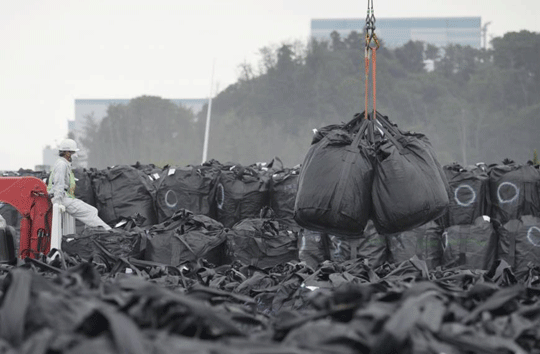
The ministry checked all the sites where the waste is kept after 91 bags were swept into rivers in Fukushima and Tochigi prefectures last year due to downpours caused by Typhoon Hagibis.
Of the 322 locations that are near rivers or in flood-prone areas, 12 sites in Fukushima Prefecture were found to be at risk of having bags of waste swept away or ruptured by mud flows.
The ministry plans to set up fences or move the waste to intermediate storage facilities to reduce the risk by the end of May this year.
Environment Minister Shinjiro Koizumi told reporters on Tuesday his ministry hopes to do the work as soon as possible because of the growing risk of sudden downpours in recent years.
LANL Plans to Release Twice the Amount of Tritium Allowed
 LANL Plans to Release Twice the Amount of Tritium Allowed http://nuclearactive.org/ March 26th, 2020 The Department of Energy (DOE) and its contractor at Los Alamos National Laboratory (LANL) plan to vent radioactive tritium into the air in an amount twice the federal standard of 10 millirems a year. LANL estimates a possible offsite dose to the public of 20.2 he Department of Energy (DOE) and its contractor at Los Alamos National Laboratory (LANL) plan to vent radioactive tritium into the air in an amount twice the federal standard of 10 millirems a year. LANL estimates a possible offsite dose to the public of 20.2 LANL Plans to Release Twice the Amount of Tritium Allowed http://nuclearactive.org/ March 26th, 2020 The Department of Energy (DOE) and its contractor at Los Alamos National Laboratory (LANL) plan to vent radioactive tritium into the air in an amount twice the federal standard of 10 millirems a year. LANL estimates a possible offsite dose to the public of 20.2 he Department of Energy (DOE) and its contractor at Los Alamos National Laboratory (LANL) plan to vent radioactive tritium into the air in an amount twice the federal standard of 10 millirems a year. LANL estimates a possible offsite dose to the public of 20.2
In 2019, the federal Environmental Protection Agency (EPA) approved a 2018 LANL plan under the Clean Air Act. This month, the New Mexico Environment Department approved the plan under the state’s Hazardous Waste Act because there are lead tools present in the containers. But there are inconsistencies between the two plans.
For instance, the earlier Clean Air Act plan proposed using “getters” to capture a portion of the vented tritium before it is released through an open door in the prefabricated shed. The later plan deleted the use of a “getter bed” and replaced it with an unnamed air emissions control system. Nevertheless, the Hazardous Waste Act plan states the gases will pass through a molecular sieve bed and through a metering value before release. https://permalink.lanl.gov/object/tr?what=info:lanl-repo/eprr/ESHID-603412 New Mexicans are concerned about the proposed venting. Tritium is radioactive hydrogen and is highly mobile moving from air to water and back. It can cross the placenta and affect a developing fetus. The 10 millirem standard is based on a 154-pound, five feet 6 inch, Anglo “reference man,” between the ages of 20 to 30, who consumes a European diet. Beata Tsosie, a Community Doula and Gardener, from Santa Clara Pueblo, said, “As a Pueblo woman living downwind and downstream from Los Alamos nuclear weapons production, I am very concerned about the lab’s intentions to go forward with releasing radioactive tritium vapor into our air, land, waters, and ecosystems. During mid April is when our land-based community is outdoors for longer periods of time preparing their fields and gardens for planting. What will it mean to also have cumulative exposure when we consume these crops? There are also increased exposures due to active foraging of wild plants, gathering of clays, fishing, hunting, and ceremony. “Our children are also outdoors for longer periods of time due to the school shutdown for COVID-19, which is scheduled to go on indefinitely. I watch my son playing in his backyard, making his own gardens, running, getting out of breath and breathing deeply the air that I need to know is safe for him to be exposed to. We live 20 minutes away from these planned releases, and now in addition to an already stressful self-quarantine I need to worry about my family being outside enjoying their birthright. “It is my understanding that in the documents submitted to the EPA and NMED in 2018, there is no inclusion of alternatives to these releases. There should not be a rush to put our communities in harms way when all solutions have not even been discussed. I know that the federal standards for tritium exposure are not protective of land-based people of color, or pregnant families and infants who are more vulnerable to radioactive toxicity. Tritium can cross placental boundaries. These standards of exposure are still based on an obsolete model of an adult, white male of European descent and custom. There must be an informed public process that prioritizes protecting those most vulnerable. I do not consent to these toxic releases in my ancestral homelands; it is the continuation of nuclear colonialism and violence on Indigenous lands and bodies and a sorrowful history of environmental racism in our sacred Jemez Plateau. I call on all of our Congressional delegation, EPA and NMED directors to put an immediate halt and suspension to these planned tritium releases and increase in LANL production. Our communities deserve reprieve, health, calm, and wellness in these challenging times.” Given the cumulative health consequences from the proposed venting, organizations and individuals are requesting the Environment Department hold a public comment period and a public hearing. |
|
Plutonium contamination at Rocky Flats
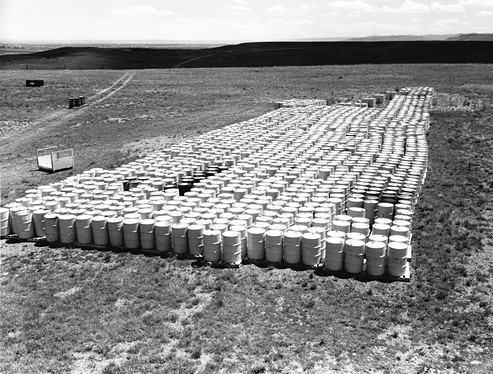
 How Colorado’s nuclear past is affecting its future, Colorado Springs INDY, GONE FISSION, by Heidi Beedle 25 Mar 20, IT WAS FEB. 25 AND BROOMFIELD City Council was done. It unanimously voted last month to withdraw from the Jefferson Parkway Public Highway Authority (JPPHA), a proposed north-south toll road that would ostensibly help mitigate traffic congestion in the Northwest Metro Denver area. The route would have taken the road through the eastern edge of the Rocky Flats Wildlife Refuge, just south of the Boulder County line, bordering Arvada and Broomfield. The council vote was influenced by preliminary soil samples taken by the JPPHA in July 2019, specifically one sample that showed plutonium levels more than five times higher than the acceptable standard (the rest of the samples taken at that time were within acceptable standards). Before its current existence as a wildlife refuge, Rocky Flats was the site of a nuclear weapons plant, which has caused concern about plutonium contamination in the area. Forty-eight subsequent samples taken by the U.S. Fish and Wildlife Service, which manages the refuge, showed levels well below cleanup standards of 50 picocuries per gram.
The city council vote is the latest installment in the ongoing conflict between concerned residents and public officials, and Rocky Flats and Colorado Department of Public Health and Environment (CDPHE). For decades, residents and at least two directors of Jefferson County Public Health, have claimed that plutonium released from the plant is responsible for the high rate of cancers in the area. These claims have been consistently disputed by CDPHE and the Department of Energy (DOE). ……..
Johnson was concerned about the instances of cancers in Jefferson County and questioned the official measurements of plutonium in the soils around Rocky Flats, finding in his own testing that plutonium levels in the soil were 44 times higher than reported by the Department of Public Health. Johnson grew increasingly concerned about an increase in cancer deaths in Jefferson County, and in a paper published in 1981, noted that a rise in certain kinds of cancers Johnson was seeing in Jefferson County, such as leukemia, “supports the hypothesis that exposure of general populations to small concentrations of plutonium and other radionuclides may have an effect on cancer incidence.” Johnson noted that “plutonium concentrations in the air at the Rocky Flats plant are consistently the highest (1970-1977) in the US DOE monitoring network,” based on his studies of the DOE’s own data. He also asserted that the DOE’s measurements were likely an underestimation.
Almost 40 years later, and the current head of the Jefferson County Public Health Department, Dr. Mark Johnson (no relation) has come to the same conclusion. In 2018 he spoke outagainst opening the wildlife refuge to the public, and he thinks the recent discovery of plutonium near the proposed parkway site should give people reason to reconsider. “
“There are clear studies that have shown there is an increased risk or rate of plutonium in the dirt there,” agrees Mark Johnson. “I have concerns already about the digging around with the subdivisions and the commercial enterprises that have gone into that area that were basically kicking up a lot of stuff — and we don’t know what is there.”
Carl Johnson was fired in 1981 for his persistent, outspoken criticism of the plant, but won a subsequent whistleblower lawsuit. Partly due to Johnson’s criticism, the FBI and the EPA began looking into operations at the Rocky Flats Plant starting in 1987. The investigation was aided by Jim Stone, an employee at the plant who also became a whistleblower over what he saw as grave safety violations……..
THOUGH EXHAUSTIVE DOCUMENTATION of waste sites and deposits exists, questions remain as to the effectiveness of the now-completed cleanup. Jon Lipsky, a former FBI agent who led the raid on Rocky Flats in 1989, criticized the decision to open the refuge to the public in 2016, and has claimed there is still work to be done. Originally, the DOE estimated it would take 65 years and $37 billion to clean up the site. It was completed in 2005 for $7 billion.
During the process, there were still surprises to be found. ……..
The questions of the lasting effects from the operations at Rocky Flats may never be answered to the satisfaction of residents like Hansen, who are dealing with serious health issues. Jeff Gipe, the artist behind the Cold War Horse memorial that was erected in 2015, is currently working on a documentary about the plant, Half-Life of Memory, which may draw more attention to the issue.
President Donald Trump, who has a good shot at re-election, has reduced the effectiveness of agencies like the EPA while also advocating for an increase in nuclear arms development.
In 2019, the federal government proposed a new plutonium pit production facility near Aiken, South Carolina. But that is presumably not our problem. https://www.csindy.com/coloradosprings/how-colorados-nuclear-past-is-affecting-its-future/Content?oid=21526239
The lingering horror of the nuclear bomb tests at Maralinga, South Australia
|
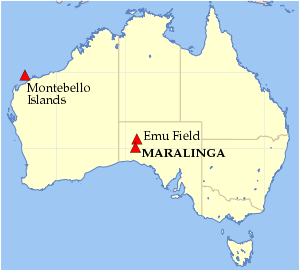
Maralinga is 54 kilometres north-west of Ooldea, in South Australia’s remote Great Victoria Desert. Between 1956 and 1963 the British detonated seven atomic bombs at the site; one was twice the size of the bomb dropped on Hiroshima. There were also the so-called “minor trials” where officials deliberately set fire to or blew up plutonium with TNT — just to see what would happen. One location called “Kuli” is still off-limits today, because it’s been impossible to clean up. I went out to the old bomb sites with a group of Maralinga Tjarutja people, who refer to the land around ground zero as “Mamu Pulka”, Pitjantjatjara for “Big Evil”. “My dad passed away with leukaemia. We don’t know if it was from here, but a lot of the time he worked around here,” says Jeremy Lebois, chairperson of the Maralinga Tjarutja council. Thirty per cent of the British and Australian servicemen exposed to the blasts also died of cancer — though the McClelland royal commission of 1984 was unable to conclude that each case was specifically caused by the tests. It’s not until you stand at ground zero that you fully realise the hideous power of these bombs. Even after more than 60 years, the vegetation is cleared in a perfect circle with a one kilometre radius. “The ground underneath is still sterile, so when the plants get down a certain distance, they die,” explains Robin Matthews, who guided me around the site. The steel and concrete towers used to explode the bombs were instantly vaporised. The red desert sand was melted into green glass that still litters the site. Years ago it would have been dangerous to visit the area, but now the radiation is only three times normal — no more than what you get flying in a plane. The Line of FireAustralia was not the first choice for the British, but they were knocked back by both the US and Canada. Robert Menzies, Australia’s prime minister at the time, said yes to the tests without even taking the decision to cabinet first. David Lowe, chair of contemporary history at Deakin University, thinks Australia was hoping to become a nuclear power itself by sharing British technology, or at least to station British nuclear weapons on Australian soil. “In that period many leaders in the Western world genuinely thought there was a real risk of a third world war, which would be nuclear,” he says. The bombs were tested on the Montebello Islands, at Emu Field and at Maralinga. At Woomera in the South Australian desert, they tested the missiles that could carry them. The Blue Streak rocket was developed and test-fired right across the middle of Australia, from Woomera all the way to the Indian Ocean, just south of Broome. This is known as “The Line of Fire” The Line of Fire from Woomera to Broome is, funnily enough, the same distance from London to Moscow,” Mr Matthews says. Just as the Maralinga Tjarutja people were pushed off their land for the bomb tests, the Yulparitja people were removed from their country in the landing zone south of Broome. Not all the Blue Streak rockets reached the sea. Some crashed into the West Australian desert. The McClelland royal commission showed that the British were cavalier about the weather conditions during the bomb tests and that fallout was carried much further than the 100-mile radius agreed to, reaching Townsville, Brisbane, Sydney and Adelaide. “The cavalier attitude towards Australia’s Indigenous populations was appalling and you’d have to say to some extent that extended towards both British and Australian service people,” Professor Lowe says. There are also questions over whether people at the test sites were deliberately exposed to radiation. “You can’t help but wonder the extent to which there was a deliberate interest in the medical results of radioactive materials entering the body,” Professor Lowe says. “Some of this stuff is still restricted; you can’t get your hands on all materials concerning the testing and it’s quite likely both [British and Australian] governments will try very hard to ensure that never happens.” Project SunshineWe do know that there was a concerted effort to examine the bones of deceased infants to test for levels of Strontium 90 (Sr-90), an isotope that is one of the by-products of nuclear bombs. These tests were part of Project Sunshine, a series of studies initiated in the US in 1953 by the Atomic Energy Commission. They sought to measure how Sr-90 had dispersed around the world by measuring its concentration in the bones of the dead. Young bones were chosen because they were particularly susceptible to accumulating the Sr-90 isotope. Around 1,500 exhumations took place, in both Britain and Australia — often without the knowledge or permission of the parents of the dead. Again, it was hard to prove conclusively that spikes in the levels of Strontium 90 during the test period caused bone cancers around the world. The Maralinga tests occurred during a period that Professor Lowe describes as “atomic utopian thinking”. “Remember at that time Australians were uncovering pretty significant discoveries of uranium and they hoped that this would unleash a vast new capacity for development through the power of the atom,” he says. Some of the schemes were absurdly optimistic. Project Ploughshare grew out of a US program which proposed using atomic explosions for industrial purposes such as canal-building. In 1969 Australia and the US signed a joint feasibility study to create an instant port at Cape Keraudren in the Kimberley using nuclear explosions. The plan was dropped, but it was for economic not environmental or social reasons. The dream (or was it a nightmare?) of sharing nuclear weapons technology with the British was never realised. All Australia got out of the deal was help building the Lucas Heights reactor. The British did two ineffectual clean-ups of Maralinga in the 1960s. The proper clean-up between 1995 and 2000 cost more than $100 million, of which Australia paid $75 million. It has left an artificial mesa in the desert containing 400,000 cubic metres of plutonium contaminated soil. The Maralinga Tjarutja people received only $13 million in compensation for loss of their land, which was finally returned to them in 1984. As we were leaving the radiation zone, the Maralinga Tjarutja people spotted some kangaroos in the distance. Over the years some of the wildlife has started to return. Mr Lebois takes it as a good sign. “Hopefully, hopefully everything will come back,” he says. |
|
The Sizewell C project would tear through preciously fragile nature preserve
Nuclear lessons from the corona virus, No place for atomic power amidst climate chaos and pandemics By Linda Pentz Gunter March 22, 2020 by beyondnuclearinternational……….I recently sat in a room of 75 people — just before you couldn’t anymore — in Suffolk, England, listening to a series of eloquent presentations advocating for a halt to the proposed Sizewell C nuclear power plant there. The occasion was an event hosted by the Nuclear Free Local Authorities. The Sizewell C project, which would add two EPRs to the still operating Sizewell B reactor site, would tear through one of the richest, most preciously fragile and most diverse nature preserves in the country — Minsmere. And be built on a beach.
The first three speakers reminded us of the breathtaking beauty of Minsmere and the animals, insects, birds, and reptiles whose lives would be disrupted, if not ended, by the construction activities alone (my talk and the two others addressed the radiological and climate risks if Sizewell C ever became operational.) We saw slides not only of these animals, but of an exotic array of spectacular plant life that would also be lost. Site construction would dissect and disconnect habitats and frighten species away, with 24-hour lights, noise, heavy machinery, traffic and the bulldozing of their landscape. Wildness, already disappearing fast enough, would be lost.
After listening to the eloquent opening presentations from nature and sports journalist, Simon Barnes, Ben McFarland, head of conservation at Suffolk Wildlife Trust, and Rachel Fulcher of Suffolk Coastal Friends of the Earth, there was only one question to be asked: Why on earth would anyone allow this to happen? But so far, Suffolk County Council has gone alone with the plan, albeit with some caveats and ongoing questions for EDF. They may yet be dissuaded.
A video from Suffolk Coastal Friends of the Earth, narrated by Fulcher, is a quietly passionate reminder, somewhat in the style of her namesake, Rachel Carson, not to pave paradise, as Joni Mitchell once warned.
The first thing that is likely to happen is that EDF will raze Coronation Wood. It will do this, not because it needs to now. It is not even certain that Sizewell C will go ahead. It will do this for show. The show in question is to prove to the world that the French nuclear industry is alive and well. It is moving forward.
Not content with the ghastly building site which is the Hinkley C two-reactor project in Somerset, EDF must impress upon the world that it is moving forward with Sizewell as well, which, the company boasts, it can complete even cheaper and faster.
At the Suffolk meeting, Theberton & Eastbridge Action Group on Sizewell screened a particularly brilliant piece of video, shot from a drone, showing the spectacular Suffolk countryside today and what the hapless Somerset countryside at the Hinkley site now looks like. You can view it below.
The French government is on record as saying that without Hinkley and Sizewell, the French nuclear brand will be finished. It sees the UK projects as an essential redemptive step, given the EPR, its supposed flagship, has so far been a financial and technical shipwreck.
As the Financial Times pointed out in May 2018, “Avoiding delays in the UK will be crucial if EDF is to persuade international buyers — and its own shareholders, not least the French government — that the EPR’s teething problems are over.”
The Royal Society for the Protection of Birds, which owns the Minsmere reserve, has said it has concerns that “EDF energy may not be able to keep its environmental promises.”
But the organization should instead be 100 per cent certain that EDF will not keep its environmental promises or any other kind for that matter. You just have to look at the company’s track record, along with the systemic disregard by all nuclear companies anywhere in the world, for the well-being and survival of animals and their habitats, both wild and domestic. (This latter is all documented in our newest booklet — Nuclear power and harm to animals, wild and domestic.)
There is particular reason to mistrust EDF because the company has experienced an endless series of technical, safety and transparency problems at the EPR construction sites still plodding their way to incompletion at Flamanville 3 in France and Olkiluoto 3 in Finland. Even such fundamentals as the concrete pour of the reactor foundation at Flamanville 3 had to be redone. The Flamanville 3 containment came from a forge which falsified quality control data and installed counterfeit parts; the vessel head is defective. And, amidst the corona virus, part of the workforce at Flamanville 1 and 2, both fortunately offline for maintenance, has now been called home. (An outbreak of covid-19 among its staff has also now forced the closure of the reprocessing plant at Sellafield in the UK.)
One can only hope that the decision-makers of Suffolk will wake up and smell the marsh-marigolds (I am no botanist so I can’t vouch for their actual aroma.) Or maybe amidst the silence of their now corona-forced sequestration, they will listen to the song of reed buntings, or sedge warblers and decide they are worth saving. Perhaps they will marvel at the aerobatics of the marsh harrier, or wander out at night and glimpse a rare barbastelle bat, “serrated wings against the sky, Like a glove, a black glove thrown up at the light,” as D.H. Lawrence so vividly described the animals in his poem, Bats (although Lawrence did not care for bats.)…….https://beyondnuclearinternational.org/2020/03/22/nuclear-lessons-from-the-corona-virus/
1 This Month



26 September – International Day for the Total Elimination of Nuclear Weapons


PLEASE OPPOSE HR 8255 AND S.3639 – bills would accelerate satellite deployment, with no environmental review or safeguards – https://ncstd5li.quorum.us/campaign/169331/
To see nuclear-related stories in greater depth and intensity – go to https://nuclearinformation.wordpress.com
-
Archives
- September 2026 (245)
- August 2026 (330)
- July 2026 (355)
- June 2026 (287)
- May 2026 (306)
- April 2026 (356)
- March 2026 (251)
- February 2026 (267)
- January 2026 (308)
- December 2025 (358)
- November 2025 (359)
- October 2025 (375)
-
Categories
- 1
- 1 NUCLEAR ISSUES
- business and costs
- climate change
- culture and arts
- ENERGY
- environment
- health
- history
- indigenous issues
- Legal
- marketing of nuclear
- media
- opposition to nuclear
- PERSONAL STORIES
- politics
- politics international
- Religion and ethics
- safety
- secrets,lies and civil liberties
- spinbuster
- technology
- Uranium
- wastes
- weapons and war
- Women
- 2 WORLD
- ACTION
- AFRICA
- Atrocities
- AUSTRALIA
- Christina's notes
- Christina's themes
- culture and arts
- Events
- Fuk 2022
- Fuk 2023
- Fukushima 2017
- Fukushima 2018
- fukushima 2019
- Fukushima 2020
- Fukushima 2021
- general
- global warming
- Humour (God we need it)
- Nuclear
- RARE EARTHS
- Reference
- resources – print
- Resources -audiovicual
- Weekly Newsletter
- World
- World Nuclear
- YouTube
-
RSS
Entries RSS
Comments RSS
 nuclear-news