Nuclear war would turn oceans upside down, crash food web
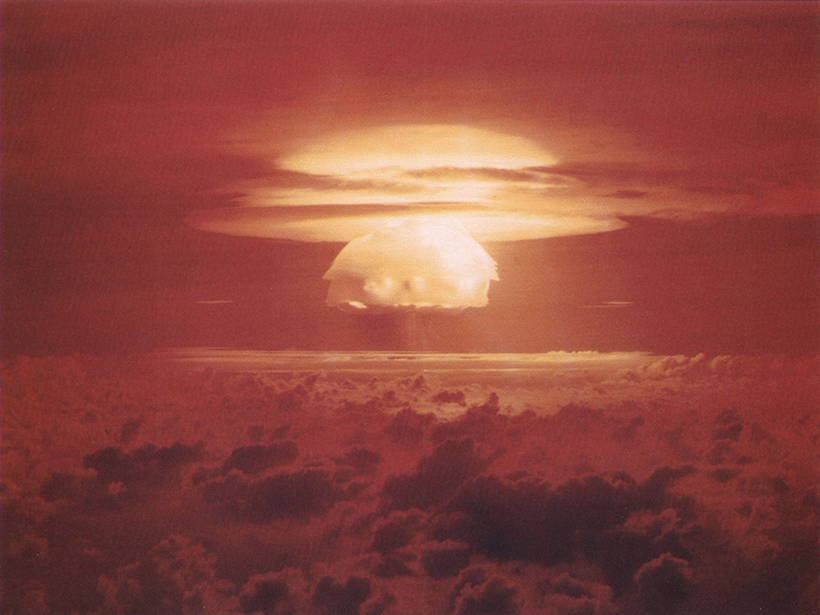
https://news.wisc.edu/nuclear-war-would-turn-oceans-upside-down-crash-food-web/ July 8, 2022 By Chris Barncard , Russia’s invasion of Ukraine has given the specter of nuclear war renewed weight as a global threat, and a new study of the environmental impact of a nuclear conflict describes dire consequences for the world’s oceans.
“If there were a nuclear war, these huge explosions and the firestorms they cause could throw so much soot — teragrams, or millions of tons — into the atmosphere, it would block out enough sunlight to cool the atmosphere significantly,” says Elizabeth Maroon, a professor of atmospheric and oceanic sciences at the University of Wisconsin–Madison.
In just one month after a nuclear exchange between Russia and the United States or India and Pakistan, average global temperatures would drop by 13 degrees Fahrenheit — a larger temperature change than in the last ice age — according to climate modeling by Maroon and collaborators from around the world. The research team, led by Louisiana State University professor of oceanography and coast sciences Cheryl Harrison, published their findings July 7 in the journal AGU Advances.
Even setting aside radioactive fallout, the consequences on land would be dire, including widespread crop failures. But in just a year, the planet’s interconnected oceans would enter a state unfamiliar to scientists like Maroon who study the way oceans have changed on much longer time scales. And, unlike effects on the atmosphere and on land, oceans would not fully recover within the 30-year time period covered by the researchers’ simulations of nuclear conflicts.
“Changes in the ocean take longer than in the atmosphere or on land, but our modeling shows that even in the first year after a nuclear war the ocean circulation would have started changing drastically,” says Maroon, an expert on the interplay between the Atlantic Ocean’s complex circulation patterns and Earth’s climate.
The Atlantic’s major circulation turn-around in the northern latitudes — in which warm surface water streaming north to Greenland, Iceland and Norway cools and sinks into middle depths to be drawn south again — comes unhinged.
“Within the first year or two, water in the North Atlantic sinks all the way to the bottom of the ocean, which we think has not happened even in the ice ages,” says Maroon. “In today’s ocean, only near Antarctica does water sink all the way to the seafloor.”
That unprecedented mixing and ocean circulation speed-up — which would last for about two decades — would move nutrients in the ocean vital for supporting the smallest and most numerous marine organisms, like plankton, into entirely unfamiliar conditions around the world.
It would also result in cooling so strong it would extend sea ice and render impassable major seaports that are now open year-round, and would likely cause significant damage to much of the ocean food web.
“It’s no secret that nuclear winter would be terrible,” Maroon says. “What this study shows are the lasting extent of effects we hadn’t really addressed before on ocean circulation and ecosystems and the very base of the food web.”
To read more about the study and its findings, visit: https://www.lsu.edu/mediacenter/news/2022/07/07docs_harrison_aguadvances.php
Could nuclear plant ruin Suffolk haven for avocets, bitterns and harriers?

Guardian, Robin McKie Science editor 3 July 22, The Bittern Hide at the RSPB’s Minsmere reserve was doing steady business last Wednesday. More than a dozen birdwatchers were crammed into the elevated shelter which overlooks a broad band of heath, freshwater pools and reed beds stretching to the Suffolk coast. Marsh harriers swirled overhead and an occasional bittern swept across the landscape. In front of another nearby hide, avocets waded leisurely across a lagoon. Minsmere is an ornithologist’s paradise.
But a threat hangs over its wildlife glories. In a few days, the government is set to announce its decision on whether to allow the Sizewell C nuclear power plant to be built by EDF on land that overlooks the 1,000-hectare (2,500-acre) reserve.
Threat to the wetlands
Approval will trigger the go-ahead for one of Europe’s biggest construction projects, and the impact on the reserve will be intense. New roads and a temporary port may be built, and dozens of huge cranes erected across land that borders Minsmere. For at least a decade, construction of the giant plant’s twin nuclear reactors will proceed – day and night.,,,,,,,,,,
Minsmere, which is celebrating its 75th anniversary this year, is rated as one of the UK’s finest wildlife reserves, though its origins are unusual. At the beginning of the second world war, it was decided the area’s low-lying farmland should be flooded as a protection against German invasion. After the war ended, it was discovered that avocets, which had been extinct in the UK for more than 100 years, had started nesting there.
“At the time, there was all sorts of pressure being put on landowners to drain land and boost food production in the UK in the years after the war,” added Rowlands.
“However, in the end it was decided to keep the area as a natural mix of shingle beaches, coastal lagoons, grazing marshes and woodland. The RSPB took this over in 1947. Essentially, the land was rewilded, long before the term became an ecological buzzword.”
Many rare species, such as the marsh harrier and the bittern, found precious refuge at Minsmere. However, it was the return of the avocet that had the greatest impact. After a century’s absence from Britain, the black-and-white wader, with its distinctive up-curved beak, established a small colony at Minsmere. From there it spread slowly across the nation. Today, there are about 1,500 breeding pairs in the UK and the bird is now depicted in the RSPB’s emblem, a symbol of hope in the cause of saving threatened bird species.
Nor are avocets, bitterns and marsh harriers the only Minsmere residents. Otters, water voles, kingfishers, nightjars, woodlarks, Dartford warblers, adders, natterjack toads and silver-studded blue butterflies have also made homes on the reserve. “It is the range of habitats that makes Minsmere special,” said Rowlands. “There are reed beds, wet grassland, ditches, coastal shingle, woodland, heather heathland and acid grassland. This is a precious space.”
The prospect of a vast construction project proceeding on adjacent land, therefore, causes concerns. In Somerset, where EDF is building the Hinkley Point C nuclear plant, about 1,600 workers are on site every day; 3m tonnes of concrete and 230,000 tonnes of steel will eventually be used to make the new power plant while the site is dominated by giant 40-metre (130ft) cranes. The construction of its twin at Sizewell C will be identical in scale.
Sizewell C will also require vast amounts of water for its workers, and to make the concrete needed for its construction. It is not clear where this water will come from in an area where supplies are already stretched.
After its completion, even greater amounts will be needed to cool its reactors. “There is also the issue of the warm water leaving the reactor,” said Rowlands. “That could have a significant impact on the marine environment on the coast at Minsmere, affecting the populations of fish and shellfish there and the birds that feed on them.”……………….. https://www.theguardian.com/uk-news/2022/jul/02/could-sizewell-c-nuclear-plant-ruin-minsmere-rspb-suffolk
Marine Management Organisation Put “On Notice” Should they Rubber Stamp Possibly “Unlawful” Seismic Blasting Plan in Irish Sea — RADIATION FREE LAKELAND

The Marine Management Organisation are, any day, due to give their decision on Nuclear Waste Services seismic blasting plan for the Irish Sea. A report condemning Nuclear Waste Services plan for seismic blasting has been funded entirely by contributions from the public and written by renowned marine expert Tim Deere-Jones. The threat to the supposedly […]
Marine Management Organisation Put “On Notice” Should they Rubber Stamp Possibly “Unlawful” Seismic Blasting Plan in Irish Sea — RADIATION FREE LAKELAND
‘Lacking in scientific rigour’: Damning verdict of marine expert on UK’s Nuclear Waste Services seismic testing plan
Radiation Free Lakeland (RFL) and the Nuclear Free Local Authorities
(NFLA) have announced the publication of a report by a renowned marine
expert which is highly critical of Nuclear Waste Services’ (NWS) proposal
to carry out a seismic survey in the Irish Sea to further a plan for an
offshore nuclear waste dump.
The report, ‘The West of Copeland Acoustic
Airgun Survey Proposal: A critical analysis Review Briefing’, was
commissioned by Radiation Free Lakeland and supported wholly through
financial contributions made by members of the public concerned about the
harm that could be caused to marine life by seismic testing.
The report was written by Tim Deere-Jones, a highly-regarded marine radioactivity and
pollution researcher and consultant who has been working independently in
this field since 1983. The NWS, an operating division of the Nuclear
Decommissioning Authority, is responsible for finding a site for a
so-called Geological Disposal Facility, either below ground or beneath the
seabed.
This nuclear waste dump will be filled with the toxic radioactive
waste that is the legacy of Britain’s seven decades of the civil nuclear
power production; much of it will remain radioactive for many tens of
thousands of years.
Three search areas in Cumbria, falling within the local
authority areas of Allerdale and Copeland and offshore up to 22kms, are
under consideration. Seismic testing will enable NWS to determine if the
geology beneath the bed of the Irish Sea is suitable to host a repository
for the nuclear waste.
This involves firing blasts of sound from air guns
below the waves every 10 seconds for four weeks or longer. This sound
penetrates under the ocean floor to help scientists discover more about the
suitability of the geology to store nuclear waste. Seismic testing can
seriously impair the health of marine life, which in the Irish Sea includes
whales, dolphins, porpoises, and seals, but some scientific reports also
suggest that even tiny shellfish and plankton can be adversely impacted,
hazarding the whole marine ecosystem.
NWS have claimed an exemption from
the requirement to seek a Marine Licence from the MMO citing their survey
as furthering ‘scientific research’ and in so doing have prevented
public analysis of their proposals or commentary from academics and marine
welfare organisations.
NFLA 27th June 2022
To Bella Lack – being called a ”snowflake” is a badge of honour
Most teenagers would take offence at being labelled a snowflake, the
disparaging moniker given to young people perceived to be too easily
offended by un-PC terms or environmental damage. For Bella Lack, who at
nineteen-years-old is already one of the UK’s leading environmental
activists, the label is a badge of honour.
“Is it fragile to care about
the future of the planet and our species? I don’t think so,” she says.
“I think it’s quite a powerful term to be honest, because lots of
snowflakes create a snowstorm.” In the UK, the youth climate movement is
largely credited with pushing the UK government to set a target for net
zero emissions by 2050, and for introducing swathes of new environmental
legislation to curb the use of disposable plastic.
Bella has quickly
emerged as one of the leading lights of Britain’s youth activist circles.
She is an ambassador for the Born Free Foundation, spent her teenage years
campaigning on everything from palm oil to circus animals, and spent 2020
filming wildlife documentary Animal alongside Jane Goodall. Her Twitter
account boasts 138,000 followers.
iNews 27th June 2022
The UK is searching the sea for a nuclear dump site with huge risks to marine life

”Protections clearly mean nothing when the nuclear waste industry wants to pave the way to a deep nuclear dump.”
By Charlie Jaay • euro news green, 22/06/2022
A new report delivers a damning verdict on the proposed seismic blasting in the Irish Sea.
The UK government’s Nuclear Waste Services (NWS) is set to carry out seismic surveys off the Cumbrian Coast between July and August this year.
They are looking for a place to dispose of the waste produced by Britain’s nuclear reactors.
The report, commissioned by Radiation Free Lakeland, calls for these plans to be postponed, claiming the impact assessment by NWS is “deeply inadequate” and “lacking in appropriate scientific and academic rigour”.
What is seismic blasting?
Seismic blasting is a process that allows scientists to find out more about the geography of the sea bed. Loud, repetitive blasts of sound are produced from an underwater airgun – like a powerful horn – and their echoes are measured to map the underwater rocks
The airgun will fire every 10 to 15 seconds, throughout the survey period of around one month.
The surveys, commissioned by NWS, will be looking into the possibility of locating a Geological Disposal Facility (GDF). Deep under the seabed, this facility will be used to dispose of the UK’s toxic legacy of high level nuclear waste – the highly radioactive byproducts of nuclear reactors.
Shearwater GeoServices, the company which last year saw the high court put an end to its work on South Africa’s ecologically sensitive Wild Coast, is carrying out the investigations.
According to a freedom of information request, a licence of exemption to carry out these surveys was given to NWS for ‘scientific research’. But Radiation Free Lakeland says the survey is not for ‘scientific research’ but a plan to dispose of nuclear waste.
“We commissioned an independent report because we need to counter the PR spin from the nuclear waste industry who are calling the seismic testing ‘non-invasive scientific research,’” says Marianne Birkby, Founder of the campaign group.
She argues that, rather than seismic blasting for scientific purposes, the plans facilitate a commercial venture for a “deep nuclear dump for heat generating nuclear waste.”
A limited company that wants to enable ever more nuclear waste from new nuclear builds, Radioactive Waste Management, is behind it, Birkby claims.
“Despite the marine protections this part of the Irish Sea has, it is an outrage that independent environmental impact assessments have not been carried out. Protections clearly mean nothing when the nuclear waste industry wants to pave the way to a deep nuclear dump.”
In response to the claims, NWS says “there is no requirement to undertake a public consultation for these surveys.”……
Seismic surveys can devastate marine life
Low frequency sounds generated by a single seismic airgun can extend over large distances, particularly in deeper waters.
They have been recorded at locations up to 4,000 kilometres from the source, and can blanket areas of up to 300,000 square kilometres with noise. Studies have shown that, because seismic surveys can disturb, injure or kill a wide variety of marine life, they can impact entire ecosystems.
Zooplankton are the base of the marine food chain and are extremely important to our ocean’s health. They are also very vulnerable to these loud noises, according to scientists.
Researchers have found that seismic surveys significantly increase the death rates of zooplankton in the 1.2 kilometre range they tested, killing all larval krill in the range.
Radiation Free Lakeland’s report says the surveys will take place when zooplankton populations are expected to be high. These creatures provide a food source for a wide variety of organisms including baleen whales, basking sharks and fish which, in turn, feed many other species.
Many other marine animals rely on sound for survival too. Seismic testing can interfere with basic functions such as communication, navigation, feeding and mating.
“Noise exposure can be a problem for a wide variety of Cetaceans-dolphins, porpoises and whales,” according to the Zoological Society of London’s Cetacean Strandings Investigation Programme.
“Noise related impacts have also been causally linked to many cetacean stranding and mass stranding events globally.”
The NWS investigation will focus on a survey area five to 20 kilometres off the Cumbrian coast in the north west of England in an area of approximately 250 square kilometres. The proposed GDF may extend over an area of 25 kilometres square, deep beneath the seabed.
This region is one of a number of designated Marine Conservation Zones in the Irish Sea. It has protected habitats and is home to a number of European protected species, such as sea turtles, minke whales, common and bottlenose dolphins, and harbour porpoises…………………
Marine habitats are already under huge pressure from pollution, irresponsible development and bottom trawling – as well as the consequences of climate change, she explains. Joan Edwards. Director of Policy at the Wildlife Trusts
We are concerned about the implications of seismic testing in the Irish Sea, which evidence shows can be devastating for marine life.”
The report claims many of the hugely important marine species found in the area have not been studied for their sensitivity to seismic surveys.
A ‘marked lack of transparency’ from Nuclear Waste Services
Marine radioactivity researcher and consultant Tim Deere-Jones is the author of Radiation Free Lakeland’s report. He says that NWS’s licence application for the seismic survey is characterised by “a marked lack of transparency.”
We are concerned about the implications of seismic testing in the Irish Sea, which evidence shows can be devastating for marine life.”
The report claims many of the hugely important marine species found in the area have not been studied for their sensitivity to seismic surveys.
A ‘marked lack of transparency’ from Nuclear Waste Services
Marine radioactivity researcher and consultant Tim Deere-Jones is the author of Radiation Free Lakeland’s report. He says that NWS’s licence application for the seismic survey is characterised by “a marked lack of transparency.”
The UK government, similar to many others, favours deep geological disposal to deal with the most radioactive waste – whether deep below ground or deep beneath the seabed.
However, there are still many concerns about this £53 billion (€62 billion) facility in the Irish Sea, which has not been tried or tested and provides no guarantees of safety. https://reliefweb.int/report/world/let-us-move-towards-world-without-nuclear-weapons
Extreme torture — Beyond Nuclear International

24/7 blasting for nuke waste dump will devastate marine life, Beyond Nuclear 19th June 2022
Extreme torture — Beyond Nuclear International magine being subjected to ear-shattering blasts every ten seconds, twentyfour hours a day for four straight weeks? By any metric, that would qualify
as the most appalling form of torture. But that is exactly what is about to
be inflicted on whales, dolphins, seals and other marine creatures in the
Irish Sea if a new wave of opposition cannot stop it. The Irish Sea is
already the most radioactive sea in the world, in large part a result of
decades of radioactive discharges from the Sellafield reprocessing facility
on the Cumbrian shoreline. Now, Nuclear Waste Services (NWS) has contracted
a company called Shearwater Geosciences to blast its undersea seismic
airguns off the Cumbria coast this summer, calling it “scientific
research”. https://beyondnuclearinternational.org/2022/06/19/extreme-torture/
Antarctic “doomsday glacier” melting at faster rate than in past 5,500 years

Two Antarctic glaciers are now losing ice at a faster rate than any time
over the past 5,500 years, with “potentially disastrous” implications for
sea level rise, new research has found. The Thwaites Glacier, known as the
“Doomsday glacier”, due to the grave risk its melting poses to the world,
is around the size of Great Britain, and its neighbour, the Pine Island
Glacier is only slightly smaller. The two glaciers form part of the Western
Antarctic Ice Sheet, which is being impacted by warming temperatures due to
the climate crisis, and are already contributing to global sea level rise.
Independent 16th June 2022
https://www.independent.co.uk/climate-change/news/antarctica-doomsday-glacier-ice-melt-b2102698.html
Seismic blasting in Irish Sea for nuclear waste dump will be devastatingto marine life.
Seismic blasting in Irish Sea for nuclear waste dump will be devastating
to marine life. In a little-known project, the government’s Nuclear Waste
Services is to blast undersea seismic airguns off the Cumbria coast this
summer in the name of ‘scientific research’ – paid for at public
expense. LINDA PENTZ GUNTER reports. IMAGINE being subjected to
ear-shattering blasts every 10 seconds, 24 hours a day for four straight
weeks? By any metric, that would qualify as the most appalling form of
torture. But that is exactly what is about to be inflicted on whales,
dolphins, seals and other marine creatures in the Irish Sea if a new wave
of opposition cannot stop it. The Irish Sea is already the most radioactive
sea in the world, in large part a result of decades of radioactive
discharges from the Sellafield reprocessing facility on the Cumbrian
shoreline. Now, Nuclear Waste Services (NWS) has contracted a company
called Shearwater Geosciences to blast its undersea seismic airguns off the
Cumbria coast this summer, calling it “scientific research.”
Morning Star 12th June 2022
Nuclear Free Local Authorities oppose Nuclear Waste Authorities’ seismic testing in the Irish Sea
| On World Oceans Day (8 June), the Nuclear Free Local Authorities have joined environmental and anti-nuclear campaigners in opposing proposals to carry out seismic testing in the Irish Sea as part of plans to develop an offshore, undersea nuclear waste dump. A joint letter, whose signatories include renowned environmentalist Jonathan Porritt, has been sent to the head of the Marine Management Organisation opposing an exemption to the requirement to obtain a Marine Licence which has been claimed by Nuclear Waste Services to enable them to plough ahead with their summer plans to carry testing in the waters off West Cumbria. The NWS, an operating division of the Nuclear Decommissioning Authority, is responsible for finding a site for a so-called Geological Disposal Facility, either below ground or beneath the seabed. This nuclear waste dump will be filled with the toxic radioactive waste that is the legacy of Britain’s seven decades of the civil nuclear power production; much of it will remain radioactive for many tens of thousands of years. Three search areas in Cumbria, falling within the local authority areas of Allerdale and Copeland and offshore up to 22kms, are under consideration. Seismic testing will enable NWS to determine if the geology beneath the bed of the Irish Sea is suitable to host a repository for the nuclear waste. This involves firing blasts of sound from air guns below the waves every 10 seconds for four weeks or longer. This sound penetrates under the ocean floor to help scientists discover more about the suitability of the geology to store nuclear waste. Seismic testing can seriously impair the health of marine life, which in the Irish Sea includes whales, dolphins, porpoises, and seals, but some scientific reports also suggest that even tiny shellfish and plankton can be adversely impacted, hazarding the whole marine ecosystem. NFLA 8th June 2022, https://www.nuclearpolicy.info/news/nuclear-free-local-authorities-oppose-seismic-testing-on-world-oceans-day/ |
Nuclear Contaminated Water From Fukushima Should Never Be Out Of One’s Mind

Nuke Contaminated Water From Fukushima Should Never Be Out Of One’s Mind, https://nation.com.pk/2022/06/07/nuke-contaminated-water-from-fukushima-should-never-be-out-of-ones-mind/ By Zhou Dingxing. Jun 7, 2022, In 2011, the “3/11” earthquake in Japan caused the meltdown of the Fukushima Daiichi Nuclear Power Plant reactor core, unleashing enormous amounts of radioactive material. The operator of the plant, Tokyo Electric Power Company (TEPCO), decided to pour in seawater to cool the reactor and contain the leakage. And because the used seawater became highly contaminated with radioactive material, TEPCO had to put it in storage tanks. A decade on, the nuclear contaminated water generated by the Fukushima Daiichi Nuclear Power Plant are about 150 tons per day in 2021, and will reach the upper limit of the storage tank capacity of 1.37 million tons in the spring of 2023.
According to estimates by the Japan Centre for Economic Research, it will cost 50-70 trillion yen (about $400-550 billion) to scrap and decontaminate the reactor, the bulk of which goes to the treatment of contaminated water. So in April 2021, the Japanese government announced that the problem of increasing amounts of nuclear contaminated wastewater would be addressed by dumping it into the sea. On May 18, 2022, the Japan Atomic Energy Regulatory Commission granted initial approval for TEPCO’s ocean dumping plan.
After the Fukushima nuclear accident, the Japanese government set up the “Nuclear Damage Compensation and Decommissioning Facilitation Corporation” (NDF), which is an official agency with 50.1 percent of TEPCO’s voting rights, in order to prevent TEPCO from going bankrupt. In other words, TEPCO is now under direct jurisdiction and control of the Japanese government. It is not hard to see that both TEPCO and the Japanese government are the masterminds behind the nuclear contaminated water dumping plan, because for them, this is the most expedient, cost-effective and trouble-saving way. Japan would need to spend only 3.4 billion yen (about $27 million) according to this plan. But the threat to nature, the environment and human life as a result of such reckless actions was probably never on their minds.
NUCLEAR CONTAMINATED WATER IS NOT NUCLEAR TREATED WATER
Monitoring data collected in 2012 showed that the concentration of Cesium in the waters near Fukushima was 100,000 becquerels per cubic meter, which is 100 times higher than what was detected in the Black Sea after the Chernobyl nuclear leak. Ten years later in 2021, 500 becquerels of radioactive elements per kilogram of weight could still be detected in the flat scorpionfish caught by Japanese fishermen off the coast of Fukushima Prefecture, or five times higher than Japan’s own standards. In the 11 years since the nuclear disaster, one or two thyroid cancer cases have been reported for every 60,000 children in Fukushima Prefecture, much higher than the normal rate.
The Japanese government and TEPCO have repeatedly claimed that nuclear contaminated water is “safe” to be dumped into the ocean because it would go through the multi-nuclide removal system (Advanced Liquid Processing System, ALPS). But it is only the radioactive substance called “Tritium” that has reached this standard. And what Japan doesn’t say is that, even after treatment, the water still contains other radioactive substances such as Strontium 90 and Carbon 14 that cause genetic mutation in the ecosystem.
Since the release of the ALPS-related report, the Japanese government has not held any briefings or hearings for the public. And in order to justify the dumping plan, the Japanese government contacted citizen and groups to ask them to stop using the words “nuclear contaminated water”, and use “nuclear treated water” instead. Vigorous public relations (PR) efforts have also been carried out to whitewash the plan. In the 2021 budget of the Japanese Reconstruction Agency, PR expenses related to the Fukushima nuclear accident have increased to 2 billion yen (around $16 million), over four times than the previous year figure. The money has been used on professional teams to weaken and remove negative public opinion in Japan and abroad about the nuclear contaminated water through various propaganda programs.
Furthermore, TEPCO’s track records for handling the nuclear accident have been filled with deception and distortion. In 2007, TEPCO admitted that it had tampered with data and concealed potential safety hazards in a total of 199 regular inspections of 13 reactors in its nuclear power plants since 1977, including the cooling system failure in the Fukushima nuclear accident. One week after the 2011 nuclear accident when experts had already made the judgment that the cores of Units 1 to 3 of the Fukushima Daiichi Nuclear Power Plant had melted, the company still refused to announce the truth to the public, and instead chose to use “core damage,” a term that was significantly less alarming. With a past so bad it is hard to make one believe that TEPCO will dump “safe” nuclear contaminated water into the sea.
WAVES OF OPPOSITION AT HOME AND ABROAD
The Japanese government has so far failed to provide sufficient and credible explanations on the legitimacy of the nuclear contaminated water dumping plan, the reliability of nuclear contaminated water data, the effectiveness of the purification devices, and the uncertainty of the environmental impact. To promote the plan under such circumstances has only brought about wide criticism and questions by various communities in Japan and beyond.
Up to 70 percent of the people in Fukushima Prefecture have expressed opposition to the dumping plan. Konno Toshio, former president of Fukushima University, was opposed to advancing the ocean dumping plan without prior understanding at home and abroad, because this plan could affect future generations and must be treated with great caution. The fishery cooperatives and local councils in Miyagi Prefecture, which is adjacent to Fukushima Prefecture, believe that the dumping of nuclear contaminated water into the ocean may affect the safety of local aquatic products and cause significant economic losses to related industries. Already, 180,000 people in Japan have signed the petition to the Japanese government to adopt disposal options other than ocean dumping.
Vladimir Kuznetsov, academician at the Russian Academy of Natural Sciences, said that radioactive substances in the nuclear contaminated water can only be partially filtered, and the treated water still contains extremely dangerous radionuclides, which will pollute marine life and spread to the entire ocean through fish migration. This will gravely harm the global marine environment and cause serious harm to the health of people in the periphery. According to a research model established by GEOMAR Helmholtz Centre for Ocean Research Kiel, half of the Pacific Ocean will be polluted in less than 57 days if nuclear contaminated water is dumped at the speed announced by Japan.
Voices of justice
Japan’s ocean dumping plan of nuclear contaminated water is a serious threat to the marine environment, and it damages marine interests of the neighbors and other littoral countries. It also violates multiple international conventions such as the United Nations Convention on the Law of the Sea, the Convention on Assistance in Nuclear Accidents or Radiation Emergencies, and the Convention on Nuclear Safety as well as principles of the international law. Many countries, including China, have expressed concern over or opposition to it.
The Russian Foreign Ministry issued a statement criticizing the Japanese government for not consulting with or providing any related information to its neighbors when the decision was made, and expressing grave concern over Japan’s dumping of nuclear polluted water into the ocean. The South Korean Foreign Ministry summoned the Japanese ambassador to Seoul to make a serious protest against Japan’s unilateral decision while large crowds gathered in front of the Japanese embassy to protest. The International Atomic Energy Agency (IAEA) has launched an assessment of Japan’s plan.
The spokesperson of the Chinese Ministry of Foreign Affairs has repeatedly pointed out that Japan’s dumping of nuclear contaminated water into the ocean is extremely irresponsible, and demanded that Japan fully consult with neighbouring countries, other stakeholders, and relevant international institutions to find a proper way to dispose of the nuclear contaminated water, before which the dumping into the ocean shall not be initiated.
The ocean is a treasure for all mankind and our home for survival. It is essential for sustainable development and our future. To dump nuclear contaminated water from Fukushima into the ocean is a major issue that bears on the environment for human survival and health, it is not just Japan’s internal affairs. Although keenly aware of the grave harm to the global marine environment caused by the dumping of such water into the sea, Japan has attempted to push through the plan without exhausting all other safe methods. Such an opaque and irresponsible approach is unacceptable, let alone trusted by countries in the region and the larger international community.
–The author is a scholar on international studies
Rare Pediatric Cancers Persist 63 Years After Nuclear Accident

Melissa Bumstead is one of those residents. She and her family live 3.7 miles from the Santa Susana site. When her toddler Grace was diagnosed with a rare form of leukemia in 2014, doctors told Bumstead there were no known links between her daughter’s cancer and environmental contamination.
But during Grace’s treatment at Children’s Hospital Los Angeles, her mother began meeting other parents who lived near her and had children facing equally rare cancers.
They plotted their homes on Google Maps and found that they all lived within roughly 10 miles of one another. It would take another year for them to realize that the SSFL site was at the center of the circle.
WebMD Cancer news, By Neil Osterweil, March 11, 2022 –– Chernobyl. Fukushima. Three Mile Island.
The world knows these names all too well because of accidents there: complete or partial meltdowns of nuclear reactors that released massive amounts of cancer-causing radiation into the air, soil, and water.
The Santa Susana Field Lab (SSFL) is far less well-known, but no less infamous for what took place at this former rocket engine and nuclear energy test site just 28 miles northwest of downtown Los Angeles.
In July 1959, an accident involving one of 10 experimental nuclear reactors at the SSFL sitereleased a cloud of harmful radiation and toxic chemicals over the surrounding area, including Simi Valley, San Gabriel Valley, Chatsworth, and Canoga Park. The small reactor had no containment vessel.
This accident resulted in a release of radioactive iodine estimated to be as much as 250 times that of the partial meltdown that would occur 2 decades later at Three Mile Island, a much larger commercial reactor that had a containment vessel.
Six decades later, hundreds of potentially carcinogenic chemicals remain in the surrounding environment. And local children are being diagnosed with rare cancers at a rate that far outpaces what experts would predict.
Decades-Long Cover-Up
In 1959, the public knew nothing about what had happened at the site.
According to John Pace, then an employee at SSFL, the accident was covered up. Pace recounted the cover-up in the documentary In the Dark of the Valley, which first aired in November 2021 on MSNBC.
In fact, the accident at SSFL remained under wraps for 2 decades, according to Daniel Hirsch, former director of the Program on Environmental and Nuclear Policy at the University of California, Santa Cruz, and now president of Committee to Bridge the Gap, a nuclear policy nongovernmental organization.
“Students working with me while I was teaching at UCLA in 1979 uncovered these Atomic Energy Commission reports from Atomics International,” he said in an interview. “We had to order the documents from the annex to the UCLA Engineering Library. They were stored offsite, and it took a few days, and when we got them, we opened them up, and there were these fold-out photographs of the fuel [rods]. As we folded out the photographs further, we saw one photo with an arrow labeled ‘longitudinal cracks,’ and then other arrows showing other kinds of cracks, and then another arrow labeled ‘melted blob.’”
Hirsch and his students found that other accidents had occurred at SSFL, including a fuel fabrication system that leached plutonium, fires in a “hot” lab where irradiated nuclear fuel from around the United States was handled, and open-air burn pits where radioactive and toxic chemical wastes were illegally torched.
According to the Committee to Bridge the Gap, when the 2,800-acre SSFL site was being developed under the name Rocketdyne by aircraft maker North American Aviation, the area was sparsely populated, with nearly as many grazing animals as people in its hills and valleys.
North American Aviation later became part of Rockwell International, which in turn sold its aerospace and defense business units to the Boeing Company in 1996. Boeing, now in charge of the site and the cleanup efforts, is doing everything in its power to shirk or diminish its responsibility, Hirsch and other critics say.
Parents Against SSFL
Today, more than 150,000 people live within 5 miles of SSFL, and more than half a million live within 10 miles.
Continue readingCo-Founder of Green and Blacks Calls Out Small Modular Reactors: They Would Produce 30 Times As Much Nuclear Waste
While Nuclear Luvvies and Lords in Cumbria Big Up Small Modular Reactors being touted by Rolls Royce, science is stacked against them. IF science is genuinely allied to ethics and a living planet then Small Modular Reactors (or any nuclear fuelled plan ) should not even be on the table.
Co-Founder of Green and Blacks Calls Out Small Modular Reactors: They Would Produce 30 Times As Much Nuclear Waste — RADIATION FREE LAKELAND
ular Reactors
(or any nuclear fuelled plan) should not even be on the table. Craig Sams
the co-founder of Green and Blacks has written on social media: “This was
what I wrote 12 years ago. The New Scientist now reports that SMRs (Small
Modular Reactors) produce 30 times as much nuclear waste for the amount of
electricity produced and its more complex. I realise Boris upset everyone
by boozing when he should’ve been following his own rules, but condemning
future generations to even worse nuclear waste problems than we already
have is the real crime against humanity. No more nuclear. The French
nuclear power stations are corroding badly and nobody’s sure what to do.
The Irish Sea is still contaminating fish. We had to stop serving laver
bread in our restaurant Seed back in 1970 because of radioactive waste
contamination and things have only got worse since then. Wind, solar,
geothermal, oil,gas, anything but nuclear”
Radiation Free Lakeland 2nd June 2022
As Elon Musk’s SpaceX Grows, So Do Complaints From Environmentalists, Indigenous Groups and Brownsville Residents
Elon Musk’s private space company has evolved into a sprawling industrial complex. But concerns are increasing about beach closures, noise and potential harm to threatened species.
Inside Climate News, By Aman Azhar, May 23, 2022
“They told us that SpaceX was testing a rocket engine and access to the beach was restricted for safety reasons,” Mancias said.
“I asked them to let us go to the beach,” he said, “and even quoted the American Indian Religious Freedom Act to get access because it was a sacred day for us.” The officers, however, still wouldn’t let them through.
Tired of blocked access to the only public beach in the area, the Comecrudo Tribe, along with two local environmental groups, have filed suit against the county, the Texas General Land Office, and its Commissioner George P. Bush over the road closures during SpaceX operations. Restricting access to a public beach violates the Texas Constitution, the coalition of plaintiffs said, in announcing the legal action……………. https://insideclimatenews.org/news/23052022/spacex-elon-musk-brownsville-boca-chica/
—
Vulnerable island ecology threatened as developed countries dump waste, conduct nuclear test in Pacific
https://www.globaltimes.cn/page/202205/1266827.shtml, By Global Times. May 29, 2022 Pacific island countries are not only direct victims of climate change, but have become the dumping ground of various forms of waste or a testing ground for nuclear weapons by developed countries in past decades, leaving tragic and dangerous consequence for local ecology, and even to the survival of people.
Starting from the 1940s, the South Pacific region has been the worst- affected area by nuclear pollution. The US carried out 67 nuclear tests in the Marshall Islands between 1946 and 1958, which caused irreparable damage to inhabitants’ health and the ecological environment, according to Hua Chunying, China’s foreign ministry spokesperson.The US has dumped nuclear waste into the Pacific Ocean, causing a large increase in cancer rates, leukemia and birth defects in newborns, and other illnesses among those living in the Marshall Islands.
The plutonium-239 and -240 concentrations in soil samples taken at the Bikini Atolls islands are 1,000 times higher than samples from Chernobyl or Fukushima, said Hua.
Six decades have passed, and American warships and test personnel have left lasting trauma and pain on the vast stretch of the Pacific Ocean.
However, the harm is never-ending. The Japanese government officially decided to dump nuclear-contaminated water from the Fukushima nuclear plant into the sea in April 2021.
“The amount, duration, and scope of affected areas and the risk level are unprecedented. Here I would like to raise three questions for the Japanese side to answer,” said Zhao Lijian, China’s spokesperson for the foreign ministry on a press conference in April 2021. “The oceans are not Japan’s trash can; and the Pacific Ocean is not Japan’s sewer. Japan should not expect the world to pay the bill for its treatment of wastewater,” he said.
1 This Month
19 February – VIRTUAL EVENT-Decision Time: AI and Our Nuclear Arsenal
12:45 p.m. Central / 1:45 p.m. Eastern
To see nuclear-related stories in greater depth and intensity – go to https://nuclearinformation.wordpress.com
-
Archives
- February 2026 (141)
- January 2026 (308)
- December 2025 (358)
- November 2025 (359)
- October 2025 (376)
- September 2025 (258)
- August 2025 (319)
- July 2025 (230)
- June 2025 (348)
- May 2025 (261)
- April 2025 (305)
- March 2025 (319)
-
Categories
- 1
- 1 NUCLEAR ISSUES
- business and costs
- climate change
- culture and arts
- ENERGY
- environment
- health
- history
- indigenous issues
- Legal
- marketing of nuclear
- media
- opposition to nuclear
- PERSONAL STORIES
- politics
- politics international
- Religion and ethics
- safety
- secrets,lies and civil liberties
- spinbuster
- technology
- Uranium
- wastes
- weapons and war
- Women
- 2 WORLD
- ACTION
- AFRICA
- Atrocities
- AUSTRALIA
- Christina's notes
- Christina's themes
- culture and arts
- Events
- Fuk 2022
- Fuk 2023
- Fukushima 2017
- Fukushima 2018
- fukushima 2019
- Fukushima 2020
- Fukushima 2021
- general
- global warming
- Humour (God we need it)
- Nuclear
- RARE EARTHS
- Reference
- resources – print
- Resources -audiovicual
- Weekly Newsletter
- World
- World Nuclear
- YouTube
-
RSS
Entries RSS
Comments RSS
 nuclear-news