Uranium mining could poison Roanoke River for generations
“This uranium operation would generate millions of tons of toxic, cancer-causing waste,” said Peter Raabe of American Rivers. “We’re talking about a radioactive legacy that would last for generations.”
The General Assembly banned uranium mining soon after the uranium was discovered more than 25 years ago.
Possible uranium mining puts Roanoke River on nation’s ‘most endangered’ list, The Washington Post, By Anita Kuma, 18 May, The mere threat of possible uranium mining in Southside Virginia has landed the Roanoke River on a list of the nation’s most endangered waterways.The conservation organization American Rivers said the possibility of lifting a statewide ban on uranium mining would threaten the river and other rivers as well as drinking water supplies in the region. Continue reading
Dead radioactive nuclear reactors will NOT be transported through Great Lakes
the controversial shipment,..would have essentially seen 1,600 tonnes of radioactive waste transported across the lakes for the first time..…
 Bruce Power scraps plans to ship generators through Great Lakes, Vancouver Sun, By Mark Iype, Postmedia News May 16, 2011 Ontario utility company Bruce Power has withdrawn its request for approval from the U.S. to transport 16 decommissioned nuclear reactors across the Great Lakes for recycling, despite permission from Canadian regulators, according to a Michigan state lawmaker. Continue reading
World’s biggest uranium hole and mountain of radioactive wastes planned
“This Environmental Impact Statement shows the company has designed Olympic Dam to leak up to eight million litres of liquid radioactive waste per day. BHP Billiton plans to dump radioactive tailings on the surface and leave them there forever, rather than pay to isolate the toxic waste from the environment.”

 BHP Billiton has released a multi-phonebook-sized environmental impact statement to support its proposal to make Olympic Dam the world’s largest uranium project, but the EIS does not address the risks that go along with Australian uranium when it is used in nuclear reactors overseas.
The Australian Conservation Foundation has challenged the company to re-do its environmental assessment to take account of disasters like Fukushima. Continue reading
Like Ukraine’s Pripyat Iitate becomes Japan’s nuclear ghost town
Fukushima village on way to becoming ghost town. By DAVID MCNEILL. The Japan Times, 14 May 11, IITATE, Fukushima Pref. — Sleepy, idyllic and dangerously irradiated, the village of Iitate is preparing to evacuate. The junior high school is closed, its children bused every day to nearby towns. Tractors sit idle, and weeds poke through rice and cabbage in the fields. Half-empty shelves greet customers at the A-Coop supermarket.
By the end of the month, this mountainous farming village of 7,000 people in Fukushima Prefecture, recently voted one of Japan’s most beautiful places, will join the Ukrainian ghost town of Pripyat on the planet’s short list of nuclear casualties….. Continue reading
Toxic radioactive effects of thorium, uranium in rare earths
 Environmental groups have long criticised rare earths mining for spewing toxic chemicals and radioactive thorium and uranium into the air, water and soil, which can cause cancer and birth defects among residents and animals…..
 China pays price for world’s rare earths addiction, By Allison Jackson (AFP) – Google News, 7 May 11, BAOTOU, China — Peasant farmer Wang Tao used to grow corn, potatoes and wheat within a stone’s throw of a dumping ground for rare earths waste until toxic chemicals leaked into the water supply and poisoned his land.Farmers living near the 10-square-kilometre expanse in northern China say they have lost teeth and their hair has turned white while tests show the soil and water contain high levels of cancer-causing radioactive materials. Continue reading
Nuclear reactors are the biggest water guzzler
 Heat Waves Putting Pressure on Nuclear Power’s Outmoded Cooling Technologies, REUTERS By Lisa Song at SolveClimate, May 4, 2011 “……Climate change studies published in research journals such as Science and the Journal of Climate project longer and more intense heat waves over the next century worldwide, adding constraints to water-intensive power systems.
According to the U.S. Geological Survey, thermoelectric generation in the U.S. from coal, natural gas and nuclear withdraws more freshwater per year than the entire agricultural sector. Overall, nuclear plants consume up to 25 percent more water than fossil fuel plants…..http://www.reuters.com/article/2011/05/04/idUS163919996420110504
Uranium mining threatens Grand Canyon’s water, and itseconomic viability
Polluting the Grand Canyon with uranium mines and radioactive tailings would have a drastic, negative effect on the area’s economic viability.
 Uranium mining and Grand Canyon, Salt Lake Tribune, BY WALKER MACKAY 1 May 11, “……..Uranium mining in the Grand Canyon area will have a huge impact on the area’s watershed. The uranium excavation process known as “breccia pipe-type” results in ore and waste rock being piled on the land’s surface, where precipitation and run-off waters can transport it into the Grand Canyon via aquifers, springs, and drainages. There is a real potential for uranium contamination to occur in the creeks, seeps, and other tributaries that supply water to Grand Canyon National Park. Continue reading
India’s Environmental Body Urges Delay in Nuclear Power Program
the Environment Appraisal Committee said the data provided by India’s state-run monopoly nuclear power producers, NPCIL, were from 2004 and hence dated.
“Due to various environmental problems including the adverse impact on the marine life, the present proposal is not acceptable,”
India green panel recommends deferment of nuclear plant plans, By Krittivas Mukherjee, NEW DELHI, April 28 , (Reuters) – A panel backed by India’s environment ministry has suggested holding off green approvals for four proposed nuclear reactors on concerns over coastal degradation and safety that intensified after last month’s nuclear disaster in Japan. Continue reading
Jaitapur nuclear project threatens rich agricultural region
is it fair to label the fears of the people of Jaitapur as anti-national because they do not want radioactive nuclear waste in their backyard?
Different rules for different people, Bahar Dutt, Hindustan Times, April 27, 2011 “……the problems for the people in Jaitapur are far more complex: a thriving vibrant economy, rich in natural resources, is being destabilised and only a handful of people have been offered employment……. Continue reading
Radiation in seafoods
“[People] should not venture into the ocean [where the radioactive materials are being released]; they should not eat any fish or seaweed from the ocean.
“The living species likely to be most affected are shellfish because they are stationary whereas fish that swim may pass through the area and out again. The shellfish such as mussels, oysters and clams certainly accumulate high levels of radioactivity….
Japanese earthquake | what Japan’s new nuclear crisis rating means, Sydney Morning Herald, Glenda Kwek April 12, 2011 As Japan raised the severity level of its nuclear crisis to match Chernobyl’s seven, an Australian scientist explained what that meant. Continue reading
World Heritage Kakadu parkland poisoned by Rio Tinto’s uranium wastes
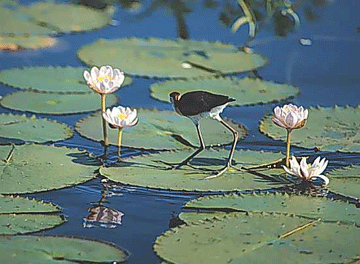 For 30 years about 100,000 litres of contaminated water a day has been leaking from the tailings dam into fissures beneath Kakadu
Radioactive water threatens Kakadu, The Age, Lindsay Murdoch, April 16, 2011 Radioactive water is in danger of spilling into an Aboriginal community and Kakadu’s World Heritage-listed wetlands if record rainfalls continue to deluge the vast Ranger uranium mine. Continue reading
Radiation contamination in Grand Canyon
Uranium Mining Threatens Grand Canyon Communities | Truthout Cathie Bird, 14 April 11, Over a thousand uranium mines have already contaminated water across the Southwest, poisoning communities with radiation that leads to cancer, harming the biodiversity of rivers and dissipating toxic ore dust into the air. Despite the immeasurable damage the mess of these abandoned mines has inflicted, including the official designation of the Four Corners as a “national sacrifice area,” the federal government and foreign mining companies want to continue uranium mining in the Grand Canyon… Uranium Mining Threatens Grand Canyon Communities | Truthout – MicroHawk’s NewsScan
The spread of radiation from Fukushima
Fish in nearby waters are now being measured at 4,000% above the Codex Alimentarius limits for Iodine-131 and 447% of Caesium-137. Radioactive caesium has a half-life of 30 years. Radiation levels for the isotope are not considered “safe” for 10 to 20 times longer. The caesium released today will remain dangerous six centuries from now.
Radiation Spreads Worldwide. The Poisoning of Mother Earth, Global Reseach Ca,by Freedom Against Censorship Thailand (FACT), 14 April 11, “………Radiation in milk in Hawaii is now at least 2,033% above Federal drinking water safety limits. The US safety limit is 3 pCi/l (picoCuries per litre). Note this is the minimum percentage found over EPA requirements. This figure is reached by adding together the Caesium-134 (800%); −137 (633%); and Iodine-131 (600%) levels und in milk. Continue reading
Increased radiation in Ontario since Fukushima disaster
Radiation in Ontario higher since Japan crisis: officials TheRecord -, 12 April 11, TORONTO — Elevated levels of radiation have been found in Ontario since the Japanese nuclear disaster but health authorities say people should not be alarmed.On Tuesday, Energy Minister Brad Duguid said radiation levels have gone up slightly since a devastating earthquake struck off the northeast coast of Japan on March 11 crippling the Fukushima Daiichi nuclear reactors.Some U.S. states have also found elevated radiation levels, Duguid said. But he added there is no reason for alarm here as officials regularly test the air, water and food.The news comes the same day that Japan increased the severity rating of the crisis at the Fukushima nuclear plant to the same level as the Chornobyl disaster…. TheRecord – Radiation in Ontario higher since Japan crisis…
Radioactive Cesium in Hawaii and other USA locations
 AUDIO Japan Nuclear Radiation In Hawaii Milk At LEAST 600% Above Federal Drinking Water Limits : The Intel Hub By Alexander Higgins – Contributing Writer April 12, 2011 Title of article now represents the minimum percentage that the radiation found in Hawaii is over EPA standards.
New EPA milk samples in Hawaii show radiation in milk at 800% above limits for Cs-134, 633% above limits for Cs-137 and 600% above EPA maximum for I-131 for a total of 2033%, or 20.33 times, above the federal drinking water limits.
New readings have also been posted for Phoenix AZ with milk being above the federal limit and Los Angeles with milk being slightly below the limit for Iodine.
Montpelier VT milk has tested positive for radioactive CS-137, above about 2/3rds the EPA maximum and Spokane WA milk testing less than half the limit for i-131….Japan Nuclear Radiation In Hawaii Milk At LEAST 600% Above Federal Drinking Water Limits :
1 This Month

Protect Sazan Island from the Trump family! https://secure.avaaz.org/campaign/en/protect_sazan_island_from_the_trump_family_loc/?bqFCVab&v=174511&cl=22707147157&_checksum=5e9dde668860e8231c33699735e16a1fbf22ab2cb01da50c999fe8732b9775ef&utm_source=email&utm_medium=blast_email&utm_campaign=174511

25 June- THE PUKE ON NUKES
Thursday, June 25, 2026
7pm Central Time (8pm ET, 6pm MT, 5pm PT) UTC – 5
From NRC & DOE Deregulation to Techno-Fascist Billionaires Going Nuclear, Plus a Few Songs from Atomic Cabaret REGISTER
26 June – Radiation Trainwreck at the NRC / Join the Protect Better Campaign – https://us02web.zoom.us/meeting/register/4ZlZ5_qLSHGiLSCg8FF6Bg#/registration


Cuba Is Not a Failed State – It Is a Besieged State
PETITION: “Global Appeal to Endorse Palestinian Right of Return of Refugees”
To see nuclear-related stories in greater depth and intensity – go to https://nuclearinformation.wordpress.com
-
Archives
- June 2026 (162)
- May 2026 (306)
- April 2026 (356)
- March 2026 (251)
- February 2026 (268)
- January 2026 (308)
- December 2025 (358)
- November 2025 (359)
- October 2025 (376)
- September 2025 (257)
- August 2025 (319)
- July 2025 (230)
-
Categories
- 1
- 1 NUCLEAR ISSUES
- business and costs
- climate change
- culture and arts
- ENERGY
- environment
- health
- history
- indigenous issues
- Legal
- marketing of nuclear
- media
- opposition to nuclear
- PERSONAL STORIES
- politics
- politics international
- Religion and ethics
- safety
- secrets,lies and civil liberties
- spinbuster
- technology
- Uranium
- wastes
- weapons and war
- Women
- 2 WORLD
- ACTION
- AFRICA
- Atrocities
- AUSTRALIA
- Christina's notes
- Christina's themes
- culture and arts
- Events
- Fuk 2022
- Fuk 2023
- Fukushima 2017
- Fukushima 2018
- fukushima 2019
- Fukushima 2020
- Fukushima 2021
- general
- global warming
- Humour (God we need it)
- Nuclear
- RARE EARTHS
- Reference
- resources – print
- Resources -audiovicual
- Weekly Newsletter
- World
- World Nuclear
- YouTube
-
RSS
Entries RSS
Comments RSS
 nuclear-news