At last, Grand Canyon to be protected from uranium mining
The moratorium will “reverse a century-long history of damage to the Grand Canyon from uranium mining,”
OBAMA ADMINISTRATION TO BAN URANIUM MINING AT GRAND CANYON, FORBES, OSHA GRAY DAVIDSON Standing at the south rim of the Grand Canyon this morning, Secretary of the Interior Ken Salazar announced that the Obama administration will enact a 20-year ban on new uranium mining in the last remaining unprotected lands surrounding the place President Theodore Roosevelt called “the one great sight which every American should see.”
Mining companies had filed thousands of claims in recent years, but it is unlikely that any of the 3,500 mining claims in the area will receive federal permits when the 20-year ban goes into effect. In March, Arizona’s Department of Environmental Quality (ADEQ) issued permits to three uranium mines on the land – provoking an outcry by native peoples, hunters, hikers, tourism groups and environmental organizations. Continue reading
New uranium mining on Grand Canyon stopped for 20 years
20-year ban planned on new Grand Canyon uranium mining, LA Times 20 June 11By Neela Banerjee, The Obama administration announces the proposed ban for 1 million acres of land bordering the Grand Canyon, an area where uranium mining claims have spiked 2,000% in the last seven years.
Mining claims around the Grand Canyon are among the thousands filed by companies along the borders of numerous national parks and wilderness areas.Critics say an outmoded 1872 law is driving the increase in claims in such sensitive places. The law allows corporations to stake out rights to federal lands for mining without a competitive bid and to extract resources without paying royalties.
The ban would strengthen a moratorium on new mining claims and activity, which the administration placed on Grand Canyon border lands two years ago in response to the jump in uranium stakes.Interior Department officials said the agency initially would extend the current moratorium another six months, until December, in order to complete the steps necessary to establish the 20-year ban. Mines currently in operation would not be affected.
Environmentalists, some lawmakers and water utilities serving metropolitan areas in the southwest, including Los Angeles, said the decision would protect the critical Colorado River watershed from possible contamination from uranium mining and would prevent the Grand Canyon panorama from being gradually industrialized…….http://www.latimes.com/news/nationworld/nation/sc-dc-0621-grand-canyon-20110620,0,1196854.story
Radiation travelling far and wide in Japan
 Elevated radiation levels widespread in eastern Japan, Unsafe levels of radioactive contamination have been reported from multiple sources throughout vast areas of eastern Japan in locations far away from the Fukushima nuclear power plant, Smart Planet By David Worthington | June 17, 2011
Science Magazine cites data from the prefectural government of Iwate revealing radioactive cesium has traveled over 100 miles away from Fukushima. Pastoral grasses are contaminated beyond safety standards
Japanese scientists have begun to track background radiation levels independently, according to the magazine’s report. Levels are exceeding acceptable safety limits in many locations.
 A “citizens’ map” of radiation levels is being maintained by a group of Japanese bloggers. Levels appear highest near Fukushima and toward its northwest. The vicinity around immediate southwest of the reactors shows elevated radiation, and a large pocket of contamination has settled further south in the outskirts of Tokyo……. http://www.smartplanet.com/blog/intelligent-energy/elevated-radiation-levels-widespread-in-eastern-japan/7160
Japan’s govt changes evacuation system, as “radiation hot spots” are found
places that are outside the evacuation zones but are feared to have concentrations of radiation due to geographical or weather conditions will be designated as “specific evacuation recommendation spots.”…….
Govt refines evacuation system, The Yomiuri Shimbun, 18 June 11 The government has decided to adopt a new system that would recommend evacuation from areas affected by radiation from the crisis-hit Fukushima No. 1 nuclear power plant not by municipality but on a house-by-house basis. Continue reading
Lingering radioactive disaster for Japan’s ‘no go’nuclear zone
 The narrow strip of hilly coastal country between Fukushima City – a metropolis of 2 million – and the crippled Daiichi nuclear plant on Japan’s east coast, is a no-go zone occupied by an invisible enemy – potentially life-threatening radiation. It is in the ground, in the atmosphere and in the sewerage…..
‘Exploding clouds of radioactive steam and debris were swept by strong winds across a broad arch of countryside, including Iitate and Minamisoma. Mountain forests, streams, rice fields, school grounds and houses were contaminated
A long wait for solace in a ravaged land, Sydney Morning Herald, Russell Skelton, June 11, 2011 Almost 100 days since the earthquake and tsunami devastated Japan, the nation struggles to give hope to its citizens Continue reading
Continuing radiation emissions into sea and air, from Fukushima

 Highly toxic radioactive iodine, cesium, strontium, plutonium and other toxic man-made radionuclides have leaked unabated since March 12 into the ocean and atmosphere…..The mainstream media is not reporting on this.
Preface Nuclear Toxicity Syndrome, The Intel Hub, By Dr. Mark Sircus – June 9th, 2011 Arnie Gundersen, widely-regarded to be the best nuclear analyst covering Japan’s Fukushima disaster, indicates that the situation on the ground at the crippled reactors remains precarious and at a minimum it will be years before it can be hoped to be truly contained. Continue reading
Japan may evacuate more towns, as radiation “hot spots” found
Japan Considers Evacuating More Towns WSJ By YUKA HAYASHI TOKYO, 9 June 11—Japanese government officials said they are considering evacuating more towns affected by radiation, after recent monitoring data showed new “hot spots” of elevated contamination farther away from the stricken Fukushima Daiichi nuclear power plant. Continue reading
Anxiety and fear, as Japanese realise the radiation fallout effects of Fukushima
VIDEO http://worldblog.msnbc.msn.com/_news/2011/06/08/6815027-japans-radiation-fallout-a-monster-you-cant-see?chromedomain=dailynightly Japan’s radiation fallout ‘a monster you can’t see World Blog Robert Bazell 8 June “….as one gets closer to the reactor site, it’s easy to see how much human damage a radiation leak can cause. As one engineer told me, “When nuclear reactors fail, they REALLY fail.”….. Levels in the air are two to 50 times the normal level. Radiation levels are high even in populous cities of 400,000 or more people – such as Koriyama and Fukushima City – each about 35 miles from the reactors. Most of the radiation escaped in the first few days of the accident and was deposited on the ground –in school yards, on people’s homes and in massive amounts in the farmlands that make up most of the area. The government monitors the levels in the air at seven sites in Fukushima Prefecture, but radiation falls in particles, and a very high levels can remain in one place, while just a few feet away there’s very little.
No one knows what the long-term effects of the radiation will be. The health dangers of elevated but relatively low levels of radiation remains one of the biggest disputes in medicine. Residents worry about the effects on themselves, and on their children especially. Farmers fear the crops they are planting this spring will never come to market after the fall harvest. And everyone knows there is no end in sight to the crisis. As Hideo Hanai, a cattle farmer, told me “It’s like being chased by a monster that you can’t see.” http://worldblog.msnbc.msn.com/_news/2011/06/08/6815027-japans-radiation-fallout-a-monster-you-cant-see?chromedomain=dailynightly
Studying the effects of Fukushima radiation in the ocean
The scientists say the effects of radioactive contamination in ocean waters, sediments and fish is not well understood. The Japanese nuclear disaster is the worst release of radioactive materials into an ocean.
Scientific voyage to study Japanese nuclear impact on ocean, MiamiHerald.com, By RENEE SCHOOF, McClatchy Newspapers, WASHINGTON, 4 June 11 — A team of scientists will set out Saturday from Hawaii on a research expedition to study how radioactive contamination from the nuclear power plant crisis in Japan has spread in the Pacific Ocean and what effects it will have on marine life, the food chain and human health. Continue reading
Radiation gradually accumulating in marine life beyond Fukushima
 More radiation worries for Japan’s fishing industry – Fishupdate.com, 31 may 11, MORE trouble appears to be on the horizon for Japan’s beleaguered fishing industry, following the country’s disastrous earthquake two months ago.
Greenpeace has said that the radioactive leaks are continuing to seriously affect fish and other marine life. According to fresh information released by the environmental group high levels of contamination have been found in fish, shellfish, and seaweed from samples taken 12 miles off the coast of the Fukushima plant.
Analysis by laboratories in France and Belgium found high levels of radioactive iodine and radioactive cesium in seafood, according to Greenpeace. Contamination levels were highest in seaweed samples, which contained radiation 50 times higher than official limits…..Greenpeace Radiation spokesman Jan Van Putte said: “Our data shows that significant amounts of contamination continue to spread over great distances from the Fukushima nuclear plant. Radioactive hazards are not decreasing through dilution or dispersion, but the radioactivity is instead accumulating in marine life.”… More radiation worries for Japan’s fishing industry – Fishupdate.com
Long lasting radioactive contamination of the sea, from Fukushima disaster
for all the focus on land-based contamination, the continuing flood of radioactive materials into the ocean at Fukushima could have the most problematic long-term impacts. ….for centuries to come, at least some radioactive materials dumped into the sea at Fukushima will find their way into the creatures of the sea and the humans that depend on them. ……
 Is Fukushima Now Ten Chernobyls into the Sea? | Common Dreams, May 26, 2011 by Harvey Wasserman New readings show levels of radioisotopes found up to 30 kilometers offshore from the on-going crisis at Fukushima are ten times higher than those measured in the Baltic and Black Seas during Chernobyl.
“When it comes to the oceans, says Ken Buesseler, a chemical oceonographer at the Woods Hole Oceanographic Institution, “the impact of Fukushima exceeds Chernobyl.” Continue reading
Radioactivity increasing in marine life around Japan
 Greenpeace: Japan nuclear plant radiation accumulating in marine life – CNN.com 27 May 11, Radiation from Japan’s damaged Fukushima Daiichi nuclear plant is accumulating in marine life off Japan’s coast above legal limits for food contamination, Greenpeace said Thursday. The environmental group said its findings run counter to Japanese government reports that radiation from the Fukushima plant, damaged in the March 11 earthquake and tsunami, is being diluted as time passes.“Despite what the authorities are claiming, radioactive hazards are not decreasing through dilution or dispersion of materials, but the radioactivity is instead accumulating in marine life,” Greenpeace radiation expert Jan Vande Putte said in a press release. Continue reading
AREVA neglecting France’s old radioactive uranium mining sites
 Today, the site is the responsibility of Areva, a majority state-owned French multinational that builds nuclear power stations and manages uranium mines around the world……
France’s respected Independent Research and Information Commission on Radioactivity (CRIIRAD). is similarly critical of the situation. “These exposures are totally unjustified and levels should be reduced by properly redeveloping the site and removing radioactive material,”
Radiation fears surround France’s old uranium mines, Google News, By Simon Coss (AFP) 27 May 11, ROSGLAS, France — It looks like any other another leafy woodland path in Brittany, but campaigners say ramblers on this particular trail may face levels of radiation at least 10 times higher than normal. Continue reading
Japanese rice contaminated with plutonium
|
Media Silent About Plutonium Contamination of Japanese Rice, Global Tech, 23 May 11
|
|
The Japanese Business Press reported on May 14 that a rice field more than 50 kilometers away from the Fukushima nuclear plant has tested for high levels of deadly plutonium. A “certain food manufacturing company” conducted the independent test that reported data different from data the Japanese government released, according to a translation of the news article
The corporate media outside of Japan did not mention the test or the increased radiation affecting the staple crop. Since the start of the disaster, the corporate media has parroted statements from TEPCO and the Japanese government in its coverage of the worst nuclear catastrophe since Chernobyl. In addition, the corporate media has all but ignored extremely high levels of nuclear radioactive contamination recently detected in Japan. “The latest joint US and Japan survey shows extremely high levels of nuclear radioactive contamination, with radiation levels higher than Chernobyl evacuation limits, now span over 800 kilometers in Japan,” writes Alexander Higgins
The total area contaminated with radiation from the Fukushima No. 1 nuclear power plant is estimated at about 800 square kilometers, or about 40 percent the size of Tokyo, according to a radiation map created by the science ministry and U.S. Department of Energy,” reports Asahi. “The report uses the same level of contamination (555,000 becquerels or higher of cesium-137) that was used to issue compulsory evacuation orders in the Chernobyl nuclear accident in 1986.” It is not likely the corporate media missed the news. Asahi has alliances with the International Herald Tribune, which is owned by the New York Times. According to the map about 800 square kilometers are contaminated with accumulated cesium-137 of 600,000 becquerels or higher per square mete
|
A legal win for Namibia’s groundwater against uranium mining

 issue is the question of who has the legal standing to go to court to ask for protection for the environment, which is unable to speak for itself…plan to extract large quantities of water from an underground water source in such a dry, environmentally sensitive and hitherto unspoilt area.
Uranium company loses desert water plan appeal, the Namibian, 20 May 11, By: WERNER MENGES A LEGAL challenge to a Canadian-owned mining company’s plan to use underground water to set up a uranium mine in the Namib Desert south-west of Usakos is heading back to the High Court after an appeal judgement that was given in the Supreme Court yesterday.
An issue that has never before had to be decided by a Namibian court is expected to be at the core Continue reading
1 This Month

Protect Sazan Island from the Trump family! https://secure.avaaz.org/campaign/en/protect_sazan_island_from_the_trump_family_loc/?bqFCVab&v=174511&cl=22707147157&_checksum=5e9dde668860e8231c33699735e16a1fbf22ab2cb01da50c999fe8732b9775ef&utm_source=email&utm_medium=blast_email&utm_campaign=174511
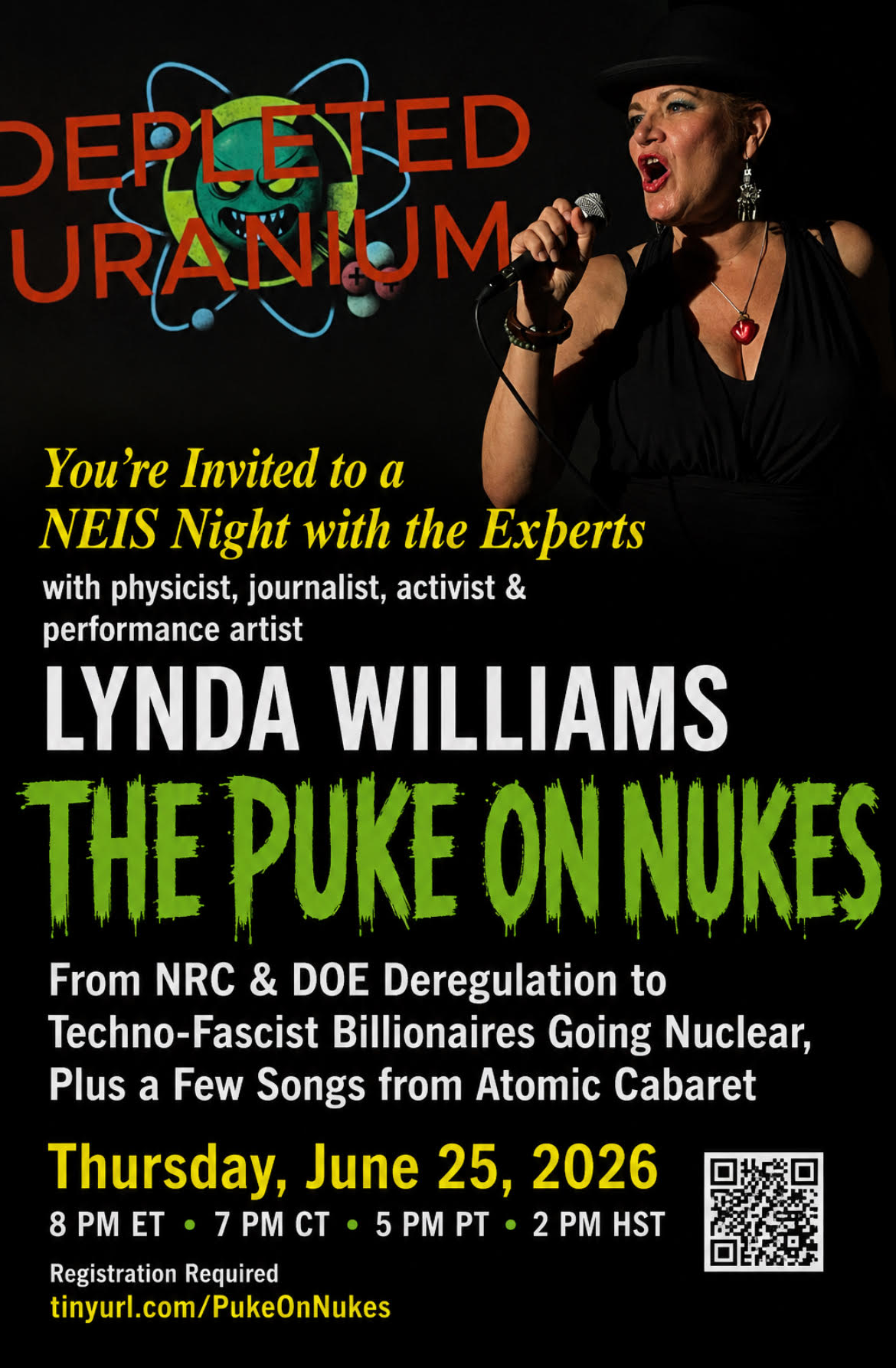
25 June- THE PUKE ON NUKES
Thursday, June 25, 2026
7pm Central Time (8pm ET, 6pm MT, 5pm PT) UTC – 5
From NRC & DOE Deregulation to Techno-Fascist Billionaires Going Nuclear, Plus a Few Songs from Atomic Cabaret REGISTER
26 June – Radiation Trainwreck at the NRC / Join the Protect Better Campaign – https://us02web.zoom.us/meeting/register/4ZlZ5_qLSHGiLSCg8FF6Bg#/registration


Cuba Is Not a Failed State – It Is a Besieged State
PETITION: “Global Appeal to Endorse Palestinian Right of Return of Refugees”
To see nuclear-related stories in greater depth and intensity – go to https://nuclearinformation.wordpress.com
-
Archives
- June 2026 (162)
- May 2026 (306)
- April 2026 (356)
- March 2026 (251)
- February 2026 (268)
- January 2026 (308)
- December 2025 (358)
- November 2025 (359)
- October 2025 (376)
- September 2025 (257)
- August 2025 (319)
- July 2025 (230)
-
Categories
- 1
- 1 NUCLEAR ISSUES
- business and costs
- climate change
- culture and arts
- ENERGY
- environment
- health
- history
- indigenous issues
- Legal
- marketing of nuclear
- media
- opposition to nuclear
- PERSONAL STORIES
- politics
- politics international
- Religion and ethics
- safety
- secrets,lies and civil liberties
- spinbuster
- technology
- Uranium
- wastes
- weapons and war
- Women
- 2 WORLD
- ACTION
- AFRICA
- Atrocities
- AUSTRALIA
- Christina's notes
- Christina's themes
- culture and arts
- Events
- Fuk 2022
- Fuk 2023
- Fukushima 2017
- Fukushima 2018
- fukushima 2019
- Fukushima 2020
- Fukushima 2021
- general
- global warming
- Humour (God we need it)
- Nuclear
- RARE EARTHS
- Reference
- resources – print
- Resources -audiovicual
- Weekly Newsletter
- World
- World Nuclear
- YouTube
-
RSS
Entries RSS
Comments RSS
 nuclear-news