Dounreay nuclear plant’s radioactive pollution of Scotland’s North coast seabed
“Once again, we see the nuclear industry causing a problem it can’t solve, and dumping the cost and consequence on the rest of us,”
 Scottish nuclear fuel leak ‘will never be completely cleaned up’ The Scottish Environment Protection Agency has abandoned its aim to remove all traces of contamination from the north coast seabed Rob Edwards guardian.co.uk, 21 September 2011 Radioactive contamination that leaked for more than two decades from the Dounreay nuclear plant on the north coast of Scotland will never be completely cleaned up, a Scottish government agency has admitted. Continue reading
Radiation danger in mushrooms in Japan

 Radiation fears, shipment bans, weigh heavily on mushroom pickers, growers, Mainichi Daily News, 17 Sept 11, The ban on wild mushroom shipments from 43 Fukushima Prefecture municipalities announced on Sept. 15, paired with widespread radiation fears, is discouraging pickers from their usual mushroom-hunting trips into the woods.
The ban came after wild mushrooms containing cesium beyond the legal limit of 500 becquerels per kilogram were found in the prefecture. Tawny milkcap mushrooms containing cesium over the legal limit, meanwhile, have also been found in Takahagi, Ibaraki Prefecture, endangering mushroom-picking in that region as well.
In the town of Tanagura in Fukushima, tawny milkcap mushrooms picked this month were found to contain 28,000 becquerels of cesium, or 56 times the legal limit. The town is famous for matsutake mushroom hunting between the end of September and late October each year….. http://mdn.mainichi.jp/mdnnews/news/20110916p2a00m0na012000c.html
Tomioka a nuclear ghost town
Inside Japan’s nuclear ghost zone, By David ShukmanEnvironment & science correspondent, BBC News 13 sept 11, As David Shukman enters the exclusion zone, he finds cattle that have starved to death. Nothing stirs in the empty heart of Tomioka, a community of 16,000 now reduced to the eerie status of a ghost town after the nuclear disaster at Fukushima. Continue reading
World waits for Fukushima nuclear plant to be brought under control
 “The whole world is waiting for Japan to bring the nuclear accident under control,” said Japan’s new prime minister, Yoshihiko Noda, last Thursday when he visited the plant
6 months into Japan’s cleanup, radiation a major worry, By Craig Dale, CBC News Sep 12, 2011 “……Decontamination The Japanese government is now conducting extensive aerial surveys, from the northeast to the central part of the country, to track the spread of radiation from Fukushima Daiichi. Continue reading
Fukushima radiation into sea at least 3 times greater than previously estimated
 Sea radiation ‘3 times higher than thought’, The Yomiuri Shimbun, 10 Sept 11, The total amount of radioactive substances released into the sea as a result of the crisis at the Fukushima No. 1 nuclear power plant is believed to have been three times the initial estimate by the plant’s operator, according to the Japan Atomic Energy Agency.
A team led by senior researcher Takuya Kobayashi estimated the actual quantity at 15,000 terabecquerels, including substances in polluted water and substances released into the air that eventually fell into the sea. Tera means one trillion.
The figure is more than triple the estimate by Tokyo Electric Power Co. Also, the new estimate does not include cesium-134, meaning the actual total could be even larger. The research team will announce its findings at a conference of the Atomic Energy Society of Japan scheduled to start in Kitakyushu on Sept. 19….. http://www.yomiuri.co.jp/dy/national/T110909005415.htm
Japan’s nuclear refugees – six months later
Six Months: The Nuclear Refugees, WSJ, 9 Sept 11, Since becoming self-appointed “nuclear refugees” in early July, Minako Ishigooka and her 14-month-old son have been living in a single room in a hostel in Naha, the prefectural seat of the southern island chain of Okinawa.
Just a few blocks away, the city’s main commercial strip is bustling with vacationers, but Ms. Ishigoooka’s days are spent on mundane tasks like making meals for her son and taking him out for walks. After he goes down for the night, she sits at the inn’s communal computer until 2 a.m. to gather news about radiation on Twitter.
She and her son have been to the beach only once but that doesn’t bother her. “At least here, I can let him play outside,” the 35-year-old mother from Tokyo says.
Fears of flare-ups in the nuclear situation or worries about radiation contamination of food have driven some residents of cities hundreds of kilometers from the disaster-struck Fukushima Daiichi plant to seek new homes. Many of them are mothers with young children like Ms. Ishigooka — the group most vulnerable to the potential effects of radiation……
One thing that makes the life rewarding for the nuclear refugees is the warm welcome from the local residents. Ms. Tatsuno says the nuclear evacuees have one thing in common with the Okinawans, who have long felt they were made to shoulder the burden of hosting U.S. bases to protect the entire nation: Deep mistrust of the government in Tokyo.
“They understand that whenever the government uses the word ‘safe’, you have to take it with a pinch of salt,” she says…. http://blogs.wsj.com/japanrealtime/2011/09/09/six-months-the-nuclear-refugees/
Japanese govt admits that it underestimated Fukushima radiation
Unsafe radiation levels in Kanto region, beyond Fukushima
The story also alludes to the strength of alternative information networks in the wake of the March crisis – after announcing her daughter’s test results on Twitter, the mother’s number of followers jumped from a number of close acquaintances to 700 people asking for details and advice about how to have their own children tested…..
While airborne radiation has lessened as emissions from the Fukushima Daiichi plant have decreased, there are concerns across the Kanto region of radioactive buildup in the soil….
Readings in one area of Saitama were over 900,000 Bq – a level greater than that which resulted in forced relocation after Chernobyl

 Contamination Outside Fukushima, JapanFocus, Sep. 04, 2011 Matthew Penney The extent of radioactive contamination in Fukushima Prefecture is at the center of important debates as some scientists, NGOs, and citizen’s groups argue that the Japanese government has not gone far enough in dealing with the fallout from the Fukushima Daiichi accident and has deliberately downplayed the potential health effects of radiation. With so much attention focused on Fukushima, however, there has been less consideration of the impact of the crisis, ongoing since March 11, on other parts of Japan. Continue reading
Farmland ruined by radioactive “superdumps” from uranium mining
He blames the recent toxic and radioactive spillages on Mine Waste Solutions, a subsidiary of Canadian First Uranium, which is reprocessing mining waste from 15 old slimes dams – some of which are located on his expansive farm – in the Klerksdorp area….
Superdumps are huge dams that store toxic waste form the smaller, historical dumps that are reprocessed for gold and uranium.
 (South Africa) Radioactive spillages condemn farmlandAugust 31 2011 IOL Science Tech, By Sheree Bega INDEPENDENT NEWSPAPERS Johan Kondos can only use a small portion of his land to grow lucerne. “……This lone field, and a few beloved cattle, is all Kondos has left of his farm in Hartbeesfontein in the North West.
Like many of his neighbours, he blames surrounding mining operations for contaminating his farm, situated about 5km from the Vaal River.
“Some of the pollution is historic but some of it is so recent, it’s still wet,” he explains.
“I’ve had calves born with two heads on my farm. At one time I was having 70 percent abortions and very high mortality with my animals. They drank from the Koekemoerspruit and ate the lucerne I produced.
He blames the recent toxic and radioactive spillages on Mine Waste Solutions, a subsidiary of Canadian First Uranium, which is reprocessing mining waste from 15 old slimes dams – some of which are located on his expansive farm – in the Klerksdorp area.
As part of this, the company is also constructing a controversial central tailings storage facility, or superdump, about 2km from the Vaal River, touting it as a model rehabilitation plan, where the mining waste from the 15 tailings dams is piped. Superdumps are huge dams that store toxic waste form the smaller, historical dumps that are reprocessed for gold and uranium.
In July, the National Nuclear Regulator (NNR) shut down Mine Waste Solutions’ operations after its inspection revealed spillages and leakages of tailings materials along the company’s extensive pipeline and on the properties of farmers like Kondos.
But a week later, Mine Waste Solutions was back on line, stating it said it had been given conditional approval to restart operations provided it follow an “enhanced pipeline maintenance programme” and submit monthly reports.
Radioactive spillages condemn farmland – IOL SciTech | IOL.co.za
Kazakhstan’s land of danger due to nuclear testing
Soviet nuclear legacy surfaces at atomic museum , By Keith Rogers, LAS VEGAS REVIEW-JOURNAL, Sep. 3, 2011 Kazakhstan is grappling with lingering health issues and trying to rehabilitate the land 20 years after nuclear weapons testing stopped at the former Soviet Union’s proving ground .
Heavily contaminated areas of the Semipalatinsk nuclear site are closed to access by Kazaks who used the land for farming and grazing. The government, with the United States, is working to keep dangerous materials out of sinister hands, said Erlan Idrissov, Kazakhstan’s ambassador to the United States.
“All those years we have been trying to make a full assessment of the dangers that were brought to the land by nuclear testing,” Continue reading
People can stay in Japanese town, but avoid the radiation outdoors
—as long as residents don’t spend too long outside, and avoid spots such as parks and forests, where radioactive elements tend to gather. Radioactive cesium has a tendency to bind to earth, and flow along with silt in water.
In One Japanese City, Hot Spots to Avoid, Government Advises Residents of Contaminated Town to Stay—but Keep Clear of Places With Radiation Risk, WSJ, 3 Sept. By PHRED DVORAK, DATE, Japan—This sprawling city, 35 miles away from the crippled Fukushima Daiichi reactors, is leading the next phase of Japan’s struggles with radiation: deciding how to handle populations in contaminated communities where the level isn’t high enough to justify evacuation. Continue reading
Nuclear physicist recommends permanent relocation for Fukushima area residents
Mamoru Fujiwara, assistant professor of nuclear physics at Osaka University, said the residents from these locations “need to be relocated permanently.”
Japan Finds Radiation Spread Over a Wide Area, WSJ, By MITSURU OBE, 31 Aug 11, TOKYO—The first comprehensive soil survey from areas around the Fukushima Daiichi nuclear plant showed extensive ground contamination and another report warned of the continued threat to Japan’s food chain, underscoring the major challenges the country still faces in its radioactive cleanup efforts…. Continue reading
Evacuate high radiation area North West Japan, says Caldicott
Dr Helen Caldicott says radiation many times in excess of that which led to the evacuation of Chernobyl has been reported in North-West Japan — so the area should be evacuated immediately.
 Fukushima Crisis: Caldicott Says Evacuate North-West Japan, 31 August 2011,by: David Donovan, Independent Australia .………The problem is that the reliability of claims from TEPCO, NISA and the Japanese Government are – as we have reported before – highly questionable. All three bodies have a major credibility crisis, with clear evidence that they colluded to cover up evidence that they knew the nuclear reactors melted down within hours of the March 11 tsunami. The reason for this seems to be that Japan is highly dependent on nuclear energy for its power needs, such that NISA has become more or less a branch of TEPCO – with staff perenially shuffling between the two bodies – and with a Japanese Government that is primarily concerned with talking down the extent of the crisis to avoid widespread panic amongst the Japanese population and allay rumblings about the viability of nuclear power…. Continue reading
Uranium mine closed in 1966, still emitting ionising radiation
Firm begins cleanup at Stanislaus National Forest uranium mine site, The Modesto Bee, Aug. 27, 2011, By John Holland KENNEDY MEADOWS — A crew has started cleanup at a uranium mine that operated in the Stanislaus National Forest from 1956 to 1966.The site, about three miles west of Kennedy Meadows, has emitted radiation that exceeded health standards, the U.S. Environmental Protection Agency said.
The cleanup is funded by the Comprehensive Environmental Response, Compensation and Liability Act, better known as the Superfund… http://www.modbee.com/2011/08/27/1833616/firm-begins-cleanup-at-uranium.html
Long process of radiation cleanup in Japan
Japan aims to halve radiation in affected areas in 2 yrs
— Japan aims to bring radiation levels below 20 millisieverts annually
* Thorough cleanup of areas frequented by children also a priority
* Group launched which will form core of new nuclear watchdog
By Shinichi Saoshiro TOKYO, Aug 26 (Reuters) – Japan aims to halve radiation over two years in places contaminated by the Fukushima nuclear crisis, removing soil, plants and trees as well as cleaning roofs of buildings in an area spanning thousands of square kilometres.
The cleanup could cost tens of billions of dollars, and thousands of evacuees may not be able to return home for years, if ever. Continue reading
1 This Month

Protect Sazan Island from the Trump family! https://secure.avaaz.org/campaign/en/protect_sazan_island_from_the_trump_family_loc/?bqFCVab&v=174511&cl=22707147157&_checksum=5e9dde668860e8231c33699735e16a1fbf22ab2cb01da50c999fe8732b9775ef&utm_source=email&utm_medium=blast_email&utm_campaign=174511
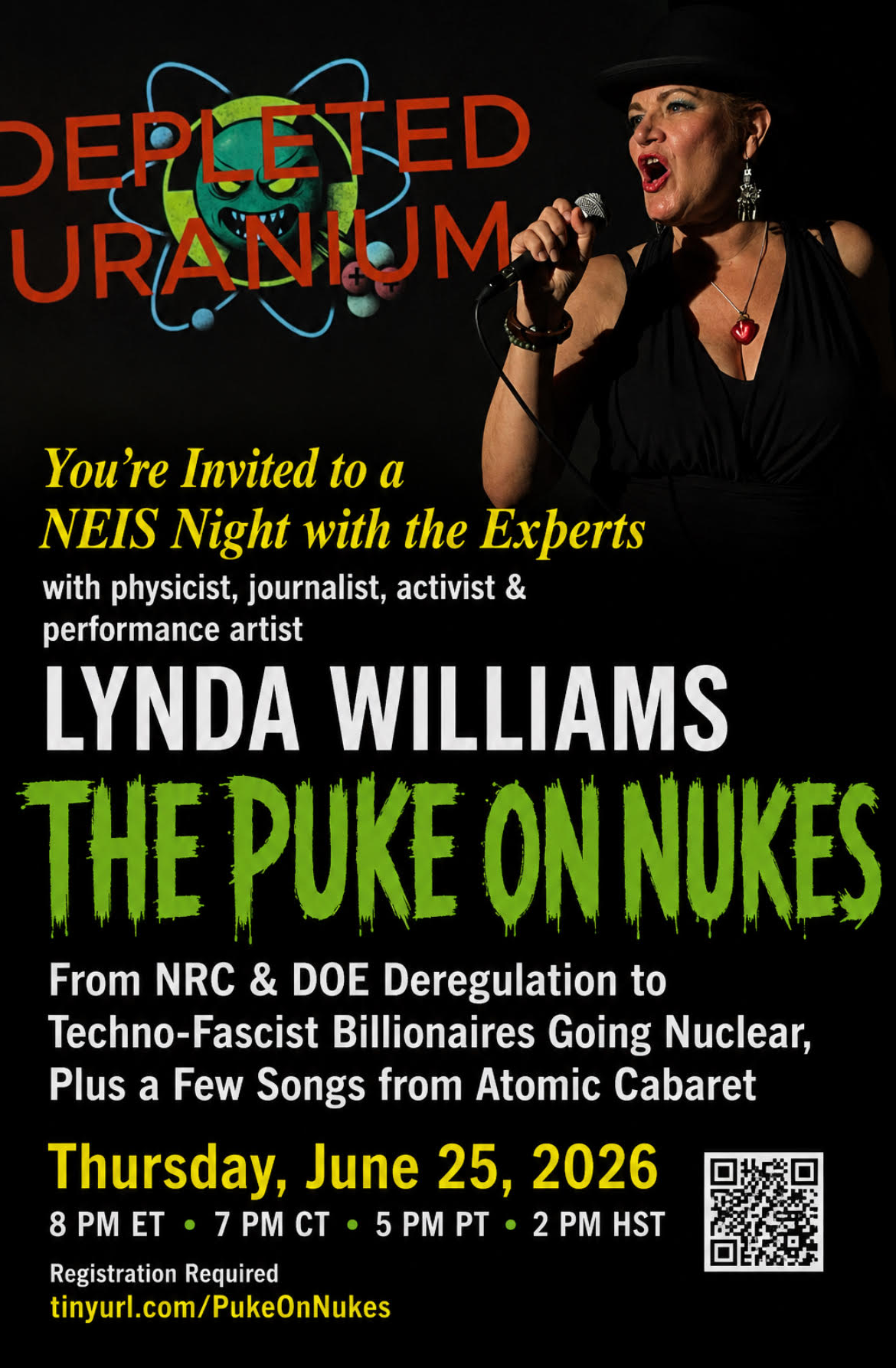
25 June- THE PUKE ON NUKES
Thursday, June 25, 2026
7pm Central Time (8pm ET, 6pm MT, 5pm PT) UTC – 5
From NRC & DOE Deregulation to Techno-Fascist Billionaires Going Nuclear, Plus a Few Songs from Atomic Cabaret REGISTER
26 June – Radiation Trainwreck at the NRC / Join the Protect Better Campaign – https://us02web.zoom.us/meeting/register/4ZlZ5_qLSHGiLSCg8FF6Bg#/registration

Cuba Is Not a Failed State – It Is a Besieged State
PETITION: “Global Appeal to Endorse Palestinian Right of Return of Refugees”
To see nuclear-related stories in greater depth and intensity – go to https://nuclearinformation.wordpress.com
-
Archives
- June 2026 (162)
- May 2026 (306)
- April 2026 (356)
- March 2026 (251)
- February 2026 (268)
- January 2026 (308)
- December 2025 (358)
- November 2025 (359)
- October 2025 (376)
- September 2025 (257)
- August 2025 (319)
- July 2025 (230)
-
Categories
- 1
- 1 NUCLEAR ISSUES
- business and costs
- climate change
- culture and arts
- ENERGY
- environment
- health
- history
- indigenous issues
- Legal
- marketing of nuclear
- media
- opposition to nuclear
- PERSONAL STORIES
- politics
- politics international
- Religion and ethics
- safety
- secrets,lies and civil liberties
- spinbuster
- technology
- Uranium
- wastes
- weapons and war
- Women
- 2 WORLD
- ACTION
- AFRICA
- Atrocities
- AUSTRALIA
- Christina's notes
- Christina's themes
- culture and arts
- Events
- Fuk 2022
- Fuk 2023
- Fukushima 2017
- Fukushima 2018
- fukushima 2019
- Fukushima 2020
- Fukushima 2021
- general
- global warming
- Humour (God we need it)
- Nuclear
- RARE EARTHS
- Reference
- resources – print
- Resources -audiovicual
- Weekly Newsletter
- World
- World Nuclear
- YouTube
-
RSS
Entries RSS
Comments RSS
 nuclear-news