Seabed off Fukushima radioactive for decades to come
Radiation settles on seabed off Japan Radio Australia 26 October 2012, New research suggests radiation from the crippled Fukushima nuclear plant has settled on the ocean floor off Japan, and could contaminate sea life for decades.
Contamination may be due to low-level leaks from the Fukushima nuclear plant. (Credit: AFP) Marine chemist Ken Buesseler of the Woods Hole Oceanographic Institution reviewed official Japanese data on radiation levels in fish, shellfish and seaweed collected near the crippled nuclear plant. He concluded the lingering contamination may be due to low-level leaks from the facility, or contaminated sediment on the ocean floor.
His research, published on Thursday in the US magazine Science, estimated that about 40 per cent of fish caught near Fukushima are considered unfit for consumption under Japanese
regulations…..http://www.radioaustralia.net.au/international/2012-10-26/radiation-settles-on-seabed-off-japan/1036750
Fukushima radioactive water could fill 50 Olympic sized swimming pools
To deal with the excess tainted water, the utility has channeled it to more than 300 huge storage tanks placed around the plant.
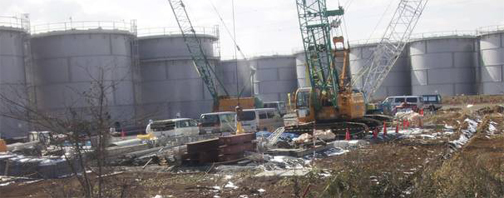
 Fukushima Nuclear Disaster: Plant’s Contaminated Water Storage Running Out Of Space HUFFINGTON POST, By MARI YAMAGUCHI 10/25/12 TOKYO — Japan’s crippled nuclear power plant is struggling to find space to store tens of thousands of tons of highly contaminated water used to cool the broken reactors, the manager of the water treatment team said.
About 200,000 tons of radioactive water – enough to fill more than 50 Olympic-sized swimming pools – are being stored in hundreds of gigantic tanks built around the Fukushima Dai-ichi plant. Operator Tokyo Electric Power Co. has already chopped down trees to make room for more tanks and predicts the volume of water will more than triple within three years. Continue reading
Fish caught off Japan’s coast becoming MORE radioactive
the most contaminated fish found yet off Fukushima were caught in August, some 17 months after the disaster. The two greenlings, which are bottom-feeders, had cesium levels of more than 25,000 becquerels per kilogram, 250 times the level the government considers safe.

 Radiation levels in fish off Japan not declining since nuclear disaster Anchorage Daily News, October 25, 2012 By MALCOLM FOSTER — Associated Press TOKYO — Radioactive cesium levels in most kinds of fish caught off the coast of Fukushima haven’t declined in the year following Japan’s nuclear disaster, a signal that the seafloor or leakage from the damaged reactors must be continuing to contaminate the waters – possibly threatening fisheries for decades, a researcher says. Continue reading
High radiation in Fukushima neighbourhoods
 Japan Newspaper: Radiation levels rising every month since decontamination in Fukushima district — Gov’t won’t help or even respond — “Are they forcing us to tolerate high radiation?” http://enenews.com/mainichi-radiation-levels-rising-every-month-since-decontamination-in-fukushima-district-govt-wont-help-or-even-respond-are-they-forcing-us-to-tolerate-high-radiation Title: One year on, Fukushima still fights uphill battle to decontaminate farming district
Source: Mainichi Japan
Date: Oct. 18, 2012
h/t Fukushima Diary
[…] The residents of the Onami district are frustrated with the government’s inaction, with one of them saying, “Are they forcing us to tolerate high radiation doses?” Continue reading
150 years before people can return to radiation contaminated land
 It takes over 150 yrs for people to come back to Futaba machi, “Decontamination is useless.” http://fukushima-diary.com/2012/10/it-takes-over-150-yrs-for-people-to-come-back-to-futaba-machi-decontamination-is-useless/ by Mochizuki October 20th, 2012 · On 10/16/2012, Assistant Prof. Kimura from Dokkyo medical university had a lecture in the
restration committee of Futaba machi.
In this lecture, he introduced his personal view over the situation that it takes over 150 years for all the citizens to come back to the town even though they consider the half-life and the shielding effect of the ground.
He adds this is on the assumption that they don’t decontaminate the town, but he also added it’s useless to decontaminate this highly contaminated land. In Futaba machi, the lowest atmospheric dose is 0.3μSv/h but the highest reading is over20μSv/h.
Cesium above new limit in Miyagi beef http://www.japantimes.co.jp/text/nn20121019a2.html Jiji SENDAI — Radioactive cesium levels above the government’s new limit have been found in beef from Miyagi Prefecture, the prefectural government said.
Meat from a cow shipped by a farmer in Tome was found to contain more than 150 becquerels of radioactive cesium per kilogram, the Miyagi Prefectural Government said Wednesday.
The stricter limit of 150 becquerels for beef and rice took effect Oct. 1. The previous limit was 500 becquerels per kilogram.
It is the first time beef with radioactive cesium levels above the tightened limit has been found.
The cow was shipped to a slaughterhouse in the Shibaura district in Tokyo and a radioactivity check on the meat was conducted Tuesday, the prefecture said. The meat was discarded, officials said.
The prefecture is investigating, suspecting that rice straw eaten by the cow was contaminated by fallout from the Fukushima No. 1 nuclear plant disaster.Miyagi Prefecture told the farmer not to ship any more cows until the investigation is completed, and asked nearby ranchers to suspend shipments voluntarily.
Critics on all sides as Australia leads way on Antarctic protection BY: MATTHEW DENHOLM, TASMANIA CORRESPONDENT The Australian October 18, 2012 AUSTRALIA and France have developed a plan to protect 1.9 million square kilometres of east Antarctica as new marine parks, although a report today will call for an even larger reserve.
The Australia-France proposal, backed by the EU, covers seven coastal zones in east Antarctica…. (subscribers only)
http://www.theaustralian.com.au/national-affairs/foreign-affairs/critics-on-all-sides-as-australia-leads-way-on-antarctic-protection/story-fn59nm2j-1226498135791
Rapid melting of ice in the Antarctic
parts of the Antarctic ice caps were melting at unprecedented rates.
“The role of scientists is not to be alarmists, and not to downplay the data, but simply to report it.”
 Antarctic climate facing ‘rapid’ changes: chief scientist, The Age, October 16, 2012 -Australia’s chief Antarctic scientist says claims by climate experts about environmental changes in the southern continent are not alarmist.
The Australian Antarctic Division (AAD) told a Senate estimates hearing today “rapid changes” taking place across the icy land mass would have significant impact on global climate.
Changes in ocean flows and shifts in Antarctic ice cap levels were occurring at rates faster than at any other time in history, chief scientist Nick Gales said. ”That’s the part that is the most dramatic about the information we’re receiving,” he told the hearing. Continue reading
The “Fukushima Syndrome” – sick and dying cattle
Inside Evacuation Zone: Cattle sick, dying — “We call it Fukushima syndrome” — Severe diarrhea, skin problems, weakened immune systems http://enenews.com/farm-evacuation-zone-cattle-sick-dying-call-fukushima-syndrome-diarrhea-like-water-snivel-spreading-dermatitis-immune-system-being-weaken October 8th, 2012
Oct 5, 2012Recent tweets by Fukushima Farm Sanctuary (@kibounobokujyou), a farm inside the 20 kilometer evacuation zone, translated by Fukushima Diary:
4 cattle have died since yesterday. One more calf is about to die. They must be fed enough though nutrition might not be perfect. Is bad disease going around ? I’m worried about radiation too. We call it Fukushima syndrome. […]
3 died yesterday. […]
Masami Yoshizawa, RancherDiarrhea like water, snivel, spreading dermatitis, their immune system is being weaken, which is obvious even for amateur. It might be because of simply the lack of nutrition, epidemic disease, or radiation exposure. Probably it’s only in this hazard area, where series of cattle die one after one. We call it Fukushima syndrome, which was born from Tepco and the government.
A lot of calves are dying but adult cattle are dying too. Calves die regardless of the age. If it becomes winter in this situation, the number might become half or less than that.
California Health Department not happy with Treasure Island’s radiation status
The Navy has yet to explain the significance of a 1965 report that described how “radioactive and poisonous wastes had been buried west of the abandoned landing strip in a future construction area.”
Navy’s Treasure Island Radiation Report Found Wanting NBC Bay Area 8 Oct 12 The Navy’s report is part of the process of turning the military land over to the city of San Francisco, which has approved construction of 8,000 homes there. By Matt Smith | Monday, Oct 8, 2012 Recent U.S. Navy explanations for widespread readings of radioactivity on the former Treasure Island Naval Station don’t adequately explore the possibility that the base might have been dusted for years with radioactive ash, soaked with radioactive sewage and contaminated by radioactive garbage, California health regulators said today. Continue reading
Contamination, Including Human Exposure – Fukushima
Fukushima Nuclear Crisis Update for October 2nd to October 4th, 2012 Greenpeace International, by Christine McCann – October 5, 2012 “…Contamination, Including Human Exposure The JAEC has begun monitoring radiation levels in restricted zones of Fukushima Prefecture via unmanned helicopters. The project, which was requested by the Ministry of Education, Culture, Sports, Science, and Technology (MEXT), marks the first time that radiation has been measured from the air in the no-go zone. The agency will compile a report by the end of the month, including radiation maps of hotspots. Meanwhile, another research team is studying radiation levels in forests and rivers there, in order to determine their effect on human habitats and the ocean. The research will continue for the next 20 years. (Source: NHK)
Researchers from the Nippon Veterinary and Life Science University (NVLU) have begun to study the effects of radiation on Japanese macaques, noting that the similarities between primates and humans may help them determine how radiation could eventually affect people. Shin-ichi Hayama, one of the scientists working on the project, said, “This presents an opportunity to study the impact of low-dose radiation on primates, which are so close to humans, over a more than 20-year period. That could help forecast the impact on humans, as well.”http://www.greenpeace.org/international/en/news/Blogs/nuclear-reaction/fukushima-nuclear-crisis-update-for-october-2/blog/42456/
Costly radiation remediation at Port Hope
 Port Hope radiation: $464,615 spent to remediate $130,000 house thestar.com October 05, 2012 PORT HOPE, ONT.—It started in the attic. Wally Davis wanted to build a room in the attic of his house. Since he lives in Port Hope, he couldn’t just go ahead and do it. He went to the Low Level Radioactive Waste Management Office, a federal agency, requested the file on his property and asked them to test for remnants of historic radioactive waste.
“There was contamination in the roof, on the floors, in the walls . . . everywhere in the house,” said Davis, 75, a retired Ontario Hydro employee.
In July 2011, Davis and his wife, Carole, were relocated to neighbouring Cobourg as agency staff started remediation work. The couple returned to their two-bedroom, 1,000-square-foot home this July and discovered that except for the outer walls, it had been essentially rebuilt.
“They did a superb job,” Davis said.
They did indeed. The waste management office spent $464,615 to clean up the house Davis bought a decade ago for $125,000 — or $130,000, he can’t remember.
“We didn’t have a clue how much they spent,” said Davis when the Star told him that almost a half-million dollars had been used to remediate his home.
“They didn’t tell us,” he said. “That is a lot of money.”The Davis home on Bruton St., in a leafy old part of town, is about two kilometres from the waterfront. It has a red-brick façade, an attached garage and a large front and back yard. There’s a shed in the back and a Canadian flag fluttering on a tall post.
Port Hope, the picture-pretty lakeside town about 110 kilometres east of Toronto, will soon see the biggest cleanup of historic radioactive waste in Canadian history. Fifty years of radium and uranium refining at the Cameco refinery, formerly Crown corporation Eldorado Nuclear Ltd., has left contamination spread around the town…. http://www.thestar.com/news/gta/article/1267186–port-hope-radiation-464-615-spent-to-remediate-130-000-house
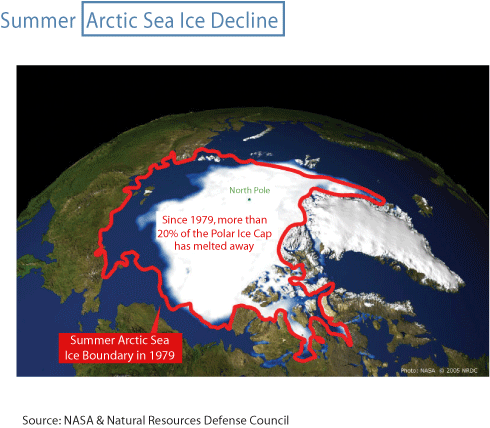
Global warming causing rapid decline in Arctic sea ice
Norwegian Arctic Summers Warmest in 1,800 Years
Summer temperatures on the Norwegian archipelago of Svalbard in the High Arctic are now higher than during any time over the last 1,800 years, including a period of higher temperatures in the northern hemisphere known as the Medieval Warm Period, according to a new study. In an analysis of algae buried in deep lake sediments, a team of scientists calculated that summer temperatures in Svalbard since 1987 have been 2 to 2.5 degrees Celsius (3.6 to 4.5 degrees F) warmer than during the Medieval Warm Period, which lasted from roughly 950 to 1250 AD. Scientists say this year’s record declines in Arctic sea ice extent and volume are powerful evidence that the giant cap of ice at the top of the planet is on a trajectory to largely disappear in summer within a decade or two, with profound global consequences. http://www.enn.com/wildlife/article/45024
Water use by nuclear power plants – another climate change problem
 Millstone shutdown is a sign of broader power problem caused by climate change, CT Mirror, September 24, 2012, By Jan Ellen Spiegel ….. Water consumption – some view raising the plant’s operating temperature as a Band-Aid for the real problem — the amount of water the nation’s 19,000 power generating units, including 104 nuclear ones, use. They consume 100 billion gallons a day — three times what cascades over Niagara Falls in the same time frame.
“U.S. power plants are at risk from not enough water due to situations like drought, too much water because of sea level rise and flooding, or water that is simply too warm,” said Steve Fleischli, acting director of the Natural Resources Defense Council‘s water and climate program. “From our perspective, what power plants can do to protect the grid is not rely so much on water.”
Most of the cooling water is returned to its source and then re-used, according to the U.S. Geological Survey, which documents fresh- and saltwater use every five years. Since 1965 most water withdrawals have gone for thermo-electric power generation. In 2005 (2010 data is not available yet), that figure was 40 percent nationally.
But in Connecticut it’s 82 percent. Among freshwater withdrawals, 24 percent goes to power plants. Of the saltwater withdrawals here, 99 percent goes to power plants.
At Millstone, Unit 2 uses 450,000 gallons of water per minute, and Unit 3 uses twice that amount. Coal plants like that in Bridgeport, which also takes its water from Long Island Sound, withdraw nearly the same amount of water as nuclear plants per megawatt hour. Gas and oil plants — similar in their water needs — require less than nuclear and coal. Conventional plants, however, generally can use warmer water than nuclear plants because without radiation concerns, their safety systems are less critical…… http://www.ctmirror.org/story/17512/millstone-shutdown-sign-broader-water-power-conflicts-climate-change
Mushrooms containing radioactive cesium sold in Western Japan
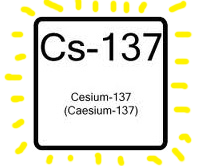 Cesium from mushroom made in Kyushu, sold in west coast of Japan
http://fukushima-diary.com/2012/09/cesium-from-mushroom-made-in-kyushu-sold-in-west-coast-of-japan/ by Mochizuki on September 30th, 2012 · According to the report of Ministry of Health, Labour and Welfare, cesium was measured from mushroom made in Ohita prefecture, in Kyushu of western Japan. It was sold in Niigata prefecture, west coast of Japan.
Also, cesium was measured from mushroom made in Shizuoka prefecture, in central Japan. It was also sold in Niigata prefecture, west coast of Japan.
Sample 1
Product : Dried mushroom
Date : 9/24/2012
Cs137 : 5.9 Bq/Kg
Production : Ohita
Sample 2
Product : Dried mushroom
Date : 9/24/2012
Cs137 : 6.3 Bq/Kg
Production : Shizuoka
1 This Month
26 September – International Day for the Total Elimination of Nuclear Weapons





PLEASE OPPOSE HR 8255 AND S.3639 – bills would accelerate satellite deployment, with no environmental review or safeguards – https://ncstd5li.quorum.us/campaign/169331/
To see nuclear-related stories in greater depth and intensity – go to https://nuclearinformation.wordpress.com
-
Archives
- September 2026 (281)
- August 2026 (330)
- July 2026 (355)
- June 2026 (287)
- May 2026 (306)
- April 2026 (356)
- March 2026 (251)
- February 2026 (267)
- January 2026 (308)
- December 2025 (358)
- November 2025 (359)
- October 2025 (375)
-
Categories
- 1
- 1 NUCLEAR ISSUES
- business and costs
- climate change
- culture and arts
- ENERGY
- environment
- health
- history
- indigenous issues
- Legal
- marketing of nuclear
- media
- opposition to nuclear
- PERSONAL STORIES
- politics
- politics international
- Religion and ethics
- safety
- secrets,lies and civil liberties
- spinbuster
- technology
- Uranium
- wastes
- weapons and war
- Women
- 2 WORLD
- ACTION
- AFRICA
- Atrocities
- AUSTRALIA
- Christina's notes
- Christina's themes
- culture and arts
- Events
- Fuk 2022
- Fuk 2023
- Fukushima 2017
- Fukushima 2018
- fukushima 2019
- Fukushima 2020
- Fukushima 2021
- general
- global warming
- Humour (God we need it)
- Nuclear
- RARE EARTHS
- Reference
- resources – print
- Resources -audiovicual
- Weekly Newsletter
- World
- World Nuclear
- YouTube
-
RSS
Entries RSS
Comments RSS

