Massive radioactive air pollution from Savannah River Nuclear Site.

 Group calls for air pollution investigation at SRS http://www.aikenstandard.com/article/20130821/AIK0101/130829945/1004/group-calls-for-air-pollution-investigation-at-srs Derrek Asberry, August 21, 2013 A nonprofit environmental group is challenging a government study of air pollutants by calling for an investigation of toxic air pollution from Savannah River Site.
The Blue Ridge Environmental Defense League filed a letter with the Agency for Toxic Substances and Disease Registry, criticizing the toxic agency’s evaluation of SRS.
“The amount of airborne radioactive pollution from SRS is massive,” said Luis Zeller, the director of the environmental group, in a recent press release. “It is greater than the liquid releases to streams and groundwater by at least an order of magnitude. How could the ATSDR miss this?”
The group cited the toxic agency’s July 1 public health evaluation of the Site, which concluded that airborne emissions of radioactive materials and most chemical pollutants from SRS were below levels that could potentially cause harmful health effects.
“The ATSDR’s study is contradictory and inconclusive,” said Charles Utley in the press release.
Utley is the environmental justice campaign coordinator for the Blue Ridge Environmental Defense League. He conducted separate field investigations around SRS and followed up with a report entitled “Sow the Wind.”
“The League’s own investigations centered on the air toxics emitted from hundreds of large and small smokestacks at SRS and how they interact to raise downwind pollution levels in Jackson, New Ellenton, Williston and other communities,” the group stated in the release.
The group continued by recommending the Agency for Toxic Substances and Disease Registry take one of two actions: conduct an analysis and produce conclusive results on radioactive air pollutions, or require the Department of Energy to determine the public health impact of radioactive air pollutants in the Central Savannah River Area.
“Our report indicates that operations at SRS have had, and will continue to have, a negative impact on the health of residents in the Central Savannah River Area,” Utley added in the press release.
SRS did not issue a comment on the issue.
USA West Coast Tuna, Salmon and Herring contaminated by radiation?
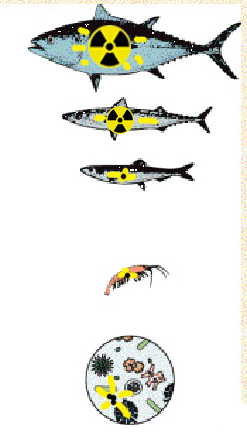 The bottom line – as nuclear experts said 4 days after the Japanese earthquake and tsunami – is that we all need to demand that fish be tested for radiation.
Is Fukushima Radiation Contaminating Tuna, Salmon and Herring On the West Coast of North America?
By Washington’s Blog Global Research, August 26, 2013 Demand that Fish Be Tested for Radiation
We’ve extensively documented that radioactivity from Fukushima is spreading to North America.
More than a year ago, 15 out of 15 bluefin tuna tested in California waters were contaminated with radioactive cesium from Fukushima.
Bluefin tuna are a wide-ranging fish, which can swim back and forth between Japan and North America in a year. But what about other types of fish?
Sockeye salmon also have a range spanning all of the way from Japan to Alaska, Canada, Washington and Oregon: Associated Press reports that both scientists and native elders in British Columbia say that sockeye numbers have plummeted:…….
Another example – pacific herring – is even more dramatic. Pacific herring is wide-ranging fish, spanning all the way from Japan to Southern California:
Every single pacific herring examined by a biologist in Canada was found to be hemorrhaging blood. As Ene News reports:
See also: Alexandra Morton via Vancouver 24 hrs, Vancouver 24 hrs, Alexandra Morton)
The Globe and Mail, Aug 13, 2013 (Emphasis Added):
Independent fisheries scientist Alexandra Morton is raising concerns about a disease she says is spreading through Pacific herring causing fish to hemorrhage. […] “Two days ago I did a beach seine on Malcolm Island [near Port McNeill on northern Vancouver Island] and I got approximately 100 of these little herring and they were not only bleeding from their fins, but their bellies, their chins, their eyeballs. […] “It was 100 per cent … I couldn’t find any that weren’t bleeding to some degree. And they were schooling with young sockeye [salmon]”
Sun News, Aug 12, 2013: Continue reading
China calls Fukushima radiation a serious international environmental issue
 Official Chinese Press: Fukushima contamination is “serious international environmental issue” — Crisis concerns the core interests of people who share the planet http://enenews.com/commentary-fukushima-contamination-is-international-environmental-issue-govt-must-address-global-anxiety-crisis-concerns-the-core-interests-of-people-who-share-planet
Source: Xinhua (China’s official press agency)
Authors: Liu Tian, Zhang Cheng
Date: Aug 23, 2013
[…] it is the time for the Japanese government to shoulder more responsibilities to address the global concerns. […]
Studies showed that radioactive substances have spread into high sea from the crippled nuclear plant, proving that the tragedy has no longer a national problem, but a serious international environmental issue that needs stronger efforts to deal with. […]
A priority for the Japanese government to relieve the global anxiety is to make the accident relevant information more transparent to the international community so as to precisely assess the graveness of the entire accident and its aftermath.
It is hoped that the Japanese government would not keep the information for its own political interests as the issue concerns not only the core interests of the Japanese people, but also people who share the planet. […]
Fukushima nuclear plant built on site of a diverted river

 Wall St. Journal: They don’t know where Fukushima’s melted fuel cores are, or in what state — Expert: “It’s important to think of worst-case scenario”… Even greater levels of contamination may be on the way — Plant “built on a river” http://enenews.com/wsj-they-dont-know-where-fukushimas-melted-fuel-cores-are-or-in-what-state-expert-its-important-to-think-of-worst-case-scenario-might-be-even-more-heavily-contaminated-water-coming-th
Title: Japan Races to Contain Worst Fukushima Spill Since Meltdown
Source: Wall St Journal
Author: Phred Dvorak
Date: Aug 22, 2013
[…] Tepco said it doesn’t think that water has flowed into the sea but can’t say for sure. Some of the flooded reactor basements are similarly too hot to approach, and it is still not clear where the melted fuel cores are, or in what state.
“In the future there might be even more heavily contaminated water coming through,” said Atsunao Marui, head of the groundwater research group at Japan’s National Institute of Advanced Industrial Science and Technology and a member of a blue-ribbon panel set up in May to figure out ways of managing the radioactive water. “It’s important to think of the worst-case scenario.”
Mr. Marui and others say the biggest reason for the scramble now is that Tepco—and the government bodies that oversee it—weren’t planning far enough ahead and waited too long to respond to problems they should have seen coming long ago.
Fukushima Daiichi was built some 40 years ago on the site of a river that was diverted in order to situate the plant, Mr. Marui says. It should have been clear that lots of groundwater would be rushing through the site, he says, and that any walls or barriers built on the seaward side would soon be overwhelmed—something that, indeed, has happened in recent weeks. […]
Massive underground reservoir of radioactive water moves closer to Fukushima coast
 The turbine buildings at the Fukushima Dai-ichi plant are about 150 meters (500 feet) from the ocean. According to a Japan Atomic Energy Agency document, the contaminated underground water is spreading toward the sea at a rate of about 4 meters (13 feet) a month.
At that rate, “the water from that area is just about to reach the coast,” if it hasn’t already,
radioactive cesium levels in most fish caught off the Fukushima coast hadn’t declined in the year following the March 2011 disaster, suggesting that the contaminated water from the reactor-turbine areas is already leaking into the sea.
But TEPCO hasn’t provided the details he and other scientists need to further assess the situation.
Radioactive Groundwater at Fukushima Nears Pacific abc news, TOKYO August 23, 2013 (AP) By MARI YAMAGUCHI Associated Press Deep beneath Fukushima’s crippled nuclear power station, a massive underground reservoir of contaminated water that began spilling from the plant’s reactors after the 2011 earthquake and tsunami has been creeping slowly toward the Pacific.
Now, 2 1/2 years later, experts fear it is about to reach the ocean and greatly worsen what is fast becoming a new crisis at Fukushima: the inability to contain vast quantities of radioactive water.
The looming crisis is potentially far greater than the discovery earlier this week of a leak from a tank that stores contaminated water used to cool the reactor cores. That 300-ton (80,000-gallon) leak is the fifth and most serious from a tank since the March 2011 disaster, when three of the plant’s reactors melted down after a huge earthquake and tsunami knocked out the plant’s power and cooling functions.
But experts believe the underground seepage from the reactor and turbine building area is much bigger and possibly more radioactive, confronting the plant’s operator, Tokyo Electric Power Co., with an invisible, chronic problem and few viable solutions. Continue reading
Radiation concentrates as it goes up the ocean’s food chain
Canadian University Scientist: Test seafood for Fukushima contamination — Continuous inputs for 2 years and counting will lead to ample opportunity for re-concentrating up food chain — Simply not enough being done on this side of Pacific http://enenews.com/canadian-university-scientist-continuous-input-of-fukushima-contamination-for-two-years-and-counting-will-lead-to-ample-opportunity-for-re-concentrating-up-food-chain-simply-not-enough-tests-being
Title: Nuclear meltdown’s effect on B.C. fish unclear
Source: Times Colonist
Author: Judith Lavoie
Date: August 21, 2013
[…] Nikolaus Gantner, an ecotoxicologist affiliated with Trent University in Peterborough, Ont., said the challenge is to discover how much radiation is accumulating in migratory or long-lived fish, such as halibut, salmon and tuna.
“There are simply not enough measurements being done in water and biota on this side of the Pacific Ocean,” he said.
“Continuous input to water for two years — and counting — will lead to ample opportunity for re-concentrating … up the food chain.”
[…] Gantner would like testing extended to seafood eaten frequently by First Nations, such as oysters and crab.
Gantner doubts whether studies will find dangerous levels of radiation in fish, and said he has no hesitation in eating fish from the Pacific. […]
UV rays, ozone layer, and geo-engineering
Don’t Believe UV Radiation Levels are “Off the Charts”? http://www.zengardner.com/dont-believe-uv-radiation-levels-are-off-the-charts/#sthash.YbDkFkJB.dpuf Zengardner.com , August 23rd, 2013. Massive UV Levels Are Not So Easy To Hide. (Even if the disinfo agents lie about the facts) Dane Wigington geoengineeringwatch.org
Yes
https://www2.ucar.edu/atmosnews/news/942/stratospheric-injections-counter-global-warming-could-damage-ozone-layer
How many lies have we been told by the government, its agencies, main stream media, and paid dis-information trolls. Who do we believe? Do we believe them when they tell us all their readings on UV radiation show everything is fine? Even when we can feel with our own skin and senses the sun is too hot?
- Increasing UV radiation from ozone layer depletion
http://www.opednews.com/articles/opedne_linda_sc_080421_dangerous_ozone_depl.htm
http://www.ncbi.nlm.nih.gov/pubmed/15092929
http://www.ncbi.nlm.nih.gov/pubmed/16440613
http://content.usatoday.com/communities/ondeadline/post/2011/10/nature-reports-largest-ozone-hole-ever-in-northern-hemisphere/1
http://www.arctic.noaa.gov/essay_weatherhead.html
http://news.nationalpost.com/2011/10/02/unprecedented-ozone-hole-opens-over-canadian-arctic/
http://theextinctionprotocol.wordpress.com/2011/10/03/hole-in-ozone-over-northern-hemisphere-largest-ever-seen-in-2011/
- Do the “liars” lie about other things as well? What about nuclear fallout? Even after Fukushima blows and continues to spew radiation to this day, and is still getting worse? Do we believe government agencies, dis-information people and all their phony statements and impressive graphs of totally fictitious data telling us everything is “normal”? How about the Gulf of Mexico oil spill, lots of charts, graphs, and phony data there, more than anyone could even begin to digest. “Data” saying everything is “safe” from too many sources to list, yet marine life and people continue to die in the gulf day in and day out in spite of everything being “fine”. What about the Exxon Valdez? How about the lead that used to be put in gasoline? That was fine till it wasn’t. DDT, that was completely safe we were told. ”Agent Orange”? Vaccines? Cell Phones? Smart Meters? Safe, safe, safe, no need to worry. The cancers and diseases being caused “are not related” many dis-information people and agencies say.
- How about geoengineering? Is it really going on? Well, “it can’t be because the government says it isn’t so”. They would never lie to us, would they? Even NASA says the chemical covered skies from global geoengineering are “safe and normal”. They have even set up special courses to teach our kids such despicable lies.
- If UV radiation had gone “off the charts”, what might it do to our aquatic friends? Lets start with global plankton populations, the foundation for life on earth. Even NASA says high UV radiation would be really bad for these microscopic organisms.
http://www.gma.org/surfing/human/ozonephyto.html
http://www.eco-action.org/dt/ozone.html
Huge and growing area of tanks storing Fukushima’s radioactive water
 Radioactive Leaks in Japan Prompt Call for Overseas Help, Bloomberg, By Yuji Okada, Jacob Adelman & Peter Langan – Aug 21, 2013
“……..Toxic Sludge. Tepco was storing 330,000 tons of radioactive water as of Aug. 13 in tanks covering an area equal to 37 football fields, according to the company. The utility is clearing forest to make room for more tanks as it adds to the stored water at a rate of 400 tons a day after pumping it out from under the plant’s reactors, which melted down as a result of the March 2011 earthquake and tsunami.
The water is treated to remove some of the cesium particles before it is stored, which has left 480 filters clogged with the radioactive material at the site. Each weigh 15 tons and are warehoused in what the utility calls temporary storage, though it will take hundreds of years for the radiation to decay. Other radioactive contaminants remain in the water even after treatment. That includes strontium, which has been linked to bone cancers.
Besides radiated water, the site north of Tokyo has more than 73,000 cubic meters of contaminated concrete, 58,000 cubic meters of irradiated trees and undergrowth, and 157,710 gallons of toxic sludge, according to the utility.
’Biggest Concern’
Japan’s nuclear watchdog has ratcheted up alarm over the potential for more leaks of highly radioactive water from the hundreds of storage tanks at the Fukushima atomic plant.
The possibility of leaks from other tanks “is the biggest concern,” said Nuclear Regulation Authority Chairman Shunichi Tanaka at a press conference yesterday. “This will need to be handled carefully on the assumption that one incident could bring another.”
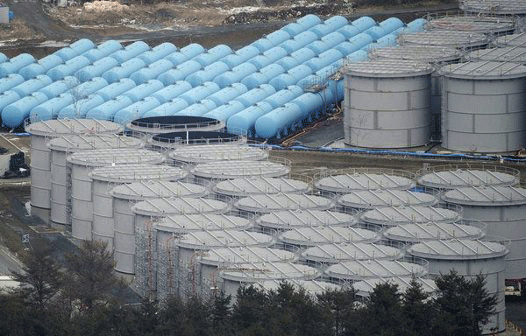
Late last night, Tepco said water leaking from the storage tank probably ran into the ocean, citing high radiation readings in a drainage ditch.
As much as 20 trillion becquerels of cesium and 10 trillion becquerels of strontium leaked into the ocean since May 2011, Tepco spokeswoman Mayumi Yoshida said today. The total amount of cesium and strontium is equivalent to about 100 times the annual limit on radiation from the plant to the ocean under normal conditions, according to calculations based on Tepco data……….
Leaking Tanks
Japan’s government has ordered an investigation into the safety of hundreds of other tanks storing contaminated water in Fukushima, the site of the world’s worst civilian nuclear disaster since the Chernobyl reactor exploded in 1986.
There are 226 tanks of similar bolted design to the leaking unit with the same 1,000-ton capacity at the site, said Tatsuya Shinkawa, director of the nuclear accident response office in the government’s Agency for Natural Resources and Energy, which called for the probe…… http://www.bloomberg.com/news/2013-08-21/tepco-shares-plunge-on-report-of-serious-radiated-water-leak.html
“Pockets” of radioactive seawater will impact USA’s West Coast
West Coast of North America to Be Hit Hard by Fukushima Radiation (Excellent maps and animation) http://www.globalresearch.ca/west-coast-of-north-america-to-be-hit-hard-by-fukushima-radiation/5346470 By Washington’s Blog Global Research, August 21, 2013
Radiation Levels Will Concentrate in Pockets In Baja California and Other West Coast Locations
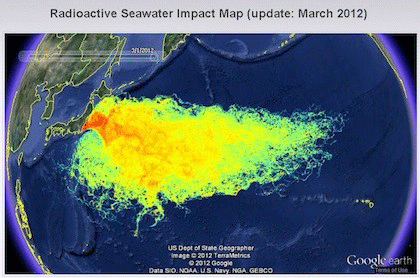
An ocean current called the North Pacific Gyre is bringing Japanese radiation to the West Coast of North America: While many people assume that the ocean will dilute the Fukushima radiation, a previously-secret 1955 U.S. government report concluded that the ocean may not adequately dilute radiation from nuclear accidents, and there could be “pockets” and “streams” of highly-concentrated radiation. Continue reading
Chris Busby explains impact of radioactive water on Fukushima coast
| Nevertheless, the sea-to-land effect is real. And anyone living within 1km of the coast to at least 200km north or south of Fukushima should get out. They should evacuate inland. It is not eating the fish and shellfish that gets you – it’s breathing.
|
Radiation contaminated food – over 6 million pounds found in South Korea
TV: Public concern over Japan fish imports “looks to be justified” — Contaminated seafood recently on sale in Korea adding to fears — Over 6 million pounds found since 3/11 — Strong backlash against gov’t http://enenews.com/tv-publics-concerns-over-japan-fish-imports-look-to-be-justified-contaminated-seafood-recently-on-sale-in-korea-over-6-million-pounds-found-since-311
Arirang News,, Aug 19, 2013: Consumer concerns about the safety of Japanese fish imports into Korea since the Fukushima nuclear disaster look to be justified as authorities here say over 3-thousand tonnes of fish from Japan have been found to contain levels of radioactive cesium since 2011. Korea’s Ministry of Food and Drug Safety on Sunday said there were 131 different cases in which fish containing traces of cesium were detected since March 2011. […] Cases peaked in 2012, but the amount has dropped sharply this year.
The Korea Herald, Aug 18, 2013: Government slammed over monitoring of Japanese seafood […] Seafood contaminated by radiation leaks from the Fukushima nuclear plant has been found in the local market recently, adding to public fears […] However, the food ministry was found not to have carried out additional inspections nor tightened return procedures […] While most products had below 10 becquerels of radiocesium (134Cs and 137Cs) per kilogram, some products showed up to 98 becquerels ― just two becquerels less than the level considered unsafe. […] The government’s stance has sparked strong public backlash. [Tepco] has recently confirmed long-held suspicions that the sea had been contaminated […]
After 2 years, Fukushima groundwater cesium levels now 8 times higher!
 Cesium levels in Fukushima water 8 times higher than after disaster Asahi Shimbun By SHUNSUKE KIMURA/ Staff Writer 16 Aug 13 Tokyo Electric Power Co. has reported finding radioactive cesium levels in underground water at the crippled Fukushima No. 1 nuclear power plant that is eight times greater than what it recorded right after the accident.
TEPCO, which operates the facility, said Aug. 15 that it detected 11,600 becquerels of radioactive cesium per liter of contaminated water in a tunnel near the No. 1 reactor building on the side facing the ocean.
That compares with 1,490 becquerels per liter it recorded at the site shortly after the accident in March 2011.
TEPCO said it believes the readings have soared due to rainwater containing cesium flowing into the tunnel. But the amount detected is roughly one-100,000th of that found in radioactive water in a tunnel near the No. 2 reactor building……http://ajw.asahi.com/article/0311disaster/fukushima/AJ201308160041
Japan’s costly nuclear radiation cleanup may not work
The mushrooms that used to provide a livelihood for foragers are now steeped in dangerous levels of caesium
Nothing on the same scale had ever been attempted before. After the Chernobyl accident in 1986, highly contaminated houses were entombed in concrete and the surrounding area was abandoned.
By contrast, Japan’s government is attempting to bring background radiation levels [down]
“Decontamination in the true sense of the word is not being carried out,” ”I think the government recognises that Fukushima cannot be returned to how it was.”
INSIGHT – JAPAN’S NUCLEAR CLEAN-UP: COSTLY, COMPLEX AND AT RISK OF FAILING YAHOO 7 NEWS, 15 AUG 13 BY SOPHIE KNIGHT KAWAUCHI, Japan (Reuters) – The most ambitious radiation clean-up ever attempted has proved costly, complex and time-consuming since the Japanese government began it more than two years in the wake of the Fukushima nuclear meltdown. It may also fail.
Doubts are mounting that the effort to decontaminate hotspots in an area the size of Connecticut will succeed in its ultimate aim – luring more than 100,000 nuclear evacuees back home.
If thousands of former residents cannot or will not return, parts of the farming and fishing region could remain an abandoned wilderness for decades. Continue reading
Regular radioactive releases into water, air are “normal” says nuclear industry
Radiological releases are an inevitable part of the nuclear power industry
“Dilution is not the solution to radioactive pollution,” “It rather guarantees a chronic exposure over years and decades to tritium, a known cause of cancer, birth defects and genetic damage, to all those who drink Lake Michigan water.”
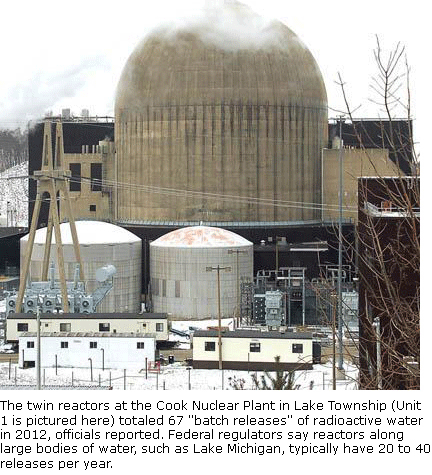 Release of nuclear plant ‘effluents’ into lake described as part of normal cycle Opinions differ on safety of practice Harbor Country News By Andrew Lersten July 17, 2013 COVERT — The May 5 release of about 80 gallons of slightly radioactive water from the Palisades nuclear power plant into Lake Michigan was unusual because it wasn’t planned.
But the incident brought into focus what many Southwest Michigan residents likely didn’t realize: The region’s two nuclear power plants (Palisades and the Donald C. Cook Plant in Lake Township) routinely discharge radioactive material into the air and into Lake Michigan.
In the nuclear industry, it’s called effluents. The federal Nuclear Regulatory Commission allows such releases, as long as they are closely monitored and do not exceed federal radiation release standards set in place by the NRC.
“Plants need to discharge small amounts of radioactive materials to operate,” said Jack Geissner, branch chief for the regional NRC office. Continue reading
US West Coast seafoods should be tested for radiation
Calls for US seafood testing after revelations of Fukushima radiation leaks http://japandailypress.com/calls-for-us-seafood-testing-after-revelations-of-fukushima-radiation-leaks-1633993/ AUGUST 16, 2013 by IDA TORRES NUCLEAR EXPERTS IN THE UNITED STATES ARE CALLING FOR TESTING OF SEAFOOD CAUGHT IN THE WEST COAST WATERS AS NEWS CAME OUT THAT THE FUKUSHIMA DAIICHI PLANT HAS BEEN LEAKING CONTAMINATED WATER INTO THE PACIFIC OCEAN FOR SOME TIME NOW. THE PLANT OPERATOR TOKYO ELECTRIC POWER ADMITTED LAST WEEK THAT EVERYDAY, 300 TONS OF WATER CONTAINING RADIOACTIVE MATERIALS HAVE BEEN SEEPING INTO THE OCEAN.
Dr. Arjun Makhijani, president of the Institute for Energy and Environmental Research, said that because the Pacific Oceanis such a large body of water, the contaminated water would have already been diluted by the time it reached the West Coast. But he acknowledges that no one knows up until now how contaminated the ocean has become and so a sampling of the US West Coast waters would be helpful, as well as a random sampling of seafood caught from that area.
The immediate concern though is for the people in Fukushima, particularly the fishermen, residents and cleanup crews, who are possibly directly affected by the leaks. There is fear that the spike in levels of strontium 90 which bio-concentrates in the bones of fish and algae. He said the accumulation effect of the radioactive strontium 90 could be extremely dangerous for a pregnant woman who has eaten or drank contaminated materials because the baby will be born with a weak immune system. Joseph Mangano, executive director of the nonprofit Radiation and Public Health Project, said that “a cocktail of more than 100 radioactive chemicals” from Fukushima can bring certain dangers when ingested through food or just breathing contaminated air. Health risks include birth defects and thyroid cancer.
1 This Month

Protect Sazan Island from the Trump family! https://secure.avaaz.org/campaign/en/protect_sazan_island_from_the_trump_family_loc/?bqFCVab&v=174511&cl=22707147157&_checksum=5e9dde668860e8231c33699735e16a1fbf22ab2cb01da50c999fe8732b9775ef&utm_source=email&utm_medium=blast_email&utm_campaign=174511


Cuba Is Not a Failed State – It Is a Besieged State
PETITION: “Global Appeal to Endorse Palestinian Right of Return of Refugees”
To see nuclear-related stories in greater depth and intensity – go to https://nuclearinformation.wordpress.com
-
Archives
- June 2026 (129)
- May 2026 (306)
- April 2026 (356)
- March 2026 (251)
- February 2026 (268)
- January 2026 (308)
- December 2025 (358)
- November 2025 (359)
- October 2025 (376)
- September 2025 (257)
- August 2025 (319)
- July 2025 (230)
-
Categories
- 1
- 1 NUCLEAR ISSUES
- business and costs
- climate change
- culture and arts
- ENERGY
- environment
- health
- history
- indigenous issues
- Legal
- marketing of nuclear
- media
- opposition to nuclear
- PERSONAL STORIES
- politics
- politics international
- Religion and ethics
- safety
- secrets,lies and civil liberties
- spinbuster
- technology
- Uranium
- wastes
- weapons and war
- Women
- 2 WORLD
- ACTION
- AFRICA
- Atrocities
- AUSTRALIA
- Christina's notes
- Christina's themes
- culture and arts
- Events
- Fuk 2022
- Fuk 2023
- Fukushima 2017
- Fukushima 2018
- fukushima 2019
- Fukushima 2020
- Fukushima 2021
- general
- global warming
- Humour (God we need it)
- Nuclear
- RARE EARTHS
- Reference
- resources – print
- Resources -audiovicual
- Weekly Newsletter
- World
- World Nuclear
- YouTube
-
RSS
Entries RSS
Comments RSS
 nuclear-news