The unsolved problem of radioactive water leaks
If nuclear energy is so safe, why is the industry incapable of dealing with the relative simple plumbing issue of water leaks?
Secondly, if the NPP by-products are so safe, why does every government in the world go to such strenuous efforts to contain them even while assuring their populaces that there’s no risk?
 Fukushima isn’t the only nuclear plant leaking radioactive water Christian Scence Monitor, 12 Aug 13 Fukushima Daiichi Nuclear Power Plant continues to leak contaminated water into the Pacific Ocean, but it’s not the only nuclear plant suffering from radioactive water issues. Taiwan’s First Nuclear Power Plant and the Plutonium Finishing Plant in Hanford, Wash., join Fukushima in grappling with leaking waste water.
Unfortunately, that reliance can also prove to be a liability. By John C.K. Daly, August 13, 2013
Water is an essential ingredient for the operation of most nuclear power plants, from providing the liquid that is flashed to steam to drive turbines to providing coolant for storage of spent fuel. In most NPPs, water is drawn from nearby rivers or from the ocean…… Continue reading
Heat pollution of Connecticut River from Vermont Yankee Nuclear Power Plant
 NRC to probe Entergy’s nuclear plant finances Rutland Herald, By Susan Smallheer Staff Writer | August 11,2013 HINSDALE, N.H. ”……….Saturday’s protest was designed to bring public attention to the fact that Vermont Yankee daily dumps 200 million gallons of “hot” water into the Connecticut River to save money by not running its cooling towers.
Dr. Andrew Larkin, a retired internist from Northampton, Mass., said the Connecticut River was 10 degrees warmer near the plant’s discharge than other spots in the river he tested.
“The heated water coming from the reactor confused us, but still we persisted,” Schakman said, adding that only one in 10 shad get past all the dams on the Connecticut River, “only to be cooked by the reactor.” “We have lost so many, now we are down to a few, but still we persist,” he said.
This is the second year that the SAGE Alliance, a coalition of antinuclear groups, has organized the flotilla to focus public attention on the water discharge. About two dozen kayaks and canoes took to the water, with an equal number of people on shore to protest the daily discharge of warm water. Some people wrote messages to Entergy on cedar shingles and set them floating on the river.
“No nuclear accidents. All it takes is one,” wrote Elo-Mai Noormets of Westminster, Vt.
“Peace and health to this river,” wrote Leslie Sullivan Sachs of Brattleboro, Vt. http://rutlandherald.com/article/20130811/THISJUSTIN/708119973
VIDEO: Strontium 90 at high levels in Fukushima’s uncontrolled water leak
 the unfortunate thing about strontium especially is that it bioaccumulates in algae, it bioaccumulates in fish. It targets the bone, because it’s like calcium.
the government is trying to shore up its decision to support restarting nuclear reactors by showing some kind of commitment to preventing this disaster from
getting too much worse………
 VIDEO: Fukushima Reinforces Worst Fears for Japanese Who Are Anti-Nuclear Power
http://www.pbs.org/newshour/bb/world/july-dec13/japan2_08-08.html
How are the Japanese people reacting to the news of the continuing contamination leak and what does it mean for Japan’s energy policy? Jeffrey Brown talks with Arjun Makhijani of the Institute for Energy
and Environmental Research and Kenji Kushida of Stanford University
about what the government may do to stop the flow.
“……..ARJUN MAKHIJANI, Institute for Energy and Environmental Research: So there are a couple of different problems. One of the problems is what they have found in the groundwater and what actually
is there.
So, so far, we have been concerned about an element called cesium, cesium 137 and 134, which is radioactive. But now they have found strontium-90, which is much more dangerous, at levels that are 30
times more than cesium. So to give you an idea of the level of contamination, if somebody drank that water for a year, they would almost certainly get cancer. So it’s very contaminated.
So that’s one problem. The other is the defenses to hold back this water from the sea seem to be overcome. So now the contaminated waters, 70,000, 80,000 gallons is flowing into the sea every day.
JEFFREY BROWN: And do we know how far out to sea this contaminated water is going and what happens to it when it goes into the sea? Continue reading
Chernobyl’s trees show radiation damage
 Chernobyl’s legacy recorded in trees By Mark Kinver Environment reporter, BBC News Exposure to radiation from the 1986 Chernobyl accident had a lasting negative legacy on the area’s trees, a study has suggested.
Researchers said the worst effects were recorded in the “first few years” but surviving trees were left vulnerable to environmental stress, such as drought.
They added that young trees appeared to be particularly affected.
Writing in the journal Trees, the team said it was the first study to look at the impact at a landscape scale.
“Our field results were consistent with previous findings that were based on much smaller sample sizes,” explained co-author Tim Mousseau from the University of South Carolina, US.
“They are also consistent with the many reports of genetic impacts to these trees,” he told BBC News.
“Many of the trees show highly abnormal growth forms reflecting the effects of mutations and cell death resulting from radiation exposure.”…… Prof Mousseau and his team hope to follow up this study by carrying out similar work in the Fukushima region in Japan, where logging also had considerable economic importance and pine trees were widely dispersed. http://www.bbc.co.uk/news/science-environment-23619870
Water discharge permit may lead to closure of Indian Point Nuclear Power Plant
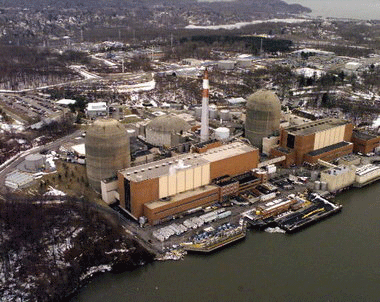 Indian Point may close if Entergy loses water-use permit Company proposes new screen-filtering system, LOHUD.com Aug. 6, 2013 The future of the Indian Point nuclear power plant may rest on the bottom of the Hudson River. That is where plant owner Entergy Nuclear wants to install a new technology
 to filter the water needed to cool the plant’s reactors. The technology is Entergy’s attempt to get a water-use permit from the state, without which it could no longer operate Indian Point.
The environmental group Riverkeeper said Entergy isn’t likely to get the state permission it needs to build anything on the river bottom — an assessment with which the utility company disagrees……..The DEC in 2010 ruled the plant’s daily use of 2.5 billion gallons of river water harmed fish populations and the river’s ecosystem. It denied Entergy the water-use permits. Without them, Entergy can’t renew the plant’s licenses for another 20 years, said Neil Sheehan, a Nuclear Regulatory Commission spokesman. The licenses expire this year and in 2015.
“A final decision by the NRC in favor of the (renewal) application is contingent upon, among other things, successful resolution of the water discharge permit issue at the state level,” Sheehan said.
Entergy has balked at building closed-cycle towers, contending they are too expensive and too massive. Entergy has estimated the towers would cost about $1 billion, approximately 10 times as much as the wire screen technology. http://www.lohud.com/article/20130806/NEWS/308060066
Japan’s desperate battle to contain Fukushima’s radioactive water
Japan Nuclear Plant’s Battle to Contain Radioactive Water Tepco Builds Sunken Barrier to Ring-Fence Site, but Water May Have Already Overtopped Wall WSJ, 6 Aug 13, by MARI IWATA and PHRED DVORAK
To stem the advance of radioactive water to the sea, the operator of the stricken Fukushima Daiichi nuclear power plant has tried plugs, walls, pumps and chemicals that harden the ground into a solid barrier.
But as Tokyo Electric Power Co. 9501.TO +3.26% prepares this week to start work on a new set of measures that would ring off and cap the area where the most highly contaminated water has been found, some experts and regulators are saying that the battle to completely contain radioactivity to the site of one of the world’s worst nuclear accidents may be a losing one.
In the most recent example of Tepco’s Sisyphean struggle, the company said late last week that rising levels of contaminated groundwater may have already overtopped a sunken barrier that the utility started only a month ago, and wasn’t even expecting to complete until late this week. Tepco’s water-control measures, such as pumping out contaminated water and putting it in storage, are “merely a temporary solution,” said Shunichi Tanaka, chairman of Japan’s Nuclear Regulation Authority, at a news conference last week. Eventually, “it will be necessary to discharge water” that’s still contaminated into the sea, he said…..
Controlling contaminated water has been a struggle at Fukushima Daiichi ever since the March 2011 earthquake and tsunami knocked out the power at the plant and sent its three active reactors spiraling out of control. Some 400 metric tons of water a day is still being used to cool the melted fuel cores—though much of that water is now recycled. More troubling is another 400 tons a day of groundwater that flows down from hills and mountains into the compound, and toward the sea.
For the past two years, Tepco has been trying to keep the contamination contained by pumping accumulated water out of the highly radioactive reactor buildings, and storing it in tanks on the plant grounds. But the company’s efforts went into overdrive a few months ago, when it found that groundwater sampled near the crippled reactors was showing spiking levels of radioactive elements. It was unclear why. What’s more, Tepco said that the water was likely leaking into the sea.
The continuing problems at the reactor site, including the company’s lack of transparency over the radioactive leaks, have drawn criticism from Japanese regulators….http://online.wsj.com/article/SB10001424127887323420604578651713545887032.html
Japan’s emergency experimental methods to stem flow of radioactive water
J apan Nuclear Plant’s Battle to Contain Radioactive Water Tepco Builds Sunken Barrier to Ring-Fence Site, but Water May Have Already Overtopped Wall WSJ, 6 Aug 13, by MARI IWATA and PHRED DVORAK “…………As an emergency measure, Tepco last month started to inject the ground near the coast with chemicals that hardened it into an underground barrier. But since then, groundwater levels in the area have risen faster, as they hit the barrier. Recently, Tepco has found that the groundwater has risen to around a meter below the surface—already above the level of the underground barrier, which starts 1.8 meters down.Now, Tepco is planning to pump out some of the water that’s built up behind the barrier, and store it as well. It’s preparing to extend the underground hardened-earth barrier in a ring around the most heavily contaminated section of coastline, in hopes of heading groundwater off before it can flood in. Tepco is also proposing to cap that ringed section with gravel and asphalt, so nothing gets out. The operator is hoping to get an initial ring of hardened ground done by October.
The company has some other more experimental ideas on the table as well. One involves surrounding the contaminated reactor buildings with a shield of frozen soil.
But there’s a risk to changing the flow of groundwater in the ways that Tepco is considering, said Tatsuya Shinkawa, nuclear accident response director of the Ministry of Economy, Trade and Industry, at a news conference last month. The water could pool dangerously underground, softening the earth and potentially toppling the reactor buildings, he said. Tepco should also try things like using robots to fix cracks in the reactor buildings where the water is likely seeping through.
Freezing soil has its own problems, said Kunio Watanabe, a geology professor at Saitama University. The technology, which is used in civil engineering to dig tunnels, may be able to cut down the amount of groundwater entering the contaminated site, but it is expensive. “You’ll need hundreds of millions of yen to build a system,” Mr. Watanabe said. “You’ll also need a large amount of electricity to maintain the ice walls.”….. http://online.wsj.com/article/SB10001424127887323420604578651713545887032.html
Scotland’s Moray dunelands to be tested for radioactivity
Testing begins on possible Moray radiation sites
http://www.scotsman.com/news/environment/testing-begins-on-possible-moray-radiation-sites-1-3031685 by ALISTAIR MUNRO 06 August 2013 TESTING has begun on potential radiation contamination at sand dunes in Moray where hundreds of aircraft were dismantled during World War
Two.
Environmental protection officers will be digging a series of test pits at Findhorn dunelands, next to the former RAF base at Kinloss. It was revealed last year that a stretch of the sand dunes had been
used to dismantle more than 1,000 aircraft following the war.
It is believed parts were disposed of in the area, including instruments with radioactive luminous paint.
The investigation is being carried out by staff at Moray Council contaminated land section and the Scottish Environmental Protection Agency.
The authorities believe the residue could pose a potential risk tohuman health and the environment.The land is no longer owned by the Ministry of Defence, but is one of nine sites in Scotland thought to be contaminated.
A Moray Council spokesman said: “Geophysical surveys of the area have
already detected the presence of material which experts believe is
worthy of further investigation.
“Staff expect to be on site for four or five days and will wear
protective clothing as a precaution.
“The investigation will entail excavating a number of shallow pits
based on information obtained from geophysical surveys of the area.”
Up to 40 trillion becquerels of tritium in the sea, from Fukushima
 Japan learns extent of nuclear leakage, news.com.au AAP August 04, 2013 THE operator of Japan’s crippled Fukushima nuclear plant has given its first public estimate of the size of the leakage of radioactive tritium into the Pacific Ocean since the disaster.
Between 20 trillion to 40 trillion becquerels of the substance is estimated to have leaked into the sea since May 2011, said Tokyo Electric Power Co (TEPCO). It was the first such figure TEPCO has released since a massive tsunami led to the accident in March 2011, a spokesman said Sunday…..
http://www.news.com.au/breaking-news/world/japan-learns-extent-of-nuclear-leakage/story-e6frfkui-1226691042588#ixzz2b7p2HHZg
Strange highly radioactive objects found on Fukushima coast
 TEPCO sources said they were considering asking an outside agency to conduct a detailed analysis, citing limitations on what the utility could investigate
Mystery objects with high radiation found on Fukushima coast Asahi Shimbun, By SHUNSUKE KIMURA/ Staff Writer August 03, 2013 In a coastal area long silent due to the Fukushima nuclear accident, the only sounds of human activity on June 18 were from workers removing rubble and continuing their decontamination efforts. But soon, their supervisor discovered something that broke up the monotony of the work and added to the eeriness of the atmosphere.
After a call to the Environment Ministry, Takeshi Kato, 55, a ministry specialist, immediately headed to the location about 15 kilometers south of the crippled Fukushima No. 1 nuclear power plant.
As he slowly walked around with a dosimeter, he reached a hot spot where radiation levels nearly doubled those of the surrounding areas. Using a fallen branch to clear away dirt, Kato uncovered a grayish pile about 3 centimeters long, about 1.5 cm wide and about 0.5 cm thick.
The surface of the pile, which looked like soil, had gamma ray readings of about 85 microsieverts per hour. The total reading, including beta rays, came to 1 millisievert per hour.
It was the first of four mysterious objects with high radiation levels found near the mouth of the Idegawa river in Naraha, Fukushima Prefecture. Continue reading
Tim Deere-Jones analyses UK government’s monitoring of marine radiation

On the basis of this review it’s my conclusion that the current programme for monitoring doses of marine derived radioactivity in food lacks the appropriate scientific rigour. It is not fit for current purpose because, owing to the weaknesses described above, it cannot provide sufficiently detailed data to justify the FSA claim that there is a “low risk from radioactivity in food” and that “no food safety risks have been identified”.

 UK government failing to protect population from potentially radioactive food
  http://www.theecologist.org/News/news_analysis/1915331/uk_government_failing_to_protect_population_from_potentially_radioactive_food.html by Tim Deere-Jones 25 July 13, Tim Deere-Jones dissects the UK Government’s system for monitoring doses of marine derived radioactivity in food and concludes that the current programme is deeply flawed.
2013 has seen a major surge in the potential for expansion of UK nuclear power. In February, the Environment Agency (EA) found no objection to the discharge and disposal of radioactive wastes from a proposed nuclear power station with two CPWRs (contained pressurised water reactors) at Hinkley Point on the Somerset coast. It stated that the discharge of gaseous and liquid wastes to the marine environment and atmosphere of the Bristol Channel could proceed.
One month later the UK Government granted permission for the construction of the Hinkley CPWR, paving the way for a three-fold increase in the amount of some radio nuclides discharged to sea and also for the rolling out of planning permissions for another eight stations holding two or three reactors each.
In the same period, the Food Standards Agency (FSA), responsible for monitoring radioactivity in food, stated that, since “an annual monitoring programme has been in place for more than 25 years and no food safety risks have been identified during this period”, it now proposed to “optimise” the monitoring of radioactivity in food by reducing the scope and volume of its annual environmental monitoring and analysis programmes.
The FSA risk estimate for marine radioactivity is based on the outcome of assessment modelling of dietary dose, received from a range of foodstuffs thought to be representative of dietary exposure pathways. Here follows my review of the data inputs quality, upon which such modelling relies for its accuracy and relevance. Continue reading
Richard Wilcox’s personal journey to Fukushima’s irradiated “dead zone”
We also spotted many suspicious looking flowers and other forms of vegetation. According to Yoichi, radiation has affected some flowers in the nuclear zone to go haywire and outgrow their natural size (a
topic for future research). Yoichi noted that radiation affects different plants differently, some are hardy and not affected; others, especially flowers may receive small doses but have big results in terms of mutations.
Below: Yoichi indicates the normal height of this flower compared to this giant version

We already know that the biologist and expert on mutagenetic affects, Tim Mosseau, has shown that in Fukushima prefecture a variety of insects and other species have been affected (1).
My Trip To The Fukushima Nuclear Disaster Zone http://rense.com/general96/trip.html
(Part One) By Richard Wilcox Ph.D. 7-26-13 On July 20, 2013 Yoichi Shimatsu and I departed from Ueno station in Tokyo to visit the Fukushima nuclear disaster region and see what we
could see…..
Undoubtedly Japan’s countryside regions have suffered from brain drain and thus the numbers of passengers do not justify the number of trains. After the Fukushima disaster many people moved out of the immediate area and this has reduced the need for trains.
Beyond that fact, Yoichi speculates that the Japanese government does not want people going up there to snoop around, Fukushima is now a DEAD ZONE and off limits. Indeed it is, even while they are urging
some people to move back in. Families that moved out of the immediate area of the nuclear disaster may now live in safer zones to the south, but they are forced to train their kids back to their original schools during the daytime, if that is where their family property is registered. Continue reading
American Medical Association (AMA) warns on seafood radiation danger
 The AMA Responds to Radiation in Seafood, FFAN Urges FDA to Act Now July 24, 2013 by Kim Roberson
Food Safety Group Applauds Recent American Medical Association (AMA)Recommendation to Test U.S. Seafood for Radiation
FFAN urges responsible, transparent testing guidelines and national database for seafood radiation. Wants results to be made public.
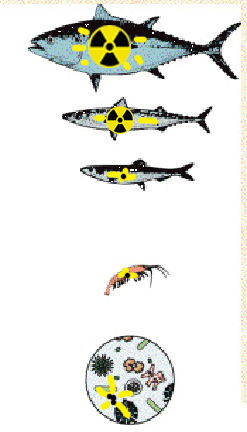
Fukushima Fallout Awareness Network (FFAN) today applauded the recent American Medical Association (AMA) resolution that calls on the U.S. government to test all U.S.seafood for radiation and fully report the results to the public. The AMA joins FFAN in demanding the public’s ‘Right to Know’ regarding radiation levels in food. The California Medical Association (CMA) initiated the resolution. Continue reading
Fukushima radiation contaminating the marine food chain
Japan Times: ‘Fears marine life is being poisoned’ by nuclear material flowing from Fukushima — Experts warn of ‘festering radioactive sore’ contaminating food chain — Tepco flip-flop ‘shocking’ http://enenews.com/japan-times-fears-marine-life-is-being-poisoned-by-nuclear-material-flowing-from-fukushima-experts-warn-of-festering-radioactive-sore-contaminating-food-chain-tepco-flip-flop-shocking
Title: Tepco now admits radioactive water entering the sea at Fukushima No.1
Source: AFP-JIJI
Date: July 22, 2013
Fisheries exec shocked by utility’s flip-flop on groundwater’s flow
Fukushima nuclear plant operator Tepco on Monday admitted for the first time that radioactive groundwater is flowing into the sea, fueling fears that marine life is being poisoned. […]
Tetsu Nozaki, chairman of Fukushima Prefectural Federation of Fisheries Co-operative Associations, voiced deep concern.
“It was quite shocking,” he told NHK. “(Tepco’s) explanation is totally different from the one in the past.”
Environmental experts warn that the festering radioactive sore could contaminate the food chain by tainting marine life and ultimately, the humans who eat it. […]
See also: NYT: Fukushima plant leaking for past 2 years? Japan Times: Groundwater is reaching sea — Reuters: Growing alarm, problems mounting — Official: If you have solutions, we’d like to know — WSJ: No ‘immediate’ health threat
All British children have plutonium in their teeth, from Sellafield nuclear plant
 Plutonium from Sellafield in all children’s teeth Antony Barnett, public affairs editor The Guardian 30 November 2003 Government admits plant is the source of contamination but says risk is ‘minute’ Radioactive pollution from the Sellafield nuclear plant in Cumbria has led to children’s teeth across Britain being contaminated with plutonium.
The Government has admitted for the first time that Sellafield ‘is a source of plutonium contamination’ across the country. Public Health Minister Melanie Johnson has revealed that a study funded by the Department of Health discovered that the closer a child lived to Sellafield, the higher the levels of plutonium found in their teeth. Continue reading
1 This Month

Protect Sazan Island from the Trump family! https://secure.avaaz.org/campaign/en/protect_sazan_island_from_the_trump_family_loc/?bqFCVab&v=174511&cl=22707147157&_checksum=5e9dde668860e8231c33699735e16a1fbf22ab2cb01da50c999fe8732b9775ef&utm_source=email&utm_medium=blast_email&utm_campaign=174511


Cuba Is Not a Failed State – It Is a Besieged State
PETITION: “Global Appeal to Endorse Palestinian Right of Return of Refugees”
To see nuclear-related stories in greater depth and intensity – go to https://nuclearinformation.wordpress.com
-
Archives
- June 2026 (129)
- May 2026 (306)
- April 2026 (356)
- March 2026 (251)
- February 2026 (268)
- January 2026 (308)
- December 2025 (358)
- November 2025 (359)
- October 2025 (376)
- September 2025 (257)
- August 2025 (319)
- July 2025 (230)
-
Categories
- 1
- 1 NUCLEAR ISSUES
- business and costs
- climate change
- culture and arts
- ENERGY
- environment
- health
- history
- indigenous issues
- Legal
- marketing of nuclear
- media
- opposition to nuclear
- PERSONAL STORIES
- politics
- politics international
- Religion and ethics
- safety
- secrets,lies and civil liberties
- spinbuster
- technology
- Uranium
- wastes
- weapons and war
- Women
- 2 WORLD
- ACTION
- AFRICA
- Atrocities
- AUSTRALIA
- Christina's notes
- Christina's themes
- culture and arts
- Events
- Fuk 2022
- Fuk 2023
- Fukushima 2017
- Fukushima 2018
- fukushima 2019
- Fukushima 2020
- Fukushima 2021
- general
- global warming
- Humour (God we need it)
- Nuclear
- RARE EARTHS
- Reference
- resources – print
- Resources -audiovicual
- Weekly Newsletter
- World
- World Nuclear
- YouTube
-
RSS
Entries RSS
Comments RSS
 nuclear-news