Water conscious Utah residents oppose nuclear power plant in Emery County
 Utah’s first nuclear plant on hold over trial for water rights
The lawsuit, filed in 2012, was brought by multiple groups hoping to kill plans for a proposed twin-reactor nuclear power plant in Emery County.
HEAL Utah and others want 7th District Judge George Harmond to rule illegal the Utah state engineer’s decision granting 53,600 acre-feet of water to the project.
Aaron Tilton’s Blue Castle Holdings is proposing to take the water from the Green River for use in the cooling process at the proposed plant, which would be located near the city of Green River in Emery County and generate 3,000 megawatts of electricity.
The groups challenging Tilton’s acquisition of the water assert that state engineer Kent Jones should have done much more in reviewing the water rights applications, including a demonstration that the water for the project won’t interfere with other water rights or harm the fragile Green River ecosystem……..
HEAL Utah and Uranium Watch are joined by 16 other plaintiffs, including the Utah Rivers Council, Living Rivers and the Center for Water Advocacy. Others include businesses that depend on the Green River such as Moki Mac River Expeditions and Holiday River Expeditions, and several residents from Green River, Moab and Salt Lake City……..http://www.ksl.com/index.php?nid=148&sid=26970736&fm=most_popular
Kazakhstan’s idea to grow food on plutonium contaminated land
 “Opening the land for grazing and other land use will be an unforgiveable mistake,” said Leonid Rikhvanov, a professor at Russia’s Tomsk Polytechnic University, in a 2010 interview with the Telegraph. “If the plutonium gets into the biological chain it could cause a cytogenetic catastrophe that will backfire on the health of our children and grandchildren.” Many people living near Semipalatinsk feel similarly
But in this poisoned place, on a small patch of land near a few downtrodden trailers, there’s an unexpected hint of vitality: bright yellow sunflowers, clustered together near rows of corn, and a barn full of plump sheep. Here, scientists from Kazakhstan’s Institute of Radiation Safety and Ecology, a governmental organization that studies the medical and biological interaction between radioactivity and the environment, have developed an experimental farm. Their goal is to measure the transference of radioactivity from contaminated soil into edible crops, and from those crops into the meat, milk, and eggs of the animals that eat them. Continue reading
Radioactive cesium in wastes found 500 km from Fukushima near great lake
 ‘Extremely Malicious’: Hundreds of tons of radioactive waste found over 500 kilometers from Fukushima near Japan’s biggest lake http://enenews.com/extremely-malicious-hundreds-of-tons-of-radioactive-waste-found-near-japans-biggest-lake-over-500-kilometers-from-fukushima
Title: Tons of cesium-tainted wood chips found near Japan’s biggest lake
Source: Kyodo
Tons of cesium-tainted wood chips found near Japan’s biggest lake
Radioactive cesium has been found on an estimated 200 to 300 tons of wood chips that were left months ago near Lake Biwa in Shiga Prefecture, prefectural officials said.
Samples of the chips show a reading of up to 3,000 becquerels per kilogram, the officials said Tuesday. […]
The Shiga government started an investigation to determine where the chips came from. They were found in the dry bed of the Kamo River in Takashima and other locations near the lake, officials said. […]
“The site is an estuary leading to Lake Biwa, and leaving (the chips) there without permission is extremely malicious. We will deal with the matter strictly,” Gov. Yukiko Kada said.
Cloud of radioactive iodine reaches France, from Fukushima
 Fukushima Doom Confirmed? France Hit By Iodine-131 Cloud While New Radiation Plume Expected To Hit West Coast Of America On Tuesday http://revolutionradio.org/?p=58394, September 22, 2013 By Paul Martin A cloud of Iodine-131 has reached France while the recent 5.3 Fukushima earthquake is sending a new radiation plume around the world according to a recent story from Bobby1′sBlog. This latest plume is expected to arrive on the West Coast of America on Tuesday, September 24th. With radiation now spreading across the entire Northern hemisphere and no end in sight, are we reaching the ‘beginning of the end’? Two videos below confirm the severity of this ongoing doomsday situation.
An earthquake that rocked Japan just south of the Fukushima area shortly after midnight on September 20 (Japan time) sent a new plume of radiation across the Pacific Ocean. Apparently radiation measurements in this area have temporarily spiked.
This new plume would arrive on the west coast around Tuesday, Sept. 24. Previous earthquakes have also generated plumes. I remember that the one that arrived after the Jan. 1, 2012 quake was really nasty.
In a previous discussion Iodine-131 from latest criticality it was noted that the iodine spike in Chiba prefecture sludge was deposited in the period August 7 through August 20. According to CRIIRAD, Montélimar, France had spikes in alpha and beta atmospheric radiation on September 4-7. Rhône river water in Avignon showed a spike in iodine-131 on Sept. 7. The iodine cloud must have widened and dispersed quite a bit in its journey across the northern hemisphere… and 75% or more of it would have decayed by the time it reached France. So it must have been quite a substantial radioactive cloud.
Fukushima not only affects Japan, but the Pacific ocean, North America, and Europe too. Australia has had average radiation levels increase substantially, also.
Costly clean-up not likely to make Fukushima area habitable again
Return to the radiation zone: Fukushima clean-up operation mired in fear and misinformation Two years after Japan’s nuclear power plant disaster nobody knows for certain how dangerous the contamination is THE INDEPENDENT DAVID MCNEILL  , MIGUEL QUINTANA FUKUSHIMA WEDNESDAY 11 SEPTEMBER 2013″……..Nobody knows for certain how dangerous the radiation is. Japan’s central government refined its policy in December 2011, defining evacuation zones as “areas where cumulative dose levels might reach 20 millisieverts per year [20 mSv/yr],” the typical worldwide limit for nuclear power plant engineers and other radiation workers.
The worst radiation is supposed to be confined to the 20km exclusion zone, but it spread unevenly: less than 5km north of the Daiichi plant, our Geiger counter shows less than 5 millisieverts a year; 40km north west, in parts of Iitate village, it is well over 120 millisieverts. Those 160,000 refugees have not returned and are scattered throughout Japan. The nuclear diaspora is swelled by thousands of voluntary refugees who, unlike the Saitos, have not returned. Local governments are spending millions of dollars to persuade them back. Continue reading
Cataracts in the eyes of birds in Chernobyl and Fukushima
the key factor determining the presence of the disease was the intensity of local radiation, with cataract scores of over one proving to be far more common in areas that were above ten microseiverts per hour
Birds live with cataracts in Chernobyl The Economist, Sep 7th 2013 CATARACTS are relatively common in people who live to a ripe old age. They are sometimes seen in animals that live in zoos as well, but in the wild they are almost unheard of. The reason is simple. Losing eyesight is in effect a death sentence for a wild animal that must find its own food and, should that animal live long enough to develop the disease, starvation or predation would quickly follow|cataracts unrelated to age are surprisingly common in birds living near the site of the Chernobyl nuclear disaster in 1986.
This is revealed in a new study by a pair of ornithologists, Timothy Mousseau of the University of South Carolina and Anders Moller of the University of Paris-Sud, which is published in the Public Library of Science. That cataracts and ionising radiation are related is well known. As high energy ions, usually produced by the sun’s rays, slam into the water found next to the lenses of the eyes, free radicals are created that damage DNA and cause errors to develop in the formation of proteins that make up the lenses, resulting in cataracts.
This led the researchers to suspect that cataracts in birds might be common in areas where there are high levels of ionising radiation, and they turned to Chernobyl as a study area. Continue reading
Japan’s radioactive leaks to Pacific Ocean make it imperative to get international help
Nuclear error Japan should bring in international help to study and mitigate the Fukushima crisis. Nature, 03 September 2013 The radioactive water leaking from the site of the wrecked Fukushima Daiichi nuclear power plant in Japan is a stern reminder that we have not seen the end of the world’s largest nuclear crisis since the Chernobyl meltdown in Ukraine in 1986……..
The most important impacts of the leaks will be those on the sea off Fukushima and the larger Pacific Ocean, which must be closely monitored. After assessments by US and Japanese scientists in 2011 and 2012, two major questions remain unanswered. How much radioactivity is still entering the sea? And, given the high levels of radioactivity that have been measured in some species long after the accident, when will fish and seafood from the region be safe to consume? The leaks make it more urgent to find answers to these questions.
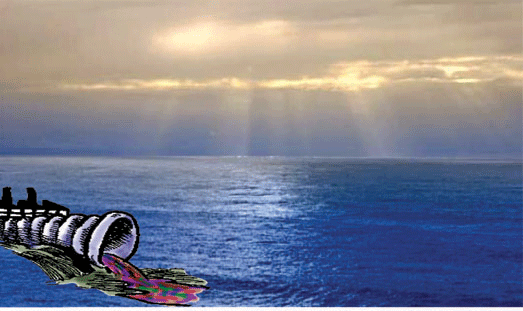
To make reliable assessments of any environmental effects, scientists need to be able to collect data on contamination of marine food webs with all long-lived radionuclides, and particularly with caesium-137, strontium-90 and plutonium-239. They also need to know the sources of contamination, and to study the transport of radionuclides in groundwater, sediments and ocean currents. Current Japanese Prime Minister Shinzo Abe and his government have promised to boost science; they should encourage and support researchers from around the world in collecting and sharing information. Chernobyl was a missed opportunity for post-accident research — in that sense at least, Fukushima could do much better. http://www.nature.com/news/nuclear-error-1.13667
Pacific Ocean – a handy drain for Fukushma’s radioactive trash
Use sea as nuclear sink, says Tokyo http://www.theaustralian.com.au/news/world/use-sea-as-nuclear-sink-says-tokyo/story-fnb1brze-1226709319491 BY:RICK WALLACE, TOKYO CORRESPONDENT September 03, 2013 THE head of Japan’s nuclear watchdog has flagged dumping contaminated water from the Fukushima Daiichi nuclear power plant into the Pacific Ocean amid mounting woes over storage and seepage of radioactive water.
But Nuclear Regulation Authority chairman Shunichi Tanaka said any water released would be treated to an extent that the level of contaminants was well below international limits.
“If (the situation) becomes more severe, and some water falls below regulatory limits, it might have to be discharged into the ocean,” he said yesterday in a speech to the Foreign Correspondents’ Club of Japan in Tokyo.
“I know this (previously) created a great stir in some circles. However, I will absolutely not support the dumping of water where the level of contamination is above the limits.”
Mr Tanaka said properly functioning nuclear plants dumped contaminated water into the ocean as part of normal operations, provided it met the limits.
But any discharge of water – irrespective of the level of decontamination carried out – is likely to spark outrage from environmentalists, fishing operators and neighbouring countries. Continue reading
Tourists unaware of radiation danger on the Great Plains
America’s Chernobyl: Radioactive Dust Near Mt. Rushmore & Black Hills http://indiancountrytodaymedianetwork.com/2013/09/02/americas-chernobyl-results-uranium-mining-great-plains-151091 ICTMN Staff September 02, 2013
In this video Charmaine White Face, a member of the Oglala band of the Great Sioux Nation, explains uranium mining and its health effects on the people of the Great Plains.
She explains about the 1868 Fort Laramie Treaty and where the abandoned open pit uranium mines are—a total of 3,272 in the states of Montana, Wyoming, North Dakota, South Dakota and Colorado she says.
“The thing about the Darrow Pit Mine is they are only about 40 miles from Mount Rushmore, millions of tourists travel to Mount Rushmore every year not knowing that they are breathing in radioactive dust and the water that they drink in the motels in Rapid City contains uranium,” White Face says.
She also discusses the Riley Pass mine and a warning sign that’s posted warning people to not stay for more than one day within a one-year period. It also says “NO CAMPING.”
White Face goes on to discuss how cancer rates for Native American people in the Northern Great Plains are higher than anyone in the country.
“When we’re standing by that sacred site praying, we’re breathing in a lot of these harmful materials,” she says.
White Face and those working with her asDefenders of the Black Hillshave started calling it America’s Chernobyl because as Dr. K. Kearfott, a nuclear physics professor at the University of Michigan, said: “The radiation levels in parts I visited with my students were higher than those in the evacuated zones around the Fukushima nuclear disaster…”
Massive radioactive water collection grows, Japan’s government paralysed on this issue
Tepco has yet to decide how to dispose of the contaminated water, spokeswoman Mayumi Yoshida said. But before it can act it will need approval from the government, residents and fishermen, who are already suspicious of the company’s motives.
Fukushima’s toxic water pool grows as Tepco dithers http://www.smh.com.au/world/fukushimas-toxic-water-pool-grows-as-tepco-dithers-20130830-2svvn.html#ixzz2dncD1B4t August 31, 2013 Yuriy Humber The Tokyo Electric Power Company is trying to decide what to do with the largest pool of radioactive water in the history of nuclear accidents. It can either dump it in the ocean, let it evaporate into the air, or both.
The more than 330,000 tonnes of water with varying levels of toxicity is stored in pits, basements and hundreds of tanks at the wrecked Fukushima nuclear plant.
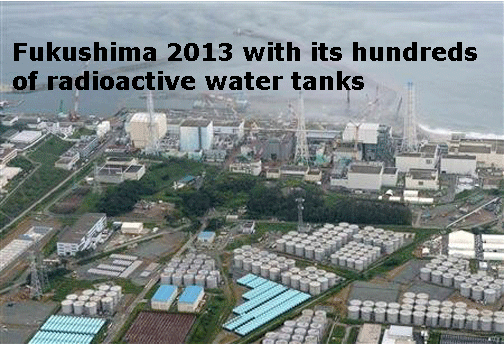
The government said this week it would take a bigger role in trying to staunch the toxic outflow that has grown to 40 times the volume accumulated in the atomic disaster at Three Mile Island in the US.
Processing and disposing of the water – enough to fill a large crude oil tanker or 132 Olympic-size swimming pools – is presenting one of the most challenging engineering tasks of our generation, former nuclear engineer Michael Friedlander said. Continue reading
Mysterious white spots on Fukushima cows – ignored by government
TV: Mystery spots on Fukushima cows ignored by gov’t — Veterinarian: It’s extremely important, Japan has to think of what to do with this problem (VIDEO) http://enenews.com/tv-mysterious-white-spots-on-fukushima-cows-ignored-by-govt-officials-veterinarian-its-extremely-important-japan-has-to-think-of-what-to-do-with-this-problem-video
Title: “White spots” on Fukushima cattle ignored by Japanese officials
Source: Channel NewsAsia
Reporter: Makiko Segawa
Date: Aug. 29, 2013
h/t Anonymous tip Channel News Asia: […] radiation exposure can cause DNA and immunological changes in living organisms. […] Farmer Masami Yoshizawa kept his cattle alive to monitor changes due to prolonged radiation exposure. Now, mysterious white spots on the fur and skin are appearing on ten […] so far, nothing has been said about the issue.
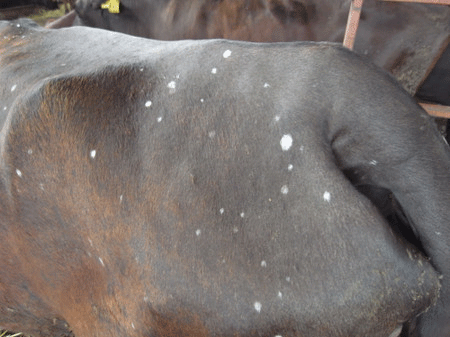
SOURCE: Farm Sanctuary
Makiko Segawa, Reporter: When you visited in December 2012 do you remember? Did youu see these white spotted cows?
Kazuo Suzuki, Ministry of Agriculture official: No, I do not remember them […]
Segawa: Could you please test these cows next time you visit?
Suzuki: As I explained before it’s not my duty. They should go to the nearby Livestock Hygiene Service. […]
Channel News Asia: Local farmers disagree, saying they were told by the Fukushima prefectural officials that all such investigations do actually fall under the Ministry of Agriculture’s authority […] Beef from Fukushima [Prefecture] was still the 5th most traded and shipped [in 2012] at Japan’s biggest beef market in Tokyo. […]
Toshimitsu Matsubara, veterinarian and president of the BBB Beef Association: “What is happening [to these cows] now is extremely important. Japan has to think of what to do with this problem.” […]
More photos of Yoshizawa’s affected cattle
Watch the Channel News Asia broadcast
USA tuan contamnated by Fukushima radiation

 Fukushima Radiation Affecting U.S. Tuna http://www.energyrefuge.com/blog/fukushima-radiation-affecting-u-s-tuna/?utm_source=feedburner&utm_medium=feed&utm_campaign=Feed%3A+EnergyrefugecomBlog+%28EnergyRefuge.com+Blog%29
by ANTONIO PASOLINI on AUGUST 28, 2013
Recent reports have exposed what some people had predicted at the time of theFukushima nuclear disaster: that radiation would spread. And it has, through fish that migrates between North America and Japan.
Reuters recently reported that “low levels of radioactive cesium from Japan’s Fukushima Daiichi nuclear accident turned up in fish caught off California in 2011”. The statement was based on a recent report compiled by Stanford University’s Hopkins Marine Station.
Bluefin spawn off the Japanese coast and many migrate across the Pacific. The researchers analyzed tissue samples collected in August 2011, five months after the nuclear spill. All samples contained reactor byproducts cesium-134 and cesium-137 at levels that produced radiation about three percent higher than natural sources.
According to this report, anada and the U.S. are feeling the effects of the radiation in food and water, with babies born with thyroid issues. Government has increased acceptable levels of certain toxic substances in the food imported from Japan.
Most of the radiation leaked in April 2011. Radioactive cesium does not quickly sink to the sea bottom but remains dispersed in the water column, from the surface to the ocean floor. Fish can swim right through it and will ingest it through seawater or by eating contaminated organisms. Bluefin tuna typically have low levels of natural radiation such as potassium 40.
Strontium 90, another radioactive element discharging from Fukushima nuclear mess
Since June 2011 there have been further large discharges of strontium from Fukushima that have not been measured with precision.
Along with caesium-137, Sr-90 is one of the most important artificial radioactive isotopes released into the environment, with a half-life of 30 years. Strontium’s chemical behaviour is similar to that of calcium, and it can accumulate in organisms, especially in bone.
Fukushima accident raised levels of radioactive strontium off the east coast of Japan by up to a hundred times : http://phys.org/news/2013-06-fukushima-accident-radioactive-strontium-east.html#jCp Researchers from the Institute for Environmental Science and Technology (ICTA) and the Department of Physics of the Universitat Autònoma de Barcelona (UAB) have studied the spread of radioactive strontium in the coastal waters of eastern Japan during the three months following the Fukushima nuclear accident, which happened in March, 2011. The samples analysed show the impact of the direct release of radioactive materials into the Pacific Ocean, and indicate that the amount of strontium-90 discharged into the sea during those three months was between 90 and 900 Tbq (terabecquerels), raising levels by up to two orders of magnitude. The highest concentrations were found to the north of the Kuroshio current, which acts as a barrier preventing radioactive material from being carried to lower latitudes. Continue reading
Radioactive plume will arrive at uneven times and concentrations on USA West Coast
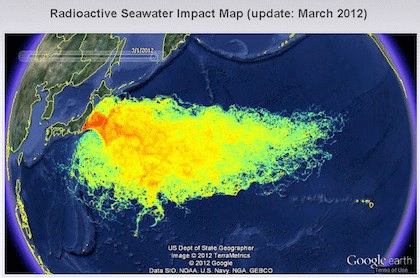 Fukushima radioactive plume to reach US in three years Phys Org 28 Aug 13“….While atmospheric radiation was detected on the US west coast within days of the incident, the radioactive particles in the ocean plume take considerably longer to travel the same distance.
In the paper, researchers from the Centre of Excellence for Climate System Science and others used a range of ocean simulations to track the path of the radiation from the Fukushima incident.
The models identified where it would likely travel through the world’s oceans for the next 10 years…… Observers on the west coast of the United States will be able to see a measurable increase in radioactive material three years after the event,” said one of the paper’s authors, Dr Erik van Sebille…… Eddies and giant whirlpools – some tens of kilometres wide – and other currents in the open ocean continue this dilution process and direct the radioactive particles to different areas along the US west coast.
“Although some uncertainties remain around the total amount released and the likely concentrations that would be observed, we have shown unambiguously that the contact with the north-west American coasts will not be identical everywhere,” said Dr Vincent Rossi.
“Shelf waters north of 45°N will experience higher concentrations during a shorter period, when compared to the Californian coast. This late but prolonged exposure is due to the three-dimensional pathways of the plume. The plume will be forced down deeper into the ocean toward the subtropics before rising up again along the southern Californian shelf.”
Interestingly, the great majority of the radioactive material will stay in the North Pacific, with very little crossing south of the Equator in the first decade. Eventually over a number of decades, a measurable but otherwise harmless signature of the radiation will spread into other ocean basins, particularly the Indian and South Pacific oceans……. For those interested in tracking the path of the radiation, we have developed a website to help them.
“Using this website, members of the public can click on an area in the ocean and track the movement of the radiation or any other form of pollution on the ocean surface over the next 10 years.”
Read more at: http://phys.org/news/2013-08-fukushima-radioactive-plume-years.html#jCp
Kazakhstan’s water imperilled by in situ leaching of uranium
Scientists studying the effects of ISL doubt how quickly mine sites can self-cleanse. This uncertainty appears to be little known to both Kazakhstan’s nuclear industry and fledgling environmentalists.
no site in the US has been entirely returned to pre-mining conditions
The cost of being the world’s No.1 uranium producer Kazakhstan’s industry has skyrocketed in the past 10 years. But what could that mean for the environment? Christian Science Monitor, By Ben Arnoldy, Staff writer / August 28, 2013 ASTANA, KAZAKHSTAN
If you make a toxic mess under one of the most isolated parts of the planet, does it matter if you don’t clean it up? Does it make a difference if that mess will be there for thousands of years? Scientists are asking those questions as Kazakhstan has steadily risen to become the world’s No. 1 uranium producer, surpassing such nations as the United States, Canada, and Australia, which require more cleanup.
Rather than employing miners to haul rock up to the surface, mine operators in Kazakhstan have embraced a newer – and generally cleaner – process by which a chemical solution is injected down a pipe to dissolve the underground uranium deposits and then is sucked back up to the surface.

This in situ leach (ISL) method avoids making a mess above ground, but leaves toxic levels of heavy metals in the ground water. In the US, companies using the method have tried for years and failed to return ground water to its pre-mining state. Continue reading
1 This Month

Protect Sazan Island from the Trump family! https://secure.avaaz.org/campaign/en/protect_sazan_island_from_the_trump_family_loc/?bqFCVab&v=174511&cl=22707147157&_checksum=5e9dde668860e8231c33699735e16a1fbf22ab2cb01da50c999fe8732b9775ef&utm_source=email&utm_medium=blast_email&utm_campaign=174511


Cuba Is Not a Failed State – It Is a Besieged State
PETITION: “Global Appeal to Endorse Palestinian Right of Return of Refugees”
To see nuclear-related stories in greater depth and intensity – go to https://nuclearinformation.wordpress.com
-
Archives
- June 2026 (129)
- May 2026 (306)
- April 2026 (356)
- March 2026 (251)
- February 2026 (268)
- January 2026 (308)
- December 2025 (358)
- November 2025 (359)
- October 2025 (376)
- September 2025 (257)
- August 2025 (319)
- July 2025 (230)
-
Categories
- 1
- 1 NUCLEAR ISSUES
- business and costs
- climate change
- culture and arts
- ENERGY
- environment
- health
- history
- indigenous issues
- Legal
- marketing of nuclear
- media
- opposition to nuclear
- PERSONAL STORIES
- politics
- politics international
- Religion and ethics
- safety
- secrets,lies and civil liberties
- spinbuster
- technology
- Uranium
- wastes
- weapons and war
- Women
- 2 WORLD
- ACTION
- AFRICA
- Atrocities
- AUSTRALIA
- Christina's notes
- Christina's themes
- culture and arts
- Events
- Fuk 2022
- Fuk 2023
- Fukushima 2017
- Fukushima 2018
- fukushima 2019
- Fukushima 2020
- Fukushima 2021
- general
- global warming
- Humour (God we need it)
- Nuclear
- RARE EARTHS
- Reference
- resources – print
- Resources -audiovicual
- Weekly Newsletter
- World
- World Nuclear
- YouTube
-
RSS
Entries RSS
Comments RSS
 nuclear-news