Deformities in Fukushima plants and insects
 Fairewinds Video: ‘Anomalies’ in plants and animals documented by Fukushima residents, some severely deformed — Scientists: Genetic mutations observed in Fukushima include trees with peculiar distortions, insect abnormalities, tumors in birds, more (PHOTO) http://enenews.com/fairewinds-video-anomalies-in-plants-and-animals-documented-by-fukushima-residents-some-severely-deformed-scientists-genetic-mutations-observed-in-fukushima-include-trees-with-peculiar-disto?utm_source=feedburner&utm_medium=email&utm_campaign=Feed%3A+ENENews+%28Energy+News%29
Fairewinds Energy Education, Apr. 10, 2014 — Chiho Kaneko, member of the Board of Directors of Fairewinds originally from Iwate, Japan (at 11:15 in): It’s not just people who are sicker. I met a home gardener who lives in Kawamata, Fukushima, 30-miles from Fukushima Daiichi. She grows luffas, whose fruit is often dried to make bath sponges. Last year, with some trepidation, she used the seeds saved from the year before. She found flower buds directly growing out of the fruit. Some of her pole beans were abnormally gigantic. Near Fukushima city, another person saw a frog so severely deformed that, at first, it was difficult to tell that it was a frog, save for its hopping. These are true events described by people I met who took notes and photographs of these environmental anomalies.
Asian Perspective Vol. 37, No. 4, Anders Pape Møller and Timothy A. Mousseau, Oct.-Dec. 2013: A careful observer [who visits Chernobyl or Fukushima] will quickly become aware of the peculiar distortions of tree growth, numerous abnormalities in insects, and tumors and cataracts in birds, all caused by genetic mutations induced by exposure to the radiation […] radiation causes damage to DNA molecules (leading to mutations if not repaired) […] We have known for more than eighty years that low-dose radiation has cytotoxic effects and causes mutations. […] we looked at 373 effect sizes from forty-six different studies […] they showed a statistically significant negative effect of radiation […] on mutation, physiology, immunology, and disease. As one would expect, effects were stronger on plants, which are stuck in one place, than on animals that can move around […] As the first scientists in both Chernobyl and Fukushima, we have performed [fifteen] published tests, of organisms ranging from plants and insects to birds and mammals in Chernobyl, that support the hypothesis that low-dose radiation disrupts development, and all fifteen studies show a higher degree of asymmetry in the more contaminated plots. […] we have assembled effect sizes from all published studies of mutation rates from Chernobyl, in total 151 estimates of mutations in forty-five studies of thirty-three species ranging from bacteria and plants to insects, birds, and mammals, including humans [The] findings are robust in showing a general, strong overall mean effect size of radiation on mutation rates. […] Mutations accumulate with time and across generations, so we may only be seeing the first stages of the negative public health consequences […] for humans.
Risks of uranium tailings to Las Vegas water in floods
A flood through Moab uranium tailings could poison Las Vegas drinking water An unseasonable flood through a 17 million ton uraniam tailing pile 500 miles upstream in Moab, Utah could spell the end of Las Vegas valley’s drinking water supply. Isn’t it about time mainstream science started paying attention to radiation remediation methods? by Sterling D. Allan Pure Energy Systems News , 13 April 14
Fukushima saw a situation in which the engineers who built the facility did not properly anticipate the magnitude of storm that ended up hitting the facility on March 11, 2011. Their having put the emergency pumps in the basement further shows their total denial about what mother nature could do.
Such a catastrophe actually hangs over Las Vegas as well, and the extend of mother nature’s unleashing wouldn’t be that high above normal. Ninety percent of Vegas valley’s drinking water comes from the Lake Mead reservoir, which is in the Colorado River drainage (source) — about 500 miles downstream from a 17 million ton uranium tailing pile in Moab, Utah. There is no containment berm protecting the pile from an unseasonably flooding Colorado River. Below is an email I received today from my New Energy Congress associate, Gary Vesperman, who lives in Boulder City, Nevada, neighboring Lake Mead. I share this for two reasons. One, to hopefully prevent such a thing from unfolding by spurring remedial measures; and second, to get you scientists among us thinking more about how we can remediate radiation in general.
It’s an email Gary wrote to John Hutchison, who has working on nuclear remediation for several years, and is coming up with some promising results……..http://pesn.com/2014/04/13/9602470_Flood-through-Moab-Uranium-tailings_could-poison-Vegas-drinking-water/
South Dakota’s 270 abandoned, open-pit uranium mines.
South Dakota groups urging cleanup of uranium mines http://www.argusleader.com/story/news/2014/04/09/south-dakota-groups-urging-cleanup-uranium-mines/7499621/ Associated Press, @ap7 April 9, 2014 RAPID CITY — Some environmental groups plan to use Earth Day to call attention to old uranium mines in South Dakota and elsewhere.
Defenders of the Black Hills and Clean Up The Mines say they’ll announce a nationwide campaign to clean up all abandoned uranium mines in the United States.
The event is scheduled for April 22 near Hermosa.
The groups say South Dakota has at least 270 abandoned, open-pit uranium mines.
Fukushima insects have significant and unprecedented deformities
PHOTOS: Study finds deformities “significantly higher” in Fukushima insects — “To my knowledge, such deformations haven’t been reported” in species before — Lower body split in half, 2 tail-like appendages — 1,000% higher death rate in young than other Japan area — Urgent investigations called for, 8 April 14 http://enenews.com/photos-study-finds-deformities-significantly-higher-in-sample-of-fukushima-insects-to-my-knowledge-such-deformations-have-not-previously-been-reported-in-species-lower-body-split-in-ha?utm_source=feedburner&utm_medium=email&utm_campaign=Feed%3A+ENENews+%28Energy+News%29
Migratory birds could be picking up Fukushima’s radioactive cesium
Birds Could Be Flying Japan Radiation Around Pacific Rim http://www.earthweek.com/2014/ew140404/ew140404b.htmlApril 4, 2014 MigMig Mi
Migratory seabirds that spend part of the year around New Zealand after flying in from Japan’s coastal waters are being checked for contamination from the Fukushima nuclear disaster.
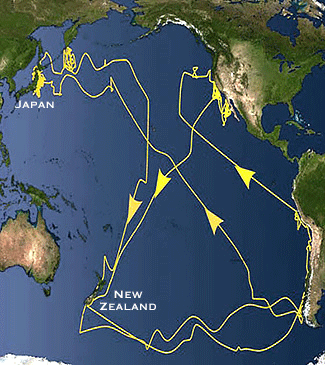
A study by the University of Auckland is investigating whether radioactive cesium has entered the New Zealand ecosystem or food chain via the shearwaters, known in New Zealand as muttonbirds. Physicist David Krofcheck told NZ Newswire that the “detection of gamma rays would tell us whether the birds spend sufficient time near Fukushima to accumulate cesium-134 from nuclear fission.”
Vast amounts of contaminated water from the meltdown-plagued Fukushima Daiichi plant have poured into the Pacific since the disaster began in March 2011. Fish have since been measured with unsafe levels of nuclear contamination. Because the shearwaters feed on seafood, it is feared the long-haul birds could be carrying radioactive debris for many thousands of miles around the Pacific Rim.
Radioactive contamination of Japan by Fukushima nuclear disaster
Caldicott: All of Japan contaminated by Fukushima — “Realistic estimate is 60,000 km², occupied by 46 million people” — “Things are grim, it gets worse by the day” — Unheard of in history, 100s of tons of melted fuel may be in earth (VIDEO) http://tinyurl.com/ldeohpa
2014/03/08 【京都】未来を担う子どもたちの為に、今、私たち
Bay FM 99.9 – Byron Bay Australia, Feb. 26, 2014:
Dr. Helen Caldicott: Things are grim — it gets actually worse by the day. […] There have been 3 meltdowns, which is just unheard of in the history of nuclear age, Units 1, 2, and 3, so that means that molten cores of about 100 tons of uranium in 3 reactors have melted their way through 6 inches of steel in the reactor vessel through to the containment floors, possibly through feet of concrete and steel into the earth. >> Full broadcast hereDr. Helen Caldicott in Kyoto, Japan, Mar. 8, 2014:
Dr. Helen Caldicott: A more realistic estimate of contamination is 60,000 square kilometers, occupied by 46 million people including parts of Tokyo and surroundings. As you can see (map on right), the whole land mass is contaminated to a greater or lesser extent.Watch Dr. Caldicott’s Kyoto presentation here
Britain getting radioactive dust from Sahara’s old French bombing?
 Algerian desert dust infected with French bomb radioactivity Dear Kitty , some blog By David
  Lowry in Britain:
Is Saharan dust radioactive? 4th April 2014
As Britain is blanketed in a layer of desert sand, DAVID LOWRY asks whether it could be contaminated by fallout from French nuclear tests in Algeria more than 50 years ago
South-easterly winds have coated Britain in a toxic Saharan dust cloud.
Combined with domestic pollution, the sand has caused air quality to plummet and engulfed many parts of the country in smog-like conditions.
But one unreported aspect of the Saharan dust is that it could be radioactive.
French nuclear testing in Algeria, conducted during the height of the independence struggle, spread radioactive fallout across southern Europe in the early 1960s – and the radioactivity that settled on the desert could have been resuspended in this natural fallout event over Britain.
It’s recently been revealed that atmospheric spread of the radioactive fallout was much larger than the French army admitted at the time.
New reports by the France 24 TV station suggest that the fallout from the tests at Reggane in central Algeria stretched across all of west Africa, across the Mediterranean and up to southern Europe.
The information came to light following appeals from military veterans who say their current ill health is linked to exposure to dangerous levels of radiation.
France‘s first nuclear device “Gerboise Bleue” (Blue Jerboa) was more than three times as powerful as the bomb dropped on Nagasaki in 1945.
Thirteen days after it was detonated, in February 1960, radioactive particles ranged from the Central African Republic to Sicily and southern Spain.
At the time the French military authorities said the fallout from the explosion was limited to the desert and that radiation levels were “generally low.”
But associations representing military veterans of France’s nuclear tests in the 1960s and 1970s are demanding that the government admits it knew that the fallout from Saharan tests was dangerous.
“In the 1960s the norms governing acceptable levels of radiation were much less strict than they are now,” said Bruno Barillot, an expert in nuclear tests who is representing veterans’ groups.
“And the medical evidence we have now shows clearly that exposure to this radiation can set off serious illnesses more than three decades later,” he told Le Parisien.
Barillot added that the declassified documents showed that the army at the time was aware that even the 1960s safety levels were largely surpassed and that significant quantities of airborne radioactive particles, particularly iodine 131 and caesium 137, could have been inhaled by large numbers of people in north Africa.
He also complained that the government had been extremely selective in terms of what documents to release………..
For more of David Lowry’s writing visit drdavidlowry.blogspot.co.uk.
Barents Sea a radiological danger, with its dead nuclear submarines
 Russia, Norway urge raising of dumped Soviet-era nuclear subs by Alexey Pavlov and Charles Digges (charles@bellona.no) MURMANSK – Two derelict Soviet-era nuclear submarines lying at the bottom of the Barents Sea present a real radiological risk to surrounding waters and could have a negative impact on the delicate ecosystems of Arctic Seas, leading Russian scientists and Russia’s Ministry for Emergency Services have said. April 3, 2014 by Bellona
The long dormant conversation about raising the subs has been reanimatedbecause of the recent joint workshop held by Russian state nuclear corporation Rosatom and Bellona last month in Murmansk, where the Russian side expressed its wish to see the vessels retrieved.
Yet, the subs are hardly all of the radioactive hazards languishing at the bottom of the Kara Sea.
According to the Norwegian Radiation Protection Authority (NRPA), other submerged radiation hazards include 19 ships containing radioactive waste; 14 nuclear reactors, including five that still contain spent nuclear fuel; 735 other pieces of radioactively contaminated heavy machinery and 17,000 containers of radioactive waste.
Bellona Murmansk director Andrei Zolotkov said an international dialogue about raising radioactive Russian military machinery 20 years ago would have been impossible.
But the overwhelming tally of international cooperative successes on radiological and nuclear hazards in Northwest Russia are, he said, immeasurable. As such, the conference has opened the door for a joint Norwegian-Russian inspection, particularly of the K-159 submarine, later this year………
The radiological archipelago
The Bellona-Rosatom workshop reinvigorated discussion about radiological research surrounding the Novaya Zemlya archipelago, were the Soviets scuttled tons of solid radioactive waste and vessels containing spent nuclear fuel.
The task of past expeditions to this Davy Jones’ locker of radioactive debris has been to inspect sunken reactor cores, ships and containers of solid radioactive waste for leaking radionuclides, as well as to search out other radiation hazards that have not been charted – something Korolyov told the international gathering.
“We have to continue searching for what is lost,” he said, and citing that previous searches for barges loaded with reactor chambers have been unsuccessful, though they are assumed to be in the waters surrounding Novaya Zemlya…….. http://bellona.org/news/nuclear-issues/2014-04-russia-norway-urge-raising-dumped-soviet-era-nuclear-subs
Increasing levels of radioactive cesium in Vancouver area
 Radio: “Surprisingly, high concentrations [of Fukushima cesium] found in Vancouver area” since ocean currents slow down — Levels are increasing — “Might be hotspots where radiation concentrates” — “Chances are high for marine life to absorb it… concern about mussels… clams, oysters” (AUDIO) http://enenews.com/radio-surprisingly-high-concentrations-fukushima-cesium-found-vancouver-area-because-movement-ocean-currents-june-last-year-increasing-levels-found-be-hotspots-radiation-concentrate-chances-h?utm_source=feedburner&utm_medium=email&utm_campaign=Feed%3A+ENENews+%28Energy+News%29
RED 93.1FM (Vancouver, BC), “The Filipino Edition”, Mar. 30, 2014:
Joseph Lopez, reporter: In the Vancouver area, as of June last year […] there are increasing levels of cesium-134, the same isotope released from Fukushima. […]
Irene Querubin, host: I hope we’re not slowly dying by that.
At 7:00 in
Lopez: There’s a strong current called the Kuroshio current […] these are highways in the ocean […] it’s one of the strongest water currents […] and this current passes through Fukushima but it is so strong it helps keep the radiation levels in the Fukushima area lower, it blows it away. […] These radioactive isotopes, in a slower speed — because they’re slowing down in these areas like Vancouver […] where the water is not as fast as in the ocean, there’s a chance for the radioactive isotopes to settle down and be in the water and possibly be absorbed by bottom feeders. […] The radioactive isotopes [are] not observed much in Japan, in the Fukushima area, surprisingly […] but the current pulls it away and acts as a boundary because it’s so fast. Once the speed slows down in our area, the chances are high for the marine life to absorb it.
At 11:00 in
Lopez: They’re not doing any testing right now, that’s why the public should be concerned […] We don’t know why they’re not doing it. They should be doing it. […] It is true that the Pacific Ocean will dilute the radiation, but what they found is there might be hotspots where this radiation might be concentrated. And surprisingly the high concentrations have been found in the Vancouver area because in these waters there’s less movement, less speed. […] I’m surprised that Dr. Smith of the Department of Fisheries and Oceans would categorically state that there’s a zero chance of starfish die-off [being related to radioactive contamination]. It’s like saying the Titanic will never sink. […] I would be concerned about mussels as well […] and clams and oysters, because they are filters. […] Remember no  level of radiation is ever safe.Full broadcast available here
Is this a target for terrorists? Oh no, it’s just a nuclear waste ship
 Nuclear waste ship in Tasman sea http://www.stuff.co.nz/national/9896660/Nuclear-waste-ship-in-Tasman-sea TIM DONOGHUE 2 April 14 The nuclear waste carrier Pacific Grebe is currently making its way through the northern mid-Tasman sea bound for Japan with canisters of high level reprocessed nuclear waste from Britain on board.
The 6,840 tonne British registered ship, owned by Warrington, UK based Pacific Nuclear Transport, sailed from Barrow-in-Furness, north of Liverpool, bound for Japan on 14 February 2014
The Japan Times reported in January, 2014 that 28 canisters of high-level radioactive waste, produced through the reprocessing of spent Japanese nuclear fuel in Britain, would be transported to the Aomori Prefecture on board Pacific Grebe.
The 28 canisters of vitrified radioactive waste included 14 for Kansai Electric Power Co and seven each for Chubu Electric Power Co. and Chugoku Electric Power Co.
The paper also reported in January that the shipment was the third involving vitrified radioactive waste to be brought to Japan from Britain.
Japan has received 104 canisters of such waste from Britain and plans to receive around 800 more. The 104 canisters have been stored at a facility in the village of Rokkasho, The Japan Times reported.
Why did Canadian government stop testing seafoods for radioactive contamination?
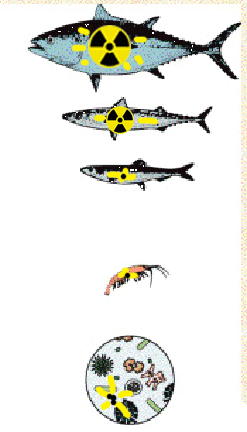
 School Science Project Reveals High Levels Of Fukushima Nuclear Radiation in Grocery Store Seafood Investment Watch By Michael Snyder March 27th, 2014 A Canadian high school student named Bronwyn Delacruz never imagined that her school science project would make headlines all over the world. But that is precisely what has happened. Using a $600 Geiger counter purchased by her father, Delacruz measured seafood bought at local grocery stores for radioactive contamination. What she discovered was absolutely stunning. Much of the seafood, particularly the products that were made in China, tested very high for radiation. So is this being caused by nuclear radiation from Fukushima? Is the seafood that we are eating going to give us cancer and other diseases? The American people deserve the truth, but as you will see below, the U.S. and Canadian governments are not even testing imported seafood for radiation. To say that this is deeply troubling would be a massive understatement.
In fact, what prompted Bronwyn Delacruz to conduct her science project was the fact that the Canadian government stopped testing imported seafood for radiation in 2012…
Alberta high-school student Bronwyn Delacruz loves sushi, but became concerned last summer after learning how little food inspection actually takes place on some of its key ingredients.
The Grade 10 student from Grande Prairie said she was shocked to discover that, in the wake of the 2011 Fukushima nuclear disaster in Japan, the Canadian Food Inspection Agency (CFIA)stopped testing imported foods for radiation in 2012.
And what should be a major red flag for authorities is the fact that the seafood with the highest radiation is coming from China… Armed with a $600 Geiger counter bought by her dad, Delacruz studied a variety of seafoods – particularly seaweeds – as part of an award-winning science project that she will take to a national fair next month.
“Some of the kelp that I found was higher than what the International Atomic Energy Agency sets as radioactive contamination, which is 1,450 counts over a 10-minute period,” she said. “Some of my samples came up as 1,700 or 1,800.”
Delacruz said the samples that “lit up” the most were products from China that she bought in local grocery stores.
It is inexcusable that the Canadian government is not testing this seafood. It isn’t as if they don’t know that it is radioactive. Back in 2012, the Vancouver Sun reported that cesium-137 was being found in a very high percentage of the fish that Japan was selling to Canada…
• 73 percent of the mackerel
• 91 percent of the halibut
• 92 percent of the sardines
• 93 percent of the tuna and eel
• 94 percent of the cod and anchovies
• 100 percent of the carp, seaweed, shark and monkfish
So why was radiation testing for seafood shut down in Canada in 2012?
Someone out there needs to answer some very hard questions……..http://investmentwatchblog.com/school-science-project-reveals-high-levels-of-fukushima-nuclear-radiation-in-grocery-store-seafood/
Negligence of USA govt in not testing seafood for Fukushima radiation
School Science Project Reveals High Levels Of Fukushima Nuclear Radiation in Grocery Store Seafood Investment Watch By Michael Snyder March 27th, 2014 “……..Meanwhile, PBS reporter Miles O’Brien has pointed out the extreme negligence of the U.S. government when it comes to testing seafood for Fukushima radiation. The following comes from a recent EcoWatch article…
O’Brien also introduces us to scientists from the Woods Hole Oceanographic Institute who have been testing waters around the reactors—as well as around the Pacific Rim—to confirm the levels of Fukushima fallout, especially of cesium.
These scientists are dedicated and competent. But they are also being forced to do this investigation on their own, raising small amounts of money from independent sources. They were, explains lead scientist Ken Buesseler, turned down for even minimal federal support by five agencies key to our radiation protection. Thus, despite a deep and widespread demand for this information, no federal agency is conducting comprehensive, on-the-ground analyses of how much Fukushima radiation has made its way into our air and oceans.
In fact, very soon after Fukushima began to blow, President Obama assured the world that radiation coming to the U.S. would be minuscule and harmless. He had no scientific proofthat this would be the case. And as O’Brien’s eight-minute piece shows all too clearly, the “see no evil, pay no damages” ethos is at work here. The government is doing no monitoring of radiation levels in fish, and information on contamination of the ocean is almost entirely generated by underfunded researchers like Buesseler.
A video news report in which O’Brien discusses these issues is posted below https://www.youtube.com/watch?v=QIjJlK5EWOw
Fishing for data in the radioactive waters off Fukushima It is the job of the authorities to keep us safe, and the Fukushima nuclear disaster was the worst nuclear disaster in human history.
So why aren’t they doing testing?
Why aren’t they checking to make sure that this radiation is not getting into our food chain? Continue reading
Ocean radiation soon to reach USA’s West Coast
Scientists Expect Traces of Ocean Radiation Soon Science Tech By Jeff Barnard
The March 2011 tsunami off Japan flooded the Fukushima Dai-Ichi nuclear plant, causing radiation-contaminated water to spill into the Pacific. Airborne radiation was detected in milk and rainwater in the U.S. soon afterward. Now, scientists are using a network of volunteers to measure radiation at beaches along the U.S. West Coast. Continue reading |
|||

The surreal problem of Chernobyl’s forests not decaying properly
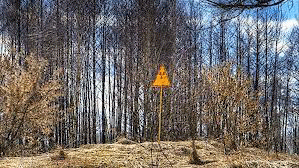 The Woods Around Chernobyl Aren’t Decaying GEOFF MANAUGH http://www.gizmodo.com.au/2014/03/the-woods-around-chernobyl-arent-
 decaying/ 19 Mar 14, Like a landscape of the undead, the woods outside Chernobyl are having trouble decomposing. The catastrophic meltdown and ensuing radiation blast of April 1986 has had long-term effects on the very soil and ground cover of the forested region, essentially leaving the dead trees and leaf litter unable to decompose. The result is a forest full of “petrified-looking pine trees” that no longer seem capable of rotting. Indeed, Smithsonian reports, “decomposers — organisms such as microbes, fungi and some types of insects that drive the process of decay — have also suffered from the contamination. These creatures are responsible for an essential component of any ecosystem: recycling organic matter back into the soil.”
All of that now has been slowed way down, as explored in a new study led by University of South Carolina biologist Timothy Mousseau, just published in Oecologica.Mouseeau and his colleagues explain that they would normally expect to see between 70 per cent and 90 per cent loss of dead plant matter over the course of a year as the discarded leaves and branches are consumed by local microbes; however, at the various test points they established throughout the Chernobyl forested region, the sampled vegetation had lost less than 40 per cent over the same time frame.
This means the woods are decaying approximately twice as slowly, stretching out their  period of decay for years, if not decades, and, in the process, piling up fuel for future forest fires.
As Smithsonian also mentions, this is perhaps the most worrisome aspect of all of this, and all the more reason to be concerned about the radioactive side-effects of such a fire: “Other studies have found that the Chernobyl area is at risk of fire, and 27 years’ worth of leaf litter, Mousseau and his colleagues think, would likely make a good fuel source for such a forest fire. This poses a more worrying problem than just environmental destruction: Fires can potentially redistribute radioactive contaminants to places outside of the exclusion zone, Mousseau says. ‘There is growing concern that there could be a catastrophic fire in the coming years,’ he says.”
Either way, there is something immensely surreal in this dream-like vision of a dead forest that simply cannot decay, its branches lifeless yet ever-present, petrified or fossilized in place, its carpet of leaves always growing deeper and seeming to never go away.
Science finds damage to plants, animals, in Chernobyl and Fukushima

Radiation Facts and Myths
Many have claimed that wildlife is thriving in the highly-radioactive Chernobyl Exclusion Zone.
Some claim that a little radiation is harmless … or even good for you.
One of the main advisors to the Japanese government on Fukushimaannounced:
If you smile, the radiation will not affect you. If you do not smile, the radiation will affect you.
This theory has been proven by experiments on animals.
Are these claims true?
We Ask an Expert
To find out, Washington’s Blog spoke with one of the world’s leading experts on the effects of radiation on living organisms: Dr. Timothy Mousseau.
Dr. Mousseau is former Program Director at the National Science Foundation (in Population Biology), Panelist for the National Academy of Sciences’ panels on Analysis of Cancer Risks in Populations Near Nuclear Facilities and GAO Panel on Health and Environmental Effects from Tritium Leaks at Nuclear Power Plants, and a biology professor – and former Dean of the Graduate School, and Chair of the Graduate Program in Ecology – at the University of South Carolina.
For the past 15 years, Mousseau and another leading biologist – Anders Pape Møller – have studied the effects of radiation on birds and other organisms.

Mousseau has made numerous trips to the Chernobyl Exclusion Zone and Fukushima – making 896inventories at Chernobyl and 1,100 biotic inventories in Fukushima as of July 2013 – to test the effect of radiation on plants and animals.
On the third anniversary of the Fukushima disaster, we spoke with Dr. Mousseau about what he discovered regarding the effects of radiation on plants, animals … and people.
Question] How did you get into this field? Is it because you are an anti-nuclear activist?
[Mousseau] No.
I’m an activist, but not an anti-nuclear scientist. I’m an activist for evidence-based science policy. Continue reading
1 This Month



26 September – International Day for the Total Elimination of Nuclear Weapons


PLEASE OPPOSE HR 8255 AND S.3639 – bills would accelerate satellite deployment, with no environmental review or safeguards – https://ncstd5li.quorum.us/campaign/169331/
To see nuclear-related stories in greater depth and intensity – go to https://nuclearinformation.wordpress.com
-
Archives
- September 2026 (281)
- August 2026 (330)
- July 2026 (355)
- June 2026 (287)
- May 2026 (306)
- April 2026 (356)
- March 2026 (251)
- February 2026 (267)
- January 2026 (308)
- December 2025 (358)
- November 2025 (359)
- October 2025 (375)
-
Categories
- 1
- 1 NUCLEAR ISSUES
- business and costs
- climate change
- culture and arts
- ENERGY
- environment
- health
- history
- indigenous issues
- Legal
- marketing of nuclear
- media
- opposition to nuclear
- PERSONAL STORIES
- politics
- politics international
- Religion and ethics
- safety
- secrets,lies and civil liberties
- spinbuster
- technology
- Uranium
- wastes
- weapons and war
- Women
- 2 WORLD
- ACTION
- AFRICA
- Atrocities
- AUSTRALIA
- Christina's notes
- Christina's themes
- culture and arts
- Events
- Fuk 2022
- Fuk 2023
- Fukushima 2017
- Fukushima 2018
- fukushima 2019
- Fukushima 2020
- Fukushima 2021
- general
- global warming
- Humour (God we need it)
- Nuclear
- RARE EARTHS
- Reference
- resources – print
- Resources -audiovicual
- Weekly Newsletter
- World
- World Nuclear
- YouTube
-
RSS
Entries RSS
Comments RSS

