Our food chain may already have radioactive contamination from Fukushima
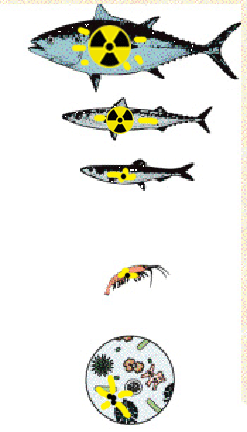 NBC Nightly News: ‘Has Radiation Entered Our Food Supply Chain?’ — USA Today: News getting worse at Fukushima, widespread suspicion leaks into ocean ‘underreported’ — Expert: “I’m not trying to be alarmist… but how will we know it’s safe” for West Coast? (VIDEO) http://enenews.com/nbc-nightly-news-has-radiation-entered-our-food-supply-chain-usa-today-news-getting-worse-at-fukushima-widespread-suspicion-leaks-are-being-underreported-expert-im-not?utm_source=feedburner&utm_medium=email&utm_campaign=Feed%3A+ENENews
USA Today,, Mar. 9, 2014: Ken Buesseler, a chemical oceanographer at the Woods Hole Oceanographic Institution […] and other scientists are calling for more monitoring. No federal agency currently samples Pacific Coast seawater for radiation, he said. “I’m not trying to be alarmist,” Buesseler said. “We can make predictions, we can do models. But unless you have results, how will we know it’s safe?” […] Last July [Tepco] acknowledged for the first time that the reactor was leaking contaminated underground water into the ocean. Since then, the news has gotten worse, and there is widespread suspicion that the problem is underreported. […] three competing models of the Fukushima radiation plume […] all predict that the plume will reach the West Coast this summer […]
NBC Nightly News, Mar. 7, 2014:
Title: Has Radiation Entered Our Food Supply Chain?
Brian Williams, anchor: Scientists from Long Beach State University have started to look for […] signs of radiation in the kelp that is found off the California coast.
Miguel Almaguer, NBC reporter: Could this kelp be contaminated with radiation from Fukushima?
Dr. Steven Manley, CSULB professor: This is used to detect the radioactive materials coming over from Fukushima.
Almaguer: Will it pose a public health threat? […] Its impact on the environment and marine life remains an unknown.
Kei Iwamoto, Ph.D. UCLA adjunct associate professor of experimental radiation oncology: We have not seen anything that should raise any kind of red flags or alarm to the general public.
Almaguer: For now, no alarm, but these researchers know their work is just beginning. Watch the NBC News broadcast here
Cesium and plutonium in upper atmosphere, from atomic bomb testing
 Nuclear weapon test debris ‘persists’ in atmosphere By Rebecca Morelle Science reporter, BBC World Service, 7 Jan 14, Radioactive particles from nuclear tests that took place decades ago persist in the upper atmosphere, a study suggests.
 Previously, scientists believed that nuclear debris found high above the Earth would now be negligible.
However this research shows that plutonium and caesium isotopes are still present at surprisingly high concentrations…The work is published in the journal Nature Communications……..http://www.bbc.co.uk/news/science-environment-25641310
Raised radiation level found in Missouri Snow

 Missouri Snow Found to Contain Radiation DOUBLE Normal Amount http://www.darkpolitricks.com/2014/01/missouri-snow-found-to-contain-radiation-double-normal-amount/ More concerns about possible impact of Fukushima Paul Joseph Watson Prison Planet.com January 6, 2014 Readings taken from snow blanketing St. Louis, Missouri contains double the normal radiation amount, once again stoking concerns that the ongoing Fukushima crisis is now firmly impacting areas of America.
The radiation return from the snow precipitation is returning DOUBLE the normal background amounts. Normal background in this area is approximately 30CPM,” writes YouTube user DutchSinse, alongside a video documenting the readings.
“This means small particles of radioactive material are indeed coming down in the precipitation. Past tests show around 30CPM in the same spot on a nice day with no precipitation,” he adds, noting that snowstorms in 2012 also showed alert level radiation readings.
As we reported earlier, Geiger counter readings taken on a beach in San Francisco returned results five times the safe level of normal background radiation, prompting federal officials to launch an investigation.
Whether such readings are linked to the ongoing Fukushima crisis is unknown, but the fact that officials in Japan have been duplicitous in downplaying the true scale of radiation releases at almost every turn has understandably fanned the flames of suspicion.
Last week it was reported that new plumes of radioactive steam were emerging from the crippled reactor number 3 at the plant, but TEPCO representatives refused to explain the cause.
A former Fukushima worker also recently revealed that duct tape and wire nets were used to “repair” leaking radioactive water tanks in 2012 as a cost cutting measure.
The Department of Health and Human Services has ordered 14 million doses of potassium iodide, the compound that protects the body from radioactive poisoning in the aftermath of severe nuclear accidents, but a DHHS official denied that the purchase was connectde to the Fukushima crisis.
Paul Joseph Watson is the editor and writer for Infowars.com and Prison Planet.com. He is the author of Order Out Of Chaos. Watson is also a host for Infowars Nightly News
Both the land and the people suffer from uranium mining: its long term harm
Uranium mining: everything about it is negative http://www.nunatsiaqonline.ca/stories/article/65674uranium_mining_everything_about_it_is_negative/ Dale DewarWynard, Sask.3 Jan 14, “There is probably fairly low probability that mining will even occur” NUNATSIAQ NEWS Youth should be congratulated on tackling the issue of uranium mining in Nunavut.
Both sides sound as though they did their research thoroughly. Unfortunately the “economic benefit” argument is based upon promise and not fact. What little research that has been done does not support the argument for local benefit. The few unskilled jobs that go locally provide money that accrues to individuals, not communities. The government of Nunavut may benefit from royalties — but as Saskatchewan recently discovered, even that was banked in Switzerland to avoid taxes.
What kind of legacy does uranium mining leave? The natural situation can never be restored; 85 per cent of the nuclear radiation bound up in the rock will be left on the surface.
The industry speaks of “reclamation” but even that is more an unfulfilled promise than fact. The area can never be normal again. Mines in northern Saskatchewan still spill toxic tailings into waters bound for the Arctic Ocean. Mining in Niger (North Africa) has been going on since 1968 with not a whisper of reclamation. Two million tonnes of radioactive tailings were dumped into local surface waters in Gabon (also Africa.)
Containment in Australia recently ruptured and is still spreading into the surface waters of the surrounding Indigenous lands. The mining company in Navajo Territory in the south-western United States transferred its assets and then declared bankruptcy.
Reclamation, such as it is, is extremely expensive. Germany began reclamation of a collection of mines referred to as WISMUT in the 1990s —to date, close to twelve billion dollars have been spent and the job is not complete.
The tailings from a proposed mine in Tanzania expected to produce uranium for 20 years has a clean-up price tag of four billion dollars.
Given that uranium has only two end uses — nuclear power and nuclear bombs — no renaissance for the first and no desire for the second, there is probably fairly low probability that mining will even occur.
The industry and the argument will serve only to divide a community that needs to work together to tackle challenging times.
America dumped radioactive trash on the ocean floor
 Nuclear Waste Sits on Ocean Floor U.S. Has Few Answers on How to Handle Atomic Waste It Dumped in the Sea By JOHN R. EMSHWILLER and DIONNE SEARCEY WSJ Dec. 31, 2013 More than four decades after the U.S. halted a controversial ocean dumping program, the country is facing a mostly forgotten Cold War legacy in its waters: tens of thousands of steel drums of atomic waste.
From 1946 to 1970, federal records show, 55-gallon drums and other containers of nuclear waste were pitched into the Atlantic and Pacific at dozens of sites off California, Massachusetts and a handful of other states. Much of the trash came from government-related work, ranging from mildly contaminated lab coats to waste from the country’s effort to build nuclear weapons.
Federal officials have long maintained that, despite some leakage from containers, there isn’t evidence of damage to the wider ocean environment or threats to public health through contamination of seafood. But a Wall Street Journal review of decades of federal and other records found unanswered questions about a dumping program once labeled “seriously substandard” by a senior Environmental Protection Agency official: Continue reading
Uranium mining in Tanzania to destroy environment, health and tourism
poaching, which has been rampant in the Selous and government is doing little to stop it because word has it senior people are benefiting from the trade in blood ivory……
So perhaps, cynical as we know them to be, they let the reserve be poached empty and then shrug and tell us that is is no longer suitable for tourism and did they not always say mining is the future for the country?
No one will dare to really expose the dangers of uranium mining to the Tanzanian public and so most people will only get the uptalk of government and not the downside of the environmental fallout’.
Tanzania conservationists reject uranium mining approvals BY PROF. DR. WOLFGANG H. THOME, ETN AFRICA CORRESPONDENT | DEC 27, 2013 Reactions to media reports in Tanzania, publishing details of approvals for uranium mining given by the country’s Atomic Energy Commission, were swift and harsh, and predicatably given on condition of anonymity, no wonder considering Tanzania’s record of often brutal suppression of dissent, especially when big commercial interests are at stake……
Uranium mining in the Selous has led to world wide protests and led to the government putting a mechanism into place to carve out over 200 square kilometres of the Selous territory to evade sanctions by UNESCO, which had made the Selous Game Reserve a World Heritage Site – for the Tanzanian government not an issue it seems as they habitually ignore that status in favour of ‘development’ Continue reading
Years of secret dumping radioactive trash into the sea,by US navy
Sailors on old warship dumped thousands of tons of radioactive waste for years Tampa Bay Times, William R. Levesque, Times Staff Writer 22 Dec 13 They asked the dying Pasco County man about his Navy service a half-century before. He kept talking about the steel barrels. They haunted him, sea monsters plaguing an old sailor.
“We turned off all the lights,” George Albernaz testified at a 2005 Department of Veterans Affairs hearing, “and … pretend that we were broken down and … we would take these barrels and having only steel-toed shoes … no protection gear, and proceed to roll these barrels into the ocean, 300 barrels at a trip.”
The Atomic Sailors Talk of Dumping Radioactive Waste at Sea
Not all of them sank. A few pushed back against the frothing ocean, bobbing in the waves like a drowning man. Then shots would ring out from a sailor with a rifle at the fantail. And the sea would claim the bullet-riddled drum. Continue reading
Radiation increase a thousand fold in Fukushima groundwater
 Radiation in Fukushima groundwater skyrockets 3,500+ times over weekend — Just 5 meters from Pacific Ocean — Nothing being done to stop it flowing into sea (PHOTO) http://enenews.com/radiation-in-groundwater-skyrockets-3500-times-over-weekend-just-5-meters-from-pacific-no-steps-being-taken-to-stop-flow-into-ocean-photo[…]
Tepco, Dec. 17, 2013: As a result of the measurement, it was found that the gross-β density in the groundwater observation holeNo.0-3-2 obtained at the east of the Units 1-4 Turbine Buildings on December 16 [was] 63,000Bq/L
Jiji Press, Dec. 17, 2013: Highest Ever Radiation Detected in Fukushima Plant Well […] Some 63,000 becquerels of radioactive materials that emit beta rays, such as strontium-90, per liter have been found in groundwater […] the highest level at the well [Tepco] said Tuesday […] sample [was] taken on Monday from the observation well 5 meters from the coast […] Since the company is not takings steps to prevent tainted water in the well from flowing into the sea […] the water is likely to be reaching the plant’s bay. […] standards require strontium-90 levels to be less than 10 becquerels in water to be released into the sea. […]
See also: Asahi: Radiation levels spike to record high in Fukushima groundwater well nearby ocean — Trench failures to blame, says Tepco — Million times more strontium/beta-ray source than cesium
World Heritage Park in Australia increasingly threatened by uranium mining
the Ranger mine is more than 30 years old and we are increasingly seeing metal fatigue and accidents, such as the one we saw so spectacularly 10 days ago.
Kakadu mine: risk of uranium leakage could be greater than thought
Study shows the radioactive particles can escape into the environment, raising alarms about the national park Oliver Milman theguardian.com, Wednesday 18 December 2013 The risk of uranium leakage from filtration systems used by facilities such as the Ranger mine in Kakadu could be greater than is currently acknowledged, with new research showing that the hazardous substance is far more mobile than previously thought. Continue reading
Radioactive debris spread through Fukushima after typhoons
Typhoons spreading Fukushima fallout ABC News 29 Nov 2013, Typhoons that hit Japan each year are contributing to the spread of radioactive material from the Fukushima nuclear disaster into the country’s waterways, researchers say.
A joint study by France’s Climate and Environmental Science laboratory (LSCE) and Tsukuba University in Japan shows contaminated soil gets washed away by the high winds and rain and deposited in streams and rivers. ”There is a definite dispersal towards the ocean,” LSCE researcher Olivier Evrard said  Wednesday.
The typhoons “strongly contribute” to soil dispersal, he said, though it can be months later, after the winter snow melts, that contamination actually passes into rivers……….
Studies have shown that soil erosion can move the radioactive varieties of cesium-134 and 137 from the northern mountains near Fukushima into rivers, and then out into the Pacific Ocean.
Last year, the radioactive content of Japan’s rivers dropped due to fairly moderate typhoons. However, more frequent and fierce storms in 2013 have brought a new flood of caesium particles.
This is “proof that the source of the radioactivity has not diminished upstream” said Mr Evrard. Tsukuba University has completed a number of studies on Fukushima since November 2011. Scientists “concentrated mostly on the direct fallout from Fukushima yet this is another source of radioactive deposits” that must be taken into account, he warned. Coastal areas home to fishermen or where people bathe in particular face a potential risk…….http://www.abc.net.au/news/2013-11-29/an-typhoons-spreading-fukushima-fallout/5124084
Utah nuclear power plant wins approval for diversion of water
“We expected this to be the case. The state engineer obviously spent two years looking at it,” said Aaron Tilton, whose company, Blue Castle Holdings, is proposing the twin-reactor plant in Emery County.
Tilton added that the judge rightfully weighed the merits of Jones’ decision within the context of what state law dictates.
“You got to look at the totality of everything that we have done and the way the law was applied. If we interpreted the law the way HEAL Utah wanted, nobody’s water rights would be approved,” he said.
The decision was blasted by HEAL Utah and other environmental groups that contended Jones’ decision was illegal because there was no demonstration by Blue Castle that the project is economically feasible or the water use is sustainable.
“It’s baffling that this project continues to stumble forward,” says HEAL Utah’s policy director, Matt Pacenza.
But 7th District Judge George Harmond said HEAL Utah and the other environmental groups failed to prove their case, and there was no lawful basis to deny the water use………http://www.ksl.com/index.php?nid=960&sid=27813730&fm=most_popular
Unforgettable photography of the world’s most radioactive places
 PHOTOGRAPHY, Ten Most Radioactive Places on Earth Mapped Out [GRAPHIC], CV News November 24, 2013 by Jim Lee ”……While the 2011 earthquake and worries surrounding Fukushima have brought the threat of radioactivity back into the public consciousness, many people still don’t realize that radioactive contamination is a worldwide danger. Radionuclides are in the top six toxic threats as listed in the 2010 report by The Blacksmith Institute, an NGO dedicated to tackling pollution. You might be surprised by the locations of some of the world’s most radioactive places — and thus the number of people living in fear of the effects radiation could have on them and their children.
For years, there have been allegations that the ‘Ndrangheta syndicate of the Italian mafia has been using the seas as a convenient location in which to dump hazardous waste — including radioactive waste — charging for the service and pocketing the profits. An Italian NGO, Legambiente, suspects that about 40 ships loaded with toxic and radioactive waste have disappeared in Mediterranean waters since 1994. If true, these allegations paint a worrying picture of an unknown amount of nuclear waste in the Mediterranean whose true danger will only become clear when the hundreds of barrels degrade or somehow otherwise break open. The beauty of the Mediterranean Sea may well be concealing an environmental catastrophe in the making.
Mafia sinks toxic waste ships in the Mediterranean
8. The Somalian Coast
Nuclear Waste Dumping at Sea “paid” – Somalia
7. Mayak Chemical Combine, Russia

6. Sellafield, UK Continue reading
Useless but “Fun” Christmas gifts are trashing the planet
 So you need that smart cuckoo clock for Christmas, do you?, George Monbiot, Guardian, 26 Nov 13
A global bullshit industry recruits the values with which we’d like the festival to be invested – to sell things no one wants Guilt is good. It’s the feature that distinguishes the rest of the population from psychopaths. It’s the sensation you are able to feel when you possess a capacity for empathy. But guilt inhibits consumption. So a global industry has developed to smother it with a 13-tog duvet of celebrities and cartoon characters and elevator music. It seeks to persuade us not to see and not to feel. It seems to work.
The 2012 Greendex survey found that people in poorer countries feel, on average, much guiltier about their impacts on the natural world than people in rich countries. The places in which people feel least guilt are, in this order, Germany, the United States, Australia and Britain, while the people of India, China, Mexico and Brazil have the greatest concerns. Our guilt, the survey reported, exists in inverse proportion to the amount of damage our consumption does. This is the opposite of what a thousand editorials in the corporate press tell us: that people cannot afford to care until they become rich. The evidence suggests we cease to care only when we become rich.
“Consumers in countries such as Mexico, Brazil, China and India,” the survey tells us, “tend to be most concerned about issues like climate change, air and water pollution, species loss and shortages of fresh water … In contrast, the economy and the cost of energy and fuel elicit the most concern among American, French and British consumers.” The more you have, the more important money becomes. My guess is that in poorer countries empathy has not been so dulled by decades of mindless consumption.
Watch the latest advertisement for Toys R Us in the US. A man dressed up as a ranger herds children on to a green bus belonging to “the Meet the Trees Foundation”. “Today we’re taking the kids on the best field trip they could wish for,” he confides to us. “And they don’t even know it.”
Did Toys R Us Just Make an Anti Science Education Ad?
On the bus he starts teaching them, badly, about leaves. The children yawn and shift in their seats. Suddenly, he announces: “But we’re not going to the forest today …” He strips off his ranger shirt. “We’re going to Toys R Us, guys!” The children go berserk. “We’re going to get to play with all the toys, and you’re going to get to choose any toy that you want!” The children run, in slow motion, down the aisles of the shop, then almost swoon as they caress their chosen toys.
Nature is tedious, plastic is thrilling. The inner-city children I took to the woods a few weeks ago would tell a different story, but hammer home the message often enough and it becomes true.
Christmas permits the global bullshit industry to recruit the values with which so many of us would like the festival to be invested – love, warmth, a community of spirit – to the sole end of selling things that no one needs or even wants…….
Are we so bored, so affectless, that we need to receive this junk to ignite one last spark of hedonic satisfaction? Have people become so immune to fellow feeling that they are prepared to spend £46 on a jar for dog treats or £6.50 a bang on personalised crackers, rather than give the money to a better cause? Or is this the western world’s potlatch, spending ridiculous sums on conspicuously useless gifts to enhance our social status? If so, we must have forgotten that those who are impressed by money are not worth impressing.
To service this peculiar form of mental illness, we must wear down the knap of the Earth, ream the surface of the planet with great holes, fleetingly handle the products of that destruction then dump the materials into another hole. A report by the Gaia Foundation reveals an explosive growth in the pace of mining: cobalt production up 165% in 10 years, iron ore by 180%, a 50% increase in nonferrous metals exploration between 2010 and 2011.
The products of this destruction are in everything: electronics, plastics, ceramics, paints, dyes, the packaging in which our fatuities arrive. As the richest deposits are mined out, ever more land must be attacked to maintain production. Even the most precious and destructive materials are junked when a new dopamine hit is required: the UK government reports that a tonne of gold embedded in electronics is landfilled in this country every year…… A fully referenced version of this article can be found at Monbiot.com http://www.theguardian.com/commentisfree/2013/nov/25/christmas-selling-things-nobody-wants
Need to monitor Fukushima radionuclides reaching West Coast of USA
 “Radionuclides from Fukushima due to hit U.S. West Coast any day now” — Senior Scientist: “Really bizarre” U.S. gov’t not testing for it — Concerned officials contacting him about threat http://enenews.com/plume-of-water-carrying-radionuclides-from-fukushima-due-to-hit-u-s-west-coast-any-day-now-senior-scientist-its-really-bizarre-that-u-s-govt-is-not-doing-any-testing-concerned-offic
Cape Cod Times, Nov. 24, 2013:
Model shows estimated location of plume in 2014
With the first plume of water carrying radionuclides from Fukushima due to hit the U.S. West Coast any day now, [Woods Hole Oceanographic Institution Senior Scientist Ken] Buesseler’s latest project is to convince the federal government to monitor radiation levels in the sea water. […] He predicts the radiation will be so diluted after the long journey across the Pacific that it will pose no threat […] But he knows that’s not enough to reassure the public. […] he knows people are concerned […] he fields regular phone calls from surfers and salmon fishermen as well as congressmen. […]
Federal Government
[Buesseler] spent this past week in Washington, D.C., meeting with representatives of the Nuclear Regulatory Commission and the Department of Energy, asking them to come up with some sort of plan to keep tabs on levels of radionuclides […] Buesseler also talked with U.S. Sen. Edward Markey, D-Mass., […] Markey said in an email that an increased federal role is not likely considering the budgetary brakes being applied by the Republicans in Congress. “The sequester is a double-punch, cutting funding for the agencies charged with promoting scientific discovery and protecting our natural resources,” he said.
Woods Hole Oceanographic Institution Senior Scientist Ken Buesseler: We’ve known that for two and half years. Every day they are making contaminated water […] I’m a little disappointed in Japan. What (the denial has) done is made the public extremely mistrustful. […] We don’t have a U.S. agency responsible for radiation in the ocean […] It’s really bizarre. […] Given what’s happened at Fukushima […] Wouldn’t you want to have some measurement?
More from Buesseler: Graphic: 900-mile-long “front” of most contaminated water from Fukushima Daiichi moving across Pacific toward U.S., Canada (VIDEO)
Staten Island radioactive clean-up drags on
Radiation Cleanup at Park on Staten Island to Take Years NYT, By LISA W. FODERARO November 25, 2013 The first sign that something was amiss at Great Kills Park, on Staten Island, came in 2005 when a police flyover of New York City detected a positive reading for radioactive material there. The finding, part of a counterterrorism search, did not come as a complete shock. After all, the 488-acre park was the depository for 15 million cubic yards of fill in the 1940s and 1950s, including medical and sanitary waste. The fill was dumped across wetlands to turn marshy areas into usable recreation space. Some of the waste, it turned out, contained radium, a naturally occurring element that was also used for decades in medical treatments, toys, cosmetics and even toothpaste.
At first, the source of radiation appeared to be confined to a small area behind a parking lot next to a field popular for flying model airplanes. The National Park Service, which operates the park, quickly fenced it off. But in the years since, further investigations by the city’s Department of Health and Mental Hygiene, the federal Environmental Protection Agency and the United States Army Corps of Engineers turned up more hot spots and a fuller, more disturbing picture.
Continue reading
1 This Month



26 September – International Day for the Total Elimination of Nuclear Weapons


PLEASE OPPOSE HR 8255 AND S.3639 – bills would accelerate satellite deployment, with no environmental review or safeguards – https://ncstd5li.quorum.us/campaign/169331/
To see nuclear-related stories in greater depth and intensity – go to https://nuclearinformation.wordpress.com
-
Archives
- September 2026 (281)
- August 2026 (330)
- July 2026 (355)
- June 2026 (287)
- May 2026 (306)
- April 2026 (356)
- March 2026 (251)
- February 2026 (267)
- January 2026 (308)
- December 2025 (358)
- November 2025 (359)
- October 2025 (375)
-
Categories
- 1
- 1 NUCLEAR ISSUES
- business and costs
- climate change
- culture and arts
- ENERGY
- environment
- health
- history
- indigenous issues
- Legal
- marketing of nuclear
- media
- opposition to nuclear
- PERSONAL STORIES
- politics
- politics international
- Religion and ethics
- safety
- secrets,lies and civil liberties
- spinbuster
- technology
- Uranium
- wastes
- weapons and war
- Women
- 2 WORLD
- ACTION
- AFRICA
- Atrocities
- AUSTRALIA
- Christina's notes
- Christina's themes
- culture and arts
- Events
- Fuk 2022
- Fuk 2023
- Fukushima 2017
- Fukushima 2018
- fukushima 2019
- Fukushima 2020
- Fukushima 2021
- general
- global warming
- Humour (God we need it)
- Nuclear
- RARE EARTHS
- Reference
- resources – print
- Resources -audiovicual
- Weekly Newsletter
- World
- World Nuclear
- YouTube
-
RSS
Entries RSS
Comments RSS

