120 Quadrillion becquerels of radioactive cesium into North Pacific Ocean from Fukushima
 Japan Gov’t-funded Study: Fukushima has released up to 120 Quadrillion becquerels of radioactive cesium into North Pacific Ocean — Does not include amounts that fell on land — Exceeds Chernobyl total, which accounts for releases deposited on land AND ocean (MAP) http://enenews.com/japan-govt-funded-study-fukushima-released-120-quadrillion-becquerels-radioactive-cesium-north-pacific-ocean-include-amount-deposited-land-higher-total-amount-released-chernobyl?utm_source=feedburner&utm_medium=email&utm_campaign=Feed%3A+ENENews+%28Energy+News%29 1 July 14,
Scientific Reports (Nature.com), Mar. 4 2014: The total amount of decay-corrected 134Cs in the [subtropical] mode water was an estimated about 6 PBq [petabecquerels, i.e. 6 quadrillion becquerels] corresponding to 10–60% of the total inventory of Fukushima-derived 134Cs in the North Pacific Ocean. […] The decay corrected ratio of 134Cs/137Cs in soils has been calculated to be 1.0, which suggests that the total amounts of 134Cs and 137Cs released from FNPP1 were equivalent. […] the total amount of Fukushima-derived radiocesium in the North Pacific remains uncertain, because it has been difficult to obtain sufficient samples of water, especially from subsurface and deep waters, in the vast North Pacific Ocean […] Estimates of the total 134Cs released to the North Pacific Ocean ranged from 10 PBq (direct discharge of 4 PBq + atmospheric deposition 6 PBq) to 46 PBq (16 + 30 PBq). Thus, the 6 PBq inventory accounts for 10–60% of the total release. However, the total inventory in the subtropical region derived from the activity in STMW [Subtropical Mode Water] may be underestimated, because CMW probably carried the radiocesium into the subtropical region, too […] The estimated inventory in the subtropical region (6 PBq or 10– 60% of the total inventory) is probably a lower limit of estimation because contribution of CMW [Central Mode Water] was not counted. […]
Funding: “This work was partially supported by a Grant-in-Aid… from the Ministry of Education, Culture, Sports, Science and Technology of Japan”
Note: The study states that up to 46 PBq of 134Cs is estimated to have been released into the North Pacific Ocean from Fukushima Daiichi. Yet, it also states that the 6 PBq in the study area represents between 10-60% of the total 134Cs released into the North Pacific Ocean. If the 10% figure is used, the total release into the N. Pacific would equal 60 PBq of 134Cs. The study also states the releases of 134Cs and 137Cs were equivalent, resulting in a total of 120 PBq into the N. Pacific. This total does not include releases deposited on land or in other bodies of water.
Chernobyl Comparison: A report by the Nuclear Enrgy Agency states that when more detailed deposition data eventually became available, the United Nations estimated the total Chernobyl release of 137Cs at 70 PBq. 134Cs is estimated to have been 53.7% of the 137Cs — approximately 38 PBq of 134Cs — resulting in a total of 108 PBq. Unlike the Fukushima total reported above, this does include all 134Cs and 137Cs releases from Chernobyl — not just what was deposited in the ocean.
High proportion of deformities in migratory birds in Japan
Emergency research underway in Japan after birds found with perplexing deformities — “Something unusual occurring inside their bodies” — Never reported in 500,000 exams done before 3/11 — Now observed at every site across country, some over 1,000 km from Fukushima (PHOTO) http://enenews.com/emergency-surveys-in-japan-after-birds-found-with-perplexing-deformities-something-unusual-occurring-inside-their-bodies-never-reported-in-500000-exams-done-before-311-now-its-see?utm_source=feedburner&utm_medium=email&utm_campaign=Feed%3A+ENENews+%28Energy+News%29
 Asahi Shimbun, June 25, 2014: [Noboru Nakamura, a researcher at the Yamashina Institute for Ornithology] has visited the riverbed [in Fukushima] 20 times […] looking into whether the earthquake or the accident at the Fukushima No. 1 nuclear power plant caused abnormal changes among wild birds. […] [Researchers] first verified abnormal change [200 kilometers from Fukushima Daiichi] in Niigata Prefecture […] Oct. 24, 2011, a common reed bunting, a small migratory bird, was found with uneven tail feathers that had a moth-eaten appearance. The institute started emergency surveys […] The most perplexing thing was the overly long feathers […] Its feathers very reliably grow to a certain length […] [Kiyoaki Ozaki, Yamashina Institute for Ornithology deputy director-general,] could not imagine a reason for them to be longer. By March 2012, the same abnormality was identified at all research sites across Japan, such as Tochigi, Ibaraki, Tokyo, Shizuoka, Shimane, Kagawa and Fukuoka [over 1,000 kilometers from Fukushima]. The proportion of birds with the abnormality was 13.8 percent. In at least one place, the ratio exceeded 25 percent. Birds born in 2011 account for 97.3 percent of the specimens with the abnormality. […] Researchers have found feathers that already appear moth-eaten when they split open the sheath. Some birds even grew back feathers with the same deformity after the researchers plucked out older, misshapen feathers. […] One thing is certain: The common reed […] pass through or stop in the Tohoku region during their migration.
Noboru Nakamura, a researcher at the Yamashina Institute for Ornithology: “In Iitate, I caught a Japanese bush warbler in the net yesterday. It had feathers missing from the back of its head, and its skin was dark on that part. I found the same thing last year and the year before in Minami-Soma. I don’t know the reason.”
Kiyoaki Ozaki, Yamashina Institute for Ornithology deputy director-general: “Bird banding surveys of the common reed bunting began in 1961, and nearly 480,000 of the birds have been examined […] we monitor [their tail feathers] closely. But this sort of abnormality hasn’t been reported before. I’ve seen thousands of the birds, but it was the first time for me to see tail feathers like these. […] There is something unusual occurring inside the birds’ bodies, perhaps with their genes or hormone secretion. [It’s] in the realm of possibility [that it could be the effect of radioactive substances].”
USA coastal communiities monitoring sea-borne Fukushima radiation plume
Fukushima radiation concerns coastal communities Tracy Loew, Statesman Journal 25 June 14, Talk in the Oregon coast town of Bandon often turns to the approaching plume of sea-borne radiation from Japan’s crippled Fukushima nuclear power plant.
“We’ve been worried about it and worried about it,” said Zac Adams, owner of Bandon Designsconstruction company. “We’re really concerned about it affecting the fisheries, the wildlife, the tourism, and most importantly our health.”…….
The radiation is expected to hit the U.S. this year at very low levels that wouldn’t harm humans or the environment. But no federal agency is monitoring it.
So Adams joined a citizen-science project, crowd-sourcing funds in his community to test a sample of seawater that he will soon collect.
Four hours north, the Tillamook Estuaries Partnership has funded two collection sites, in Tillamook and Pacific City.
“Over the last year-and-a-half, it’s been an issue that’s been raising in prominence along the coastline,” said Lisa Phipps, executive director of the partnership. “In our area, there have been groups that have been coming together to talk about what is happening in the ocean.”
And fund-raising is underway for two more sites, in Newport and Winchester Bay.
Altogether about 30 sites, from Alaska to Baja, Calif., have been funded, said Ken Buesseler, a chemical oceanographer at the Woods Hole Oceanographic Institution who put together the project, called “How Radioactive is Our Ocean?”
It uses crowd-sourced money and volunteers to collect water samples along the Pacific Coast, then ship them to Buesseler in Massachusetts to be analyzed on an $80,000 instrument………
Buesseler is looking for increased levels of Cesium-137, which already is in all oceans from previous nuclear testing and accidents; and for Cesium-134, a “fingerprint” of Fukushima.
Because of its short, two-year half-life, any Cesium-134 could only have come from the plant, he said.
So far, Buesseler said, no samples have indicated that the plume has reached the West Coast.
Buesseler posts results on the project’s website. They show Cesium-134 and increased levels of Cesium-137 off the coast of Japan and across the ocean.
“We know it’s out there,” Buesseler said. “We’ve seen it more than halfway across the Pacific.”
Northwest of Hawaii, for example, Buesseler has found Cesium-134 at concentrations as high as 3.8 becquerels per cubic meter.
But to put that in context, he said, the U.S. drinking water limit is 7,400 of those units.
“Every additional radiation exposure causes additional risks for cancer,” he said. “But when the numbers are in the one to 10 range, that’s a very small additional risk.”
That’s the range that is expected to hit our shores, with lower levels coming first.
“As the contamination arrives, we expect the concentrations to go up over the next two years,” Buesseler said……..http://www.statesmanjournal.com/story/tech/science/environment/2014/06/25/fukushima-radiation-concerns-coastal-communities/11377463/
U.S. shores continue to have increasing levels of Fukushima radiation
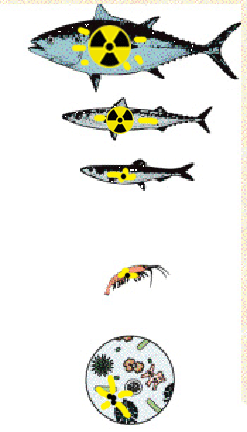 Post-Fukushima radiation levels near US shores continue to increase
http://voiceofrussia.com/news/2014_06_11/Post-Fukushima-radiation-levels-near-US-shores-continue-to-increase-5967/ Radiation levels in Albacore tuna have tripled post-Fukushima, according to Oregon State University (OSU) researchers. The scientists came to that conclusion after conducting a study on fish caught off the coast of Oregon.
According to Delvin Neville, a graduate research assistant at OSU, these trace levels are too small to be a realistic concern. “A year of eating albacore with these cesium traces is about the same dose of radiation as you get from spending 23 seconds in a stuffy basement from radon gas, or sleeping next to your spouse for 40 nights from the natural potassium-40 in their body,” said Mr. Neville.
However, researchers with the National Oceanic and Atmospheric Administration (NOAA) and the GEOMAR Research Center for Marine Geosciences say the worst is yet to come and that the most highly radioactive water hasn’t reached US shores yet.
Regardless, all scientists apparently agree that the radioactive contamination is still traveling in ocean currents, the long-term effects of which remain to be seen.
South Dakota’s community livelihood at risk from uranium polluted water
 Uranium mine would affect more than West River http://www.argusleader.com/story/opinion/readers/2014/06/07/letter-uranium-mine-affect-west-river/10109709/ Kim C. Kraft Are you aware of the potential problem of uranium mining in western South Dakota to the rest of the state? Presently, there are more than 200 abandoned uranium mines leaching radioactive debris into our rivers. Radioactive residue from these mines can be detected as far as Vermillion. So it is not just a West River problem.
Now we have Powertech/Azarga, a China-based investment company, wanting to take vast amounts of water from two major aquifers of the Southern Black Hills for in situ mine leaching of uranium. Not only will they take the water from our ranchers, who desperately need it during the drought, but contaminating it for any future use by the ranchers and surrounding communities. With the Western states becoming dryer from prolonged drought, we cannot afford to waste clean water for the benefit of foreign countries. Our state government is allowing this. Our governor and Legislature have removed oversight and control over water usage in the Southern Black Hills, thus allowing the mining companies to use up precious clean water, pollute it and then leave with no responsibility to clean the mess up. They are putting our livelihoods on the line. Remember this for the November elections.
South Dakota – take heed from Colorado’s bad experience with uranium mining
 Colorado has ‘experience’ with uranium mines http://www.argusleader.com/story/opinion/readers/2014/06/03/letter-colorado-experience-uranium-mines/9942453/
 uranium mines and prospects, Colorado has 387. While South Dakota has yet to experience an operating in-situ leach uranium mine (Powertech/Azarga is attempting to permit the first one 15 miles northwest of Edgemont), Colorado has experienced experimental in-situ leach uranium mining, which left elevated levels of gross alpha radiation, beta radiation, nitrate, ammonia and selenium in the underground aquifer. The contamination got worse after the mine was declared “restored.”
Colorado has had enough. Colorado House legislators recently passed new regulations on uranium processing. The bill sets minimum standards for groundwater cleanups before a company can be let off the hook. It also requires uranium and thorium mines to get a radioactive materials license from the state health department if they use a new process that involves injecting water into the mine’s rock formations.
Colorado state Representative Jared Wright, R-Fruita, said new mining technologies often pollute, despite promises to be safe and clean. “This bill is about protecting our citizens, those we are all here today to serve,” Wright said.
Let’s hope our legislators take heed and protect our water in 2015’s legislative session.
Uranium mining’s grave risk of polluting aquifer in Southern Black Hills, South Dakota
Risks too great to allow Hills uranium mining Jerry Wilson Argus leader 1 June 14, Chinese and Canadian-funded Powertech wants to mine uranium in the Southern Black Hills by the in situ method — dissolving uranium in the aquifer, pumping it to the surface for extraction, then dumping polluted water deep into the Earth.
Twice before, foreign corporations mined uranium in the Hills and left a radioactive mess. The South Dakota Department of Environment and Natural Resources lists 263 abandoned uranium sites in the state. Radioactive material and toxic heavy metals have polluted tributaries of several South Dakota rivers.
We needn’t repeat the mistakes of neighboring states. The Crow Butte mine near Crawford, Neb., has a long history of spills and “excursions” of radioactive water into the aquifer. And the Wyoming Department of Environmental Quality cited the Smith Ranch/Highland mine near Glenrock, Wyo., for “an inordinate number of spills, leaks and other releases … pond leaks, well casing failures and excursions.” The cleanup was projected to cost $150 million, four times the company’s bond.
Below the Inyan Kara aquifer that Powertech wants to mine lies the Minnelusa aquifer, then the Madison, all vital to future life in the region. A study of risks to the Madison aquifer by three South Dakota School of Mines and Technology researchers concluded that “Water supplies for Rapid City … and the surrounding suburban and rural areas are extremely vulnerable to contamination.” The DENR’s mission statement is clear — “protecting South Dakota’s environment and natural resources for today and tomorrow.” Unfortunately, our Legislature passed a law –– written by Powertech lobbyists –– that tied the hands of the DENR to do its job.
If in situ uranium mining pollutes the water vital to life, tourism and ranching in the Southern Hills, we might know in a year or two, or perhaps only after Powertech is gone. That is a chance we cannot afford to take. The Powertech mine must be stopped.
Treasure Island homes to be tested for radiation

 OFFICIALS TO TEST TREASURE ISLAND HOMES FOR RADIATION By Nick Smith abc 7 News, Saturday, May 31, 2014 SAN FRANCISCO (KGO) –Officials told San Francisco’s Treasure Island residents that more testing would be done to examine the risks posed by potential radiation exposure there.
“I always just feel like there’s a little bit more to what they’re saying,” Treasure Island resident Linda Brown said. Dozens of Treasure Island residents spent the day pressing state officials for new information about possible health risks associated with radiation contamination at or near their homes. ……
Fukushima radiation has caused genetic deformities in generations of butterflies
Japan Scientist: We gave butterflies food from Fukushima… then, they died; Deformities get worse with each generation — TV: “Truly horrifying… it doesn’t really even look like a butterfly anymore” (PHOTOS & VIDEO) http://enenews.com/japan-scientist-butterflies-fed-leaves-fukushima-died-deformities-worse-generation-tv-doesnt-look-like-butterfly-anymore-especially-scary-photos-video?utm_source=feedburner&utm_medium=email&utm_campaign=Feed%3A+ENENews+%28Energy+News%29
Vice on HBO, Season 2 Episode 10, May 24, 2014 (at 5:30 in):
- Dr. Joji Otaki, lead researcher, University of Ryukyus: We collected houseplant leaves from Fukushima, and those leaves are given to [butterfly] larvae collected from Okinawa… Those larvae aresupposed to be healthy. But they ate contaminated food from Fukushima. Then we see what happens.
- Vikram Ghandi, Vice: What happened?
- Otaki: They died.
- Ghandi: Dr. Otaki’s experiments have shown the truly horrifying effects contaminated food can have on living organisms.
- Otaki: You can see wrinkled wings.
- Ghandi: It doesn’t really even look like a butterfly anymore.
- Otaki: We found that mortality rate and abnormality rate of the 2nd generation is much higher — even worse in the 3rd generation.
- Ghandi: The evidence contaminated food has increasingly worse effects over the course of generations is especially scary since one of Fukushima’s primary industries is agriculture.
- Kazuya Tarukawa, farmer in Sukagawa 50 miles from Fukushima Daiichi: We had been growing produce that measured 3,000 [Bq/kg] without even knowing it. Selling such produce to the markets made me feel severely guilty.
- Ghandi: His father was consumed with guilt.
- Tarukawa: He hung himself from the tree.
Radiation levels close popular tourist park in Ibaraki Prefecture
HITACHI SEASIDE PARK CLOSED DUE TO RADIATION, FUKUSHIMA UPDATE MAY 26, 2014
 via JapanCrush / May 25, 2014 / Netizens have been alarmed by the news from national broadcaster, NHK, that part of the beautiful Hitachi Seaside Park have been closed off due to a peak in radiation levels.
Ibaraki Prefecture, which is home to the park, neighbours Fukushima Prefecture, and therefore concerns over radiation levels have been ongoing since the 2011 nuclear disaster.
From NHK.com – “…….Hitachi Seaside Park is one of Ibaraki prefecture’s leading tourist spots and had over 350000 visitors during Golden Week this year and from now on MLIT will be carrying out decontamination of the area.” http://fukushimaupdate.com/hitachi-seaside-park-closed-due-to-radiation-fears/
Dalgety Beach, Scotland to get radiation warning signs
 Radiation warning signs to be put up at Dalgety Bay beach within days http://www.thecourier.co.uk/news/local/fife/radiation-warning-signs-to-be-put-up-at-dalgety-bay-beach-within-days-1.384462 By AILEEN ROBERTSON, 23 May 2014 Warning signs telling people not to dig on Dalgety Bay’s radioactive beach will be put up in a matter of days. The signs will warn: “Radioactive contamination has been found on this beach. “To minimise any risks members of the public are advised that digging should not be carried out.” Local MP Gordon Brown, who demanded the move, previously claimed a medical experts’ report calling for new safety measures at the contaminated stretch of shore was suppressed for months. A report by the Committee on Medical Aspects of Radiation in the Environment (COMARE) was leaked ahead of its publication this week. It concluded there is unlikely to be a link between cancer rates and radiation at the beach but said there could be risks through skin contact or ingestion.
Environmental law puts a stumbling block in front of nuclear power for Poland
Poland’s nuclear energy programme stumbles again: Has PGE lost control of its sub-contractors? Greenpeace, Jan Haverkamp – May 22, 2014 In late February, during one of our regular strolls through the Lubiatowo dunes where the Polish government and the utility PGE are planning to build 3,000 MW of nuclear capacity, we found something peculiar. Bright orange sticks – exactly on the locations where the PGE subcontractor, Worley Parsons, wants to drill 20- to 200-meter-deep holes for their site assessment. Such drilling directly next to two Natura2000 areas, in a unique dune landscape with wet valleys, could easily cause irreversible damage to this home of red deer, white-tailed and lesser spotted eagles. The EU Habitat Directive and the Aarhus Convention do not leave much space for interpretation: when irreversible damage to Natura2000 sites is possible, an environmental impact assessment has to be made with full public participation.
Several decades of high radiation levels along California coast
Gov’t Report: Elevated radiation on California coast to last “several decades” — Local marine life “will accumulate” Fukushima radioactive material — Plutonium a potential concern — “On-going monitoring clearly warranted” yet ‘surprisingly little’ underway (VIDEO) http://enenews.com/inseveral-decades
California Coastal Commission (State of Calif. Natural Resources Agency), Apr. 30, 2014:
‘Several Decades’ of Fukushima Contamination
“The most recently reported measurements of radioactive cesium in North Pacific seawater indicate that the Fukushima plume is beginning its arrival off the west coast of North America. […] It remains uncertain exactly when, and at what concentration, the radioactive plume will reach the California coast […] Once the radioactive plume does reach California, concentrations of radiocesium are predicted to increase to peak values between 2016 and 2019, declining gradually thereafter over the next several decades.”
Plutonium Concerns?
“Fukushima releases were dominated by gases and volatile fission products […] with little of the […] primary nuclear fuels (plutonium, uranium) […] long-lived nuclear fission products of potential concern include isotopes of strontium and plutonium […] a very small amount of plutonium may have been released to the atmosphere”
Marine life/Seafood
“When the plume of radioactivity currently spreading across the North Pacific reaches the California coast, local marine life will accumulate Fukushima-derived radioactive cesium (and other radionuclides present at much lower levels, such as 90Sr). […] marine organisms are unlikely to accumulate dangerous quantities of radioactivity. However, on-going monitoring of the situation is clearly warranted.” [See also
On-going Monitoring?
“[S]urprisingly little research effort has been devoted to [the potential for dangerous levels of contamination] in California. […] Outside of Japan, ocean monitoring of Fukushima radiation has received much less attention and support from government agencies […] neither the U.S. federal government nor the state of California is currently testing for Fukushima-derived radiation off the California coast.”
Watch a discussion of this report at the last Coastal Commission meeting here
Radiation levels in sea off Fukushima at record high
Record high radiation in seawater off Fukushima plant, Japan Times, 17 May 14 Radiation has spiked to all-time highs at five monitoring points in waters adjacent to the crippled Fukushima No. 1 power station, plant operator Tokyo Electric Power Co. said Friday.
The measurements follow similar highs detected in groundwater at the plant. Officials of Tepco, as the utility is known, said the cause of the seawater spike is unknown.
Three of the monitoring sites are inside the wrecked plant’s adjacent port, which ships once used to supply it.
At one sampling point in the port, between the water intakes for the No. 2 and No. 3 reactors, 1,900 becquerels per liter of tritium was detected Monday, up from a previous high of 1,400 becquerels measured on April 14, Tepco said.
Nearby, also within the port, tritium levels were found to have spiked to 1,400 becquerels, from a previous high of 1,200 becquerels.
And at a point between the water intakes for the No. 1 and No. 2 reactors, seawater sampled Thursday was found to contain 840 becquerels of strontium-90, which causes bone cancer, and other beta ray-emitting isotopes, up from a previous record of 540 becquerels.
At two monitoring sites outside the port, seawater was found Monday to contain 8.7 becquerels and 4.3 becquerels of tritium. The second site was about 3 km away……… http://www.japantimes.co.jp/news/2014/05/17/national/record-high-radiation-in-seawater-off-fukushima-plant/#.U3ptgdJdWik
Tepco to start dumping Fukushima water into the ocean next week
Japan’s TEPCO to Start Dumping Fukushima Water into Ocean Next Week MOSCOW, May 16 (RIA Novosti) – Tokyo Electric Power (TEPCO), the operator of the crippled Fukushima nuclear power plant, plans to begin releasing underground water near the facility into the Pacific Ocean as early as next Wednesday, The Asahi Shimbun reported Friday.
The first water to be released will total around 560 tons, the agency said citing an official from the Ministry of Economy, Trade and Industry. TEPCO will begin releasing the water as soon as it presents results of radiation tests to local government and the fishing industry.
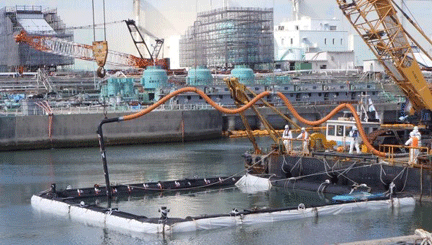
Initial talks between the government and TEPCO agreed that only water with 1,500 becquerels of radiation or less per liter could be released. Tests conducted by TEPCO and two outside agencies have revealed that the Fukushima underground water met the standards, averaging 220 to 240 becquerels of tritium per liter.
TEPCO began pumping out groundwater from the Fukushima nuclear plant in April in an effort to prevent further radioactive leaks.
The company continues to grapple with the problem of contaminated water storage, with about 450,000 tons of highly-radioactive water currently being stored in Fukushima’s underground facilities and tanks. Experts say some 15,000 tons is also being held in a service tunnel. According to recent estimates, up to 400 tons of contaminated water from the damaged plant is seeping into the Pacific Ocean every day.
In an effort to prevent further irradiation, TEPCO has adopted a plan to draw off groundwater from the plant. The fallout from Fukushima is later to be sent for analysis that will determine whether it is safe to be disposed of by dumping into the ocean.
The practice will allow the operator to reduce the accumulation of radioactive water at the plant by 100 tons a day……..https://news.google.com/news?ncl=d_uao6qIU8QsFkM74lsq0LkpKVl4M&q=radiation&lr=English&hl=en&sa=X&ei=l7N2U52sB8mtlQXZ_4HYBw&sqi=2&pjf=1&ved=0CDsQqgIwAw
1 This Month



26 September – International Day for the Total Elimination of Nuclear Weapons


PLEASE OPPOSE HR 8255 AND S.3639 – bills would accelerate satellite deployment, with no environmental review or safeguards – https://ncstd5li.quorum.us/campaign/169331/
To see nuclear-related stories in greater depth and intensity – go to https://nuclearinformation.wordpress.com
-
Archives
- September 2026 (269)
- August 2026 (330)
- July 2026 (355)
- June 2026 (287)
- May 2026 (306)
- April 2026 (356)
- March 2026 (251)
- February 2026 (267)
- January 2026 (308)
- December 2025 (358)
- November 2025 (359)
- October 2025 (375)
-
Categories
- 1
- 1 NUCLEAR ISSUES
- business and costs
- climate change
- culture and arts
- ENERGY
- environment
- health
- history
- indigenous issues
- Legal
- marketing of nuclear
- media
- opposition to nuclear
- PERSONAL STORIES
- politics
- politics international
- Religion and ethics
- safety
- secrets,lies and civil liberties
- spinbuster
- technology
- Uranium
- wastes
- weapons and war
- Women
- 2 WORLD
- ACTION
- AFRICA
- Atrocities
- AUSTRALIA
- Christina's notes
- Christina's themes
- culture and arts
- Events
- Fuk 2022
- Fuk 2023
- Fukushima 2017
- Fukushima 2018
- fukushima 2019
- Fukushima 2020
- Fukushima 2021
- general
- global warming
- Humour (God we need it)
- Nuclear
- RARE EARTHS
- Reference
- resources – print
- Resources -audiovicual
- Weekly Newsletter
- World
- World Nuclear
- YouTube
-
RSS
Entries RSS
Comments RSS

