Fukushima’s nuclear fuel found 15 miles from Tokyo suburbs
Nuclear fuel found 15 miles from Tokyo suburbs — Fukushima uranium in ‘glassy’ spheres transported over 170 km — Structural materials from the nuclear reactors also present (PHOTOS) http://enenews.com/nuclear-fuel-found-15-miles-tokyo-suburbs-fukushima-uranium-glassy-spheres-transported-170-km-structural-materials-nuclear-reactors-present-photos
Fukushima Diary, Aug 9, 2014: NHK admitted pieces of fuel rods and reactor vessels blasted to at least Ibaraki to contain Uranium & Zirconium […] NHK announced that pieces of nuclear fuel […] were blasted to at least 130km away from Fukushima nuclear plant. It was 2μm diameter particle. The ball-looking shape proves it was molten in high temperature and quickly cooled down […] the same material as nuclear fuel and the structure inside the vessels. These were collected from 3/14 ~ 3/15/2011 in Tsukuba city Ibaraki prefecture by the study group of Science Univ. of Tokyo. […]
NHK News (Translation by SysTran), Aug 9, 2014: Scattering of uranium fuel in a nuclear reactor damage […] in the Ibaraki prefecture immediately after the accident of Fukushima Daiichi Nuclear Power Station has occurred, the material of the structure of other nuclear reactor of uranium is detected […] it’s a result that confirms that damage to the reactor massive had progressed […] Research group of Izumi Nakai professors from Tokyo University of Science […] the dust in the atmosphere […] collected at Tsukuba, Ibaraki Prefecture […] 130 km from the nuclear power plant over the next morning from the night of March 14 […] It is a result, in addition to the radioactive cesium, zirconium material of the fuel rods and uranium, and iron of the material of the pressure vessel, material that matches the structure of the nuclear reactor and nuclear fuel has been detected. It is that dust that these shows feature when it is cold suddenly you have to be in the ball-shaped of about 2 micrometers in diameter, and is released after external melted at high temperatures. […]
American Chemical Society Publication, Analytical Chemistry — Detection of uranium and chemical state analysis of individual radioactive microparticles emitted from the Fukushima nuclear accident using multiple synchrotron radiation X-ray analyses, Yoshinari Abe , Yushin Iizawa , Yasuko Terada , Kouji Adachi , Yasuhito Igarashi , and Izumi Nakai (Tokyo University, Japan Synchrotron Radiation Research Institute, Meteorological Research Institute), August 1, 2014 (emphasis added): […] analyses revealed the detailed chemical nature of radioactive aerosol microparticles emitted during the Fukushima Daiichi Nuclear Power Plant (FDNPP) accident, resulting in better understanding of what occurred in the plant during the early stages of the accident. Three spherical microparticles (~2 μm Φ) containing radioactive Cs were found in aerosol samples collected on March 14th and 15th, 2011, in Tsukuba, 172 km southwest of the FDNPP […] 10 heavy elements [were] in all three particles: Fe, Zn, Rb, Zr, Mo, Sn, Sb, Te, Cs, and Ba. In addition, U was found for the first time in two of the [three] particles […]implying that U fuel and its fission products were contained in these particles […] These results strongly suggest that the FDNPP was damaged to emit U fuel and fission productsoutside the containment vessel as aerosol particles. […] individual particles revealed that they were present at high oxidation states, i.e., Fe3+, Zn2+, Mo6+, and Sn4+ in the glass matrix […] These radioactive materials in a glassy state possibly remain in the environment longer than those emitted as water soluble radioactive Cs aerosol particles.
Native Americans, Environmentalists presssure Congress to clean up uranium mines
Enviros push Congress on abandoned uranium mine cleanup, Tucson Sentinel Aug 11, 2014, Matthew Seeman Cronkite News Service The people behind Clean Up the Mines understand that others have been trying for years to clean up abandoned uranium mines and have mostly met with limited success.
But they say that doesn’t mean they shouldn’t keep trying.
The grass-roots advocacy group launched in April with the goal of getting Congress to mandate cleanup of the more than 10,000 abandoned mines in the country, at least 500 of which are on the Navajo Nation.
“This needs to be a federal standard,” said Klee Benally, a Navajo who is a member of Clean Up the Mines. “It needs to be the highest that we can possibly have to address these toxic abandoned uranium mines.”
Key to that effort is a proposed piece of legislation, the Uranium Exploration and Mining Accountability Act, that would require a complete inventory of the thousands of abandoned mines in the U.S. It would be the first bill specifically addressing uranium mining, said Charmaine White Face, who drafted the proposal and is coordinator for Defenders of the Black Hills.
She said Clean Up the Mines formed after several native communities in South Dakota shared concerns that abandoned mines had contaminated their water supply……..http://www.tucsonsentinel.com/local/report/081114_uranium_clean_up/enviros-push-congress-abandoned-uranium-mine-cleanup/
Navajo struggle to get clean water, in land polluted by uranium mining
 With uranium poisoning wells, Navajos must drive miles to get drinking water
BUT MANY WHO ARE CONSTRICTED BY CIRCUMSTANCE STILL USE CONTAMINATED SUPPLIES
Brandon Loomis, The Republic | azcentral.com Uranium’s deadly flow 11 Aug 14
THE NAVAJO NATION ESTIMATES THAT 54,000 NAVAJOS HAUL WATER FROM UNREGULATED WELLS AND STOCK PONDS NUMBERING IN THE LOW THOUSANDS. “……….Twice a week, the Yazzies, 57-year-old Milton and 83-year-old Della, come down off their lonely hill on the Navajo Reservation’s western side and point themselves toward the city for the clean water they need to keep living. For ages, they drank from a well less than a mile from their home. Then they learned that poison lurked there.Uranium is gurgling up all over Navajo country.
At least three Yazzies have died of kidney ailments, a common result of chronic exposure to uranium. Federal environmental officials warned against drinking more. Milton learned to conserve, using an outhouse across their driveway and leaving the tank-supplied indoor plumbing to Della, because of her failing eyesight.
He begged the tribe, the feds, anyone who would listen, to build a pipeline through the sparsely populated Black Falls area, southeast of Cameron.
“I’ve been working so hard all these years to get good drinking water,” he said, “and it never came.”
Though they live out of anyone’s sight, the Yazzies are far from alone in their hardship……….http://www.azcentral.com/longform/news/arizona/investigations/2014/08/05/uranium-mining-poison-wells-safe-drinking-water/13635345/
Radiation-polluted steel returned to Japan from South Korea
South Korea to return 20 kg Japanese steel scrap due to radiation contamination Aug 11, 2014 By Meeyoung Cho SEOUL (Reuters) – South Korea plans to return some steel scrap imported from Japan due to radiation contamination, the first returned shipment since Seoul heightened nuclear safety checks in 2012, the country’s nuclear watchdog said in a statement on Monday.
The Nuclear Safety and Security Commission detected caesium 137 at a higher than allowed level in 20 kilogrammes of steel scrap out of a total 20 tonnes imported earlier this month, said a spokeswoman at the agency…….http://af.reuters.com/article/worldNews/idAFKBN0GB0IA20140811
Bioaccumulation of Fukushima radiation in global food supply
 Fukushima Radiation Poisoning Global Food Supply (includes videos) http://chemtrailsplanet.net/2014/08/01/forget-mh-17-fukushima-radiation-poisoning-global-food-supply/ Chemtrail Following a major earthquake, a 15-metre tsunami disabled the power supply and cooling of three Fukushima Daiichi reactors, causing a nuclear accident on 11 March 2011. All three cores largely melted in the first three days. — World Nuclear Association
Report by Dr. Bill Deagle reminds us that extinction-level amounts of lethal radiation continues to contaminate the planet.
It has to be considered that the consequences of global panic in response to full public knowledge the horrific Fukushima event are so dire that corporate media outlets have been instructed not to cover it. Instead, we get bizarre reports on MH-370, MH-17, the Ebola virus, Israeli war on Gaza, Impeaching Obama,…on and on.
By not reporting on Fukushima, “authorities” hope to hide the dire consequences of continued radiation leak(s) from the American people and global populations for as long a possible.
By monitoring social media conversations, it’s an easy task for “rulers” to know when the “flash-point” of public awareness will prompt need to apply further media distractions or increase certain elements of the police state without actually declaring outright, “martial law”….as a last resort.
Bio-accumulation of radiation from Fukushima can damage nearly all life on earth.
All along the west coast of North America, sea stars are dying at an alarming rate. There was an “outbreak” of some unknown wasting disease last year and it appears to have come back even worse this summer. — Radiation Rain
One aspect of this out-of-control contamination is in the Pacific’s 30 foot deep layer of surface ocean water where much of the global oxygen supply is generated by plankton. Bio-accumulation in this layer is unknown and no questions are being asked by corporate media “experts”. Dalton’s Law of partial pressures of gases tells us that measured CO2 levels will respond by going up if global oxygen levels go down.
Reports of a massive case of dead star-fish, absence of certain species of fish and dwindling herds of animals up and down the Pacific region of the northern hemisphere are never connected to the consequences of bio-accumulation of radiation sprays from the ongoing Fukushima disaster.
Why?
Follow the money. Media will avoid reporting any news that could be bad for business as usual.
Spraying aerosols over the Pacific to interrupt rainfall is a desperate attempt to mitigate radiation from being washed onto crops in the central valley that provides much of our food commodities . The obvious downside is the failure of normal rainfall and forcing of drought that increases the number of wildfires in the Northwest and the opportunistic privatization of water resources.
Fukushima monkeys’ abnormal blood could have been caused only by nuclear radiation
 Guardian: Abnormal blood in monkeys linked to Fukushima disaster — Study: ‘Epidemic infectious disease’ could occur — “We cannot find other reasons except radiation” — Concern about strontium-90 & other radioactive materials besides cesium — “Potential direct relevance to humans”http://enenews.com/study-finds-blood-monkeys-70-km-fukushima-plant-epidemic-infectious-disease-could-occur-find-other-reasons-except-radiation-effects-neurological-development-discovered-other-mammals-potent?utm_source=feedburner&utm_medium=email&utm_campaign=Feed%3A+ENENews+%28Energy+News%29
The Guardian, July 24, 2014: Japanese monkeys’ abnormal blood linked to Fukushima disaster – study – Wild monkeys in the Fukushima region of Japan have blood abnormalities linked to the radioactive fall-out from the 2011 nuclear power plant disaster, according to a new scientific study that may help increase the understanding of radiation on human health. […] Professor Shin-ichi Hayama, at the Nippon Veterinary and Life Science University in Tokyo, told the Guardian […] “This first data from non-human primates — the closest taxonomic relatives of humans — should make a notable contribution to future research on the health effects of radiation exposure in humans… The low haematological values in the Fukushima monkeys could have therefore been due to the effect of any radioactive materials… We did not conclude the low-blood cell counts are caused by caesium but so far we cannot find other reasons except radiation.”
Scientific Reports (Nature.com), July 24, 2014: In April 2012 we carried out a 1-year hematological study on a population of wild Japanese monkeys inhabiting the forest area of Fukushima City. This area is located 70 km from the Fukushima Daiichi Nuclear Power Plant […] Total muscle cesium concentration in Fukushima monkeys was in the range of 78-1778 Bq/kg, whereas the level of cesium was below the detection limit in all [monkeys from 400 km away.] Fukushima monkeys had significantly low white and red blood cell counts, hemoglobin, and hematocrit […] These results suggest that the exposure to some form of radioactive material contributed to hematological changes in Fukushima monkeys. […] low hematological values in Fukushima monkeys could have […] been due to the effect of other radioactive materials. […] The hematological changes in the Fukushima monkeys might likely be the result of exposure to some form of radioactive material, but only radiocesium concentration was measured in this study. […] We therefore plan to investigate in a future study the underlying mechanism in detail with the aim of detecting other radioactive materials, such as 90Sr. […]
The Australian, Higher Education Reporter John Ross, July 25, 2014: Reality apes movie for Fukushima monkeys — In the latest Planet of the Apes movie, a virus created in a lab pushes primate evolution into overdrive while morphing into a simian flu that wipes out most of the human race. Scientists monitoring the aftermath of the Fukushima nuclear plant meltdown may be witnessing something similar in real life […] “Low blood cell count … may suggest that the immune system has been compromised, potentially making the entire troop susceptible to, for example, epidemic infectious disease.” The study suggests strongly that the blood changes are the result of nuclear contamination […]
Fox News, July 25, 2014: “The findings are consistent with what our group had found with red blood cells and hemoglobin content for children living around Chernobyl,” said Tim Mousseau, a biologist at U. of South Carolina […] “The fact that they are seeing a signal in monkeys living in Fukushima city means that there’s some potential direct relevance to the human population.”
See also: SNL mocks Fukushima — Shows radioactive monkeys replacing Godzilla (VIDEO)
Radioactive cesium in Minamisoma, Fukushima Prefecture,
Debris cleanup at Fukushima reactor may have contaminated rice crops, Japan Times, KYODO JUL 14, 2014 Debris cleanup work by Tokyo Electric Power Co. at the Fukushima No. 1 nuclear plant may have led to the contamination of rice crops in nearby areas, agriculture ministry officials said Monday.
Radioactive cesium exceeding the government limit of 100 becquerels per kilogram was detected in rice crops from Minamisoma, Fukushima Prefecture, last year, including areas located more than 20 km from the crippled nuclear plant.
Farm ministry officials said they could not deny the possibility that radioactive dust was stirred up when Tepco cleaned up debris at the No. 3 reactor last August and that the dust could have made its way north to Minamisoma……..http://www.japantimes.co.jp/news/2014/07/14/national/debris-cleanup-fukushima-reactor-may-contaminated-rice-crops/#.U9m_C-NdUnk
Tokyo’s growing nuclear radiation danger

 ‘Tokyo should no longer be inhabited,’ Japanese doctor warns residents regarding radiation http://www.naturalnews.com/046112_radiation_fukushima_tokyo.html 25 July 14 (NaturalNews)In an essay addressed to his colleagues, Japanese doctor Shigeru Mita has explained why he recently moved away from Tokyo to restart his practice in western Japan: He believes that Tokyo is no longer safe to inhabit due to radioactive contamination caused by the March 11, 2011, meltdowns at the Fukushima Daiichi nuclear plant.
The essay, titled “Why did I leave Tokyo?” was published in the newsletter of the Association of Doctors in Kodaira, metropolitan Tokyo.
Soil tests prove contamination
Dr. Mita opens his essay by contextualizing his decision to leave, noting that he had a long history as a doctor in Tokyo.
“I closed the clinic in March 2014, which had served the community of Kodaira for more than 50 years, since my father’s generation, and I have started a new Mita clinic in Okayama-city on April 21,” he wrote.
Dr. Mita notes that, for the past 10 years, he had been working to persuade the municipal government of Tokyo to stock iodine pills to distribute to the population in the case of a nuclear accident. Dr. Mita’s concern had been that an earthquake might trigger a meltdown at the Hamaoka nuclear power plant. All of his requests were rejected, however, under the excuse that there was no reason to expect such an accident.
Prior to 2011, Shinjuku (the region of Tokyo that houses the municipal government) tested at only 0.5-1.5 Bq/kg. Today, levels at nearby Kodaira are at 200-300 Bq/kg.
“Within the 23 districts of Metropolitan Tokyo, contamination in the east part is 1000-4000 Bq/kg and the west part is 300-1000 Bq/kg,” Dr. Mita wrote.
For comparison, Kiev (capital of the Ukraine) has soil tested at 500 Bq/kg (Cs-137 only). Following the Chernobyl accident, West Germany and Italy reported levels of 90-100 Bq/kg, and both experienced measurable health effects on their populations.
Dr. Mita notes that the radiation situation in Tokyo is getting worse, not better, due to urban practices of concentrating solid waste in small areas such as municipal dumps and sewage plants. That is why, he says, radiation levels in Tokyo riverbeds have actually been increasing over the prior two years.
Dr. Mita’s essay also chronicles the many cases he has observed of patients presenting with radiation-induced health problems. He notes that, since 2011, he has observed while blood cell counts declining in children under the age of 10, including in children under one year old. In all of these cases, symptoms typically improve if the children move to western Japan. He has similarly observed persistent respiratory symptoms that improve in patients who move away.
Other patients have shown symptoms including “nosebleed, hair loss, lack of energy, subcutaneous bleeding, visible urinary hemorrhage, skin inflammations, coughs and various other non-specific symptoms.” He also notes high occurrences of rheumatic muscle symptoms similar to those observed following the Chernobyl disaster.
“Ever since 3.11, everybody living in Eastern Japan including Tokyo is a victim, and everybody is involved,” he wrote.
Sources for this article include:
Widespread dispersal of radioactive cesium as Fukushima debris is removed
 Study: Cesium from Fukushima debris removal likely spread 50 km http://ajw.asahi.com/article/0311disaster/fukushima/AJ201407160064 July 16, 2014 By MIKI AOKI/ Staff Writer
Radioactive substances released during rubble-removal work at the Fukushima No. 1 nuclear plant last year likely spread to areas nearly 50 kilometers away, according to a research team at Kyoto University.
The agriculture ministry earlier raised the likelihood that debris-removal operations on Aug. 19, 2013, led to cesium levels exceeding the safety standard detected in rice harvested more than 20 km from the plant.
Akio Koizumi, a health and environment science professor at Kyoto University’s Graduate School of Medicine, and four other scientists discovered that the wind likely carried the cesium more than twice that distance.
The researchers set up air sampling instruments at three points in residential areas of Fukushima Prefecture and have measured radioactive cesium concentrations every week since September 2012 to estimate residents’ exposure to radiation.
From samples collected between Aug. 15 and 22 last year, they found a reading of 1.28 millibecquerels per cubic meter at a location in Soma, 48 km northwest of the plant. That radioactivity level was more than six times higher than usual.
Radioactivity levels were 20 to 30 times higher than normal in Minami-Soma, 27 km north-northwest of the Fukushima plant. And there were almost no changes in cesium concentrations in Kawauchi, 22 km west-southwest of the plant, the researchers said.
Based on the wind’s speed and direction at the time, as well as size of the collected particles, Koizumi and his colleagues concluded that the radioactive cesium came from the Fukushima No. 1 plant as the result of the Aug. 19, 2013, clearance work at the No. 3 reactor.
The team also found that cesium levels at the measuring point in Minami-Soma surged in both May and June 2013. They attributed the increase to debris-clearing operations at the facility.
The research results indicate that future rubble removal at the nuclear plant could disperse radioactive materials over much broader areas surrounding the facility.
In March this year, the scientists presented their findings to the Environment Ministry. It has also been reported that the agriculture ministry instructed Tokyo Electric Power Co., operator of the nuclear plant, to take measures to prevent the release of radioactive substances in the debris-removal work at the site.
TEPCO currently plans to resume debris-removal efforts by the end of July, starting with the dismantling of a cover installed on the No. 1 reactor building, where highly contaminated rubble remains to be removed.
The utility acknowledged that the Aug. 19 operations released a maximum 4 trillion becquerels–more than 10,000 times the usual levels at the site–over four hours, and apologized to residents for “causing trouble.”
However, TEPCO argued that it is unclear whether the increase in cesium readings was related to debris-clearing work.
USA soil still has radioactive material from Fukushima nuclear disaster
 Fox: Fukushima radioactive material still being found in U.S. soil — Japan Gov’t: The disaster “posed radiation threat to human society”… In 4 days “detectable all across northern hemisphere” — Denmark: Fukushima clearly had widespread consequences, not limited to borders (VIDEOS) http://enenews.com/fox-fukushima-radioactive-material-found-arizona-soil-japan-govt-fukushima-release-posed-radiation-threat-human-society-detectable-all-across-northern-hemisphere-4-days-denmark-fukushima-widespr
Danish Emergency Management Agency’s Carsten Israelson, Nordic Nuclear Safety Research’s 2013 Fukushima seminar (at 4:15 in): The accident in Fukushima… clearly showed that there are consequences that are widespread, and is not limited to borders… Nuclear accidents do happen! Nuclear accidents will likely have widespread consequences – for all of us. >> Watch presentation hereNational Institute of Radiological Sciences (Japan), March 3, 2014: The Fukushima Daiichi Nuclear Power Plant (FDNPP) accident led to the release of large amounts of radionuclides into the environment. […] The released radioactive materials posed radiation threat to human society. Thus, source identification of radioactive contamination and long-term environmental behavior of released radioactive materials are important issues of study after the FDNPP accident.
Japan Atomic Energy Agency & University of Tokyo, Apr. 10, 2014: By March 15, traces from the accident in Fukushima were detectable all across the northern hemisphere. By April 13, the associated radioactivity had spread to the southern hemisphere of the Asia-Pacific region and was clearly detectable at CTBT IMS stations located in Australia, Fiji, Malaysia, and Papua New Guinea.
Fox 10 News — Phoenix, AZ, July 15, 2014: [Aubrey Godwin, director of Arizona Radiation Regulatory Agency] says radioactive material can still be found in Arizona soil from nuclear weapons testing in the 50′s and from Fukushima’s nuclear disaster in 2011. Despite that Godwin says there is no health concern.
Tokyo in danger from Fukushima radiation, says Japanese doctor
 Japan Doctor: “Tokyo should no longer be inhabited” — Everyone here is a victim of Fukushima — People truly suffering — Bleeding under skin, urinary hemorrhaging — Children’s blood tests started changing last year — Time running short… up to physicians to save our citizens and future generations http://enenews.com/japan-doctor-tokyo-longer-be-inhabited-everyone-living-victim-fukushima-disaster-began-notice-childrens-blood-test-results-around-mid-2013-time-running-short-physicians-save-citizens-future-g?utm_source=feedburner&utm_medium=email&utm_campaign=Feed%3A+ENENews+%28Energy+News%29
Dr. Shigeru Mita’s essay published in the newsletter of Association of Doctors in Kodaira (Tokyo), translated by WNSCR, July 16, 2014: Why did I leave Tokyo? To my fellow doctors, I closed the clinic in March 2014, which had served the community of Kodaira for more than 50 years, since my father’s generation, and I have started a new Mita clinic in Okayama-city on April 21. […] It is clear that Eastern Japan and Metropolitan Tokyo have been contaminated with radiation […] contamination in the east part [of Tokyo] is 1000-4000 Bq/kg and the west part is 300-1000 Bq/kg. […] 0.5-1.5 Bq/kg before 2011. […] Tokyo should no longer be inhabited […] Contamination in Tokyo is progressing, and further worsened by urban radiation concentration […] radiation levels on the riverbeds […] in Tokyo have increased drastically in the last 1-2 years. […] Ever since 3.11, everybody living in Eastern Japan including Tokyo is a victim, and everybody is involved. […] The keyword here is “long-term low-level internal irradiation.” This differs greatly from medical irradiation or simple external exposure to radiation. […] People are truly suffering from this utter lack of support. […] If the power to save our citizens and future generations exists somewhere, it [is] in the hands of individual clinical doctors ourselves. […] Residents of Tokyo are unfortunately not in the position to pity the affected regions of Tohoku because they are victims themselves. Time is running short. […]
Dr. Mita on patient symptoms since 2011: White blood cells, especially neutrophils, are decreasing among children […] Patients report nosebleed, hair loss, lack of energy, subcutaneous bleeding, visible urinary hemorrhage, skin inflammations […] we began to notice changes in children’s blood test results around mid-2013 […] Other concerns I have include symptoms reported by general patients, such as persistent asthma and sinusitis […] high occurrences of rheumatic polymyalgia […] Changes are also noticeable in the manifestation of contagious diseases such as influenza, hand-foot-and-mouth disease and shingles. […]
Living on a radioactive uranium dump
 What does uranium do?
When uranium is ingested it is deposited in the kidneys, lungs, brain and bone marrow. The alpha particles – which contain massive doses of energy – sit in these parts and damage the tissue around them. Because it is an endocrine disrupter, it increases the risk of fertility problems and reproductive cancer. Large doses are fatal, but the constant exposure to low levels has intergenerational effects that are still not fully understood
 One man’s home is another man’s uranium dump, Mail & Guardian, Africa 18 JUL 2014 SIPHO KINGS With nowhere else to live, many seek refuge in the radiation wastelands in Gauteng, unaware of the deadly dangers the abandoned mining areas present……..Faded photographs in the town museum show people sunbathing and swimming in the lake in the 1980s. There were bars, a jetty and a miniature putting course. Now only the foundations remain after it was closed because of the increasing concentration of uranium in Robinson Lake.
In the past it was a place for the residents of Randfontein – 50km west of Johannesburg – to relax on the weekend and forget their jobs in the mining industry. But in the late 1990s the underground mines started closing because the falling price of gold and uranium made them unprofitable. The mines were abandoned and the water levels inside started rising. Acid mine drainage began seeping into the dam, increasing the level of uranium to levels 220 times higher than the safe limit. The resort closed.
Deep into winter a chill breeze blows across the lake, creating ripples in the clear water. The surface is a stark blue reflection of the sky, with the bottom tainted red from the heavy metals in the water. No alga grow here, no fish swim, no underwater life ripples the surface.
The periphery of the lake is a wide ring of cracked yellow earth. The soil beyond is brown. There are 20m-high blue gum trees. There are yellow signs with “Radiation area – Supervised area” wired to the fence around the area and nailed to the trees.
Gold seam
The Witwatersrand gold seam runs for about 100km, from Randfontein in the west of Johannesburg to Springs in the east. A century of mining drove a mining boom, thanks to this being the world’s largest concentration of the precious metal.
Mine shafts up to 3km deep were sunk. The waste was dumped above ground in over 400 mine dumps or tailings dams that now dot the province. These contain a mixture of heavy metals, and an estimated 600 000 tonnes of uranium.
The Cancer Association of South Africa (Cansa) says this is the only place in the world where large numbers of people live next to dumps full of uranium. Continue reading
Fukushima radioactive releases – Cesium 137 onto the Pacific Ocean
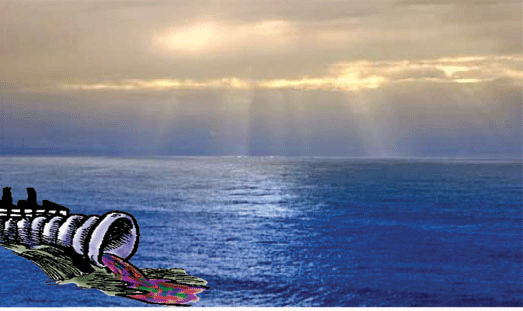 TV: Fukushima radioactive releases into ocean can continue thousands of more years, says nuclear expert — Japan gov’t concerned with tracking radioactive waste in Pacific as it returns to Fukushima from U.S. West Coast after several decades (VIDEO) http://enenews.com/tv-radioactive-releases-pacific-thousands-years-fukushima-melted-fuel-be-removed-nuclear-expert-japan-govt-concerned-radioactive-waste-ocean-coming-fukushima-several-decades-after-being-west-coast?utm_source=feedburner&utm_medium=email&utm_campaign=Feed%3A+ENENews+%28Energy+News%29
American Chemical Society — Environmental Science & Technology (pdf),Apr. 29, 2014 (emphasis added): 135Cs/137Cs Isotopic Ratio as a New Tracer of Radiocesium Released from the Fukushima Nuclear Accident […] many important issues with respect to its atmospheric transport, deposition processes, and distributions in terrestrial and marine environments remain to be investigated. It has been estimated that ∼80% of the atmospherically released 137Cs was deposited in the western North Pacific Ocean, in addition to […] 137Cs directly discharged into the ocean […] continuous input of 137Cs into the ocean due to river runoff of the 137Cs deposited in heavily contaminated Fukushima forest soil can be expected. Recent studies have revealed the start of the transport of the Fukushima accident-sourced 137Cs into the ocean interior […] it is predicted that in 30 years the Fukushima accident-derived 137Cs will come back to the ocean surface in the western North Pacific Ocean off the Fukushima coast through its transport by the Kuroshio current. Thus, to understand the environmental behavior and the fate of Fukushima accident-sourced radionuclides in the environment, a powerful Cs tracer is strongly required, because the currently widely used 134Cs/137Cs activity ratio tracer will become unavailable in several years because of the rapid decay of 134Cs […] 135Cs has a half-life of 2 × 10^6 [2.3 million] years; therefore, we are confident that the 135Cs/137Cs isotopic ratio can be considered as a new powerful tracer for long-term source identification and environmental behavior studies. […] This study was supported […] partially by the Agency for Natural Resources and Energy, the Ministry of Economy, Trade and Industry (METI), Japan [7 of study’s 8 authors are from Japan’s National Institute of Radiological Sciences]
Nuclear analyst John Large, July 9, 2014: The cores remain active for hundreds, if not thousands, of years, so there’s a commitment to keep either the ice wall technology in place or to replace it with an alternate technology by some future generation. […] Water is coming off the escarpment above the three reactors, it’s then percolating through the ground — there’s hydrostatic pressures pushing the water up toward the sea level — it’s then collecting the fission products and radioactive products from the melted-down cores and taken out to sea. […] What I think they should now have a plan to tackle the root cause… How do you control, manage and eventually remove the reactor cores? […] If the reactor cores remain in there, it’s going to be a constant leachate (water that percolates through a solid and leaches out some of the constituents) of radioactivity.
Britain’s Ministry of Defense finally to clean up Dalgety Beach radiation
 MoD will clean up radiation at Dalgety Bay beach The Scotsman by DAVID MADDOX 11 July 2014 THE Ministry of Defence is to pay an estimated £10 million to clean up radiation on a Fife beach, following a campaign by local residents concerned about health risks.
Some 3,500 radioactive particles have been found at Dalgety Bay over the past two decades.
The material is thought to date back to when parts of Second World War aircraft, including their radiated instruments, were dumped at the site.
Defence chiefs have now confirmed that work will include removing the particles from the beach, and building a wall and slipway to prevent other radioactive material from reaching the area.
It should start later this year and will continue in phases until 2018.
A report on the work does not specify costs but local MP and former prime minister Gordon Brown believes the clean-up total will be around £10m.
“After three years of intensive campaigning, including four debates in the House of Commons, I welcome the Ministry of Defence agreement to spend what I believe will be £10m to clean up the pollution caused by radiation at Dalgety Bay,” he said.
“The pollution resulted from dumping 800 wartime planes with radiated dials and other hazardous equipment into the sea. Subsequent coastal erosion has brought the pollution to the surface.”………
Dr Richard Dixon, director of Friends of the Earth Scotland, said it was not a “complete solution” but praised the local community for their campaigning.
He said: “Some radioactive waste will be left entombed on site but it should finally put an end to the danger faced by humans and wildlife in what should be one of Scotland’s more attractive seaside spots.
“All credit to the community and to Sepa for their dogged persistence in getting the MoD to finally do the right thing.”
SNP MSP Annabelle Ewing said: “Residents of Dalgety Bay and Fifers from across the Kingdom have been waiting decades for this mess to be cleaned up, so I am glad that some progress has been made on this issue and that the MoD has finally accepted
responsibility.” http://www.scotsman.com/news/politics/top-stories/mod-will-clean-up-radiation-at-dalgety-bay-beach-1-3473378
The enormous and intractable problem of Fukushima’s radioactive soil
Fukushima’s radioactive soil sparks fights, exposes the enormity and hopelessness of clean-up taskStraight, by MARTIN DUNPHY on JUL 4, 2014 “…….Soil would fill how many B.C. Places?In the months after the 2011 earthquake-and-tsunami catastrophe, environment ministry experts estimated that the amount of radioactive topsoil from parts of four surrounding prefectures that would have to be “decontaminated” and stored could be as high as 29 million cubic metres.
That would be about enough dirt to fill the 59,000-capacity B.C. Place Stadium 23 times.
However, Yuichi Moriguchi, a University of Tokyo environmental-engineering professor, pegged the amount at closer to 100 million cubic metres, enough to fill 80 B.C. Places.
Minister Ishihara had told reporters in Tokyo on June 16 that the dragged-out and often acrimonious soil-storage negotiations between Abe’s Liberal Democratic Party–led administration and local and state governments in Fukushima would be solved once the issue of “monetary value” was settled.
Fukushima residents, evacuees, the governor, and the mayors of Futaba and Okuma—the two towns adjacent to Daiichi that have been tentatively earmarked for storage facilities—were outraged by the comment.
They called it insensitive and said it failed to take into account their dislocation, fears, and sense of helplessness. They said it made them seem to be concerned only with compensation.
Minister underestimated reaction
The environment minister quickly backtracked, saying he was misconstrued, but he refused to retract his statement. After opposition pressure, however, he apologized during a June 19 parliamentary session and retracted his remark………
Many of the sites are already at or near capacity.
Costs could be wildly inaccurate
In December 2013, Tokyo announced that it would spend almost $1 billion to store 132,738 tonnes of radioactive soil already removed from near the crippled power plant. No towns came forward to offer to sell the approximately three to five square kilometres of land estimated to be needed to build the supposedly “interim” facility to house the waste, currently stored temporarily in different locations around Japan.
(That plan covers less than 150,000 tons of soil. Greenpeace International has claimed that as of February 2013, more than fourmillion tons of radioactive waste had been produced.)
The $1-billion cost of this plan might be severely underestimated, however. A disposal centre in Rokkasho, Aomori Prefecture, for low-level radioactive waste from the country’s nuclear plants (including metal parts and work clothing) cost $2 billion to build.
And it holds only 200,000 cubic metres of material.
The true cost for the planned “interim” facility could be in the tens of billions of dollars—or much higher.
Waste needs to be stored for 30 years
Prefecture officials and residents expressed skepticism about the unclear future location of “permanent” storage sites, noting that the material would have to be stored away for a minimum of 30 years and voicing fears that their towns would become the preferred perpetual spots…….
There are many areas outside this district that are contaminated as well, to varying degrees, including isolated “hot spots”. Some of these were found in Tokyo, more than 200 kilometres away from Daiichi. On the other hand, that original clean-up area consists of up to 70 percent woodlands, hills, and mountains, much of which (if not most) will probably never be touched by decontamination efforts.
Some areas may be deserted forever
And if more than five centimetres of topsoil needs to be scraped off to remove radioactive cesium, after years of rain and groundwater movement, the volume of material needing to be stored will rise accordingly. Prof. Tomoko M. Nakanishi, from the University of Tokyo’s graduate school of agriculture, conducted soil research in Fukushima post-disaster and had this to say about how readily radioactive cesium was absorbed by the soil: “It was like pollen with superglue.”
Friends of the Earth, an international network of environmental groups, reported in 2012 that a test soil-decontamination program for only three houses in Fukushima generated 35 tons of soil waste.
In the end, it will probably be areas around parks, residences, schools, hospitals, and other public buildings that will see the most attention from decontamination efforts.
Some parts of the surrounding prefectures may never see a return to levels of human activity to compare with pre-Fukushima. And some areas may remain deserted forever.
Oh, yeah, then there’s the ocean
This is without even mentioning the incalculable amount of radioactive groundwater and cooling water that has flowed into the Pacific Ocean nonstop since the first day of the disaster almost three-and-a-half years ago. Woods Hole Oceanographic Society scientists labelled this “the largest accidental release of radiation to the ocean in history”.
According to Greenpeace International, one month after the meltdowns, cesium-137 levels in the sea near Daiichi were 50 million times higher than pre-disaster measurements. (Cesium-137 has a half-life of 30 years; cesium-134’s is a bit more than two years.)
And Asahi—using data provided by Tokyo Electric Power Co. (TEPCO), the Daiichi plant operator—says that 462TBq (a terabecquerel equals one trillion Becquerels) of radioactive strontium have been dumped into the Pacific. Strontium is potentially far more dangerous to human life than either cesium-134 or cesium-137.
There have been conflicting reports about the amounts of even deadlier plutonium that might have been released into the soil, air, or water……http://www.straight.com/news/680196/fukushimas-radioactive-soil-sparks-fights-exposes-enormity-and-hopelessness-clean-task
1 This Month



26 September – International Day for the Total Elimination of Nuclear Weapons


PLEASE OPPOSE HR 8255 AND S.3639 – bills would accelerate satellite deployment, with no environmental review or safeguards – https://ncstd5li.quorum.us/campaign/169331/
To see nuclear-related stories in greater depth and intensity – go to https://nuclearinformation.wordpress.com
-
Archives
- September 2026 (269)
- August 2026 (330)
- July 2026 (355)
- June 2026 (287)
- May 2026 (306)
- April 2026 (356)
- March 2026 (251)
- February 2026 (267)
- January 2026 (308)
- December 2025 (358)
- November 2025 (359)
- October 2025 (375)
-
Categories
- 1
- 1 NUCLEAR ISSUES
- business and costs
- climate change
- culture and arts
- ENERGY
- environment
- health
- history
- indigenous issues
- Legal
- marketing of nuclear
- media
- opposition to nuclear
- PERSONAL STORIES
- politics
- politics international
- Religion and ethics
- safety
- secrets,lies and civil liberties
- spinbuster
- technology
- Uranium
- wastes
- weapons and war
- Women
- 2 WORLD
- ACTION
- AFRICA
- Atrocities
- AUSTRALIA
- Christina's notes
- Christina's themes
- culture and arts
- Events
- Fuk 2022
- Fuk 2023
- Fukushima 2017
- Fukushima 2018
- fukushima 2019
- Fukushima 2020
- Fukushima 2021
- general
- global warming
- Humour (God we need it)
- Nuclear
- RARE EARTHS
- Reference
- resources – print
- Resources -audiovicual
- Weekly Newsletter
- World
- World Nuclear
- YouTube
-
RSS
Entries RSS
Comments RSS

